
1 Dollar a Day Car Insurance in New Jersey: Cost, Eligibility & Coverage
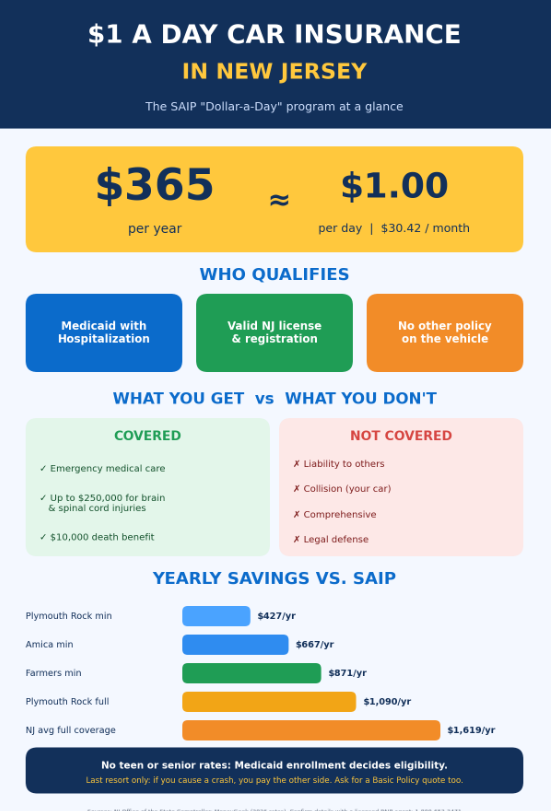
Quick answer: New Jersey’s “Dollar-a-Day” car insurance is the Special Automobile Insurance Policy (SAIP). It costs $360 per year if paid in full or $365 in two installments and is available only to eligible residents enrolled in federal Medicaid with hospitalization. It covers specified emergency medical care after an auto accident, not liability for damage or injuries you cause to others. It also excludes collision and comprehensive coverage. Verify eligibility with a PAIP insurance producer before buying.
Key takeaways
- Official price: $360 prepaid or $365 in two installments; this is an annual policy, not daily coverage.
- Eligibility: Qualifying federal Medicaid with hospitalization, a valid license and vehicle registration, and verification at application and renewal.
- Limited benefits: Immediate emergency care, qualifying serious brain and spinal cord injury treatment up to $250,000, and a $10,000 death benefit.
- Major exclusions: No bodily injury or property damage liability, and no collision or comprehensive coverage.
- 2026 standard minimum: Ordinary NJ Standard Policies require $35,000/$70,000 bodily injury and $25,000 property damage liability, while the Basic Policy and SAIP follow separate rules.
- Compare protection, not only premiums: Sample SAIP-versus-standard prices are not like-for-like insurance products.
On this page
What is Dollar-a-Day insurance in NJ?
The New Jersey Department of Banking and Insurance (DOBI) administers SAIP under state law. The state says National Continental Insurance Company has serviced the program since January 1, 2011, while AIPSO manages plan operations. SAIP is a lawful, restricted option for eligible Medicaid recipients, but its medical-only protection is much narrower than a standard auto policy.
SAIP has a state-set annual price rather than an individualized premium based on your credit or previous accidents. Eligibility still depends on a qualifying Medicaid enrollment and valid driving and registration status. It is not a substitute for liability insurance.
How We Researched This Article
This edition checks DOBI’s official SAIP FAQ and its Basic and Standard Policy comparisons, the New Jersey Office of the State Comptroller’s October 2023 SAIP letter, and a published 2026 New Jersey rate comparison from MoneyGeek using Quadrant Information Services data. Government guidance controls program terms; third-party rates are samples, not offers. The older 2022 program figures are labeled as historical.
Editorial verification: Publicly available official New Jersey guidance was checked on November 16, 2026. We have not verified an individual applicant’s Medicaid eligibility or requested insurer-specific quotes. A licensed PAIP producer must confirm eligibility and the policy documents in each case.
Dollar-a-Day requirements
- Active Medicaid with Hospitalization (verify your NJ FamilyCare plan includes it)
- A valid NJ driver’s license and current registration (a suspended or revoked license or registration disqualifies you)
- Only one policy may insure a particular vehicle; SAIP covers one vehicle per policy.
- Personal use only; commercial use is not covered
- Each person named as covered under SAIP must be a qualifying Medicaid enrollee; the policy is not a blanket household policy.
- Medicaid is re-verified at application and every renewal
Past tickets and at-fault accidents do not by themselves block SAIP eligibility, but a suspended or revoked license or registration does. The New Jersey Comptroller identified multiple-vehicle cases raising Medicaid asset-eligibility concerns in 2023. The report recommended tighter verification; it did not establish a blanket one-vehicle-per-person prohibition. Each vehicle requires its own policy and the state may examine eligibility.
Do you have the right Medicaid? A plain-English explainer
The central eligibility question is whether your Medicaid plan qualifies as federal Medicaid with hospitalization. Not every Medicaid program qualifies, and the state’s insurance producer verification process is more reliable than assuming your NJ FamilyCare card alone is enough.
Medicaid basics in New Jersey
New Jersey Medicaid is administered by the Division of Medical Assistance and Health Services. The Comptroller reported more than 2.2 million Medicaid enrollees in its 2023 review; that is a historical figure, not a confirmed 2026 enrollment count. NJ FamilyCare is the name many residents see on their coverage materials.
Who is eligible for Medicaid at all
Medicaid eligibility varies by program, household income, residency, and applicable immigration status. Do not assume that eligibility for one NJ FamilyCare benefit automatically means eligibility for SAIP. A PAIP producer can check your enrollment against the required Medicaid-with-hospitalization category.
Income-based programs versus asset-based programs
Some Medicaid categories consider income alone; other programs also have asset tests. The Comptroller’s 2023 example of one aged, blind, or disabled Medicaid category used $4,000 for an individual and $6,000 for a couple, with one vehicle exempt. Those figures must not be presented as universal or current Medicaid limits: check the rules of your own program before relying on them.
How to check your coverage in five minutes
- Find your Medicaid or NJ FamilyCare card and write down the ID number.
- Check your plan paperwork or member portal for the name of your program and whether it includes hospital coverage.
- Call the number on the back of the card if the paperwork is unclear and ask whether your plan includes hospitalization benefits.
- Take the card to a PAIP agent, who can run the number through the state’s verification line and tell you right away whether you qualify.
What if you are not sure?
Do not guess. If you are close to the line, such as having Medicaid for only part of your care, ask both your plan and a PAIP agent. Also ask whether anyone else in your household who drives would need to qualify, since every named operator on the policy must be a Medicaid enrollee.
Why the state checks so carefully
In a 2023 review, the New Jersey Comptroller described eligibility problems involving people who had insured 8, 21, or as many as 46 vehicles over differing periods. These were specific investigations, not evidence that every multi-vehicle applicant is ineligible. If you insure another vehicle, verify how its value affects your Medicaid program.
Common Medicaid-related surprises
- A new job or raise: Changes in income may affect Medicaid eligibility depending on your plan; verify before renewal.
- Missed renewal paperwork: Medicaid coverage can lapse if you miss a renewal notice, and SAIP depends on it.
- A second household driver: Each covered operator must meet the program’s Medicaid enrollment requirements.
- Moving out of state: New Jersey Medicaid and SAIP are for New Jersey residents.
How to apply for $1 Dollar a Day Auto Insurance
- Gather your NJ license, vehicle registration, and Medicaid ID card.
- Visit any licensed agent who writes Personal Automobile Insurance Plan (PAIP) business, or call PAIP at 1-800-652-2471.
- The agent verifies Medicaid by phone with the state system.
- Pay $360 for the full policy year or two $182.50 installments totaling $365. Verify the payment schedule with the producer.
What $1 Dollar a Day Car Insurance covers (and what it doesn’t)
| Coverage | SAIP (~$365/yr) | Standard minimum |
|---|---|---|
| Emergency medical treatment | Yes | Yes (PIP) |
| Brain / spinal cord injury | Up to $250,000 | Special qualifying benefits under PIP (up to $250,000) |
| Death benefit | $10,000 | Depends on policy terms; do not assume SAIP benefits |
| Bodily injury liability | No | Yes |
| Property damage liability | No | Yes |
| Your car’s repairs | No | Only with collision/comprehensive |
| Legal defense if sued | No | Yes |
Big risk: If you cause a crash, you personally owe the other driver’s medical bills and car repairs. Lawsuits and wage garnishment are possible. Treat SAIP as a last resort.
Coverage gap map: what each option pays for
| Protection | SAIP | NJ Basic Policy | Standard minimum | Full coverage |
|---|---|---|---|---|
| Your emergency medical care | Immediate emergency treatment and qualifying injury benefits | Limited | Yes | Yes |
| Damage you cause to others’ property | No | $5,000 | Yes | Yes |
| Injuries you cause to others | No | Optional $10,000 per accident | Yes | Yes |
| Your own car repairs | No | Optional with some insurers | No | Yes |
| Legal defense | No | Only if bodily injury liability is purchased and claim is covered | Yes | Yes |
Basic Policy details are summarized from MoneyGeek; “Limited” marks partial or unverified coverage. Confirm exact terms with an agent.
How much does it cost?
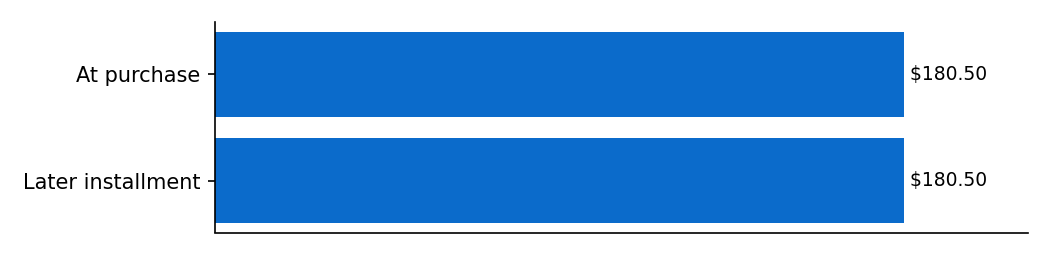
The annual SAIP premium is $365 when paid in two installments or $360 when prepaid, according to NJ DOBI. The two-payment option is $182.50 per installment if evenly split. The $5 difference is the cost of selecting the installment option. This is annual coverage, not a daily or monthly plan.
SAIP payment options: $360 prepaid, or two installments of $182.50 each ($365 total).
Monthly and yearly savings comparison
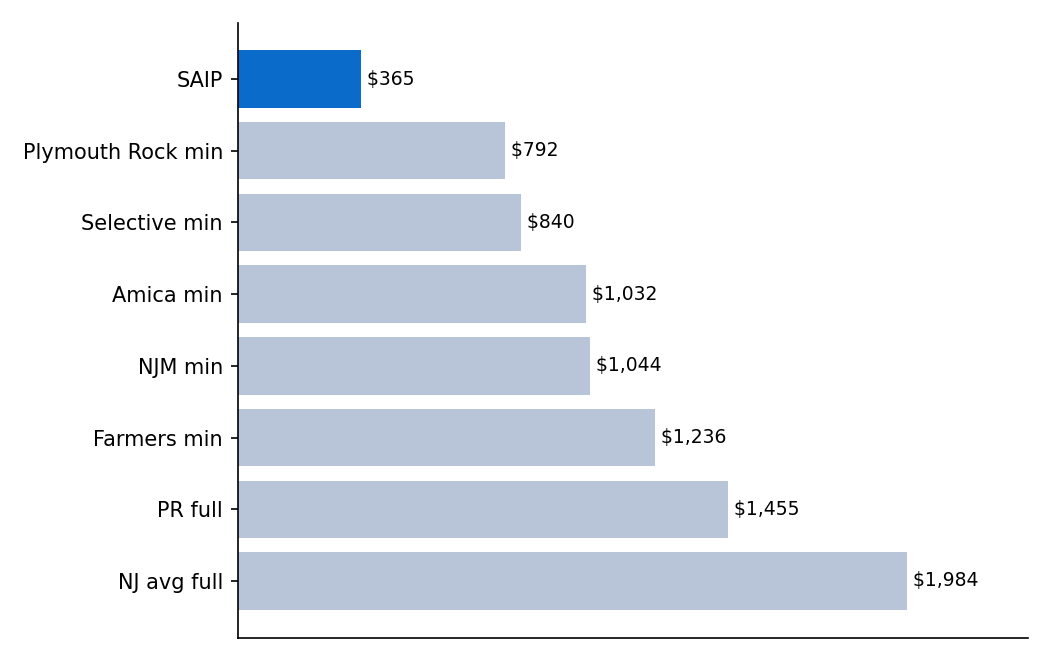
The following published New Jersey rates are sample quotes for clean-record drivers from a third-party analysis. Their policies include substantially more protection than SAIP. Differences in the prices are premium-only arithmetic, not comparable insurance savings or recommendations to drop liability coverage.
| Alternative | Yearly cost | Premium difference/year | Premium difference/month |
|---|---|---|---|
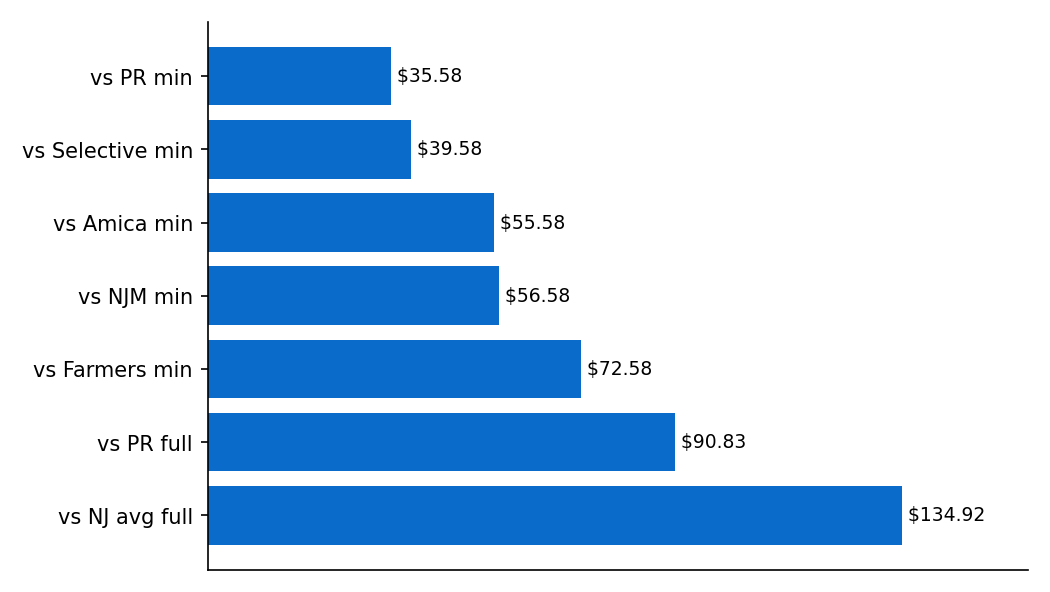
| Plymouth Rock, minimum | $792 | $427 | $35.58 |
| Selective, minimum | $840 | $475 | $39.58 |
| Amica, minimum | $1,032 | $667 | $55.58 |
| NJM, minimum | $1,044 | $679 | $56.58 |
| Farmers, minimum | $1,236 | $871 | $72.58 |
| Plymouth Rock, full coverage | $1,455 | $1,090 | $90.83 |
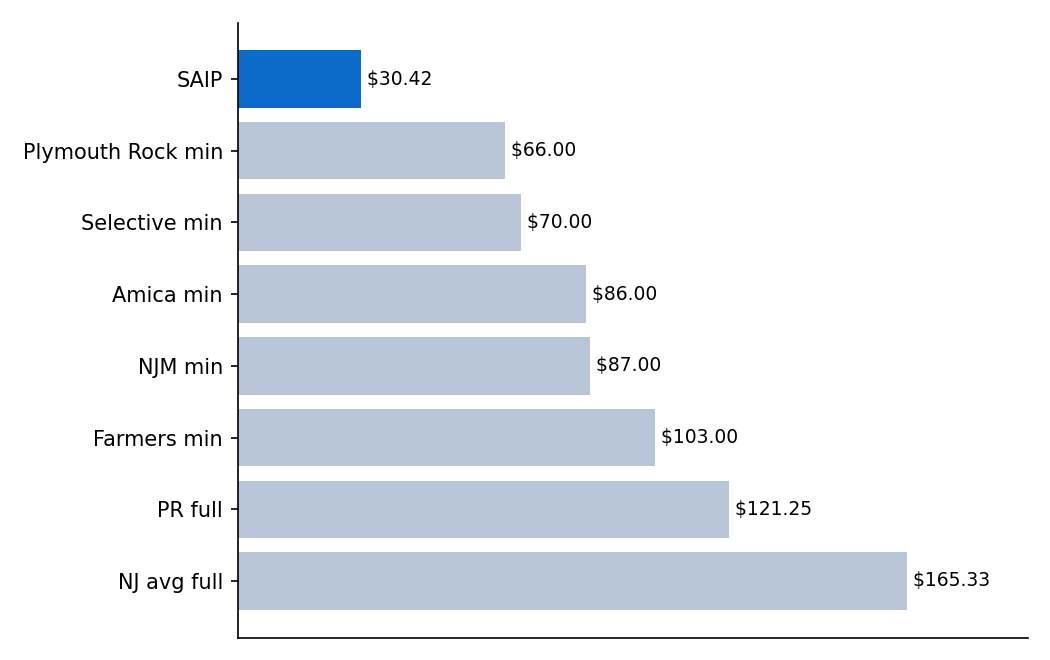
| NJ average, full coverage | $1,984 | $1,619 | $134.92 |
Annual premium vs. SAIP ($365)
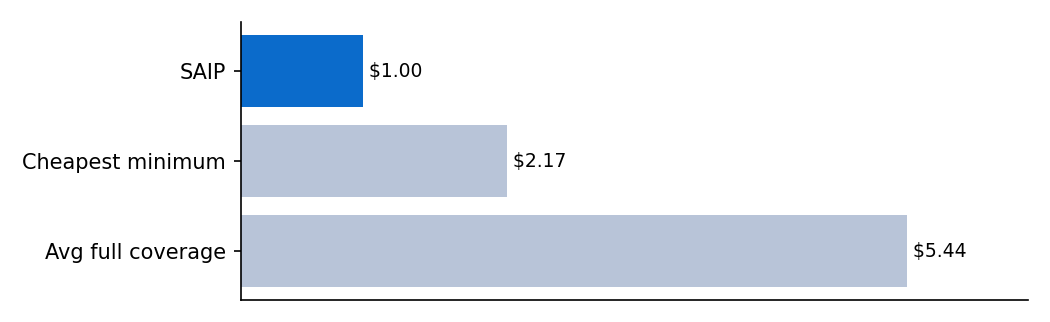
Cost per day
Monthly cost (annual ÷ 12)
Monthly savings with SAIP vs. each option
Illustrative five-year premium differences (not equal coverage or future-rate predictions)
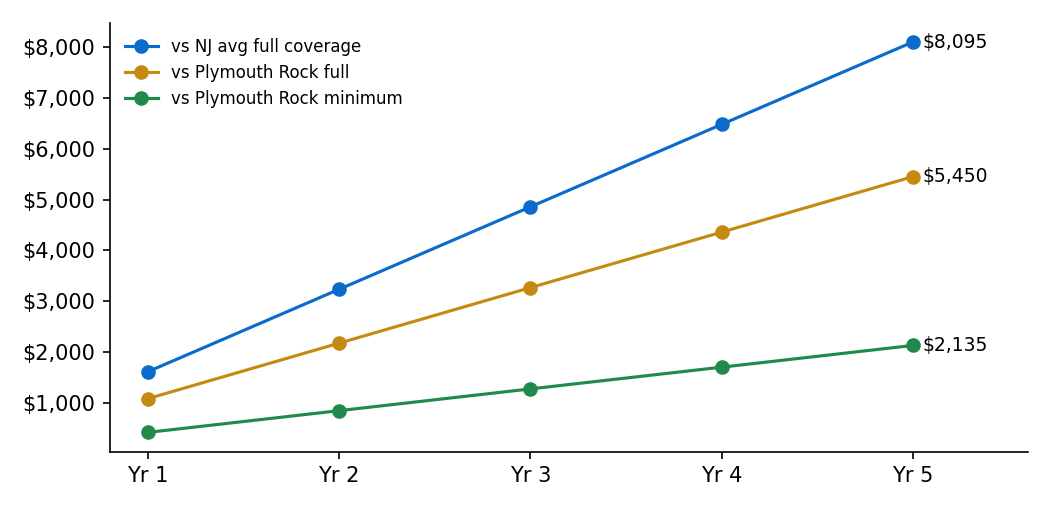
vs. NJ avg full coverage vs. Plymouth Rock full vs. Plymouth Rock minimum. Assumes constant rates.
Important comparison limitation: SAIP and the policies in the table do not insure the same risks. A lower SAIP premium comes with no liability, collision, or comprehensive coverage. The dollar differences are not estimates of economic savings after a crash.
SAIP premium comparison worksheet (not a coverage calculator)
Use the same term length when comparing prices. The equation below shows only the difference in premiums; SAIP lacks the liability protection in Basic and Standard policies.
Annual quote minus $365 = annual premium difference (when SAIP is paid in installments). For example, a $792 annual Standard Policy has a $427 higher premium. If SAIP is prepaid at $360, that difference becomes $432.
Payment-plan check: $360 prepaid versus $182.50 + $182.50 in two installments. Request written payment dates and compare the actual liability limits, PIP, and exclusions before purchasing.
$1 Dollar-a-Day for teens
SAIP does not publish separate teen or senior rates. A young driver must have a valid New Jersey license and qualify under the policy’s Medicaid rules; learner’s permit situations and listed-driver eligibility should be confirmed directly with a PAIP agent. Because SAIP excludes liability coverage, families should price a Basic and a Standard Policy before relying on it.
$1 Dollar-a-Day for seniors
SAIP also does not have a distinct senior version. Older drivers qualify through the same federal Medicaid-with-hospitalization rule. Some Medicaid categories use asset tests; the dollar figures in the Comptroller’s 2023 letter are examples from that period, not universal current thresholds. Those with savings or property have especially strong reasons to compare liability coverage.
Cheaper alternatives with liability
New Jersey’s Basic Policy has $5,000 of property damage liability, $15,000 in personal injury protection (with special higher benefits for qualifying injuries), and an optional $10,000 total bodily injury liability limit per accident. This is still very limited coverage, but it addresses some risks SAIP excludes. To compare a full range of private policies, consider both a Basic Policy quote and a Standard Policy quote with identical limits across insurers. No-down-payment marketing does not mean insurance is free to start.
Written comparisons should show exactly what each policy covers. Check the coverage limits and quote comparisons before treating a lower premium as a better value.
Once you qualify for a Basic or Standard Policy, compare the total annual cost and check whether standard auto policies under $100 a month are realistic for your specific New Jersey driver profile and coverage limits.
Myths vs. facts about $1 Dollar-a-Day insurance
| Myth | Fact |
|---|---|
| “Anyone low-income can get it.” | Eligibility depends on Medicaid with Hospitalization, not income alone. |
| “It’s full insurance for a dollar a day.” | It is a limited, medical-focused policy with no liability, collision, or comprehensive coverage. |
| “My driving record will block me.” | Past violations do not disqualify you; a current suspension does. |
| “One policy covers all my cars.” | Only one policy can cover a vehicle, and each vehicle needs its own. |
| “Teens and seniors get special rates.” | There are no age-based versions; the price and rules are the same for everyone. |
| “It’s the same as the state minimum.” | Sources describe SAIP as falling short of standard minimum requirements, even though it lets eligible drivers drive legally. |
Key terms explained
SAIP
The Special Automobile Insurance Policy, the official name of New Jersey’s Dollar-a-Day program.
PAIP
The Personal Automobile Insurance Plan, the state-regulated mechanism through which agents place SAIP and other plan business.
AIPSO
The Automobile Insurance Plan Service Office, a private organization contracted to manage plan operations.
Servicing carrier
The licensed insurer that issues SAIP policies under its own name.
Liability coverage
In a standard auto policy, bodily injury and property damage liability insurance can pay covered third-party losses up to the policy limits. SAIP does not provide that protection, even when the insured driver is legally eligible for the program.
Collision and comprehensive
Optional coverages that repair your own car after a crash or after events like theft and storms. SAIP does not include them.
Medicaid with Hospitalization
The category of Medicaid enrollment that SAIP requires. Confirm that your plan includes it before applying.
A quick checklist before you apply for $1 Dollar a Day Car Insurance in NJ
- ☐ My Medicaid card shows coverage that includes hospitalization.
- ☐ My license and registration are valid and not suspended.
- ☐ I have no other policy on the vehicle.
- ☐ I priced a Basic Policy and a minimum standard policy.
- ☐ I understand I would pay for any damage I cause to others.
- ☐ I can make both installment payments on time.
- ☐ I know my Medicaid renewal date and my insurance renewal date.
If you can check every box and have decided SAIP is your only realistic option, it can be a reasonable way to stay legal on the road. If the liability gap worries you, which it should, start by asking your agent for a Basic Policy quote.
Program statistics
| Metric (2022, Comptroller) | Figure |
|---|---|
| Policyholders (Dec. 2022) | 51,661 |
| Premiums paid | $20,754,827 |
| Claims submitted | 772 |
| Paid out to date | $11,379,342 (about $14,700 per claim) |
Where each premium dollar went (2022)
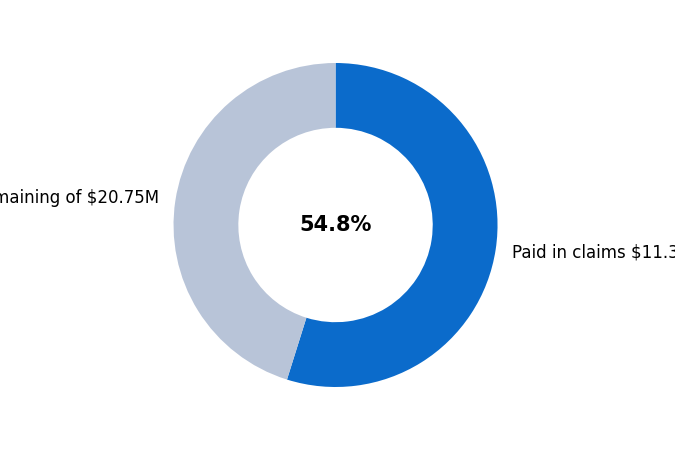
Claims paid ÷ premiums, from comptroller figures. Payouts are “to date” and may not be matched to the same period.
Historical claims and policyholder counts (2022)
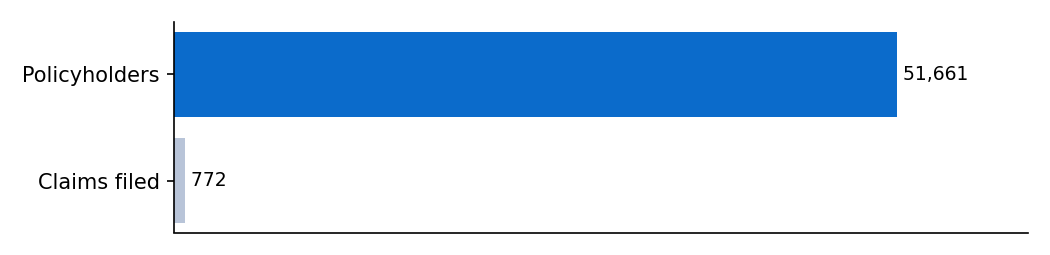
The number of submitted claims (772) divided by year-end policyholders (51,661) is approximately 1.5%. This ratio is a rough descriptive calculation, not a verified annual claim-frequency or actuarial loss ratio.
Step-by-step: how to get Dollar-a-Day insurance in New Jersey
Applying is simpler than most people expect, because the state built the program around Medicaid verification instead of underwriting. There is no credit check, and your driving history does not decide whether you are accepted. Here is the process from start to finish.
Step 1: Confirm you have the right kind of Medicaid
This is the step where most applications fail. SAIP is tied to Medicaid with Hospitalization, so having some other form of public health coverage does not automatically qualify you. If you are unsure, look at your Medicaid or NJ FamilyCare card and ask the agent to run the number. Agents verify eligibility by calling a state-administered line, and the system reports whether the person is enrolled in a qualifying program.
Step 2: Make sure your license and registration are valid
An applicant cannot apply if their driver’s license or vehicle registration is suspended or revoked. If you have an unpaid ticket, surcharge or other issue that has put your license in suspended status, resolve it with the Motor Vehicle Commission first. A past violation that has already been cleared does not block you, but a current suspension will.
Step 3: Gather your documents
- Your New Jersey driver’s license
- Your current vehicle registration and proof of ownership
- Your current Medicaid ID card
- Names of every Medicaid enrollee in the home who will drive the vehicle
- Your previous insurance history, if any
Step 4: Find an agent who writes SAIP
Many licensed agents who handle PAIP business can submit a SAIP application. You can call the plan at 1-800-652-2471 and ask for a participating producer. It is sensible to request Basic and Standard Policy quotes during the same appointment, but agent commissions and fees should not be assumed identical without confirmation.
Step 5: Complete the application and pay
The application is free. You pay either the full annual premium at purchase or half up front ($182.50) and the rest later. Paying the full year at once brings the cost to about $360, a savings of roughly $5. If cash is tight, the installment option is usually the better fit, as long as you make the second payment on time so the policy does not lapse.
Step 6: Keep your proof of insurance in the car
Once the policy is issued, you can drive legally. Keep your insurance card with the vehicle and store a photo of it on your phone. Mark the renewal date on your calendar, because your Medicaid status is checked again at renewal.
Is Dollar-a-Day insurance right for you? A decision guide
The honest answer is that SAIP fits a narrow group of people. It is designed as a bridge for drivers who cannot afford anything else and would otherwise drive uninsured. Use the lists below to decide.
SAIP may be worth considering if:
- You are on Medicaid with hospitalization, and every other policy quote is out of reach right now.
- You have very few assets that a lawsuit could take, and no home or savings at risk.
- You drive rarely and carefully, in low-traffic areas.
- You understand that you will pay for any damage you cause to others yourself.
Look at other options first if:
- You can afford even a Basic Policy or a minimum standard policy.
- You own a home, have savings, or earn wages that could be garnished.
- You finance or lease the car, since lenders require collision and comprehensive coverage.
- You drive for work, deliveries, or rideshare, because SAIP excludes commercial use.
- You commute long distances or drive in heavy traffic, where the chance of an at-fault crash is higher.
A useful way to think about it is the difference between “legally allowed to drive” and “financially protected.” SAIP gives you the first and only a sliver of the second. It protects your own emergency medical care, but it does nothing for the other person if you are at fault.
What happens in a crash: four illustrative scenarios
The scenarios below are simplified examples to show how the policy behaves. They are not real claims, and dollar amounts are illustrative round numbers.
Scenario 1: You are rear-ended and hurt
Another driver hits you, and you go to the emergency room. SAIP can pay for emergency treatment, which typically includes the ER visit, X-rays, medications, and initial care. Follow-up therapy for something like whiplash is not covered by SAIP, though your Medicaid may cover some of it. The other driver’s liability coverage, if they have any, is what normally pays for your car repairs.
Scenario 2: You cause a minor fender-bender
You slide into another car in a parking lot and cause $3,000 in damage. SAIP pays nothing toward that repair. You owe the other driver, or their insurer will pursue you. With a standard policy, property damage liability would cover this. Even a small incident like this can equal a large share of a low-income household’s monthly budget.
Scenario 3: You cause a serious crash
You cause an accident that injures another driver, with medical costs of $50,000 and vehicle damage of $15,000. These are the example figures insurance analysts use to illustrate the risk. Because SAIP has no liability coverage, every dollar becomes your personal responsibility. Lawsuits, wage garnishment, and asset seizure are all possible outcomes. This is the single biggest reason experts call SAIP a last resort.
Scenario 4: You are seriously injured
If you suffer a brain or spinal cord injury, SAIP offers up to $250,000 in coverage, which is the policy’s strongest feature. If the crash is fatal, a $10,000 death benefit applies. This is the part of the policy that gives real value, and it is why the program is not worthless, just incomplete.
Who pays in each scenario with SAIP only
| Scenario | Your medical bills | Other party’s losses | Your car |
|---|---|---|---|
| Rear-ended, you hurt | Emergency care only | Not your cost | Not covered by SAIP |
| Minor fender-bender, at fault | Minimal | You pay | Not covered |
| Serious at-fault crash | Emergency care | You pay everything | Not covered |
| Severe spinal/brain injury | Up to $250,000 | You pay if at fault | Not covered |
💡 Pro Tip #1: Get two quotes at the same appointment. When you meet the agent, ask for the SAIP price and a Basic Policy quote in the same visit, and bring your Medicaid card, license, and registration so nothing has to be repeated. If the Basic Policy is within your budget, it adds liability protection that SAIP never will, and you will have made the decision with real numbers instead of guesses.
Dollar-a-Day for teens: let’s take a deeper look
Whether a teenager can be included depends on valid New Jersey driving privileges, qualifying Medicaid status and the named-operator requirements. Have a PAIP producer confirm those details before allowing a teen to rely on the policy. SAIP still supplies no liability coverage if a young driver causes a crash.
What a teen needs to be covered
- A valid New Jersey license. New Jersey uses a graduated licensing system, so a teen driver moves from a permit to a probationary license before a full license. Check the Motor Vehicle Commission for the current age and restriction rules.
- Their own Medicaid enrollment that qualifies for SAIP.
- To be listed on the application as an operator.
The teen driver risk
Teen drivers have higher crash rates than adults across the country, which is the reason regular insurers charge families so much more once a teenager is added. SAIP skips age-based pricing entirely, so there is no teen surcharge, which looks like a bargain. The catch is that the policy still has no liability coverage. A teenager with an inexperienced driving record who causes a crash leaves the family fully exposed.
Smarter options for families with teens
- Ask a standard insurer whether the teen can be rated on a parent’s policy and what discounts apply, such as good-student or driver-training discounts.
- Compare the NJ Basic Policy for the household vehicle.
- Delay licensing if the family cannot afford liability protection, since an uninsured at-fault teen crash can create debt that follows the family for years.
Dollar-a-Day for seniors: a deeper look
Many people looking up this program are older adults living on fixed incomes. Seniors are well represented in the Medicaid programs that open the door to SAIP, including programs for people who are aged, blind or disabled. Eligibility has nothing to do with turning a certain age. It depends entirely on being enrolled in a qualifying Medicaid program.
Asset limits matter more for seniors
A 2023 Comptroller report gave an example of a Medicaid program with asset thresholds of $4,000 for one person and $6,000 for a couple. These were not universal thresholds and should not be used as 2026 eligibility advice. Ask NJ FamilyCare whether vehicle ownership affects your specific category.
Protecting what you have
If you qualify for SAIP but own property or have savings or wages to protect, compare the Basic and Standard policies closely. Only a Standard Policy with adequate liability limits may provide meaningful protection against a major injury claim; the Basic Policy still has very low limits.
Practical tips for seniors
- Ask your county Medicaid office or a benefits counselor whether any additional discounts or programs apply to you.
- Ask regular insurers about mature-driver and defensive-driving course discounts, which some carriers offer.
- Keep your Medicaid renewal paperwork organized, since losing eligibility means losing the ability to renew SAIP.
- Consider driving less. Fewer miles reduce both risk and the chance that a gap in coverage hurts you.
NJ Basic Policy vs. Dollar-a-Day vs. standard coverage
New Jersey’s 2026 Standard Policy minimums
For Standard Policies issued or renewed on or after January 1, 2026, the minimum liability limits are $35,000 for bodily injury to one person, $70,000 per accident, and $25,000 for property damage (35/70/25). The state’s 2025 DOBI bulletin describes this change. New Jersey’s Basic Policy is an explicit statutory exception; SAIP is a separate, Medicaid-restricted program. The Basic and Standard policies include personal injury protection benefits that SAIP does not replicate in full.
New Jersey has several ways to meet its insurance requirement, and they differ a lot in what protection you actually buy.
Dollar-a-Day (SAIP)
Price: about $365 a year. Strength: lowest price and open regardless of credit or driving record. Weakness: Medicaid required, medical-only, no liability.
Basic Policy
This is the state’s stripped-down option for drivers who cannot afford a standard policy. It provides $5,000 of property damage liability and an optional $10,000 of bodily injury liability for all persons in a crash. It costs less than a standard policy and gives you at least some protection for harm you cause others, which SAIP does not.
Standard policy
A standard policy provides the broadest protection, including liability and personal injury protection. The cheapest minimum policy found in the 2026 rate analysis was $792 a year, while the average full-coverage policy was $1,984 a year for a clean-record driver.
Price versus protection
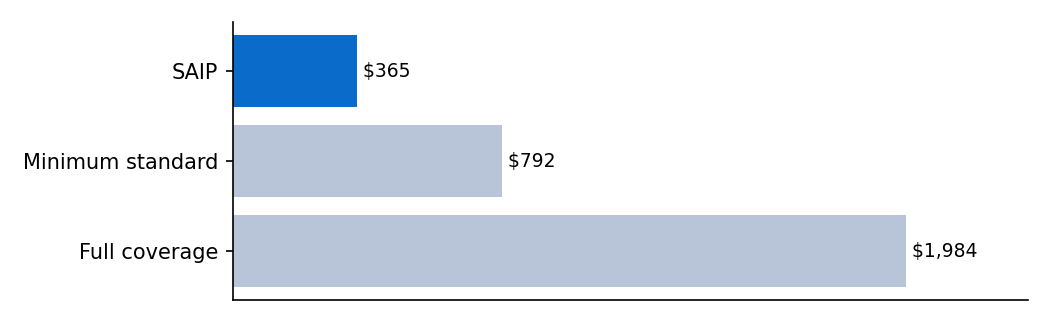
Basic Policy pricing varies by insurer and driver, so it is not charted. Get a quote.
What a dollar a day means for your budget
At $365 a year, SAIP is roughly $30.42 a month when averaged across 12 months, but the actual payment is $182.50 per installment, not a $30 monthly bill. Before switching policies, compare insurance installment and payment-plan options and ask about financing or service fees.
The low premium matters only alongside the risk you retain. For example, a $3,000 at-fault property-damage loss equals more than eight years of $365 annual SAIP premiums, and SAIP will not pay that third-party repair bill. A serious injury lawsuit could involve far greater exposure. These are illustrative arithmetic comparisons, not predicted claim costs.
That does not make SAIP a bad choice for someone who truly has no other path. It makes it a choice you should make with eyes open, and one you should revisit each renewal as your finances change.
Questions to ask your agent
- Does my Medicaid plan qualify as Medicaid with Hospitalization?
- What is the total I owe today, and when is the second installment due?
- Can you also quote a Basic Policy and a minimum standard policy?
- What exactly does SAIP pay for after a crash, and what does it exclude?
- Who is covered under the policy besides me?
- What happens at renewal, and what do I need to bring?
- If my Medicaid ends mid-term, what happens to the policy?
- Can I get proof of insurance today?
Renewing, changing, or losing your policy
Renewal
Your Medicaid eligibility is verified again at every renewal, so bring your current Medicaid card. Apply for renewal ahead of the expiration date so you are not scrambling after a lapse.
If your Medicaid status changes
NJ DOBI says that losing Medicaid eligibility during an active SAIP term does not automatically cancel the policy. However, benefits become restricted under its program rules, and qualifying enrollment must be demonstrated again at renewal. Tell your agent immediately and arrange suitable replacement insurance before the term ends.
If you move or change vehicles
SAIP is tied to a specific vehicle, and only one policy can cover a vehicle. When you replace your car, contact your agent to update the policy. If you move within New Jersey, update your address on both the policy and your registration.
Driving uninsured is the real danger
Letting coverage lapse can bring fines, license consequences, and higher future prices. A lapse is usually more expensive than the premium you were trying to save.
Real-life situations: what to do
“I just lost my job and my Medicaid.”
If you lose qualifying federal Medicaid with hospitalization, you will not qualify to renew SAIP unless you regain eligibility. DOBI says the current term does not automatically cancel mid-policy, but benefits are limited. Notify your producer and arrange another lawful policy before the term ends; do not assume full benefits continue.
“I just started working again, and my income went up.”
A higher income can affect eligibility for some Medicaid programs. Confirm your status with NJ FamilyCare rather than assuming SAIP will end immediately. If you will not qualify at renewal, budget for a Basic or Standard Policy before your current term expires.
“I drive for DoorDash, Uber, or deliveries.”
SAIP is for personal use only and does not cover commercial use. Using it for paid delivery or rideshare is a serious gap. Ask a standard insurer about coverage for gig driving, and do not assume your personal policy follows you onto the job.
“I just bought a different car.”
SAIP is tied to the vehicle named on the policy. Contact your agent before you drive the new car, and bring the registration and proof of ownership. Remember that only one policy can cover a vehicle, and that insuring several cars can trigger review of your Medicaid eligibility.
“My family has two drivers and two cars.”
Each vehicle needs its own policy at about $365, and each driver must be a Medicaid enrollee. Add up the cost and compare it with Basic Policy quotes for both vehicles. At two policies, you may be paying $730 a year for no liability coverage on either car.
“I’m moving to New Jersey from another state.”
You will need to meet New Jersey residency requirements and be enrolled in New Jersey Medicaid, then have a valid New Jersey license and registration. Out-of-state Medicaid does not qualify you.
Common mistakes to avoid
- Assuming it covers the other driver. It doesn’t. This is the most common and most costly misunderstanding.
- Insuring several vehicles. Each vehicle needs its own policy, and multiple cars can draw review of your Medicaid eligibility.
- Using the car for business. Delivery and rideshare use is a commercial use that SAIP does not cover.
- Missing the second installment. A lapse can leave you uninsured and disqualify you from easy renewal.
- Not comparing alternatives. Many people never get a Basic Policy quote, even though it adds meaningful liability protection.
- Forgetting Medicaid renewal. Your insurance depends on it, so treat both deadlines together.
- Relying on unofficial websites. Rates and rules change, so confirm everything with a licensed PAIP agent or the state.
Ways to lower the cost of regular insurance
If you decide SAIP is too limited, these steps can bring a regular policy within reach.
- Compare at least five carriers. The rate differences in the table above show how much quotes vary, from $792 to $1,236 for minimum coverage alone.
- Ask about monthly payments and low down payments. Some carriers offer low-deposit options.
- Raise deductibles on optional coverages if you carry them.
- Drop coverage you do not need on an older car, such as collision on a low-value vehicle.
- Ask about discounts for safe driving, bundling, paperless billing, defensive driving courses and low mileage.
- Keep a clean record. Violations and at-fault accidents raise prices for years.
- Review your coverage yearly. Rates change, and the cheapest carrier this year may not be next year.
💡 Pro Tip #2: Treat renewal as a two-deadline job. Your Medicaid renewal and your SAIP renewal are linked, because Medicaid is re-verified every time you renew. Put both dates on your phone calendar with a reminder at least 60 days ahead, and never cancel or let the policy lapse until your replacement coverage is active, even for a single day.
Bottom line: SAIP is a low-premium, legally recognized program for eligible Medicaid recipients who cannot afford broader coverage. Its serious-injury benefit is meaningful, but it excludes liability coverage. Compare the limited SAIP terms with a Basic and a Standard Policy before buying, rather than treating SAIP as equivalent to ordinary insurance.
Our recommendation by situation
| Your situation | Best starting point | Why |
|---|---|---|
| On qualifying Medicaid, no assets, cannot afford any other quote | SAIP | Keeps you legally insured at about $30 a month while you build a budget for more protection. |
| On Medicaid, can stretch to a small monthly payment | Basic Policy quote first | Adds property damage and optional bodily injury liability that SAIP lacks. |
| Own a home or have savings | Standard minimum or better | A judgment against you could reach assets, so liability protection matters most. |
| Financing or leasing a car | Full coverage | Lenders typically require collision and comprehensive coverage. |
| Rideshare or delivery driver | Commercial or gig-ready policy | SAIP excludes commercial use. |
| Teen driver in the household | Compare standard and Basic options | SAIP has no teen surcharge but no liability protection if a new driver causes a crash. |
| Senior on a fixed income | SAIP or Basic Policy, based on assets | Check how vehicles and savings affect Medicaid asset limits before choosing. |
Whichever row fits you, get at least two quotes, write down the coverage limits next to each price, and decide based on what you could realistically afford to pay out of pocket after a bad day on the road.
Official resources and contacts
- PAIP office (find an agent): 1-800-652-2471
- NJ Department of Banking and Insurance, SAIP page: state.nj.us/dobi
- NJ Office of the State Comptroller, SAIP letter: nj.gov/comptroller
- NJ Medicaid program information: the Division of Medical Assistance and Health Services, part of the Department of Human Services
Resumen en español
¿Qué es el seguro de “un dólar al día” en Nueva Jersey? Es la Póliza Especial de Seguro de Automóvil (SAIP). Cuesta unos $365 al año, aproximadamente un dólar por día, y es solo para personas inscritas en Medicaid con hospitalización.
¿Qué cubre? Tratamiento médico de emergencia después de un accidente, hasta $250,000 por lesiones cerebrales y de la médula espinal, y un beneficio por fallecimiento de $10,000.
¿Qué no cubre? No cubre responsabilidad civil, choque ni daños completos. Si usted causa un accidente, tendrá que pagar los daños y las lesiones de la otra persona.
Requisitos: licencia y registro válidos de Nueva Jersey, elegibilidad para Medicaid federal con hospitalización y verificación al renovar. El SAIP no sustituye la responsabilidad civil. Si necesita una póliza ordinaria, puede cotizar seguro de carro gratis y comprobar por escrito qué daños a terceros cubre.
Cómo solicitarlo: lleve su licencia, registro y tarjeta de Medicaid a un productor de seguros PAIP o llame al 1-800-652-2471. La solicitud de SAIP no tiene cargo. Para otras pólizas, las cotizaciones de seguro de auto permiten comparar límites y primas, pero no sustituyen la verificación oficial del programa SAIP.
Consejo: pida también una cotización de la Póliza Básica y una póliza estándar. Antes de comparar un seguro de auto barato con responsabilidad civil con SAIP, confirme las coberturas que cada uno incluye y los límites de pago si ocurre un accidente.
(FAQ) Frequently Asked Questions
Does SAIP cover my passengers?
The policy extends to qualified operators and named dependents who are Medicaid enrollees. Passengers who are not covered persons should be discussed with your agent before you rely on the policy for them.
Can I buy SAIP online?
The process runs through licensed agents and the PAIP office, since Medicaid must be verified. Some agencies handle part of the process remotely, but expect to provide documents.
Does a bad driving record disqualify me?
No. Past tickets or accidents do not disqualify you, as long as your license and registration are currently valid.
Will SAIP cover a rental car or someone else’s car?
It is written for a specific insured vehicle. Ask your agent about driving other vehicles before you assume coverage.
Is the price the same for everyone?
The published SAIP premium is fixed at $360 if prepaid annually or $365 in two installments, regardless of age, credit, or driving history. A qualifying Medicaid plan and valid driving status remain mandatory.
Can I switch from SAIP to a regular policy mid-term?
You can buy a regular policy at any time. Get the new policy active before cancelling SAIP so there is no gap, and ask about any refund of unused premium.
Is Dollar-a-Day available in other states?
No, SAIP is specific to New Jersey. California has a separate low-cost program that includes liability coverage.
Is Dollar-a-Day legal proof of insurance?
Yes, it lets eligible drivers drive legally, though it doesn’t meet the standard minimums.
Can I insure two cars?
Each vehicle needs its own policy at $365, and multiple vehicles may trigger a Medicaid review.
What if I lose Medicaid?
New Jersey DOBI states that the current SAIP term does not automatically cancel if Medicaid ends mid-term, but benefits become restricted. You must demonstrate qualifying enrollment again at renewal. Contact your producer and arrange replacement coverage in advance.
Do I need Medicaid?
Yes, it is the core requirement.
The Final Word on $1 a Day Car Insurance in New Jersey
New Jersey’s Dollar-a-Day coverage, officially the Special Automobile Insurance Policy (SAIP), costs $360 annually when prepaid or $365 in two installments. For an eligible driver, it provides the program’s restricted emergency medical benefits, but not liability for an at-fault crash. In a 2026 third-party rate sample, minimum Standard Policies started at $792 annually for a particular driver profile. The $427 price gap versus $365 does not compare equal protection.
The low price reflects limited protection. SAIP does not pay for liability, collision, or comprehensive losses. This is why the financial trade-offs of very cheap car insurance matter more than the advertised premium: a covered medical emergency is not the same as protection against a third-party injury lawsuit.
Eligibility depends on federal Medicaid with hospitalization, valid licenses and registration, and the program’s operator rules. It is verified when the policy is purchased and renewed. No additional age-based SAIP premium is listed in official guidance.
Our advice is to use SAIP as a bridge, not a destination. If you can stretch your budget, get a quote for the NJ Basic Policy, which adds some liability protection, or for a minimum standard policy. Ask your agent for both prices in the same visit. Write the coverage limits next to each number, and decide based on what you could realistically afford to pay after a bad day on the road.
If SAIP is the only policy within reach, confirm the actual restrictions with a PAIP producer, maintain Medicaid eligibility, and request comparison quotes as your circumstances change. A price comparison should always identify what coverage is absent.
Sources
Official sources and rate methodology: NJ DOBI SAIP questions and answers (checked November 16, 2026); New Jersey Basic Policy; New Jersey Standard Policy; DOBI 2026 minimum-limits bulletin; NJ State Comptroller (October 12, 2023); and MoneyGeek SAIP rate analysis (2026). Published quote averages reflect the source’s sample driver and coverage; no personal insurance quotes were obtained for this article.