
30 Day Car Insurance
30-day car insurance is something many drivers search for, but few major U.S. insurers sell a true one-month policy. Most standard policies run six or 12 months. You can still get about 30 days of legal coverage, and in some cases pay only for that time, by choosing the right option.
This guide explains the six main ways to get one month of coverage, what each costs, which companies offer weekly or daily plans, how early cancellation works, and the state rules that can catch you out. Every figure is sourced and dated, and hypothetical examples are labeled.
KEY TAKEAWAYS
- Most insurers do not sell 30-day policies. The most common workaround is buying a six-month policy and canceling it after a month.
- Flexible plans exist in some states. Insurify Car sells liability coverage in seven-day increments in 16 states, and Hugo lets you start with as few as three days.
- Know the cancellation rules. A prorated refund returns your unused premium, but a short-rate penalty or a cancellation fee can raise the cost of one month noticeably.
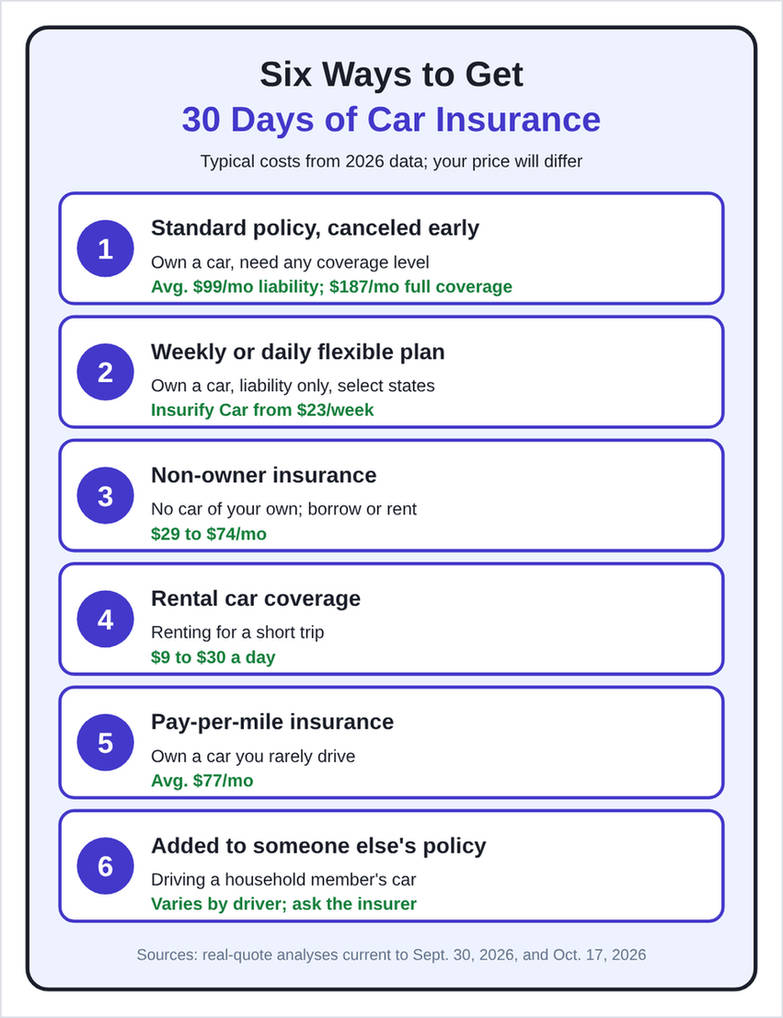
Six ways to get about 30 days of car insurance, with typical costs from real-quote analyses current to September 30 and October 17, 2026. Prices are averages or starting rates, not quotes.
BEFORE YOU BUY
Decide whether you need coverage for a car you own, a car you borrow, or a rental. That one answer rules out half the options below.
What is 30-day car insurance?
"30-day car insurance" usually means any way to be insured for about one month. In the U.S., one real-quote analysis updated October 30, 2026, says most major insurers sell only six- or 12-month terms, and most will not sell a term shorter than six months. Insurers do let you pay monthly, so many people confuse a monthly payment with a monthly policy.
The difference matters. A monthly payment plan keeps a six-month policy running until you cancel it. A true short-term option, such as a weekly plan, ends when you stop paying or reach the cancellation date you set.
Common reasons people need about a month of coverage include driving a car they are about to sell, visiting family and borrowing a car, waiting for a new car to arrive, renting during a move, or covering a gap between jobs or policies. Each situation points to a different option, as the table below shows.
Ways to get about 30 days of car insurance
| Option | How it works | Covers damage to the car you drive? | Best for |
|---|---|---|---|
| Standard policy, canceled early | Buy a six-month policy, cancel after a month, get a refund | Yes, if you buy collision and comprehensive | Car owners who need any coverage level |
| Weekly or daily flexible plan | Pay in 3-, 7-, or 30-day blocks and stop when done | Usually no; mostly liability only | Car owners in states where these plans are sold |
| Non-owner insurance | Liability coverage for driving cars you do not own | No | Drivers without a car who borrow or rent |
| Rental car coverage | Bought per day at the counter or from a third party | Yes, with a damage waiver | Short rentals |
| Pay-per-mile insurance | Monthly base rate plus a per-mile charge | Yes, if you buy full coverage | Owners of rarely driven cars |
| Added to someone else's policy | The owner adds you as a driver | Depends on their policy | Driving a household member's car |
How much does one month car insurance cost?
It depends mostly on the option you choose. In a real-quote analysis with rates current to September 30, 2026, liability-only coverage averaged $99 a month, and full coverage averaged $187 a month nationally. Non-owner coverage ranged from $29 to $74 a month, and the cheapest liability-only company, Country Financial, averaged $45.
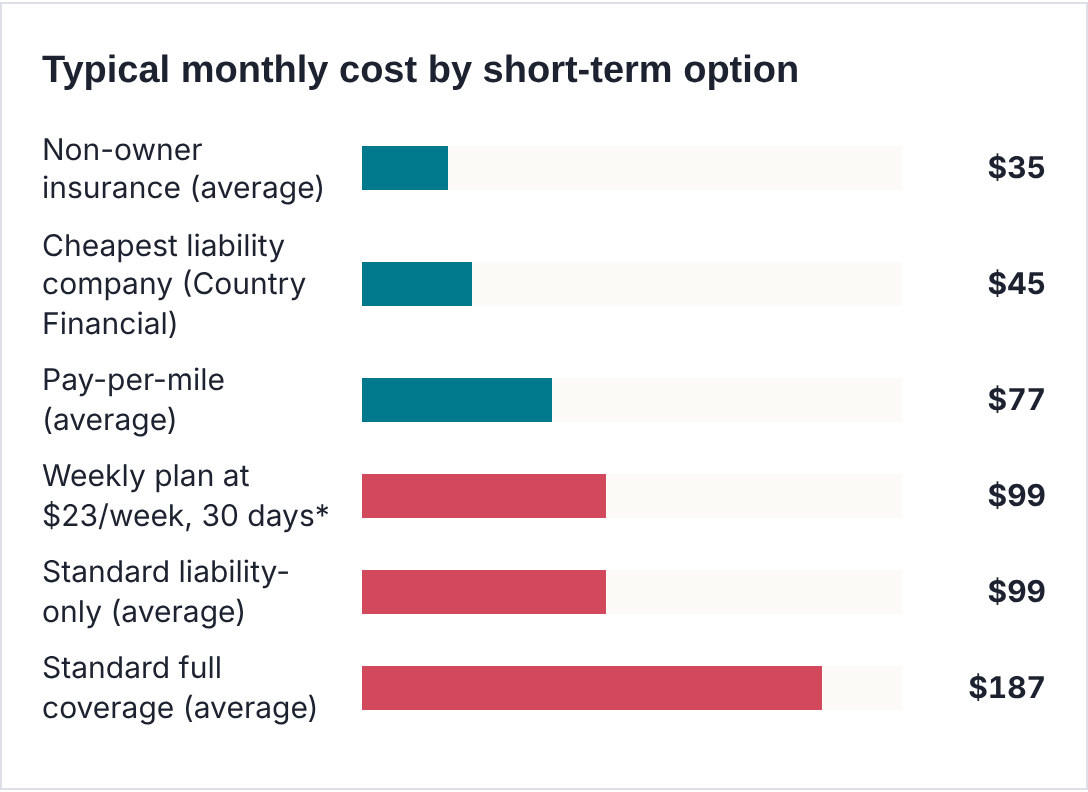
Real-quote analyses with rates current to September 30, 2026, and October 30, 2026. *Our calculation: $23 × 30 ÷ 7 = about $99; $23 is a starting rate in select states. Averages, not quotes.
Your state also matters. One state-by-state analysis updated October 1, 2026, estimated one-month minimum-coverage premiums, prorated from six-month policies, from $21 in Iowa to $97 in New York.
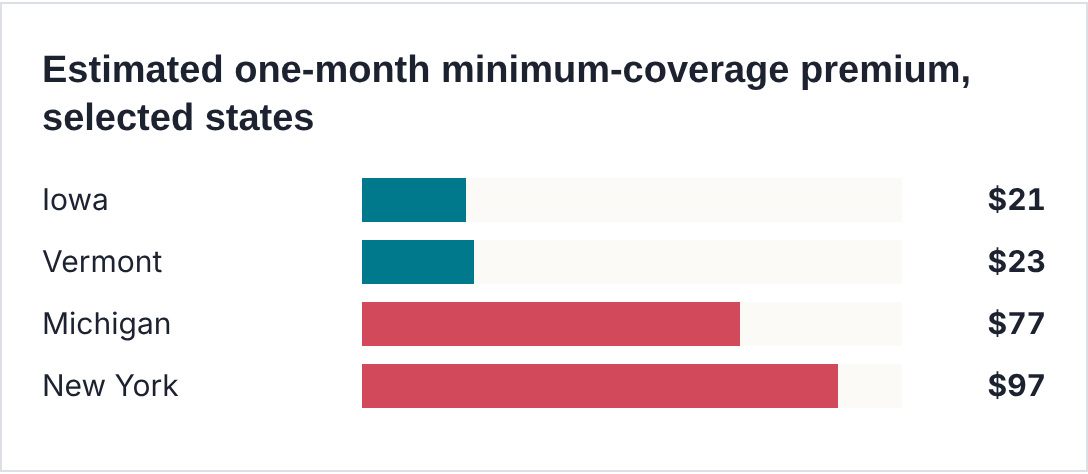
State-by-state analysis updated October 1, 2026; one-month cost prorated from a six-month minimum-coverage policy. The same analysis put the national month-to-month average at about $113, prorated from a $678 six-month policy.
Option 1: Buy a standard policy and cancel early
This is the most widely available route. You buy a normal six-month policy, use it for a month, and cancel. You can buy liability-only or full coverage, and you get proof of insurance right away. The catch is how your refund is calculated.
- Pro rata refund: the insurer returns the full unused part of your premium.
- Short-rate refund: the insurer keeps a penalty, often 10% to 15% of the unearned premium, according to an analysis updated August 31, 2026. Short-rate is more common when you cancel, rather than the insurer.
- Non-refundable fees: policy and broker fees are generally not returned.
Rules vary by company and state, so ask before you buy: "If I cancel after 30 days, how is my refund calculated, and is there a fee?"
Hypothetical: cost of one month on a $678 six-month policy
| Refund method | Premium used (1 month) | Penalty or fee | Your total cost for 30 days |
|---|---|---|---|
| Pro rata, no fee | $113 | $0 | $113 |
| Pro rata with a $50 cancellation fee | $113 | $50 | $163 |
| Short-rate, 10% of unearned premium | $113 | $56.50 | $169.50 |
| Short-rate, 15% of unearned premium | $113 | $84.75 | $197.75 |
Hypothetical example; our calculation. The $678 six-month premium and $113 monthly figure come from a state-by-state analysis updated October 1, 2026. Unearned premium after one month: $678 − $113 = $565. Your insurer's terms may differ.

If you pay in monthly installments and cancel before the next draft, you may simply owe nothing more, but confirm this in writing. Some insurers charge installment fees, and the same analysis estimated them at $5 to $15 per payment.
Option 2: Weekly and daily flexible plans
A few newer programs let you buy coverage in short blocks and stop when you are done. They are the closest thing to true one month car insurance in the U.S., but they are limited to certain states and mostly to liability coverage.
Insurify Car
Insurify Car sells state-minimum liability coverage in seven-day increments, starting at $23 a week in select states, according to an analysis updated September 30, 2026. You can set a cancellation date when you start, cancel at any time, and get same-day digital proof. It is offered in 16 states: Alabama, Arizona, Colorado, Florida, Georgia, Illinois, Indiana, Kentucky, Michigan, Missouri, Nevada, Ohio, South Carolina, Tennessee, Texas, and Virginia.
Hugo
Hugo lets you start with as little as three days of coverage and pay in 3-, 7-, or 30-day blocks from a prepaid balance. Its plans include Flex (state-minimum liability by the day), Basic (liability plus medical coverage), and Unlimited Full, which adds collision and comprehensive. Hugo is underwritten by First Acceptance, is not available in most states, and does not appear to offer SR-22 filings, according to a review updated September 17, 2026.
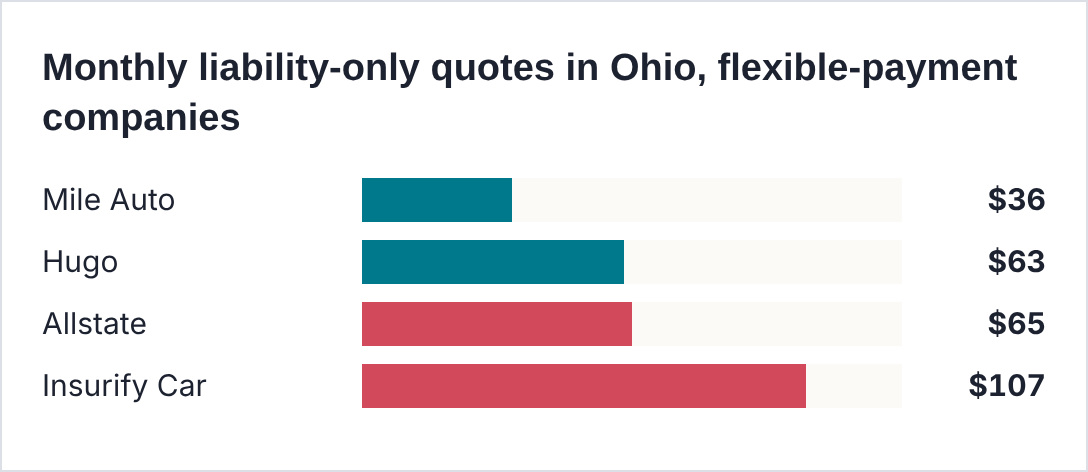
Ohio real-quote analysis, rates current to September 27, 2026. The same analysis listed Insurify Car "as low as $35/week in Ohio." Averages, not quotes.
These averages vary widely. Nationally, the same company's analysis listed average monthly liability-only quotes of $141 for Insurify Car and $175 for Hugo. A weekly plan saves money only if you truly need short coverage; for a full month or longer, compare it with a standard policy.
Option 3: Non-owner car insurance
If you do not own a car, non-owner insurance is often the cheapest choice. It provides liability coverage when you drive a car you borrow or rent. It does not cover damage to the car you drive. In the September 2026 analysis, non-owner policies cost $29 to $74 a month, and another analysis put the average at $35.
Non-owner coverage can also satisfy an SR-22 requirement with insurers that offer it, and it keeps you continuously insured, which can help your rates when you buy a car later.
Option 4: Rental car coverage
For a rental, coverage is bought by the day. One analysis put rental car insurance at $9 to $30 a day. A local news report from June 23, 2026, said rental counter coverage often costs $30 to $60 a day, while third-party providers sell primary rental coverage for under $20 a day.
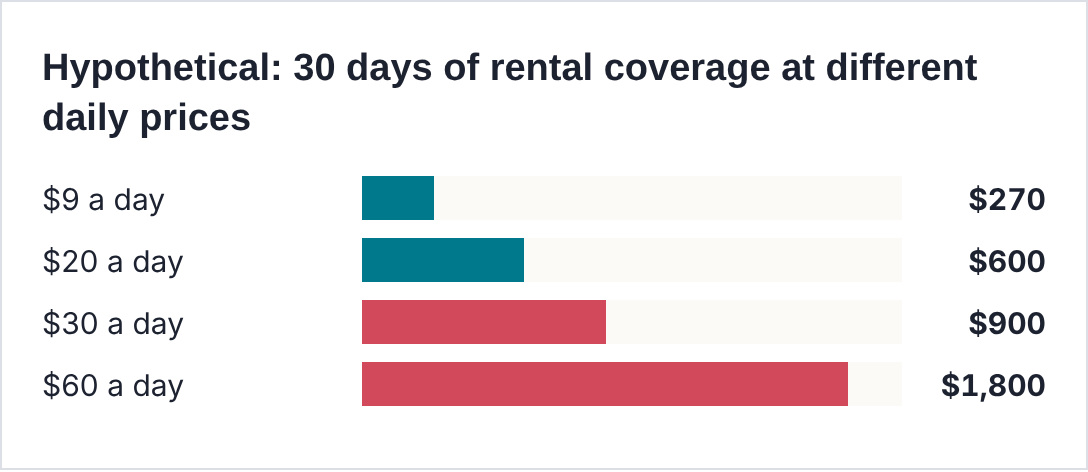
Our calculation: daily price × 30. Daily ranges from a real-quote analysis (September 30, 2026) and a June 23, 2026, consumer report.
Daily coverage gets expensive quickly. For a month-long rental, a non-owner policy plus a credit card's rental benefit may cost less. Most credit cards offer secondary coverage, which pays after your auto insurance, and they usually exclude liability. Without a personal auto policy, the card's coverage may become primary, so read your card's terms.
Option 5: Pay-per-mile insurance
If you own a car you will barely drive for a month, pay-per-mile insurance can lower the bill. You pay a monthly base rate plus a charge for each mile. One analysis put the average at $77 a month. These are ongoing policies, not 30-day plans, but low mileage keeps the monthly cost down.
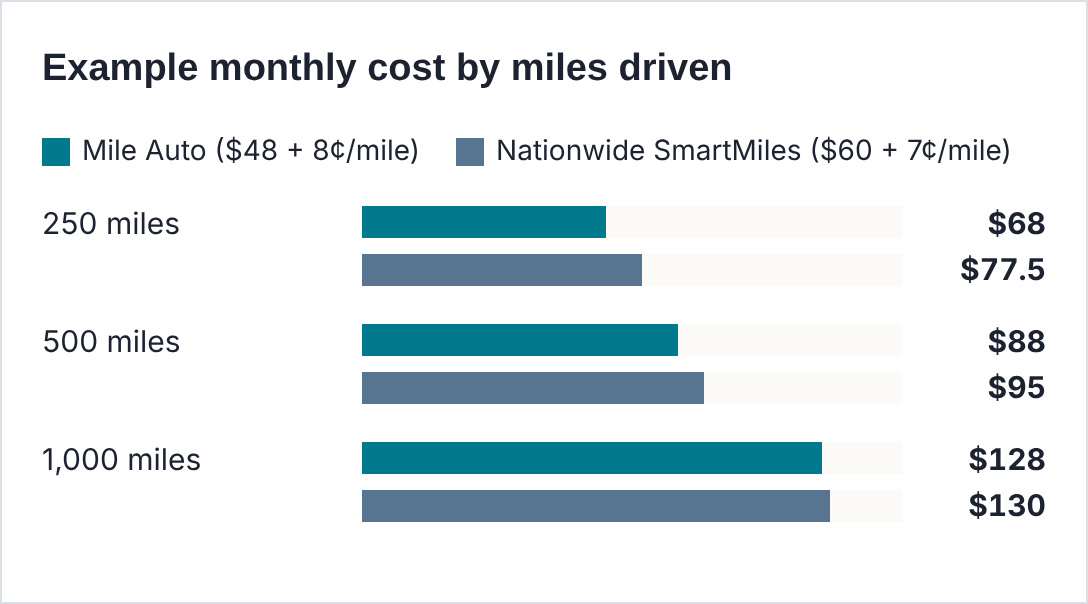
Our calculation is based on published examples: Mile Auto's $48 base rate and 8 cents a mile, and a Nationwide SmartMiles example of a $60 base rate and 7 cents a mile for a Chicago driver. Your rates will differ.
Pay-per-mile programs are available only in certain states. Check your ZIP code with each company before comparing.
Option 6: Get added to someone else's policy
If you are staying with family or a partner for a month, ask whether you can be added to their policy. It can cost less than a separate policy, but eligibility varies by insurer, and adding a driver can raise the owner's premium. Occasional drivers with permission may already be covered under the owner's policy through permissive use, but rules differ by insurer and state, so the owner should call their company first.
Which option is best for you?
Best 30-day option by situation
| Your situation | Best option | Why |
|---|---|---|
| You own a car and need full coverage for a month | Standard policy, canceled early | Flexible plans rarely include collision and comprehensive |
| You own a car and need only legal liability for a few weeks | Weekly plan, where available | Pay only for the weeks you use |
| You do not own a car but borrow one | Non-owner insurance | Liability coverage at $29 to $74 a month |
| You are renting for a few days | Rental car coverage | Bought per day, no long-term policy |
| Your car will mostly sit for the month | Pay-per-mile insurance | Low mileage keeps the bill down |
| You are driving a household member's car | Ask to be added to their policy | Often cheaper than a separate policy |
State rules to know before you cancel
Ending coverage on a registered car can trigger penalties, even if you park it. New York is the strictest example. The New York DMV says to turn in your license plates before your coverage ends. If you do not, your registration can be suspended for as many days as the car was uninsured.
New York insurance-lapse civil penalties
| Length of lapse | Penalty per day |
|---|---|
| 1 to 30 days | $8 |
| 31 to 60 days | $10 |
| 61 to 90 days | $12 |
New York DMV, accessed October 2026. The penalty option is not available for lapses over 90 days or if you used it within the previous 36 months. A 25-day lapse costs $200.
Other states have their own penalties. In Ohio, driving uninsured can bring a 90-day license suspension, possible impoundment, and a minimum $75 reinstatement fee. In Texas, a first uninsured conviction carries a $175 to $350 fine. A coverage gap can also raise your future premiums; one analysis estimated 10% to 30%.
PRO TIP #1
Before buying a policy you plan to cancel, ask the insurer three questions: Is the refund pro rata or short-rate? Is there a cancellation fee? How long does the refund take? Write down the answers, the agent's name, and the date.
How to get 30-day car insurance, step by step
- 1. Decide what you need to cover: your own car, a borrowed car, or a rental.
- 2. Check your state's minimum and any lender requirements if the car is financed.
- 3. Check flexible plans first if you live in one of the states they serve.
- 4. Compare at least three standard quotes with identical limits and deductibles.
- 5. Ask about cancellation terms before you pay.
- 6. Save your proof of insurance and set a calendar reminder for your cancellation date.
- 7. Cancel in writing and keep the confirmation, then return plates if your state requires it.
Pros and cons of short-term coverage
Pros and cons of 30-day car insurance options
| Pros | Cons |
|---|---|
| Keeps you legal for a short need | Few true 30-day policies exist |
| Weekly plans let you stop paying when done | Flexible plans are limited by state and mostly liability only |
| Standard policies can include full coverage | Early cancellation can bring fees or a short-rate penalty |
| Non-owner coverage is low-cost | Non-owner and most flexible plans do not cover your car |
PRO TIP #2
If your one-month need might stretch longer, compare the full six-month price, not just the first month. A weekly plan that looks cheap for two weeks can cost more than a standard policy over several months, and repeated short policies can count against you when you next shop.
Common mistakes to avoid
- Assuming a monthly payment is a monthly policy. Your six-month policy keeps running until you cancel.
- Letting coverage lapse on a registered car. Return plates or keep coverage where your state requires it.
- Relying only on a credit card for a rental. Most cards do not cover liability.
- Buying daily rental coverage for a whole month without comparing a non-owner policy.
Frequently asked questions
Can I buy 30 day car insurance?
Rarely as a true one-month policy. Most major insurers sell six- or 12-month terms. You can buy a standard policy and cancel after a month, use a weekly plan such as Insurify Car or Hugo where available, or choose non-owner or rental coverage if you do not own the car.
How much does one month of car insurance cost?
In 2026 real-quote data, liability-only coverage averaged $99 a month, and full coverage averaged $187 nationally. Non-owner policies cost $29 to $74 a month. One analysis estimated one-month minimum coverage from $21 in Iowa to $97 in New York. Your age, record, car, and state decide your own price.
Will I get a refund if I cancel after a month?
Usually, for the unused premium. With a pro rata refund, you get all of it back. With a short-rate refund, the insurer may keep 10% to 15% of the unearned premium. Some insurers also charge a cancellation fee or keep policy fees, so ask first.
Which companies offer weekly or daily car insurance?
Insurify Car sells liability coverage in seven-day increments in 16 states, from $23 a week in select states. Hugo lets you start with three days and pay in 3-, 7-, or 30-day blocks. Both are limited by state, so check your ZIP code.
Can I get full coverage for just 30 days?
Yes, most reliably by buying a standard full-coverage policy and canceling after a month. Hugo's Unlimited Full plan includes collision and comprehensive where offered. Most weekly plans and all non-owner policies are liability only, so they will not pay to repair the car you drive.
What insurance do I need if I borrow a car for a month?
The owner's policy may cover you through permissive use, but rules differ by insurer. For a longer arrangement, being added to the owner's policy or buying non-owner insurance, which costs $29 to $74 a month in 2026 data, can give you your own liability coverage.
Does canceling after 30 days hurt my insurance record?
Canceling itself is allowed, but a coverage gap afterward can raise future premiums by 10% to 30% in one estimate. Repeated short-term cancellations can also affect future rates. If you will drive again soon, a non-owner policy can keep you continuously insured.
Do I need to return my plates when I cancel?
In some states, yes. New York says to turn in your plates before coverage ends, or your registration can be suspended. It also allows a per-day civil penalty of $8 to $12 for lapses up to 90 days. Check your own state's DMV rules before canceling.
Final recommendation
For most car owners, the simplest route is a standard policy canceled after a month, as long as the refund is pro rata with no fee. If you need only liability and live where weekly plans are sold, compare Insurify Car and Hugo. If you do not own the car, start with non-owner insurance.
NEXT STEP
Write down the dates you need coverage and the car you will drive. Then get three quotes, ask each insurer how cancellation refunds work, and choose the option with the lowest total cost for your exact dates.
Prices, availability, and cancellation terms vary by insurer, state, driver, and vehicle. The rates in this article are averages, starting prices, and hypothetical calculations, not quotes. This article is for information only and is not legal or financial advice. The publisher is not an insurance company or a licensed insurance agency.
The bottom line on 30-day car insurance: a true one-month policy is rare, but a standard policy canceled early, a weekly plan, non-owner coverage, or rental coverage can keep you legally insured for exactly the time you need.
Sources
- Insurify, Can You Get One-Day Car Insurance? (updated October 30, 2026).
- Insurify, One-Week Car Insurance (updated September 30, 2026).
- Insurify, Temporary Car Insurance in Ohio (rates current to September 27, 2026).
- MoneyGeek, Temporary and Month-to-Month Car Insurance (updated October 1, 2026).
- MoneyGeek, Car Insurance Refund (updated August 31, 2026).
- Credit Karma, Hugo Auto Insurance Review (updated September 17, 2026) and Hugo (accessed October 2026).
- First Alert 4, Understanding Rental Car Insurance (June 23, 2026).
- Mile Auto, How it works and Nationwide, SmartMiles (accessed October 2026).
- New York DMV, Auto Liability Insurance (accessed October 2026).