
Pay As You Go Car Insurance in Texas
If you drive less than the typical Texan, pay as you go car insurance in Texas can cut your premium, and Texas is one of the best states to shop for it: four pay-per-mile programs are open to Texans in 2026, and Texas law ties the insurance requirement to driving rather than to a parked car. Texas was also where pay-by-the-mile coverage began, when a 2001 state law opened the door, and a Dallas company called MileMeter sold some of the first per-mile policies.
But Texans also drive a lot, and "pay as you go" means three different things depending on who is selling it. This guide explains how pay-per-mile, pay-per-day, and low-down-payment plans work in Texas, which companies sell each one, what they cost, how many miles you can drive before pay-per-mile stops saving money, and which driving-tracking discounts the big insurers offer instead.
KEY TAKEAWAYS
- Nationwide SmartMiles and Lemonade Car confirm Texas on their own pages, and Allstate Milewise and Mile Auto are listed for Texas by 2026 reviews; Metromile and Noblr are no longer options.
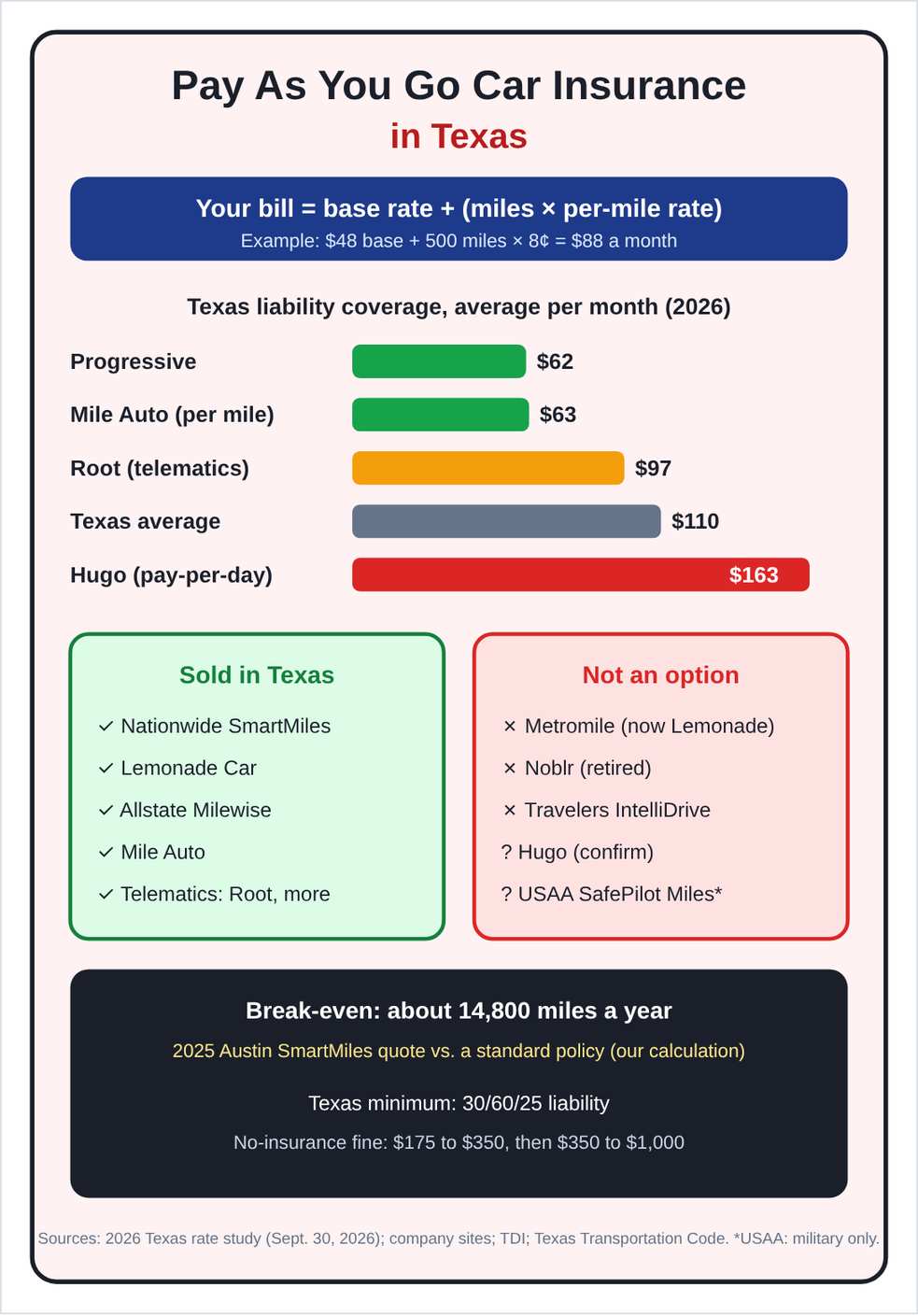
- Mile Auto is the cheapest pay-per-mile company in Texas based on 2026 data, averaging $63 a month for liability coverage against a $110 state average.
- A 2025 Austin quote for SmartMiles beat a standard policy up to roughly 14,800 miles a year (our calculation), so pay-per-mile works best for drivers below that level.
What "pay as you go" car insurance means in Texas
Texans see the phrase used for three different products. Only two of them change your price based on how much you drive, and the third is mostly about how you pay.
Three types of pay as you go car insurance in Texas
Type | How you pay | Texas examples | Watch out for |
|---|---|---|---|
Pay-per-mile | Monthly or daily base rate plus a charge for each mile | Nationwide SmartMiles, Lemonade Car, Allstate Milewise, Mile Auto | Costs more if you drive a lot |
Pay-per-day | A daily rate, billed in short blocks | Hugo (Texas availability unconfirmed) | Can cost more than a monthly policy |
Monthly or low down payment | A standard policy paid in monthly installments | Progressive, GAINSCO, Direct Auto, Dairyland, and others | The total premium does not drop |
Company sites and 2026 reviews (accessed November 11, 2026). Availability can change; confirm with a quote.
A fourth idea often gets mixed in: usage-based insurance, also called telematics, which tracks how you drive rather than just how far. The Texas Department of Insurance describes both pay-by-the-mile and usage-based programs on its consumer tip page, and both are legal in Texas. Usage-based programs are covered later in this guide.
How pay-per-mile insurance charges you
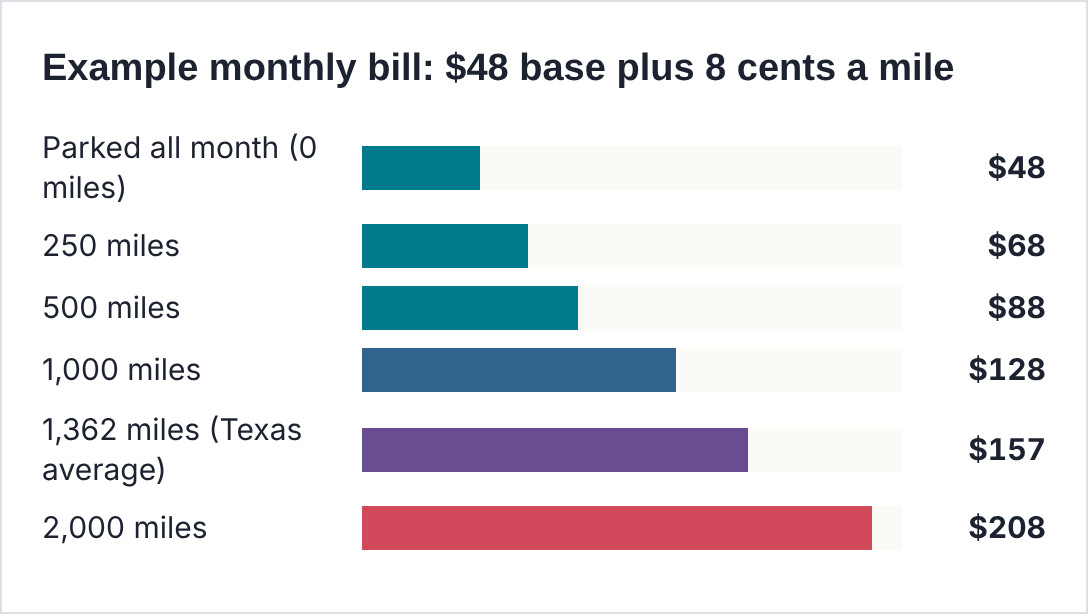
Every pay-per-mile policy uses the same basic formula. A fixed base rate covers your car while it is parked and reflects your age, driving record, car, credit, and ZIP code. Then you pay a few cents for each mile you drive. The Texas Department of Insurance describes it as "a base amount plus a fee for the number of miles you drive each month."
Programs track miles in different ways. Mile Auto asks for an odometer photo each month and uses no device. Nationwide SmartMiles and Allstate Milewise use a plug-in device or a connected car, and Lemonade uses your phone's sensors. Most programs also cap the miles they charge in a single day, which matters in a state where a drive from Houston to El Paso runs about 750 miles.
Pay-per-mile companies in Texas
Many ranking pages get Texas wrong. Some still list Metromile, which never sold in Texas and now operates as Lemonade, or Noblr, which USAA retired in 2025. This table reflects official company pages and 2026 reviews as of November 11, 2026.
Pay-as-you-go options for Texas drivers, November 2026
Program | Texas status | How it charges | Tracking |
|---|---|---|---|
Nationwide SmartMiles | Available (Texas not excluded on Nationwide's page) | Base premium plus per-mile; only the first 250 miles a day count | Plug-in device or connected car |
Lemonade Car | Available (Texas listed on Lemonade's page) | Base price plus per-mile price | Phone app |
Allstate Milewise | Listed for Texas by reviews; confirm | Daily base rate plus per-mile rate | Plug-in device and app |
Mile Auto | Listed for Texas by a 2026 review; confirm | Monthly base plus per-mile rate | Monthly odometer photo |
USAA SafePilot Miles* | Unconfirmed for Texas | Fixed rate plus monthly mileage adjustment | USAA app |
Hugo | Sources conflict | Daily rate in short blocks | App, no mileage tracking |
Metromile | Not available | Now part of Lemonade | Not applicable |
Noblr | Not available | Retired by USAA in 2025 | Not applicable |
Nationwide SmartMiles and Lemonade pay-per-mile pages; USAA Texas and SafePilot Miles pages; 2023 to 2026 reviews (accessed November 11, 2026). Allstate's and Mile Auto's own sites could not be checked for this article. *USAA is available only to military members, veterans, and their families.
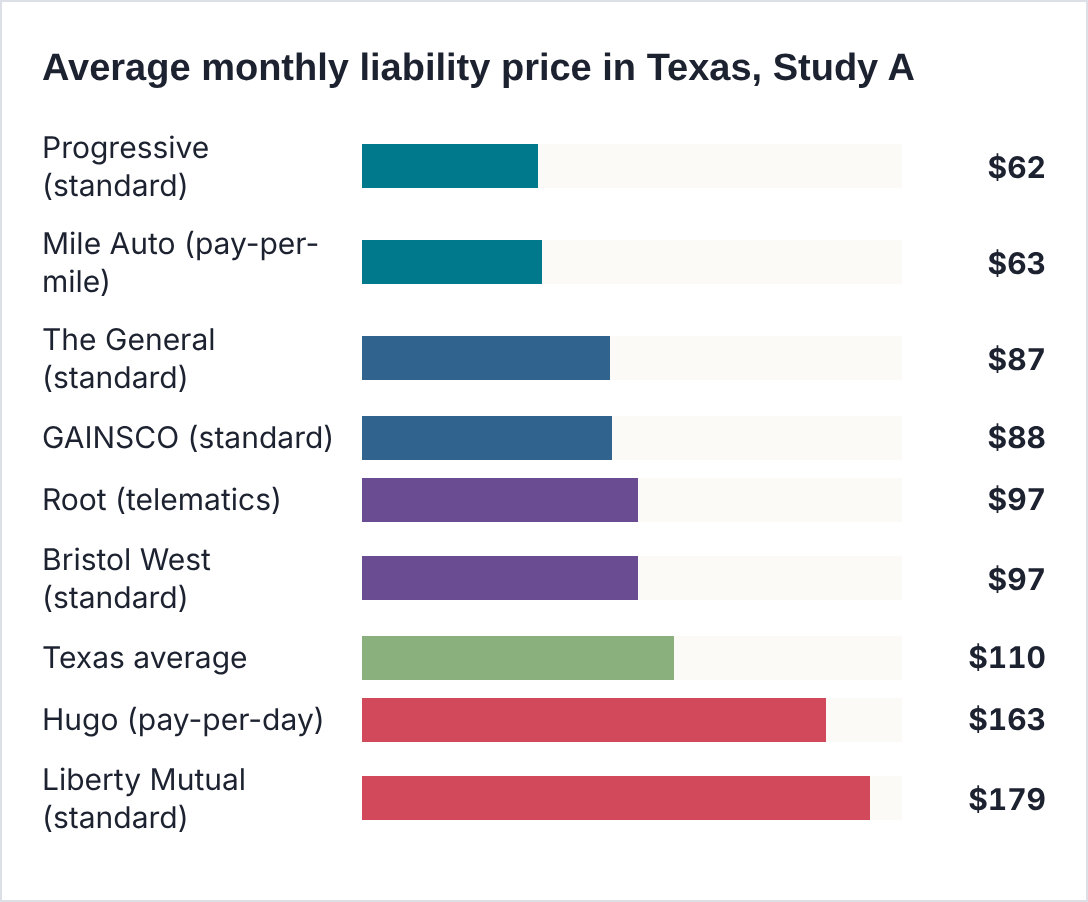
Study A, a Texas rate study updated September 30, 2026, found Mile Auto's average liability price at $63 a month, among the lowest of 33 companies and well below the $110 state average. Keep the context in mind: pay-per-mile buyers tend to drive less than average, so their averages naturally run lower. Progressive, a standard insurer, averaged almost the same at $62.

Nationwide SmartMiles
SmartMiles is available in Texas; Nationwide's own page excludes only Alaska, Hawaii, Louisiana, Michigan, North Carolina, New York, and Oklahoma. Your bill is a base premium plus a per-mile rate times last month's miles, and only the first 250 miles in a day count, so a road trip to Big Bend will not blow up your bill. Drivers can earn a safe-driving discount of up to 10%, first applied at renewal.
A 2025 review collected real quotes in Austin: a base of about $984 a year plus 5.5 cents a mile. For six months of full coverage, that worked out to about $630 for a driver covering 5,000 miles a year and $768 at 10,000 miles, compared with $900 for a standard policy. A 2025 report also cited Nationwide's figure that the average SmartMiles driver saved 33% between March 2023 and April 2024.
Lemonade Car
Lemonade, which absorbed Metromile in 2022, lists Texas among its pay-per-mile states, along with Arizona, Colorado, Illinois, Indiana, Ohio, Oregon, Tennessee, and Washington. Its price is a base rate plus miles times a per-mile rate, tracked through your phone, though Lemonade does not publish dollar amounts. One unusual feature: Tesla owners who use Full Self-Driving can get those miles at a 50% discount, measured through Tesla's data connection.
Allstate Milewise
Milewise charges a daily base rate plus a per-mile rate; one commonly cited example is $1.50 a day plus 6 cents a mile. It uses a plug-in device and an app. Reviews list Texas among its roughly 22 states, but the most detailed list we found dates to 2023, and Allstate's own page could not be checked, so confirm with a quote. That older review put Texas Milewise averages at $49 a month for liability and $79 for full coverage.
Mile Auto
Mile Auto skips devices and apps entirely. Each month, you photograph your odometer, and your bill is a base rate plus your miles times a per-mile rate, with one 2026 review citing about $48 a month plus 8 cents a mile. That review lists Texas among Mile Auto's seven states. Send each photo on time: a 2024 firsthand review in another state reported that late photos are billed as if you drove 75 miles a day.
USAA SafePilot Miles and Hugo
USAA's Texas page describes SafePilot Miles, which combines a fixed rate with a monthly mileage adjustment and promises up to 20% savings for low mileage, but a footnote says it is "only available in select states." If your phone app goes offline for three or more days, USAA bills 50 miles a day. Military families should ask USAA directly whether it is offered at their Texas address.
Hugo sells pay-by-the-day coverage in short blocks of 3, 7, 14, or 30 days. Sources disagree on Texas: a June 2026 competitor review said Hugo does not sell here, while an November 2026 report said Hugo added a carrier partner in Texas and Florida, and Study A listed a Texas Hugo average of $163 a month. Get a quote before counting on it.
The cheapest pay as you go car insurance company in Texas
Based on the most recent published Texas data, Mile Auto is the cheapest pay-per-mile company in Texas. In Study A, updated September 30, 2026, its Texas customers paid an average of $63 a month for liability coverage, 43% less than the $110 state average (our calculation), and less than every pay-as-you-go rival with a published Texas average.
Cheapest pay as you go options in Texas, ranked
Rank | Company | Type | Texas price | Data |
|---|---|---|---|---|
1 | Mile Auto | Pay-per-mile | $63 a month, liability | Study A, September 30, 2026 |
2 | Allstate Milewise | Pay-per-mile | $49 liability; $79 full coverage | 2023 review; likely out of date |
3 | Nationwide SmartMiles | Pay-per-mile | About $82 a month base plus 5.5 cents a mile, full coverage | 2025 Austin quote |
4 | Lemonade Car | Pay-per-mile | Not published | Get a quote |
5 | Hugo | Pay-per-day | $163 a month, liability | Study A; Texas availability unconfirmed |
Study A: Texas rate study updated September 30, 2026, based on quotes from the publisher's users. SmartMiles monthly base is our calculation from a $984 yearly base. Prices are averages or examples, not quotes, and are not directly comparable across sources.
Allstate Milewise posted even lower numbers, $49 a month for liability, but those figures come from a 2023 review, before several years of Texas rate changes, so we rank it second until newer data appears.
Nationwide SmartMiles is the best value for full coverage among programs with Texas pricing: in the 2025 Austin example, a driver covering 5,000 miles a year paid about $1,260 for full coverage, $540 less than a standard policy. Lemonade does not publish Texas prices, so it can only be judged with a quote.
The cheapest company for you depends on your miles, your record, and your ZIP code. Mile Auto's low average reflects buyers who drive little, and its roughly 8-cent per-mile rate costs more per mile than the 5.5 cents in the SmartMiles example, so higher-mileage drivers may find SmartMiles cheaper. Get quotes from at least two pay-per-mile companies and one standard insurer, such as Progressive, which averaged $62 a month for Texas liability coverage in Study A.
How much can you save with pay-per-mile in Texas?
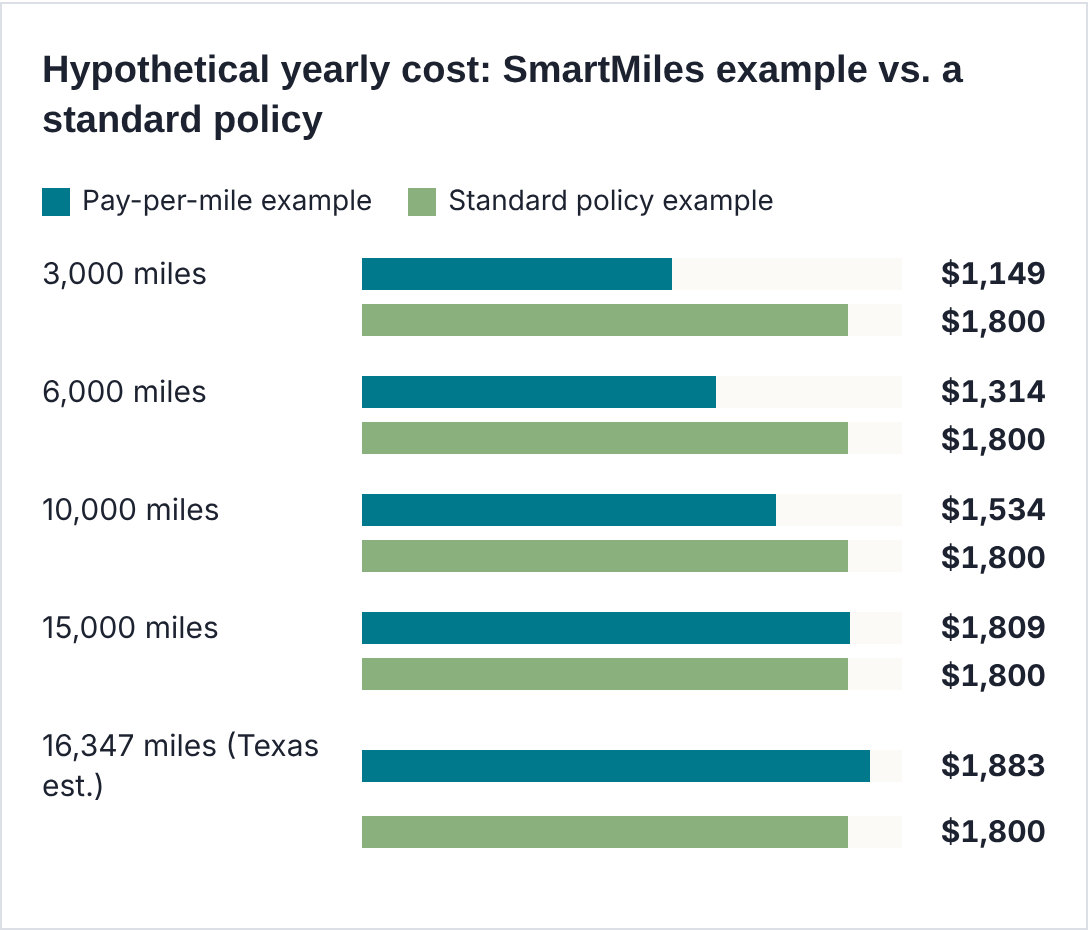
Savings depend almost entirely on your mileage. Using the 2025 Austin SmartMiles quote, a base of $984 a year plus 5.5 cents a mile, we compared the yearly cost at different mileages with the $1,800 a year implied by that review's standard full coverage quote. These are hypothetical figures for one driver and ZIP code, not offers.
Hypothetical savings by yearly mileage (our calculation)
Miles a year | Pay-per-mile cost | vs. $1,800 standard |
|---|---|---|
3,000 | $1,149 | Saves $651 |
6,000 | $1,314 | Saves $486 |
10,000 | $1,534 | Saves $266 |
14,800 (break-even) | About $1,798 | About even |
16,347 (Texas estimate) | $1,883 | Costs $83 more |
In this example, pay-per-mile beat the standard policy up to about 14,800 miles a year. Federal highway data cited by the Texas Department of Insurance puts the national average at 13,476 miles, and one analysis of federal data put the average Texas driver at about 16,347 miles, though that figure is only partly verified. Either way, a typical Texas commuter is near or above the break-even point, while retirees, remote workers, and two-car households with a little-used second car are often well below it.
Four Texas drivers, four results
Hypothetical Texas drivers (our calculation)
Driver | Miles a year | Pay-per-mile cost | Result vs. $1,800 |
|---|---|---|---|
Retiree in San Antonio who drives to church and the store | 4,000 | $1,204 | Saves about $596 |
Remote worker in Austin | 7,000 | $1,369 | Saves about $431 |
Dallas commuter with a 20-mile trip each way | 13,000 | $1,699 | Saves about $101 |
Rural driver in West Texas | 22,000 | $2,194 | Costs about $394 more |
Hypothetical drivers using the same $984 base and 5.5 cents a mile from a 2025 Austin quote. Real base rates vary by city, record, and car; Houston and Dallas base rates are typically higher than Austin's.
Big-city Texas vs. the rest of the state
Where you live changes the math. In Study B, a national rate study updated November 3, 2026, full coverage averaged $270 a month in Houston and $275 in Dallas, so the base rate alone is higher there. But short city commutes keep mileage down. Rural Texans face lower base rates and much longer drives to work, school, and stores, so a standard policy or a safe-driving discount usually fits them better.
What Texas car insurance costs without pay-as-you-go
To judge any pay-as-you-go quote, compare it with standard prices. Rate studies differ widely, so we name each one. Study A found a Texas average of $110 a month for liability and $204 for full coverage. Study B, which prices a 30-year-old man with a 2018 Honda Civic, found $87 for minimum coverage and $247 for full coverage, with State Farm the cheapest company open to everyone at $56 and $140.
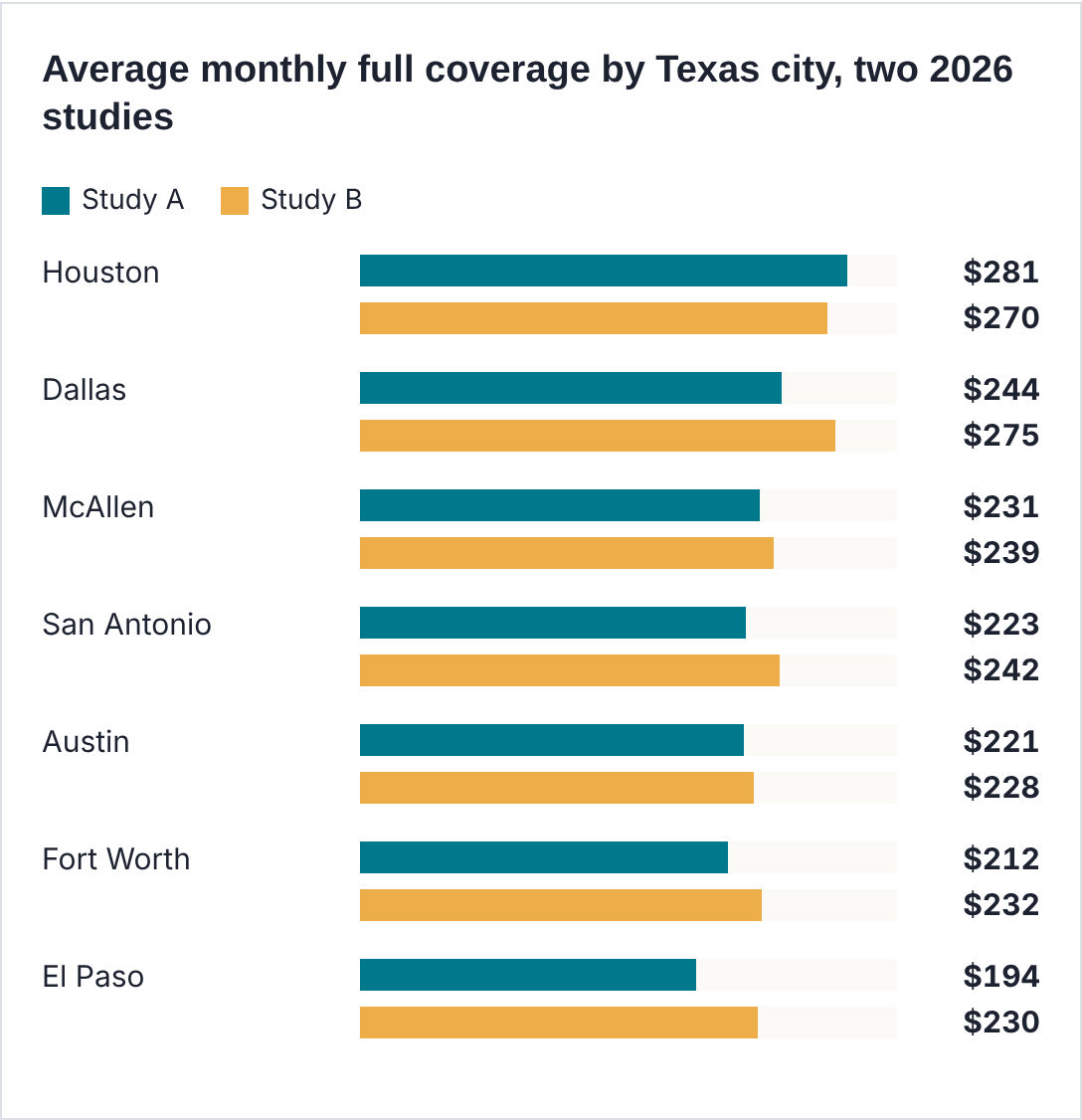
Cheapest companies in Texas, Study B (monthly)
Driver | Cheapest overall | Cheapest open to everyone |
|---|---|---|
Minimum coverage | USAA*, $46 | State Farm, $56 |
Full coverage | USAA*, $124 | State Farm, $140 |
18-year-old, full coverage | USAA*, $296 | GEICO, $390 |
After an accident, full coverage | State Farm, $163 | State Farm, $163 |
After a DUI, full coverage | State Farm, $142 | State Farm, $142 |
Poor credit, full coverage | USAA*, $194 | AAA, $337 |
Study B: national rate study updated November , 2026. *USAA is available only to military members, veterans, and their families. Texas Farm Bureau, which another 2026 study found cheapest for some drivers, typically requires a county membership with dues that vary.
Prices have also stabilized. According to the Texas Department of Insurance, statewide auto rates rose 4.8% in 2024 and just 0.9% in 2025, and in November 2026 the department said rate decreases filed since July 1 would affect 4.4 million Texas policyholders. That makes 2026 a good year to shop, whether you choose pay-per-mile or a standard policy.
Who insures Texas drivers
Largest Texas auto insurers, 2025
Rank | Insurer group | Texas market share |
|---|---|---|
1 | Progressive | 23.21% |
2 | State Farm | 17.85% |
3 | Allstate | 10.47% |
4 | Berkshire Hathaway (GEICO) | 10.33% |
5 | USAA* | 8.88% |
6 | Farmers | 5.21% |
7 | Texas Farm Bureau | 3.05% |
Texas Department of Insurance, 2025 private passenger auto report. Texans paid $35.42 billion in auto premiums in 2025. Of these groups, only Allstate sells a pay-per-mile program, Milewise; the others rely on telematics discounts.
When a standard policy is the better deal
If you drive more than about 15,000 miles a year, have a long commute, or take frequent highway trips, a standard policy with a safe-driving discount will usually cost less than pay-per-mile. The same is true if you have a spotless record and qualify for a low-cost standard insurer's best tier, since the base rate on a pay-per-mile policy can be close to a full standard premium.
Low-down-payment and monthly plans in Texas
Many Texans who search for pay as you go insurance really want a low first payment and monthly bills. That is a payment plan, not a usage-based price, and it does not lower your total cost. In Study A's Texas data, some of the cheapest liability options among companies that cater to low-deposit buyers were The General at $87 a month, GAINSCO at $88, Bristol West at $97, Dairyland at $103, and Direct Auto at $108.
Texas has long required insurers in the standard market to offer monthly installment plans with capped down payments; an insurance agents' association summary of the state rule cites a down payment cap of 16.66% of the premium, about two months, on a 12-month policy. That summary is older, so confirm the current terms with your insurer. Ask whether installment fees apply, because a few dollars a month adds up over a year, and check whether paying in full earns a discount.
PRO TIP #1
Before choosing a low-down-payment plan, ask for the total 6-month or 12-month cost including fees. A policy with a $0 or tiny first payment can still cost more over the year than one with a normal down payment and a pay-in-full discount.
Texas law: when your car must be insured
Texas rules differ from states like New York and Georgia in one important way. Texas Transportation Code Section 601.051 says a person "may not operate a motor vehicle in this state unless financial responsibility is established for that vehicle." The requirement is tied to driving. When you register or renew, the county must see proof of insurance and must tell you the car may not be driven unless coverage stays in effect.
We found no Texas rule that fines a car owner for a gap in coverage on a registered car that is not being driven, the way New York and Georgia do. That makes pay-per-mile and seasonal coverage changes less risky here. But you still need valid proof of insurance to renew your registration, and the state's TexasSure database lets police and courts check coverage instantly, so never drive a car whose coverage has ended.
Texas car insurance rules every pay-as-you-go driver should know
Rule | Details |
|---|---|
Minimum liability | $30,000 per person; $60,000 per accident for injuries; $25,000 property damage (30/60/25) |
Personal injury protection | Included at $2,500 unless you reject it in writing |
Uninsured motorist | Must be offered; included unless you reject it in writing |
Insurance verification | TexasSure database used by police, courts, and registration offices |
Proof at registration | Required to register or renew |
Vehicle inspections | Safety inspections for most passenger cars ended January 1, 2025; emissions tests continue in 17 counties |
Texas Department of Insurance consumer guide (updated December 11, 2025); Office of Public Insurance Counsel; Texas Transportation Code Sections 502.046 and 601.051; TxDMV (accessed November 11, 2026).
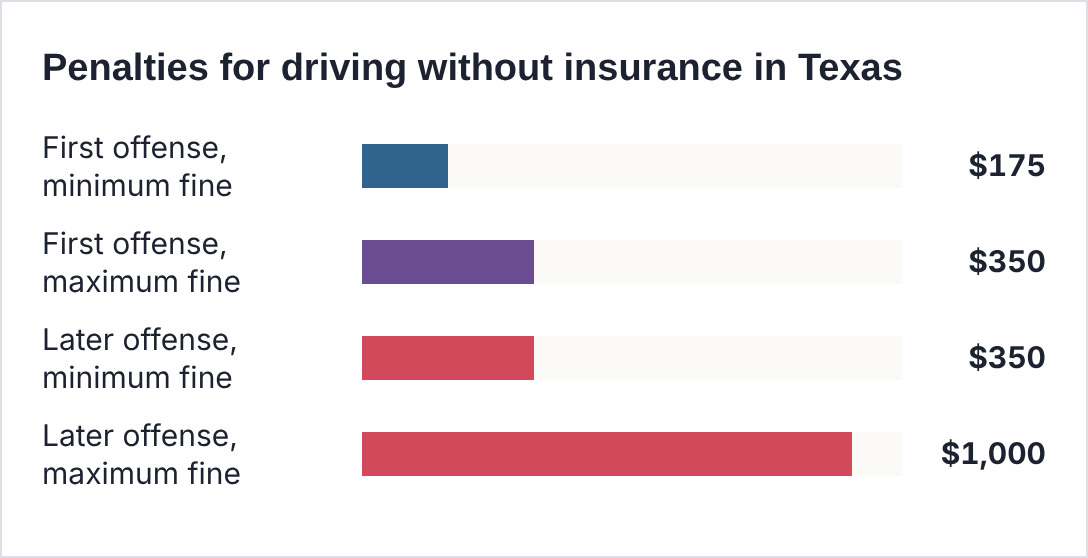
Driving uninsured is common enough that it matters for every Texan. TxDMV estimated that 11.87% of Texas drivers were uninsured as of September 2025, and the Insurance Research Council put the rate at 14.5% for 2023. That is a good reason to keep uninsured motorist coverage rather than rejecting it, whatever kind of policy you buy.
Driving-behavior discounts in Texas
If pay-per-mile does not fit, a usage-based program can reward safe driving no matter how far you go. Texas has no special rules limiting these programs, so whether your rate can rise depends on the insurer.
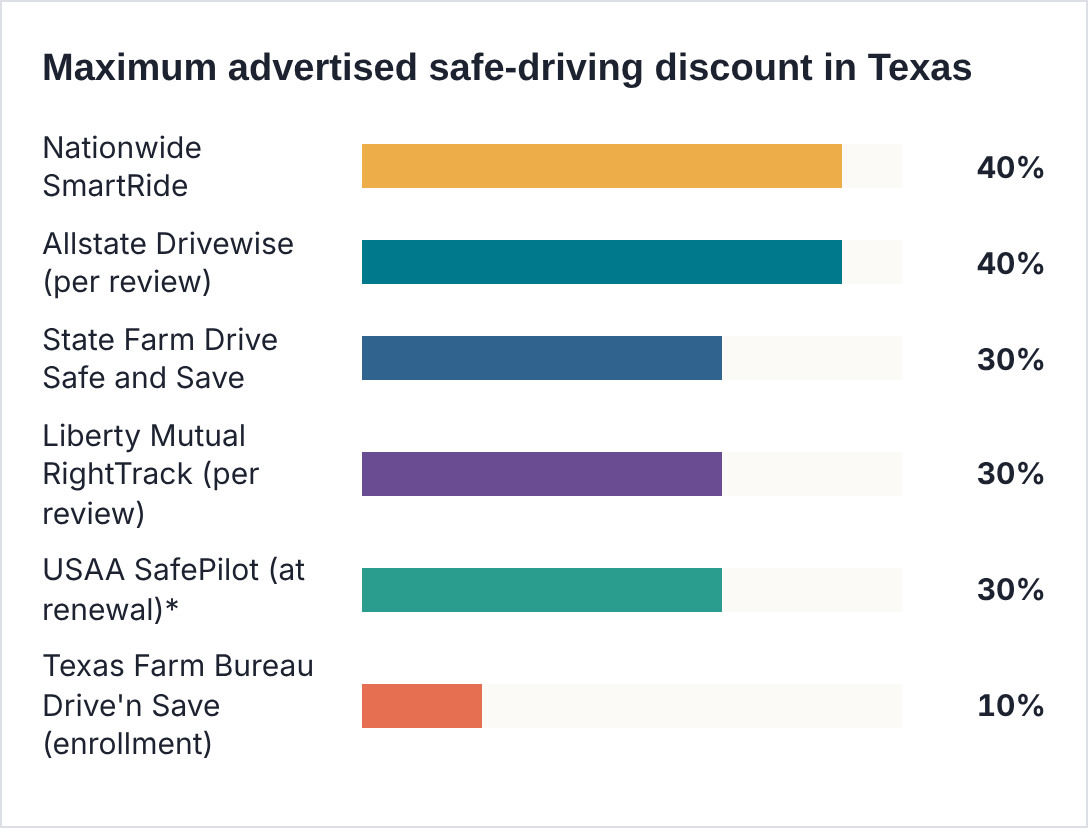
Telematics programs available to Texas drivers
Program | Maximum savings | Can your rate go up? |
|---|---|---|
Nationwide SmartRide | Up to 40% | No, according to Nationwide |
State Farm Drive Safe and Save | Up to 30% | No surcharge, but the discount can fall to $0 |
Progressive Snapshot | Average $328 at renewal | Yes, for about 2 in 10 drivers |
Allstate Drivewise | Up to 40% (per review) | Yes, for risky driving |
GEICO DriveEasy | Not published | Rates "generally will vary" |
Liberty Mutual RightTrack | Up to 30% (per review) | No, according to reviews |
USAA SafePilot* | Up to 15% to enroll; 30% at renewal | Possible for some new enrollees from November 2026 |
Texas Farm Bureau Drive'n Save | 10% for enrolling | Not stated |
Root | Price set by a 30-day test drive | Price depends on test drive |
Company pages and 2023 to 2026 reviews (accessed November 11, 2026). Travelers IntelliDrive is not offered to new Texas customers. *USAA is available only to military members, veterans, and their families.
Pay-per-mile vs. telematics vs. a low-mileage rating
Three ways Texas drivers can pay less
Feature | Pay-per-mile | Behavior telematics | Low-mileage rating |
|---|---|---|---|
What lowers your bill | Fewer miles | Safe driving habits | Low estimated annual miles |
Best for | Under about 10,000 to 15,000 miles a year | Careful drivers at any mileage | Light drivers who do not want tracking |
Tracking | Device, app, or odometer photo | App or device | Odometer readings or your estimate |
Bill changes monthly? | Yes | No; discount set at renewal | No |
Defensive driving and other Texas discounts
Texas regulates a six-hour driving safety course that many insurers reward with a discount, but the state does not set the amount; each company decides, so ask your insurer before you enroll. The Texas Department of Insurance also lists discounts for anti-theft devices, airbags, anti-lock brakes, multiple cars, bundling, and a clean record. A 2025 Texas law, effective January 1, 2026, requires insurers to refresh credit-based insurance scores periodically, which can help drivers whose credit has improved.
Who benefits from pay as you go car insurance in Texas
Is pay-as-you-go right for you?
Driver | Good fit? | Best option |
|---|---|---|
Retiree or remote worker under 8,000 miles a year | Yes | Pay-per-mile (SmartMiles, Lemonade, Milewise, or Mile Auto) |
Two-car household with a rarely used second car | Yes | Pay-per-mile on the second car |
City commuter with a short drive | Often | Compare pay-per-mile and telematics |
Long-distance commuter or rural driver | No | Standard policy plus telematics |
Driver who needs a low first payment | Maybe | Monthly installment plan; compare total cost |
Rideshare or delivery driver | Usually no | Standard policy with a rideshare endorsement |
Pros and cons of pay as you go car insurance in Texas
Pros and cons
Pros | Cons |
|---|---|
Low-mileage drivers can save hundreds a year | Long Texas commutes can erase the savings |
Four pay-per-mile programs sell in Texas | Bills change month to month |
Texas ties insurance to driving, not parked cars | Tracking devices, apps, or photos are required |
Daily mileage caps protect road trips (SmartMiles) | Base rates in Houston and Dallas are high |
Works with full coverage for financed cars | Fewer discounts and agents than standard insurers |
Privacy: device, app, or photo?
The Texas Department of Insurance suggests asking what data a program collects, how it is used, and who it is shared with. Mile Auto's odometer photos collect the least data. Device and app programs may record speed, braking, location, and time of day, even when your price is based only on miles.
Road trips and driving out of state
Texas is big, and a single trip can add hundreds of miles. SmartMiles counts only the first 250 miles in a day, and Milewise has a daily cap in most states. Check the cap before a long drive, and remember that your coverage follows you to other states.
Full coverage, loans, and leases
Pay-per-mile policies can include collision and comprehensive, so they work for financed and leased cars. Hail is a major Texas risk, and comprehensive coverage is what pays for hail damage, so do not drop it to save money if your car is worth repairing.
How to switch without a gap
Start the new policy before you cancel the old one, and make sure the new insurer's coverage appears in TexasSure. A gap does not trigger a fine on a parked car in Texas, but driving even one day without coverage can.
How to get pay as you go car insurance in Texas
- Check your real annual mileage using two odometer readings or service records.
- Get pay-per-mile quotes from Nationwide SmartMiles and Lemonade, and ask Allstate and Mile Auto whether they cover your ZIP code.
- Get at least two standard quotes with the same limits, plus a telematics discount quote.
- Compare the yearly total, including base rate, per-mile charges, and fees.
- Ask about daily mileage caps, tracking method, and what happens if the device or app disconnects.
- Start the new policy before canceling the old one.
Questions to ask before you buy
- What is my base rate and per-mile rate, and are they fixed for the policy term?
- Is there a daily cap on counted miles?
- What happens if I miss an odometer photo or the device disconnects?
- Can my rate go up because of how I drive?
- Are there monthly fees beyond the base and per-mile charges?
PRO TIP #2
Track your miles for one normal month before buying. Multiply by 12, and if the total is well under 14,000 miles a year, pay-per-mile is worth a quote; if it is above 16,000, focus on standard insurers and safe-driving discounts.
Pay as you go car insurance in Texas at a glance
This illustrated summary pulls together the main points of this guide.
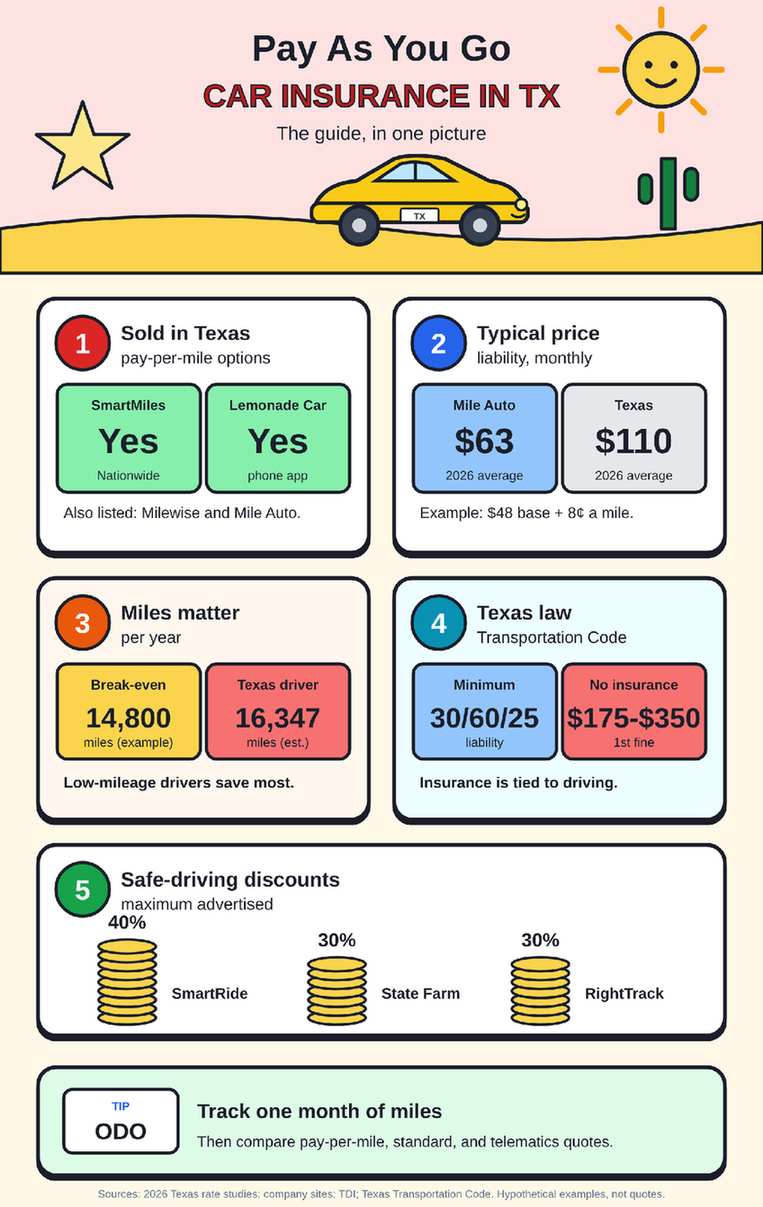
Frequently asked questions
Is pay-per-mile insurance available in Texas?
Yes. Nationwide SmartMiles and Lemonade Car confirm Texas on their own pages, and 2026 reviews list Allstate Milewise and Mile Auto in Texas too. Metromile and Noblr are no longer options. Availability can vary by ZIP code, so confirm with a quote.
How much does pay-per-mile insurance cost in Texas?
In Study A, Mile Auto averaged $63 a month for liability coverage, against a $110 Texas average. A 2025 Austin SmartMiles quote was about $984 a year plus 5.5 cents a mile for full coverage. Your price depends on your base rate and miles.
What is the cheapest pay as you go car insurance company in Texas?
Mile Auto, based on the latest published data. In Study A, updated September 30, 2026, it averaged $63 a month for Texas liability coverage, against a $110 state average. Allstate Milewise showed lower prices in a 2023 review, but that data is older, and Nationwide SmartMiles may be cheaper for higher-mileage drivers.
How many miles make pay-per-mile worth it in Texas?
In our example based on a 2025 Austin quote, pay-per-mile beat a standard policy up to about 14,800 miles a year. Drivers under 10,000 miles saved the most. One analysis estimates the average Texas driver covers about 16,347 miles, above that break-even point.
Do I need insurance on a parked car in Texas?
Texas law requires insurance to operate a vehicle, and we found no fine for a coverage gap on a car that is not driven. But you need proof of insurance to register or renew, and driving even once without coverage risks a fine of $175 to $350. Keep comprehensive coverage if hail or theft could damage the car.
Is Metromile available in Texas?
No. Metromile never sold in Texas, and it became part of Lemonade in 2022. Lemonade Car now sells pay-per-mile coverage in Texas, so Texans who wanted Metromile can get a Lemonade quote instead.
Does Hugo sell pay-per-day insurance in Texas?
Sources disagree. A June 2026 review said Hugo does not cover Texas, while an November 2026 report said it added a Texas carrier partner, and one rate study listed a $163 monthly Hugo average. Get a quote to confirm before relying on it.
What is the cheapest car insurance in Texas?
In Study B, State Farm was the cheapest company open to everyone, at $56 a month for minimum coverage and $140 for full coverage; USAA was lower for military families. In Study A, Progressive and Mile Auto had the lowest liability averages, at $62 and $63.
What is the minimum car insurance in Texas?
Texas requires 30/60/25 liability: $30,000 per person and $60,000 per accident for injuries, and $25,000 for property damage. Personal injury protection of $2,500 and uninsured motorist coverage are included unless you reject them in writing.
The final word on pay as you go car insurance in Texas
Pay as you go car insurance in Texas is a real option, not just a sales phrase. Nationwide SmartMiles and Lemonade Car confirm Texas coverage; Allstate Milewise and Mile Auto are listed by reviews, and Texas law ties the insurance requirement to driving, which makes per-mile coverage simpler here than in many states. For retirees, remote workers, and owners of a rarely used second car, the savings can reach several hundred dollars a year.
The catch is mileage. Many Texans drive more than the roughly 14,800-mile break-even point in our example, and for them, a standard policy with a safe-driving discount from State Farm, Progressive, Nationwide, or another insurer will usually cost less. Check your real miles, compare pay-per-mile and standard quotes side by side, and choose based on total yearly cost.
NEXT STEP
Record your mileage for one month, then get quotes from SmartMiles, Lemonade, and at least two standard insurers with the same coverage, and compare the full yearly cost before you switch.
Prices, program availability, discounts, and laws change and vary by driver, vehicle, and ZIP code. The figures in this article are published averages, official rules, and our calculations, not quotes or offers. This article is for information only and is not legal or financial advice. The publisher is not an insurance company or a licensed insurance agency.
The bottom line on pay as you go car insurance in Texas: if you drive well under about 14,000 miles a year, get a pay-per-mile quote; if you drive more, let a safe-driving discount do the saving.
Sources
- Texas Department of Insurance, usage-based insurance tips (November 3, 2025); TDI auto insurance guide (December 11, 2025); TDI, rate changes (January 22, 2026); TDI, auto rate decreases (November 8, 2026); TDI 2025 auto line report.
- Nationwide, SmartMiles and SmartRide; Lemonade, pay-per-mile car insurance (June 25, 2026); USAA, Texas auto insurance (accessed November 11, 2026).
- Insurify, Texas no-deposit car insurance (September 30, 2026); Insurify, Mile Auto (November 3, 2026); Insurify, Milewise (2023); Insurify, Texas average cost (November 1, 2026).
- ValuePenguin, SmartMiles review (July 8, 2025); ValuePenguin, Texas car insurance companies (November 3, 2026).
- State Farm, Texas discounts; Progressive, Snapshot; GEICO, DriveEasy; Travelers, IntelliDrive; Texas Farm Bureau, Drive'n Save (March 30, 2023).
- Texas Transportation Code 601.051, 601.191, and 502.046; TxDMV, TexasSure; Texas DPS, SR-22.
- Insurance Information Institute, uninsured motorists; CarInsurance.com, miles driven by state (July 26, 2024); IIAT, Texas monthly installment rule.
- TDI Bulletin B-0012-25, 2025 legislation (August 5, 2025); BikePortland, MileMeter in Texas (2008).