
California Low Income Car Insurance: CLCA Costs & Eligibility
Editorial team · Fact-checked against official program guidance: November 17, 2026
For eligible California drivers, the California Low Cost Automobile Insurance (CLCA) Program offers a way to satisfy the state’s insurance requirement without purchasing a standard policy. The published base liability premium ranges from $199 to $418 per year by county for adults without age or driving-experience surcharges; additional charges can apply. California reported 66,998 active CLCA policies as of December 31, 2025. A low premium matters, but the unusually low coverage limits also matter.
This guide relies chiefly on the California Department of Insurance’s March 2026 report (covering 2025 program activity), the current CLCA administrator FAQ, and the federal 2026 poverty guidelines. It explains the income limits, county-based base premiums, potential surcharges, installment fees, application steps, and the risks of a 10/20/3 liability policy.
KEY TAKEAWAYS
- CLCA base liability premiums range from $199 to $418 per year by county under the schedule effective May 1, 2025. Driver surcharges and installment fees can raise the total.
- The 2026 income cap is $39,900 for a one-person household and $82,500 for a four-person household; a car must be worth $25,000 or less.
- CLCA provides just 10/20/3 liability with limited optional medical payments and uninsured motorist benefits. It does not include collision or comprehensive insurance.
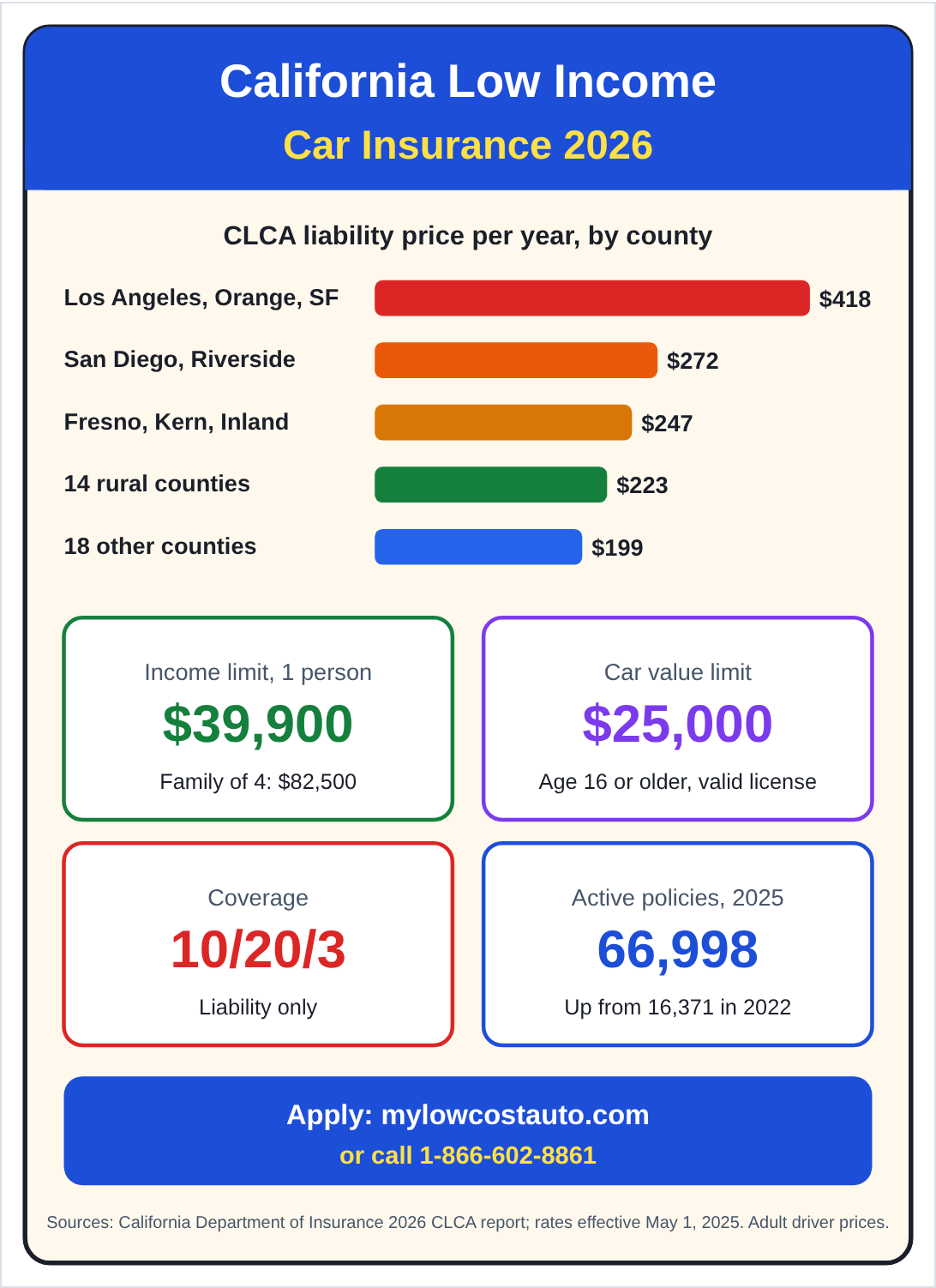
California Low Cost Automobile Insurance prices by county tier, with 2026 eligibility limits and enrollment. Prices are for adult drivers before optional coverage.
What is California low income car insurance?
California low income car insurance usually means the California Low Cost Automobile Insurance Program. The Legislature created it in 1999, piloted it in Los Angeles and San Francisco counties in 2000, and expanded it to all 58 counties in April 2006. It was set to end in 2025, but a 2023 law, AB 917, removed the end date, so the program is now permanent.
The California Department of Insurance oversees CLCA, while the California Automobile Assigned Risk Plan (CAARP) administers applications and assigns policies to authorized insurers. The 2026 report identified approximately 1,672 CAARP-certified producers as of January 2026. Applicants do not choose an insurer in the usual way. A valid California driver’s license, including an eligible AB 60 license, can satisfy the licensing requirement; immigration status alone is not a disqualifier. A separate Spanish-language explanation of passport-based insurance questions covers other documentation situations; a passport by itself does not satisfy CLCA’s California-license requirement.

Who qualifies for CLCA
You must meet every rule below. The program is designed for good drivers with low incomes and older, inexpensive cars. For distinctions between ordinary auto policies and the licensing requirement, see the Spanish-language discussion of insurance options for drivers without a standard license; CLCA itself still requires a valid California license.
CLCA eligibility rules in 2026
| Rule | Requirement |
|---|---|
| Age | 16 or older; under 18 must be emancipated |
| License | A valid California driver’s license |
| Income | At or below 250% of the federal poverty level |
| Car value | $25,000 or less |
| Driving record, last 3 years | No more than one at-fault property-damage accident or one point, not both |
| Injury accidents | No at-fault accident that caused injury or death |
| Convictions | No felony or misdemeanor Vehicle Code conviction |
| Use | Personal driving only; no rideshare or delivery work |
California Insurance Code section 11629.7 and following; California Department of Insurance 2026 CLCA legislative report (March 16, 2026).
Acceptable income evidence may include CalFresh, Medi-Cal, SSI, CalWORKs, tax returns, W-2 forms, payroll records, or other documents listed by the administrator. A Certification of Income Eligibility may be used when conventional proof is unavailable, subject to program review. Applicants with fewer than three years of verified driving experience may qualify but pay a surcharge. Household size follows the program’s tax-form-based definition, not simply the number of people who share an address.
2026 income limits for California low income car insurance
The income limit is 250% of the federal poverty guidelines, which the federal government updated on January 15, 2026. The table shows the yearly gross household income limits for 2026.
2026 CLCA income limits
| Household size | Yearly income limit |
|---|---|
| 1 | $39,900 |
| 2 | $54,100 |
| 3 | $68,300 |
| 4 | $82,500 |
| 5 | $96,700 |
| 6 | $110,900 |
| 7 | $125,100 |
| 8 | $139,300 |
| Each extra person | +$14,200 |
Our calculation: 250% of the 2026 federal poverty guidelines (Federal Register, January 15, 2026), matching figures published by three consumer sites. Confirm on mylowcostauto.com before you apply.
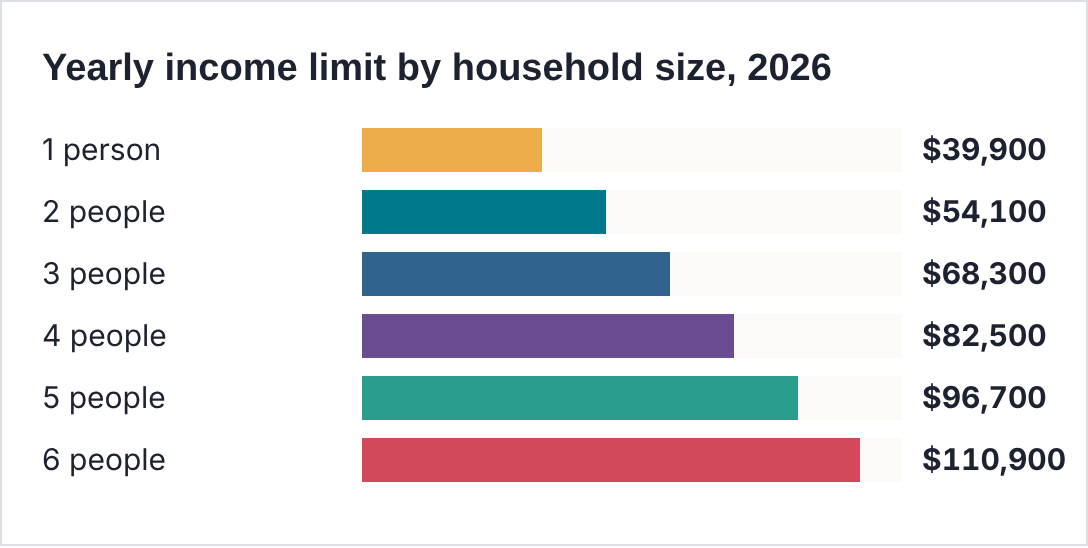
Our calculation is based on the 2026 federal poverty guidelines at 250%.
For example, a four-person household with $80,000 in gross yearly income falls below the published $82,500 income ceiling. Income alone does not establish eligibility: the driver must also meet licensing, driving-record, vehicle-value, and other program rules. Verify the household definition and required documents before applying.
What CLCA covers
A CLCA policy is liability insurance. It pays for injuries and damage you cause to other people, up to its limits. It does not repair or replace your own car, because there is no collision or comprehensive coverage.
CLCA limits vs. regular California minimums
| Coverage | CLCA policy | Regular minimum since 2025 | Regular minimum from 2035 |
|---|---|---|---|
| Injury to one person | $10,000 | $30,000 | $50,000 |
| Injury to all people in one crash | $20,000 | $60,000 | $100,000 |
| Property damage | $3,000 | $15,000 | $25,000 |
SB 1107 (Chapter 717, Statutes of 2022); California DMV; California Department of Insurance (July 23, 2024).
California raised its regular minimum limits to 30/60/15 on January 1, 2025, and they will rise again to 50/100/25 on January 1, 2035. The Department of Insurance confirmed in July 2024 that CLCA limits stay at 10/20/3, which the law treats as meeting the state’s insurance requirement for CLCA drivers.
Two optional benefits are available at extra cost: uninsured motorist bodily injury coverage with limits of $10,000 per person/$20,000 per accident, and medical payments coverage of $1,000 per person. Neither replaces collision or comprehensive insurance. The CLCA administrator lists an additional combined cost of approximately $38–$81 per year, depending on the county.
How much California low income car insurance costs
CLCA base premiums depend on the county and use the California Department of Insurance’s published rate schedule effective May 1, 2025. The $199–$418 figures below apply to base liability coverage before surcharges for younger or less-experienced drivers, optional benefits, and installment transaction fees. The program’s online calculator currently shows possible annual premiums as high as $986 for some driver profiles. Always use the official calculator for a personalized program estimate.
CLCA yearly prices by county tier
| Counties | Liability | Uninsured motorist | Medical payments |
|---|---|---|---|
| Los Angeles, Orange, San Francisco, Alameda, Santa Clara | $418 | $54 | $24 |
| San Diego, Riverside, Sacramento, Contra Costa, Marin, San Mateo, Solano, Ventura | $272 | $27 | $14 |
| Fresno, Kern, San Bernardino, Monterey, Napa, Placer, San Joaquin, San Luis Obispo, Santa Barbara, Santa Cruz, Sonoma, Stanislaus, Yolo | $247 | $32 | $19 |
| Alpine, Calaveras, Del Norte, Glenn, Inyo, Lassen, Mariposa, Modoc, Mono, Plumas, Sierra, Siskiyou, Trinity, Tuolumne | $223 | $35 | $15 |
| Amador, Butte, Colusa, El Dorado, Humboldt, Imperial, Kings, Lake, Madera, Mendocino, Merced, Nevada, San Benito, Shasta, Sutter, Tehama, Tulare, Yuba | $199 | $25 | $14 |
To compare regular-market context in cities within those county tiers, the site also has Spanish-language local analyses for Los Angeles auto insurance and San Jose auto insurance. Those separate-market comparisons use different profiles and must not be treated as CLCA prices.
Source: California Department of Insurance 2026 legislative report, county schedule effective May 1, 2025. Base liability rates for the indicated counties; additional charges may apply.
Los Angeles County’s $418 base liability premium is the equivalent of about $34.83 per month if the annual amount is simply divided by 12; CLCA is not a month-to-month policy. Adding both listed optional benefits brings that county’s base-policy subtotal to $496 a year, before any applicable driver surcharge or payment-plan fees. In a $199 county, the same addition totals $238. Those are premium comparisons, not guaranteed quotations.
The CDI rate schedule specifies a 25% surcharge for unmarried drivers ages 19–24, 55% for drivers with fewer than three years of verifiable driving history, and 120% for drivers ages 16–18. The report provides corresponding premium columns by county. Do not add these percentages together without an official quote, because the administrator determines the applicable driver category and calculation.
CLCA payment plans: down payment and installment fees
The official administrator offers payment in full or 20% down followed by seven installments. Each of the seven installment payments carries a $4 transaction fee, adding $28 to the stated premium if all seven scheduled installment payments are made. These amounts are examples for base liability premiums only, without add-ons or driver surcharges.
| Base annual premium | 20% initial payment | Each of seven subsequent payments* | Total including seven $4 fees |
|---|---|---|---|
| $199 | $39.80 | About $26.74 | $227 |
| $418 | $83.60 | About $51.77 | $446 |
*Illustrative calculation: 80% of the base premium split seven ways, then $4 added to each installment. Rounding, optional coverages, eligibility surcharges, and payment arrangements can change the exact schedule. See the official CLCA rate calculator.
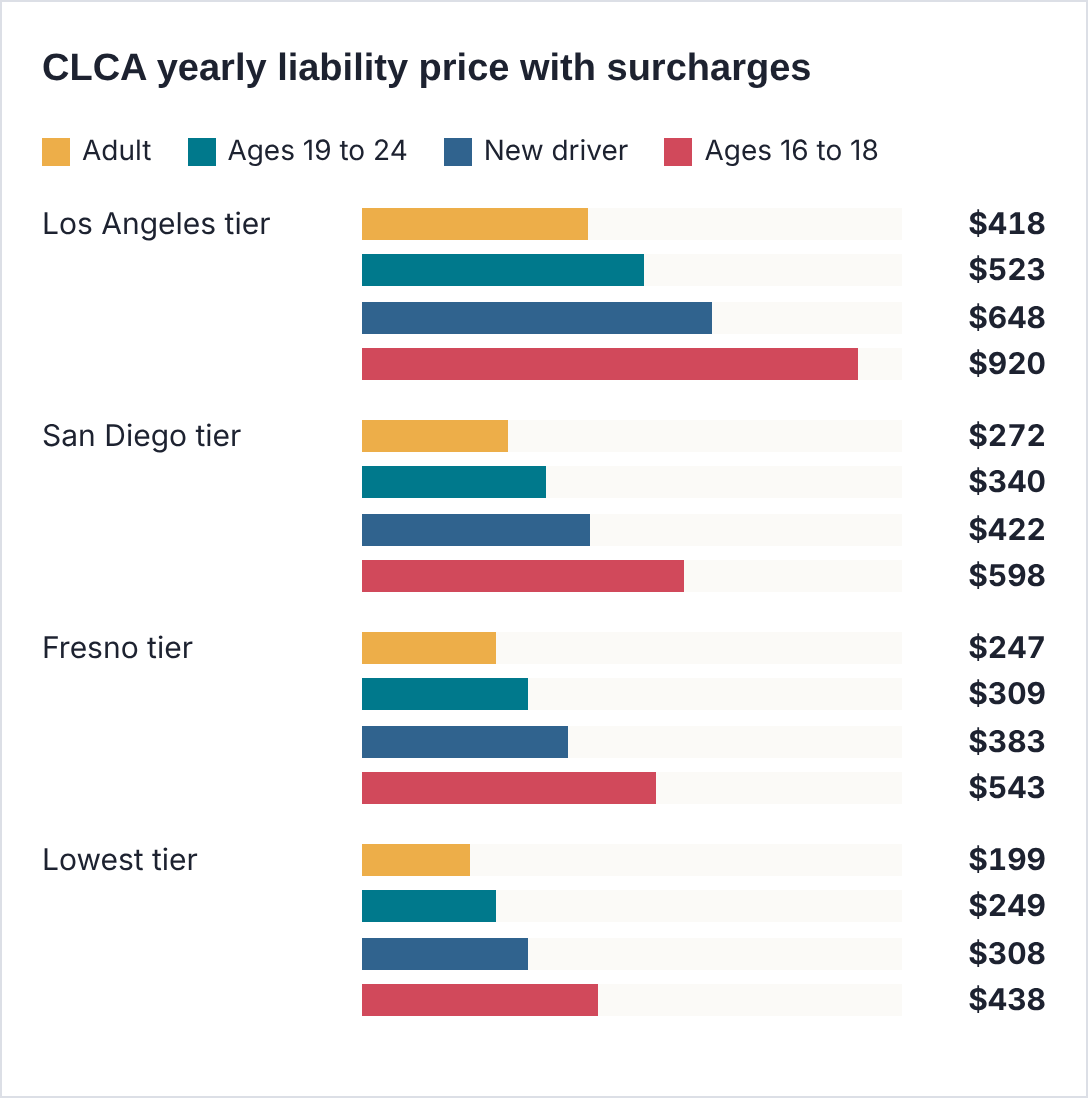
California Department of Insurance; rates effective May 1, 2025. Surcharges: 25% for unmarried drivers aged 19 to 24, 55% under three years of driving history, 120% for ages 16 to 18.
How to apply for CLCA
You can begin on the official website, by phone, or through a certified agent. The program offers an online application, but eligibility checks and document verification still apply; a completed web form does not itself bind insurance coverage. Follow these steps.
- Check your eligibility on mylowcostauto.com or by calling 1-866-602-8861.
- Gather your California driver’s license, vehicle registration, and proof of income, such as a CalFresh or Medi-Cal notice or a signed income certification.
- Choose a certified agent from the program’s list, or follow the online steps.
- Pick any optional coverage, such as uninsured motorist or medical payments.
- Pay in full or choose an installment plan, and keep your proof of insurance in the car.
PRO TIP #1
Only use mylowcostauto.com, the 1-866-602-8861 phone line, or a certified agent. If someone contacts you first and asks for a fee to enroll you, call the Department of Insurance hotline at 800-927-4357 before you pay.
CLCA is growing fast
Enrollment expanded substantially in recent years. The CDI reported 66,998 active policies as of December 31, 2025, rather than an estimate of how many low-income households are eligible. The report also states that many applicants previously had no insurance, but that alone cannot establish how much the program reduced California’s statewide uninsured rate.
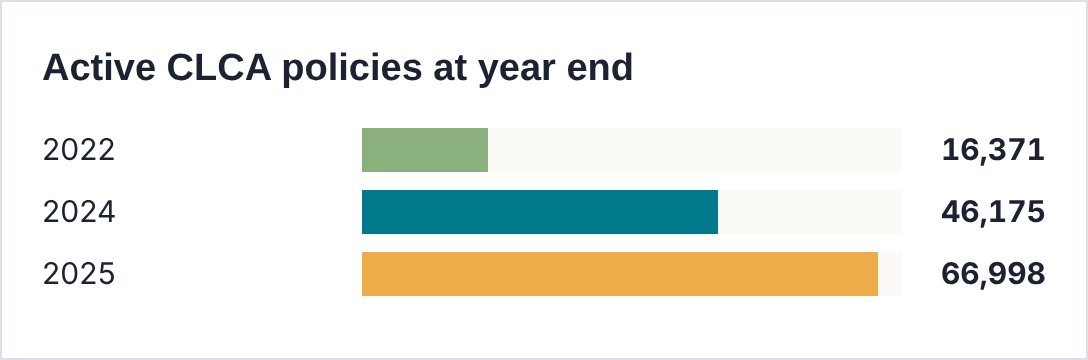
California Department of Insurance 2025 and 2026 CLCA legislative reports; Assembly analysis of AB 917 (April 2023).
According to CAARP data included in the 2026 CDI report, 77% of 2025 applicants were uninsured when applying. The program reported 364,851 drivers served since its 2000 launch and more than $18.7 million in claims payments during 2025. These are program activity figures; they are not estimates of how much an individual applicant would save.
California Department of Insurance 2026 CLCA legislative report (March 16, 2026).
CLCA vs. regular car insurance in California
CLCA’s low base price can be compelling, but comparing it against a regular car insurance quote requires care. Standard California minimum liability limits are 30/60/15, substantially higher than CLCA’s 10/20/3. Published insurer averages usually reflect different ZIP codes, driver profiles, and underwriting assumptions. They do not establish that a particular company will beat CLCA in your county. For a useful comparison, request a real quote at your own address and examine both price and coverage limits. A Spanish-language quote-preparation checklist explains what information to collect for that comparison.
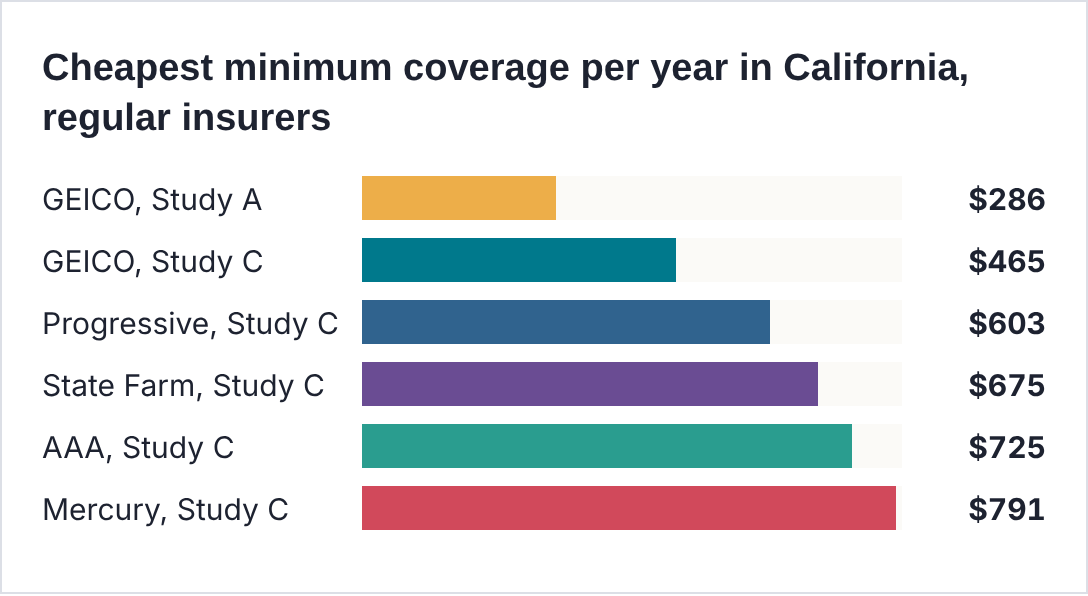
Study A: California rate study updated October 2, 2026 (median, 35-year-old good driver). Study C: California low-income rate study updated July 28, 2026. Averages, not quotes.
One 2026 California study reported a $286 annual GEICO minimum-coverage figure for its specified sample driver, which is less than the $418 CLCA base premium in the highest-priced county tier. But this is not a like-for-like Los Angeles quote: the study figure is a statewide estimate for a defined driver, and the regular policy has higher liability limits. It illustrates why comparing personalized standard-market offers can be worthwhile, not why GEICO must be cheaper for a particular CLCA applicant.
CLCA may still be attractive to younger or newer drivers who meet its conditions, but these drivers face program surcharges and can receive different standard-market quotes. For example, the CDI’s rate table lists $523 a year in base liability plus the youthful-driver surcharge for an unmarried driver aged 19–24 in the highest-price tier. Compare exact quotes with the same applicant details before drawing a conclusion.
Average car insurance cost in California, 2026
| Study | Liability or minimum | Full coverage |
|---|---|---|
| Study A (Oct. 2, 2026) | From $24 a month (GEICO) | $158 a month |
| Study B (Oct. 29, 2026) | $98 a month | $203 a month |
| Study C (Oct. 1, 2026) | $68 a month | $145 a month |
| CLCA, Los Angeles tier | About $35 a month | Not offered |
Study A: California rate study updated October 2, 2026. Study B: California quote analysis updated October 29, 2026. Study C: California rate study updated October 1, 2026. CLCA monthly figure is our calculation.
Cheapest regular insurers for low-income drivers
If you do not qualify for CLCA, or you want higher limits, these companies posted the lowest liability prices in Study B’s California data. A Spanish-language comparison of major U.S. auto insurers can help identify companies to quote, but the prices there are not CLCA program rates.
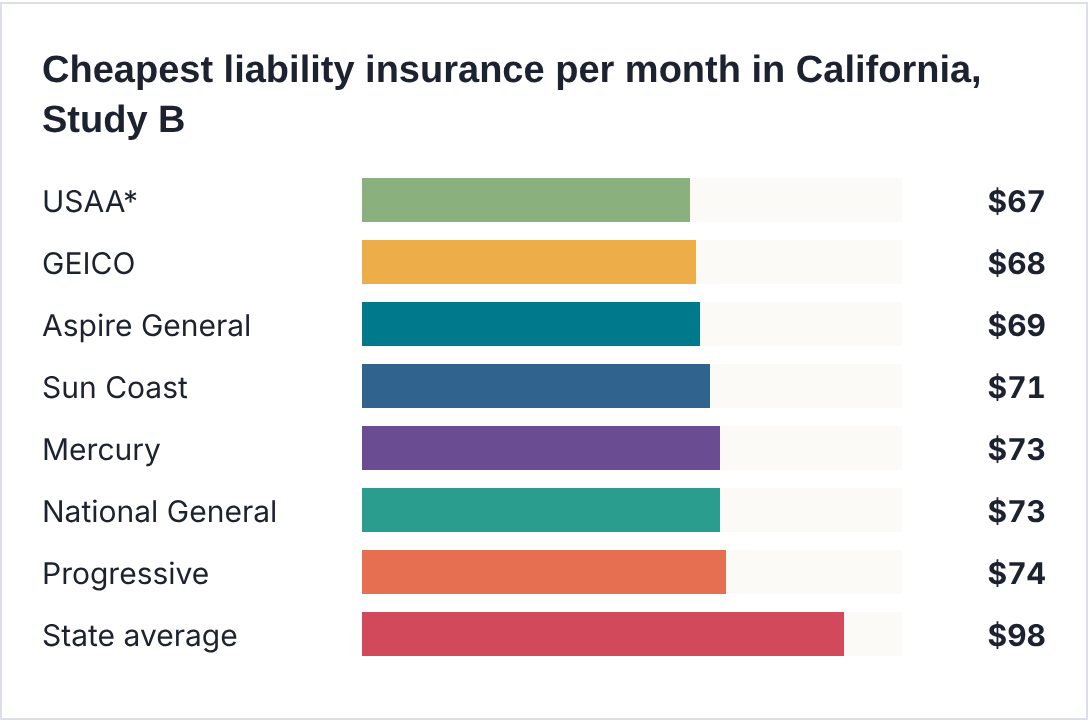
Study B: California quote analysis updated October 29 and October 21, 2026. *USAA is for military families only. Averages, not quotes.
Several 2026 rate studies list GEICO among competitive California insurers for some sample drivers, but the order changes by record and coverage level. For a speeding ticket, accident, or DUI, another insurer may price more favorably. A CLCA applicant should check at least one regular-market quote, especially when stronger limits matter, and avoid inferring personal savings from statewide medians. If you choose to compare private-market quotes, the site also explains how online car insurance quotes work (Spanish-language article).
California rules that protect low-income drivers
California has distinctive auto-insurance rating rules under Proposition 103, approved in 1988. The main mandatory rating factors are driving safety record, annual mileage, and years of driving experience, followed by approved optional factors. These rules regulate how premiums are calculated; they do not guarantee that every eligible driver will obtain a specific rate reduction.
California rules that can lower your rate
| Rule | What it means for you |
|---|---|
| Good Driver Discount | Qualifying Good Drivers receive rates at least 20% below non-Good Driver rates at the same insurer, not necessarily 20% off every quote |
| Driving record comes first | Insurers must weigh your record, then miles driven, then experience |
| No credit scores | Insurers cannot use your credit to set your auto rate |
| Prior insurance | California regulates the use of prior insurance history; confirm the relevant rule with the DOI |
| Mileage counts | Annual mileage is a required rating factor; any reduction depends on the insurer’s approved plan |
California Insurance Code section 1861.02 (Proposition 103); California Code of Regulations, title 10, section 2632.5; Experian (March 2025).
California prohibits the use of credit history as a private passenger auto-insurance rating factor. Annual mileage is a mandatory rating factor, so it is important to report your expected mileage accurately; that does not mean every driver automatically receives a separately labeled low-mileage discount. If you drive very little, compare a conventional insurer’s approved rating with any eligible mileage-based offering rather than assuming a pay-per-mile product will be cheaper.
PRO TIP #2
Give every insurer an accurate estimate of your annual mileage and ask how that amount affects its filed California rate. A lower mileage figure may reduce the quoted premium, but the result depends on the company’s approved rating plan.
The cost of driving uninsured in California
Important distinction: failing to show an insurance card at a traffic stop, driving while genuinely uninsured, and being involved in a reportable uninsured collision can result in different enforcement outcomes. Do not treat the maximum suspension in the table as an automatic penalty for every stop.
A 2023 estimate cited by the Insurance Research Council put California’s uninsured-motorist share at about 20.4%. That historical statewide estimate is separate from CLCA’s 2025 applicant statistics. Driving without the required proof of financial responsibility can lead to fines, vehicle-registration problems, and consequences after a crash.
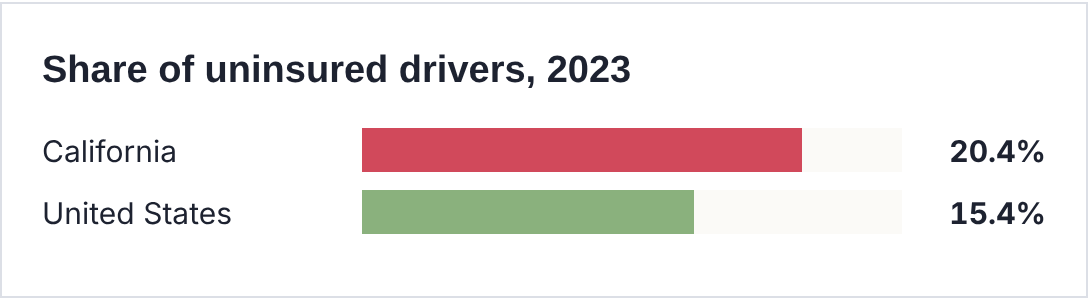
Insurance Research Council, 2023 data, the latest available.
Penalties for driving without insurance in California
| Penalty | Details |
|---|---|
| First offense fine | $100 to $200, plus penalty assessments |
| Repeat within three years | $200 to $500, plus penalty assessments |
| Vehicle impound | The court may order your car impounded |
| License suspension after a crash | Up to four years in certain uninsured-reportable-collision cases; reinstatement rules apply |
| SR-22 filing | May be required to reinstate driving privileges after certain uninsured-collision suspensions |
| Lost damages | Proposition 213 generally restricts non-economic damages for uninsured drivers, subject to legal exceptions |
California Vehicle Code section 16029; California DMV; Proposition 213. Penalty assessments can raise the total well above the base fine.
Pros and cons of CLCA
CLCA pros and cons
| Pros | Cons |
|---|---|
| From $199 a year for adults | Low 10/20/3 limits |
| Prices do not depend on credit | No collision or comprehensive coverage |
| Accepts new and young drivers | Surcharges up to 120% for teens |
| CalFresh or Medi-Cal proves income | You cannot choose your insurer |
| Permanent program, no end date | No rideshare or delivery driving |
| Optional uninsured motorist coverage | Car must be worth $25,000 or less |
California Department of Insurance; our assessment.
The largest drawback is the policy’s low liability limits. If a crash causes more than $10,000 in covered injuries to one person or $3,000 in covered property damage, CLCA may leave a substantial unpaid amount. Drivers with assets to protect should obtain a regular-market quote with higher limits, even when it costs more, and consider the total financial exposure rather than premium alone. For a broader comparison of standard-market choices, see affordable California car insurance options (Spanish-language article).
Tips to lower your California car insurance bill
- Check CLCA first if your household income is under 250% of the poverty level.
- Get at least one regular quote from GEICO, Mercury, or Progressive and compare limits as well as price.
- Ask for the Good Driver Discount if you have a clean record for three years.
- Report low mileage, or try a pay-per-mile plan such as Nationwide SmartMiles.
California low income car insurance at a glance
This illustrated summary pulls together the main points of this guide.
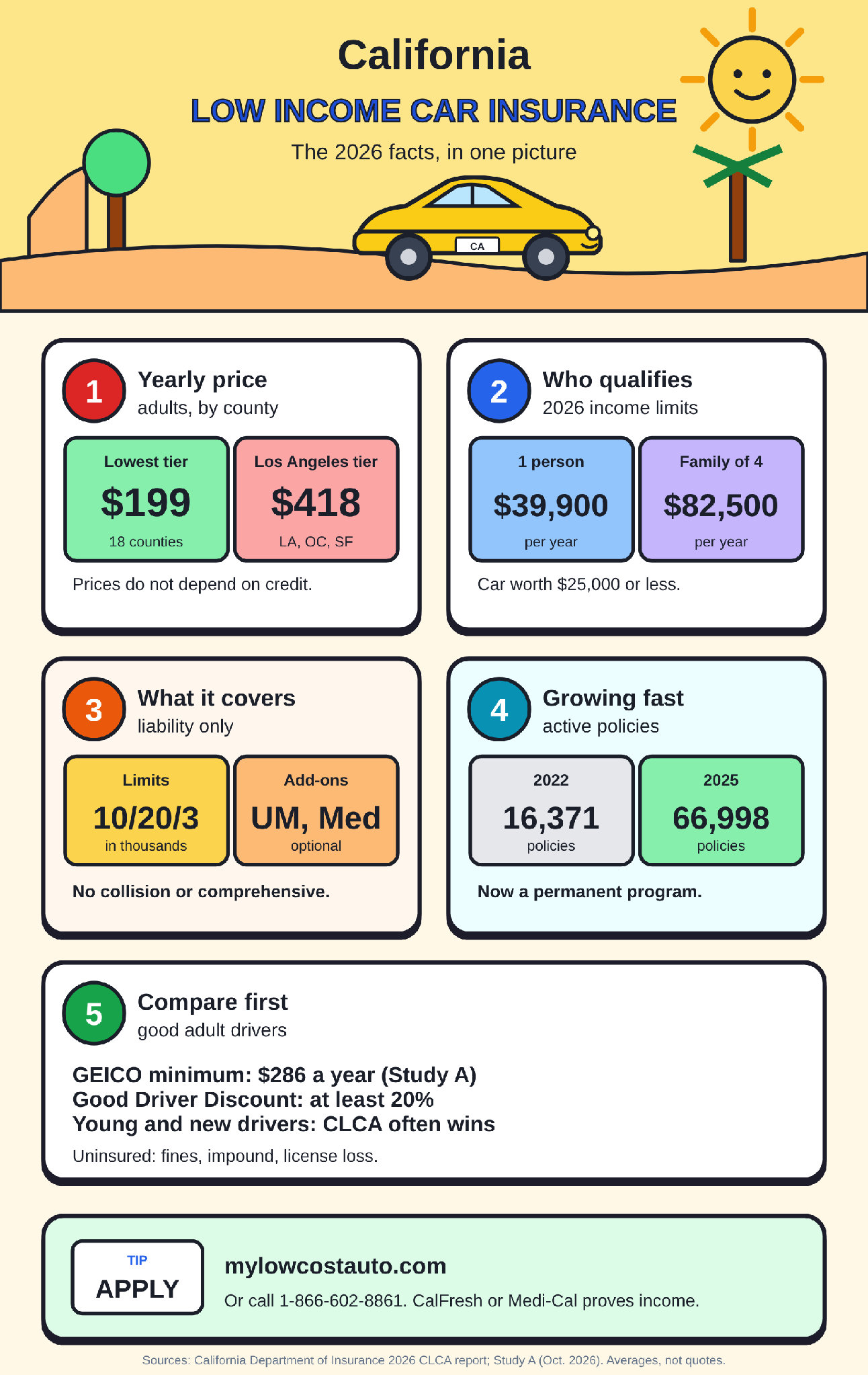
California low income car insurance at a glance. Sources: California Department of Insurance; Study A; Study C.
Frequently asked questions
Who qualifies for California low income car insurance?
You need a valid California license, be at least 16, earn no more than 250% of the federal poverty level, and own a car worth $25,000 or less. Your record can include no more than one at-fault property-damage accident or one point in three years.
How much does CLCA cost in 2026?
Adult liability coverage costs $199 to $418 a year, depending on your county, under the rates in effect since May 1, 2025. Los Angeles, Orange, San Francisco, Alameda, and Santa Clara counties pay the most. Young and new drivers pay surcharges of 25% to 120%.
What is the income limit for CLCA in 2026?
The limit is $39,900 a year for one person, $54,100 for two, $68,300 for three, and $82,500 for four, with $14,200 more for each extra person. These figures equal 250% of the 2026 federal poverty guidelines.
Does CLCA meet California’s new minimum insurance law?
Yes. Regular policies must carry 30/60/15 limits since 2025, but the Department of Insurance confirmed that CLCA policies keep their 10/20/3 limits and still satisfy the law for program drivers.
Can undocumented immigrants get CLCA?
Yes, if they meet the other rules. Immigration status does not affect eligibility, but you need a valid California driver’s license. California issues licenses regardless of immigration status under AB 60.
Is CLCA cheaper than GEICO?
It depends on your age, record, and county. In Study A, GEICO’s minimum coverage averaged $286 a year for a 35-year-old good driver, below CLCA’s top tier. Young and new drivers usually pay less with CLCA. Compare both before you buy.
The final word on California low income car insurance
California’s Low Cost Automobile Insurance Program is a real, ongoing state-sponsored option. Under the rate schedule effective May 2025, base liability premiums are $199–$418 a year by county for adults without driver surcharges; the 2026 household-income ceiling is $82,500 for four people. But eligibility also depends on a qualifying vehicle and driving record, and the 10/20/3 coverage limits leave more exposure than a standard California minimum policy.
Start at mylowcostauto.com or call 1-866-602-8861. Check your eligibility, use the official rate calculator, and review payment options including installment fees. If feasible, compare a personalized standard auto insurance quote with higher limits. Do not start driving until the insurer or authorized producer confirms that coverage is in force.
Sources
Primary sources are the program administrator, California Department of Insurance, California DMV, and the 2026 Federal Register. Third-party price studies are contextual market illustrations only and cannot establish an individual quote.
- Official CLCA eligibility, coverage and installment FAQ; official county rate calculator (checked November 2026).
- California Department of Insurance, 2026 CLCA legislative report (March 16, 2026).
- California Department of Insurance, 2025 CLCA legislative report.
- California Department of Insurance, California’s Low Cost Auto Insurance alert (July 23, 2024).
- California Department of Insurance, CLCA income eligibility.
- Federal Register, 2026 poverty guidelines (January 15, 2026).
- California Insurance Code section 11629.7 and section 1861.02.
- California Assembly Insurance Committee, AB 917 analysis (April 26, 2023).
- SB 1107 (Chapter 717, Statutes of 2022).
- California DMV, insurance requirements (July 10, 2025).
- California Vehicle Code section 16029.
- California Code of Regulations, title 10, section 2632.5.
- Insurance Information Institute, uninsured motorists, citing the Insurance Research Council.
- Experian, states that restrict credit-based insurance scores (March 2025).
- Nationwide, SmartMiles in California.
- Study A: NerdWallet, cheap car insurance in California (October 2, 2026).
- Study B: Insurify, California car insurance (October 29, 2026).
- Study C: MoneyGeek, best car insurance in California (October 1, 2026), and its low-income California analysis (July 28, 2026).
- Consumer Action, California’s Low Cost Automobile Insurance Program.
Independent informational disclosure: Generalinsurance.org is not California’s Low Cost Automobile Insurance Program, does not issue insurance policies, and cannot guarantee eligibility, rate, or coverage start date. Program details may change. Verify everything with the official administrator before acting. This article is educational and not legal or financial advice.