
Cheap Car Insurance in GA With No Down Payment
If you are searching for cheap car insurance in GA with no down payment, here is the short answer: a policy that starts with literally $0 is rare. Most insurers want a first payment before coverage begins. What you can usually find is a low initial payment, often your first monthly installment instead of a large lump sum.
That distinction matters because the smallest first payment is not always the cheapest policy. This guide explains what “no down payment” really means, what Georgia law requires, what drivers in the state are paying in 2026, and how to start coverage with as little upfront as possible without overpaying later.
KEY TAKEAWAYS
- "No down payment" usually means a small first installment, not free coverage. Expect to pay something on the day the policy starts.
- Georgia averages about $77 a month for minimum coverage and $184 for full coverage for a 30-year-old driver, according to a September 2026 rate analysis.
- Compare the total cost, not just the first bill. Monthly plans can carry installment fees, while paying in full may earn a discount.
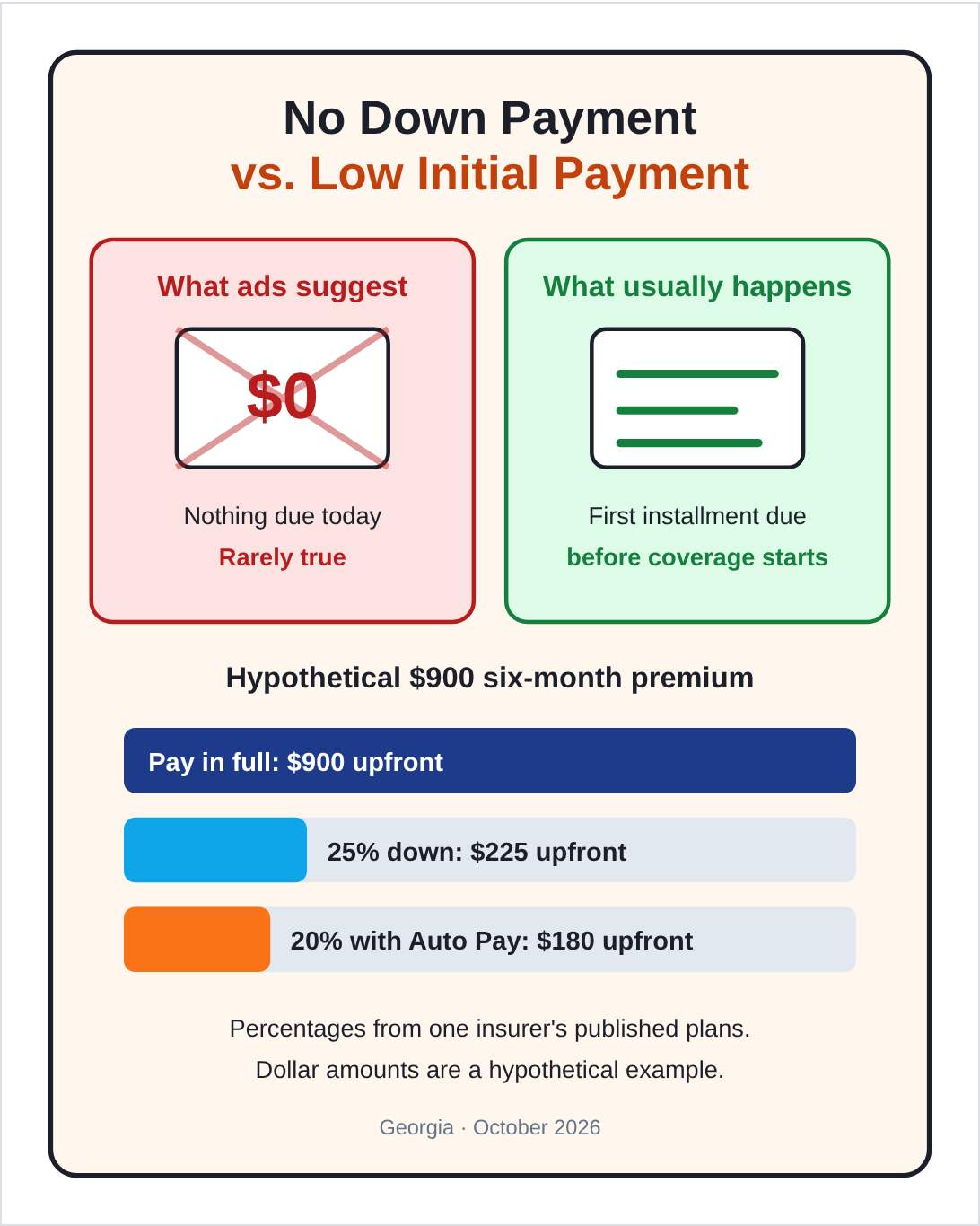
How a "no down payment" offer usually works in practice. The 25% and 20% figures are the initial payments GEICO publishes for new policies on its five-installment plans; the $900 premium is a hypothetical example, not a quote.
What does no-down-payment car insurance actually mean?
In car insurance, a "down payment" is simply the first amount you pay to start a policy. It is not a separate fee or a loan deposit. It is the first slice of your premium, which is the total price of the policy for its term, usually six or twelve months.
When an insurer or an ad promises "no down payment," it usually means the first payment is no larger than a regular monthly installment. You are not paying a big chunk upfront and then smaller bills later. One national insurer's consumer guide puts it plainly: in most cases you cannot start a valid auto policy without paying anything upfront, and offers that claim $0 down usually still require the first month's premium.

Different companies use different words for the same thing. You may see "deposit," "initial payment," "first installment," "amount due today," or "down payment." What matters is the dollar figure due on the day coverage begins, and how that compares with the full cost.
Three numbers you need to keep separate
The three payment figures every quote should show
| Term | What it means | Why it matters |
|---|---|---|
| Initial amount due | What you pay to activate the policy, often the first installment | Determines whether you can afford to start coverage today |
| Monthly installment | Each later payment on a payment plan | Must fit your monthly budget for the whole term |
| Total policy cost | All payments added together, including any installment fees | The real price you pay for the coverage |
Here is a hypothetical example to show why the difference matters. Imagine two quotes for the same coverage. Quote A asks $95 to start and $95 a month for six months, or $570 total. Quote B asks $160 to start but only $70 a month afterward, or $510 total. Quote A is easier to start, but Quote B costs $60 less over the term (our calculation).
Georgia car insurance requirements
Georgia requires liability coverage of at least $25,000 per person and $50,000 per incident for bodily injury, plus $25,000 per incident for property damage. This is often written as 25/50/25, according to the Georgia Office of the Commissioner of Insurance. Collision and comprehensive coverage are optional under state law.
Liability coverage pays others when you cause a crash. It does not repair your own car, and it does not pay your own medical bills. Insurers must also offer uninsured motorist coverage, which protects you if an uninsured driver hits you; you can turn it down only in writing. About 19% of Georgia drivers were uninsured in 2023, according to the Insurance Research Council.
What happens if your coverage lapses
Georgia tracks insurance electronically, so a gap shows up quickly. The Georgia Department of Revenue treats ten or more days without minimum liability coverage as a lapse. Each lapse carries a $25 lapse fee, and if the fee or new proof of insurance is not received in time, the vehicle's registration can be suspended. Reinstatement costs $60 for a first or second suspension within five years and $160 for a third.
Driving without required insurance is a misdemeanor under Georgia Code § 40-6-10, punishable by a fine of $200 to $1,000, up to 12 months in jail, or both. Not being able to afford coverage is not a legal exception. This is general information, not legal advice; contact the Department of Revenue or an attorney about your situation.
Can you get cheap car insurance in GA with no down payment?
Not in the literal sense for most drivers. We found no Georgia law that requires insurers to offer coverage with nothing paid upfront, and no major insurer we reviewed advertises a true $0 start. What Georgia drivers can find are payment plans that spread the premium across the term and keep the first payment small.
Payment terms are a business decision for each insurer, not a state rule. Georgia law sets how much liability coverage you must carry, but it does not set how large your first payment must be. That is why two companies can quote the same coverage with very different amounts due at the start.
GEICO is one insurer that publishes its plans in detail. For a new policy, its five-installment plan asks for 25% of the total premium on the effective date, and the same plan with automatic payments asks for 20%. Paying in full avoids its installment charges. The company notes that some plans are not available in every state, so confirm what applies in Georgia.
GEICO's published auto payment plans for new policies
| Plan | Initial payment | Remaining payments |
|---|---|---|
| Pay in full | 100% on the effective date | No installment charges |
| 2 installments | 50% on the effective date | Rest two months later |
| 3 installments | 40% on the effective date | Two 30% payments |
| 4 installments | 25% on the effective date | Three 25% payments |
| 5 installments (new policies) | 25% on the effective date | Four payments of 18.75% |
| 5 installments with Auto Pay | 20% on the effective date | Four equal automatic payments |
Source: GEICO auto payment plans page, accessed October, 2026. GEICO states that installment fees may apply and that certain plans may not be available in all states.
What to ask before assuming you can start with nothing down
- What is the exact amount due today to make the policy effective?
- Which payment plans are available to me in Georgia, and do any lower the first payment?
- Is there an installment fee, and does it change if I use automatic payments?
- What is the total of all payments for the full policy term?
The cheapest car insurance options in Georgia right now
Georgia Farm Bureau has the lowest full-coverage rate in a September 2026 analysis: $134 a month for a 30-year-old man with good credit. Among companies open to all drivers, Progressive comes next at $153. The same study puts the statewide average at $184 a month for full coverage.
A second analysis, based on real quotes collected through September 30, 2026, ranks Auto-Owners first at $140 a month for full coverage, followed by State Farm at $150. That study uses a broader driver group, so its numbers run higher and should not be mixed with the first study's figures.
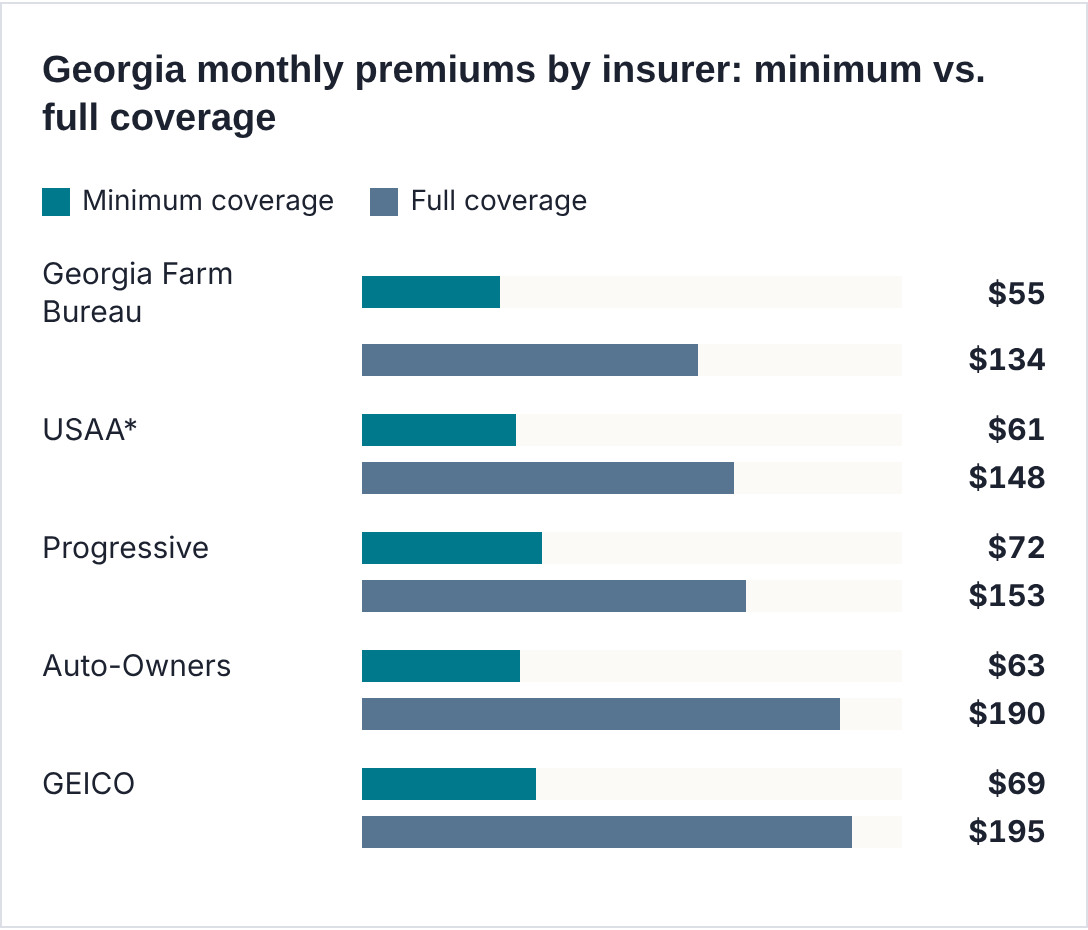
Rate analysis updated September 2026. Driver profile: 30-year-old man with good credit and a clean record; teen and other profiles excluded. Monthly averages across 777 Georgia ZIP codes. *USAA is available only to military members, veterans and their eligible family members.
Georgia insurers compared in two 2026 rate studies
| Insurer | Full coverage, study A (monthly) | Minimum, study A (monthly) | Full coverage, study B (monthly) | Liability, study B (monthly) | First-payment terms we could verify |
|---|---|---|---|---|---|
| Georgia Farm Bureau | $134 | $55 | Not reported | Not reported | Not published; may require Farm Bureau membership |
| Progressive | $153 | $72 | $190 | $96 | Not published; ask for the amount due today |
| Auto-Owners | $190 | $63 | $140 | $78 | Not published; sold through independent agents |
| GEICO | $195 | $69 | Not reported | Not reported | Published: 25% upfront on 5-pay plan, 20% with Auto Pay (new policies) |
| State Farm | Not reported | Not reported | $150 | $84 | Not published; ask your agent |
| USAA* | $148 | $61 | $176 | $98 | Not published; military eligibility required |
Study A: rate analysis updated September 29, 2026, 30-year-old man with good credit, full coverage including collision and comprehensive. Study B: median of real quotes current to September 30, 2026, drivers ages 20 to 70 with clean records and credit of 600 or higher, $1,000 deductibles on full coverage. Compare only within the same study. *USAA is available only to military members, veterans, and their eligible family members.
Notice that the cheapest premium and the lowest first payment are separate questions. Only GEICO among these companies publishes its initial-payment percentages. For the others, the amount due today is something you need to request in the quote itself.
How much does cheap car insurance cost in Georgia?
Minimum liability coverage averages $77 a month in Georgia, and full coverage averages $184, according to the September 2026 analysis for a 30-year-old driver. That is a gap of $107 a month (our calculation). Georgia's full-coverage average is 4% above the national figure, and its minimum-coverage average is 16% higher.
Minimum coverage pays for injuries and damage you cause to others, up to Georgia’s legal limits. Full coverage adds collision and comprehensive coverage, which pay to repair or replace your own car. If you finance or lease, your lender will usually require full coverage.
Minimum liability vs. full coverage in Georgia
| Minimum liability | Full coverage | |
|---|---|---|
| What it pays for | Injuries and property damage you cause to others | Liability plus damage to your own car from crashes, theft, weather, and more |
| Required by Georgia law? | Yes, at 25/50/25 or higher | No, but lenders and leasing companies usually require it |
| Average monthly cost, study A (30-year-old man) | $77 | $184 |
| Average monthly cost, study B (real quotes) | $157 | $259 |
| Best for | Older, paid-off cars with low value | Newer, financed or leased cars |
Study A: September 2026 rate analysis. Study B: real quotes current to September 30, 2026, with a broader driver group and different coverage assumptions. Figures are averages, not quotes.
Your own price can land far from these averages. Insurers weigh your age, driving record, credit-based insurance score, ZIP code, vehicle, and coverage choices. In the September 2026 study, a speeding ticket raised Georgia full-coverage rates about 14% and an at-fault accident about 35%. Drivers with poor credit averaged $421 a month for full coverage.
Five of the cheapest cars to insure in Georgia
The car you drive changes your premium, and a lower premium means a smaller first payment. In a rate analysis by vehicle model, the Honda CR-V had the lowest average full-coverage premium in Georgia, $1,120 for six months. The Mini Cooper Countryman JCW and the Volkswagen Tiguan followed, at $1,142 and $1,144.

Original illustrations of each model with its average six-month full-coverage premium in Georgia. Vehicle-model rate analysis, accessed October, 2026; sample drivers ages 18 and 40, liability limits of 100/300/100 and $500 deductibles. Statewide averages, not quotes.
Average six-month full-coverage premium by model in Georgia
| Rank | Model | Six-month premium | Hypothetical first payment at 20% (our calculation) |
|---|---|---|---|
| 1 | Honda CR-V | $1,120 | $224 |
| 2 | Mini Cooper Countryman JCW | $1,142 | $228 |
| 3 | Volkswagen Tiguan | $1,144 | $229 |
| 4 | Mini Cooper Electric | $1,147 | $229 |
| 5 | Subaru Forester | $1,164 | $233 |
To see how this connects to your first payment, apply GEICO's published 20% initial payment for its five-installment Auto Pay plan to each average. The CR-V would start at about $224 and the Forester at about $233 (our calculation). These are illustrations built from statewide averages, not quotes; your premium depends on you, not just the car.
How to find affordable coverage with a small initial payment
The goal is a first payment you can afford today on a policy you can also afford over the full term. This step-by-step process helps you get there without missing hidden costs.
- 1. Compare at least three insurers. Rates in Georgia vary widely. In the September 2026 study, the gap between the most and least expensive full-coverage companies was $151 a month.
- 2. Ask for the minimum amount required to activate coverage. Request the exact figure, not "about one month."
- 3. Compare every payment plan offered. Ask about monthly, quarterly, and pay-in-full options, and whether automatic payments lower the first payment or the fees.
- 4. Review deductibles and coverage limits. A higher deductible lowers the premium but raises what you pay after a claim. Keep the same limits across quotes.
- 5. Check every discount you may qualify for. Ask by name; some are not applied automatically.
- 6. Confirm the final amount due and the effective date before you pay. Make sure the new policy starts no later than the day your old one ends.
The best option depends on your eligibility, the coverage you need, the total cost, and the actual payment terms. A slightly larger first payment can be the better deal if it removes fees for the rest of the term.
Initial payment vs. total cost: a hypothetical comparison
The chart below applies GEICO's published initial-payment percentages to a hypothetical $900 six-month premium. To show how fees add up, it also assumes a hypothetical $5 fee on each installment after the first, or $1 with automatic bank payments. These are illustrations, not quotes.
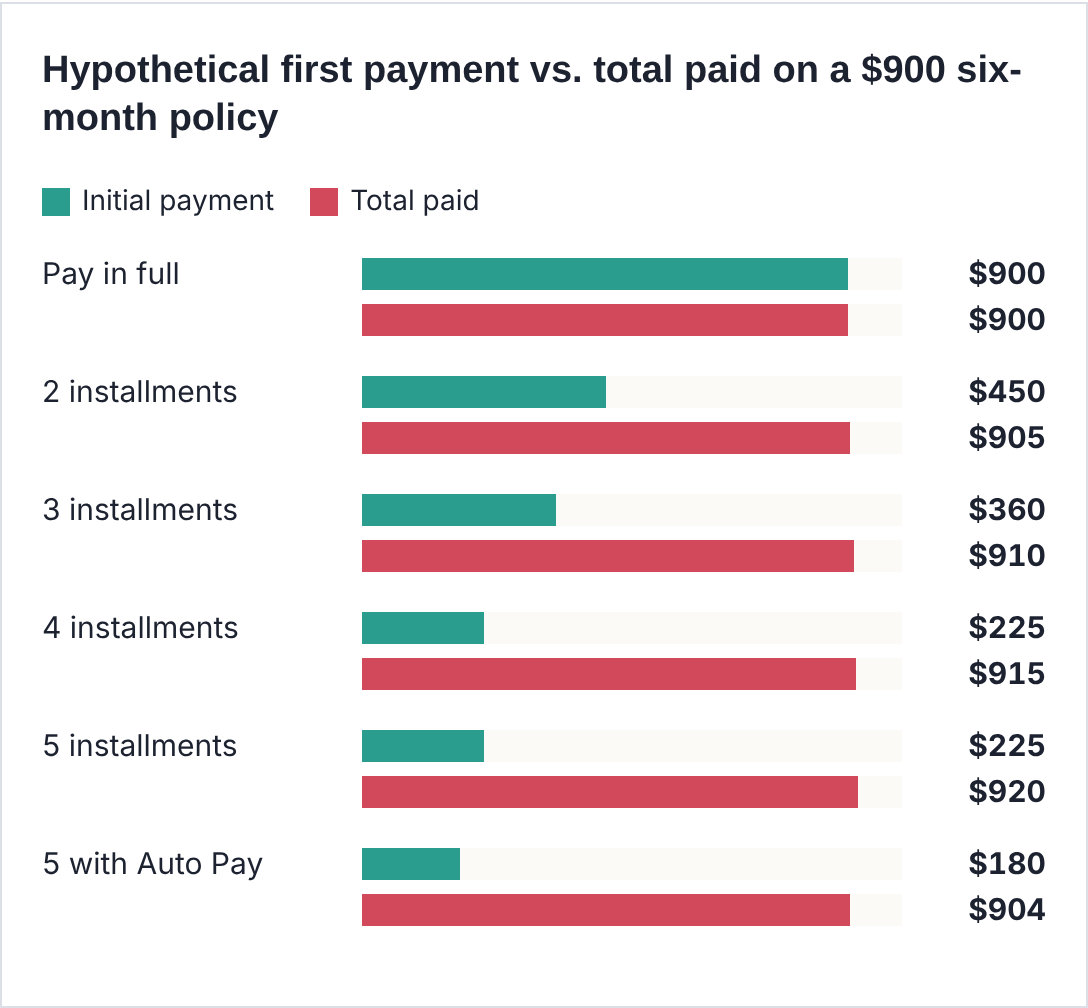
Hypothetical example. Initial-payment percentages from GEICO's published plans for new policies (accessed October 23, 2026). Premiums and fees are assumptions: $5 per later installment, $1 with automatic bank payments. Actual fees and plan availability vary by state.
Hypothetical payment plans on a $900 six-month premium
| Plan | Initial payment | Later installments | Assumed fees | Total paid |
|---|---|---|---|---|
| Pay in full | $900 | None | $0 | $900 |
| 2 installments | $450 | 1 × $450 | $5 | $905 |
| 3 installments | $360 | 2 × $270 | $10 | $910 |
| 4 installments | $225 | 3 × $225 | $15 | $915 |
| 5 installments | $225 | 4 × $168.75 | $20 | $920 |
| 5 with Auto Pay | $180 | 4 × $180 | $4 | $904 |
All dollar amounts are hypothetical and calculated by us. They are not GEICO quotes and do not represent a price any driver can obtain.
What affects your initial insurance payment?
Your first payment is mostly a slice of your premium, so anything that raises the premium usually raises the first payment too. But the size of the slice depends on the insurer's billing rules, and those vary from company to company.
General factors
- Total premium. Your age, driving record, ZIP code, vehicle, credit-based insurance score, and coverage choices set the overall price.
- Policy term. A six-month policy spreads a smaller premium over fewer payments than a twelve-month policy.
- Payment schedule. More installments usually mean a smaller first payment, as GEICO's plans show.
- Coverage selection. Dropping optional coverage on an older car lowers the premium and the first slice of it.
Company-specific factors
- Billing rules. Each insurer decides what percentage is due upfront and which plans it offers in Georgia.
- Payment method. Some plans with the smallest first payment require automatic payments.
- Underwriting. An insurer may limit payment options for drivers with recent lapses, poor payment history, or high-risk records. Ask; do not assume.
- New versus renewal. Some plans are only for new policies or only for renewals.
Discounts and ways to reduce the cost
The Georgia Office of the Commissioner of Insurance encourages drivers to ask about discounts for multiple vehicles, driver education, good students, safety and anti-theft devices, low mileage and bundling with home insurance. Each insurer sets its own amounts and rules, so a discount at one company may not exist at another.
Ways to lower your premium or first payment
| Discount or strategy | Who may qualify | What to verify |
|---|---|---|
| Bundling auto with home or renters | Drivers who also need property insurance | The total of both policies, not just the auto discount |
| Multiple vehicles | Households insuring two or more cars | Whether every vehicle must be on the same policy |
| Good student or driver education | Young drivers with qualifying grades or courses | Grade or course requirements and proof needed |
| Safety and anti-theft devices | Cars with qualifying equipment | Which devices count |
| Low mileage or telematics | Drivers who drive little or drive safely | Whether driving data can raise your rate |
| Pay in full | Drivers who can pay the whole premium | Discount amount versus the cash you need today |
| Automatic payments | Drivers with a bank account or card | Lower first payment or lower fees, and overdraft risk |
| Higher deductible | Drivers with savings to cover a claim | That you could pay the deductible tomorrow |
| Drop optional coverage on an older car | Owners of paid-off, low-value cars | Car value versus a year of collision and comprehensive |
Discount names and eligibility vary by insurer; we do not list percentages because they are not consistent across companies. Never misstate your address, driving history or vehicle use to get a lower price; doing so can void a claim.
Common mistakes when shopping for low-cost insurance
Comparing quotes with different coverage limits. A cheap quote may simply have lower limits or a higher deductible. Set the same limits, deductibles, and drivers on every quote before comparing prices.
Focusing only on the first payment. A low amount due today can hide higher monthly payments or fees. Always ask for the total of all payments for the term.
Overlooking installment fees. Insurers that bill monthly may add a fee to each payment. Ask what it is and whether automatic payments reduce it.
Choosing a deductible you cannot afford. A $1,000 deductible lowers the premium, but it does not help if you cannot pay it after a crash. Pick an amount you could cover from savings.
Assuming an advertised price is yours. Ads and averages are not offers. Your final price depends on underwriting, and the insurer can decline or reprice your application.
Frequently asked questions
Can I get car insurance in Georgia with no money down?
Rarely in the literal sense. Most insurers require a first payment before coverage starts. What you can usually find is a plan where the first payment is about the size of a monthly installment. GEICO, for example, publishes a plan for new policies that asks for 20% upfront with automatic payments.
What is the cheapest way to start a car insurance policy?
Choose a payment plan with many installments, sign up for automatic payments if that lowers the first payment, and buy only the coverage you need. Then compare the amount due today across at least three insurers. The cheapest start is not always the cheapest policy, so check the total too.
Can I pay for car insurance monthly in Georgia?
Yes, most insurers offer monthly or other installment plans, but terms differ. Some charge a fee per installment, and some offer a discount for paying in full. Ask each insurer which plans are available in Georgia and what each one costs over the full term.
Does no-down-payment insurance cost more overall?
It can. Spreading the premium over more payments may add installment fees, and you give up any pay-in-full discount. The difference may be small or large depending on the insurer. Compare the total of all payments, not just the first one, before deciding.
What is the minimum car insurance required in Georgia?
Georgia requires liability coverage of at least $25,000 per person and $50,000 per incident for bodily injury, plus $25,000 for property damage. Insurers must also offer uninsured motorist coverage, which you can decline only in writing. Collision and comprehensive coverage are optional unless a lender requires them.
Can I get affordable insurance with a poor driving record?
Often, but you will pay more. A September 2026 analysis found an at-fault accident raised Georgia full-coverage rates about 35%. Some insurers may also limit payment options for high-risk drivers. Shop widely, ask about defensive-driving or safe-driving programs, and review your rate again once violations age off your record.
How can I lower my initial insurance payment?
Ask for a plan with more installments, enroll in automatic payments if the insurer offers a smaller first payment for it, raise your deductible if you can afford it, and drop optional coverage you do not need. Also ask about every discount you qualify for, since a lower premium lowers each payment.
What should I compare before choosing a policy?
Compare the coverage limits, deductibles, amount due today, monthly payment, installment fees, total of all payments, and the policy start date. Also check that the insurer is licensed in Georgia; the Office of the Commissioner of Insurance offers a license lookup tool on its website.
The Final Word On Cheap Car Insurance in GA With No Deposit
Cheap car insurance in GA with no down payment usually means a policy you can start with one small installment, not a policy that starts for free. The most useful thing you can do is ask every insurer two questions: what is due today, and what is the total for the full term? A low first payment and a low total premium are two different things, and the best deal balances both.
Start by comparing at least three quotes with the same 25/50/25 or higher limits and the same deductibles. Ask about payment plans, automatic-payment options, and discounts, then confirm the amount due and the effective date in writing before you pay. Keep your old policy active until the new one begins so you never face a lapse.
Premiums, payment plans, and eligibility vary by insurer and by your individual circumstances. The rates in this article are averages and hypothetical examples, not quotes. This article is for information only and is not legal or financial advice. The publisher is not an insurance company or a licensed insurance agency.
Sources
- Georgia Office of the Commissioner of Insurance, Auto Insurance (accessed October, 2026).
- Georgia Department of Revenue, Penalties and Fines for Lapse of Insurance Coverage (accessed October, 2026).
- Official Code of Georgia § 40-6-10, 2025 version.
- Official Code of Georgia § 33-24-44, cancellation notice, 2025 version.
- GEICO, Auto Payment Methods and Plans (accessed October, 2026).
- ValuePenguin, Cheapest Car Insurance in Georgia (updated September 29, 2026).
- Insurify, Georgia Car Insurance (rates current to September 30, 2026).
- Insurify, Uninsured Motorist Coverage in Georgia, citing the Insurance Research Council.
- CarInsurance.com, Cheapest Cars to Insure in Georgia (accessed October, 2026).
- The General, No Down Payment Car Insurance (July 7, 2026).