
How To Get Cheap Car Insurance
Last updated on March 17, 2026
The Generalinsurance.org Editorial Team produces informational content about insurance topics, focusing on clear, practical explanations to help readers understand common coverage options, costs, and shopping considerations.
Articles cover everyday questions related to auto, home, renters, life, and other insurance categories, including policy basics, pricing factors, coverage comparisons, and ways consumers may reduce costs while maintaining appropriate protection.
Content reviewed internally for clarity and consistency of general insurance concepts.
Note: This content is for general informational purposes only and does not constitute insurance, legal, or financial advice. Generalinsurance.org is an independent informational website and is not affiliated with any insurer.
As 2026 begins, car insurance remains one of the largest recurring expenses for American drivers. The national average for full coverage now stands at approximately $2,500–$2,700 annually (about $208–$225 monthly), reflecting modest increases of 4 to 7% from late 2025 levels. These rises stem from ongoing factors like elevated vehicle repair costs due to advanced technology, lingering supply chain issues, higher claim severity, and regional risks such as severe weather events.
While premiums have stabilized compared to the double-digit jumps of prior years, savvy drivers can still cut costs significantly—often saving $500–$1,200 or more per year by simply leveraging proven strategies. This in-depth guide, based on the latest 2026 data and industry trends, outlines actionable steps to secure affordable coverage without skimping on protection.
Why Car Insurance Rates Are Elevated in 2026
Understanding the drivers behind premiums helps identify savings opportunities:
- Repair and Parts Costs: Modern vehicles with sensors, cameras, and electric components cost more to fix. Imported parts face potential tariff impacts, pushing claims higher.
- Claim Trends: Increased accident severity, distracted driving, and weather-related losses continue to pressure insurers.
- Regional Variations: Urban density, uninsured motorists, and litigation in certain states amplify rates.
- Positive Shifts: Safer vehicle tech (e.g., automatic braking) and telematics adoption are beginning to moderate increases for low-risk drivers.
Rates differ dramatically by state. Here’s a snapshot of 2026 estimated full coverage averages:
| State | Average Annual Full Coverage (2026 Est.) | Key Factors Contributing to Rates |
| Vermont | $1,500–$1,600 | Low population, fewer claims |
| Idaho | $1,600–$1,800 | Rural roads, low theft |
| Maine | $1,700–$1,900 | Safe driving culture |
| Ohio | $1,800–$2,000 | Competitive market |
| Louisiana | $3,800–$4,200 | High litigation, weather risks |
| Florida | $3,500–$3,800 | Uninsured drivers, hurricanes |
| Nevada | $3,300–$3,500 | Urban traffic, theft |
| National Average | $2,500–$2,700 | – |

These figures blend projections from sources like Bankrate, Insure.com, and industry forecasts, adjusted for early 2026 trends.
Personal factors—driving record, age, credit score (where allowed), mileage, and vehicle—can swing your quote by 50% or more.
Strategy #1: Shop Around and Compare Multiple Quotes
The most powerful tool for lowering rates is competition. Identical coverage can vary by hundreds—or even thousands—between carriers. Taking time to compare auto insurance quotes can make it much easier to spot better pricing and coverage combinations before your renewal date.
- Switching insurers saves an average of $500–$1,200 annually in 2026.
- Top affordable national providers include Travelers (often ~$1,700–$2,100/year full coverage), GEICO, American Family, State Farm, and USAA (for eligible military families, frequently under $1,800).
- Regional stars like Erie and Auto-Owners undercut nationals in many Midwest and Northeast states.
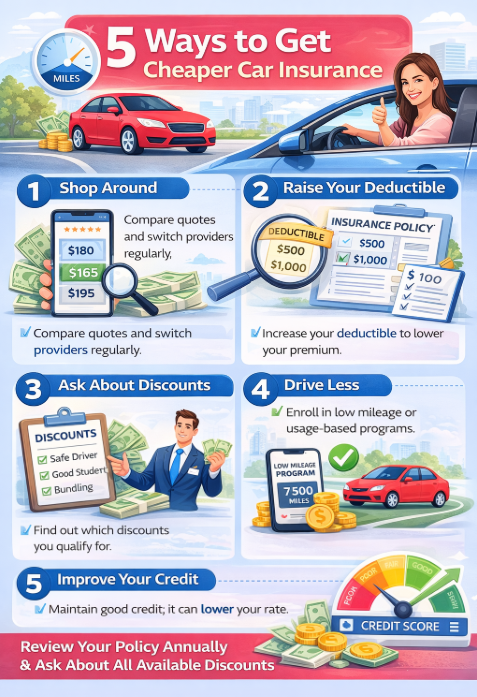
How to Shop Effectively:
- Use independent comparison sites or direct quotes from 4–6 insurers.
- Time it right: Quote 2–3 weeks before renewal, after life changes (new car, move, marriage), or annually.
- Ensure apples-to-apples comparisons: Match limits, deductibles, and add-ons.
#2: Stack Every Available Discount
Insurers offer 15–30+ discounts; combining them can slash 30–50% off premiums. Many drivers miss valuable car insurance discounts simply because they do not ask about them during the quote process.
Top 2026 Discounts and Potential Savings:
| Discount Type | Average Savings | Eligibility/Details |
| Multi-Policy Bundling (Auto + Home/Renters) | 10–30% | Highest impact; often 20–25% with the same carrier |
| Safe Driver (Clean Record) | 20–40% | 3–5 years violation-free |
| Telematics/Usage-Based | 10–40% | Safe habits via app (e.g., Progressive Snapshot, State Farm Drive Safe & Save) |
| Good Student | 15–25% | Full-time students with a B average |
| Low Mileage | 10–30% | Under 7,500–10,000 miles/year |
| Defensive Driving Course | 5–15% | Approved online/state course |
| Multi-Vehicle | 10–25% | Multiple cars on policy |
| Vehicle Safety Features | 5–25% | Anti-theft, airbags, ADAS |
| Pay in Full/Autopay/Paperless | 5–15% | Avoid fees; easy setup |
| Good Credit | 10–40% | Where permitted, build a score for big wins |
Many discounts aren’t auto-applied—ask explicitly during quoting.
#3: Raise Your Deductible Wisely
Your deductible is the amount paid out-of-pocket before coverage activates for collision/comprehensive claims.
- Boosting from $500 to $1,000: Saves 15–25% (~$300–$600/year).
- To $2,000: Up to 30–40%, but only if you have an emergency fund.
This works best for safe drivers with savings buffers.
#4: Tailor Coverage to Your Needs
Avoid over- or under-insuring. For drivers mainly focused on affordability, reviewing minimum coverage car insurance options can be a practical starting point before deciding whether full coverage is worth the extra cost.
- Minimum Liability: ~$600–$800/year average—cheapest but leaves gaps.
- Full Coverage: Recommended for newer/financed vehicles; includes collision/comprehensive.
- Drop comp/collision on older cars (value <10x annual premium).
- Opt for higher liability (e.g., 100/300/100) for better protection without huge cost jumps.
#5: Embrace Telematics and Pay-Per-Mile Programs
Usage-based insurance (UBI) explodes in 2026 with connected cars and EVs. For low-mileage households, exploring pay-per-mile insurance savings can be one of the smartest ways to align premiums with actual driving habits.
- Safe drivers earn 20–40% via monitored habits.
- Low-mileage options (e.g., Nationwide SmartMiles) save 30–50% for <8,000 miles/year.
#6: Boost Controllable Risk Factors
- Clean Record: Avoid tickets/accidents—biggest long-term saver.
- Credit Improvement: Hundreds in savings were used.
- Vehicle Choice: Sedans/crossovers with top IIHS safety ratings are cheaper than sports/luxury models.
#7: Optimize Payment and Policy Habits
- Pay annually: Dodge installment fees.
- Go digital: Paperless/autopay yields 5–10%.
- Bundle aggressively: Top saver for households with multiple policies.
Savings for Specific Driver Profiles
- Young Drivers: Add to family policy; leverage good student/distant student discounts.
- Seniors: Mature driver courses, low-mileage reductions.
- High-Risk Drivers: Seek forgiving carriers; rebuild record over time.
Realistic 2026 Savings Breakdown
Aggressive stacking yields impressive results:
| Strategy Combo | Estimated Annual Savings |
| Switch + Basic Discounts | $400–$800 |
| + Bundling + Telematics | +$400–$700 |
| + Higher Deductible + Low Mileage | +$300–$600 |
| Maximum Stacking | $1,200–$2,100+ |
Final Tips For Securing Cheaper Car Insurance
Rates may continue to rise, but proactive smart drivers can still win big. Finding cheaper car insurance doesn’t require sacrificing protection—it simply requires a smarter approach. The most effective way to lower your premium is to compare multiple insurers regularly, even if you’re happy with your current provider. Rates change frequently, and loyalty alone rarely guarantees the best price. By shopping around, you can uncover discounts and pricing models that better match your driving habits.
Adjusting your coverage strategically can also lead to meaningful savings. Raising your deductible, removing unnecessary add-ons, or tailoring coverage to the actual value of your vehicle can reduce costs without increasing risk. If you drive fewer miles each year, look for insurers that reward low mileage or usage-based driving. These programs can be especially valuable for remote workers, retirees, or households with multiple vehicles.
Maintaining a clean driving record remains one of the most powerful ways to keep premiums low. Avoiding accidents and tickets not only prevents surcharges but also unlocks safe-driver and accident-free discounts. Improving your credit where allowed, bundling auto insurance with home or renters coverage, and asking about every available discount can further reduce your rate.
Ultimately, cheaper car insurance comes from being proactive. Take time to review your policy annually, ask questions, and compare options. Small changes can add up to significant long-term savings while still keeping you well protected on the road. For more strategies, review our guide on how to get cheap car insurance.