
Cheap Full Coverage Car Insurance Under $150 a Month
Getting Cheap full coverage car insurance under $150 a month is a realistic goal for many drivers, even though national averages run higher. In a real-quote analysis current to September 30, 2026, full coverage averaged $187 a month nationally, but six companies came in under $150. In many states, the cheapest full-coverage policies cost well under $100.
This guide names the cheapest full-coverage companies, shows the states where $150 is easy and where it is hard, picks the best overall provider, covers young drivers, seniors, and drivers with a DUI or poor credit, and ends with 10 tips. Every figure is sourced and dated.
KEY TAKEAWAYS
- Six companies averaged under $150 for full coverage in national real-quote data: NJM, Auto-Owners, Country Financial, State Farm, Safeco, and GEICO.
- Your state matters most. The cheapest full-coverage averages ranged from $56 in New York to $163 in Florida in 2026 state studies.
- State Farm is our best overall pick, at $103 a month for full coverage nationally and at or under $150 in every state dataset we checked where it was listed.
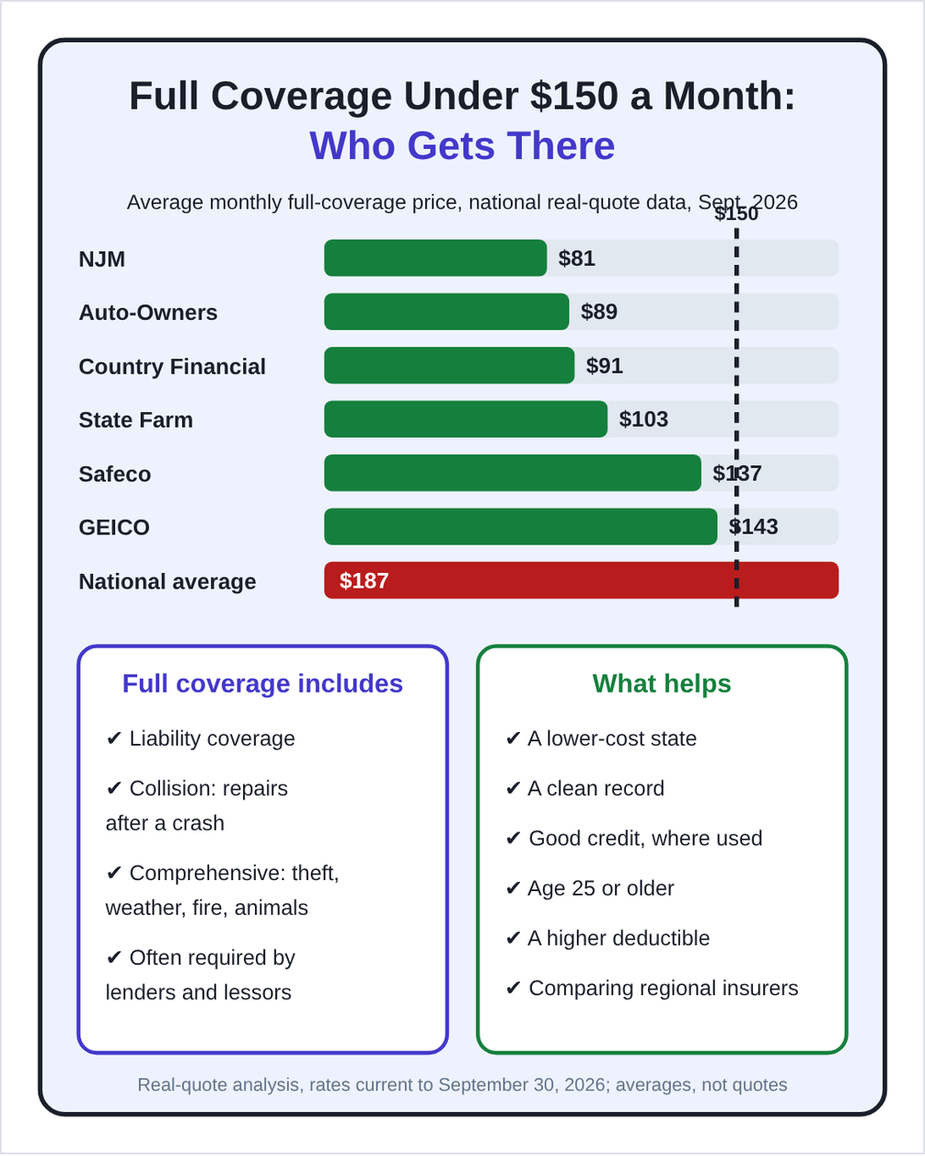
Average monthly full-coverage prices for the six companies under $150 in a national real-quote analysis with rates current to September 30, 2026, compared with the $187 national average. Drivers ages 20 to 70 with clean records and credit scores of 600 or higher; collision and comprehensive at $1,000 deductibles.
BEFORE YOU BUY
Check whether your lender or leasing company sets a maximum deductible or minimum limits. A cheap full-coverage quote only helps if it meets those rules.
What full coverage means
"Full coverage" is an informal term, not a single policy. It usually means liability coverage plus collision and comprehensive. Liability pays for injuries and damage you cause to others. Collision pays to repair your car after a crash, and comprehensive covers theft, fire, weather, and similar damage, each after your deductible.
Liability-only vs. full coverage
| Liability-only | Full coverage | |
|---|---|---|
| Pays for damage you cause to others | Yes | Yes |
| Pays to repair your own car after a crash | No | Yes, minus your deductible |
| Covers theft, fire, and weather damage | No | Yes, minus your deductible |
| Usually required for financed or leased cars | No | Yes |
| National average, real-quote data (monthly) | $99 | $187 |
National averages from a real-quote analysis with rates current to September 30, 2026; liability limits from the state minimum up to $50,000/$100,000; full coverage with $1,000 deductibles.
Can you get full coverage for under $150 a month?
Yes, for many drivers, but not at the national average. Two 2026 national analyses put average full coverage at $187 a month (study B, real quotes current to September 30, 2026) and about $215 a month (study A, a rate study updated September 18, 2026, using $500 deductibles). Both are above $150, so getting under the line means choosing the right company, the right state factors, or both.
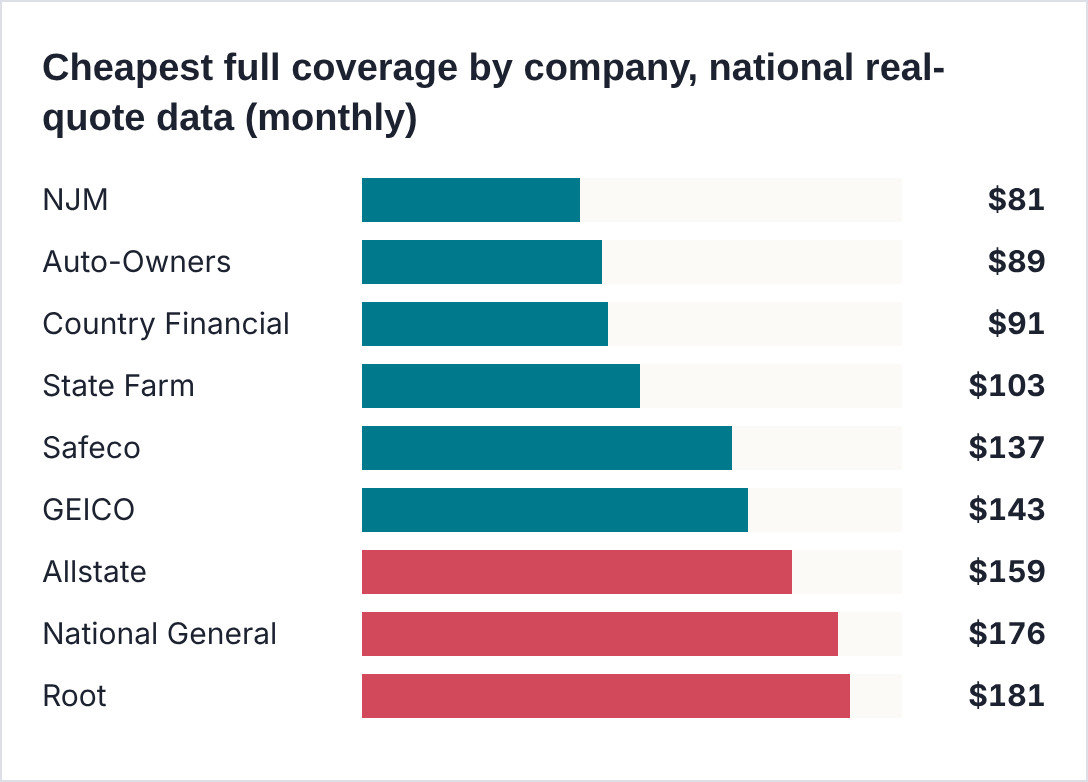
Study B: real-quote analysis, rates current to September 30, 2026; drivers ages 20 to 70 with clean records and credit scores of 600 or higher; collision and comprehensive at $1,000 deductibles. National average: $187.
Study A, which uses $500 deductibles and a 40-year-old profile, found only one company under $150 nationally: USAA at about $136 a month, for military families. Its cheapest companies open to everyone were Travelers at about $164 and GEICO at about $180. The difference from Study B shows how much the deductible and driver profile affect full-coverage prices.
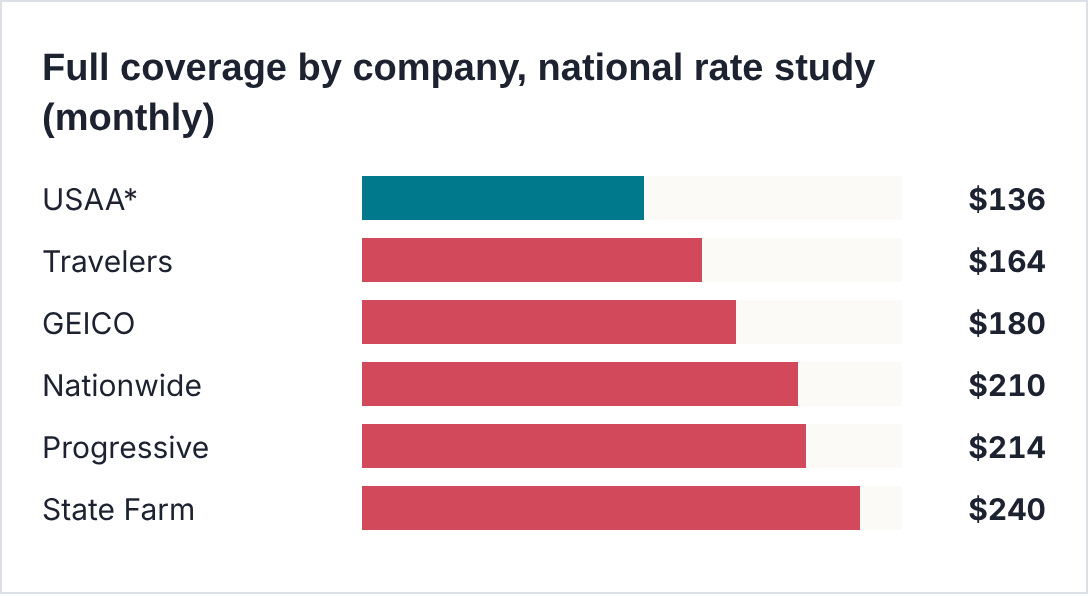
Study A: national rate study updated September 18, 2026; 40-year-old drivers; 100/300/100 limits with $500 deductibles; annual premium ÷ 12 (our calculation). *USAA serves military families. National average: about $215.
The cheapest full coverage by state
Where you live can move full coverage from well under $150 to well over it. State rate studies of a 40-year-old driver with a clean record and good credit, published from August to October 2026, found these cheapest full-coverage averages:
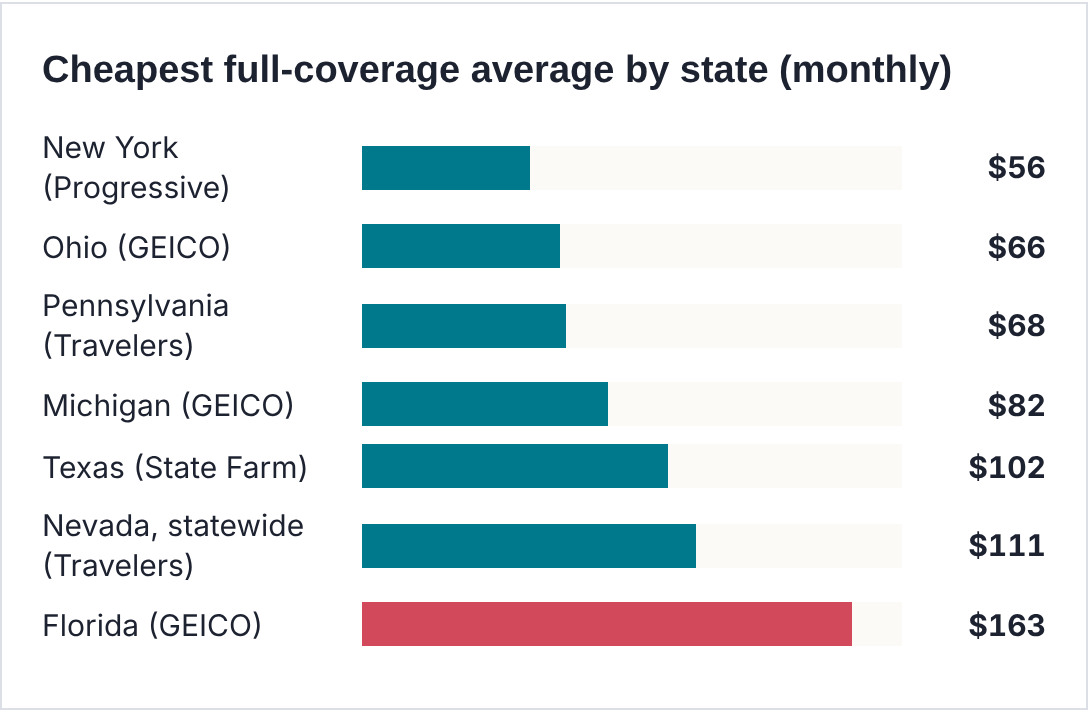
State rate studies: New York (Aug. 13), Ohio (Oct. 6), Pennsylvania (Aug. 25), Michigan (Oct. 15), Texas (Oct. 9), Nevada (Sept. 29), and Florida (Oct. 1, 2026). Full coverage at 100/300/100. Statewide averages; city drivers may pay more.
How many companies came in under $150 in each state study
| State | Companies under $150 for full coverage | Cheapest | Date |
|---|---|---|---|
| New York | 8 of 10 listed (Progressive, NYCM, Kemper, American Family, GEICO, Erie, State Farm, Allstate) | $56 | Aug. 13, 2026 |
| Ohio | All 5 listed (GEICO, Auto-Owners, Erie, Progressive, Grange) | $66 | Oct. 6, 2026 |
| Pennsylvania | All 5 listed (Travelers, Nationwide, Erie, Donegal, Westfield) | $68 | Aug. 25, 2026 |
| Michigan | All 5 listed (GEICO, Travelers, Progressive, Auto-Owners, Pioneer State Mutual) | $82 | Oct. 15, 2026 |
| Texas | 5 of 6 listed (State Farm, GEICO, AAA, Mercury, Germania) | $102 | Oct. 9, 2026 |
| Florida | None of the companies listed | $163 | Oct. 1, 2026 |
40-year-old driver with a clean record and good credit; full coverage at 100/300/100 limits. Some state studies listed only their five cheapest companies.
Florida is the exception, but even there, real-quote data is more encouraging. A Florida analysis with rates current to September 30, 2026, found State Farm at $128 a month and Progressive at $144 for full coverage, both under $150. In Las Vegas, Country Financial averaged $95 and State Farm $140, even though the city's overall average was $251.
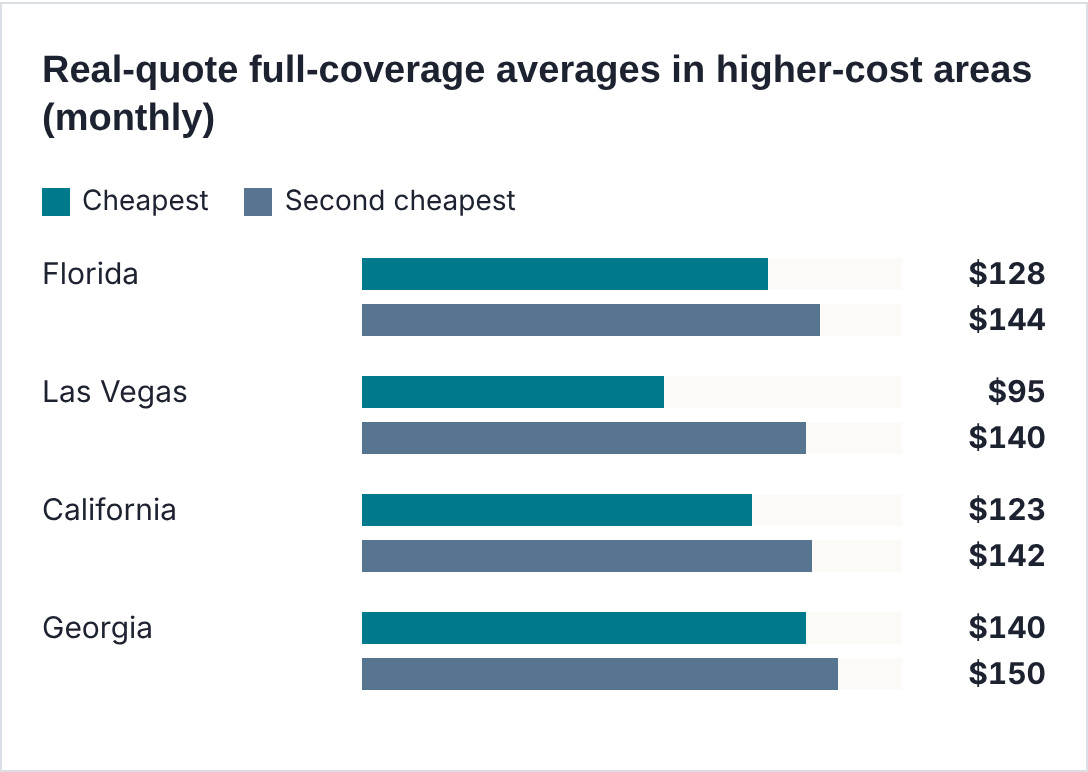
Real-quote analyses, rates current to September 30, 2026. Florida: State Farm, Progressive. Las Vegas: Country Financial, State Farm. California: Aspire General, GEICO. Georgia: Auto-Owners, State Farm.
More states where full coverage is cheap
A separate state-by-state analysis updated July 8, 2026, found cheapest-company full-coverage averages well under $150 in several other low-cost states. These figures use a different driver profile and method than the state studies above, so compare them with each other rather than with the chart.
More low-cost states for full coverage
| State | Cheapest company | Monthly average | Source date |
|---|---|---|---|
| Hawaii | GEICO | $77 | July 8, 2026 |
| Vermont | Co-Op | $83 | July 8, 2026 |
| Idaho | State Farm | $85 | July 8, 2026 |
| Maine | Travelers | $87 | July 8, 2026 |
If you live in one of these states, a clean-record adult may be able to buy full coverage for well under $100, leaving room under the $150 line for higher limits or a lower deductible.
The best overall provider for cheap full coverage under $150
Our pick is State Farm. It averaged $103 a month for full coverage in national real-quote data, and it came in at or under $150 in every state dataset we checked where it was listed: $102 in Texas (the cheapest company there), $113 in New York, $128 in Florida's real-quote data, $140 in Las Vegas, and $150 in Georgia, right at the line. It is available nationwide and ranked among the cheapest for 18-year-olds and seniors.
Runners-up: GEICO, at $143 nationally, was the cheapest full-coverage company in the Ohio and Michigan studies. Auto-Owners and Country Financial had lower national averages, $89 and $91, but sell only in certain states. NJM averaged $81 but serves a limited number of states. USAA is cheapest for military families.
Best picks for full coverage under $150
| Need | Our pick | Why |
|---|---|---|
| Best overall | State Farm | $103 nationally; at or under $150 in every state dataset we checked where listed |
| Widely available runner-up | GEICO | $143 nationally; cheapest full coverage in Ohio and Michigan studies |
| Lowest average (regional) | Auto-Owners or Country Financial | $89 and $91 nationally |
| Northeast and Mid-Atlantic | NJM, Progressive, or Travelers | $81 nationally for NJM; cheapest in New York and Pennsylvania studies |
| Military families | USAA | About $136 in the national rate study |
Full coverage under $150 for drivers 25 and younger
Young drivers face the steepest climb. In a real-quote analysis updated October 17, 2026, 18-year-olds averaged $351 a month for full coverage, and the cheapest company, USAA, still averaged $185. State Farm was next at $208.
Lower-cost states change the picture. In Ohio's state study, GEICO's cheapest full-coverage rate for a male driver on a family policy was $125 at 18, $90 at 21, and $72 at 25, all under $150. In Pennsylvania, the cheapest fell under $150 by age 25 ($132), and Iowa marketplace quote data from September 2026 showed drivers ages 16 to 25 averaging $100 to $118 with the two cheapest companies.
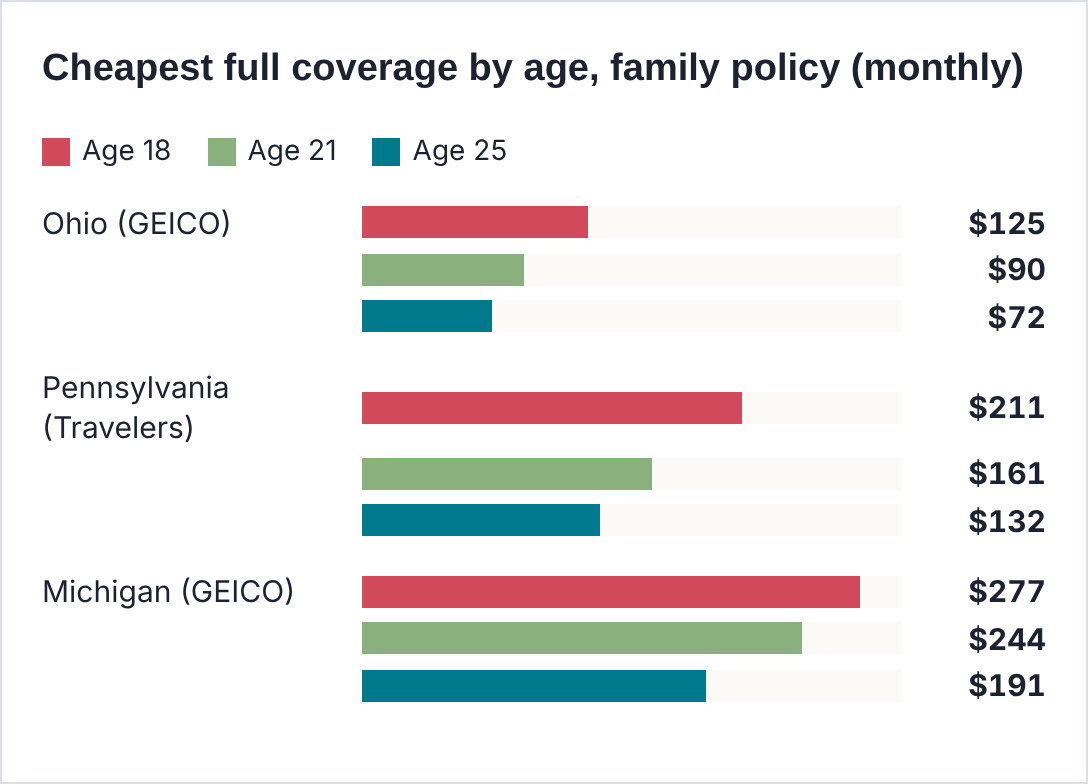
State rate studies: Ohio updated October 6, 2026; Pennsylvania updated August 25, 2026; Michigan updated October 15, 2026. Male driver on a family policy where specified; full coverage at 100/300/100 with a $1,000 deductible.
- Stay on a parent's policy while you are eligible.
- Choose a car that is cheap to insure and a deductible you could actually pay.
- Ask about good-student and driver-training discounts.
- Re-shop at 21 and 25, when the state data shows sharp drops.
Full coverage under $150 for seniors
Seniors have the easiest path. In the October 2026 real-quote analysis, the five cheapest companies for seniors all averaged $64 to $79 a month for full coverage, about half the $150 line. The national average for drivers in their 60s was $163, so shopping still matters.
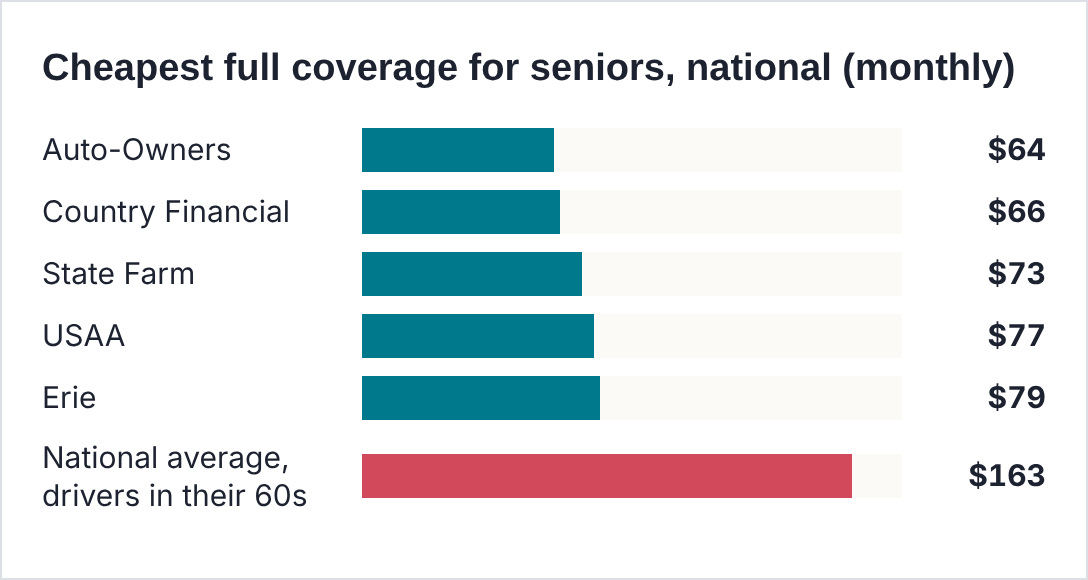
Real-quote analysis updated October 17, 2026; rates current to September 30, 2026.
State quote data shows the same pattern. In 2026 marketplace data, seniors 65 and older averaged $79 a month for full coverage with Progressive or GEICO in Wyoming, and $75 with Liberty Mutual's direct channel in Maine.
Seniors can also ask about mature-driver course discounts, report low mileage, and bundle home and auto. The analysis noted that full-coverage rates may start rising around age 70, so re-shop at renewal.
Full coverage under $150 with a DUI or poor credit
A DUI or poor credit raises full-coverage prices, but some states still come in under $150. The 2026 state studies found these cheapest full-coverage averages for a 40-year-old with one change to their profile:
Cheapest full coverage after a DUI or with poor credit
| State | After a DUI (cheapest) | With poor credit (cheapest) | Date |
|---|---|---|---|
| New York | $59 (Progressive) | $113 (Erie) | Aug. 13, 2026 |
| Pennsylvania | $94 (Travelers) | $140 (Nationwide) | Aug. 25, 2026 |
| Ohio | $96 (GEICO) | $125 (Grange) | Oct. 6, 2026 |
| Michigan | $151 (Progressive) | Not applicable; Michigan bars credit scores in rating | Oct. 15, 2026 |
| Texas | $155 (State Farm) | Not publicly confirmed | Oct. 9, 2026 |
State rate studies; full coverage at 100/300/100. "Not publicly confirmed" means the study did not report that figure.
The cheapest company often changes after a DUI or with poor credit. In New York, Progressive stayed cheapest after a DUI, but Erie was cheapest with poor credit. In Ohio, GEICO stayed cheapest after an OVI, while Grange led for poor credit. Because each insurer weighs these factors differently, drivers with either issue should compare more companies than usual.
10 tips for full coverage under $150 a month
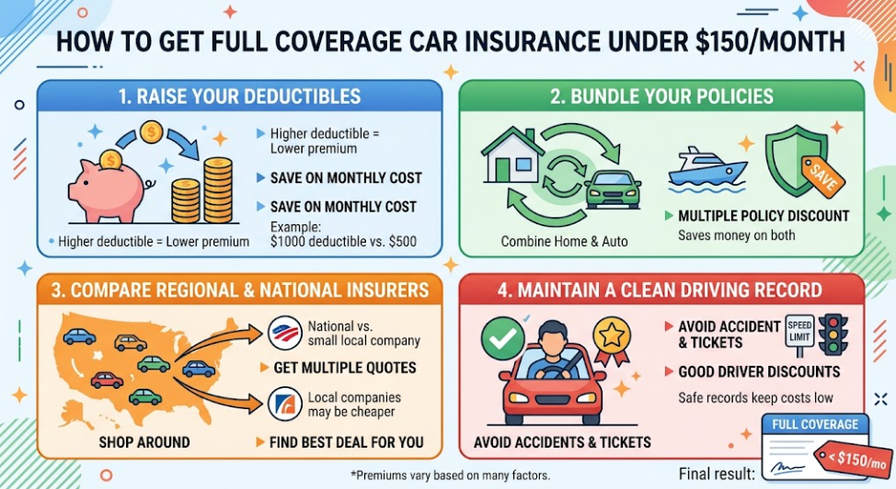
- 1. Compare at least three companies, including a regional one. The lowest national averages came from Auto-Owners, Country Financial, and NJM.
- 2. Request identical coverage on every quote: limits, deductibles, drivers, and term.
- 3. Raise your deductible if you could pay it after a claim and your lender allows it.
- 4. Consider dropping collision and comprehensive on an older car you own outright, if replacing it would not strain you.
- 5. Choose a car that is cheap to insure before you buy.
- 6. Pay in full or by automatic bank transfer. GEICO says paying by EFT can save up to $36 a year in installment fees.
- 7. Use online discounts, such as Progressive's sign-online discount, which averages 10% and varies by state.
- 8. Bundle home or renters insurance and compare the combined total.
- 9. Consider pay-per-mile coverage if you drive little; Mile Auto averaged $139 a month for full coverage in October 2026 data.
- 10. Re-shop every year and after birthdays, moves, or a clean-record anniversary.
Is full coverage under $150 worth it?
If your car is financed, leased, or worth more than you could easily replace, usually yes. A $150 policy costs $1,800 a year, about $444 less than the $2,244 yearly cost of a $187 average policy (our calculation).
Hypothetical: how coverage choices add up
The table below is a hypothetical example, not a quote. It shows how a driver might compare three options. The point is the method: write down each option's yearly cost and what you would pay out of pocket after a covered collision, then choose the mix you can afford on both counts.
Hypothetical comparison of three full-coverage options
| Option | Monthly premium | Yearly premium (our calculation) | You pay after a covered claim |
|---|---|---|---|
| A: $500 deductible | $150 | $1,800 | $500 |
| B: $1,000 deductible | $135 | $1,620 | $1,000 |
| C: Liability-only | $70 | $840 | Your full repair cost |
Hypothetical figures for illustration only. Your actual savings from a higher deductible depend on your insurer, state, car, and driving record.
In this example, option B saves $180 a year compared with option A, but costs $500 more after one claim. Option C is cheapest but leaves you paying for your own car's damage. A financed car usually rules out option C.
Pros and cons of full coverage under $150 a month
| Pros | Cons |
|---|---|
| Protects your own car after a crash, theft, or weather damage | Costs much more than liability-only |
| Usually meets lender and lease requirements | Higher deductibles raise your out-of-pocket cost after a claim |
| Achievable in many states and for most seniors | Hard to reach for drivers under 21 or in high-cost states |
| Saves hundreds a year compared with average prices | May not be worth it on an older, low-value car |
PRO TIP #1
Get two full-coverage quotes from the same company: one with a $500 deductible and one with $1,000. Compare the yearly price difference with the extra $500 you would pay after a claim. If the higher deductible saves a meaningful amount and you have the cash set aside, it can be the simplest way to get under $150.
Common mistakes to avoid
- Comparing quotes with different deductibles. A $1,000-deductible quote will look cheaper than a $500 one.
- Choosing a deductible you cannot pay. Pick one you could cover after a crash.
- Ignoring lender rules. Many lenders limit how high your deductible can be.
- Skipping regional insurers. The lowest full-coverage averages came from companies that sell only in certain states.
PRO TIP #2
- Confirm your coverage before you drive. Get your insurance ID card and declarations page showing collision and comprehensive, your deductibles, and the effective date. If your car is financed, make sure the lender is listed as required. Keep your old policy active until the new one starts.
Frequently asked questions
Can I get full coverage car insurance for under $150 a month?
Many drivers can. Six companies averaged under $150 for full coverage in national real-quote data current to September 30, 2026, led by NJM at $81 and Auto-Owners at $89. In New York, Ohio, Pennsylvania, and Michigan state studies, the cheapest full coverage was under $85. Your age, record, and state still decide your own price.
Which company has the cheapest full coverage?
Nationally, NJM, Auto-Owners, and Country Financial had the lowest averages in real-quote data, at $81, $89, and $91, but they sell only in certain states. Among widely available companies, State Farm averaged $103 and GEICO $143. USAA was cheapest in a separate rate study, for military families.
What is the best company for full coverage under $150?
State Farm, for most drivers. It averaged $103 a month nationally and stayed at or under $150 in every state dataset we checked where it was listed, including Texas, Florida, New York, Georgia, and Las Vegas. GEICO is a strong runner-up, and regional companies may be cheaper where they sell.
Which states make full coverage under $150 hardest?
Among the states we reviewed, Florida, where the cheapest full coverage in one rate study was $163 a month. Real-quote data was more encouraging, with State Farm at $128 and Progressive at $144. Michigan and Texas drivers with a DUI also landed just above $150.
Can young drivers get full coverage under $150?
Sometimes, in lower-cost states. Nationally, 18-year-olds averaged $351 a month for full coverage, and the cheapest company, USAA, averaged $185. In Ohio, the cheapest family-policy rate was $125 at 18 and $72 at 25. Staying on a parent's policy and re-shopping at 21 and 25 helps.
Can seniors get full coverage under $150?
Usually, if they shop. The five cheapest companies for seniors, Auto-Owners, Country Financial, State Farm, USAA, and Erie, averaged $64 to $79 a month for full coverage in an October 2026 analysis. The average for drivers in their 60s was $163, so comparing quotes matters.
Does a higher deductible lower my full-coverage price?
Usually. The deductible is what you pay toward a covered collision or comprehensive claim, so a higher deductible generally lowers your premium. Choose one you could afford after a crash, check whether your lender sets a maximum, and compare quotes with the same deductible.
Is full coverage required?
Not by state law, which generally requires liability coverage and, in some states, other coverages such as personal injury protection. But lenders and leasing companies usually require collision and comprehensive until the car is paid off or returned. If you own your car outright, it is your choice.
Final recommendation
Full coverage under $150 a month is within reach for most adults with clean records, most seniors, and many drivers in lower-cost states. Start with State Farm and GEICO, add any regional companies that serve your area, and compare identical quotes. Then fine-tune your deductible and discounts.
NEXT STEP
Gather your driver's license, vehicle identification number, current policy, and any lender requirements, then request full-coverage quotes from at least three insurers with the same limits and deductibles. Keep your current coverage active until the new policy starts.
Prices and discounts vary by insurer, state, driver, and eligibility. The rates in this article are averages and hypothetical calculations, not quotes. This article is for information only and is not legal or financial advice. The publisher is not an insurance company or a licensed insurance agency.
The bottom line on cheap full coverage car insurance under $150 a month: it is realistic for many drivers, so compare national and regional companies, use a deductible you can afford, and choose the policy that protects your car and fits your budget.
Sources
- Insurify, Cheapest Car Insurance Companies, 18-Year-Olds, Seniors, California, Georgia, Las Vegas, and Mile Auto (rates current to September 30, 2026).
- CarInsurance.com, Cheapest Car Insurance Companies (updated September 18, 2026).
- MoneyGeek state studies: New York (Aug. 13), Ohio (Oct. 6), Pennsylvania (Aug. 25), Michigan (Oct. 15), Texas (Oct. 9), Nevada (Sept. 29), and Florida (Oct. 1, 2026).
- Insurify, Florida Car Insurance (rates current to September 30, 2026).
- Experian, Cheapest Car Insurance in Iowa (September 9, 2026), Wyoming (October 13, 2026), and Maine (September 9, 2026).
- ValuePenguin, Car Insurance Rates by State (updated July 8, 2026).
- GEICO, Automatic Payments and Progressive, Car Insurance Discounts (accessed October 2026).
- State of Michigan, Auto Insurance FAQ (accessed October 2026).