
No-Credit-Check-Car-Insurance
For some drivers who demand privacy, no credit check car insurance is a real option, but it is less common than many ads suggest. Most U.S. insurers use a credit-based insurance score when they set prices, and in 2026 data, drivers with poor credit paid about $82 a month more for full coverage than drivers with excellent credit. A few insurers skip credit entirely, and four states ban its use in pricing.
This guide explains what "no credit check" really means, which companies do not use credit, where state law protects you, what poor or no credit costs, and the cheapest companies if your credit is weak. It also covers your legal rights and 10 practical ways to pay less. Every figure is sourced and dated, and our own calculations are labeled.
KEY TAKEAWAYS
- Getting a quote will not hurt your credit. Insurers use a soft inquiry, which does not affect your credit score.
- Four states ban credit-based pricing: California, Hawaii, Massachusetts, and Michigan. Maryland, Oregon, and Utah limit it.
- A few insurers do not use credit at all, including CURE in Michigan, New Jersey, and Pennsylvania, and Dillo in Texas.
- If your credit is poor, shop hard. Country Financial, USAA, Auto-Owners, and GEICO had the lowest full-coverage averages for poor-credit drivers in October 2026 quote data.
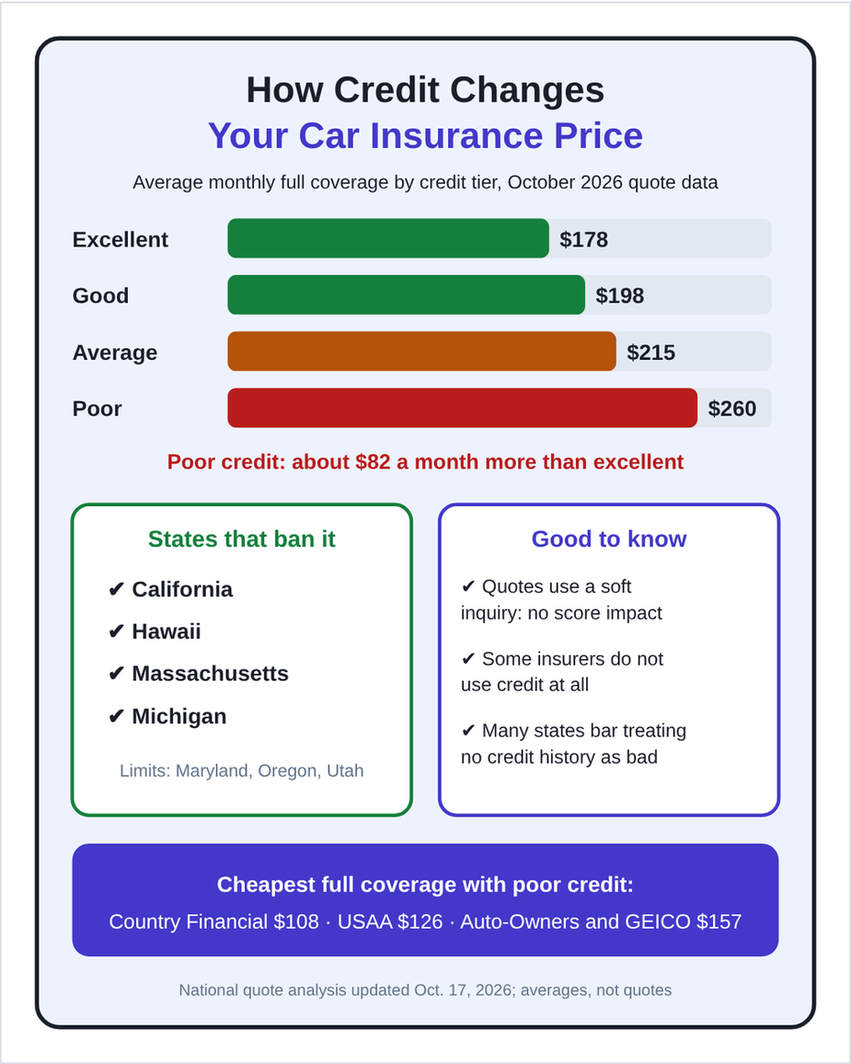
Average monthly full-coverage prices by credit tier and the cheapest companies for poor-credit drivers, from a national quote analysis updated November 2nd, 2026, plus the states that ban or limit credit-based pricing.
BEFORE YOU BUY
Check whether you live in a state that bans credit-based pricing. If you do, every insurer there must price you without your credit, and you can compare quotes normally.
What does "no credit check car insurance" mean?
The phrase is used in three different ways, and knowing which one applies to you saves time.
Three meanings of "no credit check" car insurance
| Meaning | What it is | Who it helps |
|---|---|---|
| The insurer does not use credit | The company prices policies without a credit-based insurance score | Drivers in the states where these insurers sell |
| State law bans credit in pricing | No insurer may use credit to set your rate | Drivers in California, Hawaii, Massachusetts, and Michigan |
| The quote does not hurt your credit | Insurers use a soft inquiry that does not affect your scores | Everyone shopping for insurance |
A fourth idea causes confusion: buying insurance is not borrowing money. You do not need a credit approval to buy a policy, and in most states credit cannot be the only reason an insurer turns you down. What credit usually affects is how much you pay, and sometimes which payment plans you are offered.
Who benefits most
Insurers that skip credit, or states that ban it, help most if your credit is poor but your driving record is clean. In that case, credit may be the biggest thing raising your price. They help less if you have recent accidents or violations, because those insurers price mainly on your driving record.
Drivers with a thin file, such as young adults and people new to the U.S., can also benefit, although many states already require a lack of credit history to be treated neutrally. If your credit is good, a no-credit insurer may not save you anything.
Do car insurance quotes affect your credit score?
No. Experian, one of the three national credit bureaus, says insurers typically use a soft pull when they prepare a quote, and that "requesting car insurance quotes won't affect your credit scores at all." A hard inquiry, which can lower your score slightly, comes from applying for a loan or credit card, not from shopping for insurance.
Insurers also do not use the same score a lender sees. They use a credit-based insurance score, built from your credit report to predict the likelihood of insurance claims. A 2007 Federal Trade Commission report found that these scores predict claims, which is why most insurers use them where the law allows.
What an insurance score cannot use
State laws limit what goes into an insurance score. The NAIC's chart of state laws lists common rules: scores may not use income, gender, race, religion, marital status, ZIP code, or nationality, and many states exclude medical collection accounts. One insurer's consumer-protection summary adds that it cannot use the number of credit inquiries, the type of card you use, your total available credit, or information you are disputing.
Many states also exempt insurance uses from credit freezes, so a freeze on your credit report may not stop an insurer from checking it. If you have frozen your credit, ask the insurer how it will handle the check.
How much does poor credit raise car insurance?
A lot, in most states. A national quote analysis updated November 2, 2026, found these averages by credit tier:
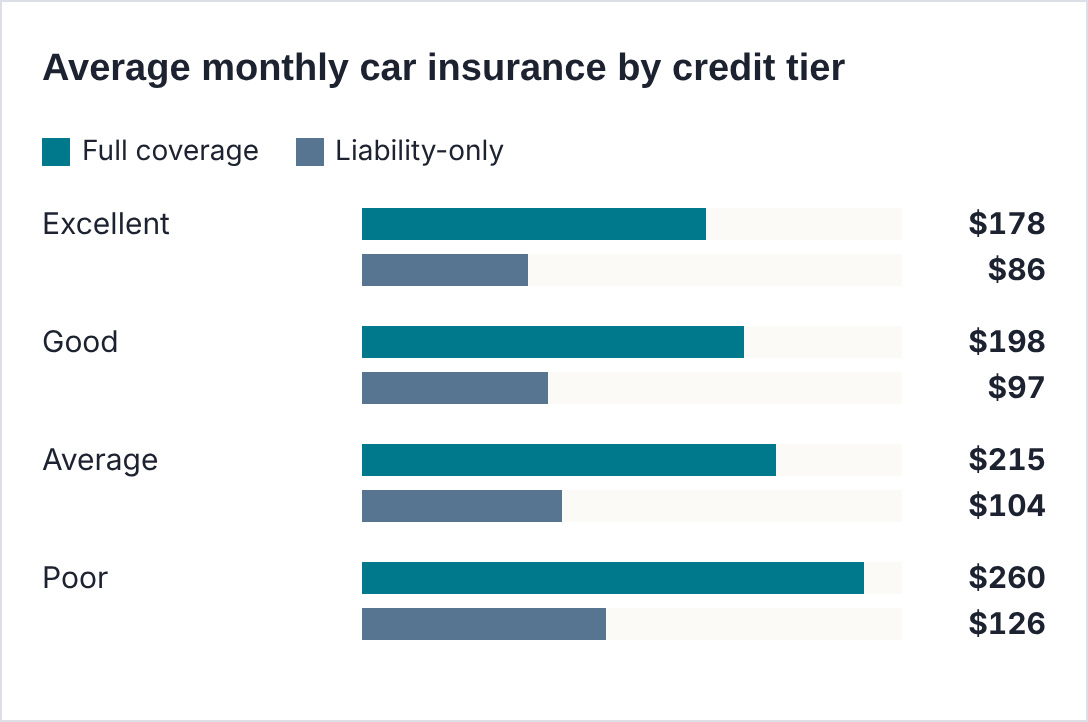
Study B: national real-quote analysis updated November 2, 2026; rates current to September 30, 2026; drivers ages 20 to 70 with clean records. Full coverage includes collision and comprehensive with $1,000 deductibles.
In that data, poor credit added about $82 a month, or $984 a year, for full coverage compared with excellent credit, and about $40 a month for liability-only coverage (our calculation).
Rate studies that hold every other factor constant show even bigger gaps. One study of a 40-year-old with a clean record, using 2026 premium data, found poor credit added an average of $2,102 a year for full coverage across the 46 states and Washington, D.C., that allow credit-based pricing. A second study, which compared five credit tiers across 46 insurers, found these annual full-coverage prices:
Annual full-coverage price by company: poor vs. excellent credit
| Company | Excellent credit | Poor credit | Poor credit, per month (our calculation) | Increase |
|---|---|---|---|---|
| GEICO | $1,091 | $2,548 | $212 | 133% |
| Travelers | $1,074 | $2,689 | $224 | 150% |
| Nationwide | $1,442 | $2,754 | $230 | 91% |
| Progressive | $1,421 | $3,411 | $284 | 140% |
| Allstate | $2,111 | $3,733 | $311 | 77% |
Study A: national rate study using 2026 premium data for a 40-year-old with a clean record, a 2012 Toyota Camry, and full coverage at 100/300/100 limits with a $1,000 deductible. Monthly figures are annual ÷ 12; increases are our calculation from the annual figures. Prices vary by state.
The lesson is not that one company is always best for poor credit. It is that each insurer weighs credit differently. Travelers was the cheapest of these five for excellent credit, but GEICO was cheapest for poor credit, and Nationwide's increase was the smallest in percentage terms among the four lowest-priced companies. That spread is why shopping matters more when your credit is weak.
States that ban or limit credit in car insurance
If you live in one of these states, you may already have no credit check car insurance from every company. Four states ban credit-based pricing, and three more limit it.
State rules on credit in car insurance
| State | Rule | What it means for you |
|---|---|---|
| California | Ban | Insurers cannot use credit history to set rates or deny a policy; banned since Proposition 103 (1988) |
| Hawaii | Ban | Insurers cannot deny coverage or set rates based on credit |
| Massachusetts | Ban | Credit and insurance scores cannot be used to issue or renew policies |
| Michigan | Ban on rating | Insurers cannot use credit to set rates; credit may still affect payment plan options |
| Maryland | Limit | Credit-based surcharges are capped, and credit cannot raise premiums at renewal |
| Oregon | Limit | Credit cannot be the only reason to refuse a new policy, or to cancel or non-renew after 60 days |
| Utah | Limit | Credit alone cannot be used to deny, cancel, or non-renew a policy |
Summarized from state-rule summaries published by Experian, a national quote analysis (November 2, 2026), and a national rate study (October 1, 2026), plus Michigan's insurance code. Rules can change; check your state insurance department.
Michigan has an important wrinkle. Its 2019 auto insurance reform barred credit scores as a rating factor, but Michigan law (MCL 500.2153) still lets insurers use credit information to decide which installment plans you can choose. So your credit should not change your Michigan rate, but it can change how much you pay up front.
Legislators in other states are debating the issue. In 2026, bills to ban or limit credit-based pricing were introduced or advanced in at least six states, including Illinois and New York. None of those had become law in the sources we reviewed, so treat them as proposals, not protections.
In states that allow credit, the penalty varies widely. One 2026 study measured the yearly cost of poor credit compared with excellent credit for the same driver:
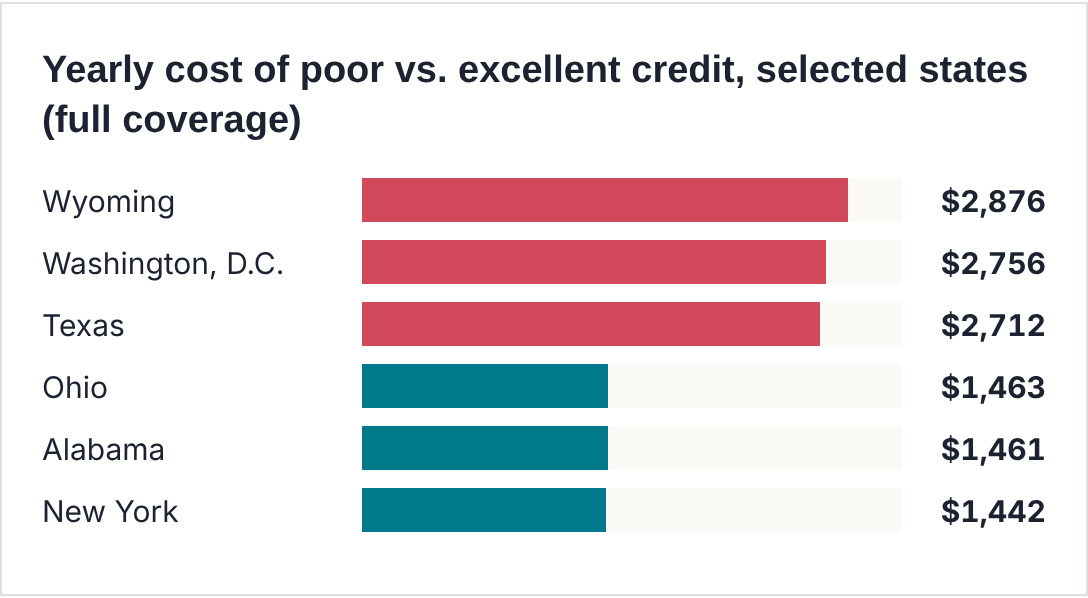
Study A: rate study published September 11, 2026, using 2026 premium data; 40-year-old male, clean record, 2012 Toyota Camry LE, full coverage at 100/300/100, most populous city in each state. Dollar gap = poor-credit annual premium minus excellent-credit annual premium.
Car insurance companies that do not check credit
A small number of insurers say they do not use credit to price policies. They sell only in certain states.
Insurers that say they do not use credit in pricing
| Company | States | What it says | Good to know |
|---|---|---|---|
| CURE (Citizens United Reciprocal Exchange) | Michigan, New Jersey, Pennsylvania | Does not use required credit checks, education, or occupation; prices mainly on driving record | Nonprofit reciprocal exchange founded in 1990 |
| Dillo | Texas | Does not check credit | Underwritten by Alinsco Insurance; offers month-to-month policies and SR-22 filings, according to two 2026 analyses |
| Glacier | Pennsylvania and Delaware, per a 2026 analysis | Its advertising says it does not use your credit score to set rates | Confirm current states and terms directly |
CURE from its own company information (accessed October 2026); Dillo and Glacier from a national quote analysis updated October 30, 2026, and a rate study updated October 1, 2026. Availability can change.
You may also see Root described as a no-credit insurer. In a December 1, 2020, post, Root said credit plays "a relatively small role" in its pricing, not that it does not use credit. We could not confirm that it has stopped using credit, so check its current terms if this matters to you.
Insurers that skip credit are not automatically cheaper. They may weigh your driving record more heavily, and one study noted Dillo's rates were higher than mainstream insurers'. Compare their quotes with the cheapest mainstream options below.
Texas: where no credit check matters most
Texas is a good example of why these insurers exist. In the September 2026 study, poor credit added $2,712 a year to full coverage in Texas, a 183% increase over excellent credit for the same driver. Texas drivers with weak credit have two strategies: get a quote from Dillo, which does not check credit, and compare it with the cheapest mainstream companies for poor credit. The Texas state study we reviewed did not publish a poor-credit price, so use real quotes to decide.
Cheapest car insurance for poor or no credit
Most drivers with poor credit will save more by comparing mainstream insurers than by searching only for no-credit companies. In the October 2026 quote analysis, these companies had the lowest full-coverage averages for poor-credit drivers:
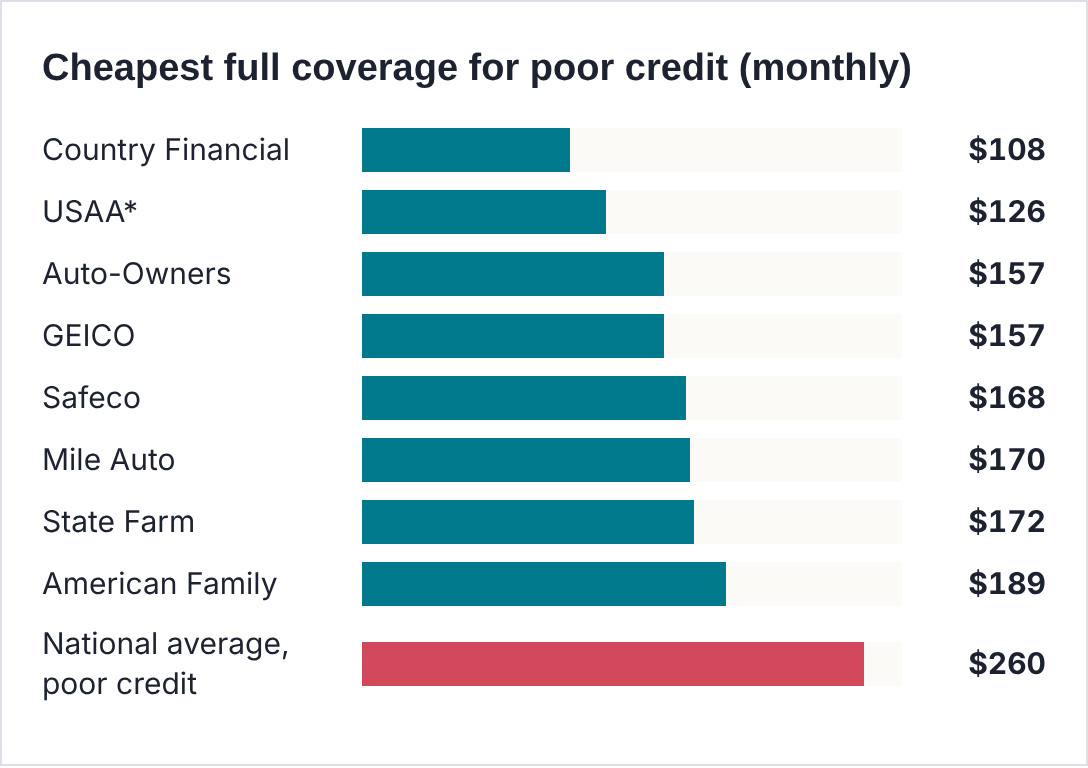
Study B: national real-quote analysis updated November 2, 2026; rates current to September 30, 2026. *USAA serves military members, veterans, and their families. Availability of Country Financial and Auto-Owners varies by state.
Cheapest liability-only coverage for poor credit
| Company | Monthly liability-only | Monthly full coverage |
|---|---|---|
| Country Financial | $53 | $108 |
| USAA | $64 | $126 |
| Auto-Owners | $83 | $157 |
| GEICO | $87 | $157 |
| State Farm | $89 | $172 |
| Mile Auto | $91 | $170 |
Same study B data. The analysis listed identical averages for drivers with poor credit and drivers with no credit history.
Nonstandard insurers, which often market to drivers with credit or record problems, were not the cheapest in this data. The General averaged $264 a month for full coverage, Bristol West $257, and Dairyland $304. They can still be useful if mainstream companies decline you, so include one in your comparison if you have both poor credit and violations.
State examples
State rate studies of a 40-year-old with poor credit, published in 2026, found the cheapest full coverage at $113 a month in New York (Erie, August 13), $125 in Ohio (Grange, October 6), and $140 in Pennsylvania (Nationwide, August 25). The cheapest company for poor credit was often not the cheapest for good credit, which is another reason to compare.
Car insurance with no credit history
No credit history is different from bad credit. If you are young, new to the U.S., or have never borrowed, you may have a thin or empty credit file. The NAIC's chart of state laws notes that many states bar insurers from treating a lack of credit history as a negative, and one insurer's summary of consumer protections says no credit history cannot count against you unless it is treated as neutral.
That means a driver with no credit may be rated like an average-credit driver, not a poor-credit driver. Rules vary by state, so ask each insurer how it treats a thin file.
Your rights when an insurer uses credit
State laws give you protections, even where credit is allowed. The NAIC's summary of state laws, last reviewed in 2025, lists provisions found in many states:
- Disclosure: insurers must tell you that credit information will be used.
- Adverse action notice: if credit raises your price or leads to a denial, you must be told the specific reasons.
- No sole-basis decisions: credit generally cannot be the only reason to deny, cancel, or non-renew a policy.
- Medical collections excluded: many states bar using medical debt collections.
- Updates: many states require scores to be recalculated at least every three years.
- Extraordinary life circumstances: many states require exceptions for events such as serious illness, divorce, a death in the family, identity theft, job loss of three months or more, or military deployment overseas.
PRO TIP #1
If a hardship damaged your credit, ask for an extraordinary life circumstances review. In many states, insurers must consider events like a serious illness, divorce, or job loss. Send a short written request with documents, and ask the insurer to re-rate your policy.
Credit, payment plans, and down payments
Credit can affect how you pay, not just what you pay. Michigan's law shows how this works: even though credit cannot set your Michigan rate, insurers may use credit information to decide which installment plans you can choose. A driver with weak credit may be offered fewer monthly plans or asked for a larger first payment.
If a quote asks for more up front than you can afford, ask whether another payment plan is available, whether paying by automatic bank transfer changes the options, and what the total cost is over the full term. A smaller first payment does not always mean a cheaper policy.
Alternatives that reduce the weight of credit
If you cannot avoid a credit check, you can reduce how much it matters.
- Usage-based programs: Progressive Snapshot, State Farm Drive Safe & Save, GEICO DriveEasy, Nationwide SmartRide, and USAA SafePilot base part of your price on how you drive. One 2026 rate study said these programs generally offer 15% to 40% discounts, usually after two to six months of driving data. Some can raise rates for risky driving.
- Pay-per-mile insurance: programs such as Nationwide SmartMiles and Mile Auto charge partly by mileage. Mile Auto averaged $170 a month for poor-credit full coverage in the October 2026 data.
- Pay in full: if you can, paying the whole term avoids installment fees and can sidestep payment-plan limits tied to credit.
The best overall choice for drivers with poor credit
There is no single winner, because credit rules depend on your state. Our picks, based on the data above:
Best picks by situation
| Your situation | Our pick | Why |
|---|---|---|
| You live in California, Hawaii, Massachusetts, or Michigan | Compare all insurers | None may use credit to set your rate |
| You live in Michigan, New Jersey, or Pennsylvania | Get a CURE quote | Does not use credit in pricing |
| You live in Texas | Get a Dillo quote, then compare | Does not check credit; compare with mainstream rates |
| Poor credit, any state | Country Financial or GEICO | $108 and $157 a month for full coverage in 2026 data |
| Military family with poor credit | USAA | $126 a month for full coverage in 2026 data |
For most drivers outside the ban states, GEICO is the most practical first quote, because it is widely available and was among the cheapest for poor credit in both 2026 datasets. Country Financial and Auto-Owners can be cheaper but sell only in certain states.
Improving your credit: what it could save
Credit can improve, and your premium can follow. Using the October 2026 averages, moving from poor to average credit would lower average full coverage from $260 to $215 a month, a $45 monthly or $540 yearly difference (our calculation). Moving to good credit would save $62 a month, or $744 a year.
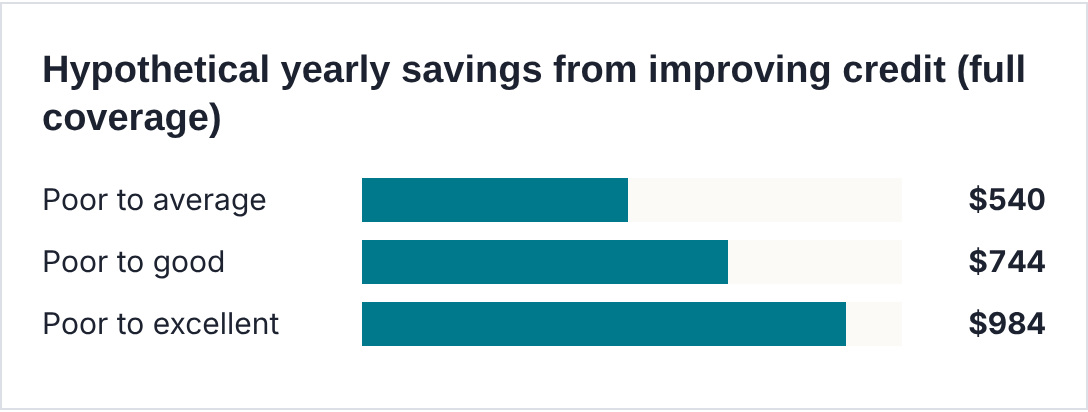
Our calculation from study B: average monthly full-coverage prices by credit tier (November 2, 2026): poor $260, average $215, good $198, excellent $178. Averages, not a promise of savings.
Your insurer may not update your score automatically, so ask for a re-rate after your credit improves. Steps that help credit include paying bills on time, keeping card balances low, and limiting new accounts. You can check your credit reports for free at AnnualCreditReport.com and dispute errors.
10 tips for cheaper car insurance with poor or no credit
- 1. Check your state's rules first. In four states, credit cannot affect your rate.
- 2. Get quotes from at least three insurers, including one that does not use credit where available.
- 3. Include regional companies such as Country Financial or Auto-Owners if they serve your area.
- 4. Compare identical coverage: the same limits, deductibles, drivers, and term.
- 5. Join a usage-based program if you drive safely.
- 6. Raise your deductible if you could pay it after a claim.
- 7. Ask about discounts for bundling, safe driving, multiple cars, and paying in full.
- 8. Request an extraordinary life circumstances review if a hardship hurt your credit.
- 9. Check your credit reports for errors and dispute them.
- 10. Ask for a re-rate when your credit improves, and re-shop at every renewal.
Pros and cons of no credit check car insurance
Pros and cons
| Pros | Cons |
|---|---|
| Your credit history does not raise your price | Few insurers offer it, and only in certain states |
| Helpful after a hardship or with a thin credit file | Not always cheaper than mainstream insurers |
| Pricing focuses on your driving record | Violations may weigh more heavily |
| Every insurer qualifies in the four ban states | Payment plans may still depend on credit in some states |
PRO TIP #2
Ask every insurer one question: "How much of my price comes from my credit?" Many agents can tell you whether your credit tier is raising your quote. If it is, compare an insurer that does not use credit, a usage-based program, and the cheapest mainstream company side by side.
Common mistakes to avoid
- Avoiding quotes because you fear a credit hit. Insurance quotes use soft inquiries.
- Assuming "no credit check" means cheapest. Compare it with mainstream companies.
- Letting coverage lapse. A gap can raise future prices more than credit does.
- Ignoring an adverse action notice. It tells you what to fix and may reveal an error.
FAQs about no credit check auto insurance
Is there car insurance with no credit check?
Yes, in some places. CURE says it does not use credit in Michigan, New Jersey, and Pennsylvania, and Dillo does not check credit in Texas. In California, Hawaii, Massachusetts, and Michigan, state law bars all insurers from using credit to set rates.
Will getting a car insurance quote hurt my credit?
No. Insurers use a soft inquiry when they prepare a quote, and soft inquiries do not affect your credit scores, according to Experian. You can compare as many quotes as you want without any effect on your credit. Hard inquiries come from applying for loans or credit cards.
How much more do drivers with bad credit pay?
In October 2026 quote data, poor-credit drivers averaged $260 a month for full coverage, compared with $178 for excellent credit, about $82 more. Controlled rate studies that change only the credit tier found even larger gaps, averaging $2,102 a year in one 2026 study.
Which company is cheapest for bad credit?
Country Financial had the lowest full-coverage average for poor credit at $108 a month, followed by USAA at $126 for military families, then Auto-Owners and GEICO at $157, in October 2026 data. GEICO is the most widely available of these.
Which states do not allow credit in car insurance?
California, Hawaii, Massachusetts, and Michigan ban credit-based pricing. Maryland, Oregon, and Utah limit how insurers can use it. In Michigan, insurers may still use credit information to decide which installment plans you can choose. Several other states considered bans in 2026.
Can I get car insurance with no credit history?
Yes. Buying insurance does not require a credit approval. Many states bar insurers from treating a lack of credit history as a negative, so a thin file may be rated as neutral. Ask each insurer how it treats drivers with no credit.
Can an insurer deny me because of my credit?
In many states, credit cannot be the only reason to deny, cancel, or non-renew a policy, according to the NAIC's summary of state laws. If credit affects your price or eligibility, you are generally entitled to a notice explaining the reasons.
Will my rate drop if my credit improves?
It can, but not always automatically. Many states require scores to be updated at least every three years. Ask your insurer to re-rate you after your credit improves, and compare new quotes at renewal to see whether another company now prices you lower.
Final recommendation
Start with your state's rules. If you live in a ban state, compare all insurers normally. If you live where CURE, Dillo, or Glacier sells, get their quotes. Everywhere else, compare GEICO with regional companies such as Country Financial and Auto-Owners, and add a usage-based program if you drive safely.
NEXT STEP
Gather your driver's license, vehicle identification number, and current policy. Request at least three quotes with identical coverage, ask each insurer how credit affects your price, and keep your current policy active until the new one starts.
Prices, credit rules, and availability vary by insurer, state, driver, and vehicle. The rates in this article are averages and hypothetical calculations, not quotes. This article is for information only and is not legal or financial advice. The publisher is not an insurance company or a licensed insurance agency.
The bottom line on no credit check car insurance: it exists through a few insurers and in four states, but most drivers save the most by comparing quotes, using their legal rights, and improving their credit over time.
Sources
- Insurify, No-Credit-Check Car Insurance and Does Credit Score Affect Car Insurance? (updated November 2, 2026; rates current to September 30, 2026).
- MoneyGeek, The Credit Score Tax (September 11, 2026) and Which Insurance Companies Don't Use Credit Scores? (updated October 1, 2026).
- Experian, Do Car Insurance Quotes Affect Your Credit Score? (March 19, 2025).
- NAIC, Use of Credit Reports/Scoring in Underwriting (Summer 2025).
- NJM, Summary of Consumer Protections (accessed November 2026).
- CURE Auto Insurance, company information (accessed November 2026).
- Root, Dropping Credit Score from Car Insurance (December 1, 2020).
- Glacier Insurance TV ad, "Credit Score Weight" (via iSpot.tv).
- MoneyGeek state studies: New York (Aug. 13), Ohio (Oct. 6), and Pennsylvania (Aug. 25, 2026).
- State of Michigan, Auto Insurance FAQ and MCL 500.2153 (accessed October 2026).