
Pay As You Go Car Insurance Explained
Last updated on February 16, 2026
The Generalinsurance.org Editorial Team produces informational content about insurance topics, focusing on clear, practical explanations to help readers understand common coverage options, costs, and shopping considerations.
Articles cover everyday questions related to auto, home, renters, life, and other insurance categories, including policy basics, pricing factors, coverage comparisons, and ways consumers may reduce costs while maintaining appropriate protection.
Content reviewed internally for clarity and consistency of general insurance concepts.
Note: This content is for general informational purposes only and does not constitute insurance, legal, or financial advice. Generalinsurance.org is an independent informational website and is not affiliated with any insurer.
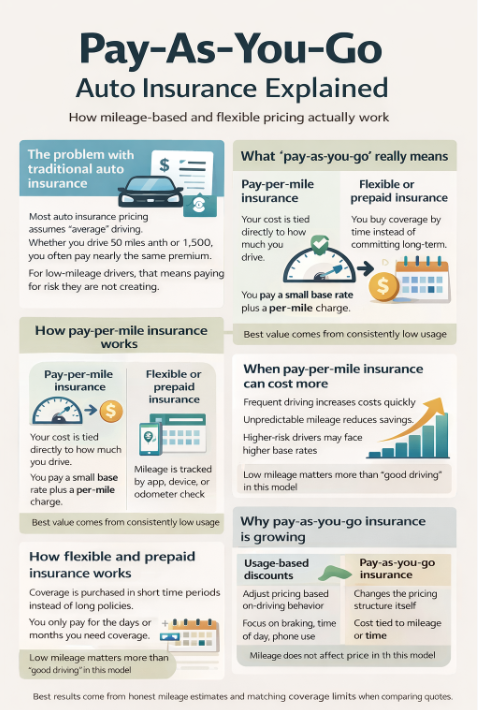
With drivers seeing insurance rates rising, many are turning to pay-as-you-go auto insurance and prepaid coverage to save money. For some, the savings can add up to hundreds per year. Flexible and prepaid auto insurance operates on a time-based model rather than a mileage-based one. Instead of purchasing a traditional six- or twelve-month policy, drivers buy coverage in shorter increments, such as daily, weekly, or month-to-month periods. This approach is designed for drivers who do not need continuous insurance but still want to remain legally covered when they do use their vehicle.
This model is often used by people who drive infrequently, are temporarily between vehicles, or want to avoid large upfront premium payments. By paying only for the time coverage is needed, drivers can reduce short-term financial pressure. However, unlike pay-per-mile insurance, this structure does not reward low mileage. Whether a vehicle is driven ten miles or a thousand miles during the coverage window, the price remains the same.
Flexible insurance works best as a situational solution, not a permanent replacement for standard coverage. When used strategically, it can solve specific problems, but when relied on continuously, it often becomes more expensive than traditional policies.
Risks Associated With Short-Term Coverage
The most significant risk associated with flexible insurance is the potential for coverage gaps. While the ability to turn coverage on and off may seem convenient, even short lapses can negatively impact a driver’s insurance history. Insurers frequently treat gaps as a risk factor, which can lead to higher premiums when returning to a traditional policy.
Another concern is cost efficiency. Short-term insurance is typically priced at a higher effective monthly rate when used continuously. Drivers who renew coverage month after month may end up paying more over the course of a year than they would with a standard policy, without realizing it until costs are compared side by side.
Flexible insurance requires discipline and planning. Drivers who underestimate how often they need coverage or forget to reactivate policies risk being uninsured, which carries legal and financial consequences that far outweigh any short-term savings.
Why Pay-As-You-Go Insurance Has Gained Traction
Pay-as-you-go insurance has grown in popularity largely because driving habits have changed. Remote and hybrid work arrangements have significantly reduced commuting mileage for millions of drivers, making traditional pricing models feel outdated and unfair. Many drivers are paying for risks they no longer generate.
At the same time, rising insurance premiums have forced consumers to re-evaluate how much value they are getting from their policies. Higher repair costs, more expensive vehicles, and increased claim severity have pushed rates upward, even for drivers who rarely use their cars. Pay-as-you-go insurance offers a way to regain some control by aligning costs more closely with actual usage.
For drivers whose vehicles sit parked for long periods, usage-based pricing represents a shift away from assumptions and toward measurable behavior. That alignment is the core reason these models continue to gain attention.

Comparing Pay-As-You-Go Insurance To Usage-Based Discounts
Pay-as-you-go insurance is often confused with usage-based discount programs, but the two operate very differently. Usage-based programs adjust premiums based on how a person drives, not how much they drive. Factors such as braking patterns, acceleration, time of day, and phone usage influence pricing, while mileage may play only a minor role or none at all.
Pay-as-you-go insurance, particularly pay-per-mile models, changes the pricing structure itself. Instead of rewarding or penalizing behavior, it ties cost directly to usage. This distinction matters because a safe driver who drives long distances may receive discounts under a usage-based program but still pay more overall than a low-mileage driver using a pay-per-mile policy.
Understanding this difference helps drivers avoid frustration. Many programs are marketed using similar language, but only true pay-as-you-go models consistently benefit drivers who drive very little.
How To Compare Pay-As-You-Go Quotes Accurately
Comparing pay-as-you-go insurance requires more than looking at a single monthly number. For pay-per-mile insurance, drivers need to estimate realistic monthly mileage, including occasional long trips, not just average weeks. A few high-mileage months can significantly change annual costs.
For flexible insurance, drivers should calculate how many months of coverage they realistically need over a year. What appears inexpensive on a month-to-month basis can become costly when coverage is used continuously. Matching coverage limits, deductibles, and optional protections across quotes is essential for meaningful comparisons.
Without careful estimates, drivers risk choosing a policy that looks cheaper on paper but costs more in practice.
The Importance Of Honesty When Estimating Mileage
Pay-as-you-go auto insurance rewards accuracy. Underestimating mileage can lead to unexpected bills, while overestimating may push drivers away from options that could save them money. Reviewing past driving habits, work schedules, and seasonal travel patterns provides a far better estimate than guessing.
Honest estimates also prevent disappointment. Many drivers assume they are low-mileage until they actually track their driving. Pay-as-you-go insurance works best when expectations match reality.
Is Pay-As-You-Go Auto Insurance Worth It
Pay-as-you-go auto insurance can be highly effective for drivers whose habits align with its structure. Pay-per-mile insurance tends to deliver the strongest value for consistently low-mileage drivers by directly tying cost to usage. Flexible insurance can solve short-term coverage needs, but it is rarely the most economical long-term solution.
The deciding factor is not marketing language but math. When drivers evaluate real-world usage, expected mileage, and coverage needs honestly, the right option usually becomes obvious. Pay-as-you-go insurance is neither a gimmick nor a universal solution. It is a tool that works well when used correctly.
The Final Word On Pay As You Go Car Insurance
Pay-as-you-go auto insurance is not a gimmick, but it is also not a one-size-fits-all solution. Its value depends almost entirely on how you actually use your vehicle. For drivers who put on consistently low mileage, pay-per-mile insurance can meaningfully reduce wasted spending by aligning cost with real risk. For others who only need coverage occasionally, flexible or prepaid insurance can solve short-term problems without long commitments.
The mistake many drivers make is relying on marketing labels instead of understanding the pricing structure. “Usage-based” does not always mean mileage-based, and flexibility does not always equal savings. The math matters more than the terminology.
Before choosing a pay-as-you-go policy, take an honest look at your driving habits, expected mileage, and how often you truly need coverage. When expectations match reality, these models can offer fairer pricing and better control. When they don’t, traditional insurance may still be the smarter long-term choice. Compare pay-as-you-go car insurance quotes and prepaid plans online in under five minutes. Get the savings you deserve today.