
Pay As You Go Car Insurance in California
If your car sits in the driveway most of the week, paying the same premium as a daily commuter feels unfair, and that is why so many drivers search for pay as you go car insurance in California. The good news is that California allows pay-per-mile pricing and requires insurers to weigh miles driven heavily. The catch is that fewer companies sell it here than in most states, and several popular programs are not available at all.
This guide clears up the confusion. It explains the three things "pay as you go" can mean, which pay-per-mile companies actually sell to Californians in 2026, how each one charges, and what the base rates and per-mile rates look like. It also works through the savings math, shows the mileage where pay-per-mile stops paying off, and covers California's unique rules on tracking, the pros and cons, and the best alternatives if no per-mile insurer fits.
KEY TAKEAWAYS
- Nationwide SmartMiles has a California version, and Lemonade advertises pay-per-mile car insurance in California; Allstate Milewise, Progressive Snapshot, and State Farm Drive Safe and Save are not available here.
- Pay-per-mile combines a monthly base rate with a per-mile charge, typically about 6 to 7 cents, and usually saves money only below roughly 10,000 miles a year.
- California law lets insurers price on verified miles but bans pricing on driving behavior or tracking your car's location.
What "pay as you go" car insurance means in California
People use the phrase for three different products, and only one of them changes your price based on how much you drive. Knowing which one you want saves time when you call for quotes.
| Type | How you pay | Price depends on miles? | California availability |
|---|---|---|---|
| Pay-per-mile | Monthly base rate plus a charge for each mile | Yes | Nationwide SmartMiles; Lemonade Car |
| Pay-per-day | Prepaid balance charged a daily rate | No, on days covered | Hugo tested it in California in 2019; current status unclear |
| Monthly or low down payment | A regular policy billed monthly with a small first payment | No | Widely available from standard insurers |
Nationwide; Lemonade; J-PAL study of Hugo in California (2019); company and review sites (accessed November 11, 2026).
This guide focuses on pay-per-mile, the only option that rewards driving less. If you simply need a smaller first payment, any California insurer that bills monthly can help, and the state's Low Cost Auto program, covered below, can help low-income drivers.
Key terms to know
| Term | What it means |
|---|---|
| Base rate | The fixed monthly charge, paid even if the car never moves |
| Per-mile rate | The charge for each mile driven, often a few cents |
| Daily cap | The most miles counted in one day, such as 250 |
| Verified mileage | Miles confirmed by an odometer reading or device |
| Telematics | Technology that records driving data from a car or phone |
| Prop 103 | The 1988 law that sets California's mandatory rating factors |
| Break-even mileage | The yearly miles where pay-per-mile costs the same as a flat policy |
How pay-per-mile insurance charges you
Every pay-per-mile policy uses the same basic formula. You pay a fixed monthly base rate, which covers your car while it is parked and reflects your record, age, car, and ZIP code. Then you pay a per-mile rate for every mile you drive that month. The two together make your bill.
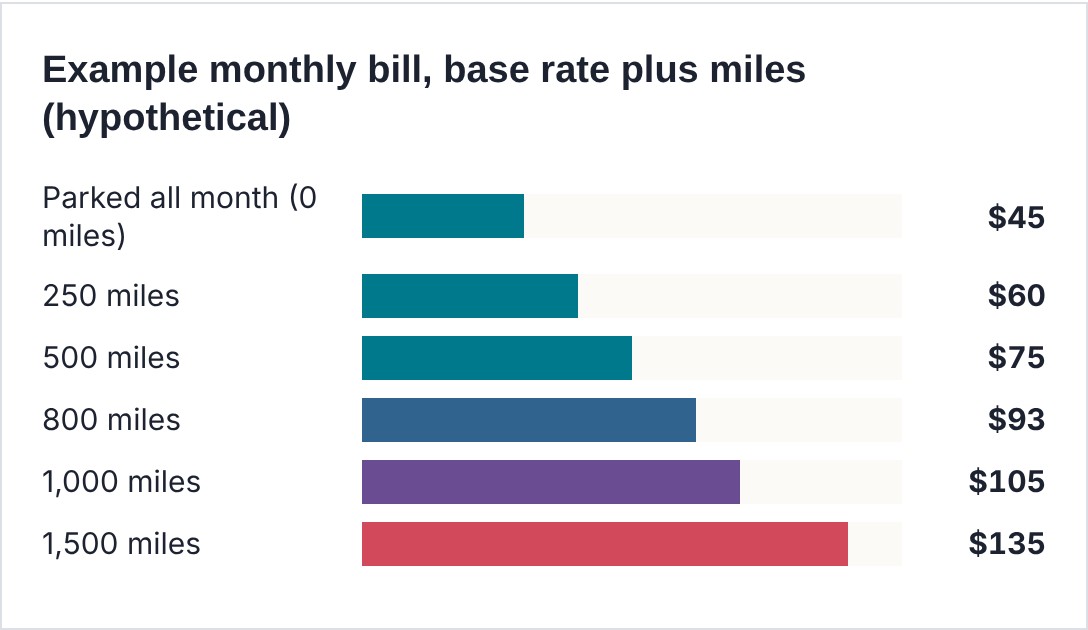
Industry examples fall in a similar range. One 2026 rate study described typical base rates of $30 to $60 a month and per-mile charges of about 6 to 7 cents. Another used $34 a month plus 5 cents a mile, so 800 miles cost $74. Nationwide's own example, from Chicago, was a $35 base plus 7 cents a mile.
Most programs also limit how much a long day costs. Nationwide's road trip exception counts only the first 250 miles you drive in a day, so a 600-mile drive to Lake Tahoe and back is billed as 250 miles. Ask any insurer you consider whether it has a daily cap.
How your miles are counted in California
Mileage has to be verified, and California law spells out how. Insurers may use odometer readings taken by the insurer, a repair shop, a smog check station, or the DMV, readings you report yourself, or a device that records miles. Nationwide SmartMiles uses a plug-in device or an eligible connected car. Lemonade uses its app. Mile Auto, where available, uses a monthly odometer photo.
Pay-per-mile companies available in California
Availability is where most online guides go wrong. Several lists still rank Metromile first, or include Allstate Milewise, even though neither is an option for a new California customer today. This table reflects official company pages and recent reviews as of November 11, 2026.
| Program | California status | How it charges | Mileage tracking |
|---|---|---|---|
| Nationwide SmartMiles | Available; quote by phone or agent | Monthly base plus per-mile rate; first 250 miles a day counted | Plug-in device or connected car |
| Lemonade Car (pay-per-mile) | Advertised for California on Lemonade's site | Fixed monthly base plus per-mile price; plans from $30 a month | Lemonade app |
| Metromile | No new policies under the Metromile name | Merged into Lemonade after its 2022 purchase | Not applicable |
| Mile Auto | Sources conflict; confirm before buying | Base rate plus per-mile rate | Monthly odometer photo |
| Allstate Milewise | Not available in California | Daily base plus per-mile rate | Not applicable |
| Progressive Snapshot | Not available in California | Behavior-based program | Not applicable |
| State Farm Drive Safe and Save | Not available in California | Behavior-based program | Not applicable |
| USAA SafePilot Miles | Not available in California | Pay-per-mile | Not applicable |
| Hugo (pay-per-day) | Not offered in California, per a 2026 review | Daily rate from a prepaid balance | Not mileage-based |
Nationwide SmartMiles California page; Lemonade California and availability pages; State Farm FAQ; 2025 and 2026 company reviews (accessed November 11, 2026). Sources disagree on Lemonade's and Mile Auto's California pay-per-mile status, so confirm with a quote.
Nationwide SmartMiles
SmartMiles is the most clearly available pay-per-mile program in California. Nationwide maintains a California-specific SmartMiles page, and California is not on its list of excluded states. Your monthly bill is a base premium plus a per-mile rate times the miles from your prior billing cycle, with the first 250 miles in a day counted. In California, Nationwide notes that its Safe Driving Behavior Discount is not available because state law bars behavior-based pricing.
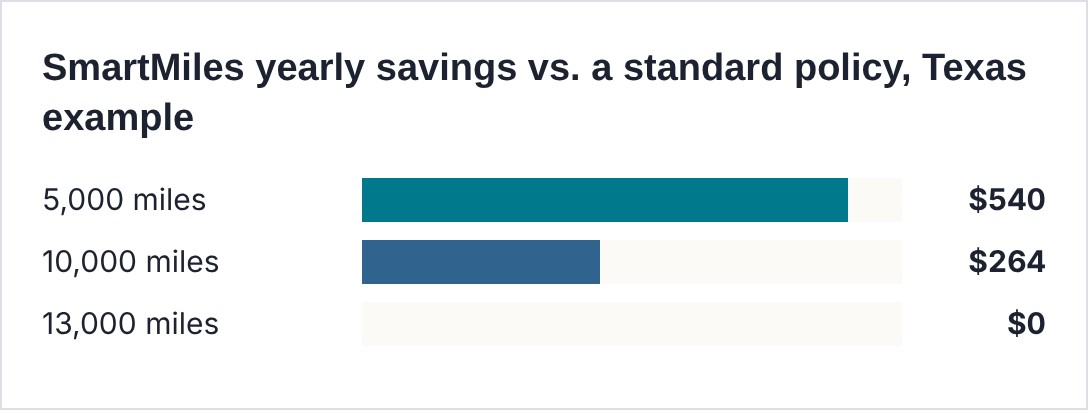
Nationwide does not publish California rates. In a Texas example from a 2025 review, SmartMiles charged a $984 annual base plus 5.5 cents a mile, saving up to $540 a year at 5,000 miles, $264 at 10,000 miles, and nothing at 13,000 miles compared with a standard Nationwide policy.
Lemonade Car
Lemonade bought Metromile in July 2022, and Metromile customers have since been moved toward Lemonade Car. Lemonade's California page presents pay-per-mile car insurance with a monthly base price that does not change, plus a per-mile price, and says plans start as low as $30 a month. Its app records miles in the background. Because one Lemonade availability table lists pay-per-mile in only a few states, get a California quote to confirm the pay-per-mile version before you switch.
One caution: some Lemonade pages describe app-tracked braking and speeding affecting your price. That does not apply in California, where only verified miles may be used, so expect your California rate to depend on miles, not driving style.
Mile Auto
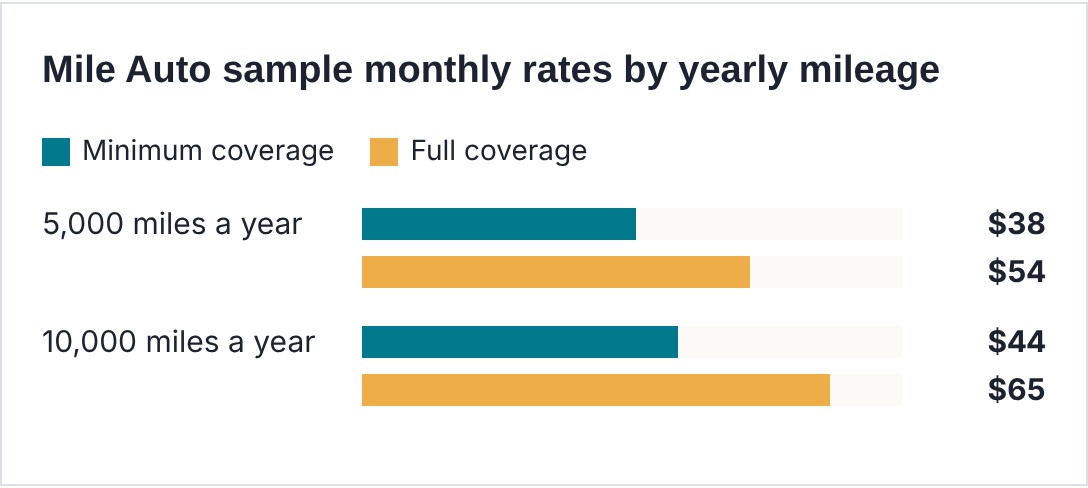
Mile Auto charges a fixed monthly base plus a per-mile rate and asks for an odometer photo each month, with no device or app. A September 2026 review listed California among its states, but others did not, and one reader reported that it no longer sells new California policies. If it does quote you, its published examples show how cheap low mileage can be.
Programs that will not work in California
Allstate's Milewise does not appear on any reliable list of California states. Progressive's Snapshot and State Farm's Drive Safe and Save both say they are not available in California, and USAA's SafePilot Miles also excludes the state. Some of these programs rely partly on driving behavior, which California law does not allow insurers to use for pricing, and the others are simply not filed for California.
California's unique rules: miles yes, driving behavior no
California regulates car insurance pricing more tightly than any other state. Proposition 103, passed by voters in 1988, requires insurers to set rates using three mandatory factors in order of importance: your driving safety record, the number of miles you drive each year, and your years of driving experience. Miles driven is the second most important factor by law.
A 2009 regulation, Title 10, section 2632.5 of the California Code of Regulations, lets insurers use verified actual mileage instead of an estimate. It allows a technological device to verify miles, but says the device may collect only miles driven and may not collect or store your car's location, except for emergency road, theft, map, or travel services. Participation must be voluntary.
| Data | Allowed for pricing? | Source |
|---|---|---|
| Verified miles driven | Yes | 10 CCR § 2632.5 |
| Odometer readings from smog checks, shops, or the DMV | Yes, to verify miles | 10 CCR § 2632.5 |
| Vehicle location | No, except emergency, theft, map, or travel services | 10 CCR § 2632.5 |
| Speed, hard braking, phone use | No | Prop 103 rating rules |
| Credit score | No | Prop 103 rating rules |
| Good driver discount | Required: at least 20% | Insurance Code § 1861.02 |
California Insurance Code section 1861.02; 10 CCR section 2632.5 (2009); news coverage of AB 311 (July and August 2026).
That may change one day, but not soon. Assembly Bill 311, which would have allowed opt-in pricing based on driving behavior, passed the Assembly 77 to 0 but was held in the Senate Appropriations Committee in August 2026, which ended it for the year. The California Department of Insurance opposed the bill.
Pay-per-mile vs. usage-based vs. a low-mileage discount
Three tools reward driving less, and they work differently. Pay-per-mile bills you for the miles you actually drive each month. Usage-based programs in other states score how you drive, which California does not allow for pricing. A low-mileage rating on a standard policy charges a fixed premium based on the miles you expect to drive or have verified.
| Feature | Pay-per-mile | Behavior-based telematics | Low-mileage rating |
|---|---|---|---|
| Bill changes monthly | Yes | No | No |
| Uses speed or braking | No in California | Yes, in other states | No |
| Allowed in California | Yes | No | Yes, required factor |
| Device or app | Usually | Yes | Optional for verification |
| Best for | Under about 10,000 miles a year | Not available in California | Any driver below average mileage |
Your privacy with a mileage device
Privacy is one of the main reasons drivers hesitate to plug in a device or install an app. California offers stronger protection than most states. Under its 2009 regulation, a device used for verified mileage pricing may collect only the miles driven and may not collect or store your car's location, except when you use emergency road service, theft recovery, maps, or travel services. Participation must also be voluntary, and insurers must offer every verification method equally to all customers. If you prefer not to use a device at all, ask whether the insurer accepts odometer readings from smog checks or service visits instead. Read the app's privacy policy before you enroll, because apps can collect data for purposes other than pricing.
How California compares with other states
California is the only state that bars insurers from pricing on driving behavior collected by telematics, according to 2026 coverage of the AB 311 debate. In most other states, pay-per-mile programs can add a safe driving discount on top of mileage savings, and Nationwide's SmartMiles includes one outside California. Those differences explain why national rankings of pay-per-mile insurers often do not apply to California drivers. Allstate's Milewise is sold in about 22 states, none of them California. For Californians, that means fewer programs and smaller extra discounts, but also more privacy and a price that depends mainly on how much you drive.
How much can you save with pay-per-mile in California?
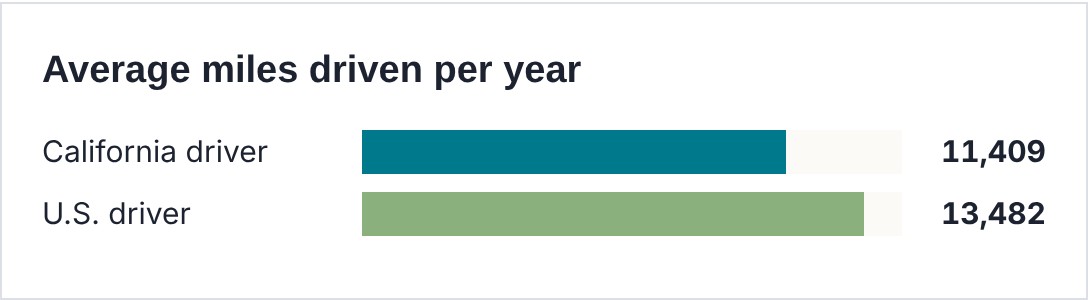
The answer depends on how far you drive compared with other Californians. California drivers average 11,409 miles a year, below the national average of 13,482, according to 2022 Federal Highway Administration data. If you drive well under that, pay-per-mile can cut your bill. If you drive more, it usually costs extra.
To show the math, we built a hypothetical California pay-per-mile policy with a $45 monthly base and 6 cents a mile, the middle of the typical ranges reported in 2026, and compared it with California's average liability-only premium of $1,170 a year from Study B, a real-quote analysis updated November 11, 2026.
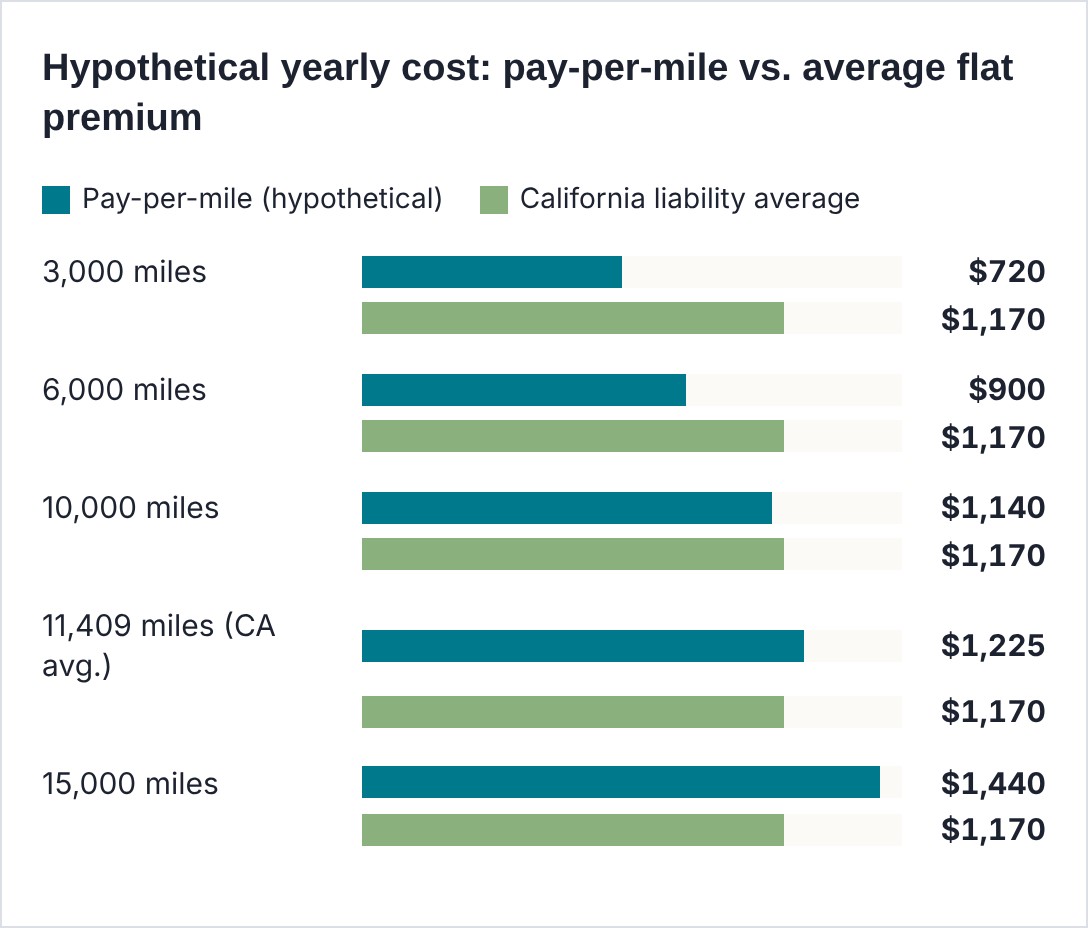
In this example, a driver who covers 3,000 miles a year would save about $450, and a driver at 6,000 miles would save about $270. The break-even point is about 10,500 miles a year. At California's average of 11,409 miles, pay-per-mile would cost about $55 more than the flat average, and at 15,000 miles, about $270 more.
| Miles a year | Pay-per-mile cost | vs. $1,170 average | Monthly difference |
|---|---|---|---|
| 3,000 | $720 | Save $450 | About $38 less |
| 6,000 | $900 | Save $270 | About $23 less |
| 8,000 | $1,020 | Save $150 | About $13 less |
| 10,000 | $1,140 | Save $30 | About $3 less |
| 11,409 | $1,225 | Pay $55 more | About $5 more |
| 15,000 | $1,440 | Pay $270 more | About $23 more |
Hypothetical; our calculation using a $45 monthly base and 6 cents a mile. Your base rate depends on your record, car, and ZIP code, and full coverage costs more.
Four California drivers, four results
These hypothetical examples use the same $45 base and 6 cents a mile as the chart above, compared with the $1,170 average for liability-only coverage. Real base rates will be higher or lower depending on each driver's record, car, and ZIP code.
| Driver | Miles a year | Pay-per-mile cost | Result vs. $1,170 |
|---|---|---|---|
| Weekend car in San Diego | 2,000 | $660 | Saves $510 |
| Retiree in Sacramento | 4,000 | $780 | Saves $390 |
| Hybrid worker in Oakland | 7,000 | $960 | Saves $210 |
| Inland Empire commuter | 16,000 | $1,500 | Pays $330 more |
Hypothetical; our calculation. Not a quote.
Real-world estimates point the same way. One 2026 rate study said low-mileage drivers can save 20% to 40% with pay-per-mile, and that traditional insurance is almost certainly cheaper once you drive 1,500 miles or more a month. A 2008 Brookings Institution study of California estimated that pay-as-you-drive pricing would lower costs for 64% of California households, saving them an average of $276 per vehicle a year in 2007 dollars, and would cut driving by about 8%.
What California car insurance costs without pay-per-mile
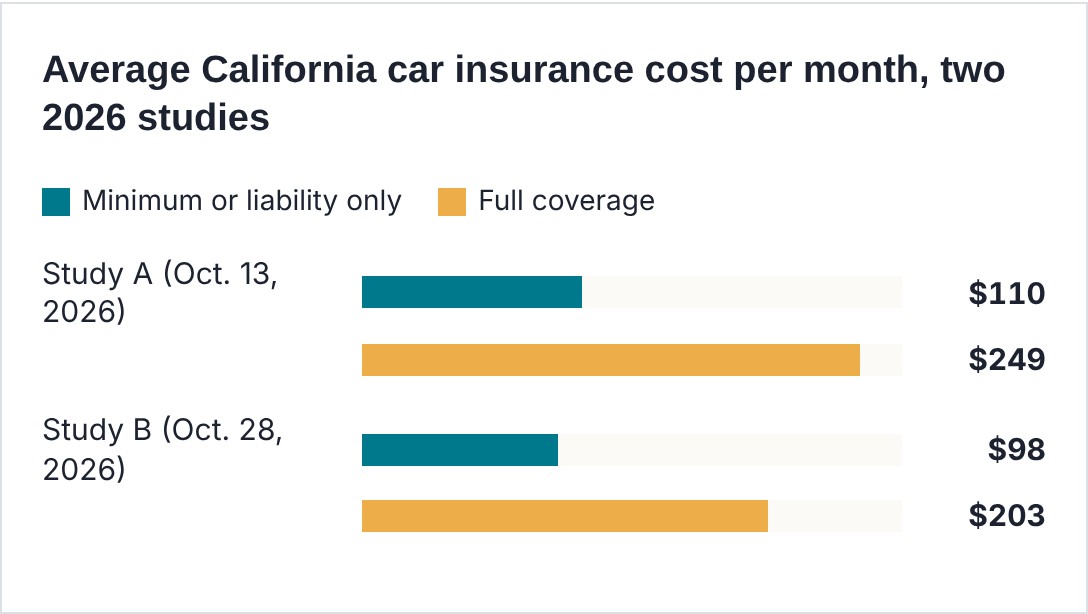
To judge any pay-per-mile quote, compare it with what standard policies cost. Study A, an analysis updated November, 2026, put California's average at $249 a month for full coverage and $110 a month for minimum coverage. Study B put the averages at $203 for full coverage and $98 for liability-only coverage.
Remember that pay-per-mile does not mean less coverage. You can buy the California minimum of 30/60/15, which rose from 15/30/5 on January 1, 2025, or full coverage with collision and comprehensive. Your base rate rises with more coverage, so compare quotes with identical limits.
Who benefits most from pay-as-you-go insurance in California
| Driver | Good fit? | Why |
|---|---|---|
| Remote and hybrid workers | Yes | No daily commute keeps miles low |
| Retirees | Yes | Fewer miles and flexible schedules |
| City drivers in San Francisco, Los Angeles, or San Diego | Often | Transit, biking, and short trips cut mileage |
| Second or weekend cars | Yes | The car sits most of the time |
| College students without daily driving | Often | Low mileage during the school year |
| Long-distance commuters | No | Miles add up past break-even |
| Rideshare and delivery drivers | No | High mileage and commercial-use exclusions |
| Frequent road-trippers | Maybe | Daily caps help, but miles still add up |
Pros and cons of pay as you go car insurance in California
| Pros | Cons |
|---|---|
| Low-mileage drivers can save hundreds a year | Few insurers sell it in California |
| California bans behavior-based pricing, so mileage is what counts | Costs more once you pass about 10,000 miles a year |
| No location tracking allowed for pricing | Bills change month to month |
| Daily caps limit the cost of road trips | A device or app is usually required |
| Same coverage options as a standard policy | Base rate still reflects your record and ZIP code |
| Encourages driving less | Not built for rideshare or delivery work |
In California, the biggest drawback is choice. With only a couple of pay-per-mile insurers clearly available, you cannot shop as widely as drivers in other states, and the cheapest standard insurer for your profile may still beat the best per-mile quote. That is why the smartest approach is to price both kinds of policy side by side, using your real mileage and the same coverage limits.
Pay-per-day insurance: the Hugo experiment
California was home to one of the most studied pay-as-you-go experiments. In 2019, Hugo, a startup selling liability coverage in blocks of days, worked with researchers from J-PAL and Harvard Business School. Among 1,537 applicants with a median income of about $34,000, those offered pay-as-you-go coverage were 10.8 percentage points more likely to buy insurance, an 89% increase over the 12.1% baseline, and they had 27% more insured days.
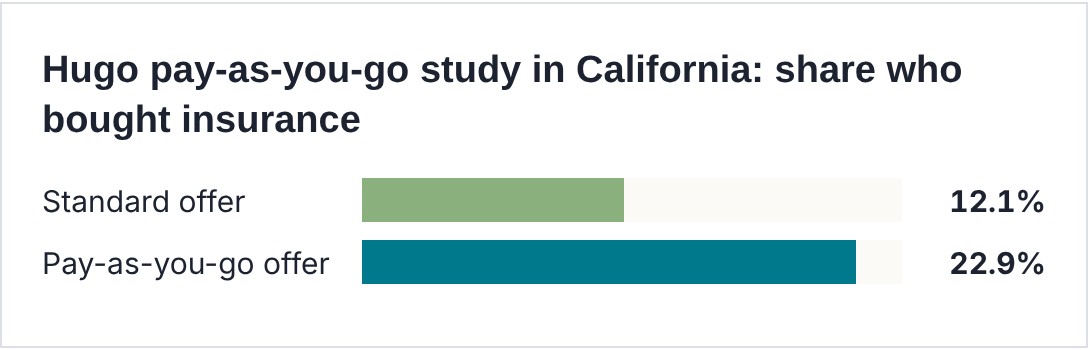
The study showed that flexible payment helps budget-strapped drivers get insured. But by the end of the study, the share of drivers who were insured was about the same in both groups. A 2026 review says Hugo does not currently offer coverage in California, so drivers looking for this model today should ask agents about short policy terms and monthly billing instead.
Low-mileage discounts from standard California insurers
If no pay-per-mile insurer fits, you can still be rewarded for driving less. Because Prop 103 makes annual mileage a mandatory rating factor, every California insurer must consider how far you drive. Report your mileage accurately at every renewal, and ask whether the insurer offers a verified mileage program, which can use odometer readings from smog checks or service visits.
California has done this before. In 2011, the state approved mileage-only programs from State Farm and the Automobile Club of Southern California. State Farm offered a 5% initial discount for verified mileage, and the Auto Club priced verified low-mileage drivers 1% to 10.5% below drivers who estimated their miles, an average saving of $68 a vehicle. Ask any insurer what its current program offers.
| Year | Event |
|---|---|
| 1988 | Voters pass Prop 103, making miles driven a mandatory rating factor |
| 2008 | Brookings study estimates savings for 64% of California households |
| 2009 | Regulation allows verified actual mileage and bans location tracking for pricing |
| 2011 | State Farm and Auto Club of Southern California launch mileage programs |
| 2019 | Hugo pay-per-day study enrolls 1,537 California applicants |
| 2022 | Lemonade acquires Metromile |
| 2025 | California minimum limits rise to 30/60/15 |
| Aug. 2026 | AB 311, to allow behavior-based pricing, stalls in the Senate |
Prop 103; Brookings Institution (July 31, 2008); 10 CCR § 2632.5; Insurance Journal (December 2010); J-PAL; Lemonade; SB 1107; Capitol Weekly (August 26, 2026).
The California Low Cost Auto program
For low-income drivers, the state's Low Cost Auto program may beat any pay-as-you-go option. It offers liability coverage at limits of 10/20/3 for $199 to $418 a year, depending on county, under rates effective May 1, 2025. To qualify, you need a valid California license, a good driving record, a car worth $25,000 or less, and household income up to 250% of the federal poverty level, from about $39,900 for one person to $96,700 for a household of five.
| Option | Best for | Typical cost | Watch out for |
|---|---|---|---|
| Pay-per-mile | Drivers under about 10,000 miles a year | Base rate plus about 6 to 7 cents a mile | Few California insurers |
| Low-mileage rating on a standard policy | Any driver with lower mileage | Varies by insurer | Must report miles accurately |
| Low Cost Auto program | Low-income drivers with good records | $199 to $418 a year (liability) | Limits of 10/20/3 only |
| Monthly billing, low down payment | Drivers short on cash | Same premium, spread out | Total cost may not drop |
California Department of Insurance, Low Cost Auto program 2026 report; mylowcostauto.com; 2026 rate studies.
How to get pay as you go car insurance in California
- Work out your real yearly mileage from your odometer and an old smog check or service receipt.
- Get a Nationwide SmartMiles quote online, by phone at 1-855-241-9720, or through an agent.
- Get a Lemonade Car quote and confirm that the California policy is priced per mile.
- Get at least one standard quote with the same limits, and report your low mileage accurately.
- Compare the yearly cost at your expected mileage, including any device requirements.
- Check whether the policy has a daily mileage cap for road trips.
- Start the new policy before canceling the old one, so there is no gap.
Questions to ask before you buy
- What is my monthly base rate, and what is my per-mile rate?
- Is there a daily mileage cap for long trips?
- How are my miles verified, and what data does the device or app collect?
- Can I switch back to a standard policy if my driving changes?
- Does the policy cover rideshare or delivery driving?
Common mistakes to avoid
The first mistake is guessing your mileage. Many drivers overestimate, and an accurate odometer check can change which option is cheapest. The second is comparing a pay-per-mile quote for minimum coverage with a standard quote for full coverage; match the limits and deductibles exactly.
The third is forgetting about changes in your life. A new job with a long commute can push a pay-per-mile bill past a flat premium within months. The fourth is relying on old lists that still recommend Metromile or Allstate Milewise for California. Finally, do not let a device stay unplugged; most programs need verified miles to bill you correctly.
If your driving changes
Pay-per-mile works best when your mileage is steady and low. If you start commuting again, compare your recent bills with a standard quote, and ask whether your insurer lets you move to a regular policy at renewal. Going the other way, if you start working from home, tell your insurer your new expected mileage right away, since miles driven must factor into your California rate.
Pay as you go car insurance in California at a glance
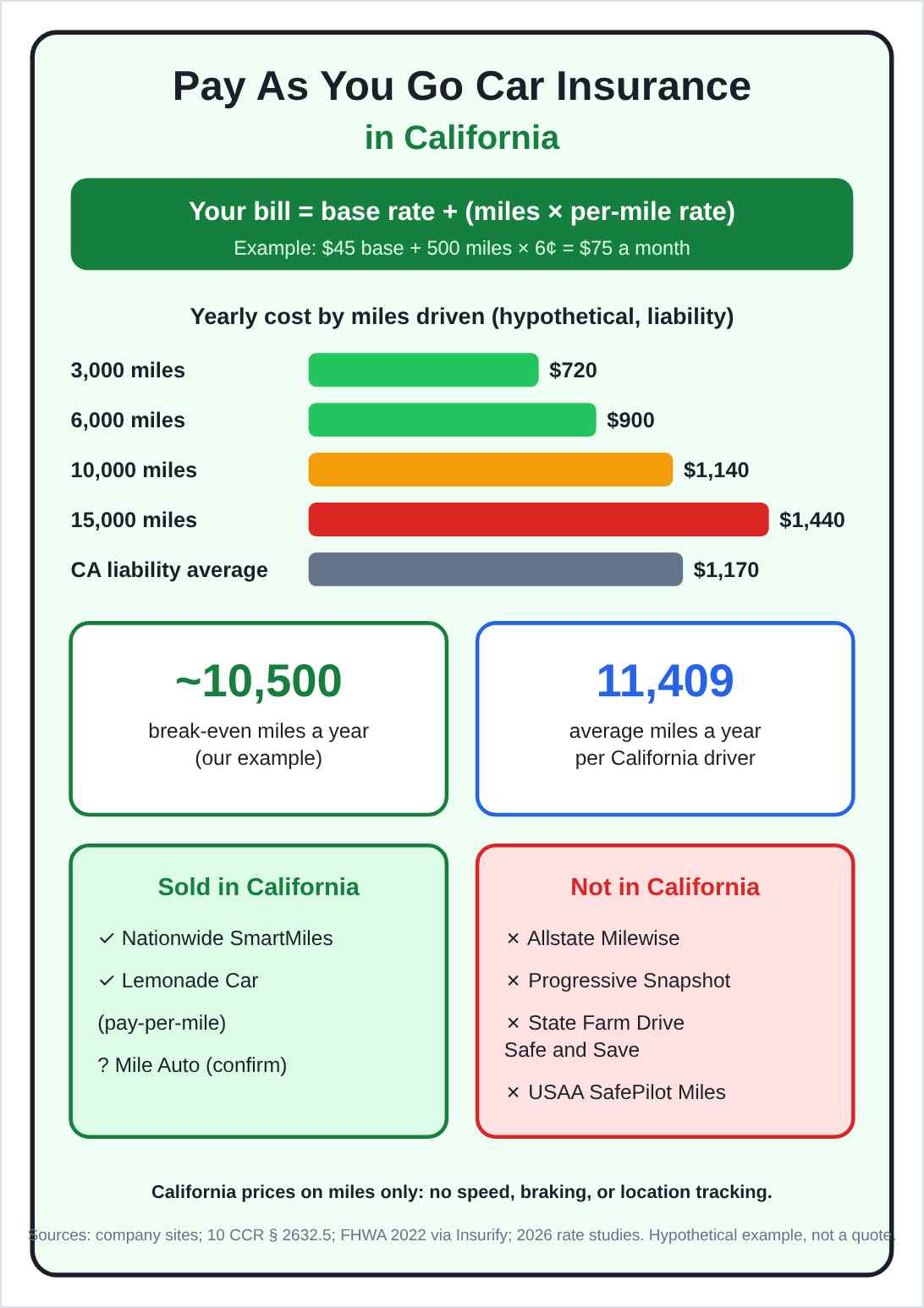
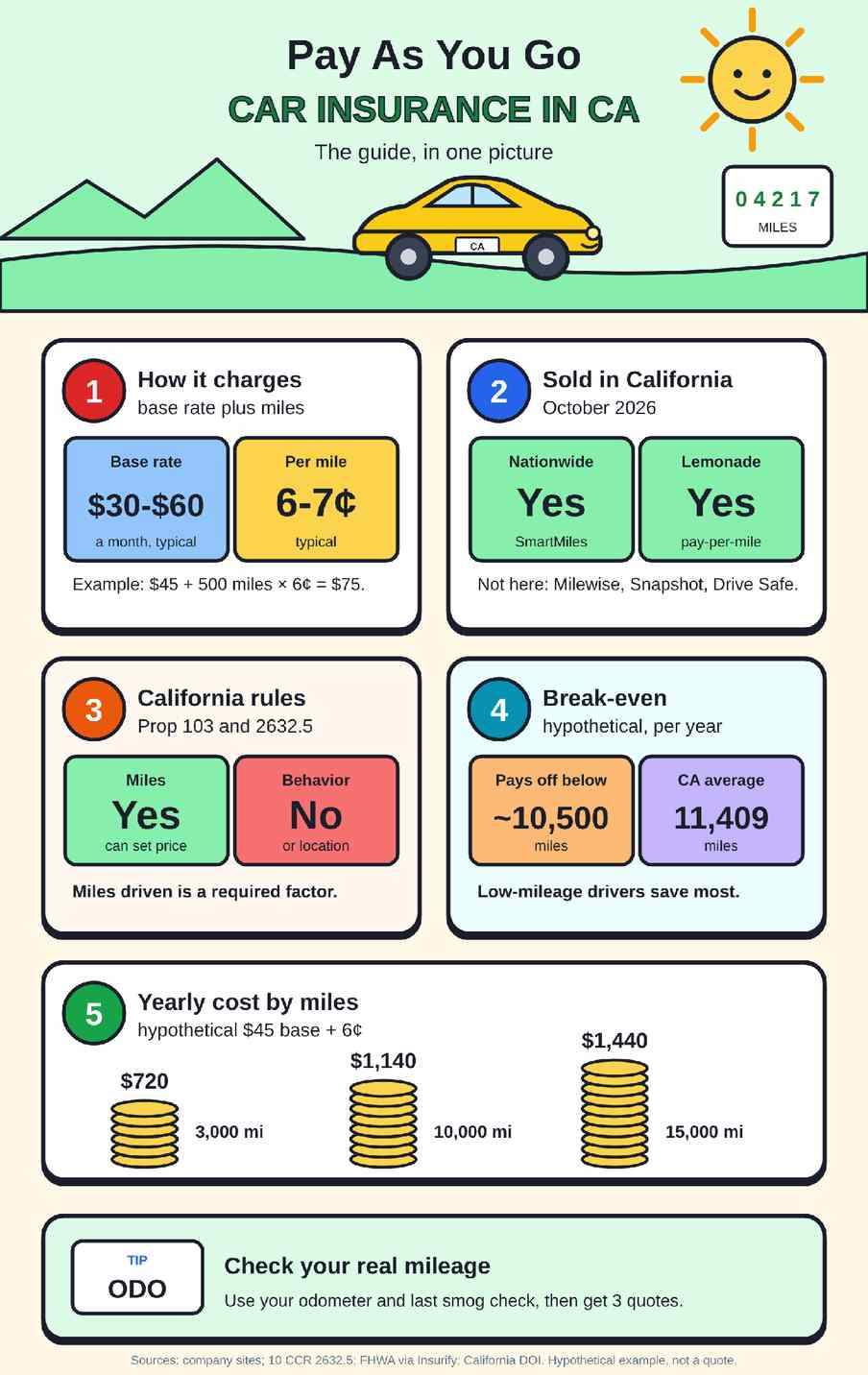
This illustrated summary pulls together the main points of this guide.
Frequently asked questions
Does California allow pay-per-mile car insurance?
Yes. Prop 103 makes miles driven a mandatory rating factor, and a 2009 regulation lets insurers use verified actual mileage, including from a device. The device may record only miles, not your location, and insurers cannot price on speed, braking, or other driving behavior in California.
Which companies offer pay-per-mile insurance in California?
Nationwide SmartMiles has a California version, sold online, by phone, or through agents, and Lemonade advertises pay-per-mile car insurance in California. Mile Auto's California status is unclear. Allstate Milewise, Progressive Snapshot, State Farm Drive Safe and Save, and USAA SafePilot Miles are not available in California.
Is Metromile still available in California?
Not under the Metromile name for new customers. Lemonade bought Metromile in July 2022, and the brand has been folded into Lemonade Car. Lemonade's California page advertises pay-per-mile pricing with plans starting at $30 a month, so request a Lemonade quote instead.
How much does pay-per-mile insurance cost per mile?
A 2026 rate study described typical per-mile charges of about 6 to 7 cents, on top of base rates of $30 to $60 a month. Nationwide's Chicago example was 7 cents a mile on a $35 base. Rates depend on your record, car, ZIP code, and coverage.
How many miles do I need to drive for pay-per-mile to save money?
Usually fewer than about 10,000 miles a year. In our hypothetical California example, a $45 base plus 6 cents a mile broke even at about 10,500 miles. California drivers average 11,409 miles a year, so pay-per-mile tends to help drivers well below average.
Can insurers track my driving in California?
Only to count miles. California regulations say a mileage device may collect only miles driven and may not collect or store your car's location, except for emergency, theft, map, or travel services. Driving behavior such as speed and braking cannot be used to set your rate.
What happens on a road trip with pay-per-mile insurance?
You pay for the miles, but caps can help. Nationwide SmartMiles counts only the first 250 miles you drive in a day, so a long drive costs less than its full mileage. Ask any insurer about a daily cap before buying, especially if you travel often.
Can I buy car insurance by the day in California?
Options are limited. Hugo sold pay-per-day coverage in California and was the subject of a 2019 study, but a 2026 review says it does not currently offer coverage in California. Short-term drivers can ask agents about monthly billing or a standard policy they can cancel.
The final word on pay as you go car insurance in California
California is friendlier to low-mileage drivers than its short list of pay-per-mile insurers suggests. Miles driven is a mandatory pricing factor, verified mileage is allowed, and driving behavior and location are off limits. Nationwide SmartMiles and Lemonade Car are the main pay-per-mile options, while several popular national programs are not sold here.
If you drive well under about 10,000 miles a year, a pay-per-mile quote could save you hundreds of dollars. If you drive more, a standard policy with accurately reported mileage is usually cheaper. Either way, compare quotes with identical coverage, and let your odometer, not a guess, guide your choice.
Availability, rates, discounts, and regulations change and vary by driver, vehicle, and ZIP code. The figures in this article are published rates, averages, and hypothetical calculations, not quotes or offers. This article is for information only and is not legal or financial advice. The publisher is not an insurance company or a licensed insurance agency and is not affiliated with any company named here.
The bottom line on pay as you go car insurance in California: it works best for drivers who keep their miles low, and a few minutes with your odometer and two or three quotes will tell you whether it can cut your bill.
Sources
- Nationwide, SmartMiles California and SmartMiles (accessed November 1, 2026).
- Lemonade, Car insurance in California and availability (accessed November 1, 2026).
- State Farm, Drive Safe and Save FAQ; ValuePenguin, Progressive Snapshot review.
- 10 CCR § 2632.5; California Department of Insurance, pay-as-you-drive regulation text (2009); Insurance Code § 1861.02.
- Capitol Weekly, Driving data bill stalls again (August 26, 2026); CalMatters, telematics bill (July 2026).
- MoneyGeek, Pay-per-mile car insurance (November 1, 2026); NerdWallet, Pay-per-mile car insurance (July 2, 2026).
- ValuePenguin, Nationwide SmartMiles review (July 8, 2025) and Mile Auto review (September 30, 2026).
- Insurify, Average miles driven per year (March 18, 2026) and California average cost (November 11, 2026).
- Experian, Average cost of car insurance in California (November 1, 2026).
- J-PAL, Pay-as-you-go car insurance in California.
- Brookings Institution, Pay-as-you-drive auto insurance in California (July 31, 2008).
- Insurance Journal, California approves pay-as-you-drive programs (December 2010).
- Ocho, Hugo insurance alternatives (June 22, 2026).
- California Department of Insurance, Low Cost Auto program report (2026); CDI, 2025 changes.