
Temporary Car Insurance in Georgia
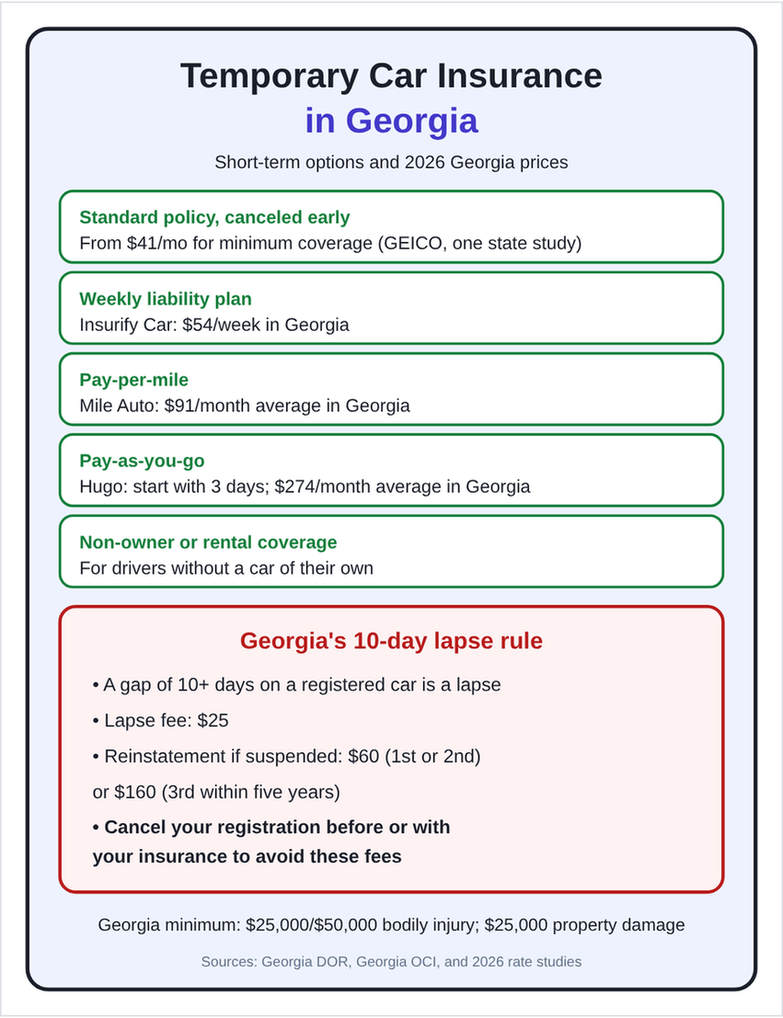
If you need temporary car insurance in Georgia, the first thing to know is that no major insurer sells a true one-week or one-month policy in the state. You still have real short-term options, including weekly liability plans, pay-as-you-go coverage, non-owner policies, and standard policies you can cancel early. The catch is Georgia’s strict electronic insurance tracking, which can bring fines if you cancel the wrong way.
This guide explains Georgia’s insurance rules, the 10-day lapse rule and its fees, every short-term option with 2026 Georgia prices, the cheapest companies and cities, and a step-by-step plan for getting covered and canceling without penalties. Every figure is sourced and dated, and hypothetical examples are labeled.
KEY TAKEAWAYS
- No true temporary policies. Georgia drivers use weekly plans, pay-as-you-go coverage, non-owner policies, rental coverage, or a standard policy canceled early.
- Georgia tracks coverage electronically. A gap of 10 or more days on a registered vehicle is a lapse, with a $25 fee and a reinstatement fee of $60 or $160 if your registration is suspended.
- Cancel your registration first. The Georgia Department of Revenue says canceling registration before or with your insurance avoids lapse and reinstatement fees.
- Cheapest Georgia coverage in 2026: GEICO averaged $41 a month for minimum coverage in one state study, and Auto-Owners $78 for liability-only in real-quote data.
Does temporary car insurance exist in Georgia?
Not as a standard product. A Georgia quote analysis updated November 2, 2026, says Georgia has no true temporary car insurance, and that most insurers sell six- or 12-month policies. What Georgia does have are flexible options that let you pay for, or keep, coverage for only as long as you need it.
Short-term car insurance options in Georgia
| Option | How it works | Covers your own car? | Best for |
|---|---|---|---|
| Standard policy, canceled early | Buy a six-month policy and cancel when you no longer need it | Yes, with collision and comprehensive | Owners of Georgia-registered cars |
| Weekly liability plan | Pay in seven-day increments; cancel any time | No; state-minimum liability | Short-term liability needs |
| Pay-as-you-go | Start with a few days and add more as needed | Depends on the plan | Drivers who want small payments |
| Pay-per-mile | Monthly base rate plus a per-mile charge | Yes, with full coverage | Cars that will barely be driven |
| Non-owner insurance | Liability coverage when you drive cars you do not own | No | Visitors and people who borrow cars |
| Rental car coverage | Bought per day from the rental company or a third party | Yes, with a damage waiver | Short rentals |
| Added to someone else’s policy | The owner adds you as a driver | Depends on their policy | Staying with family in Georgia |
Georgia car insurance rules you need to know
Georgia requires liability insurance on every registered vehicle and checks it electronically. The Georgia Office of the Commissioner of Insurance lists these minimum limits:
Georgia minimum liability coverage
| Coverage | Minimum limit |
|---|---|
| Bodily injury liability, per person | $25,000 |
| Bodily injury liability, per accident | $50,000 |
| Property damage liability, per accident | $25,000 |
Georgia Office of Commissioner of Insurance, Auto Insurance (accessed November 2026). Collision and comprehensive are optional under state law but often required by lenders.
Georgia does not rely on your insurance card for registration. According to the DeKalb County Tax Commissioner, “insurance cards are not considered acceptable proof of insurance for vehicle registration purposes in Georgia.” Instead, insurers send coverage information to the state electronically, and they have 30 days from the start of coverage to do it.

Make sure the vehicle identification number (VIN) on your policy is correct, because a wrong VIN can stop the information from reaching the state. You can check your status through Georgia DRIVES e-Services.
Your card still matters for traffic stops, accidents, and out-of-state driving. When you buy from a private party or move to Georgia, the county may accept a binder or declarations page less than 30 days old; for dealership purchases and renewals, only electronic transmission from your insurer counts.
Georgia’s 10-day lapse rule and fees
This is the rule that makes temporary insurance tricky in Georgia. The Georgia Department of Revenue (DOR) says a lapse occurs when there is a gap of 10 or more days between one policy’s end and the next one’s start, or when insurance ends and no new policy is reported within 30 days. If the new policy starts the same day the old one ends, there is no lapse.
Georgia lapse and reinstatement fees
| Situation | Fee |
|---|---|
| Any lapse in coverage on a registered vehicle | $25 lapse fee |
| Reinstatement after the 1st suspension | $60 (plus the $25 lapse fee) |
| Reinstatement after a 2nd suspension within five years | $60 (plus the $25 lapse fee) |
| Reinstatement after a 3rd suspension within five years | $160 (plus the $25 lapse fee) |
Georgia Department of Revenue, Penalties and Fines for Lapse of Insurance Coverage (accessed November 2026). Any registration fees and ad valorem taxes due are added.
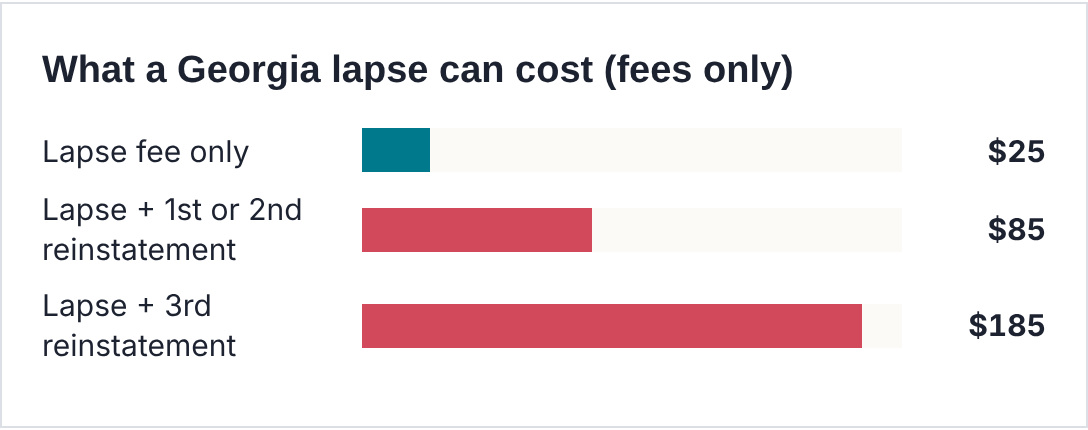
The timeline matters too. If no new insurance is reported within 30 days of a termination notice, the state mails a Notice of Pending Suspension. If nothing arrives within 30 days of that notice, the registration is suspended. The registration is also suspended if the $25 lapse fee is not paid within 30 days of the letter.
Storing a car you will not drive
Some drivers look for temporary insurance because a car will sit unused for a while, such as during a deployment, a long trip, or a repair. In Georgia, the key question is whether the car stays registered. A registered vehicle needs continuous Georgia liability coverage, so dropping liability while keeping the tag can trigger a lapse. Your two clean choices are to keep at least the minimum liability coverage in force, or to cancel the registration before or with the insurance and re-register when you need the car again. If the car is financed, your lender may also require you to keep collision and comprehensive.
How to end temporary coverage without a lapse fee
The DOR gives a clear answer: to avoid lapse and reinstatement fees when you no longer need a vehicle registered, cancel the registration before or at the same time you cancel the insurance. If you are replacing one policy with another, make the new policy start the same day the old one ends.
Your temporary car insurance options in Georgia
1. A standard policy canceled early
This is the most widely available route and the only one that reliably offers full coverage. You buy a normal six-month policy, use it as long as you need, and cancel. Most insurers refund unused premium. With a pro rata refund you get all of it back; with a short-rate refund, an insurer may keep 10% to 15% of the unearned premium, according to an analysis updated August 31, 2026. Ask how your refund is calculated before you buy.
Hypothetical: one month on a Georgia minimum-coverage policy
| Refund method | Six-month premium | Premium used (1 month) | Penalty | Cost for one month |
|---|---|---|---|---|
| Pro rata, no fee | $246 | $41 | $0 | $41 |
| Short-rate, 10% of unearned | $246 | $41 | $20.50 | $61.50 |
| Short-rate, 15% of unearned | $246 | $41 | $30.75 | $71.75 |
Hypothetical; our calculation, using GEICO’s $41 monthly minimum-coverage average in a Georgia rate study updated October 15, 2026 (× 6 = $246). Unearned premium after one month: $205. Your quote and refund terms will differ.
2. Weekly liability plans
Insurify Car, sold through an online agency, offers state-minimum liability coverage in Georgia in seven-day increments. The Georgia quote analysis lists it at $54 a week, with an average monthly quote of $191. You can set a cancellation date and stop when you are done. It does not cover damage to your own car.
3. Pay-as-you-go coverage
Hugo sells policies to Georgia drivers, according to the same analysis. Hugo lets you start with as little as three days of coverage and pay in 3-, 7-, or 30-day blocks, per a September 2026 review. Its Georgia average was high, though: $274 a month in the analysis’s table. Hugo also does not appear to offer SR-22 filings.
4. Pay-per-mile insurance
If your car will mostly sit, pay-per-mile insurance charges a monthly base rate plus a few cents per mile. Mile Auto averaged $91 a month in Georgia, the lowest of the flexible options in the analysis, and $164 for full coverage. It is an ongoing policy, but low mileage keeps the bill down.
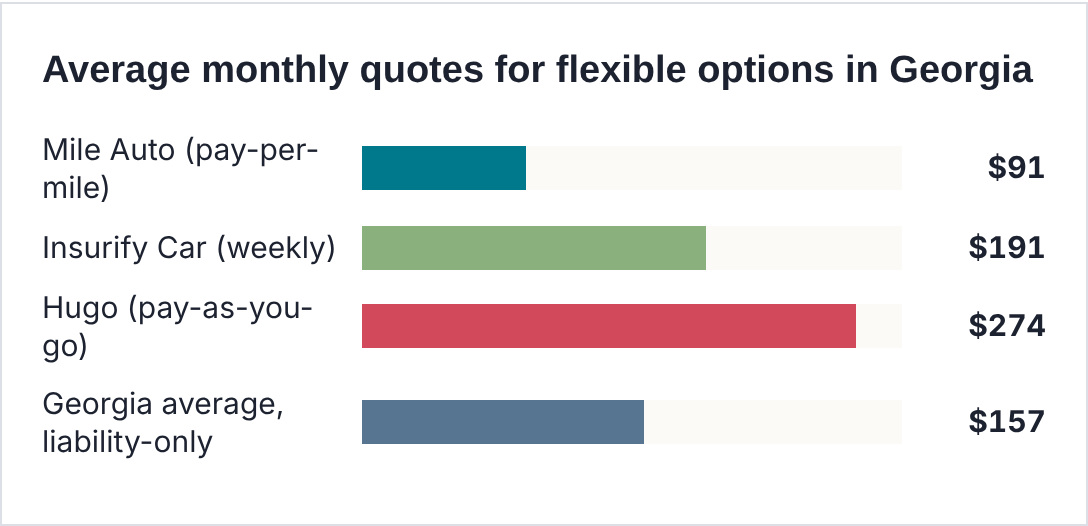
Notice that the weekly and pay-as-you-go averages are above Georgia’s $157 liability-only average. Flexibility can cost more per month, so these plans make the most sense for truly short needs. For a month or more, compare them with a standard policy you can cancel.
5. Non-owner insurance
If you do not own a car but will drive borrowed or rented ones in Georgia, a non-owner policy gives you liability coverage. A national analysis updated September 30, 2026, put non-owner coverage at $29 to $74 a month. It does not cover damage to the car you drive, and it can satisfy an SR-22 requirement with insurers that offer it.
6. Rental car coverage
For a rental in Atlanta or anywhere else in the state, coverage is bought by the day. One national analysis put rental car insurance at $9 to $30 a day, and a June 2026 consumer report said rental counter coverage often costs $30 to $60 a day. Most credit cards offer only secondary coverage and usually exclude liability.
7. Being added to someone else’s policy
If you are staying with family in Georgia for a while, ask to be added to their policy. It can cost less than a separate policy. Occasional drivers with permission may already be covered by the owner’s policy, but rules vary, so the owner should check with their insurer first.
Questions to ask a Georgia insurer about short-term coverage
- Is there a minimum policy term, and can I cancel at any time?
- Is the refund pro rata or short-rate, and is there a cancellation fee?
- Does the plan include uninsured motorist coverage?
- When will you report my coverage to Georgia, and is my VIN correct?
- Do you file SR-22 forms, if I need one?
If you’re visiting or moving to Georgia
Visitors usually do not need Georgia insurance at all. If you are visiting with your own car, your home-state policy generally travels with you; check your policy or call your insurer to confirm. If you are visiting without a car, the owner’s policy or a rental company’s coverage may apply, or you can buy a non-owner policy. New residents are different. Once you register a vehicle in Georgia, it needs Georgia liability coverage reported to the state. When you register, county tag offices may accept your insurer’s electronic report, or a binder or declarations page less than 30 days old. Line up a Georgia policy before you go to the tag office, and keep your old policy active until the new one starts.
Buying a car in Georgia: temporary tags and insurance
A new car purchase is one of the most common reasons Georgians need coverage fast. A Georgia dealer issues a 45-day temporary operating permit (TOP) at the sale, at no additional cost, according to the DeKalb County Tax Commissioner. For a dealer purchase, your insurer must transmit coverage electronically; to extend a dealer TOP, your insurance must already be current in the state’s database. If you already have a policy, call your insurer before you drive away. Many insurers give a grace period of about 7 to 30 days to add a newly bought car, according to a June 2026 rate study, but some give only a few days and some give none. If you do not have a policy, buy one before you leave, using the VIN from the purchase paperwork.
How much does short-term car insurance cost in Georgia?
Georgia is more expensive than average, so the company you choose matters. Two 2026 analyses found these Georgia prices. Study A is a state rate study updated October 15, 2026; study B is a real-quote analysis with rates current to September 30, 2026. Compare each only with itself.
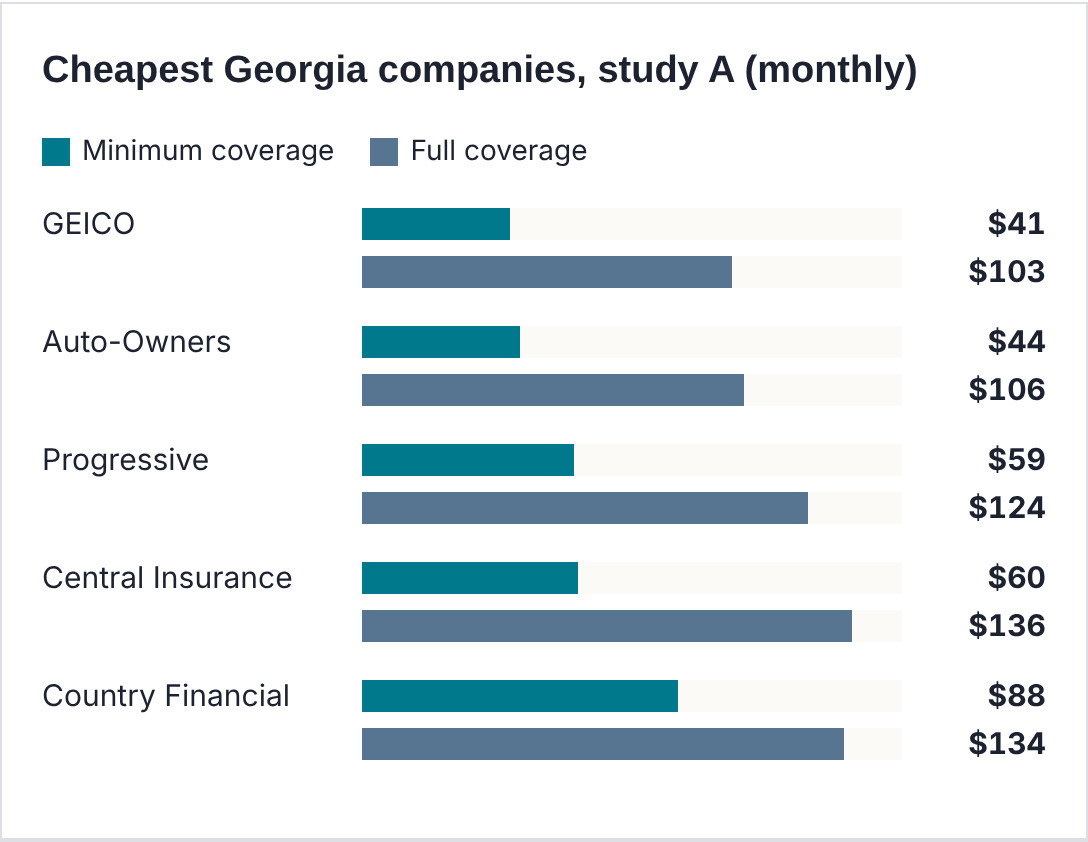
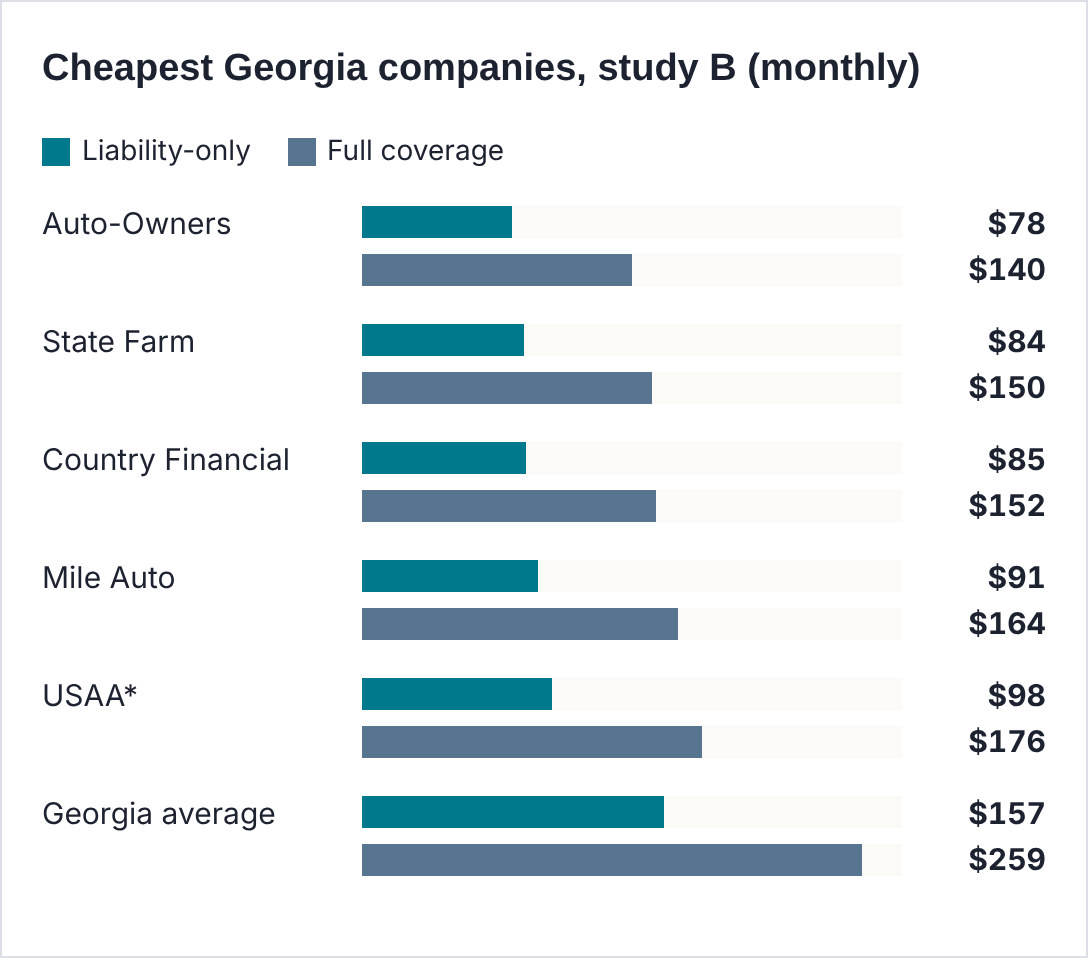
In study B, Georgia averaged $1,880 a year for liability-only coverage and $3,106 for full coverage, compared with $1,183 and $2,242 nationally. The gap between the average and the cheapest companies is large: Auto-Owners’ liability-only average was $79 a month below the Georgia average, about $948 a year (our calculation).
Cheapest Georgia cities for minimum coverage
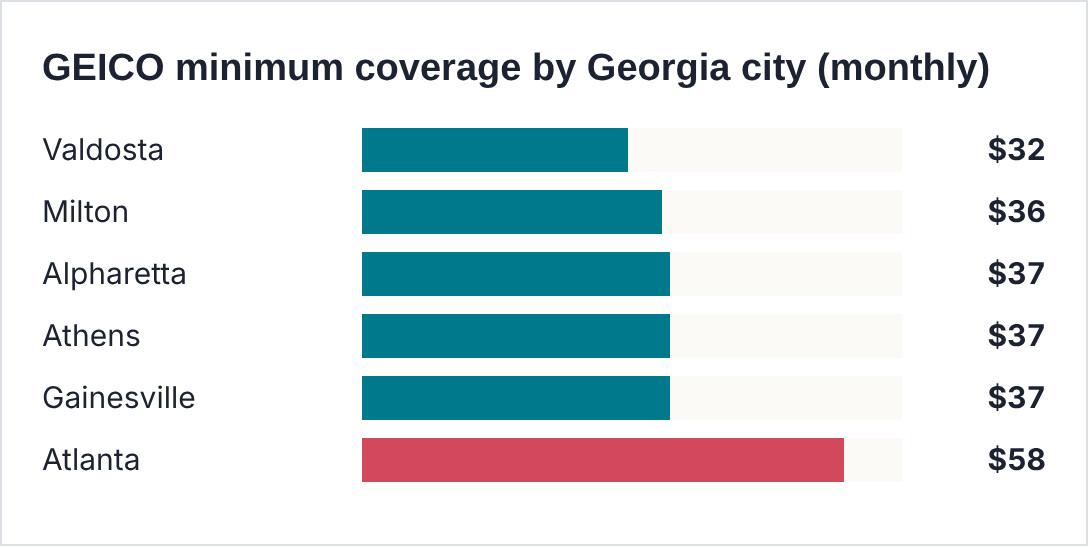
Where you live in Georgia changes the price. Study A found GEICO cheapest in 16 of the 20 largest cities for minimum coverage. Seguro de auto en Atlanta.
Temporary coverage for special situations in Georgia
Teens. Study A says teens under 18 cannot hold their own policy in Georgia. On a family policy, the cheapest full-coverage rates were $284 to $290 a month at 18 and $131 to $139 at 25. A teen who needs coverage for a summer is usually best added to a parent’s policy.
Seniors. Study A found GEICO cheapest for seniors at $112 a month for full coverage, followed by Auto-Owners at $123. Georgia has a defensive-driving discount law, so ask insurers about approved course discounts.
Drivers with a DUI. Study A says a Georgia DUI conviction typically requires an SR-22 for three years, and it found Safeway Insurance cheapest after a DUI at $179 a month. Short-term plans may not offer SR-22 filings, so a standard policy is usually required.
Poor credit. Safeway Insurance was cheapest for drivers with poor credit in study A, at $139 a month.
College students. A student who brings a car to a Georgia campus for a semester usually does best staying on a parent’s policy, with the school address listed if the insurer requires it. A student without a car who drives friends’ or rental cars may want a non-owner policy instead.
Cheapest Georgia full coverage for young drivers on a family policy (monthly)
| Age | Female | Male |
|---|---|---|
| 16 | Auto-Owners $315 | Auto-Owners $333 |
| 18 | Auto-Owners $284 | Country Financial $290 |
| 21 | GEICO $178 | GEICO $183 |
| 25 | Auto-Owners $131 | Auto-Owners $139 |
Study A: Georgia state rate study updated October 15, 2026.
Best temporary option by Georgia situation
| Your situation | Best option | Why |
|---|---|---|
| Visiting Georgia and borrowing a car | Non-owner policy or the owner’s policy | You do not need your own vehicle coverage |
| Renting a car for a trip | Rental coverage or a non-owner policy | Daily coverage for short rentals |
| Owning a Georgia-registered car for a few weeks | Standard policy canceled early, or a weekly plan | Then cancel registration before or with insurance |
| Storing a car you rarely drive | Pay-per-mile, or cancel registration and insurance together | Avoids lapse fees |
| Buying a car from a dealer | Add it to your policy or buy a new one before you leave | Coverage must be reported electronically |
| Needing an SR-22 | Standard policy from an insurer that files SR-22s | Many flexible plans do not |
Why uninsured motorist coverage matters in Georgia
Even a short-term policy should protect you from other drivers. Study A notes that about 19% of Georgia drivers carry no insurance, and that Georgia’s 25/50/25 minimum limits are low by national standards. Uninsured motorist coverage, which the Georgia insurance commissioner’s office describes as protection when an uninsured driver injures you or damages your vehicle, can fill that gap. Many weekly and pay-as-you-go plans are state-minimum liability only, so ask whether uninsured motorist coverage is included or available before you buy, and compare the price difference with a standard policy.
How to get temporary car insurance in Georgia, step by step
- Decide what you need to cover: your own car, a borrowed car, or a rental.
- Check your registration status in Georgia DRIVES e-Services.
- Get quotes from the cheapest Georgia companies, such as GEICO, Auto-Owners, State Farm, and Country Financial.
- Compare flexible options such as weekly, pay-as-you-go, and pay-per-mile plans.
- Ask about cancellation: pro rata or short-rate refund, and any fee.
- Confirm the VIN is correct so your coverage reaches the state.
- Save your proof of insurance before you drive.
- When you are done, cancel your registration first, or have a new policy start the same day the old one ends.
Pros and cons of temporary coverage in Georgia
| Pros | Cons |
|---|---|
| Flexible plans let you pay by the week or day | Flexible plans average more per month than standard liability |
| Standard policies can include full coverage | Short-rate refunds or fees can raise the cost of a short stay |
| Non-owner and rental options suit visitors | Lapses on registered cars bring $25 to $185 in fees |
| Cheap companies start around $41 a month | Atlanta-area prices are higher than in smaller cities |
Common mistakes to avoid
- Canceling insurance but keeping the registration. That starts the 10-day lapse clock.
- Relying on an insurance card for registration. Georgia uses electronic reporting from your insurer.
- Letting a typo in your VIN block the report. Check every digit on your policy.
- Choosing a flexible plan for a long stay. Over a month or more, a standard policy is often cheaper.
FAQs about temporary car insurance in GA
Can you get temporary car insurance in Georgia?
Not as a true one-week or one-month policy from major insurers. Georgia drivers can use weekly liability plans, pay-as-you-go coverage, pay-per-mile insurance, non-owner policies, rental coverage, or a standard six-month policy canceled early, depending on whether they own the car.
What happens if my Georgia insurance lapses?
A gap of 10 or more days on a registered vehicle is a lapse. The state charges a $25 lapse fee, and if your registration is suspended, reinstatement costs $60 for a first or second suspension within five years, or $160 for a third, plus the lapse fee.
How do I cancel car insurance in Georgia without a fine?
Cancel your vehicle registration before or at the same time you cancel your insurance, according to the Georgia Department of Revenue. If you are switching insurers instead, make the new policy start the same day the old one ends, so there is no gap.
How much is weekly car insurance in Georgia?
A Georgia quote analysis listed Insurify Car’s weekly liability plan at $54 a week, with an average monthly quote of $191, as of September 30, 2026. Prices depend on your profile. For longer needs, compare a standard policy; in the same data, Auto-Owners averaged $78 a month for liability-only coverage.
What are Georgia’s minimum insurance requirements?
Georgia requires liability coverage of at least $25,000 per person and $50,000 per accident for bodily injury, plus $25,000 for property damage, according to the state insurance commissioner’s office. Collision and comprehensive are optional by law but often required by lenders.
Is my insurance card proof for Georgia registration?
No. Georgia county tag offices say insurance cards are not acceptable proof for registration. Insurers report coverage electronically within 30 days. A binder or declarations page under 30 days old may work for private-party purchases or new residents. Keep your card for traffic stops and accidents.
Do I need insurance to drive a car I just bought in Georgia?
Yes. A dealer gives you a 45-day temporary operating permit, but the car still needs insurance before you drive it. If you already have a policy, your insurer may cover the new car for a short grace period; call to confirm and add it.
What is the cheapest car insurance in Georgia?
In a state study updated October 15, 2026, GEICO was cheapest for minimum coverage at $41 a month, followed by Auto-Owners at $44. In real-quote data, Auto-Owners led for liability-only at $78 and full coverage at $140. Your cheapest company depends on your profile and city.
The final word on temporary car insurance in GA
For most Georgia drivers, a standard policy from a low-cost insurer, canceled correctly, is the cheapest temporary solution. Use a weekly or pay-as-you-go plan only for very short needs, and a non-owner or rental policy if you do not own the car. Whatever you choose, cancel your registration before or with your insurance to avoid Georgia’s lapse fees.
Prices, availability, cancellation terms, and state fees can change. The figures in this article are averages, published fees, and hypothetical calculations, not quotes. This article is for information only and is not legal or financial advice. The publisher is not an insurance company or a licensed insurance agency.
The bottom line on temporary car insurance in Georgia: true short-term policies are rare, but the right mix of a low-cost policy, a flexible plan, or non-owner coverage, plus careful cancellation, keeps you legal without paying Georgia’s lapse fees.
Sources
- Georgia Department of Revenue, Lapse or Loss of Insurance Coverage and Penalties and Fines for Lapse of Insurance Coverage (accessed October 2026).
- Georgia Office of Commissioner of Insurance, Auto Insurance (accessed October 2026).
- DeKalb County Tax Commissioner, Insurance Requirements and Temporary Operating Permits (accessed October 2026).
- Insurify, Temporary Car Insurance in Georgia (updated October 17, 2026) and Georgia Car Insurance (updated October 18, 2026; rates current to September 30, 2026).
- MoneyGeek, Cheapest Car Insurance in Georgia (updated October 15, 2026).
- Insurify, One-Week Car Insurance (updated September 30, 2026).
- Credit Karma, Hugo Auto Insurance Review (updated September 17, 2026).
- MoneyGeek, Car Insurance Refund (August 31, 2026).
- First Alert 4, Understanding Rental Car Insurance (June 23, 2026).
- CarInsurance.com, New Car Grace Period (updated June 26, 2026).