
Usage-Based Car Insurance Options
Last updated on February 2, 2026
The Generalinsurance.org Editorial Team produces informational content about insurance topics, focusing on clear, practical explanations to help readers understand common coverage options, costs, and shopping considerations.
Articles cover everyday questions related to auto, home, renters, life, and other insurance categories, including policy basics, pricing factors, coverage comparisons, and ways consumers may reduce costs while maintaining appropriate protection.
Content reviewed internally for clarity and consistency of general insurance concepts.
Note: This content is for general informational purposes only and does not constitute insurance, legal, or financial advice. Generalinsurance.org is an independent informational website and is not affiliated with any insurer.
Usage-Based Car Insurance Options
Drivers are looking for ways to save money on car insurance and are increasingly turning to alternative coverage like usage-based auto insurance. The main benefit of usage-based car insurance is that it represents an innovative approach to vehicle coverage, allowing premiums to align more closely with actual driving patterns rather than broad estimates. If you want a quick refresher on fundamentals first, start with car insurance basics, then come back here for the usage-based breakdown.
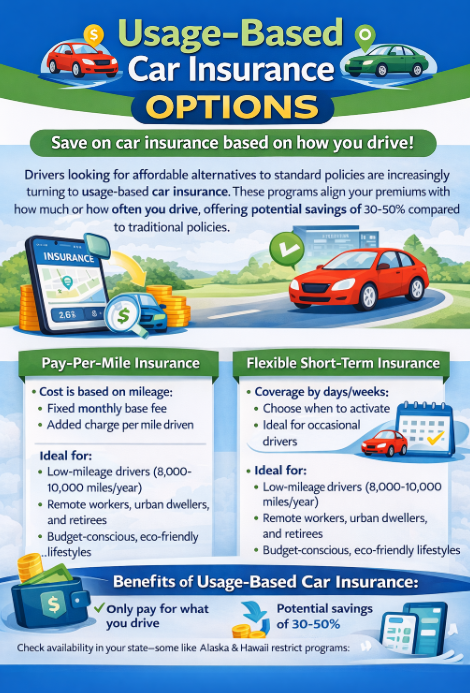
This increasingly popular category of automobile insurance coverage encompasses two primary models: pay-per-mile insurance, where costs are directly tied to the distance driven (typically a fixed base premium plus a variable per-mile fee), and flexible short-term insurance, which enables coverage in smaller increments like days or weeks, often with options to activate or pause as needed. If you’re comparing quotes, keep your limits and deductibles identical across providers—using a structured page like compare auto insurance quotes makes it much easier to avoid apples-to-oranges pricing.
These options appeal to a growing segment of drivers influenced by remote work trends, urban lifestyles reliant on public transit, and economic pressures favoring cost control. In 2026, with average annual mileage dropping below 12,000 for many households due to hybrid work models, these programs offer potential savings of 30-50% for qualifying low-usage drivers compared to standard policies.
However, no single provider guarantees the lowest rates universally. Factors such as location, vehicle type, credit history (where permitted), and exact mileage can significantly influence quotes. State regulations also play a role, limiting availability in places like Alaska, Hawaii, and parts of the Northeast. This guide explores leading providers, their mechanics, ideal customer profiles, advantages, drawbacks, and practical comparisons to help inform decisions. For broader shopping strategy, see the full car insurance guide.
Determining Suitability for Usage-Based Coverage
Usage-based plans shine for specific lifestyles but may underperform for others. Consider this option if:
- Annual mileage stays under 8,000-10,000 miles
- Daily routines involve minimal driving, such as remote employment, retirement, or reliance on ridesharing/biking
- Trips are predominantly short, local errands during low-risk hours
- Budget flexibility prioritizes paying only for active use
Avoid these plans if:
- Commuting or frequent travel pushes mileage above average (13,000+ annually)
- Privacy concerns arise from mileage verification or telematics
- Consistent, predictable billing from traditional policies is preferred
- High-risk factors already elevate base rates substantially
Additional savings tips include bundling with home/renters policies where possible, maintaining clean records, and selecting higher deductibles on comprehensive/collision portions. If you want to choose a deductible intelligently (instead of guessing), use insurance deductible as your reference.
Leading Pay-Per-Mile Providers in 2025
Pay-per-mile remains the dominant usage-based model, featuring a monthly base rate (covering parked vehicle risks) plus a per-mile charge (typically 5-10 cents). Many include daily caps (150-250 miles) to protect against occasional long trips. For a deeper explanation of how the model works and where savings usually come from, see pay-per-mile insurance benefits.
Nationwide SmartMiles
Nationwide’s SmartMiles stands as one of the most accessible and robust pay-per-mile programs, available in 44 states (excluding AK, HI, LA, NC, NY, and OK). It integrates seamlessly with Nationwide’s broader ecosystem, offering full coverage parity with traditional policies.
Ideal for: Moderate low-mileage drivers seeking national brand reliability, multi-vehicle households, or those valuing safe-driving incentives.
Pricing structure: Base premium + variable per-mile fee, billed monthly. Includes a 250-mile daily cap and up to 10% safe-driving renewal discount.
Advantages:
- Broadest state availability among major carriers
- Connected car compatibility or a simple plug-in device
- Full suite of add-ons (roadside, rental reimbursement)
- Strong claims handling from an established insurer
Drawbacks:
- Base rates may run higher than niche specialists for ultra-low mileage
- Telematics monitors habits beyond miles in some configurations
- Not optimized for sub-5,000-mile drivers
Pro tip: Existing Nationwide customers can switch mid-policy; compare against standard quotes, as bundled discounts sometimes outperform SmartMiles. If you want a quote workflow that keeps comparisons fair, start with general car insurance quotes and keep your coverage settings consistent.

Allstate Milewise
Allstate’s Milewise provides pay-per-mile through a daily base rate plus per-mile charges, emphasizing app-based transparency. Available in approximately 21 states, including AZ, IL, OH, TX, and VA.
Ideal for: Drivers preferring major carrier support, bundling opportunities, or detailed trip feedback via the Allstate app.
Pricing structure: Daily fixed rate + per-mile (often capped at 150-250 miles/day by state).
Advantages:
- Robust mobile app for real-time tracking and payments
- Access to Allstate’s extensive agent network for claims
- Competitive for bundled home/auto scenarios
- Trip-level insights help refine habits
Drawbacks:
- More limited geographic reach
- Potential higher effective rates for very infrequent drivers
- A device is required in most cases
Pro tip: Test against Allstate’s Drivewise (behavior-based discount) program—sometimes the traditional policy wins for moderate mileage. You can also cross-check a traditional quote comparison using compare car insurance quotes online.
Mile Auto
Mile Auto specializes exclusively in pay-per-mile, using non-invasive monthly odometer photos rather than constant tracking. Operates in states like AZ, FL, GA, IL, OH, OR, TN, and TX.
Ideal for: Privacy-focused low-mileage drivers confident in consistent under-10,000-mile usage.
Pricing structure: Base + per-mile, verified via user-submitted photos.
Advantages:
- No plug-in device or GPS monitoring
- Often, the lowest per-mile rates among specialists
- Simple, transparent process
- Strong value for true minimal drivers
Drawbacks:
- Manual reporting required (risk of lapses if forgotten)
- Fewer states than big carriers
- Limited add-ons compared to nationals
Pro tip: Photograph odometer on the same day monthly to avoid disputes; ideal if telematics feels intrusive. For a more detailed savings discussion, see pay-per-mile insurance savings.
Lemonade (Incorporating Former Metromile Features)
Following Lemonade’s acquisition, pay-per-mile continues in limited states (primarily AZ, OR, WA for per-mile; broader traditional in others). Focuses on app-driven, tech-forward experience.
Ideal for: Tech-savvy urban drivers in supported states seeking streamlined digital management.
Pricing structure: Base + per-mile, with plug-in or app options.
Advantages:
- Instant quotes and policy management
- Potential behavior-based adjustments
- Bundling with Lemonade’s other products (renters, home)
Drawbacks:
- Very restricted availability post-acquisition
- Mixed claims feedback during transition
- Higher base in some profiles
Pro tip: Bundle with renters/home for extra discounts if eligible. If you’re actively shopping, compare the final annualized cost (not just the per-mile rate) and include your expected “high-mileage month” scenario.
Flexible Short-Term Coverage Options
True on-demand daily/weekly insurance remains rare in the U.S., but providers offer adaptable liability-focused plans. If you’re researching temporary coverage in general, you can also review temporary car insurance options.
Hugo Insurance
Hugo provides “unlimited” basic or full coverage with flexible activation periods and micropayments. Available in 16+ states, including AL, AZ, FL, GA, IL, IN, and TX.
Ideal for: Intermittent drivers, cash-flow-constrained individuals, or those needing pauseable coverage.
Pricing structure: Fixed plans (basic/full) with payment flexibility; no true per-mile.
Advantages:
- Activate/deactivate easily via the app
- Small payments (as low as days/weeks)
- No large upfront premiums
Drawbacks:
- Often higher annualized cost for continuous use
- Primarily liability; full coverage limited
- Potential gaps raise future rates
Pro tip: Use for genuine intermittent needs; compare against a high-deductible traditional for year-round. If you want more alternatives, see best short-term car insurance options.
Distinguishing Usage-Based Discounts
Programs like Progressive Snapshot, State Farm Drive Safe & Save, or Travelers IntelliDrive monitor habits for discounts (up to 30-40%) on standard policies but aren’t true pay-per-mile. Useful complements if open to telematics without mileage-based billing. If your goal is simply saving money, don’t skip the basics—review general insurance discounts to make sure you aren’t leaving easy savings on the table.
Comparative Ranking for Low-Mileage Drivers (Typical Patterns, 2025)
Rankings reflect general outcomes for clean-record, low-mileage (<7,000 annual) profiles with comparable coverage:
- Most cost-effective specialists: Mile Auto, Lemonade (where available) – Sharpest per-mile rates for minimal usage.
- Strong mid-tier value: Nationwide SmartMiles, Allstate Milewise – Balance affordability with broad support/features.
- Flexibility-focused: Hugo – Best for variable needs, though potentially pricier annualized.
Practical Cost Calculations
Estimate: Base $40-80/month + $0.05-0.09/mile.
- 200 miles/month: ~$50-98 total
- 600 miles/month: ~$70-134 total
- Include one higher-month scenario when quoting.
Overall Advantages and Challenges
Broad benefits:
- Aligns costs with actual risk/exposure
- Encourages mindful driving
- Supports sustainable lifestyles
Challenges:
- Variable bills complicate budgeting
- Tracking/verification requirements
- Savings erode with increased mileage
- Inconsistent state access
Selection Strategy
- Ultra-low mileage/max savings: Prioritize Mile Auto or Lemonade.
- Brand trust/bundling: Nationwide or Allstate.
- Intermittent/flexible: Hugo.
- Tracking aversion: Mile Auto’s photo method.
Always obtain multiple quotes, matching limits/deductibles. A practical way to do that is to start with compare car insurance quotes online and keep the same deductible selected across every estimate.
Common Questions Addressed
- Core definition? Primarily pay-per-mile or short-term flexible; verify mileage vs. time-based.
- Viable at 10,000 miles/year? Marginal—calculate precisely against standard quotes.
- Location tracking? Varies; some mileage-only, others fuller telematics.
- Full coverage possible? Yes, with most pay-per-mile, it affects the base but not the structure.
- Zero-drive months? Base persists for parked coverage.
- Road trip impact? Daily caps mitigate; plan accordingly.
- Distinct from UBI? Pay-per-mile focuses on miles; UBI emphasizes habits.
- Lapses in flexible plans? Risk higher future rates; maintain continuity if possible.
- Fair comparisons? Align coverages, then project annual costs with realistic mileage.
- Quickest, cheapest path? Quote specialist pay-per-mile, major carrier option, and traditional low-cost policy.
The Final Word On Usage-Based Car Insurance Coverage
Usage-based car insurance continues to grow as rates for traditional coverage keep rising. It has solidified its place as a smart alternative for millions of Americans adapting to new driving realities. With remote work, urban mobility shifts, and rising traditional premiums, drivers averaging under 10,000 miles annually can often save 30-50% by aligning costs directly with actual vehicle use.
Specialists like Mile Auto and Lemonade (in supported states) typically deliver the deepest savings for ultra-low-mileage households, while major carriers such as Nationwide SmartMiles and Allstate Milewise offer reliable infrastructure and bundling perks for those prioritizing brand trust. Hugo remains a standout for intermittent drivers needing payment flexibility, though continuous coverage often proves more economical through traditional or per-mile plans.
Ultimately, the value lies in honest self-assessment: track your typical mileage, factor in occasional high-use months, and obtain multiple quotes with identical coverages. For low-usage drivers open to minimal tracking, these innovative options not only reduce expenses but also promote fairer, more transparent pricing. In an era of personalized services, usage-based insurance empowers you to pay only for the risk you create – making it a compelling choice for budget-conscious, low-mileage motorists nationwide. Compare the cheapest usage-based car insurance quotes online in under 5 minutes and save hundreds.