
$20 Down Payment Car Insurance
Last updated on Jun 30th, 2026
The Generalinsurance.org Editorial Team produces informational content about insurance topics, focusing on clear, practical explanations to help readers understand common coverage options, costs, and shopping considerations.
Articles cover everyday questions related to auto, home, renters, life, and other insurance categories, including policy basics, pricing factors, coverage comparisons, and ways consumers may reduce costs while maintaining appropriate protection.
Content reviewed internally for clarity and consistency of general insurance concepts.
Note: This content is for general informational purposes only and does not constitute insurance, legal, or financial advice. Generalinsurance.org is an independent informational website and is not affiliated with any insurer.
$20 may be possible
But it is usually limited to lower-risk drivers and cheaper coverage options.
Licensed insurer first
A real policy with a slightly higher first payment is better than a risky offer.
Ask what is due today
This question helps avoid misleading “zero down” or “no deposit” wording.
There’s a bunch of reasons why you might need a $20 down auto insurance coverage. Maybe your current policy lapsed. Maybe you just bought a car. Maybe you need proof of insurance to register a vehicle, leave a dealership, reinstate your license, or avoid driving uninsured.
💡 A $20 first payment sounds perfect. It sounds affordable, simple, and fast. But here is the honest answer: a $20 down payment for car insurance is possible for some drivers, but it is not common for everyone. Most insurance companies require a larger initial premium payment before coverage becomes effective.
A very low first payment, such as $20, is usually available only to certain lower-risk drivers, in certain states, buying cheaper coverage, or using a special billing or financing arrangement. That does not mean you should give up. It means you need to understand what “$20 down” really means, who is most likely to qualify, and how to shop without falling for misleading ads.
Is $20 Down Auto Insurance Real?
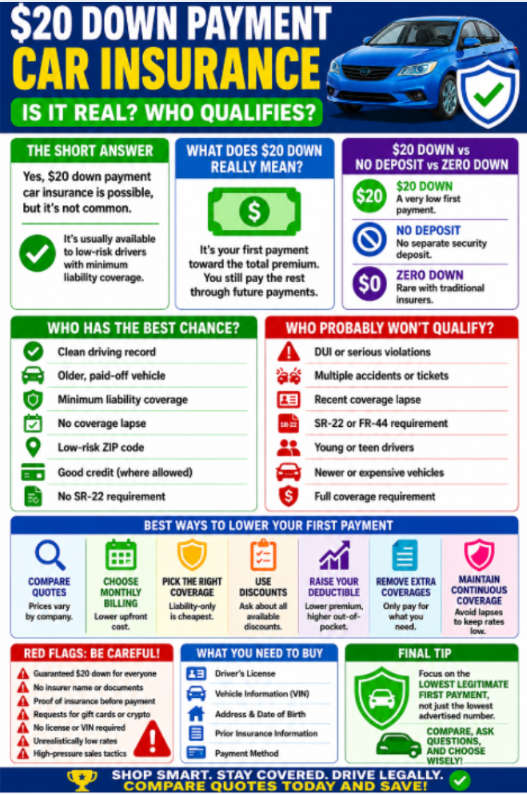
The good news is $20 down payment car insurance may be possible, but it’s also not guaranteed. A $20 first payment is most realistic for drivers who have:
For many drivers, the first payment will be higher than $20. That is especially true if you need full coverage, have recently had an accident, have a DUI, are a young driver, live in a high-cost state, or have allowed your insurance to lapse.
✅ The best goal is not chasing a guaranteed $20 policy. The better goal is finding the lowest legitimate first payment from a licensed insurer.
What Does $20 Down Payment Car Insurance Mean?
A down payment on car insurance is usually not a separate security deposit. It is typically included in your total policy premium.
For example, if your total six-month premium is $900, the insurance company may allow you to pay it in installments. Your first payment activates the policy, and the remaining balance is divided into future payments.
That first payment may be called:
- A down payment
- An initial payment
- A first installment
- A policy activation payment
- A first-month payment
- A premium payment
The wording can vary, but the idea is the same: the insurer usually wants some money before coverage starts.
⚠️ A $20 down payment means you pay $20 upfront to begin the policy or payment plan. It does not mean your total insurance cost is only $20. You still owe the remaining premium according to the payment schedule.
$20 Down vs No Deposit vs Zero Down
These phrases are often used together, but they do not always mean the same thing.
| Term | What It Sounds Like | What It Usually Means |
|---|---|---|
| $20 Down | Start coverage for $20 | A very low initial premium payment |
| No Deposit | No money required | Usually no separate security deposit |
| Zero Down | Start for $0 | Rare with traditional insurers |
| Low Down Payment | Lower first payment | Realistic for many drivers |
| Monthly Billing | Pay over time | Common, but may include fees |
The safest way to understand any offer is to ask one question:
📌 What exact amount is due today before coverage becomes effective?
That one question cuts through the advertising language.
Is $20 Down Car Insurance the Same as No-Deposit Insurance?
Nope, it’s not. A $20 down payment policy still requires a payment. No-deposit insurance usually means the insurer is not charging a separate deposit beyond the premium needed to start the policy.
Many consumers assume “no deposit” means no money up front. That is usually not correct. In most cases, no-deposit insurance means:
- No separate security deposit
- No extra deposit fee
- No separate upfront charge outside the premium
But you may still need to pay the first premium installment before the policy begins.
Why Insurance Companies Require Money Upfront
Insurance companies take on risk as soon as your coverage becomes effective.
If your policy starts at 9:00 AM and you cause an accident at 10:00 AM, the insurer may immediately be responsible for a covered claim. That claim could involve vehicle damage, injuries, legal costs, or property damage.
Because the insurer is taking on risk immediately, most companies require payment before activating coverage.
⚠️ This is why true no-money-down car insurance is generally not available from traditional insurers. A policy needs a valid premium payment to become active.
Who Is Most Likely to Qualify for $20 Down Payment Car Insurance?
Not every driver has the same chance of qualifying for a very low first payment.
| Driver Factor | Chance of $20 Down | Why It Matters |
|---|---|---|
| Clean driving record | Higher | Lower risk to the insurer |
| Minimum liability coverage | Higher | Usually cheaper than full coverage |
| Older paid-off vehicle | Higher | No lender full-coverage requirement |
| No coverage lapse | Higher | Continuous coverage helps pricing |
| Low-risk ZIP code | Higher | Lower local claim costs |
| Good credit where allowed | Higher | May reduce premium |
| No SR-22 requirement | Higher | Less high-risk underwriting |
| Multiple accidents | Lower | Higher claims risk |
| DUI history | Lower | Major risk factor |
| Full coverage needed | Lower | More expensive coverage |
A $20 first payment is most realistic when the total premium is already low. That usually means liability-only coverage, a safe driver profile, and a vehicle that does not require lender-mandated physical damage coverage.
Who Probably Will Not Qualify for $20 Down?
Some drivers will have a difficult time finding a $20 first payment.
You may need more money upfront if you have:
- A DUI
- Multiple tickets
- At-fault accidents
- A recent coverage lapse
- An SR-22 or FR-44 filing requirement
- A suspended license history
- A new or financed vehicle
- A teen driver on the policy
- Poor credit where credit is allowed
- A high-performance or expensive vehicle
- A high-cost ZIP code
That does not mean you cannot get insured. It means you may need to compare more companies, work with an independent agent, or accept a higher initial payment.
Can You Get $20 Down Full Coverage Car Insurance?
Usually, this is difficult. Full coverage generally refers to a vehicle insurance policy that includes liability, collision, and comprehensive coverage. It is not a specific legal term, but consumers often use it to describe coverage that protects both other people and your own vehicle.
Full coverage costs more because it may pay for damage to your car from:
- Accidents
- Theft
- Fire
- Vandalism
- Falling objects
- Weather damage
- Animal collisions
If your car is financed or leased, your lender will usually require comprehensive and collision coverage. That makes the policy more expensive and usually makes a $20 down payment less realistic. A $20 first payment is much more likely with minimum liability coverage than with full coverage.
Liability-Only vs Full Coverage
| Feature | Liability Only | Full Coverage |
|---|---|---|
| Covers damage you cause to others | Yes | Yes |
| Covers damage to your own vehicle | No | Usually yes |
| Usually the cheapest upfront | Yes | No |
| Required by lenders | Usually no | Often yes |
| Better chance of $20 down | Higher | Lower |
| Best for | Older paid-off cars | Newer or financed cars |
Liability-only coverage can reduce costs, but it also leaves your own vehicle unprotected if you cause an accident. Do not reduce coverage only to lower the first payment unless you understand the risk.
Why Most Drivers Pay More Than $20 Upfront
Most drivers pay more than $20 because the initial payment is tied to the total premium and billing plan.
Your first payment may be affected by:
- The total policy premium
- Coverage level
- Billing schedule
- State rules
- Insurer underwriting
- Policy fees
- Installment fees
- Prior insurance history
- Driver risk profile
Even if an insurer offers monthly payments, the first payment may be larger than later payments. This can happen because the first payment may include setup costs, policy fees, or a larger share of the premium.
Chart: Likelihood of Very Low First Payments
| Situation | Chance of Very Low First Payment |
|---|---|
| Clean driver, liability-only, older paid-off car | High |
| Clean driver, full coverage, financed car | Medium |
| Minor ticket, liability-only | Medium |
| Recent lapse, average driver | Low |
| DUI or SR-22 requirement | Very Low |
| Teen driver with full coverage | Very Low |
This chart is not a rate estimate. It is a risk-based comparison showing which profiles are generally more likely to receive a very low upfront payment option.
Best Ways to Find the Lowest First Payment
1. Compare Several Insurance Companies
Insurance prices vary widely between companies. One insurer may consider you a preferred customer, while another may price you as a higher risk. Do not stop after one quote.
You can also review broader insurer comparisons such as The General vs Progressive insurance or National General vs GEICO coverage when comparing options.
Compare:
- National insurers
- Regional insurers
- Nonstandard insurers
- Independent agents
- Online quote platforms
✅ PRO TIP: Get at least five quotes before buying. The cheapest company for your neighbor may not be the cheapest company for you.
2. Ask for Monthly Billing
Monthly billing usually lowers the amount due today compared with paying the entire policy upfront.
However, monthly billing can cost more over time because some insurers charge installment fees. If your main problem is cash flow, monthly billing may still be the best choice. Ask:
- What is due today?
- What is due next month?
- Are there installment fees?
- Is there an autopay discount?
- Is there a paperless billing discount?
3. Choose Minimum Liability If Appropriate
Minimum liability coverage is usually the cheapest legal option. This may help reduce your first payment, but it comes with trade-offs. State minimum limits may not be enough to fully protect you after a serious accident.
Minimum liability may make sense if:
- Your car is older
- Your car is paid off
- You need to get legal coverage quickly
- You cannot afford full coverage
It may not make sense if:
- Your vehicle is financed
- You rely heavily on your car
- You could not afford to replace your vehicle
- You have assets to protect
4. Remove Optional Coverages
Optional coverages can increase your premium.
Examples include:
- Roadside assistance
- Rental reimbursement
- Custom equipment coverage
- Gap coverage
- New car replacement
- Enhanced glass coverage
Some of these coverages are valuable. Others may not be necessary for your situation.
✅ PRO TIP: Do not remove coverage blindly. Remove only the extras you understand and truly do not need.
5. Raise Your Deductible Carefully
If you carry comprehensive and collision coverage, raising your deductible can lower your premium.
| Deductible Choice | Premium Effect | Risk |
|---|---|---|
| Lower deductible | Higher premium | Less out-of-pocket after claim |
| Higher deductible | Lower premium | More out-of-pocket after claim |
A higher deductible may lower costs, but only choose a deductible you could actually pay after an accident.
6. Ask About Discounts
Discounts can reduce your premium and possibly your first payment. Common discounts include:
| Discount | Who May Qualify |
|---|---|
| Safe driver | Drivers with clean records |
| Multi-policy | Bundling auto with home or renters |
| Multi-vehicle | Insuring more than one vehicle |
| Good student | Eligible students with good grades |
| Defensive driving | Drivers completing approved courses |
| Paperless billing | Online documents |
| Autopay | Automatic payments |
| Telematics | Safe driving through app/device |
| Low mileage | Drivers who do not drive much |
Discounts vary by insurer and state. Always ask which discounts are included in your quote.
7. Maintain Continuous Coverage
Coverage lapses often result in higher premiums with many insurers. A lapse can signal a higher risk. Even if you were not driving, some insurers may still rate you differently if you had a break in coverage.
If your policy is about to cancel, contact your insurer before the cancellation date. It may be easier to adjust the payment plan than to restart coverage later at a higher price.
Companies Worth Comparing for Low Down Payments
No company can guarantee $20 down payment car insurance for everyone. Rates and billing options depend on your state, driving profile, vehicle, and coverage needs. Still, these companies and agency options may be worth comparing:
| Company or Option | Why Compare |
|---|---|
| Progressive | Broad availability and online quoting |
| GEICO | Often competitive for many drivers |
| State Farm | Large agent network |
| Dairyland | Nonstandard and higher-risk market focus |
| The General | High-risk driver options |
| Direct Auto | Flexible payment positioning in some markets |
| National General | Nonstandard auto options |
| Bristol West | Often used for higher-risk drivers |
| Freeway Insurance | Agency model with multiple carriers |
| OCHO | Payment/financing-style model, where available |
Do not assume any one company will be the cheapest. The best option depends on your personal profile. If you are considering switching carriers, this guide on how to switch to National General car insurance may also be useful.
Same-Day $20 Down Car Insurance
Many drivers searching for $20 down insurance need coverage today. Same-day car insurance is possible from many companies, but you usually need payment before coverage becomes effective. If you only need coverage for a limited period, it may also help to compare short-term car insurance providers. Drivers comparing short-term options can also review temporary car insurance options and rates.
To buy coverage quickly, have this information ready:
| Information Needed | Why It Matters |
|---|---|
| Driver’s license | Confirms identity and driving record |
| Vehicle VIN | Identifies the exact car |
| Address | Determines rating territory |
| Date of birth | Used for underwriting |
| Prior insurance info | Helps determine risk |
| Vehicle ownership/lender info | Needed for financed cars |
| Payment method | Activates coverage |
You may be able to quote, buy, and download proof of insurance online the same day. For more short-term coverage research, see these top short-term car insurance providers.
Can You Get $20 Down With Bad Credit?
It depends on your state and insurer. In many states, insurers may use credit-based insurance factors when pricing auto insurance. In states where that is allowed, drivers with stronger credit may receive lower premiums than drivers with weaker credit. However, some states restrict or prohibit the use of credit in auto insurance pricing.
If your credit is not strong, you can still shop for coverage. Compare multiple insurers because each company weighs risk differently.
Can You Get $20 Down With an SR-22?
Usually, it is harder. An SR-22 is not insurance itself. It is a certificate that proves you carry the required coverage. Drivers who need an SR-22 are often considered higher risk, which can increase premiums and upfront costs.
You may need an SR-22 after:
- DUI or serious violation
- Driving uninsured
- License suspension
- Multiple traffic violations
- Certain accident situations
If you need an SR-22, ask specifically whether the quote includes the filing and what amount is due today.
Red Flags: When a $20 Down Offer May Be Misleading
🚩 Be careful with any insurance offer that promises too much. Warning signs include:
- Guaranteed $20 down for everyone
- No insurer name shown
- No policy documents
- Proof of insurance before payment
- Requests for gift cards
- Requests for crypto
- Cash-only pressure
- No license verification
- No VIN required
- Refusal to disclose fees
- Unrealistically cheap full coverage
A legitimate policy should clearly show:
- Insurance company name
- Coverage limits
- Deductibles
- Effective date
- Amount due today
- Future payment schedule
- Fees
- Cancellation rules
Questions to Ask Before Buying
Before you buy a low-down-payment policy, ask these questions:
- What exact amount is due today?
- Is this payment part of my premium?
- Are there agency fees or policy fees?
- When is my next payment due?
- What happens if I miss a payment?
- Is coverage effective immediately?
- What company is underwriting the policy?
- Are all discounts already included?
- What are my liability limits?
- What are my deductibles?
- Can I cancel without a penalty?
- Will the down payment change after the underwriting review?
These questions will help you avoid surprises.
Better Alternatives If You Cannot Find $20 Down
If you cannot find true $20 down payment car insurance, you still have options.
Choose the Lowest Legitimate First Payment
A $45 or $75 first payment from a licensed insurer may be better than chasing a questionable $20 offer.
Use Monthly Billing
Monthly billing can reduce immediate cash pressure.
Try Usage-Based Insurance
Usage-based programs may help safe or low-mileage drivers save money.
Contact an Independent Agent
Independent agents can compare multiple companies, including carriers that may not appear in standard online searches.
Delay the Start Date Until Payday
If you are not driving yet, setting a policy start date for payday may help. Newer drivers can also compare temporary car insurance options for new drivers.
Avoid Driving Uninsured
Driving uninsured can lead to fines, license suspension, vehicle impoundment, SR-22 requirements, and personal liability after an accident.
FAQ About $20 Down Auto Insurance
The Final Word on $20 Down Payment Car Insurance
$20 down payment car insurance is possible, but it is not the normal outcome for every driver. The drivers most likely to qualify usually have clean records, continuous coverage, older paid-off vehicles, and minimum liability policies. Drivers who need full coverage, have recent violations, need SR-22 filings, or live in expensive insurance markets will often pay more upfront.
The safest strategy is to compare several licensed insurers and focus on the lowest legitimate first payment, not just the lowest advertised number. A real policy with a slightly higher first payment is better than a questionable offer that promises $20 down but hides fees, limits, or underwriting problems.
If you need coverage today, compare quotes, ask what is due now, review the payment schedule, and confirm exactly when coverage becomes effective. That is the best way to find affordable car insurance without falling for misleading low-down-payment advertising. Compare $20 down payment car insurance plans online in just five minutes. Save hundreds with direct auto insurance rates.
Bottom Line
Focus on the lowest legitimate first payment from a licensed insurer, confirm the amount due today, and review the full payment schedule before buying.