
Cheap Car Insurance in Florida With No Down Payment
If you are looking for cheap car insurance in Florida with no down payment, start with one Florida rule most guides skip: state law generally requires an insurer or agent to collect at least one month's premium from you before a new policy takes effect. The main exception is a policy paid entirely by automatic payments.
That means a true $0 start is uncommon in Florida, but a small first payment is very achievable. This guide explains the law in plain English, shows what Florida drivers pay in 2026, lists five cars that cost less to insure in the state, and walks you through starting coverage with the smallest possible amount upfront.
KEY TAKEAWAYS
- Florida generally requires one month's premium upfront on a new policy, paid from your own funds, unless you set up automatic payments for every payment.
- Minimum coverage averages about $62 a month and full coverage about $219 for a 40-year-old driver in an October 2026 study.
- Compare the total, not just the start. The cheapest premium and the smallest first payment don't always come from the same policy.
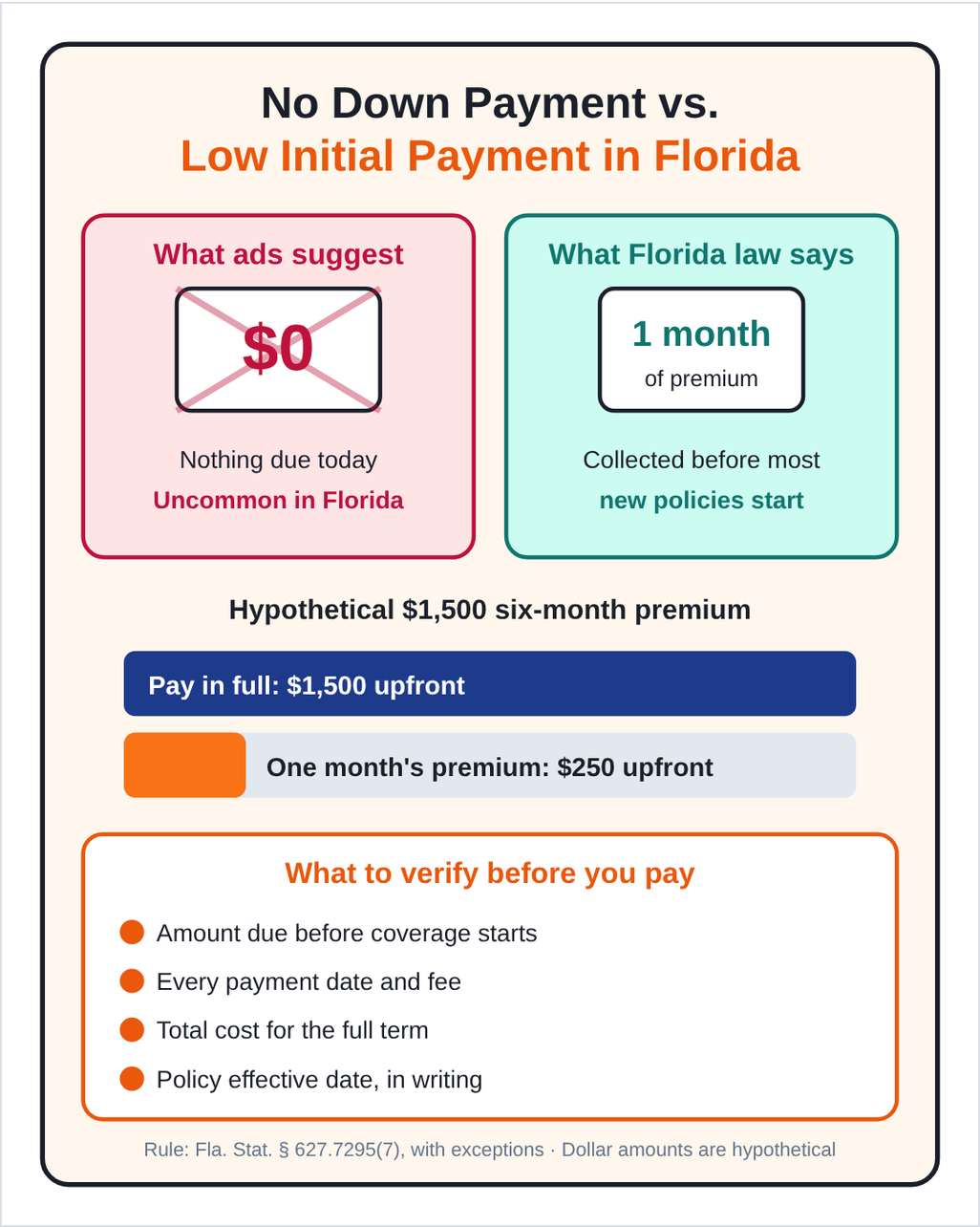
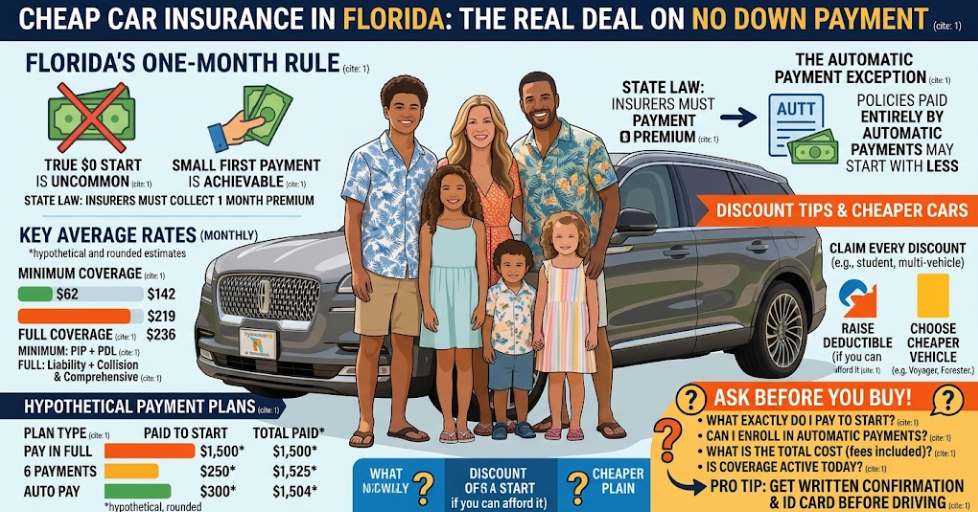
Florida's one-month rule compared with $0-down advertising. The rule comes from Florida Statutes § 627.7295(7) and has exceptions, including policies paid entirely by automatic payments; the $1,500 premium is a hypothetical example, not a quote.
What does no-down-payment car insurance actually mean?
A car insurance down payment is simply the first part of your premium. Your premium is the full price of the policy for its term, usually six or twelve months. The down payment is the share you pay before coverage begins; the rest comes in installments.
"No down payment" is marketing language, not a policy type. It usually means your first payment is no bigger than a regular monthly installment. Insurers also use labels such as "deposit," "initial payment," and "amount due today," because each company writes its own billing terms. The dollar figure is what matters.
Three payment figures to compare on every quote
| Term | What it means | Why it matters |
|---|---|---|
| Initial amount due | What you pay before the insurer makes the policy effective | Decides whether you can start coverage today |
| Monthly installment | Each later scheduled payment | Must fit your budget for the whole term |
| Total policy cost | All payments added together, including any fees | The real price of your coverage |
Florida car insurance requirements
Every vehicle with a Florida registration must carry at least $10,000 of Personal Injury Protection (PIP) and $10,000 of Property Damage Liability (PDL), according to the Florida Department of Highway Safety and Motor Vehicles (FLHSMV). Bodily injury liability is not required for most drivers, though it is required in certain cases, such as for taxis or after some violations.
Florida is a no-fault state for injuries. Your own PIP pays a share of your medical costs and lost income up to its limit, regardless of who caused the crash. PDL pays for damage you cause to other people's property.
Neither pays for injuries you cause to others or for repairs to your own car, which is why many drivers add bodily injury liability and uninsured motorist coverage. About 20.6% of Florida drivers were uninsured in 2023, the seventh-highest rate in the country, according to the Insurance Research Council.
Penalties and special filings
If your insurance lapses, FLHSMV can suspend your driving privilege and license plate for up to three years, and reinstatement costs can be up to $500. Hardship licenses are not available for insurance-related suspensions. An SR-22 filing certifies bodily injury and property damage coverage when the state requires it for reinstatement.
After a DUI conviction, Florida law requires much higher liability limits, commonly filed on a form called an FR-44: $100,000 per person and $300,000 per crash for bodily injury, plus $50,000 for property damage, kept for at least three years under Florida Statutes § 324.023. This is general information.
Can you get cheap car insurance in Florida with no down payment?
Usually with literally nothing paid, because of Florida law. Florida Statutes § 627.7295(7) says a new private passenger auto policy or binder may be issued only if the insurer or agent has collected at least one month's premium before the effective date. The money must come from your own funds, even if the premium is financed or paid on an installment plan.
The statute lists several exceptions. The rule does not apply when:
- Every payment is made by payroll deduction, automatic electronic funds transfer or a recurring credit or debit card agreement with the insurer.
- You or a family member are renewing or replacing a policy with the same insurer or insurer group.
- You are adding a vehicle or coverage to a policy you already have with that insurer.
- The insurer writes coverage mainly for active-duty or former military members and their dependents.
In practice, setting up automatic payments is the main way a new Florida customer may be able to start with less than a full month's premium. Ask the insurer directly whether that option is offered to you.
One more Florida-specific detail: GEICO says Florida policies it issues with only PIP and/or property damage coverage must be paid in full. If you are buying the bare minimum from GEICO, expect no installment plan at all. For other coverage, GEICO publishes plans for new policies starting at 25% of the premium, or 20% with automatic payments, and notes some plans are not offered in every state.
Questions to ask before you buy
- What exact amount must I pay before the policy becomes effective?
- Can I enroll in automatic payments, and does that change the amount due today?
- When is each later payment due, and are there installment or late fees?
- Is any part of this financed by a separate premium finance company?
- Will you confirm the effective date in writing?
The cheapest car insurance companies in Florida
GEICO has the lowest rates in an October 2026 study of a 40-year-old Florida driver: $42 a month for minimum coverage and $163 for full coverage. Travelers and State Farm follow within a few dollars. The study draws on Florida rate filings.
A second analysis, based on real quotes current to September 30, 2026, ranks State Farm first for full coverage at $128 a month and Progressive second at $144. It uses a broader driver group and different limits, so compare its numbers only with each other.
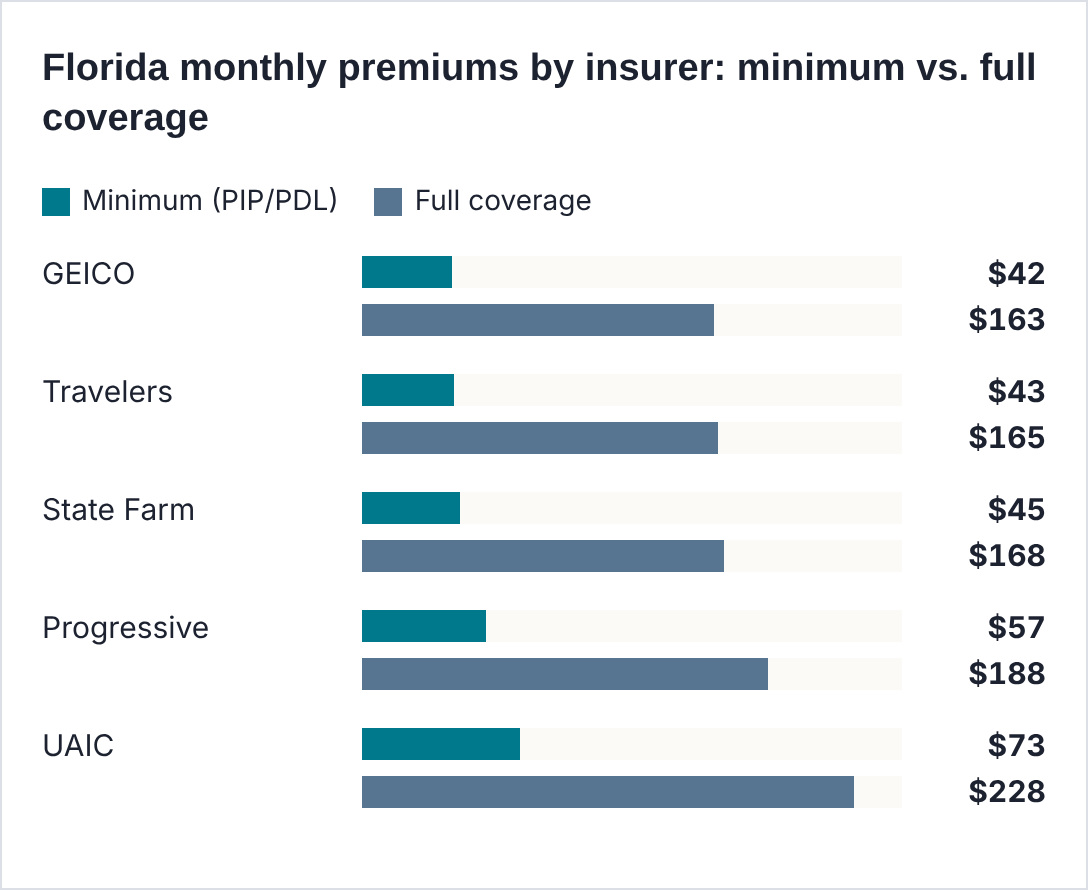
Study A: rate study updated October, 2026. Driver: 40-year-old man, clean record, good credit, 2020 Toyota Camry LE, 12,000 miles a year. Full coverage: 100/300/100 liability with $1,000 deductible. Minimum: $10,000 PIP and $10,000 PDL. Statewide Florida averages.
Florida insurers in two 2026 rate studies
| Insurer | Minimum, study A (monthly) | Full coverage, study A (monthly) | Full coverage, study B (monthly) | Liability, study B (monthly) | First-payment terms we could verify |
|---|---|---|---|---|---|
| GEICO | $42 | $163 | Not publicly confirmed | $93 | PIP/PD-only Florida policies must be paid in full; other new policies 25% upfront on 5-pay, 20% with Auto Pay |
| Travelers | $43 | $165 | Not publicly confirmed | Not publicly confirmed | Not publicly confirmed |
| State Farm | $45 | $168 | $128 | $82 | Not publicly confirmed |
| Progressive | $57 | $188 | $144 | $93 | Not publicly confirmed |
| UAIC | $73 | $228 | Not publicly confirmed | Not publicly confirmed | Not publicly confirmed |
Study A: rate study updated October, 2026 (profile above). Study B: real quotes current to September 30, 2026, drivers ages 20 to 70 with clean records and credit of 600 or higher, $1,000 deductibles on full coverage. "Not publicly confirmed" means the figure was not published, not that it is zero. Florida law's one-month rule applies to all insurers unless an exception fits.
How much does cheap car insurance cost in Florida?
Florida’s minimum coverage averages $62 a month and full coverage averages $219 in study A, a gap of $157 a month (our calculation). In study B, the averages are $142 for liability coverage and $236 for full coverage; its “liability” policies include bodily injury limits that Florida’s bare minimum does not.
Florida prices depend on your ZIP code, driving record, age, vehicle, and coverage. Florida law lets insurers use credit information in pricing, but not as the only reason for an adverse decision.
Minimum coverage vs. full coverage in Florida
| Minimum (PIP and PDL) | Full coverage | |
|---|---|---|
| What it pays for | Your own injuries up to PIP limits, and damage you cause to others' property | Minimum coverage plus bodily injury liability and damage to your own car |
| Required by Florida law? | Yes: $10,000 PIP and $10,000 PDL | No, but lenders and leasing companies usually require collision and comprehensive |
| Average monthly cost, study A (40-year-old) | $62 | $219 (100/300/100 limits) |
| Average monthly cost, study B (real quotes) | $142 (with bodily injury liability) | $236 |
| What it leaves out | Injuries you cause to others; damage to your own car | Usually little for most drivers, depending on limits chosen |
Figures are averages, not quotes. Study B's liability policies include bodily injury limits between the state minimum and $50,000/$100,000.
Prices are improving. On March 5, 2026, the Florida Office of Insurance Regulation said the state's five largest auto insurance groups, with 78% of the market, indicated an average rate decrease of 8% for 2026. State Farm requested a 10% cut, and Allstate and USAA 7% each.
Five cars that cost less to insure in Florida
The car you insure affects your premium, and a smaller premium means a smaller first payment. A rate study updated August 13, 2026, compared average six-month full-coverage premiums by model across Florida, using a sample of 18- and 40-year-old drivers, 100/300/100 liability limits, and $500 deductibles. These five had the lowest averages.
No car qualifies you for a no-down-payment policy, and Florida's one-month rule applies to whatever you drive. Treat this list as a starting point if you are choosing a vehicle.
1. Chrysler Voyager
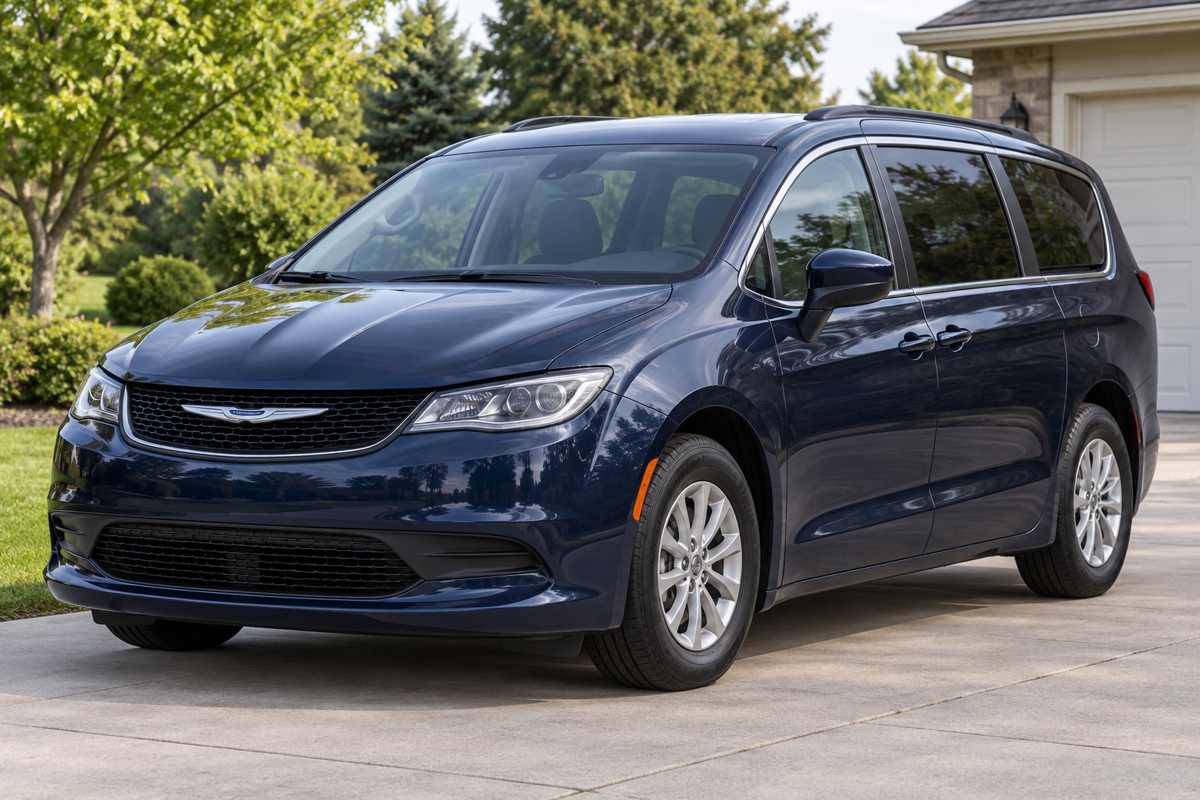
Original vector illustration of the Chrysler Voyager, a minivan. Illustration only; not to scale.
Average premium: $1,192 for six months of full coverage in Florida. The Chrysler Voyager is a minivan. It had the lowest average premium of any model in Florida, $26 below the next vehicle over six months.
2. Subaru Forester
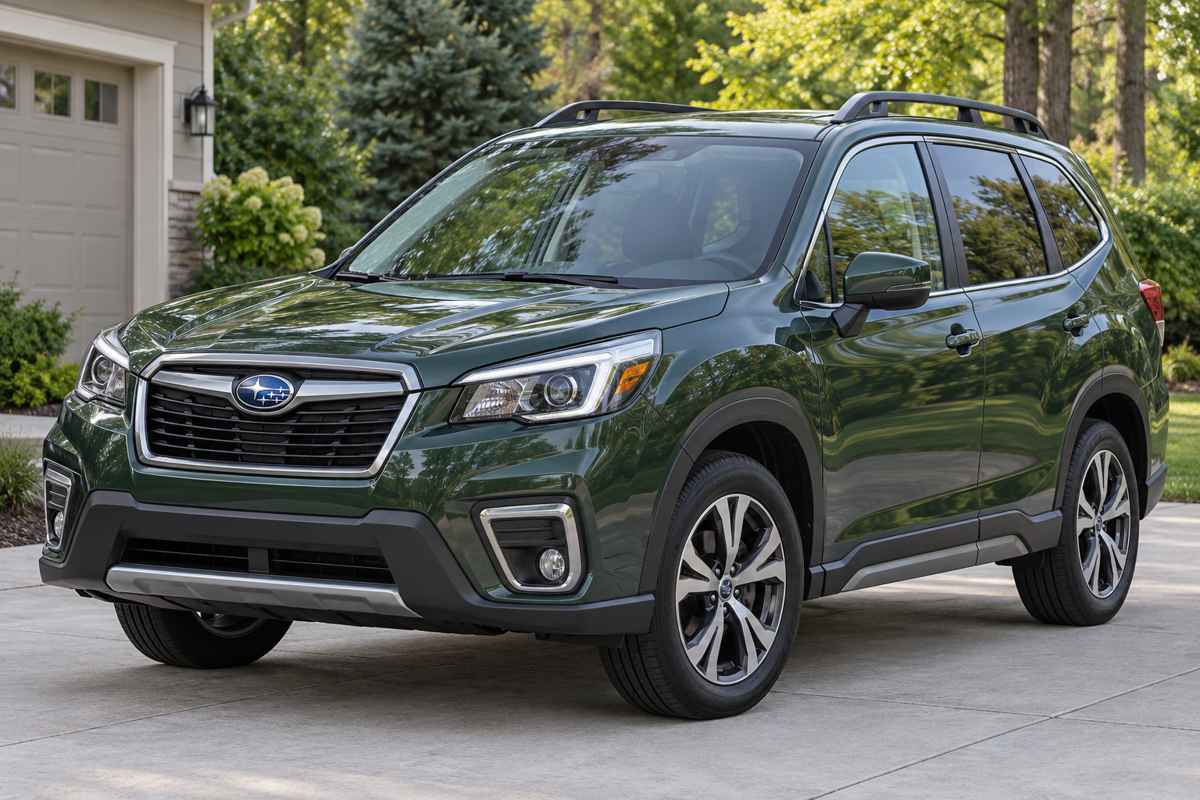
Original vector illustration of the Subaru Forester, a compact SUV. Illustration only; not to scale.
Average premium: $1,218 for six months of full coverage in Florida. The Subaru Forester is a compact SUV. It ranked second, the lowest-priced conventional SUV on the list.
3. Mini Cooper Countryman JCW
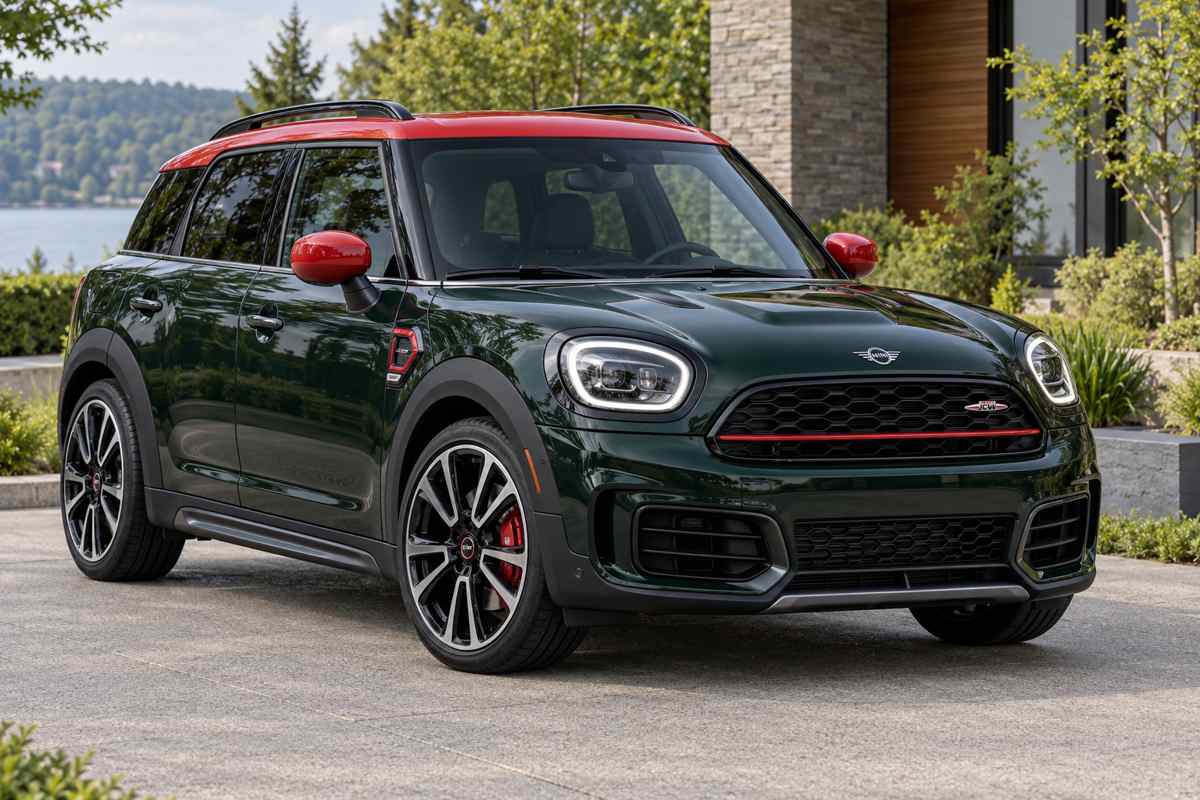
Original vector illustration of the Mini Cooper Countryman JCW, a small performance crossover. Illustration only; not to scale.
Average premium: $1,231 for six months of full coverage in Florida. The Mini Cooper Countryman JCW is a small performance crossover. It ranked third despite being the high-performance John Cooper Works version, $39 above the Voyager.
4. Mazda MX-5 Miata

Original vector illustration of the Mazda MX-5 Miata, a two-seat convertible. Illustration only; not to scale.
Average premium: $1,236 for six months of full coverage in Florida. The Mazda MX-5 Miata is a two-seat convertible. It is the only sports car in the top five, $44 above the Voyager for six months.
5. Volkswagen Tiguan

Original vector illustration of the Volkswagen Tiguan, a compact SUV. Illustration only; not to scale.
Average premium: $1,260 for six months of full coverage in Florida. The Volkswagen Tiguan is a compact SUV. It rounded out the five, $68 above the Voyager for six months.
Five cars with the lowest average insurance premiums in Florida
| Rank | Make and model | Model year | Average six-month premium | Insurance-cost finding | Source and date |
|---|---|---|---|---|---|
| 1 | Chrysler Voyager | Not specified by source | $1,192 | Lowest in the study; only minivan | Vehicle-model rate study, Aug. 13, 2026 |
| 2 | Subaru Forester | Not specified by source | $1,218 | Lowest-priced compact SUV | Vehicle-model rate study, Aug. 13, 2026 |
| 3 | Mini Cooper Countryman JCW | Not specified by source | $1,231 | Performance trim still ranked third | Vehicle-model rate study, Aug. 13, 2026 |
| 4 | Mazda MX-5 Miata | Not specified by source | $1,236 | Only sports car in the top five | Vehicle-model rate study, Aug. 13, 2026 |
| 5 | Volkswagen Tiguan | Not specified by source | $1,260 | Fifth-lowest; $68 above first | Vehicle-model rate study, Aug. 13, 2026 |
Statewide Florida averages for sample 18- and 40-year-old drivers, full coverage at 100/300/100 with $500 deductibles. The study does not publish model years or explain each ranking.
To connect the car to your first payment: one month of a six-month premium is one-sixth of it. On the averages above, that is about $199 for the Voyager and $210 for the Tiguan (our calculation). These are illustrations from statewide averages, not quotes.
How to find affordable coverage with a small initial payment
Aim for the smallest legal first payment on a policy whose total you can also afford. Follow these steps in order.
- 1. Compare at least three insurers. In study A, full coverage ranged from $163 to $266 a month between the cheapest and most expensive companies listed.
- 2. Request identical coverage on every quote. Match PIP, property damage, and bodily injury limits, deductibles, drivers, and term.
- 3. Ask for the minimum amount needed to activate the policy, both with and without automatic payments.
- 4. Compare every payment plan and its fees. Write down each due date and any charge per installment.
- 5. Check discounts you may qualify for. A lower premium shrinks every payment, including the first.
- 6. Confirm the final amount due and the effective date in writing before you pay.
First payment vs. total cost: a hypothetical comparison
The chart uses a hypothetical $1,500 six-month premium. It compares paying in full, Florida's one-month minimum on a six-payment plan, and GEICO's published 25% and 20% plans for new policies. Installment fees of $5, or $1 with automatic payments, are assumptions, not real charges.
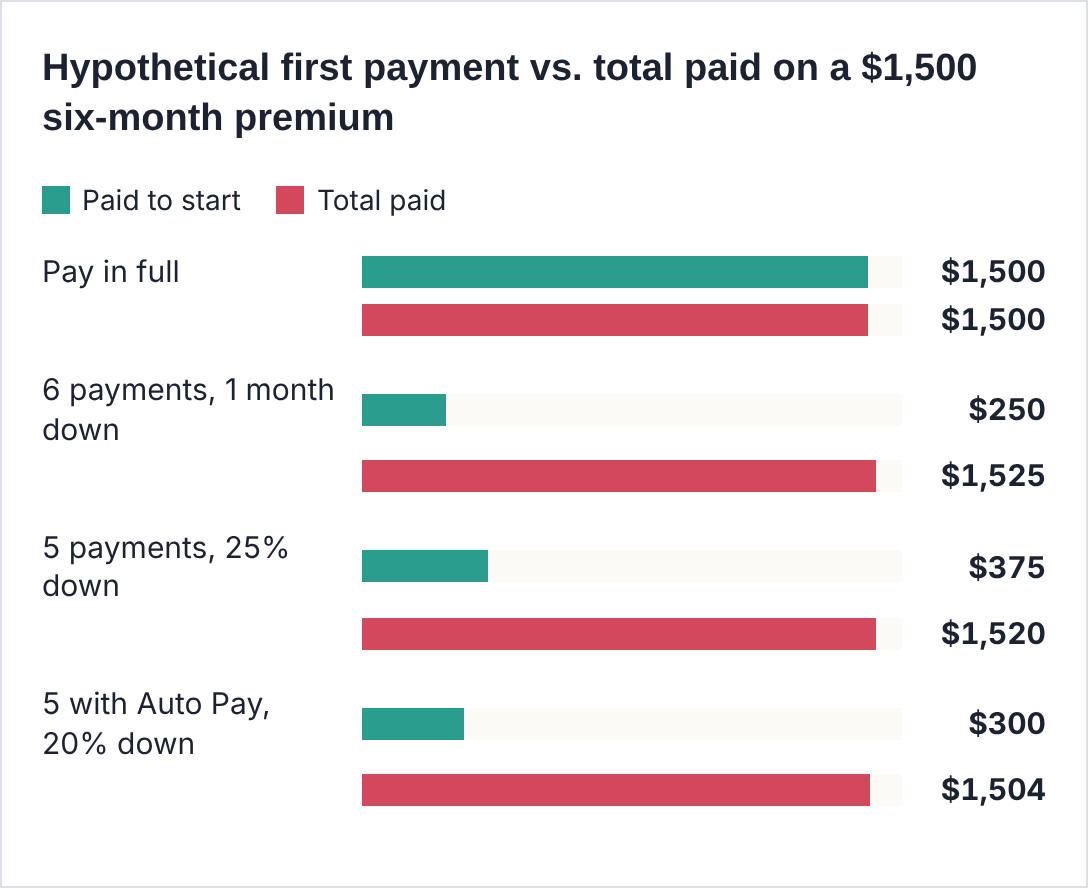
Hypothetical example calculated by us. The one-month minimum reflects Fla. Stat. § 627.7295(7); the 25% and 20% figures are GEICO's published plans for new policies. Premiums and fees are assumptions, not quotes.
Hypothetical payment plans on a $1,500 six-month premium
| Plan | Paid to start | Later payments | Assumed fees | Total paid |
|---|---|---|---|---|
| Pay in full | $1,500 | None | $0 | $1,500 |
| 6 payments, one month down | $250 | 5 × $250 | $25 (5 × $5) | $1,525 |
| 5 payments, 25% down | $375 | 4 × $281.25 | $20 (4 × $5) | $1,520 |
| 5 payments with Auto Pay, 20% down | $300 | 4 × $300 | $4 (4 × $1) | $1,504 |
All figures are hypothetical and calculated by us. They are not insurer quotes.
What affects your initial payment in Florida?
Florida law, your premium, and your insurer's billing rules set your first payment.
Florida law
- The one-month minimum for most new policies, unless every payment is automatic or another exception applies.
General factors
- Premium size: your record, ZIP code, vehicle, coverage, and credit-based insurance score.
- Policy term: a six-month policy has a smaller premium to divide than a twelve-month policy.
- Payment schedule: more installments usually mean a smaller share upfront.
Company-specific practices
- Billing rules differ by insurer; GEICO, for example, requires PIP/PD-only Florida policies to be paid in full.
- Underwriting may limit payment plans for drivers with recent lapses or missed payments.
- New versus renewal: renewing with the same insurer is exempt from the one-month rule.
Discounts and ways to reduce the cost
A lower premium reduces every payment, including the first one. Ask each insurer which discounts apply in Florida.
Ways to lower your Florida premium or first payment
| Discount or strategy | Who may qualify | What to verify | Limitation |
|---|---|---|---|
| Automatic payments | Drivers with a reliable bank account or card | Whether it lowers the amount due today or the fees | Missed drafts can lead to cancellation |
| Renew with your current insurer | Current policyholders | Renewal price versus new quotes | Renewals are exempt from the one-month rule, but may not be cheapest |
| Bundling auto with home or renters | Drivers who need property insurance | The combined total of both policies | Can raise the total if the second policy is costly |
| Multi-vehicle | Households with two or more cars | Whether all cars must be on one policy | Not useful for one car |
| Good student or driver education | Young drivers with qualifying grades or courses | Proof required | Age limits apply |
| Higher deductible | Drivers with savings for a claim | That you could pay it after a crash | Raises out-of-pocket cost |
| Choose a car that is cheaper to insure | Drivers buying a vehicle | Actual quotes on each car | Averages may not match your quote |
We do not list discount percentages because they vary by insurer. Never misstate your address, garaging location, mileage, driving record or household drivers; doing so can void a claim.
Common mistakes when shopping for low-cost insurance
Comparing quotes with different coverage. A PIP/PDL-only quote is not comparable with a policy that includes bodily injury liability. Match limits first.
Focusing only on the first payment. Always ask for the total of all payments for the term.
Ignoring fees. Ask about installment, late, and returned-payment fees, and whether automatic payments lower them.
Buying only the minimum without understanding the gap. Florida's minimum does not cover injuries you cause to others, which can leave you personally responsible.
Choosing a deductible you cannot afford. Pick one you could pay after a crash.
Letting coverage lapse. A gap can bring a suspension of up to three years, so start the new policy before the old one ends.
Frequently asked questions
Can I get car insurance in Florida with no money down?
Usually not. Florida law generally requires at least one month's premium to be collected from your own funds before a new policy takes effect. The main exception is a policy where every payment is made automatically, by bank draft, recurring card, or payroll deduction. Ask insurers whether they offer that option to you.
How much is the first payment for car insurance in Florida?
For most new policies, at least one month's premium, and often more depending on the plan. GEICO, for instance, publishes plans for new policies that start at 25% of the premium, or 20% with automatic payments. Your exact amount depends on your premium and the plan you choose.
Can I pay Florida car insurance monthly?
Often, yes, once the first payment is made. Most insurers offer installment plans, but terms and fees differ. One exception to know: GEICO says Florida policies with only PIP and property damage coverage must be paid in full. Ask each insurer which plans it offers for the coverage you want.
Does paying monthly cost more overall?
It can. Installment plans may carry a fee on each payment, and paying in full sometimes earns a discount. The difference may be small. Compare the total of all payments for each plan, using the same coverage, before you decide.
What is the minimum car insurance required in Florida?
Every registered vehicle needs at least $10,000 of Personal Injury Protection and $10,000 of Property Damage Liability. Bodily injury liability is not required for most drivers but is strongly worth considering. After a DUI, Florida requires $100,000/$300,000 bodily injury and $50,000 property damage liability for at least three years.
Who has the cheapest car insurance in Florida?
In an October 2026 study of a 40-year-old driver, GEICO was cheapest at $42 a month for minimum coverage and $163 for full coverage, with Travelers and State Farm close behind. A real-quote study ranked State Farm first for full coverage. Your cheapest option depends on your profile, so compare quotes.
Which cars are cheapest to insure in Florida?
An August 2026 study found the lowest average full-coverage premiums for the Chrysler Voyager, Subaru Forester, Mini Cooper Countryman JCW, Mazda MX-5 Miata and Volkswagen Tiguan. The five were within $68 of each other for six months. A cheaper car lowers the premium but does not remove Florida's first-payment rule.
How can I lower my first insurance payment?
Ask whether automatic payments let you start with less, choose a plan with more installments, raise your deductible if you can afford it, and claim every discount you qualify for. If you already have a policy, renewing or adding a car with the same insurer is exempt from Florida’s one-month rule.
Final recommendation
In Florida, the smallest realistic first payment is usually one month’s premium, and automatic payments may lower it further. A low first payment and a low total premium are different things, so compare both, along with coverage limits, fees, eligibility, and the effective date.
Request at least three quotes with identical coverage, and ask each insurer for its automatic-payment option and its total cost.
Premiums, payment plans, and eligibility vary by insurer and by your circumstances. The rates in this article are averages and hypothetical examples, not quotes. This article is for information only and is not legal or financial advice. The publisher is not an insurance company or a licensed insurance agency.
The bottom line on cheap car insurance in Florida with no down payment: expect to pay about one month's premium to start, ask about automatic payments, and choose the policy whose first payment and total cost both fit your budget.
Sources
- Florida Statutes § 627.7295, 2026 (accessed October, 2026).
- Florida Statutes § 324.023, 2026 (accessed October, 2026).
- Florida Statutes § 626.9741, use of credit information, 2026.
- Florida Department of Highway Safety and Motor Vehicles, Insurance (accessed October 2026).
- Florida Office of Insurance Regulation, rate announcement (March 5, 2026).
- GEICO, Auto Payment Methods and Plans (accessed October 2026).
- MoneyGeek, Cheapest Car Insurance in Florida (updated October, 2026).
- Insurify, Florida Car Insurance (rates current to September 30, 2026).
- Insurance Information Institute, Uninsured Motorists, citing the Insurance Research Council.
- CarInsurance.com, Cheapest Cars to Insure in Florida (updated August 13, 2026).