
Car Insurance Online With a Checking Account
Yes, you can buy car insurance online with a checking account and never touch a credit card. Most major insurers let you pay your premium by electronic funds transfer (EFT), a direct withdrawal from your bank account, and several reward you for it with lower installment fees or an automatic payment discount.
This guide is for drivers who would rather not put insurance on a credit card or set up automatic card payments. It names companies whose own pages confirm checking-account payments, compares what each offers, identifies the cheapest options for teens, seniors, and everyone else, and lays out the pros and cons of paying this way.
KEY TAKEAWAYS
- Paying from checking is widely available. GEICO, Progressive, State Farm, Nationwide, and Travelers all confirm EFT or bank-account payments on their own pages.
- It can cost less. GEICO says EFT customers could save up to $36 a year on installment fees, and Progressive, Nationwide, and Travelers list payment-related discounts.
- Keep enough money in the account. A declined withdrawal can lead to bank fees and, eventually, a canceled policy.
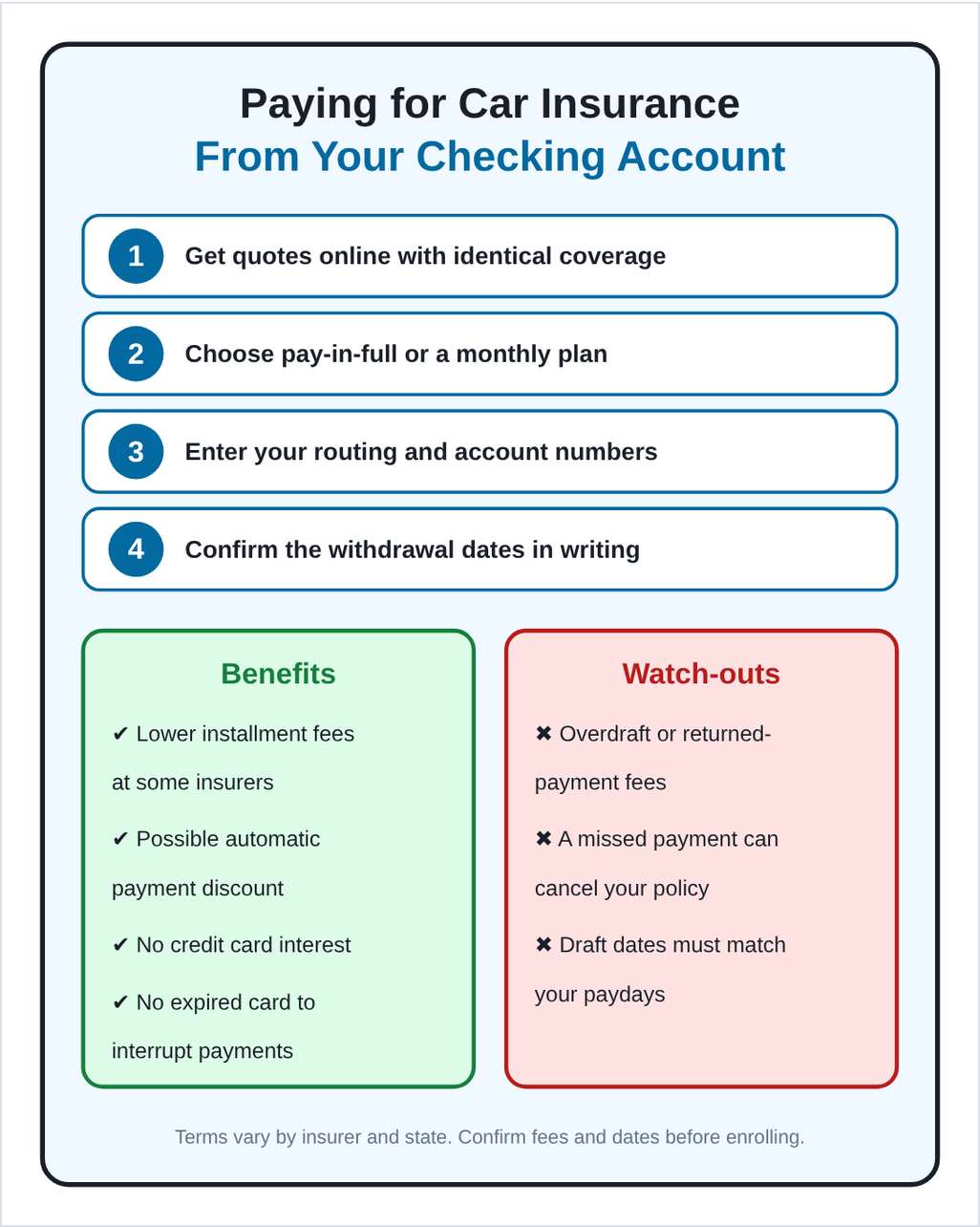
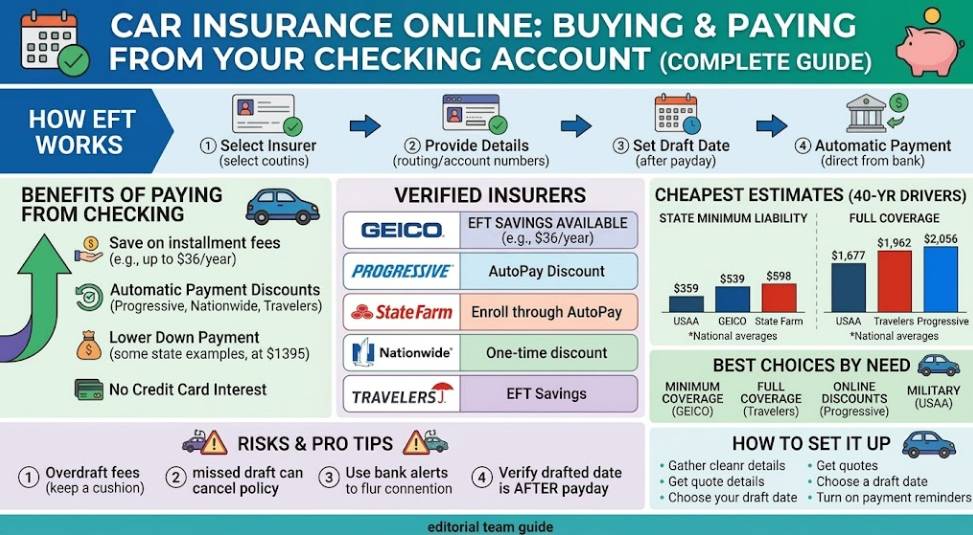
Four steps to buy car insurance online and pay from a checking account, with the main benefits and risks. Fees, discounts, and plans vary by insurer and state.
How paying from a checking account works
When you pay by EFT, you authorize the insurer to withdraw your premium directly from your checking account. You can usually do this for the first payment, for every later installment, or both. Insurers call it EFT, bank draft, automatic withdrawal, ACH, or AutoPay.
You can also make one-time payments from your checking account online or by phone without signing up for automatic withdrawals. That suits people who want to control the timing of each payment. The trade-off is that some fee reductions and discounts apply only to automatic payments.
Ways to pay for car insurance compared
| Payment method | How it works | Typical cost effect | Main risk |
|---|---|---|---|
| Automatic withdrawal from checking (EFT) | Insurer drafts each installment on a set date | Often lower installment fees; some insurers offer a discount | Overdraft or returned-payment fees if funds are short |
| One-time payment from checking | You pay each bill online or by phone | Usually standard installment fees | Forgetting a due date |
| Debit card (automatic or one-time) | Payment pulled from your bank via your card | Varies; some insurers treat it like a card payment | Same as checking; card details can expire |
| Credit card (automatic or one-time) | Charged to your card | Varies; card interest applies if you carry a balance | Interest and debt build-up |
| Paying in full | One payment for the whole term | Avoids installment fees; some insurers offer a discount | Requires the most cash upfront |
What you need to set up checking-account payments
Information to have ready
| Item | Where to find it | Why the insurer needs it |
|---|---|---|
| Bank routing number | Bottom left of a check, or your bank's app | Identifies your bank |
| Checking account number | Bottom of a check, or your bank's app | Identifies your account |
| Account holder name | Your bank statement | Must match the account |
| Preferred draft date | Your pay schedule | Avoids drafts before payday |
| Email or phone for alerts | Your contact details | Lets the insurer send reminders and confirmations |
Benefits of paying car insurance from your checking account
- Lower installment fees at some insurers. GEICO says EFT customers “could save up to $36 a year on reduced installment fees.” A Massachusetts regulator filing for Progressive Direct lists installment fees of $5 or $8, reduced to $1 or $4 with EFT.
- Possible discounts. Progressive offers an automatic payment discount from a checking account, credit card, or debit card. Nationwide offers a one-time discount for automatic bank deductions. Travelers lists savings for EFT payments.
- Sometimes a smaller down payment. In Massachusetts installment filings, several insurers ask for less upfront with EFT, as the chart below shows.
- No credit card interest. If you carry a card balance, insurance charged to the card can cost more over time.
- Fewer interruptions. A checking account does not expire the way a card does, so automatic payments are less likely to fail for that reason.
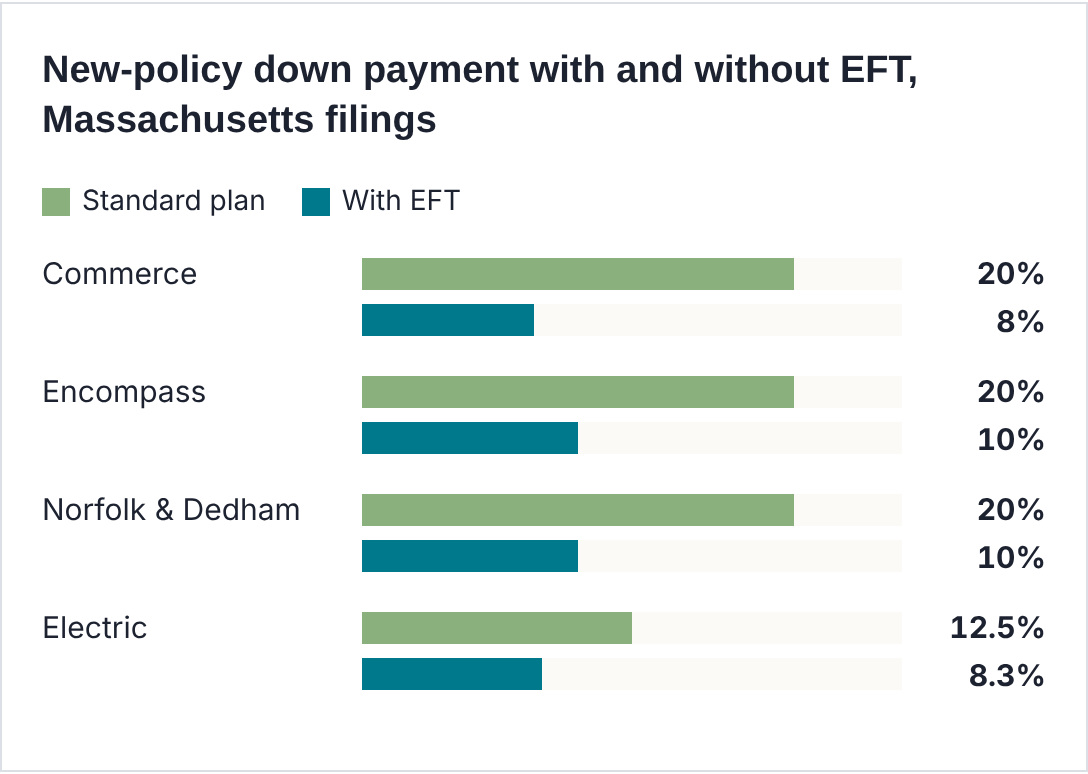
Down payment as a percentage of premium for new policies, from the Massachusetts Division of Insurance comparison of motor vehicle installment plans (undated). Electric compares its 12-payment plan with and without EFT. Massachusetts terms only; other states differ.
A state rule that rewards automatic bank payments
Florida offers a clear example of how automatic payments can matter. Florida law generally requires insurers to collect at least one month's premium before a new policy takes effect, but that rule does not apply when every payment is made by payroll deduction, automatic electronic funds transfer, or a recurring card agreement. For a Florida driver paying from checking, setting up automatic EFT may let you start with less money upfront. Ask the insurer how this works for your policy.
These filings are specific to Massachusetts, where insurers must file their installment plans. They do not prove that the same insurers offer the same terms in your state, but they show a common pattern: insurers often reward EFT with a smaller first payment or lower fees.
Where to get car insurance online with a checking account
We verified checking-account or EFT payments on each company's own pages. Discount amounts are rarely published, so the table lists exactly what each source says.
Verified checking-account payment options by insurer
| Insurer | Checking-account payment | Payment-related savings, per the insurer | Limits | Source and date |
|---|---|---|---|---|
| GEICO | EFT links your checking account to your policy | EFT enrollees "could save up to $36 a year on reduced installment fees" | Some plans not available in all states | GEICO automatic payments page, accessed Oct. 2026 |
| Progressive | Automatic payments from a checking account, credit card, or debit card | Automatic payment discount; cannot be combined with pay-in-full discount | Not available in CA | Progressive discounts page, accessed Oct. 2026 |
| State Farm | EFT from checking, money market, or savings accounts | Not stated on payment page | Enroll through AutoPay | State Farm payment page, accessed Oct. 2026 |
| Nationwide | Automatic deductions from your bank account | One-time automatic payments discount | Amount not stated | Nationwide discounts page, accessed Oct. 2026 |
| Travelers | Electronic funds transfer (EFT) | Savings for EFT, payroll deduction, or on-time payment | Not available in CA | Travelers discounts page, accessed Oct. 2026 |
USAA, Allstate, Liberty Mutual, and Amica also list EFT options in Massachusetts installment filings; we did not verify their national payment terms on official pages.
GEICO
GEICO lets you "choose Electronic Funds Transfer (EFT) to link your checking account to your GEICO policy," and you can manage it from the billing page of its website. Payments are processed on the schedule you select, and GEICO offers text reminders before each one. Its published plans for new policies start at 25% of the premium on a five-payment plan, or 20% with automatic payments. Best for: low prices and clearly stated EFT savings.
Progressive
Progressive offers an automatic payment discount "for setting up automatic payments from a checking account, credit card, or debit card," though it cannot be combined with the pay-in-full discount. It also offers a sign-online discount averaging 10%, varying by state, plus a paperless discount, which suits drivers buying online. These discounts are not available in California. Best for: stacking online and automatic-payment discounts.
State Farm
State Farm accepts "Electronic Funds Transfers (EFT) from your checking, money market, or savings accounts," and you can enroll in AutoPay. You can quote online, and State Farm also works through local agents. It ranked among the cheapest companies in a real-quote analysis and for teens and seniors. Best for: drivers who want an agent plus bank-account payments.
Nationwide
Nationwide says, “Set up automatic deductions from your bank account and get a one-time discount.” It also offers a recurring paperless discount. It ranked fifth for state-minimum coverage in a September 2026 national study. Best for: drivers who also want options like pay-per-mile coverage, which Nationwide offers through SmartMiles.
Travelers
Travelers says you can save by paying through "electronic funds transfer (EFT), payroll deduction or by consistently paying your premium on time," along with pay-in-full and early-quote discounts outside California. It had the cheapest full coverage among widely available insurers in a September 2026 national study. Best for: full coverage paid from checking.
The cheapest companies for checking-account payers
The cheapest insurer is still the biggest factor in what you pay. A national rate study updated September 18, 2026, compared annual premiums for 40-year-old drivers. The charts show its five cheapest companies for state-minimum and full coverage.
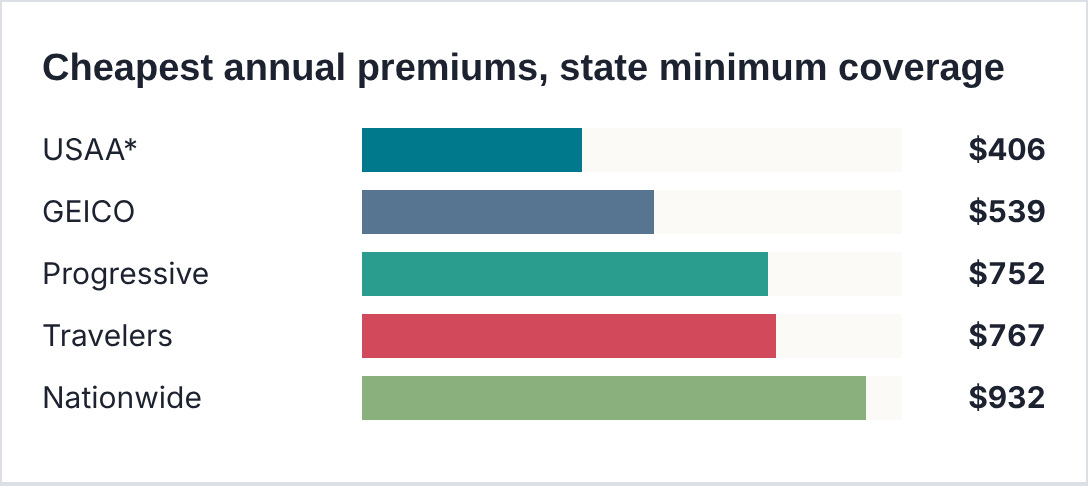
Study A: national rate study updated September 18, 2026; 40-year-old male and female drivers; state minimum liability. *USAA serves military members, veterans, and their families. National average: $738.
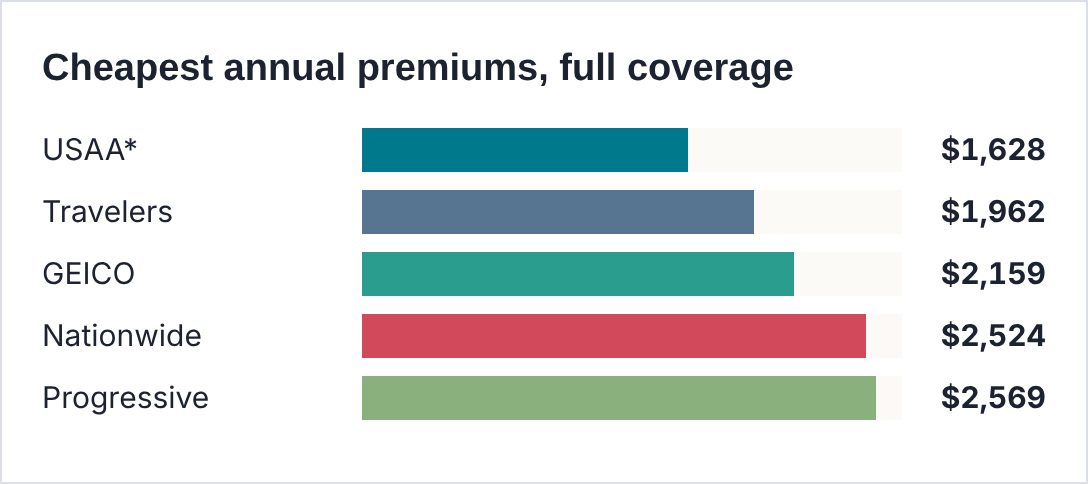
Study A: national rate study updated September 18, 2026; 40-year-old drivers; 100/300/100 limits with $500 deductibles. *USAA serves military families. National average: $2,578.
A second analysis, based on real quotes current to September 30, 2026, found State Farm at $53 a month for liability-only coverage and $103 for full coverage, and GEICO at $79 and $143. That analysis also ranked Country Financial and Auto-Owners among the cheapest, though we did not verify their online checking-account payment options.
Our pick: the best overall choice
For most drivers who want to pay from checking, GEICO is the strongest overall choice. It was the cheapest widely available company for state-minimum coverage in study A, at $539 a year, and it is the only company in our table that publishes a specific EFT saving, up to $36 a year. For full coverage, Travelers was cheapest among widely available insurers at $1,962 a year and lists an EFT discount outside California. Military families should start with USAA.
These are averages. Your cheapest company depends on your age, record, vehicle, location, and coverage, so compare at least three quotes.
Best choices by need
| Need | Our pick | Why |
|---|---|---|
| Cheapest minimum coverage paid from checking | GEICO | Lowest widely available state-minimum premium in study A; EFT fee savings up to $36 a year |
| Cheapest full coverage paid from checking | Travelers | Lowest widely available full-coverage premium in study A; EFT discount outside CA |
| Most online discounts | Progressive | Automatic payment, sign-online, and paperless discounts outside CA |
| Local agent plus EFT | State Farm | EFT from checking or savings; among cheapest in real-quote data |
| Military families | USAA | Cheapest overall in study A; eligibility limited |
Car insurance with a checking account for teens
Teen insurance is expensive, so every fee you avoid counts. In a real-quote analysis updated October, 2026, 18-year-olds paid a national average of $186 a month for liability-only coverage and $351 for full coverage. The cheapest companies were well below that.
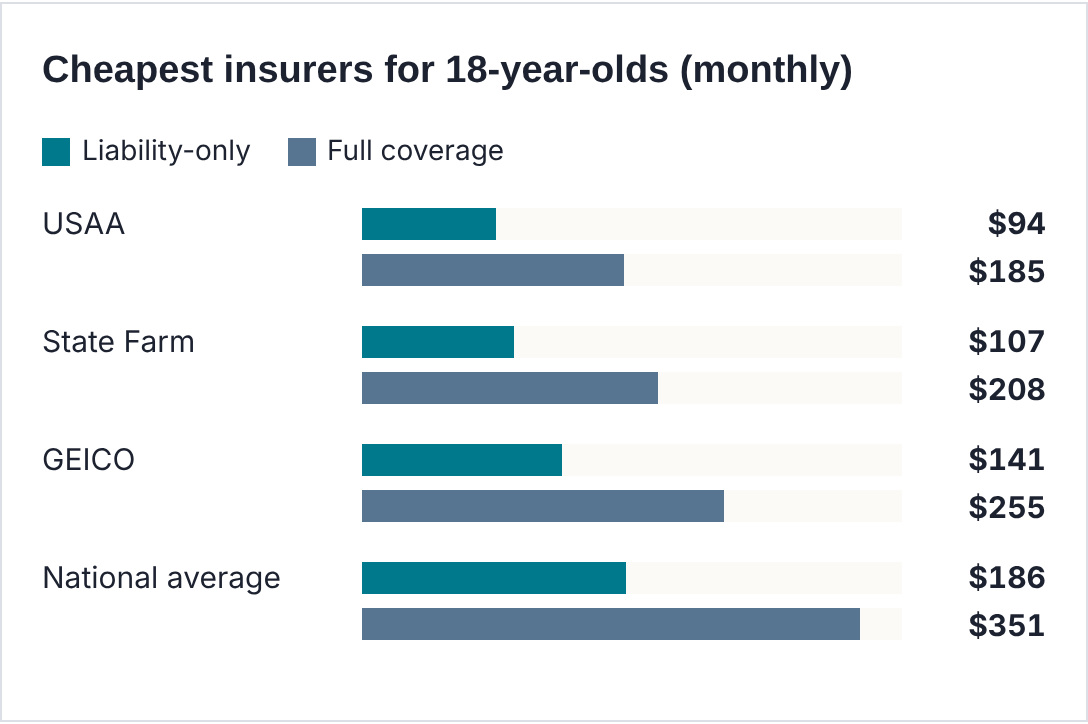
Real-quote analysis updated October, 2026; rates current to September 30, 2026. Erie ($119) and The General ($154) also ranked in the top five for liability-only; their full-coverage rates were not listed.
Notice the gap between the cheapest company and the average: State Farm's $107 liability-only figure is $79 a month below the $186 average (our calculation). That gap matters far more than any payment method, so shop first, then choose how to pay.
Many teens have a checking account before they have a credit card, which makes EFT a natural fit. A parent can also pay from a household account if the teen is added to the family policy, which is often cheaper than a separate policy.
- Add the teen to a parent's policy first and compare it with a separate policy.
- Use automatic payments from the account that receives the paycheck, scheduled for the day after payday.
- Ask about good-student discounts, which many insurers offer.
- Set up low-balance alerts so a draft never bounces.
Car insurance with a checking account for seniors
Seniors often prefer bank drafts to cards because they are predictable and easy to track. Seniors also pay some of the lowest rates. In the same real-quote analysis, drivers in their 60s averaged $85 a month for liability-only coverage and $163 for full coverage.
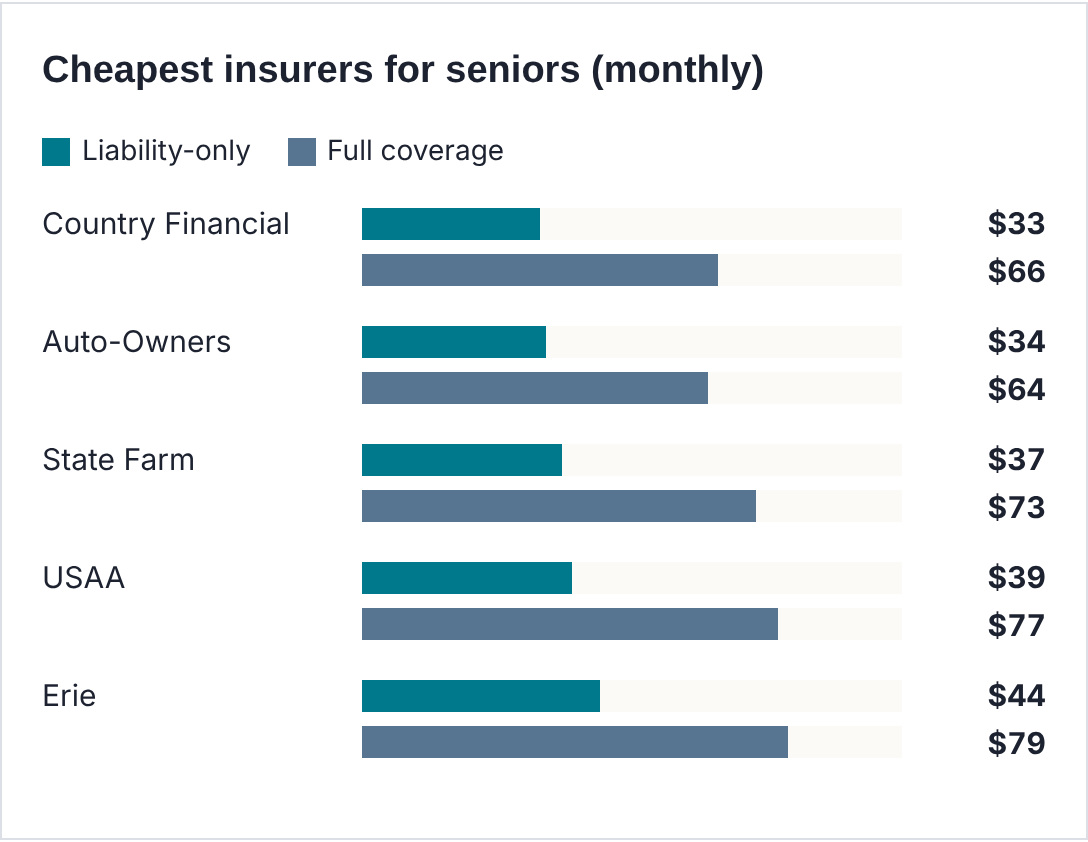
Real-quote analysis updated October, 2026; rates current to September 30, 2026. National averages for drivers in their 60s: $85 liability-only and $163 full coverage.
- Use automatic withdrawals timed to Social Security or pension deposits.
- Ask about mature-driver course discounts, which some states require insurers to offer.
- Keep paper or email confirmations of each withdrawal for your records.
- Beware of calls or texts asking for your bank details; pay only through the insurer's official website, app, or phone number.
What paying from checking can save: a hypothetical example
Installment fees look small, but they add up. The chart uses the Progressive Direct Massachusetts figures, $5 per installment without EFT and $1 with EFT, applied to two common plans. These are illustrations, not quotes.
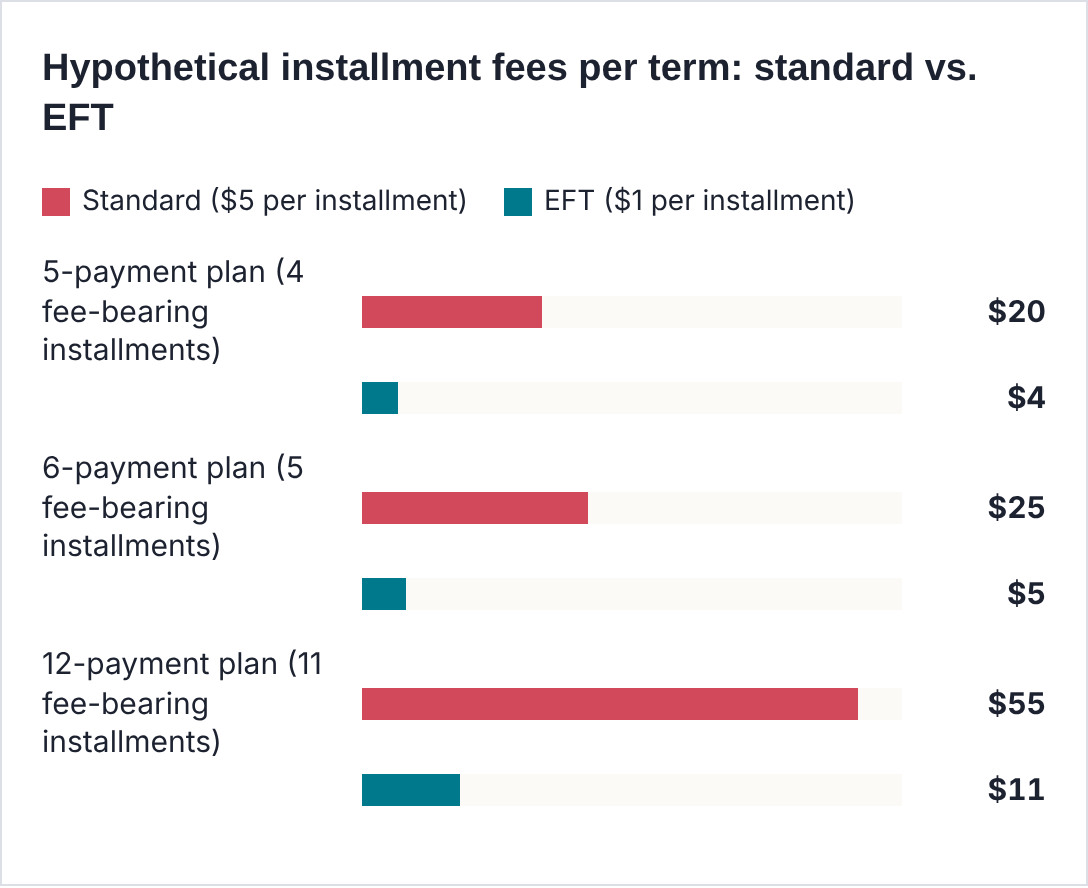
Our calculation using installment fees of $5 standard and $1 with EFT from a Progressive Direct Massachusetts filing; no fee on the down payment. Actual fees vary by insurer, state, and risk criteria.
Hypothetical cost of paying a $1,200 six-month premium three ways
| Payment method | Paid to start | Later payments | Fees or interest | Total paid |
|---|---|---|---|---|
| Pay in full from checking | $1,200 | None | $0 | $1,200 |
| Six payments from checking (EFT, $1 fee) | $200 | 5 × $200 | $5 | $1,205 |
| Six payments by credit card, balance carried at 22% APR | $200 | 5 × $200 | $25 in fees plus about $66 in interest | About $1,291 |
Hypothetical. Fees of $5 standard and $1 EFT reflect one Massachusetts filing. Interest assumes an average card balance of about $600 carried for six months at a hypothetical 22% annual rate: $600 × 22% ÷ 2 = $66 (our rough calculation). Card payments are assumed to carry the $5 standard fee. Your card terms will differ, and many people pay cards in full monthly with no interest.
Checking account, debit card, or credit card: which is best?
For people avoiding credit cards, the choice is usually between checking-account EFT and a debit card. Both draw money from your bank, but insurers may treat them differently. Progressive's automatic payment discount, for example, applies to a checking account, credit card, or debit card, while GEICO describes its fee savings specifically for EFT and treats recurring card payments as a separate option.
Checking-account EFT has two practical advantages over a debit card: the account number does not expire, and some insurers charge lower installment fees for it. A debit card can be easier to enter online. Either way, ask the insurer whether the fee and any discount differ between the two before you choose.
If you do not have a checking account
Not everyone has a bank account. If you do not, ask insurers which other methods they accept. State Farm, for example, says it accepts debit and credit cards online, by phone, or in person, and many insurers that work through local agents accept payments at the agent's office. Prepaid debit cards may work for some insurers but not others.
Be aware that you may miss out on EFT fee reductions and automatic payment discounts. If you plan to open a checking account soon, a basic low-fee account could pay for itself through lower insurance fees over a year.
Pros and cons of paying car insurance from a checking account
Pros and cons
| Pros | Cons |
|---|---|
| Lower installment fees at some insurers, such as GEICO's EFT savings | Overdraft or returned-payment fees if the account is short |
| Automatic payment discounts at insurers such as Progressive and Nationwide | A missed draft can lead to cancellation of your policy |
| No credit card interest or added card debt | No card rewards points |
| Possible smaller down payment with EFT at some insurers | You must share bank routing and account numbers |
| Payments do not fail because a card expires | Some discounts require automatic withdrawals, not one-time payments |
| Easy to budget around your paydays | Draft dates may need adjusting if your pay schedule changes |
For most budget-minded drivers, the pros outweigh the cons, as long as you keep a cushion in the account. If your balance often runs close to zero, self-scheduled one-time payments may be safer than automatic drafts.
Keeping your bank details safe
- Type the insurer's web address yourself or use its official app, rather than following links in unexpected messages.
- Never give account numbers to an unsolicited caller, even one claiming to be your insurer; hang up and call the number on your policy documents.
- Turn on your bank's transaction alerts so you see each withdrawal as it happens.
- Review your statements monthly and report any unfamiliar withdrawal to your bank quickly.
How to buy car insurance online and pay from checking
- 1. Gather your information: driver's license, vehicle identification number, current policy, and your bank's routing and account numbers.
- 2. Get at least three online quotes with the same limits, deductibles, drivers, and term.
- 3. Ask each insurer how checking-account payments affect the price: fees, discounts, and the down payment.
- 4. Choose a draft date one or two days after payday.
- 5. Enter your bank details only on the insurer's secure website or app.
- 6. Save the confirmation showing the payment schedule and effective date.
- 7. Turn on payment reminders if the insurer offers them; GEICO, for example, offers text alerts before each draft.
What can change your cost?
Your premium depends on your age, driving record, ZIP code, vehicle, coverage, deductibles, and, in many states, credit-based insurance score. Your payment method can change the fees, any payment discount, and sometimes the down payment. Your plan matters too: paying in full avoids installment fees, while more installments usually mean a smaller first payment and more fees.
Discounts and other ways to save
Payment and online discounts to ask about
| Discount or strategy | Who might qualify | What to verify | Limitation |
|---|---|---|---|
| Automatic payment from checking | Drivers who enroll in automatic withdrawals | Discount amount and whether it is one-time or recurring | May not combine with pay-in-full discounts |
| Reduced EFT installment fees | Drivers paying monthly by EFT | Fee per installment with and without EFT | Only helps if you pay in installments |
| Sign online or paperless | Drivers who buy and sign documents online | Whether both apply together | Not offered in every state |
| Pay in full | Drivers who can pay the whole term | Discount versus EFT savings | Requires the most cash upfront |
| Good student or mature driver | Students with good grades; older drivers who take a course | Proof required | Rules vary by insurer and state |
We do not list percentages unless the insurer publishes them. Never misstate your address, mileage, driving history, or household drivers to get a lower price; doing so can void a claim.
Common mistakes to avoid
Setting the draft date before payday. Choose a date after your deposit clears.
Assuming one-time bank payments earn the same discount. Many savings apply only to automatic withdrawals; ask.
Ignoring overdraft rules. Know what your bank charges if a draft exceeds your balance.
Comparing quotes with different coverage. Match limits, deductibles, drivers, and term.
Forgetting to update your bank details. If you change banks, update the insurer before the next draft.
Sharing bank details with an unverified caller. Pay only through official channels.
Frequently asked questions
Can I buy car insurance online with just a checking account?
Yes. Most major insurers accept payments from a checking account. GEICO, Progressive, State Farm, Nationwide, and Travelers all confirm EFT or bank-account payments on their own pages. You will need your bank's routing number and your account number, plus your driver's license and vehicle details.
Is it cheaper to pay car insurance from a checking account?
Often, yes. GEICO says EFT customers could save up to $36 a year on installment fees, and Progressive, Nationwide, and Travelers offer payment-related discounts. The exact savings vary by insurer and state, so compare the total cost with and without automatic payments.
Which company is best for paying car insurance from checking?
For most drivers, GEICO: it had the cheapest widely available state-minimum premium in a September 2026 study and publishes EFT fee savings. For full coverage, Travelers was cheapest among widely available insurers and offers an EFT discount outside California. Military families should check USAA.
Do I have to use automatic payments?
No. Most insurers also accept one-time payments from your checking account online or by phone. However, some discounts and fee reductions apply only to automatic withdrawals, so ask each insurer how the choice affects your cost.
What happens if my automatic payment bounces?
Your bank may charge an overdraft or returned-payment fee, and your insurer may charge a late fee. If the payment is not made, the insurer can cancel your policy after giving the notice your state requires. Keep a cushion in the account and turn on payment reminders.
What is the cheapest car insurance for teens who pay from checking?
In an October 2026 real-quote analysis, USAA was cheapest for 18-year-olds at $94 a month for liability-only coverage, followed by State Farm at $107. The national average was $186. Adding a teen to a parent’s policy is often cheaper than a separate policy.
What is the cheapest car insurance for seniors?
The same analysis found Country Financial cheapest for seniors at $33 a month for liability-only coverage, followed by Auto-Owners, State Farm, USAA, and Erie. Drivers in their 60s averaged $85 for liability-only and $163 for full coverage nationally.
Is it safe to give an insurer my bank account number?
Generally, yes, when you enter it on the insurer's official website or app or give it through the insurer's verified phone number. Avoid sharing bank details with unsolicited callers or through links in unexpected texts or emails. Review your statements for any unexpected withdrawals.
Final recommendation
Paying from checking is a simple way to avoid credit card debt, and it often lowers your fees. Start with the cheapest insurers for your situation, ask each one how checking-account payments change the price, and choose a draft date that matches your paycheck. Then compare the amount due today, the total cost, and the effective date.
Prices, payment terms, and discounts vary by insurer, state, driver, and eligibility. The rates in this article are averages and hypothetical examples, not quotes. This article is for information only and is not legal or financial advice. The publisher is not an insurance company or a licensed insurance agency.
The bottom line on car insurance online with a checking account: it is widely available, it can lower your fees, and it keeps insurance off your credit card, so compare quotes, enroll carefully, and keep enough money in the account for every draft.
Sources
- GEICO, Automatic Payments and Auto Payment Methods and Plans (accessed October 2026).
- Progressive, Car Insurance Discounts (accessed October, 2026).
- State Farm, Insurance Payment Plans (accessed October, 2026).
- Nationwide, Auto Insurance Discounts (accessed October, 2026).
- Travelers, Car Insurance Discounts (accessed October, 2026).
- Massachusetts Division of Insurance, Progressive Direct installment payment plans and Comparison of Motor Vehicle Installment Plans (accessed October 2026).
- CarInsurance.com, Cheapest Car Insurance Companies (updated September 18, 2026).
- Insurify, Cheapest Car Insurance Companies, Cheapest Car Insurance for 18-Year-Olds, and Cheapest Car Insurance for Seniors (rates current to September 30, 2026).
- CarInsurance.com, Installment service fees (updated May 20, 2026).