
First Month Free Car Insurance
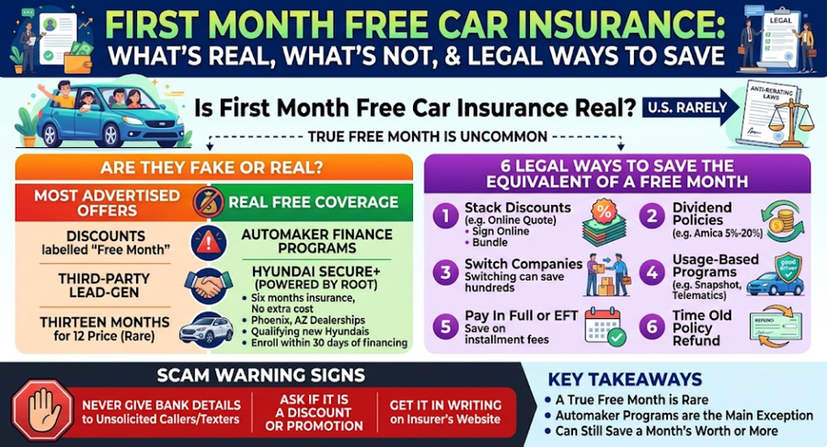
For drivers low on cash, first month free car insurance can be a tempting type of coverage to look for. However, in the U.S., it’s rare for a simple reason: state anti-rebating laws generally bar insurers and agents from giving away coverage or other inducements that are not part of the policy. The good news for drivers who need to get insured with no money out of pocket upfront: free coverage does exist in a few places, mainly through automaker finance programs, and there are legal ways to save at least a month's worth of premium.
This guide explains why free months are uncommon, where real free coverage exists in 2026, how "one month free" offers usually work, and six legal ways to save the equivalent of a free month or more. It also covers scam warning signs. Every figure is sourced and dated, and our calculations are labeled.
KEY TAKEAWAYS
- A true free month is rare in the U.S. Anti-rebating laws generally ban inducements not stated in the policy.
- Automaker programs are the main exception. Hyundai's Secure+ program with Root gives six months of insurance at no extra cost on qualifying new Hyundais financed in Phoenix, Arizona, through January 4, 2027.
- You can still save a month's worth. On a six-month policy, one month equals about 16.7% of the premium, and stacked discounts, dividends, or switching companies can match or beat that.
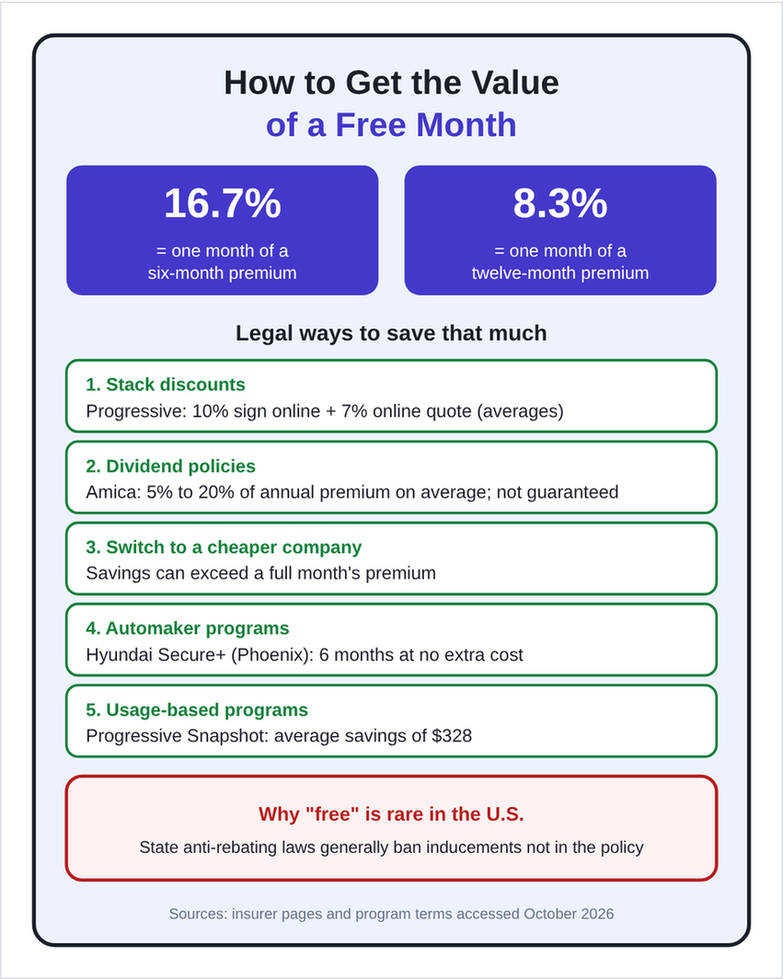
What a free month is worth as a share of your premium, and five legal ways to save that much, with figures from Progressive, Amica, and Hyundai program pages accessed October 2026. Discount averages vary by state and driver.
BEFORE YOU BUY
If an ad promises a free month, ask whether it is a discount, an extra month of coverage, or a promotion from a third party. Then ask the insurer to show the offer in writing, on its own website or in its documents.
Is first month free car insurance real?
In the U.S., a true free month from an insurer is uncommon, and the reason is legal, not just commercial. Most states have anti-rebating laws that bar insurers and agents from offering anything of value that is not stated in the policy to persuade you to buy. A month of coverage at no charge would usually be exactly that kind of inducement.

Outside the U.S., "one month free" promotions are more common. In Singapore, for example, DirectAsia ran a 2021 promotion it described as one month free, delivered as a 9% discount on an annual premium. That example shows how most "free month" offers really work: as a discount roughly equal to a month, not an extra month of coverage.
How "first month free" offers usually work
| Type of offer | What you actually get | Common in the U.S.? |
|---|---|---|
| Discount equal to about a month | A lower premium, such as about 8% to 9% off an annual policy | Discounts, yes; "free month" labels, rarely |
| Extra month added to the term | Thirteen months for the price of twelve | Rare; may conflict with anti-rebating laws |
| Automaker or lender program | Insurance included with a qualifying vehicle purchase or finance deal | Limited programs only |
| Lead-generation ad | A form that collects your details for quote sellers | Common; read the fine print |
Why anti-rebating laws limit free coverage
Rebating means giving back part of the premium, or something else of value, to win a sale. States limit it to keep pricing fair, so that two drivers with the same risk pay the same price. The rules differ by state, but the pattern is consistent:
Examples of state anti-rebating rules
| State | Rule | Gift or rebate limit |
|---|---|---|
| New York | Insurance Law § 2324 bars "valuable consideration or inducement of any kind" not specified in the policy | A 2007 legal opinion cited a $15 limit for advertising merchandise; a free car wash was ruled an unlawful inducement |
| South Dakota | Bulletin 09-01 says inducements, discounts, or incentives not in the policy are generally prohibited | Promotional gifts allowed up to $25 in invoice value |
| Florida | Statute § 626.572 allows agents to rebate commissions only under strict conditions | Rebate must follow a filed, uniform schedule available to everyone in the same class |
New York DFS OGC Opinion No. 07-07-07 (July 13, 2007); South Dakota Division of Insurance Bulletin 09-01 (February 11, 2009); Florida Statutes § 626.572. Rules may have changed since these dates; check your state insurance department.
The rules have loosened somewhat. In December 2020, the National Association of Insurance Commissioners (NAIC) amended its model unfair trade practices law to let insurers offer "value-added products or services at no or reduced cost," such as loss-control or safety services related to the coverage. States decide whether to adopt that language, and it is aimed at services, not free months of premium.
Where free car insurance really exists in 2026
The clearest current U.S. example is an automaker finance program. Hyundai's Secure+ program, powered by Root Insurance, gives six months of auto insurance at no additional cost on a qualifying new Hyundai financed or leased through Hyundai Motor Finance at Phoenix-area dealerships.
Hyundai Secure+ powered by Root: key terms
| Feature | Details |
|---|---|
| What you get | Six months of auto insurance at no additional cost |
| Where | Arizona residents; new Hyundais bought at the 14 Hyundai dealerships in Phoenix |
| Deadline | Purchase or lease before January 4, 2027; enroll within 30 days of financing |
| Eligibility | Must qualify under Root's underwriting; approval is not guaranteed |
| Liability limits | $100,000/$300,000 bodily injury and $100,000 property damage |
| Physical damage | Collision and comprehensive with $1,000 deductibles |
| Other coverage | Rental, roadside, medical payments, and uninsured/underinsured motorist coverage |
| Restrictions | Limits and deductibles cannot be changed; moving out of state ends eligibility; no refund if you cancel |
| After six months | You pay Root, or switch to another insurer |
Hyundai Motor America, Secure+ powered by Root program page (accessed October 2026). Terms can change; confirm with the dealer before you buy.
How much is six months of coverage worth? At the $187 national full-coverage average from a 2026 real-quote analysis, six months would cost about $1,122 (our calculation). Your own value depends on your age, record, and ZIP code. Weigh it against the program's limits: you cannot change the coverage during the free term, you get no refund if you cancel, and after six months you pay Root's regular price or switch insurers.
This kind of program is not new. In 2005, Volkswagen ran a pilot that offered a year of free insurance on certain new models at 43 dealerships in Illinois and Wisconsin. These programs are usually local, time-limited, and tied to buying or financing a specific vehicle, so they help only if you were already planning that purchase.
Another rare form of "free" coverage was the 2020 premium givebacks. When driving dropped early in the pandemic, Allstate announced it would return about 15% of April and May premiums, about $600 million in total, and American Family announced a one-time payment of about $50 per insured car. These were emergency programs, not ongoing offers.
What a free month is worth
To compare offers, translate "one month free" into a percentage. On a six-month policy, one month is one-sixth, or about 16.7%, of the premium. On a twelve-month policy, it is one-twelfth, or about 8.3% (our calculation).
Hypothetical: what one free month is worth
| Six-month premium | One month (16.7%) | Twelve-month premium | One month (8.3%) |
|---|---|---|---|
| $400 | $67 | $800 | $67 |
| $600 | $100 | $1,200 | $100 |
| $900 | $150 | $1,800 | $150 |
| $1,200 | $200 | $2,400 | $200 |
Hypothetical premiums; our calculation, rounded to the nearest dollar.
Any legal saving at least that large gives you the value of a free month, even if nobody calls it that. The rest of this guide shows how to get there.
6 legal ways to save the value of a free month
1. Stack discounts
Discounts are written into an insurer's rates, so they are legal everywhere they are filed. Progressive, for example, lists these average savings on its discounts page:
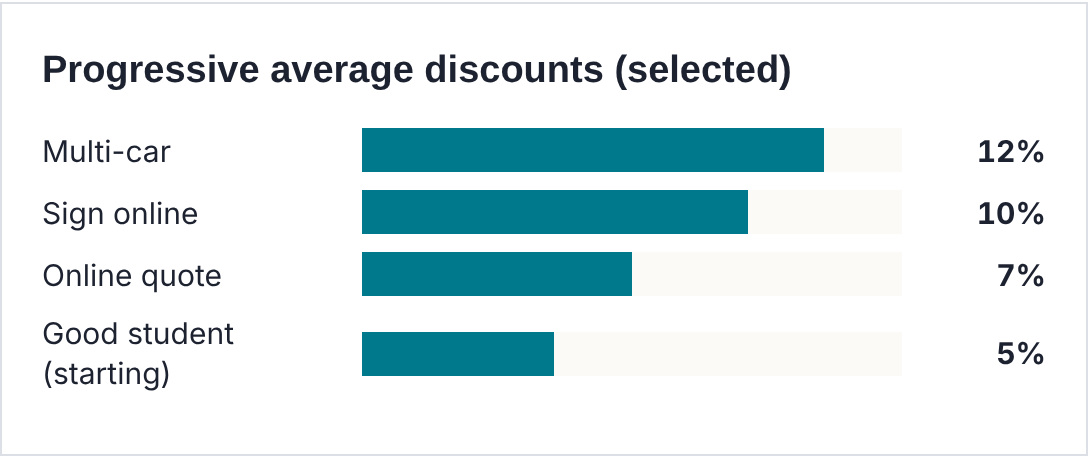
Progressive discounts page, accessed October 2026. Averages vary by state. Sign online not available in CA or HI; online quote not available in CA, GA, or NY; good student not offered in CA or HI.
Stacking even two of these can approach a month. If a 10% sign-online discount and a 7% online-quote discount apply one after the other, the combined saving is about 16.3% (our calculation: 1 − 0.90 × 0.93), close to one month of a six-month premium. Insurers apply discounts differently, so ask each one to show the effect on your quote.
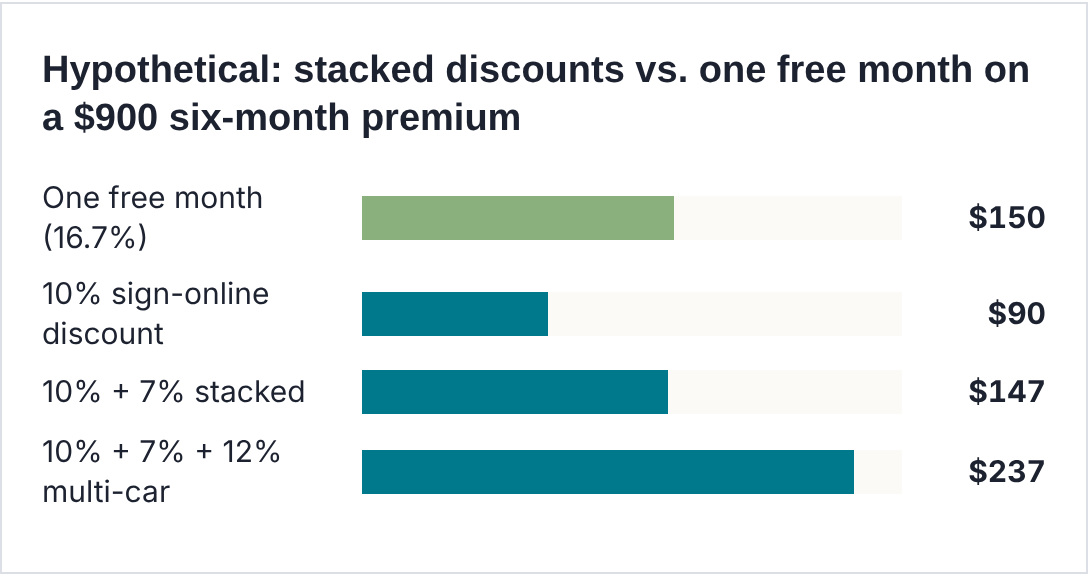
Hypothetical; our calculation. Discounts applied one after another to a $900 six-month premium: 10% = $90; 1 − 0.90 × 0.93 = 16.3% = $147; 1 − 0.90 × 0.93 × 0.88 = 26.3% = $237. Percentages are Progressive averages; your discounts will differ.
2. Choose a dividend policy
Some mutual insurers return part of the premium as dividends. Amica says its auto dividend payments average 5% to 20% of the annual premium, paid by check or applied to a future premium. Since one month is about 8.3% of an annual premium, a dividend in the upper part of that range would be worth more than a free month (our calculation). Dividends are not guaranteed, are not available in every state, and you must still be a policyholder when they are declared.
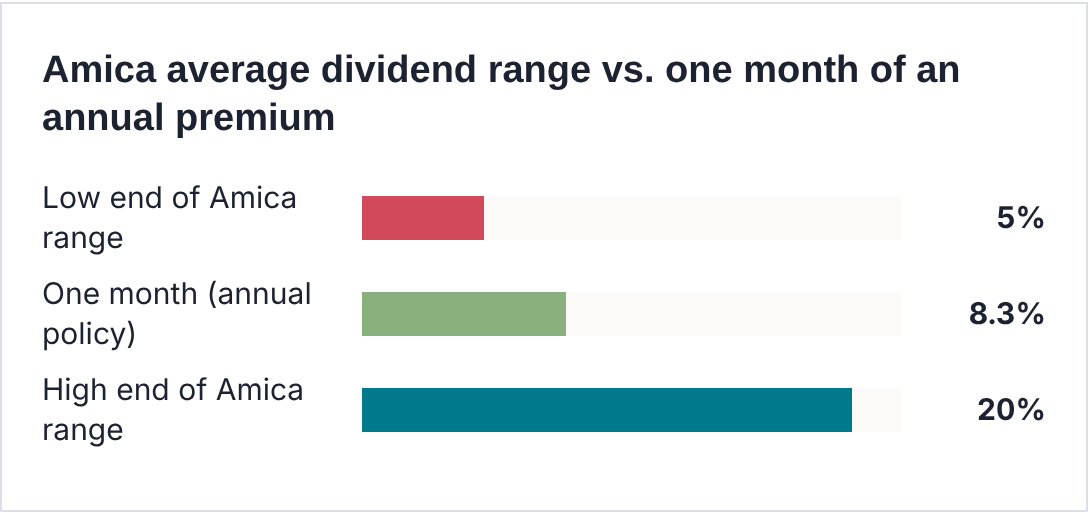
Amica auto dividend policies page, accessed October 2026: average dividends of 5% to 20% of annual premium; not guaranteed. One month = 1 ÷ 12 (our calculation).
3. Switch to a cheaper company
The biggest saving usually comes from changing insurers, not from promotions. In a real-quote analysis with rates current to September 30, 2026, full coverage averaged $187 a month nationally, while State Farm averaged $103 and GEICO $143. Liability-only coverage averaged $99, while Country Financial averaged $45 and State Farm $53.
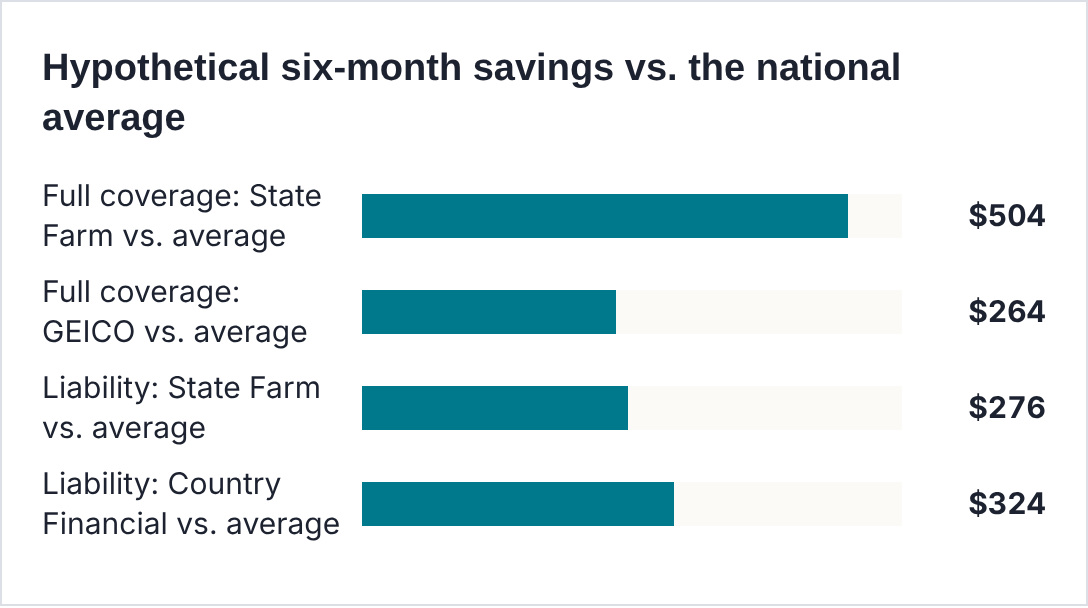
Our calculation: (national average − company average) × 6, using a real-quote analysis with rates current to September 30, 2026. Full-coverage average $187; liability-only average $99. Averages, not quotes.
For a driver paying the full-coverage average, a switch to a company averaging $103 would save about $504 over six months, the value of nearly five months at the new price (our calculation). That is several "free months," with no promotion required.
4. Use a usage-based program
Programs that track driving can lower your price after a short trial. Progressive says Snapshot users save an average of $328, and one 2026 rate study said usage-based programs generally offer 15% to 40% discounts after two to six months of data. Some programs can raise rates for risky driving, so read the terms. Pay-per-mile programs, such as Mile Auto and Nationwide SmartMiles, can also cut costs if you drive little.
5. Pay in full or by automatic payment
Installment fees can add up to a meaningful share of a month. GEICO says customers paying by electronic funds transfer could save up to $36 a year on reduced installment fees. Progressive offers pay-in-full and automatic payment discounts, though not together and not in California. Ask each insurer what each payment method costs over the full term.
6. Time your switch with your old policy's refund
When you cancel a policy early, most insurers refund the unused premium. With a pro rata refund, you get all of it back; with a short-rate refund, an insurer may keep 10% to 15% of the unearned premium, according to an August 2026 analysis. Start your new policy and cancel the old one effective the same day, so the refund helps fund your first month without any gap in coverage.
PRO TIP #1
Ask every insurer to show your quote with and without each discount. Then add up the savings and compare the total with one month of premium. If the discounts beat a month, you have the value of a free month, written into the policy where it is legal and lasting.
Coverage you may already have at no extra charge
Sometimes the "free" coverage you need is already in a policy you or your household has. These are not promotions, but they can save you from buying coverage you do not need yet.
The new car grace period. If you already have an active auto policy and buy another car, many insurers automatically extend your coverage to the new vehicle for a short time. A rate study updated June 26, 2026, says insurers commonly offer grace periods of about 7 to 30 days, though some give only a few days and some give none. The coverage usually mirrors your existing policy, so a liability-only policy gives only liability on the new car.
Most states do not require a grace period, and a lender may require full coverage before you drive off, so call your insurer before you buy.
Permissive use. If you borrow a friend's or relative's car occasionally, the owner's policy typically covers drivers who have permission, according to a quote analysis updated October 17, 2026. Rules vary by insurer and state, so the owner should confirm with their company before you drive.
Being added to a household policy. If you live with family, being added as a driver on their policy can cost less than a separate policy and avoids a second first payment. It is not free, because adding a driver can raise the premium, but it is often the cheapest way to start.
None of these replace your own policy for long, but they can cover a short gap legally while you compare quotes, so you never feel pushed into a "free month" deal that costs more later.
How to spot a fake "free month" offer
Because true free months are rare in the U.S., treat bold "free insurance" ads with caution. Many are lead-generation pages that collect your details for companies selling quotes. Others may be outright scams.
- Check the license. Every insurer and agent must be licensed in your state; your state insurance department can confirm it.
- Get it in writing on the insurer's own website or documents, not just in an ad or text.
- Never give bank or card details to an unsolicited caller or texter; contact the insurer through its official website or app.
- Ask what happens after the free period, including the regular price and any cancellation terms.
- Confirm proof of insurance before you drive. A promise is not coverage.
Who benefits most with first month free car insurance coverage?
Automaker programs help buyers who were already planning to finance a specific new vehicle in the program area. Discount stacking helps drivers who can buy online, insure more than one car, or bundle.
Dividend policies suit drivers who stay with one insurer for years. Switching helps almost anyone paying more than the cheapest companies in their area, which, judging by the gap between national averages and the cheapest companies, is a large share of drivers.
Pros and cons of chasing a "free month"
| Pros | Cons |
|---|---|
| Automaker programs can cover several months at no extra cost | Programs are local, time-limited, and tied to a vehicle purchase |
| Discounts and switching can save more than a month every term | Discounts vary by state and are not all available everywhere |
| Dividends can return 5% to 20% of annual premium at Amica | Dividends are not guaranteed |
| Savings are written into the policy and legal | "Free month" ads may be lead generation or scams |
PRO TIP #2
If you are buying a new car, ask the dealer and the finance office whether any insurance program comes with the purchase. Then compare that program's coverage and price after the free period with independent quotes. A free start only helps if the policy afterward is competitive.
Common mistakes to avoid
- Choosing a policy for a free month alone. A free month on an expensive policy can cost more over a year than no promotion at a cheaper company.
- Ignoring the terms after the free period. Ask what the price will be, whether coverage can change, and whether cancellation affects refunds.
- Letting coverage lapse while waiting for a promotion. A gap can raise future prices and break state law.
- Trusting an ad over the insurer's own documents. Confirm every offer in writing.
FAQs about first month free car insurance plans
Is first month free car insurance real?
Rarely in the U.S. State anti-rebating laws generally bar insurers and agents from offering inducements not stated in the policy, which would usually include a free month. The main exceptions are automaker or lender programs, such as Hyundai's Secure+ program with Root in Phoenix, and filed discounts that equal about a month.
Which companies offer free car insurance?
In 2026, Hyundai's Secure+ program, powered by Root, gives six months at no additional cost on qualifying new Hyundais financed or leased at Phoenix-area dealerships through January 4, 2027. We found no major U.S. insurer advertising a general first-month-free offer to all drivers.
Why can't insurers just give a month free?
Anti-rebating laws are meant to keep prices fair, so drivers with the same risk pay the same rate. New York's law, for example, bars "valuable consideration or inducement of any kind" not specified in the policy. Discounts are allowed because they are filed and available to everyone who qualifies.
How much is a free month worth?
About 16.7% of a six-month premium or 8.3% of a twelve-month premium (our calculation). On a $900 six-month policy, that is $150. Any legal discount, dividend, or switch that saves at least that much gives you the value of a free month.
Can stacking discounts equal a free month?
Often. Progressive lists average savings of 10% for signing online and 7% for an online quote, which together come to about 16.3% when applied one after another (our calculation). Adding a multi-car or bundle discount can push savings well past one month, where available.
Do dividends count as free insurance?
They can work like it. Amica says its auto dividends average 5% to 20% of the annual premium, paid by check or applied to a future premium. One month of an annual policy is about 8.3%. Dividends are not guaranteed and are not available in every state.
Are "free car insurance" ads scams?
Not always, but be careful. Many are lead-generation pages, and some may be scams. Confirm the insurer is licensed in your state, get the offer in writing on the insurer's own documents, and never share bank details with an unsolicited caller or texter.
What is the best way to save a month's premium?
For most drivers, switching to a cheaper company. In 2026 real-quote data, State Farm averaged $103 a month for full coverage versus a $187 national average, which would save about $504 over six months (our calculation). Then add every discount you qualify for.
Final recommendation
Do not wait for a free month; build one. If you are buying a new car, ask whether an insurance program comes with it. Otherwise, compare quotes from the cheapest companies, stack every eligible discount, and consider a dividend policy. Most drivers can save at least a month's worth of premium legally, every term.
NEXT STEP
Gather your driver's license, vehicle identification number, and current policy. Request at least three quotes with identical coverage, ask each insurer to list every discount it applied, and compare the savings with one month of your current premium.
Promotions, discounts, dividends, and laws vary by insurer, state, driver, and vehicle. The figures in this article are averages, published program terms, and hypothetical calculations, not quotes. This article is for information only and is not legal or financial advice. The publisher is not an insurance company or a licensed insurance agency.
The bottom line on first month free car insurance: true free months are rare in the U.S., but automaker programs, stacked discounts, dividends, and switching to a cheaper company can give you the value of a free month or more.
Sources
- Hyundai Motor America, Secure+ powered by Root Insurance (accessed October 2026) and Coverager, Progress in the Hyundai–Root partnership (December 5, 2025).
- F&I Magazine, VW Offers Free Insurance Incentive (January 3, 2005).
- New York DFS, OGC Opinion No. 07-07-07 (July 13, 2007).
- South Dakota Division of Insurance, Bulletin 09-01: Rebating Laws (February 11, 2009).
- Florida Statutes § 626.572 (accessed October 2026).
- Locke Lord, NAIC Adopts Amendments to the Unfair Trade Practices Act Model (December 2020).
- DirectAsia (Singapore), One Month Free Car Insurance promotion (May to November 2021).
- KSAT, Auto insurance companies return $800 million in premiums (April 7, 2020).
- Progressive, Car Insurance Discounts and GEICO, Automatic Payments (accessed October 2026).
- Amica, Auto Insurance Dividend Policies (accessed October 2026).
- Insurify, Cheapest Car Insurance Companies (rates current to September 30, 2026) and Can You Get One-Day Car Insurance? (updated October 17, 2026).
- CarInsurance.com, New Car Grace Period (updated June 26, 2026).
- MoneyGeek, Car Insurance Refund (August 31, 2026) and usage-based program discounts (updated October 29, 2026).