
Temporary Car Insurance in California
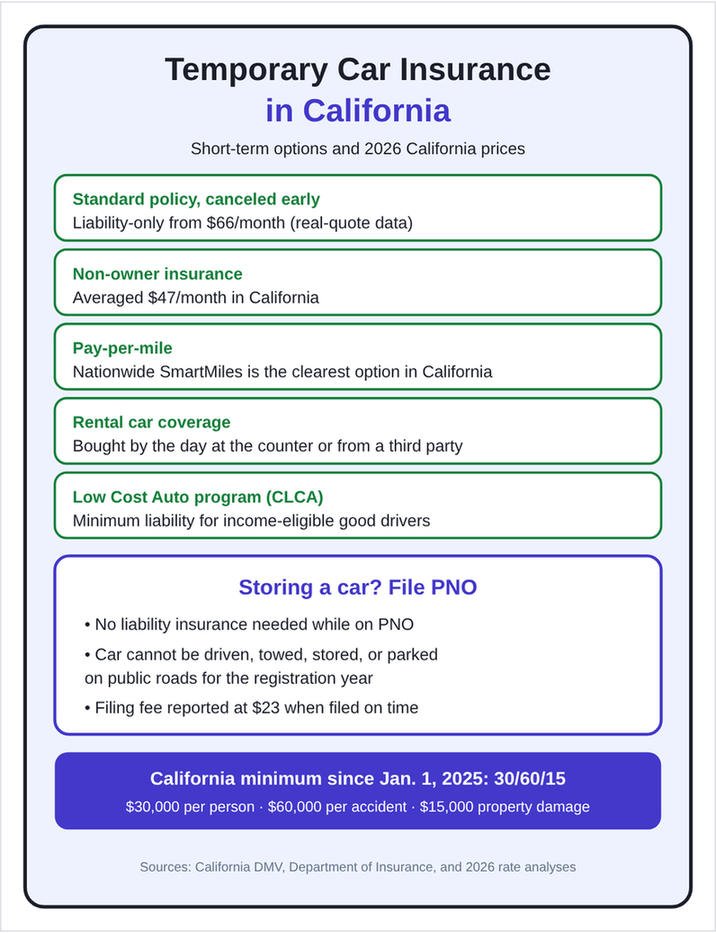
Shopping for temporary car insurance in California usually starts with a surprise: no major insurer sells a true one-week or one-month policy in the state. California drivers still have solid short-term choices, including standard policies they can cancel early, non-owner coverage, rental coverage, pay-per-mile insurance, and a state program for income-eligible drivers. The key is matching the option to your situation and handling the DMV side correctly.
This guide covers California’s insurance rules, every short-term option with 2026 California prices, how Planned Non-Operation lets you drop insurance on a stored car legally, the cheapest companies, and a step-by-step plan for getting covered and canceling without trouble. Every figure is sourced and dated, and hypothetical examples are labeled.
KEY TAKEAWAYS
- No true temporary policies. The shortest standard term is six months, which you can cancel early.
- California’s minimums rose in 2025. Standard policies must carry at least 30/60/15 liability limits. The CLCA program has separate limits.
- Storing a car? Use Planned Non-Operation (PNO). With PNO, a car that stays off public roads does not need liability insurance.
- Cheapest California coverage: USAA averaged $66 a month for liability-only, and Aspire General and GEICO $68, in 2026 real-quote data; non-owner coverage averaged $47.
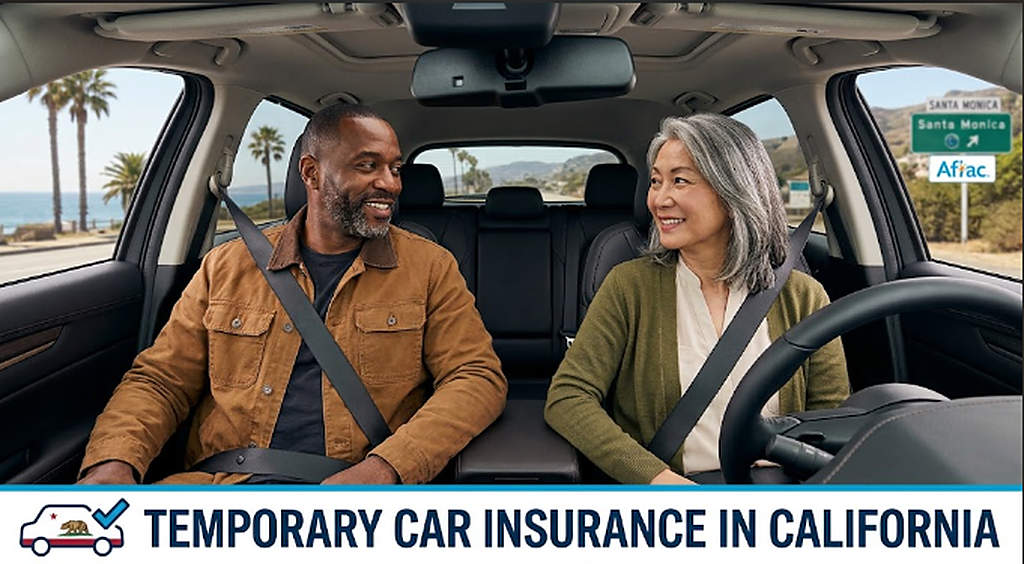
Does temporary car insurance exist in California?
Not as a standard product. A California quote analysis updated November 1, 2026, says true temporary policies are not sold in the state and that the shortest standard term is six months. You can buy a six-month policy and cancel early, though some insurers keep more of the premium under short-rate cancellation. California also lacks some of the weekly and pay-as-you-go plans sold in other states, which makes the remaining options more important to understand.
| Option | How it works | Covers your own car? | Best for |
|---|---|---|---|
| Standard policy, canceled early | Buy a six-month policy and cancel when done | Yes, with collision and comprehensive | Owners of California-registered cars |
| Non-owner insurance | Liability coverage when you drive cars you do not own | No | Visitors and people who borrow cars |
| Rental car coverage | Bought per day from the rental company or a third party | Yes, with a damage waiver | Short rentals |
| Pay-per-mile insurance | Monthly base rate plus a per-mile charge | Yes, with full coverage | Cars that will barely be driven |
| Added to someone else’s policy | The owner adds you as a driver | Depends on their policy | Staying with family in California |
| Low Cost Auto program (CLCA) | State program selling liability coverage to eligible drivers | No | Income-eligible good drivers |
| Planned Non-Operation plus storage coverage | File PNO with the DMV and keep only comprehensive, if you want it | Theft and damage only, not driving | Cars stored off public roads |
California car insurance rules you need to know
California raised its minimum liability limits on January 1, 2025, under Senate Bill 1107, replacing the old 15/30/5 minimums. Standard auto policies must meet the new limits. CLCA policies satisfy California’s financial responsibility law under separate limits.
| Coverage | Minimum limit |
|---|---|
| Bodily injury or death, one person | $30,000 |
| Bodily injury or death, more than one person | $60,000 |
| Property damage | $15,000 |
California Department of Insurance and DMV. Instead of a policy, drivers may meet the requirement with a $75,000 cash deposit with the DMV or a $75,000 surety bond, according to a California quote analysis.
Insurers report coverage to the DMV electronically. If the DMV does not receive proof of insurance, it suspends the vehicle’s registration, and the car cannot be driven or parked on public roads until proof is filed. That is why canceling a policy on a registered car without a plan can cause problems.
Penalties for driving without insurance in California
| Offense | Penalty |
|---|---|
| First conviction | $100 to $200 fine, plus penalty assessments |
| Another conviction within three years | $200 to $500 fine, plus penalty assessments; the vehicle may be impounded |
| Accident while uninsured | License suspension for up to four years; it may be restored after one year with an SR-22 kept for three years |
California Vehicle Code § 16029 and a California quote analysis updated Novemver 1, 2026. Penalty assessments can add hundreds of dollars to the base fine. This is general information, not legal advice.
Your temporary car insurance options in California
1. A standard policy canceled early
This is the most widely available option and the only one that reliably includes full coverage. You buy a six-month policy, use it as long as you need, and cancel. Most insurers refund unused premium. With a pro rata refund, you get all of it back; with a short-rate refund, an insurer may keep 10% to 15% of the unearned premium, according to an analysis updated August 31, 2026. Ask how refunds work before you buy.
| Refund method | Six-month premium | Premium used (1 month) | Penalty | Cost for one month |
|---|---|---|---|---|
| Pro rata, no fee | $408 | $68 | $0 | $68 |
| Short-rate, 10% of unearned | $408 | $68 | $34 | $102 |
| Short-rate, 15% of unearned | $408 | $68 | $51 | $119 |
Hypothetical; our calculation, using GEICO’s $68 monthly liability-only average in a California real-quote analysis (rates current to September 30, 2026) × 6 = $408. Unearned premium after one month: $340. Your quote and refund terms will differ.
California’s Good Driver Discount makes this option more attractive for experienced drivers. Every California auto insurer must offer a discount that makes a qualifying good driver’s rate at least 20% lower than a non-good driver’s rate at the same company. You generally qualify if you have been licensed for at least three consecutive years with no more than one point on your record.
2. Non-owner insurance
If you do not own a car but will drive borrowed or rented ones in California, a non-owner policy gives you liability coverage. The California quote analysis put the average at $47 a month. It does not pay for damage to the car you drive, but it meets state minimums and keeps you continuously insured, which can help when you buy a car later.
3. Rental car coverage
For a rental in Los Angeles, San Francisco, San Diego, or anywhere else in the state, coverage is bought by the day. One national analysis put rental car insurance at $9 to $30 a day, and a June 2026 consumer report said rental counter coverage often costs $30 to $60 a day. Check whether your own auto policy or credit card already covers rentals; most cards offer only secondary coverage and usually exclude liability.
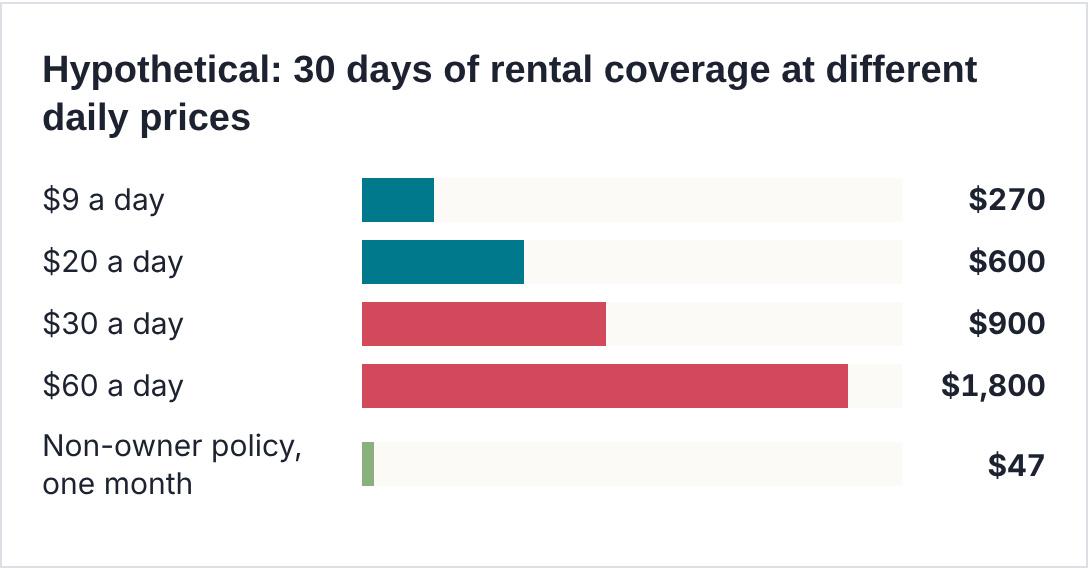
For a long rental, a non-owner policy combined with a damage waiver or card benefit can cost far less than daily counter coverage, though the two protect different things.
4. Pay-per-mile insurance
California drivers have fewer pay-per-mile choices than most. Nationwide SmartMiles is the clearest option in the state, though Nationwide says its safe-driving discount is not offered in California. Allstate Milewise, Mile Auto, and USAA SafePilot Miles do not list California. California’s 2009 rules let insurers verify mileage with a device, an odometer reading, or self-reporting, but do not allow a device to monitor where you drive. If your car will mostly sit, ask traditional insurers about low-mileage or verified-mileage discounts too.
5. Pay-as-you-go and weekly plans
Weekly liability plans sold in other states are not widely available in California. One California quote analysis listed Hugo in its rate table at an average of $147 a month, while another 2026 source said Hugo is not offered in California, so confirm availability on Hugo’s website before you rely on it. At that average, it would cost more than double the cheapest standard liability-only policies in the same analysis.
6. California’s Low Cost Automobile Insurance Program
The California Low Cost Automobile Insurance Program (CLCA) sells liability policies with limits of $10,000 per person, $20,000 per accident, and $3,000 for property damage to income-eligible good drivers. The Department of Insurance says it offers seven payment plans and charges no broker’s fee. The vehicle must be worth $25,000 or less. It is not a short-term policy, but it can be the most affordable way to stay legal while your finances recover. Call 1-866-602-8861 or visit mylowcostauto.com to check eligibility.
7. Being added to someone else’s policy
If you are staying with family in California for a while, ask to be added to their policy. It can cost less than a separate policy, though it may raise the owner’s premium. Occasional drivers with permission may already be covered under the owner’s policy, but rules vary by insurer, so the owner should check first.
Storing a car: Planned Non-Operation
If your car will sit for a full registration year, California offers a legal way to stop paying for liability coverage. Planned Non-Operation (PNO) tells the DMV that the vehicle “will not be driven, towed, stored, or parked on public roads or highways for the entire registration year.” A stored vehicle on PNO is not required to carry liability insurance, according to a guide from eTags, a private registration service.
| Feature | Details |
|---|---|
| What it is | A DMV status for vehicles kept entirely off public roads for the registration year |
| Insurance | Liability insurance is not required while on PNO |
| Filing fee | Reported at $23 when filed on time; late filing adds penalties |
| When to file | Up to 60 days before registration expires; up to 90 days after with penalties |
| If the car is used on public roads | It may be cited or impounded, and full registration fees and penalties may apply |
| Moving the car | Contact the DMV first; a moving permit may be issued for certain purposes |
California DMV, Important Vehicle Information (ISD 83 VR), and eTags, California PNO guide (last modified January 16, 2026). eTags is a private company; confirm current fees and deadlines with the DMV.
Even on PNO, you can keep comprehensive-only “storage” coverage to protect against theft, fire, or weather while the car sits, if your insurer offers it. That coverage does not include liability, so you cannot legally drive the car. When you are ready to drive again, buy a policy, pay the registration fees, and end PNO before the car goes back on the road.
How much does short-term car insurance cost in California?
Two 2026 analyses show what Californians pay. Study A is a rate study updated September 25, 2026, using a 30-year-old man with good credit. Study B is a real-quote analysis with rates current to September 30, 2026. Compare each only with itself.
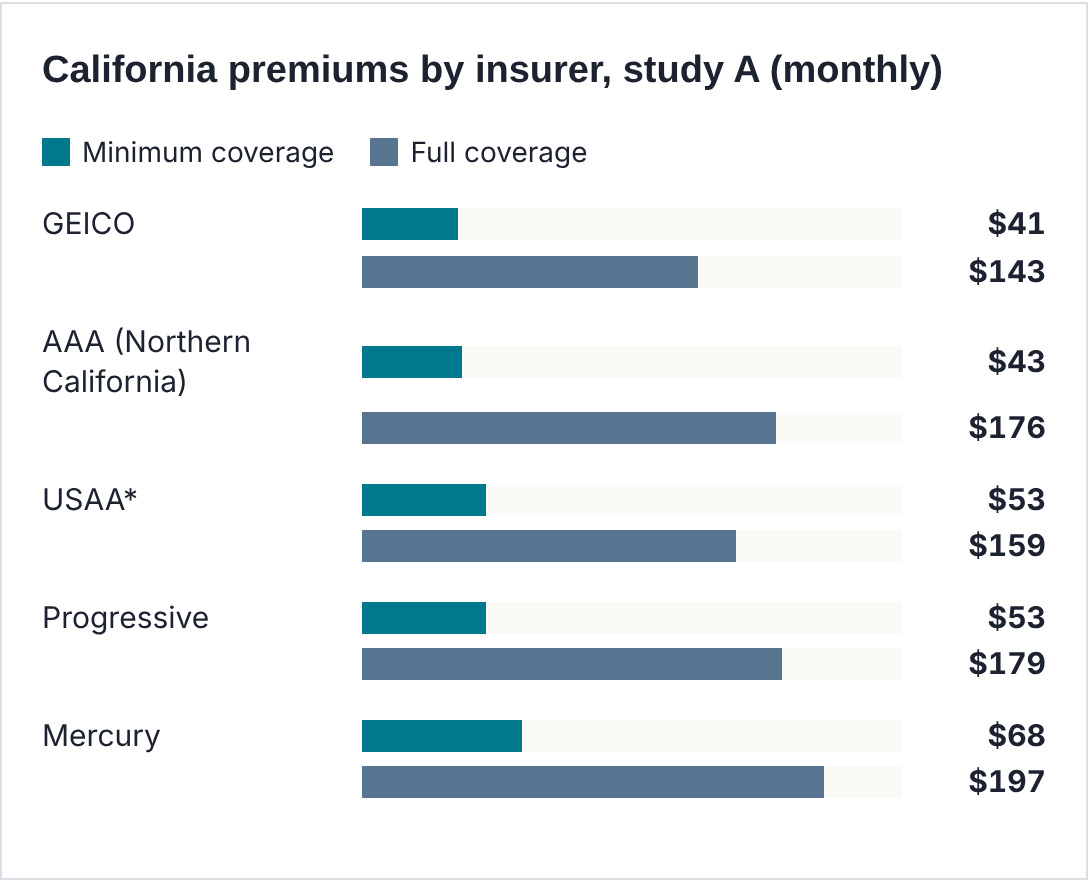
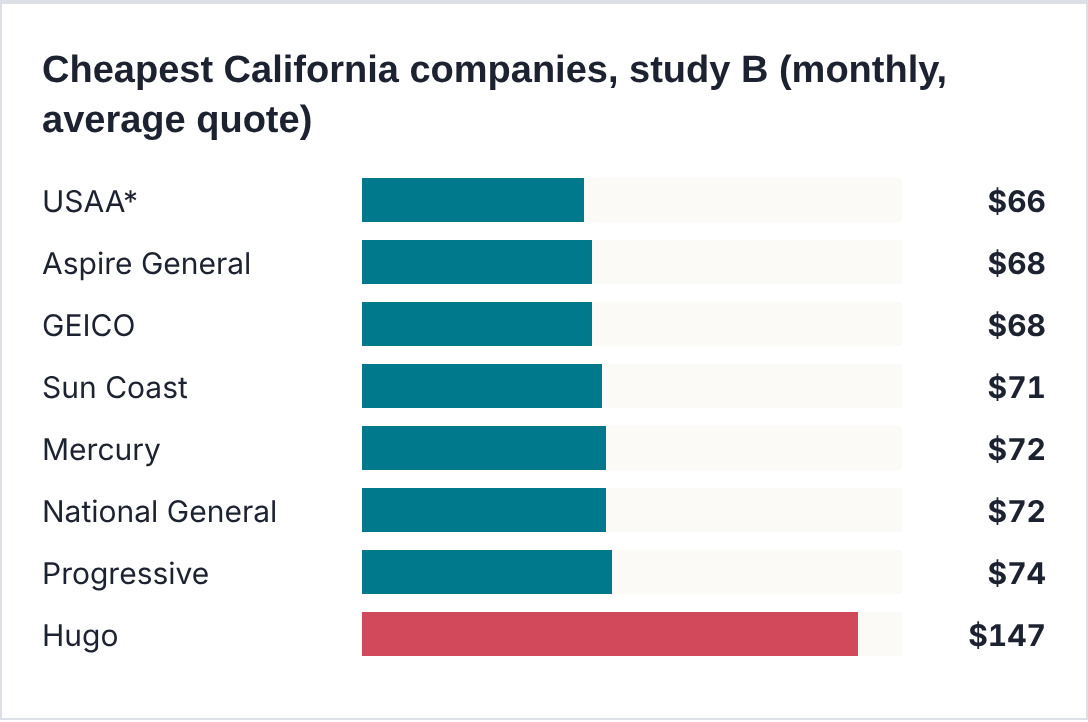
In study A, minimum liability coverage averaged $75 a month statewide and full coverage $221. Study B put California’s averages at $98 for liability-only and $203 for full coverage, with Aspire General cheapest for full coverage at $123. The gap between the averages and the cheapest companies is the biggest saving available to most drivers.
| Coverage | Average (monthly) | Cheapest company (monthly) | Savings per month (our calculation) |
|---|---|---|---|
| Study A: minimum coverage | $75 | $41 (GEICO) | $34 |
| Study A: full coverage | $221 | $143 (GEICO) | $78 |
| Study B: liability-only | $98 | $66 (USAA*) | $32 |
| Study B: full coverage | $203 | $123 (Aspire General) | $80 |
Our calculation within each study. *USAA serves military families. Averages, not quotes.
How California prices drivers differently
California’s Proposition 103 changed how auto insurance is priced. Your driving record, the miles you drive each year, and your years of driving experience weigh most heavily. Insurers cannot use credit history to set rates or deny a policy. In study A, a speeding ticket raised full-coverage rates about 44%, and an at-fault accident added about $216 a month. For a short-term buyer, that means a clean record and accurate low mileage do more to cut your price than almost anything else.
Cars that are cheaper to insure in California
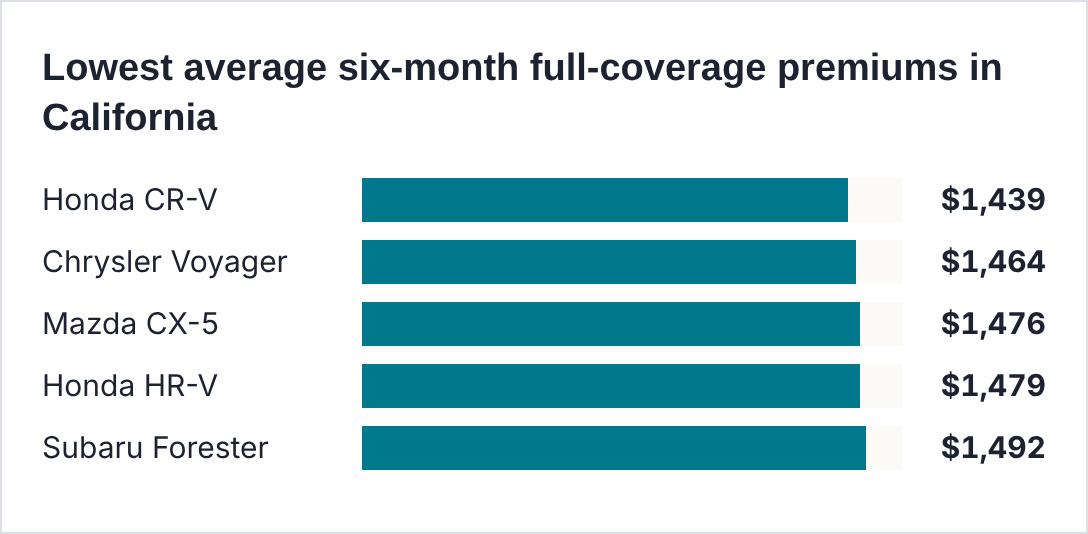
If you are buying or borrowing a car for a short stretch, the model matters. A rate study updated April 6, 2026, compared average six-month full-coverage premiums across California for 40-year-old drivers with clean records and good credit, using 100/300/100 limits and $500 deductibles. The Honda CR-V had the lowest average, followed by the Chrysler Voyager, Mazda CX-5, Honda HR-V, and Subaru Forester, all within $53 of each other over six months.
Temporary coverage for special situations in California
Visitors. If you are visiting with your own car, your home-state policy generally travels with you; confirm with your insurer. If you are visiting without a car, the owner’s policy, rental coverage, or a non-owner policy can work.
New residents. If you are moving to California and will register your car here, line up a policy that meets California’s 30/60/15 limits before you visit the DMV, because the DMV checks for insurance electronically. Keep your old policy active until the new one starts, then cancel it. Tell your new insurer your real annual mileage and California garaging address, since both affect your price under Proposition 103.
College students. A student bringing a car to a California campus for a semester usually does best on a parent’s policy, with the school address listed if the insurer requires it. A student without a car who borrows or rents may want non-owner coverage.
Drivers needing an SR-22. The California quote analysis put SR-22 policies at an average of $171 a month. After an uninsured accident, a license may be restored after one year with an SR-22 kept for three years. Short-term plans may not file SR-22s, so a standard policy is usually required. Drivers turned down elsewhere can apply through the California Automobile Assigned Risk Plan, which offers coverage that can be paid in installments.
Drivers with a DUI. The same analysis put DUI liability coverage at an average of $134 a month.
| Your situation | Best option | Why |
|---|---|---|
| Visiting and borrowing a car | Owner’s policy or a non-owner policy | No vehicle coverage needed |
| Renting for a trip | Rental coverage, your own policy, or a card benefit | Daily coverage for short rentals |
| Owning a California-registered car for a few months | Standard policy canceled early | Full coverage available; cancel correctly |
| Storing a car for a year | PNO plus optional comprehensive | No liability needed off public roads |
| Low income and a clean record | CLCA program | Program-specific liability limits at reduced cost |
| Needing an SR-22 | Standard policy from an insurer that files SR-22s | Many flexible plans do not |
Buying a car in California: getting covered fast
A car purchase is one of the most common reasons Californians need coverage in a hurry. If you already have a policy, call your insurer before you drive away. Many insurers give a grace period of about 7 to 30 days to add a newly bought car, according to a June 2026 rate study, though some give only a few days and some give none. If you do not have a policy, you can usually buy one the same day; a California quote analysis named Nationwide, GEICO, and Root among insurers offering same-day coverage. Have the VIN ready from the purchase paperwork.
How to get temporary car insurance in California, step by step
- Decide what you need to cover: your own car, a borrowed car, or a rental.
- Check whether a cheaper route fits, such as non-owner coverage, PNO, or the CLCA program.
- Get quotes from the cheapest California companies, such as GEICO, USAA if eligible, Aspire General, Mercury, and Progressive.
- Use at least 30/60/15 limits on every standard policy quote, and ask about the Good Driver Discount.
- Ask about cancellation: pro rata or short-rate refund, and any fee.
- Report your mileage accurately; it matters more in California than in most states.
- Save your proof of insurance before you drive.
- When you are done, file PNO, sell or transfer the car, or start a new policy the same day the old one ends.
Questions to ask a California insurer about short-term coverage
- Is the refund pro rata or short-rate if I cancel early, and is there a fee?
- Do I qualify for the Good Driver Discount, and is it applied to this quote?
- How do you verify mileage, and is there a low-mileage discount?
- Do you offer comprehensive-only coverage for a car on Planned Non-Operation?
- Do you file SR-22 forms, if I need one?
- When will you report my coverage to the DMV?
Pros and cons of temporary coverage in California
- Standard policies can be canceled early and include full coverage
- PNO lets a stored car go without liability insurance legally
- Non-owner coverage averaged $47 a month
- Good Driver Discount of at least 20% for qualifying drivers
- No true weekly or monthly policies from major insurers
- PNO cars cannot be driven or parked on public roads
- Pay-per-mile choices are limited in California
- Short-rate refunds or fees can raise the cost of a short stay
Common mistakes to avoid
- Canceling insurance on a registered car without PNO. The DMV can suspend the registration.
- Driving a car that is on PNO. It can be cited or impounded, and full fees become due.
- Buying the old 15/30/5 limits. California’s minimums have been 30/60/15 since January 1, 2025.
- Overpaying for daily rental coverage on a long rental. Compare a non-owner policy and your card’s benefits.
Frequently asked questions
Can you get temporary car insurance in California?
Not as a true one-week or one-month policy from major insurers. California drivers can buy a six-month policy and cancel early, use non-owner or rental coverage, choose pay-per-mile insurance, join a household member’s policy, or file Planned Non-Operation for a stored car.
What is the minimum car insurance in California?
Since January 1, 2025, California requires at least $30,000 for injury or death to one person, $60,000 for injury or death to more than one person, and $15,000 for property damage. Collision and comprehensive are optional unless a lender or leasing company requires them.
Do I need insurance on a car I am not driving in California?
If the car stays registered for road use, yes. If you file Planned Non-Operation and keep the car entirely off public roads for the registration year, liability insurance is not required. You can still keep comprehensive coverage to protect against theft or damage while it is stored.
How much is non-owner car insurance in California?
A California quote analysis updated November, 2026, put non-owner coverage at an average of $47 a month. It provides liability coverage when you drive cars you do not own, but it does not pay for damage to the car you are driving.
What happens if I cancel my insurance in California?
Insurers report coverage to the DMV electronically. If the DMV does not receive proof of insurance for a registered car, it can suspend the registration, and the car cannot be driven or parked on public roads. File PNO, sell the car, or start a new policy first.
Is there weekly car insurance in California?
Weekly liability plans sold in other states are not widely available in California. One quote analysis listed Hugo’s pay-as-you-go coverage at $147 a month in California, but another source said Hugo is not offered there, so confirm on Hugo’s website before relying on it.
What is the cheapest car insurance in California?
In study A, GEICO had the cheapest minimum coverage at $41 a month and full coverage at $143. In study B’s real-quote data, USAA averaged $66 for military families, with Aspire General and GEICO at $68. Your record, mileage, and experience drive your price.
Can low-income drivers get cheaper coverage?
Yes. California’s Low Cost Automobile Insurance Program sells liability policies with limits of $10,000 per person, $20,000 per accident, and $3,000 for property damage to income-eligible good drivers, with seven payment plans and no broker’s fee, for vehicles worth $25,000 or less. It is not a short-term policy, but it can keep costs low. Call 1-866-602-8861 or visit mylowcostauto.com to check eligibility.
The final word on temporary car insurance in California
For most Californians who need a few weeks or months of coverage on their own car, a standard policy from a low-cost insurer, canceled with a pro rata refund, is the best temporary solution. If you do not own the car, use non-owner or rental coverage. If the car will sit for a year, file Planned Non-Operation. And if money is tight, check the CLCA program first.
Prices, availability, cancellation terms, and DMV fees can change. The figures in this article are averages, published fees, and hypothetical calculations, not quotes. This article is for information only and is not legal or financial advice. The publisher is not an insurance company or a licensed insurance agency.
The bottom line on temporary car insurance in California: true short-term policies are rare, but a cancelable low-cost policy, non-owner or rental coverage, Planned Non-Operation, or the CLCA program can cover almost every short-term need legally.
Sources
- California DMV, Insurance Requirements and Important Vehicle Information (ISD 83 VR) (accessed October 2026).
- California Vehicle Code § 16029 (accessed October 2026).
- California Department of Insurance, Auto Insurance Guide and California Low Cost Automobile Insurance Program (accessed October 2026).
- California Low Cost Auto Insurance Program (accessed October 2026).
- eTags, California PNO guide (last modified January 16, 2026).
- Insurify, Temporary Car Insurance in California (updated October 17, 2026) and California Car Insurance (rates current to September 30, 2026).
- ValuePenguin, Cheapest Car Insurance in California (updated September 25, 2026).
- Nationwide, SmartMiles (accessed October 2026) and Insurance Journal, California Gets Pay-As-You-Drive (October 19, 2009).
- MoneyGeek, Car Insurance Refund (August 31, 2026).
- Insurify, One-Week Car Insurance (updated September 30, 2026) and First Alert 4, Understanding Rental Car Insurance (June 23, 2026).
- CarInsurance.com, New Car Grace Period (updated June 26, 2026).
- OCHO, Hugo Insurance Alternatives (June 22, 2026), for Hugo’s California availability.