
Temporary Car Insurance in Florida
Anyone looking for temporary car insurance in Florida runs into two facts quickly: no major insurer sells a true short-term policy in the state, and Florida punishes coverage gaps more harshly than most places. Insurers must report a canceled policy to the state within 10 days, and a lapse can suspend both your driver's license and your registration. With the right plan, though, you can be covered for exactly as long as you need.
This guide covers Florida's PIP and property damage rules, the 90-day rule that catches many snowbirds, the one-month first-payment law, every short-term option with 2026 Florida prices, the cheapest companies, and a step-by-step plan for ending coverage without a suspension. Every figure is sourced and dated, and hypothetical examples are labeled.
- No true temporary policies. Florida drivers use weekly installment plans, pay-as-you-go coverage, non-owner or rental coverage, or a standard policy canceled early.
- Florida requires $10,000 PIP and $10,000 property damage liability on every registered vehicle, continuously for the whole registration period.
- Lapses are costly. Reinstatement fees are $150, $250, or $500, depending on how many reinstatements you have had within three years.
- Snowbirds, take note: a nonresident's car that has been in Florida more than 90 days in the past 365 must carry Florida PIP coverage.
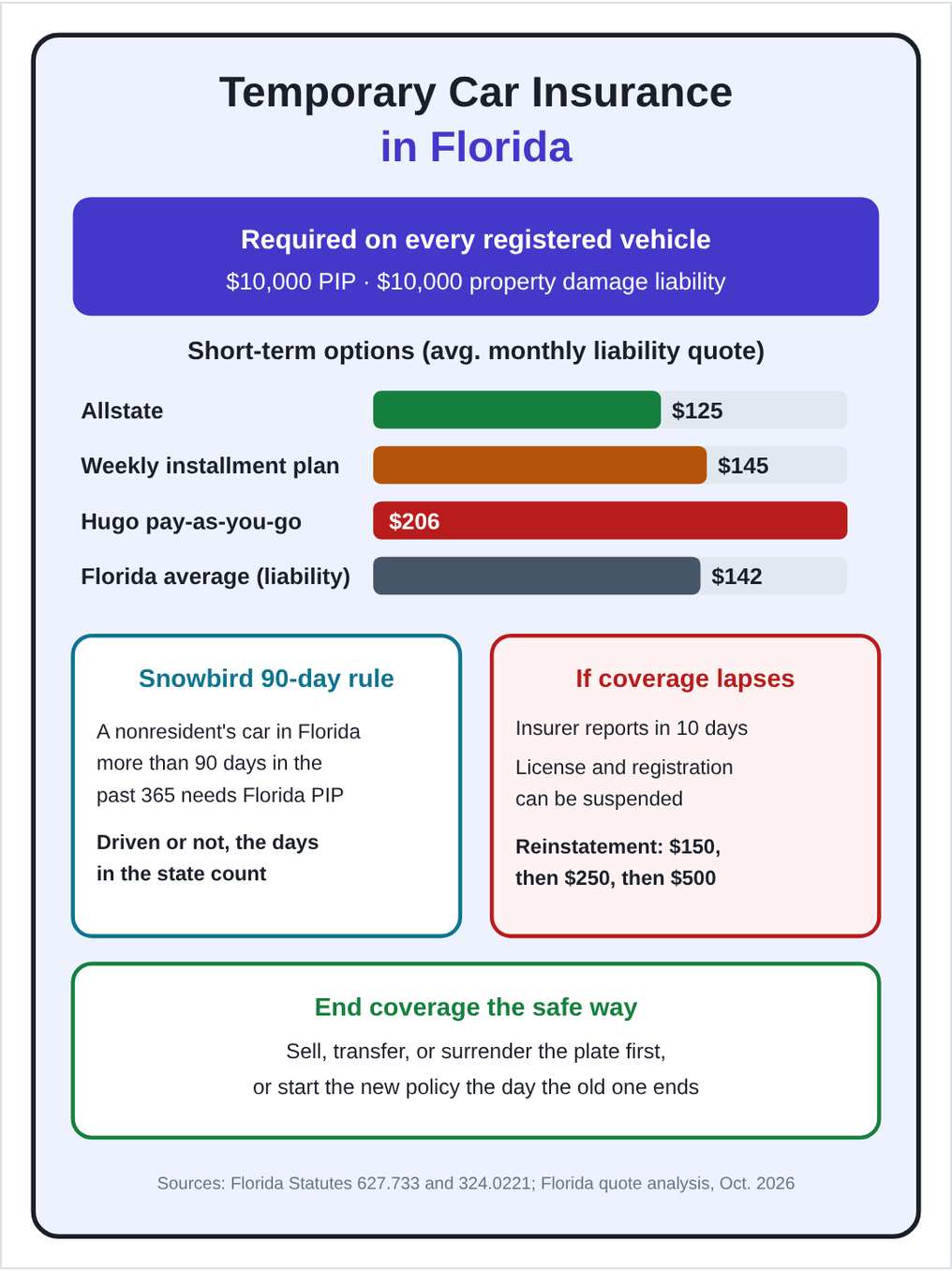
Florida's required coverage, short-term options with average monthly liability quotes from a Florida analysis updated October 17, 2026 (rates current to September 30, 2026), the 90-day rule for nonresidents, and the reinstatement fees that follow a lapse.
BEFORE YOU BUYDecide whether the coverage is for a Florida-registered car, an out-of-state car you are keeping in Florida, a borrowed car, or a rental. Each one points to a different option and a different way to end coverage.
Does temporary car insurance exist in Florida?
Not as a standard product. A Florida quote analysis updated October 17, 2026, says "temporary car insurance policies aren't available in Florida," and that most policies run six or 12 months. Florida drivers do have short-term workarounds, including weekly installment plans, pay-as-you-go coverage, month-to-month billing on standard policies, non-owner policies, and rental coverage.
Short-term car insurance options in Florida
Option | How it works | Covers your own car? | Best for |
|---|---|---|---|
Standard policy, canceled early | Buy a six-month policy and cancel when done | Yes, with collision and comprehensive | Owners of Florida-registered cars |
Weekly installment plan | Pay in seven-day increments; first week due at purchase | No; minimum liability | Short-term liability needs |
Pay-as-you-go | Start with a few days and add more | Depends on the plan | Drivers who want small payments |
Non-owner insurance | Liability coverage when you drive cars you do not own | No | Visitors and people who borrow cars |
Rental car coverage | Bought at the rental counter or from a third party | Yes, with a damage waiver | Florida's many vacation renters |
Added to someone else's policy | The owner adds you as a driver | Depends on their policy | Staying with family in Florida |
Florida car insurance rules you need to know
Florida is a no-fault state for injuries, and its minimums look different from most states'. According to the Florida Department of Highway Safety and Motor Vehicles (FLHSMV), every vehicle with a Florida registration must carry at least $10,000 of Personal Injury Protection (PIP) and $10,000 of Property Damage Liability (PDL). Bodily injury liability is not required for most drivers.
Florida required coverage
Coverage | Minimum | What it pays |
|---|---|---|
Personal Injury Protection (PIP) | $10,000 | A share of your own medical costs and lost income after a crash, whoever caused it |
Property Damage Liability (PDL) | $10,000 | Damage you cause to other people's property |
Bodily injury liability | Not required for most drivers | Injuries you cause to others; required in some cases |
After a DUI conviction (FR-44) | $100,000/$300,000 bodily injury and $50,000 property damage | Required for at least three years |
FLHSMV and Florida Statutes § 324.023 (accessed October 2026). Bodily injury liability is also required after some crashes and violations.
Florida also requires that coverage be continuous. Under Florida Statutes § 627.733, owners and registrants must keep security in force for the full registration period. That rule is the reason a short-term policy on a Florida-registered car needs careful planning.
What happens if your Florida coverage lapses
Florida's system is built to catch gaps fast. Under Florida Statutes § 324.0221, insurers must report the cancellation or nonrenewal of PIP or property damage coverage to the state within 10 days. After notice, the state must suspend the owner's registration and driver's license if required coverage was not in force. A Manatee County tax collector guide says this kind of suspension affects plates and registrations in your name and lasts three years or until you comply.
Florida reinstatement fees after an insurance suspension
Reinstatement | Fee |
|---|---|
First reinstatement | $150 |
Second reinstatement within 3 years of the first | $250 |
Each later reinstatement within that 3-year period | $500 |
Florida Statutes § 324.0221 (2026). If no second reinstatement occurs within three years, the next one is $150 again. When both license and registration are suspended, one fee is paid. A county tax collector lists a $6.25 service fee and card processing fees on top.
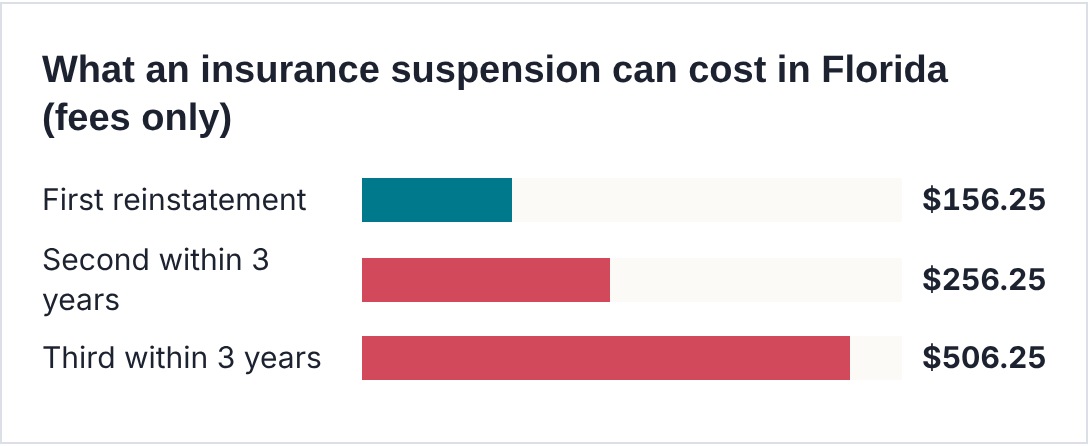
Our calculation: statutory reinstatement fee plus the $6.25 service fee listed by the Manatee County Tax Collector. Excludes card fees, a replacement license ($31.25 if needed), and the cost of new coverage.
To reinstate, you must buy coverage and show proof on a state form, which must be kept for two years. FLHSMV says hardship licenses are not available for insurance-related suspensions, so you could not legally drive at all until the matter is cleared.
How to end temporary coverage without a suspension
The safest approach is to make sure no Florida registration is left without coverage. Before your insurance ends, sell or transfer the vehicle, or surrender the license plate at your county tax collector's office, or have a new policy start the same day the old one ends.
Keep the receipt or confirmation. If you get a suspension notice anyway, a tax collector guide says you can clear it by proving coverage was in force, proving you no longer own the car, or, in some cases, surrendering the plate and paying the applicable fee.
PRO TIP #1Handle the plate before the policy. Because Florida insurers report cancellations within 10 days, do the plate or registration step first and the insurance cancellation second. Keep both confirmations together, in case you need to prove the order later.
Storing a car in Florida
If your Florida-registered car will sit unused for months, the continuous-coverage rule still applies as long as the registration is active. You have two clean choices.
You can keep at least PIP and PDL in force, often the cheapest coverage you can buy, and add comprehensive if you want protection from theft, flood, or storm damage while the car sits. Or you can surrender the plate at your county tax collector's office, cancel the liability coverage afterward, and keep comprehensive-only coverage if your insurer offers it. When you want to drive again, buy PIP and PDL coverage and get a plate before the car goes back on the road.
The 90-day rule for snowbirds and visitors
Florida draws millions of seasonal residents and visitors; the Florida quote analysis cites 143 million visitors in 2024. Most visitors can rely on their home-state policy. But Florida Statutes § 627.733 says a nonresident owner must keep Florida security in force while a vehicle stays in Florida if it "has been physically present within this state for more than 90 days during the preceding 365 days." The statute counts days in the state, whether or not the car is driven.
For a snowbird who leaves a car in Florida for a long winter, that means checking with your home insurer about Florida PIP coverage, or buying a Florida policy for the season and ending it correctly in spring. Ask your insurer before the 90 days pass, not after.
Florida's one-month first-payment rule
Florida also controls how a new policy starts. Florida Statutes § 627.7295(7) says a new private passenger auto policy or binder may be issued only after the insurer or agent collects at least one month's premium from your own funds, even if the premium is financed or paid in installments. The rule has important exceptions.
Exceptions to Florida's one-month rule
Exception | Who it helps |
|---|---|
All payments by payroll deduction, automatic electronic funds transfer, or a recurring card arrangement with the insurer | Drivers who pay automatically |
Renewing or replacing a policy with the same insurer or insurer group | Current policyholders and family members |
Insurers that mainly cover active-duty or former military members and their dependents | Military families |
Certain automatic payments from an agent or premium finance company on policies with specified minimum coverage | Some financed policies |
Florida Statutes § 627.7295(7) (accessed October 2026), summarized. Read the statute for exact conditions.
One insurer-specific rule matters for short-term buyers too: GEICO says Florida policies it issues with only PIP and property damage coverage must be paid in full. If you buy the bare minimum from GEICO, expect to pay the whole term up front and receive a refund of unused premium when you cancel.
Your temporary car insurance options in Florida
1. A standard policy canceled early
This is the most widely available route and the only one that reliably includes full coverage. You buy a six-month policy and cancel when you no longer need it. With a pro rata refund you get all unused premium back; with a short-rate refund, an insurer may keep 10% to 15% of the unearned premium, according to an analysis updated August 31, 2026.
Hypothetical: one month of GEICO minimum coverage in Florida
Step | Amount |
|---|---|
Six-month PIP/PDL premium, paid in full ($42 × 6) | $252 |
Premium used in one month | $42 |
Refund if pro rata (our calculation) | $210 |
Refund if short-rate at 10% of unearned (our calculation) | $189 |
Net cost for one month, pro rata vs. short-rate | $42 vs. $63 |
Hypothetical; our calculation, using GEICO's $42 monthly minimum-coverage average in a Florida rate study updated October 1, 2026, and GEICO's paid-in-full rule for PIP/PD-only Florida policies. Your quote and refund terms will differ.
Refunds are not instant. One 2026 analysis said refunds typically take seven to 30 days, so if you are paying a full term up front, budget for the wait. Ask the insurer how the refund is sent, whether to your card, bank account, or by check, before you buy.
2. Weekly installment plans
Insurify Car, sold through an online agency, offers minimum liability coverage in Florida paid in seven-day installments, with the first week's premium due at purchase. Its Florida average was $145 a month in the analysis's table. You can set a cancellation date and stop paying when you are done. It does not cover damage to your own car, and short-term options like this generally do not file the SR-22 or FR-44 forms some drivers need.
3. Pay-as-you-go coverage
Hugo sells pay-as-you-go coverage in Florida, with a daily installment option, according to the same analysis. Its Florida table average was $206 a month, the highest of the flexible options listed. Hugo lets you start with as little as three days of coverage, per a September 2026 review.
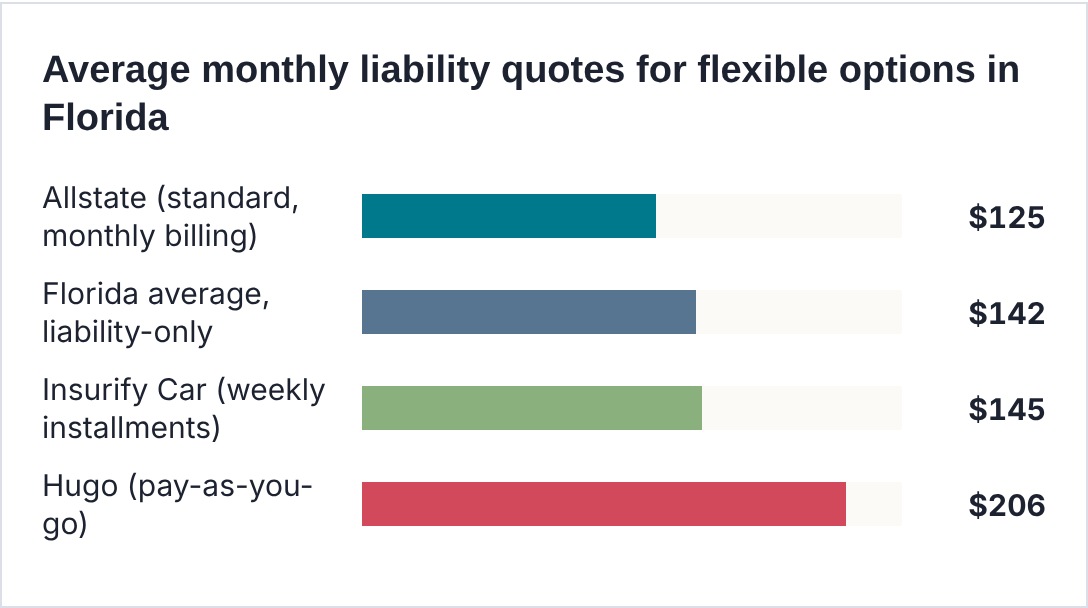
Florida quote analysis updated October 17, 2026; table rates current to September 30, 2026. The same page cites higher short-term averages in its text ($235 and $251), so treat these as rough guides.
Notice that the flexible plans cost more per month than the Florida liability average. Pay for flexibility only when you truly need coverage for a short time.
4. Non-owner insurance
If you do not own a car but will drive borrowed or rented cars in Florida, a non-owner policy gives you liability coverage. The Florida analysis says non-owner policies, usually sold in six- or 12-month terms, often cost less than standard policies, and a national analysis put non-owner coverage at $29 to $74 a month. It does not cover damage to the car you drive.
5. Rental car coverage
For Florida's vacation renters, rental coverage starts immediately at the counter. One national analysis put rental car insurance at $9 to $30 a day, and a June 2026 consumer report said counter coverage often costs $30 to $60 a day, while third-party providers sell primary rental coverage for under $20 a day. Check your own policy and card benefits first; most cards offer only secondary coverage and usually exclude liability.
6. Being added to someone else's policy
If you are staying with family in Florida, ask to be added to their policy. Florida's one-month rule does not apply when a family member replaces or renews a policy with the same insurer group, and adding a driver to an existing policy avoids a new first payment entirely, though it may raise the owner's premium.
Buying a car in Florida: getting covered fast
If you already have a policy, call your insurer before you drive away. Many insurers give a grace period of about 7 to 30 days to add a newly bought car, according to a June 2026 rate study, though some give only a few days and some give none.
If you need a new policy, expect to pay at least one month's premium to start under Florida's rule, unless you qualify for an exception such as automatic payments. Have the VIN from the purchase paperwork ready.
How much does short-term car insurance cost in Florida?
Florida is one of the more expensive states. The Florida quote analysis put the average at $2,723 a year, 27% above the U.S. average of $2,144. Two 2026 analyses show the cheapest companies. Study A is a rate study updated October 1, 2026, using a 40-year-old driver. Study B is a real-quote analysis with rates current to September 30, 2026. Compare each only with itself.
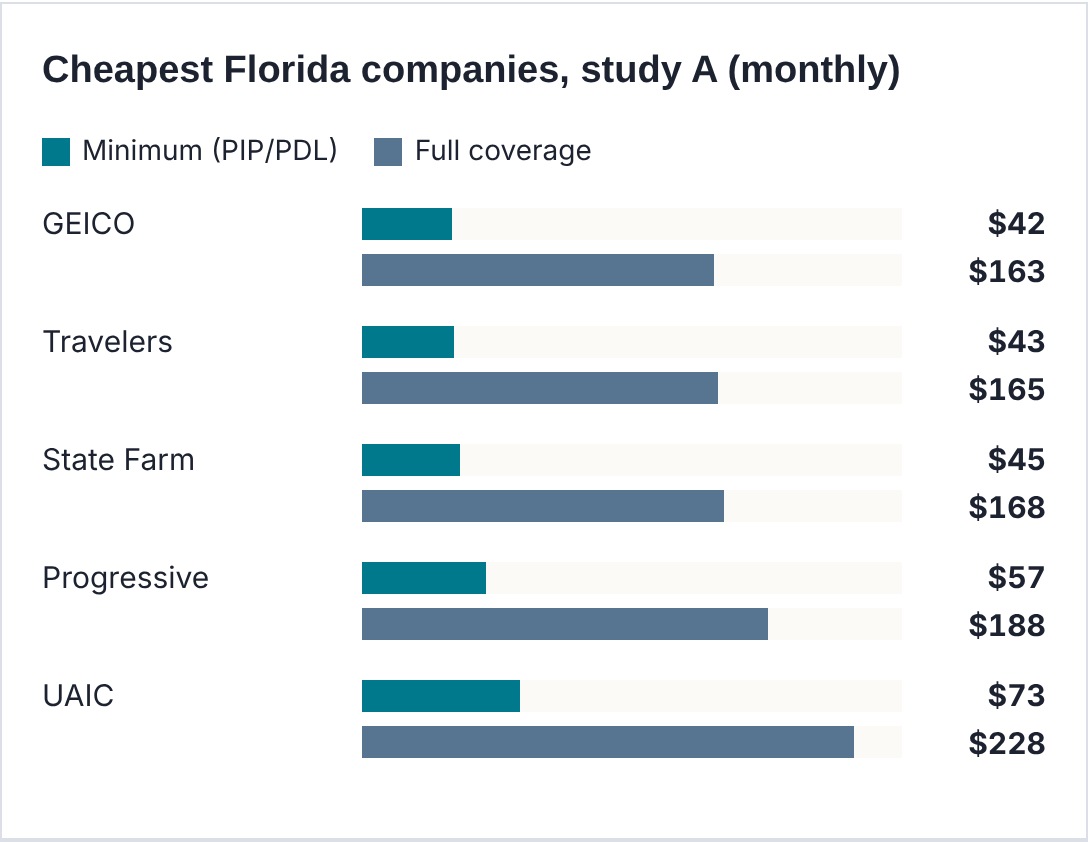
Study A: Florida rate study updated October 1, 2026; 40-year-old driver; full coverage at 100/300/100. Study averages: $62 minimum, $219 full coverage.
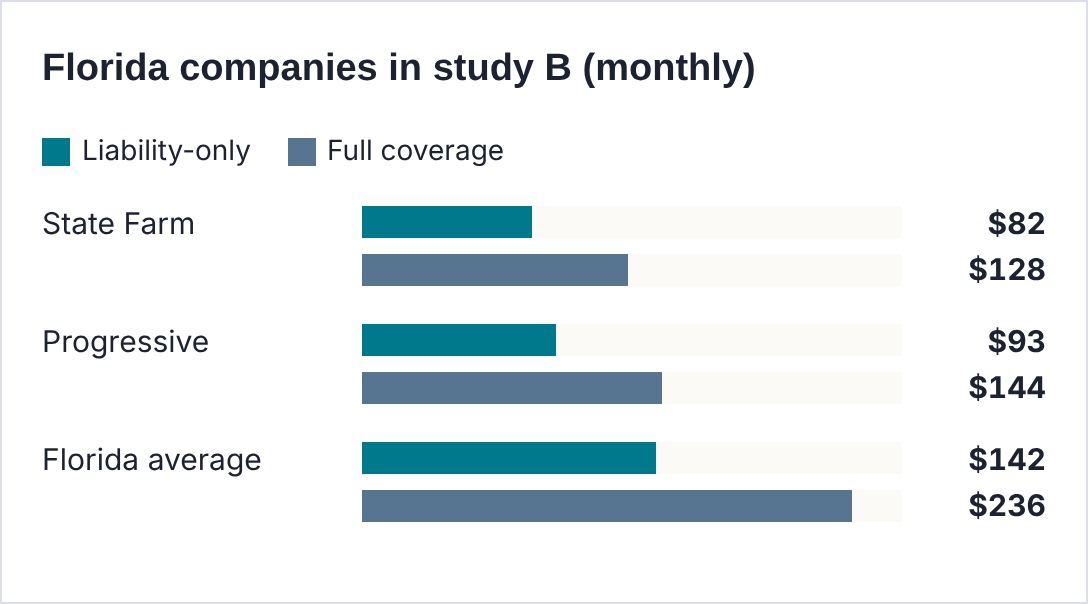
Study B: Florida real-quote analysis updated October 17, 2026; rates current to September 30, 2026; liability-only includes bodily injury limits, so it costs more than PIP/PDL-only minimums.
The difference between the two studies' "minimum" figures is mostly about coverage. Study A prices Florida's bare PIP/PDL minimum, while study B's liability-only figures include bodily injury liability, which protects you if you injure someone. For a short-term buyer, that extra protection is often worth comparing.
Here is why it matters. PIP pays toward your own medical bills and lost income, and PDL pays for property you damage. Neither pays for injuries you cause to another person.
If you are at fault in a serious crash with only PIP and PDL, the injured person could pursue you personally for their costs. Even for a few weeks of driving, ask each insurer what bodily injury liability adds to the price, and compare that cost with the risk you would be carrying without it.
Prices are easing in 2026
On March 5, 2026, the Florida Office of Insurance Regulation said the state's five largest auto insurance groups, with 78% of the market, indicated an average rate decrease of 8% for 2026. State Farm requested a 10% cut, and Allstate and USAA 7% each. If you priced Florida coverage last year, it is worth getting fresh quotes.
Temporary coverage for special situations in Florida
Young drivers. The Florida analysis put the average liability premium for 18-year-olds at $315 a month. A teen who needs coverage for a summer is usually best added to a parent's policy.
Drivers with a DUI. After a DUI, Florida requires FR-44 coverage at 100/300/50 limits for at least three years. The analysis put DUI liability coverage at an average of $182 a month and FR-44 coverage at $166. Weekly and pay-as-you-go plans generally do not file these forms.
Military families. Florida's one-month first-payment rule does not apply to insurers that mainly cover active-duty or former military members and their dependents, which can make starting coverage easier.
New residents. Once you register a car in Florida, it needs Florida PIP and PDL continuously. Line up a Florida policy before you register, and keep your old policy until the new one starts.
College students. A student bringing a car to a Florida campus for a semester usually does best on a parent's policy. A student without a car who borrows or rents may want non-owner coverage.
Best temporary option by Florida situation
Your situation | Best option | Why |
|---|---|---|
Vacationing and renting a car | Rental coverage, your own policy, or a card benefit | Coverage starts at the counter |
Snowbird keeping a car in Florida over 90 days | Florida PIP coverage for the season | Required for nonresidents after 90 days in 365 |
Owning a Florida-registered car for a few months | Standard policy canceled early | Then handle the plate before canceling |
Borrowing a car while visiting | Owner's policy or a non-owner policy | No vehicle coverage needed |
Needing an SR-22 or FR-44 | Standard policy from an insurer that files them | Flexible plans generally do not |
Selling or storing a car | Surrender or transfer the plate, then cancel | Avoids a suspension |
How to get temporary car insurance in Florida, step by step
- Decide what you need to cover: a Florida-registered car, an out-of-state car, a borrowed car, or a rental.
- Count your days if you are a nonresident keeping a car in Florida.
- Get quotes from the cheapest Florida companies, such as GEICO, Travelers, State Farm, and Progressive.
- Compare PIP/PDL-only with a policy that adds bodily injury liability.
- Ask about the first payment, including whether automatic payments change it.
- Ask about cancellation: pro rata or short-rate refund, and any fee.
- Save your Florida ID card and declarations page before you drive.
- When you are done, handle the plate first, or start a new policy the same day the old one ends.
Questions to ask a Florida insurer
- Is a PIP/PDL-only policy paid in full or in installments?
- How much is due today, and does automatic payment change it?
- Is the refund pro rata or short-rate if I cancel early?
- Do you file SR-22 or FR-44 forms, if I need them?
- Will my out-of-state policy include Florida PIP if my car stays here over 90 days?
Pros and cons of temporary coverage in Florida
Pros | Cons |
|---|---|
Weekly and pay-as-you-go plans let you pay in small blocks | Flexible plans averaged more per month than standard liability |
Standard policies can include full coverage and be canceled early | A lapse can suspend your license and registration |
Rental and non-owner options suit visitors | At least one month's premium is usually due to start a new policy |
2026 rate decreases at large insurers | Reinstatement fees rise from $150 to $500 for repeat lapses |
If you need coverage for more than a few weeks, price a standard policy first. In study B, Allstate's standard liability coverage averaged $125 a month, below the $145 and $206 averages for weekly and pay-as-you-go plans in the same analysis. Ask for a pro rata refund policy, and cancel the right way when you are done.
Common mistakes to avoid
Canceling insurance while the plate is still active. The insurer reports it within 10 days, and a suspension can follow.
Forgetting the 90-day rule. A snowbird's car parked in Florida all winter can need Florida PIP coverage.
Assuming you can drive on a hardship license. Hardship licenses are not available for insurance-related suspensions.
Buying PIP/PDL only without thinking about bodily injury. The minimum does not protect you if you injure someone.
Florida temporary car insurance at a glance
This illustrated summary pulls together the rules and options covered above.

Florida temporary car insurance at a glance. Sources: Florida Statutes 627.733 and 324.0221; Florida quote analysis updated October 17, 2026. Averages, not quotes.
FAQs about temporary car insurance in Florida
Can you get temporary car insurance in Florida?
Not as a true short-term policy from major insurers. A Florida analysis says temporary policies are not available in the state. Florida drivers can use weekly installment plans, pay-as-you-go coverage, non-owner or rental coverage, or a standard six-month policy canceled early.
What insurance is required in Florida?
Every vehicle with a Florida registration must carry at least $10,000 of Personal Injury Protection and $10,000 of Property Damage Liability, continuously for the registration period. Bodily injury liability is not required for most drivers, but it is required after a DUI and some crashes.
What happens if I cancel my Florida car insurance?
Insurers must report cancellations to the state within 10 days. If no other coverage is in force, your license and registration can be suspended. Reinstatement costs $150, $250, or $500, depending on how many reinstatements you have had within three years.
Do snowbirds need Florida car insurance?
If your car has been physically in Florida more than 90 days during the past 365 days, Florida law requires the nonresident owner to keep Florida security in force while the car stays in the state, whether or not it is driven. Ask your home insurer how to meet that requirement.
How much is weekly car insurance in Florida?
A Florida quote analysis listed Insurify Car's weekly-installment liability coverage at an average of $145 a month, with the first week due at purchase, and Hugo at $206 a month, as of September 30, 2026. The same page cites higher averages elsewhere, so get your own quote.
Can I start Florida car insurance with no down payment?
Usually not. Florida law generally requires at least one month's premium from your own funds before a new policy starts. Exceptions include policies where every payment is automatic, same-group replacements, and insurers that mainly serve military families. GEICO requires PIP/PD-only Florida policies to be paid in full.
What is the cheapest car insurance in Florida?
In a Florida rate study updated October 1, 2026, GEICO was cheapest for minimum coverage at $42 a month and full coverage at $163, with Travelers and State Farm close behind. In real-quote data, State Farm led at $82 for liability-only and $128 for full coverage.
Do I need insurance to rent a car in Florida?
Rental companies offer coverage at the counter, and it starts immediately. Your own auto policy or credit card may already cover rentals, so check before you buy. Most cards offer only secondary coverage and usually exclude liability, so many renters still need liability protection.
The final word on temporary auto insurance in Florida
For most Floridians who need a few weeks or months of coverage on their own car, a standard policy from a low-cost insurer, canceled with a pro rata refund after the plate is handled, is the best temporary solution. Visitors should start with rental or non-owner coverage, and snowbirds should plan for the 90-day rule before winter begins.
NEXT STEPWrite down the dates you need coverage and the car you will drive. Get three quotes from Florida's cheapest insurers, ask about the amount due today and refund terms, and plan how you will handle the plate before you cancel.
Prices, availability, cancellation terms, and state fees can change. The figures in this article are averages, published fees, and hypothetical calculations, not quotes. This article is for information only and is not legal or financial advice. The publisher is not an insurance company or a licensed insurance agency.
The bottom line on temporary car insurance in Florida: true short-term policies are not sold, but a cancelable low-cost policy, a flexible plan, or non-owner or rental coverage can work, as long as you respect Florida's continuous-coverage rules.
Sources
- Florida Statutes § 627.733, § 324.0221, § 627.7295, and § 324.023 (accessed October 2026).
- Florida Department of Highway Safety and Motor Vehicles, Insurance (accessed October 2026).
- Manatee County Tax Collector, FR7 Case: PIP Cancellation (accessed October 2026).
- Insurify, Temporary Car Insurance in Florida (updated October 17, 2026) and Florida Car Insurance (rates current to September 30, 2026).
- MoneyGeek, Cheapest Car Insurance in Florida (updated October 1, 2026).
- Florida Office of Insurance Regulation, 2026 rate decreases announcement (March 5, 2026).
- GEICO, Auto Payment Methods and Plans (accessed October 2026).
- MoneyGeek, Car Insurance Refund (August 31, 2026) and Temporary and Month-to-Month Car Insurance (updated October 1, 2026).
- Credit Karma, Hugo Auto Insurance Review (updated September 17, 2026).
- Insurify, One-Week Car Insurance (updated September 30, 2026) and First Alert 4, Understanding Rental Car Insurance (June 23, 2026).
- CarInsurance.com, New Car Grace Period (updated June 26, 2026).