
Aetna Car Insurance: Does Aetna Sell Auto Coverage in 2026?
Last updated:
Editorial details
This ACCC Insurance Company review is published by Generalinsurance.org for informational purposes. ACCC no longer sells insurance policies. Claims, deadlines, and guaranty protections may vary by state and accident date. We are not affiliated with ACCC Insurance Company or the Texas Department of Insurance.
Many drivers who search for Aetna car insurance remember the name from their parents' policies, and they are not wrong: Aetna insured cars for most of the 20th century. But Aetna has not sold auto insurance since April 1996, when it sold its property and casualty business, including car insurance, to Travelers for about $4.16 billion. Today, Aetna is a CVS Health company that sells health benefits.
This guide answers the question fully. It covers Aetna's long auto insurance history, what happened to its car policies, what Aetna sells now, and how an Aetna health plan works with your auto policy after a crash. It also reviews Travelers, the company that took over Aetna's auto business, with 2026 prices, discounts, and ratings, so you can decide where to buy car insurance today.
KEY TAKEAWAYS
- Aetna does not sell car insurance; its auto and home insurance business went to Travelers in a deal that closed April 2, 1996.
- An Aetna health plan may help pay for crash injuries, but it coordinates with your auto coverage and may seek repayment from a settlement.
- Travelers averaged $173 a month for full coverage in a 2026 rate study, below the $208 national average, and AM Best rates it A++ (Superior).
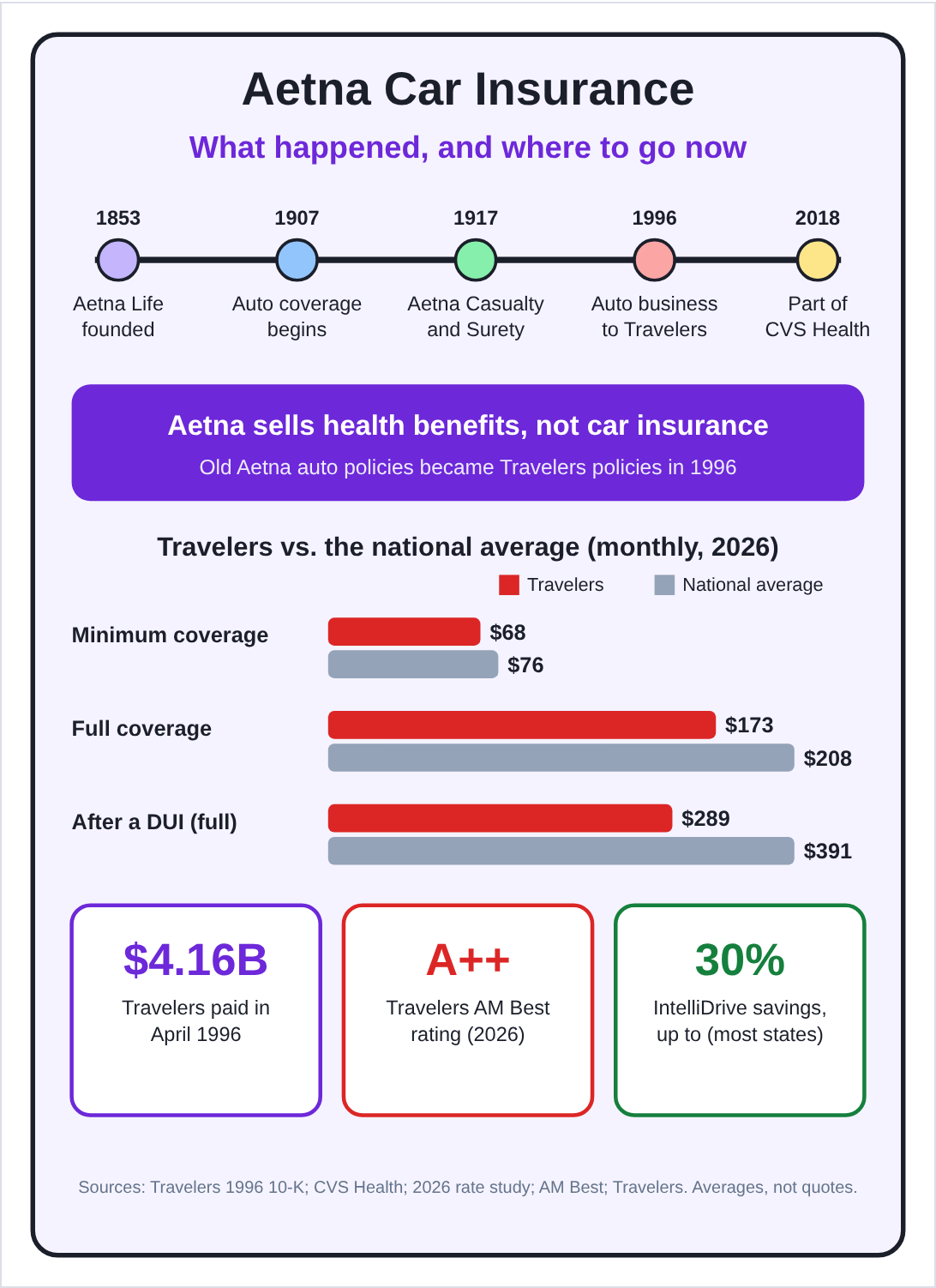
Aetna's auto insurance timeline and 2026 Travelers prices against national averages, from a rate study updated October 1, 2026. Averages, not quotes.
Does Aetna sell car insurance?
No. Aetna has not sold auto insurance since 1996, and it has no Aetna-branded car policy, auto partner program, or member auto discount today. Aetna's own discount page lists offers such as weight management and vision and hearing savings, and it states that discount offers are not insurance.
Aetna, a CVS Health company, describes itself as offering medical, dental, vision, pharmacy, Medicare, Medicaid, and other health benefits. In an October 3, 2026, release, CVS Health said Aetna serves an estimated 37 million people. Pages that publish "Aetna auto insurance" ratings, discounts, or SR-22 fees are describing a product that does not exist.
Aetna's car insurance history
Aetna's auto story is older than most people realize. The Aetna Life Insurance Company was incorporated in Hartford, Connecticut, on May 28, 1853, after splitting from the Aetna Insurance Company, a fire insurer founded in 1819. As cars spread in the early 1900s, Aetna moved into auto coverage, and by most accounts it began selling car insurance in 1907.
Aetna and the car: a timeline
| Year | Event |
| 1853 | Aetna Life Insurance Company is incorporated in Hartford |
| 1907 | Aetna Accident and Liability Company is formed and begins selling auto insurance, by most accounts |
| 1912 | Aetna offers a combination auto policy covering several risks at once |
| 1913 | The Automobile Insurance Company is formed to cover cars against fire |
| 1917 | The casualty arm becomes the Aetna Casualty and Surety Company |
| 1967 | The holding company Aetna Life and Casualty is created |
| Nov. 29, 1995 | Travelers agrees to buy Aetna's property and casualty business for $4 billion |
| Apr. 2, 1996 | The sale closes for about $4.16 billion; Aetna exits auto insurance |
| Nov. 28, 2018 | CVS Health completes its purchase of Aetna |
Connecticut History; Aetna company histories; Deseret News (November 29, 1995); Travelers Property Casualty 1996 Form 10-K; CVS Health (November 28, 2018). Early dates vary slightly by source.
For decades, Aetna Life and Casualty was one of the country's largest sellers of auto and homeowners insurance. When it agreed to sell the business in 1995, the combined Travelers and Aetna property and casualty operations had about $10 billion in premiums, making the new company the fourth-largest property and casualty insurer in the United States, according to news reports at the time.
Aetna's road safety legacy
Aetna did more than sell policies. Historical accounts credit the company with early driver-safety tools, including a reaction-time tester called the Reactometer in the 1930s and the Drivotrainer, a classroom driving simulator introduced in the early 1950s and used in high school driver education. That safety focus fit the business: safer drivers meant fewer claims.
What the 1996 sale meant for drivers
Travelers won the business over other bidders, including the investment firm KKR and the insurer CNA, according to reports at the time. The merger was expected to cut up to 3,300 jobs, but for policyholders, the main change was the name on their bills. Coverage continued under the same companies, now owned by Travelers.
What happened to Aetna auto insurance policies?
Travelers bought two companies from Aetna: The Aetna Casualty and Surety Company and The Standard Fire Insurance Company. The buyer was first called Travelers/Aetna Property Casualty Corp. and was renamed Travelers Property Casualty Corp. in March 1997, according to its annual report. Aetna's auto and homeowners policies moved with those companies.
That means anyone with an old Aetna auto policy, or a question about one, should contact Travelers, not Aetna. Aetna kept its health, retirement, and international businesses and later narrowed its focus to health benefits.
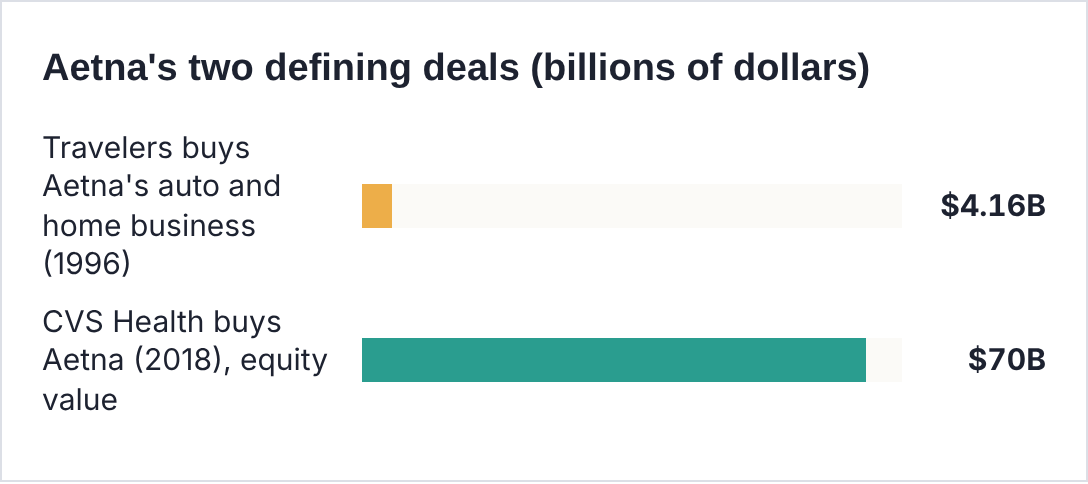
Travelers Property Casualty 1996 Form 10-K; CVS Health release (November 28, 2018). CVS valued the deal at about $78 billion including Aetna's debt.
Why people still search for Aetna car insurance
The search makes sense. Aetna sold auto insurance for nearly 90 years, and many drivers grew up with the Aetna Life and Casualty name on their family's policies. Travelers also has major operations in Hartford, and at least one Travelers office listing at 151 Farmington Avenue, Aetna's address, is labeled Aetna Inc., which adds to the confusion.
Others search because they have Aetna health insurance and want to know whether it covers a car accident. That is a real question with a useful answer, covered below. And some people simply see "Aetna auto insurance" on review sites that recycle old content. Those pages often list ratings and discounts that belong to no actual auto product.
Aetna car insurance: myths vs. facts
| What you may read | The fact |
| Aetna sells auto insurance | Aetna has sold no auto insurance since April 1996 |
| Aetna has always been only a health insurer | Aetna sold auto and home insurance for most of the 20th century |
| Aetna offers SR-22 filings | Aetna sells no auto policy, so it files no SR-22 |
| Aetna agents can sell you car insurance | Aetna lists no auto partner program |
| Aetna members get auto insurance discounts | Aetna's member discounts do not include auto insurance |
Travelers Property Casualty 1996 Form 10-K; Aetna member discounts page (accessed October 28, 2026).
What Aetna sells today
Aetna's products today are all health-related. In May 2025, CVS Health announced that Aetna would leave the Affordable Care Act individual exchanges for 2026, affecting about 1 million members in 17 states, so most Aetna coverage now comes through employers, Medicare, and Medicaid.
Aetna products in 2026
| Product line | Examples | Covers car damage? |
| Employer medical plans | HMO, PPO, POS, EPO, high-deductible plans with an HSA | No |
| Medicare | Medicare Advantage and Part D plans | No |
| Medicaid | State Medicaid managed care plans | No |
| Dental and vision | Employer and individual plans | No |
| Voluntary benefits | Accident and hospital indemnity plans | No |
| Pharmacy and student health | Pharmacy benefits and student plans | No |
CVS Health, Aetna overview and October 3, 2026, release; Fierce Healthcare and AJMC (May 2025). Product availability varies by employer and state.
Does Aetna health insurance cover car accident injuries?
It can, but not on its own. An Aetna health plan may pay for medical care after a crash, but it coordinates with your auto coverage, and the order of payment depends on your state, your plan, and your auto policy. Aetna's sample coverage document lists "an automobile insurance policy" among the plans it coordinates with, and it excludes costs another party must pay first.
In no-fault states, your personal injury protection, or PIP, usually pays first. Aetna's provider manual says it coordinates benefits with PIP as state or federal law allows. In other states, medical payments coverage on your auto policy or the at-fault driver's liability insurance may pay. Your health plan can fill gaps, subject to its deductibles and copays.
Who usually pays for crash injuries
| Situation | Usually pays first | Role of an Aetna health plan |
| No-fault state with PIP | Your PIP coverage | Coordinates with PIP as state law allows |
| At-fault state, other driver liable | Other driver's liability insurance, often after a settlement | May pay medical bills, then seek repayment |
| You have MedPay | Your medical payments coverage | Pays costs left after MedPay, under plan rules |
| Aetna Medicare Advantage member | No-fault or liability insurance | Medicare rules make the auto coverage primary |
Aetna sample certificate of coverage and provider manual; CMS Medicare Secondary Payer overview (accessed October 28, 2026). Rules vary by state and plan.
Repayment from a settlement
Many health plans have a right to be repaid when someone else is responsible for your injuries. One Aetna employer plan booklet we reviewed gives the plan subrogation rights and an automatic lien on a member's settlement or judgment, including money from uninsured motorist, medical payments, and no-fault auto coverage. Terms vary by plan, especially between self-funded employer plans and insured plans.
If you are injured in a crash and settle with the other driver's insurer, expect your health plan to ask about the accident. Tell your attorney or the adjuster that you have Aetna coverage, and ask the plan for its lien amount in writing before you sign a settlement.
Aetna Medicare members after a crash
For Medicare members, federal law sets the order. The Centers for Medicare and Medicaid Services says no-fault and liability insurance pay first, and that this rule overrides state law and private contracts. Medicare may make conditional payments that must later be repaid, and Medicare Advantage plans, including Aetna's, may contact you to request repayment from a settlement.
These rules come from the Medicare Secondary Payer provisions of the Social Security Act, section 1862(b), and federal regulations at 42 CFR Part 411. CMS advises people with Medicare to contact its Benefits Coordination and Recovery Center after an auto accident so the right insurer is billed first and any conditional payments are tracked. Doing that early can prevent a repayment demand from arriving long after your case is closed.
Health insurance vs. car insurance: what each covers
Health insurance and car insurance overlap only on medical bills. Everything else after a crash belongs to your auto policy. This table shows which coverage handles which cost.
What pays for what after a crash
| Cost | Aetna health plan | Car insurance |
| Your medical bills | Yes, under plan rules | PIP or medical payments, if you have it |
| Passengers' medical bills | Only if they are Aetna members | PIP, medical payments, or liability |
| Damage to your car | No | Collision coverage |
| Theft, hail, or flood damage | No | Comprehensive coverage |
| Injuries or damage you cause to others | No | Liability coverage |
| Lost wages | No | PIP in some states |
| Rental car while yours is repaired | No | Rental reimbursement |
General comparison; check your Aetna plan documents and auto policy for exact terms.
No-fault and at-fault states
Where you live changes the order of payment. In no-fault states, drivers carry PIP, which pays their own medical bills and some lost wages regardless of who caused the crash, and lawsuits are limited to more serious injuries. In at-fault states, the driver who caused the crash, through his or her liability insurance, is responsible, but payment often waits until fault is settled.
That waiting period is where your Aetna plan matters most. It may pay medical bills while the auto claim is pending, then seek repayment when the settlement arrives. Medical payments coverage, sold as an option in many at-fault states, can pay faster and reduce what your health plan has to cover.
Steps to take after a crash if you have Aetna coverage
- Get medical care first, and keep every bill and record.
- Report the crash to your auto insurer and, if you were not at fault, to the other driver's insurer.
- Tell your Aetna plan the injuries came from a car accident when it asks.
- File any PIP or medical payments claim on your auto policy.
- Before you settle, ask your Aetna plan for its lien or repayment amount in writing.
- If you are on Medicare, report the accident as CMS directs, so conditional payments are handled correctly.
Questions to ask your Aetna plan
- Do you coordinate benefits with PIP or medical payments coverage in my state?
- Is my plan self-funded by my employer or fully insured?
- Will you seek repayment from my settlement, and how is the amount figured?
- Do I need prior authorization for treatment after an accident?
PRO TIP #1
After any crash, report the accident to your auto insurer and tell your Aetna health plan that the injury came from a car accident. Keeping both informed early helps avoid denied bills, duplicate payments, and surprise repayment demands later.
The Aetna Accident Plan
Some employers offer an Aetna Accident Plan as a voluntary benefit. It pays fixed cash amounts directly to you for covered injuries, in addition to other health coverage, and Aetna says it is not a substitute for major medical insurance. It does not pay for vehicle damage or your liability to others, so it never replaces car insurance.
Travelers: the company that took over Aetna's auto business
If you want the closest thing to Aetna car insurance today, look at Travelers. It absorbed Aetna's auto and home business in 1996 and remains one of the country's largest auto insurers. Here is how it performs in 2026.
Two studies help. Study A is a national rate study updated October 1, 2026, using a 30-year-old man with a 2018 Honda Civic EX, 50/100/50 liability limits, and $500 deductibles. Study B is a national real-quote analysis updated October 27, 2026, reporting liability-only averages. Compare each study only with itself.
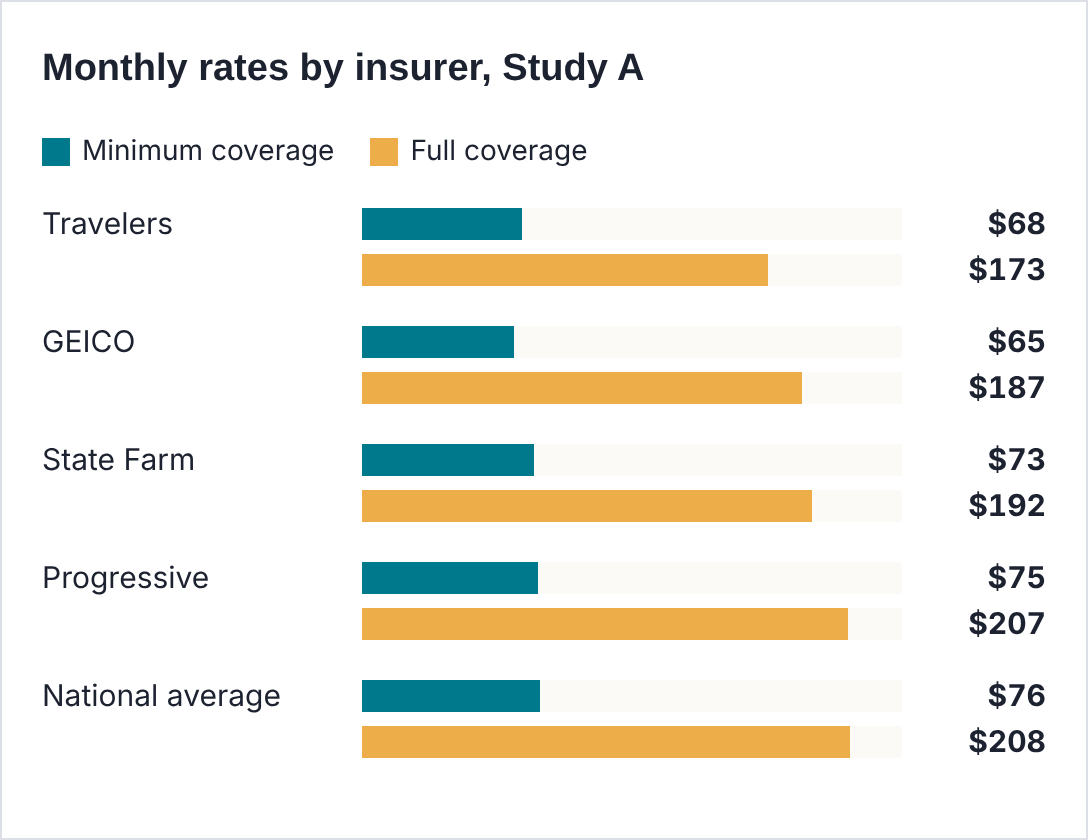
Study A: national rate study updated October 1, 2026; 30-year-old man, 2018 Honda Civic EX, 50/100/50 limits, $500 deductibles.
In Study A, Travelers had the cheapest full coverage of the four big insurers, at $173 a month, $35 below the national average. Its minimum coverage, at $68, was just $3 more than GEICO's and $8 below the national average.
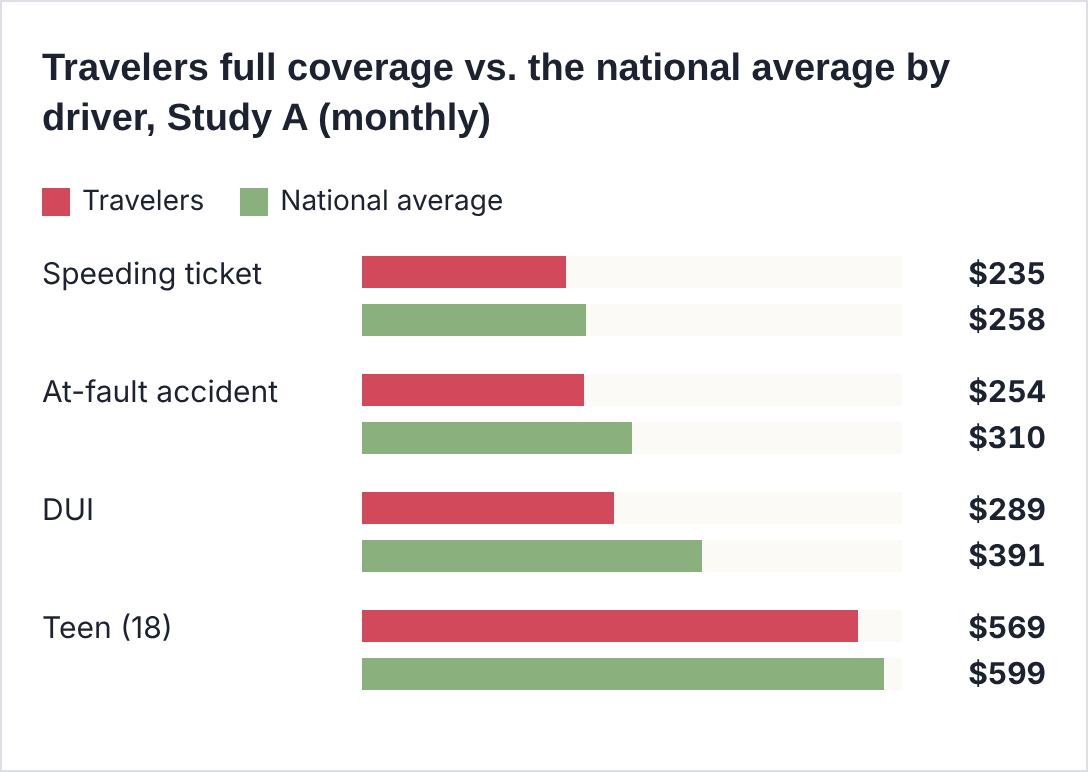
Study A: national rate study updated October 1, 2026; full coverage.
Travelers stayed below average for drivers with a ticket, an accident, or a DUI. The DUI gap was largest: $289 a month against a $391 national average, a difference of $102 a month, or $1,224 a year (our calculation).
Travelers liability-only averages by driver, Study B
| Driver | Travelers | National average | Difference |
| All drivers | $98 | $99 | $1 less |
| Senior | $72 | $86 | $14 less |
| DUI | $140 | $142 | $2 less |
| Teen | $225 | $186 | $39 more |
Study B: national real-quote analysis updated October 27, 2026; liability-only monthly averages. Differences are our calculation.
Study B tells a slightly different story for teens. Travelers' teen liability average was $39 above the national average, while seniors paid $14 less. Families with a young driver should compare carefully.
Teens and seniors
An 18-year-old paid $569 a month for full coverage with Travelers in Study A, slightly below the $599 national average. Travelers offers good student, student away at school, and driver training discounts that can help. Seniors fared well in Study B, at $72 a month for liability-only coverage, $14 below the national average.
Travelers discounts and IntelliDrive
Travelers lists 12 auto discounts on its website. Its IntelliDrive program tracks driving for 90 days and can save up to 30% in most participating states, up to 40% in Nevada, and up to 25% in New Jersey. Risky driving can raise your premium, except in a few places, including Washington, D.C., Montana, North Carolina, and Virginia.
Travelers auto discounts
| Discount | Who qualifies |
| Multi-policy | Bundling auto with home, condo, or renters |
| Multicar | Two or more cars on one policy |
| Home ownership | Drivers who own a home |
| Safe driver | A clean driving record |
| Continuous insurance | Drivers with no gap in coverage |
| Hybrid or electric vehicle | Owners of qualifying vehicles |
| New car | Cars that are recent models |
| Payment | Electronic funds transfer, paying in full, or a good payment history |
| Early quote | Quoting before your current policy ends |
| Good student | Students with good grades |
| Student away at school | Students at school without a car |
| Driver training | Young drivers who complete a course |
| IntelliDrive | Up to 30% in most participating states |
Travelers discounts and IntelliDrive pages (accessed October 28, 2026). Amounts and availability vary by state.
Travelers ratings
Travelers ratings scorecard
| Rating | Score | What it means |
| AM Best (Aug. 2026) | A++ (Superior), stable | Top financial strength |
| J.D. Power 2026 auto study | 657, highest in New York | Strong customer satisfaction in NY |
| J.D. Power 2025 claims study | 691 vs. 700 average | Slightly below average claims experience |
| Complaints (NAIC data) | About 62% fewer than expected | Well below average complaints |
AM Best (August 21, 2026); J.D. Power 2026 U.S. Auto Insurance Study (June 9, 2026); J.D. Power 2025 claims score as reported in 2026; complaint comparison from a rate study updated October 1, 2026.
What car insurance costs in 2026
For context, Study A put the national average at $76 a month for minimum coverage and $208 a month for full coverage, or about $908 and $2,495 a year. Your price depends on your state, age, record, vehicle, and coverage choices, which is why matched quotes matter more than any average.
Travelers vs. other big insurers
Where to buy car insurance instead of Aetna
| Factor | Travelers | GEICO | State Farm | Progressive |
| Minimum coverage (Study A) | $68 | $65 | $73 | $75 |
| Full coverage (Study A) | $173 | $187 | $192 | $207 |
| Link to Aetna | Bought Aetna's auto business in 1996 | None | None | None |
| Telematics program | IntelliDrive | Yes | Yes | Yes |
Study A: national rate study updated October 1, 2026; monthly averages.
Pros and cons of Travelers as an Aetna alternative
| Pros | Cons |
| Took over Aetna's auto business in 1996 | Teen liability above average in Study B |
| Cheapest full coverage of four big insurers in Study A | Claims score slightly below average in 2025 |
| A++ rating from AM Best | IntelliDrive can raise rates in most participating states |
| Complaints well below expected levels | Not sold in every state |
| 12 discounts plus IntelliDrive | Minimum coverage $3 above GEICO in Study A |
Aetna vs. Travelers today
The two companies share a history but sell completely different products now. This side-by-side shows where each fits.
Aetna and Travelers in 2026
| Factor | Aetna | Travelers |
| Owner | CVS Health | The Travelers Companies (publicly traded) |
| Main products | Health, dental, vision, Medicare, Medicaid | Auto, home, and business insurance |
| Sells car insurance | No | Yes |
| Role after a crash | May pay medical bills, then seek repayment | Pays under your auto policy's coverages |
| Link to old Aetna auto policies | Sold them in 1996 | Took them over in 1996 |
Who should consider Travelers
Is Travelers a good fit?
| Driver | Good fit? | Why |
| Adults wanting full coverage | Yes | $173 a month in Study A, below average |
| Drivers with a DUI or accident | Worth a quote | Below national averages in Study A |
| Seniors | Yes | $72 liability-only in Study B, below average |
| Families with a teen driver | Compare carefully | Teen liability above average in Study B |
| Safe drivers open to tracking | Yes | IntelliDrive savings up to 30% in most participating states |
| Homeowners who want one insurer | Yes | Multi-policy and home ownership discounts |
Studies A and B; Travelers discounts and IntelliDrive pages (accessed October 28, 2026).
How to shop for car insurance now
- Decide on your coverage: state minimum, or full coverage with collision and comprehensive.
- Get at least three quotes, such as Travelers, GEICO, and State Farm, with the same limits and deductibles.
- Ask each insurer about discounts and telematics programs like IntelliDrive.
- Check whether your state uses PIP, and how it works with your health plan.
- Read the policy's medical payments and uninsured motorist options, since they work alongside your Aetna coverage.
- Start the new policy before the old one ends, so there is no gap.
Watch out for "Aetna auto insurance" offers
Because Aetna sells no car insurance, any call, text, or website offering an "Aetna auto policy" is either misleading or a scam. Do not give out your Aetna member ID or payment details. Aetna's Special Investigations Unit takes fraud reports at 1-800-338-6361 or AetnaSIU@aetna.com.
PRO TIP #2
When you buy car insurance, add medical payments coverage if your state does not require PIP. It pays crash medical bills quickly, regardless of fault, and can cover the deductibles and copays your Aetna health plan leaves behind.
Aetna car insurance at a glance
This illustrated summary pulls together the main points of this guide.
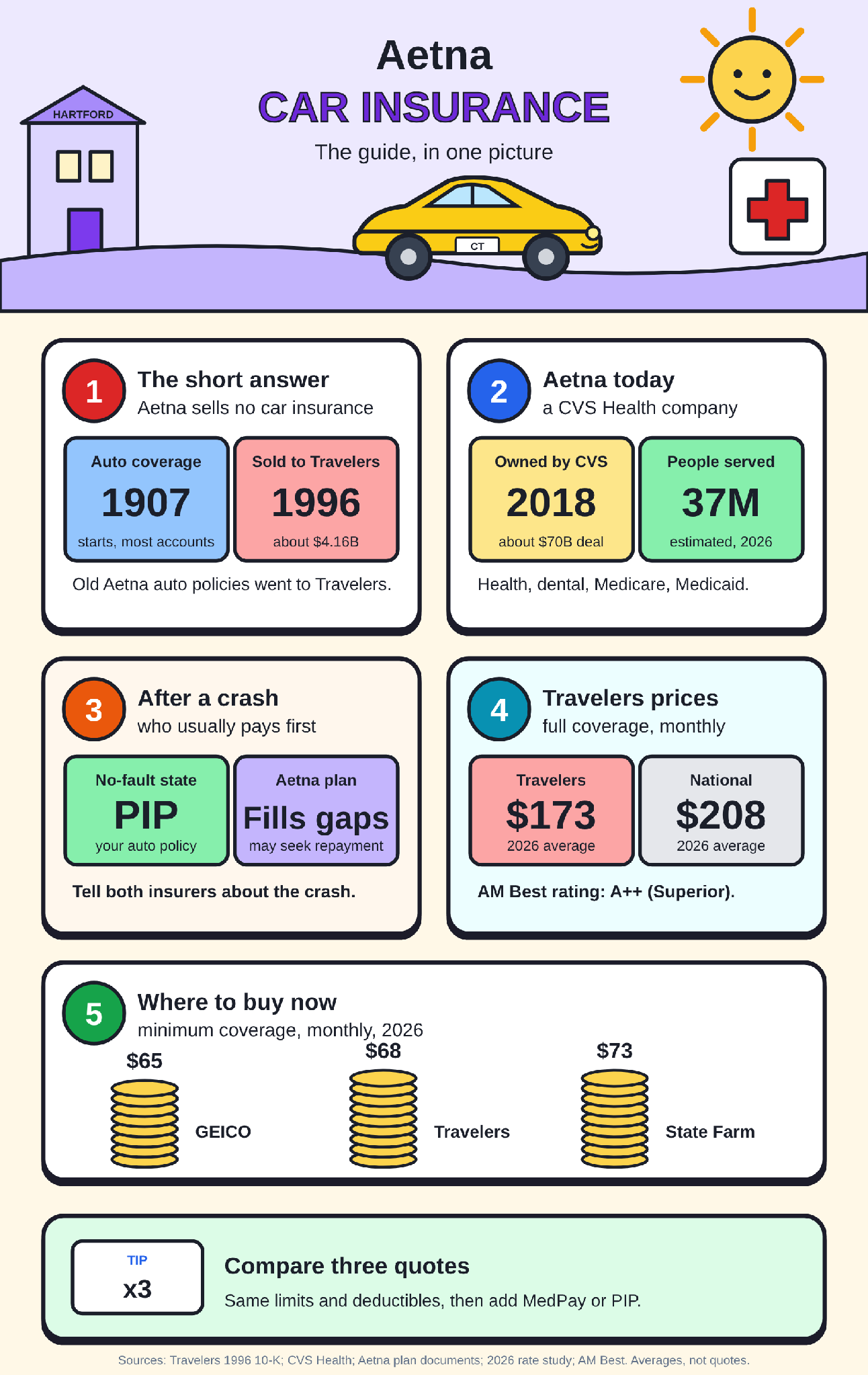
Aetna car insurance at a glance. Sources: Travelers 1996 10-K; CVS Health; Aetna plan documents; 2026 rate study; AM Best. Averages, not quotes.
Frequently asked questions about Aetna Car Insurance
Does Aetna offer car insurance?
No. Aetna sold its property and casualty business, including auto and homeowners insurance, to Travelers in a deal that closed April 2, 1996. Since then, it has focused on health benefits and is now a CVS Health company. Aetna has no auto policy, auto partner program, or member auto discount.
Who took over Aetna car insurance?
Travelers did. It bought The Aetna Casualty and Surety Company and The Standard Fire Insurance Company for about $4.16 billion in 1996. The buyer was first named Travelers/Aetna Property Casualty Corp. and became Travelers Property Casualty Corp. in 1997. Questions about old Aetna auto policies go to Travelers.
When did Aetna start selling car insurance?
Aetna began writing auto coverage in the early 1900s, and most accounts date its first car insurance to 1907. It offered a combination auto policy by 1912, and its casualty arm became the Aetna Casualty and Surety Company in 1917. It sold auto insurance for nearly 90 years.
Will Aetna health insurance pay for car accident injuries?
It may, but it coordinates with your auto coverage. In no-fault states, personal injury protection usually pays first. In other states, medical payments coverage or the at-fault driver's insurance may pay. Your Aetna plan can cover remaining costs under its rules and may seek repayment from a settlement.
Can Aetna take money from my car accident settlement?
Many health plans, including some Aetna employer plans, have subrogation or reimbursement rights. One Aetna plan booklet we reviewed gives the plan a lien on a member's settlement or judgment. Terms vary by plan, so ask the plan for its lien amount in writing before you settle.
Who pays first for an Aetna Medicare member after a crash?
Federal Medicare rules make no-fault and liability insurance the primary payer, and those rules override state law and private contracts. Medicare may make conditional payments that must be repaid, and Medicare Advantage plans may contact you to request repayment from any settlement you receive.
Who owns Aetna now?
CVS Health does. CVS announced the deal in December 2017 and completed it on November 28, 2018, paying $212 per Aetna share, about $70 billion, or about $78 billion including debt. Aetna operates as a CVS Health company and serves an estimated 37 million people.
Is Travelers a good replacement for Aetna car insurance?
For many drivers, yes. In a 2026 rate study, Travelers averaged $173 a month for full coverage, below the $208 national average, and AM Best rates it A++ (Superior). Complaints run well below average. Teens may find better prices elsewhere, so compare at least three quotes.
The final word on Aetna car insurance
Aetna was once one of America's biggest car insurers, but that chapter closed in 1996, when Travelers bought its auto and home business. Today, Aetna is a health company owned by CVS, and no Aetna auto policy exists. If you have Aetna health coverage, it can still matter after a crash, because it works alongside PIP, medical payments coverage, and the other driver's insurance.
For car insurance itself, Travelers is the natural successor and a strong performer in 2026, with below-average full coverage prices and an A++ rating. But the best policy for you comes from comparing quotes, so check Travelers alongside at least two other insurers.
NEXT STEP
Get quotes from Travelers and two other insurers with the same coverage. Then check your Aetna plan's rules for car accident injuries, so you know how your health and auto coverage will work together.
Prices, discounts, ratings, and plan rules change and vary by state, driver, and plan. The figures in this article are published averages, plan documents, and our calculations, not quotes or offers. This article is for information only and is not legal, medical, or financial advice. The publisher is not an insurance company or a licensed insurance agency.
The bottom line on Aetna car insurance: you cannot buy it, but you can buy coverage from the company that took over Aetna's auto business, and you can use your Aetna health plan wisely if you are ever hurt in a crash.
Sources
- Travelers Property Casualty Corp., 1996 Form 10-K (SEC).
- Deseret News, Travelers to buy Aetna's property-casualty units (November 29, 1995).
- CVS Health, completion of Aetna acquisition (November 28, 2018).
- CVS Health, Aetna 2027 Medicare plans (October 3, 2026) and Aetna overview.
- Connecticut History, Aetna; Aetna Inc. company history.
- Fierce Healthcare, Aetna to exit ACA exchanges in 2026 (May 2025).
- Aetna: member discounts, provider manual, sample certificate of coverage, example plan booklet, Accident Plan FAQ, and fraud reporting (accessed October 28, 2026).
- CMS, Medicare Secondary Payer and Medicare.gov, Who pays first.
- Travelers: car insurance discounts and IntelliDrive (accessed October 28, 2026).
- J.D. Power, 2026 U.S. Auto Insurance Study (June 9, 2026).
- ValuePenguin, Travelers review and average cost of car insurance (October 1, 2026).
- Insurify, Travelers car insurance (October 27, 2026); CarInsurance.com, Travelers review (2026).
Disclaimer
This website provides an independent article. It is not affiliated with, endorsed by, sponsored by, or connected to Aetna Inc., Aetna Life Insurance Company, CVS Health Corporation, The Travelers Companies, Inc., or any of their affiliates, or with any other company named in this article.
All company names, brand names, and trademarks are the property of their respective owners and are used here only to identify the companies and products discussed. Their use does not imply any affiliation or endorsement.
The information on this page is provided for general informational and educational purposes only. It is not insurance, legal, medical, tax, or financial advice, and it is not an offer, quote, or solicitation to buy or sell insurance. We are not an insurance company, insurance agency, or licensed insurance producer, and we cannot bind coverage, change a policy, or handle claims.
Prices, discounts, ratings, plan rules, and company details can change at any time and vary by state, driver, and plan.
While we make reasonable efforts to keep this article accurate, we make no representations or warranties, express or implied, about its completeness, accuracy, or reliability. Always confirm details with the insurer or health plan, read your policy documents, and consult a licensed professional before making a decision. Your use of this information is at your own risk, and we are not liable for any loss or damage arising from reliance on it.