
Temporary Car Insurance in Michigan
Whether you are covering a borrowed car for a summer in Grand Rapids, storing a classic through a Detroit winter, or driving a car home from college in Ann Arbor, buying temporary car insurance in Michigan means working inside the country's most distinctive no-fault system. Michigan insurers rarely sell policies shorter than six months, but state law gives short-term drivers two real advantages: refunds generally figured pro rata when you cancel, and the right to drop no-fault coverage on a car that is not driven.
This guide explains Michigan's required coverages, the personal injury protection (PIP) choices that drive your price, the Michigan Catastrophic Claims Association (MCCA) fee, storage coverage, penalties, every short-term option with 2026 Michigan prices, and a step-by-step plan. Every figure is sourced and dated, and hypothetical examples are labeled.
- No true temporary policies. Weekly coverage, early cancellation, non-owner, and rental coverage fill the gap.
- Refunds are generally pro rata. Michigan law requires insurers to refund unused premium pro rata when you cancel, though an insurer may file a minimum retention rule for auto policies.
- Parked car? Use storage coverage. Michigan lets you keep only comprehensive coverage on a vehicle that is not driven or moved on a highway.
- Your PIP choice changes the price. Unlimited PIP carries an $84 MCCA fee per vehicle from July 2026; every other option carries $19.
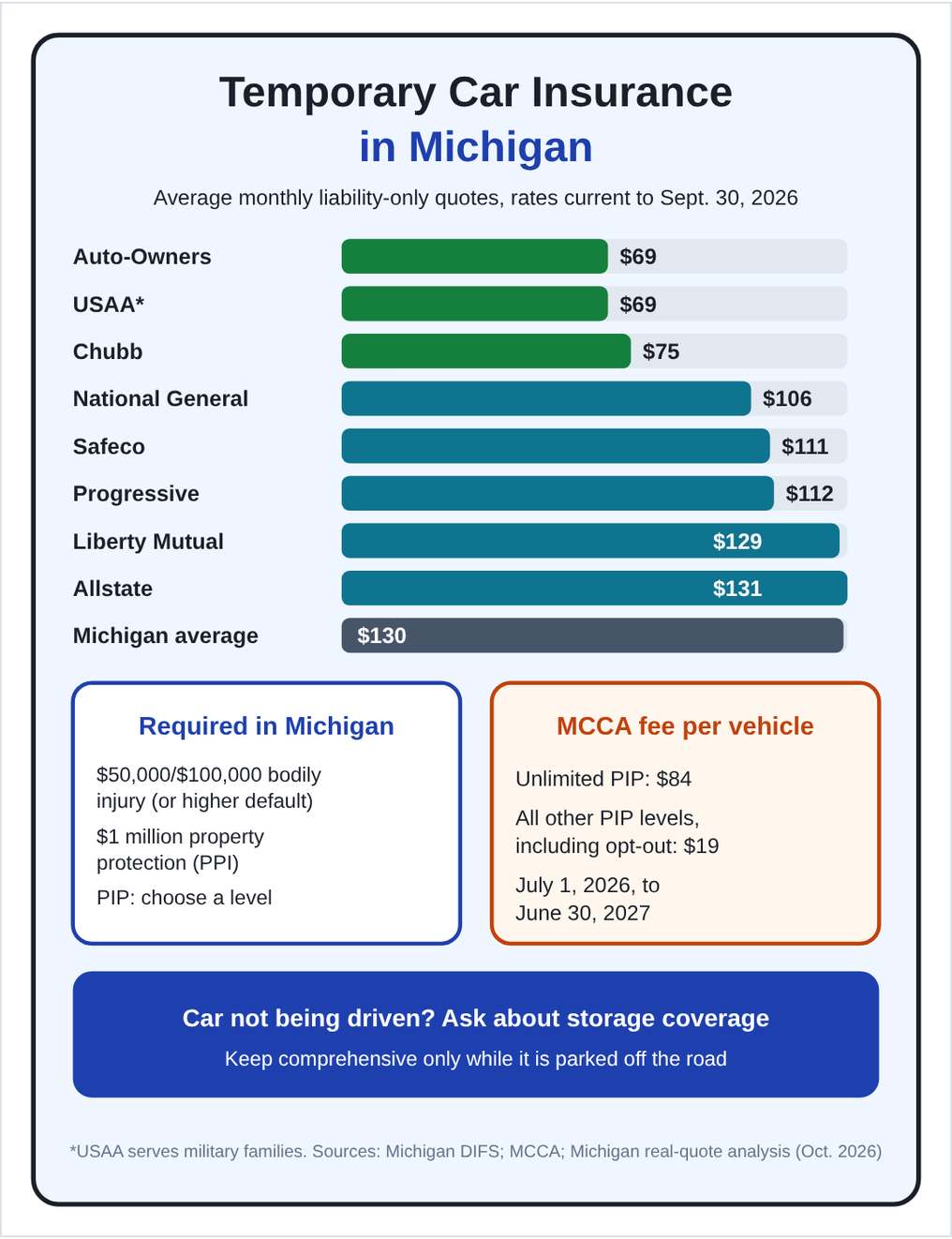
Average monthly liability-only quotes in Michigan from a real-quote analysis updated November 4, 2026 (rates current to September 30, 2026), plus required coverages and the 2026–2027 MCCA fee. Averages, not quotes.
Does temporary car insurance exist in Michigan?
Not as a short policy term. A Michigan quote analysis updated November 4, 2026, says temporary car insurance in Michigan "doesn't technically exist," because most insurers sell six-month or one-year policies. It lists the practical alternatives: weekly coverage through Insurify Car, month-to-month payment on a standard policy with early cancellation, non-owner liability coverage, and rental car coverage.
Insurify Car's weekly coverage averaged $147 a month, or about $34 a week, in that analysis. It does not include collision, comprehensive, SR-22 filings, or rideshare coverage.
Short-term car insurance options in Michigan
Option | How it works | Covers your own car? | Best for |
|---|---|---|---|
Weekly coverage (Insurify Car) | Liability coverage paid weekly; cancel anytime | No | A few weeks of driving |
Standard policy, canceled early | Six-month policy; refund generally pro rata | Yes, with full coverage | Owners who need collision and comprehensive |
Storage coverage | Comprehensive only on a car that is not driven | Theft, fire, and other damage | Cars parked for a season |
Pay-per-mile insurance | Base rate plus a per-mile charge | Yes, with full coverage | Cars that barely move |
Non-owner insurance | Liability when you drive cars you do not own | No | People who borrow or rent |
Rental car coverage | Bought for the rental period | Yes, with a damage waiver | Short rentals |
Michigan quote analysis updated November 4, 2026; MCL 500.3101 as read in Meemic Insurance Co. v. Michigan Millers Mutual (Mich. Ct. App. 2015). Confirm availability with each insurer.
Michigan car insurance requirements
Michigan's no-fault law requires three parts on every registered vehicle, according to the Department of Insurance and Financial Services (DIFS): personal injury protection, property protection insurance, and residual bodily injury and property damage liability.
Michigan required coverage
Coverage | What it pays | Requirement |
|---|---|---|
Bodily injury liability | Injuries you cause to others, when they can sue | $50,000/$100,000 minimum; $250,000/$500,000 if you do not choose |
Property damage liability | Damage you cause in other states | $10,000 |
Property protection insurance (PPI) | Damage your car causes to property in Michigan | $1 million |
Personal injury protection (PIP) | Your medical bills, lost wages, and replacement services | Choose a level, from unlimited to opt-out |
Michigan DIFS, Quick Facts (FIS-PUB 0202A); Michigan car insurance laws guide (updated October 13, 2026).
Most companies also offer limited property damage liability, called mini-tort coverage. It pays up to $3,000 when you are at least 50% at fault for damage to another person's car that their insurance does not cover.
Uninsured motorist coverage is optional, but Michigan has a serious uninsured problem: about 22.3% of Michigan drivers were uninsured in 2023, the fourth-highest rate in the country, according to the Insurance Research Council. On any policy, short-term or not, it is worth pricing.
PIP choices: the biggest lever on your price
Since Michigan's 2019 reform, drivers choose how much PIP medical coverage to buy. DIFS lists six levels, and some come with eligibility rules. If you do not choose, the policy is issued with unlimited PIP and charged for it.
Michigan PIP medical options
PIP level | Who can choose it |
|---|---|
Unlimited | Anyone; the default |
$500,000 per person | Anyone |
$250,000 per person | Anyone |
$250,000 with exclusions | Named insured has non-Medicare qualified health coverage, or excluded relatives do |
$50,000 per person | Named insured is enrolled in Medicaid, and others in the household meet coverage rules |
No PIP medical (opt-out) | Named insured has Medicare Parts A and B, and others in the household meet coverage rules |
Michigan DIFS, Quick Facts (FIS-PUB 0202A). Summarized; see DIFS for the full eligibility rules.
PIP pays medical expenses up to your chosen limit, plus lost wages and replacement services for up to three years after a crash. Lower PIP levels cost less, but they leave more risk on you and your health insurance. On a short-term policy, choose deliberately rather than accepting the default.
The MCCA fee
Every Michigan policy also carries a per-vehicle fee from the Michigan Catastrophic Claims Association, which reimburses insurers for very large PIP claims. For policies from July 1, 2026, through June 30, 2027, the fee is $84 per vehicle with unlimited PIP and $19 per vehicle for every other PIP option, including opt-outs.
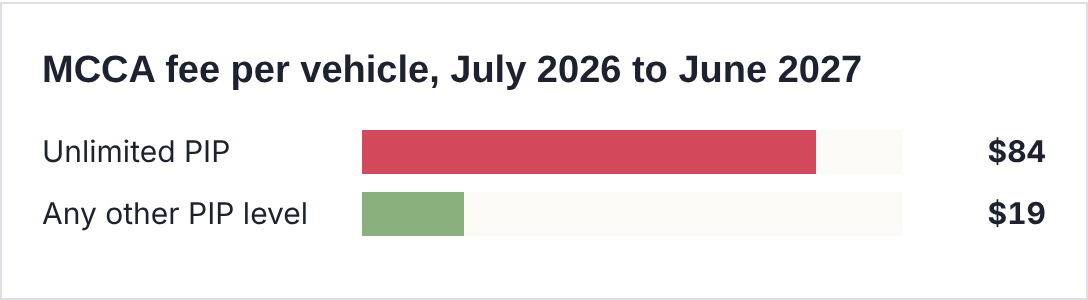
MCCA assessment for July 1, 2026, to June 30, 2027, as reported in an AAIS compliance alert. The $84 includes a $65 pure premium and a $19 deficit recoupment.
PRO TIP #1Pick your PIP level before you get quotes. If you do not choose, Michigan policies default to unlimited PIP, which carries the higher $84 MCCA fee. Ask each insurer to quote the same PIP level so you are comparing like for like, and make sure you qualify for any lower level you choose.
Penalties for driving uninsured in Michigan
Michigan treats uninsured driving as a crime. According to DIFS, driving without insurance is a misdemeanor with a fine of up to $500 and up to one year in jail, and a court may suspend your license for 30 days or until you show proof of insurance. Owning an uninsured car, or letting someone drive it, can also make you personally liable for injuries and damage.
What a Michigan lapse can cost
Consequence | Detail |
|---|---|
Criminal charge | Misdemeanor |
Fine | Up to $500 ($200 to $500 per a 2026 legal guide) |
Jail | Up to one year |
License | Suspension for 30 days or until you show proof of insurance |
Registration | No renewal, transfer, or replacement until requirements are met |
Lawsuits | You can be sued personally for a crash you cause |
Michigan DIFS, Quick Facts and auto insurance FAQ; Michigan car insurance laws guide (updated October 13, 2026).
Michigan's cancellation rules work in your favor
Michigan law is friendlier to early cancellation than many states. Under MCL 500.3020, when you ask to cancel, the insurer must refund the premium above the pro rata amount for the time that has passed.
There is one exception to know: an insurer may file a rule setting a minimum premium it keeps on an auto policy. That minimum applies only when it is more than the pro rata amount, and it does not apply to renewal policies, or when you no longer need coverage or have replaced the policy with another insurer's auto policy.
In practice, ask each insurer one question before you buy: "Do you have a minimum retention on a new policy, and how much is it?" If the answer is no, a six-month policy canceled after a month or two can cost about the same as a short-term policy.
Hypothetical: one month on a Michigan liability policy
Step | Amount |
|---|---|
Six-month premium | $414 |
Premium used (one month) | $69 |
Unearned premium refunded pro rata | $345 |
Net cost for one month, with no minimum retention | $69 |
Hypothetical; our calculation, using Auto-Owners' $69 monthly liability-only average in a Michigan real-quote analysis (rates current to September 30, 2026) × 6 = $414. A filed minimum retention could raise the cost.
Storage coverage: Michigan's answer for a parked car
Michigan drivers often store cars for the winter, and state law allows for it. In Meemic Insurance Co. v. Michigan Millers Mutual, the Michigan Court of Appeals read MCL 500.3101 as letting an owner delete coverages for a vehicle that is not driven or moved on a highway and keep only comprehensive coverage. In that case, the owner of a 1966 Corvette had done exactly that. That means you do not need full no-fault coverage on a car that sits in a garage all winter. A storage arrangement keeps comprehensive coverage for theft, fire, and other damage. A national analysis put average storage policy costs at $12 to $18 a month at four large insurers. The catch: you cannot drive the car, or move it on a public road, until you restore full coverage.
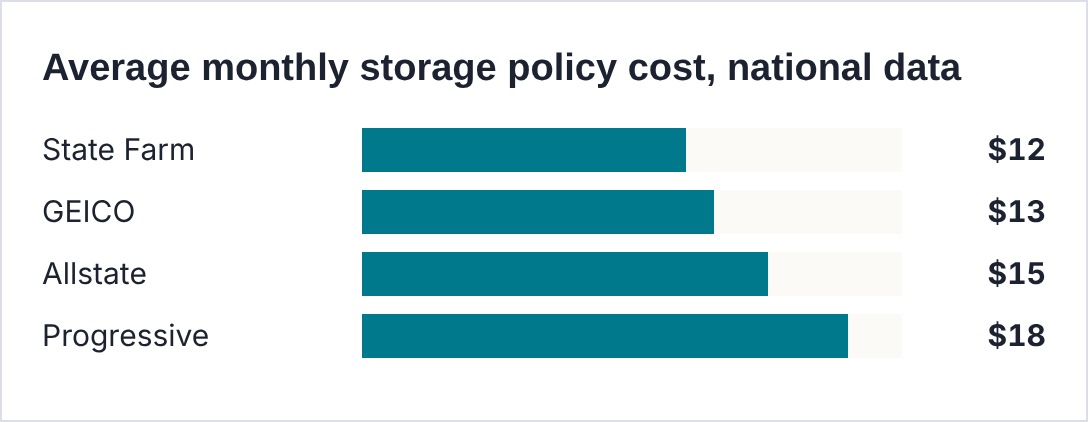
Insurify, Car Insurance Coverage for Stored Vehicles (updated November 17, 2025); national averages from quotes and Quadrant estimates. Michigan prices may differ.
BEFORE YOU STORE
Call your insurer before you drop coverage, and ask how its storage option works in Michigan. Restore full no-fault coverage before the car goes back on the road, even for a short drive to a mechanic.
Your temporary car insurance options in Michigan
1. Weekly coverage
Insurify Car sells weekly coverage in Michigan that you can cancel anytime. The Michigan analysis put its average at $147 a month, or about $34 a week, and said liability rates start as low as $69 a month. It excludes collision and comprehensive, so it will not pay to repair your own car.
2. A standard policy canceled early
Because Michigan generally requires pro rata refunds, this is often the best value for anything longer than a few weeks, and it is the only route that reliably includes full coverage. Choose your PIP level, buy from a low-cost insurer, and cancel when you are done.
3. Pay-per-mile insurance
Pay-per-mile choices are limited in Michigan. Allstate Milewise lists Michigan among its 22 states. Nationwide SmartMiles is not available in Michigan, and Mile Auto's seven states do not include it.
4. Non-owner insurance
If you do not own a car but drive borrowed or rented ones, a non-owner policy gives you liability coverage. A national analysis put non-owner coverage at $29 to $74 a month. It does not pay for damage to the car you drive.
5. Rental car coverage
For a short rental, one national analysis put rental car insurance at $9 to $30 a day, and a June 2026 consumer report said counter coverage often costs $30 to $60 a day. Check your own policy and card benefits first, since most cards offer only secondary coverage and usually exclude liability.
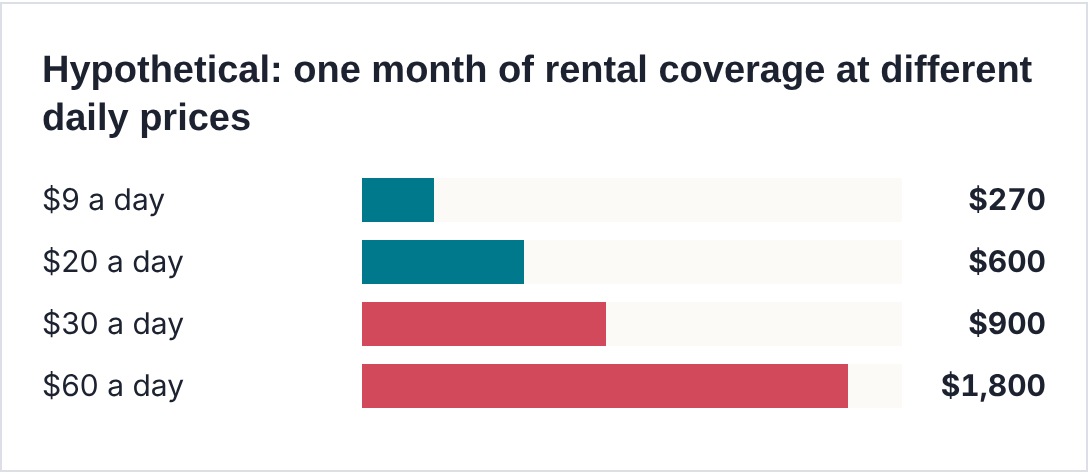
Our calculation: daily price × 30. Daily ranges from a national analysis (September 30, 2026) and a June 23, 2026, consumer report.
6. Being added to someone else's policy
A college student home for the summer or a relative staying a few weeks can often be added to the owner's policy. That may raise the owner's premium, so compare it with weekly or non-owner coverage.
7. The Michigan Automobile Insurance Placement Facility
Drivers who have trouble finding coverage can apply to the Michigan Automobile Insurance Placement Facility through an agent. DIFS says Michigan law guarantees coverage to eligible residents with a Michigan-registered car or a valid Michigan driver's license.
How much does short-term car insurance cost in Michigan?
Michigan is expensive. In real-quote data, Michigan averaged $130 a month for liability-only and $229 for full coverage, among the highest in the country. One factor that does not affect Michigan prices: since 2020, insurers cannot use credit scores to set auto rates.
Two 2026 analyses show the cheapest companies. Study A is a rate study updated November, 2026, using a 40-year-old driver. Study B is a real-quote analysis with rates current to September 30, 2026. Compare each only with itself.
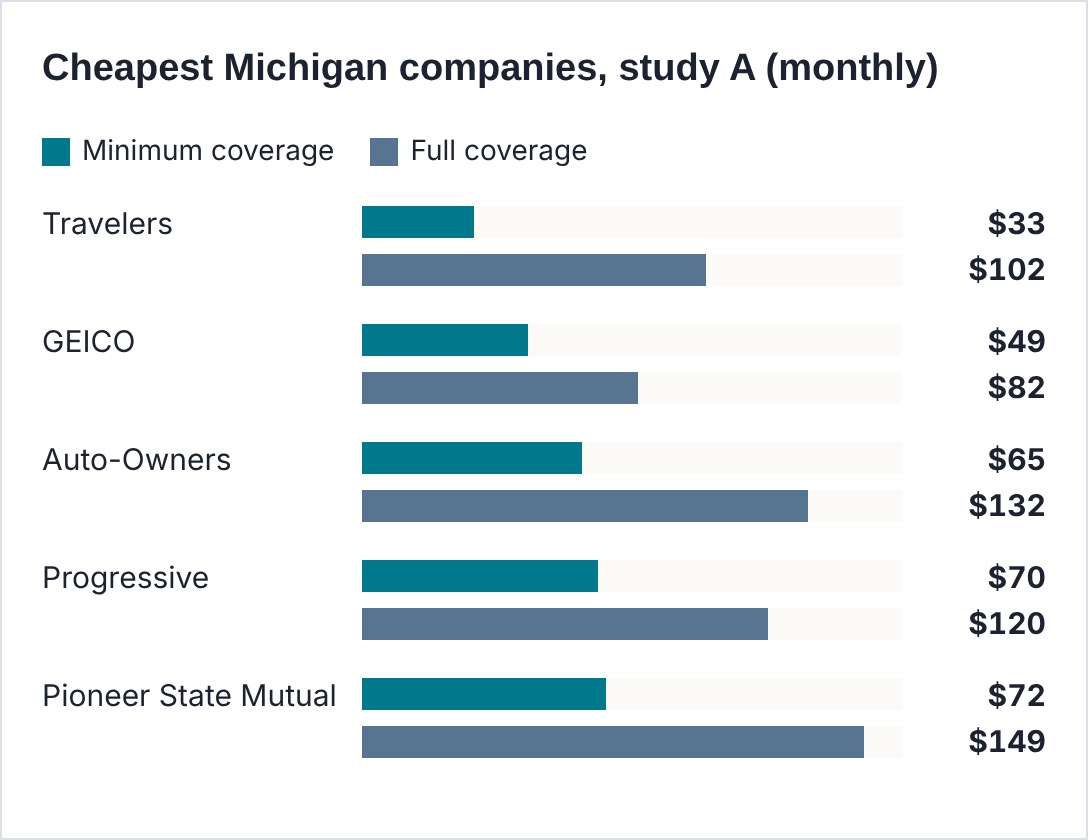
Study A: Michigan rate study updated November, 2026; 40-year-old driver; minimum coverage at 50/100/10 plus PIP; full coverage at 100/300/100 with a $1,000 deductible.
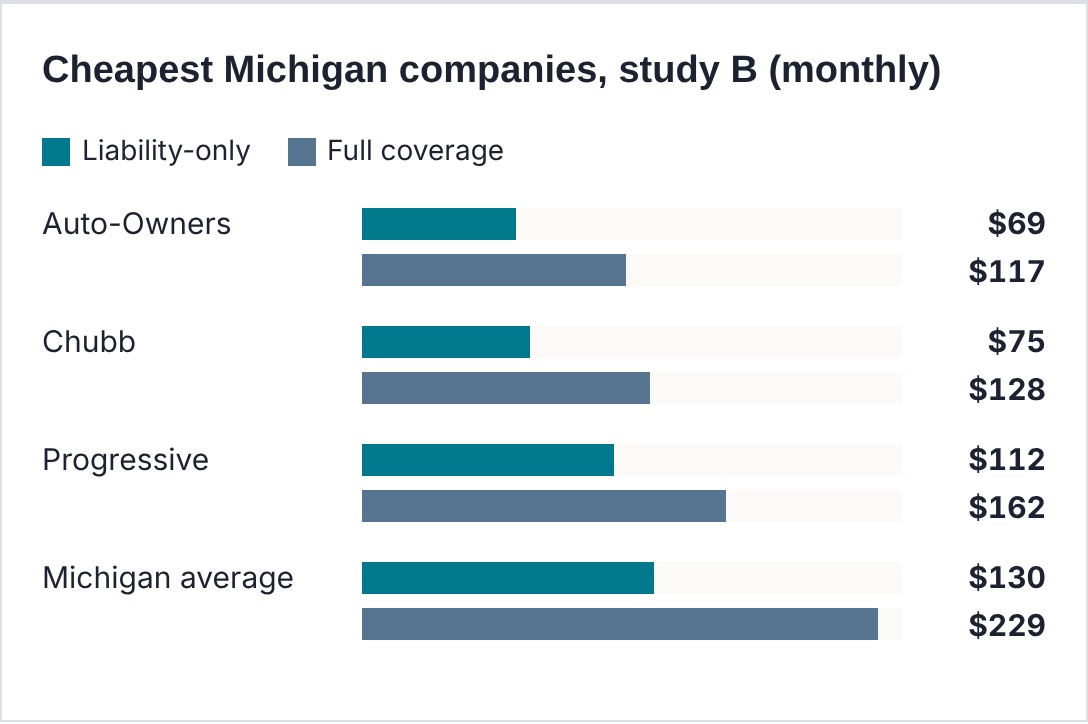
Study B: Michigan real-quote analysis updated November, 2026; rates current to September 30, 2026. USAA, available to military families, matched Auto-Owners at $69 for liability.
Prices across Michigan cities
Location makes a big difference in Michigan. In study A, the cheapest minimum coverage in Detroit cost three times as much as in Portage.
Cheapest minimum coverage in selected Michigan cities, study A
City | Cheapest company | Monthly |
|---|---|---|
Portage | Travelers | $19 |
Grand Rapids | Travelers | $20 |
Lansing | Travelers | $21 |
Ann Arbor | Travelers | $24 |
Warren | Travelers | $31 |
Flint | Travelers | $36 |
Livonia | AAA | $45 |
Dearborn | Travelers | $54 |
Detroit | Travelers | $57 |
Study A: Michigan rate study updated November, 2026; minimum coverage. Averages, not quotes.
Temporary coverage for special situations in Michigan
College students. A student bringing a car to campus usually does best on a parent's policy. A student who borrows or rents may want weekly or non-owner coverage.
Teens. In study A, GEICO had the cheapest full coverage on a family policy at every age from 16 to 25, though prices stay high until 25.
Cheapest full coverage for young drivers on a family policy, study A
Age | Cheapest company | Monthly |
|---|---|---|
16 | GEICO | $309 |
18 | GEICO | $277 |
20 | GEICO | $258 |
22 | GEICO | $232 |
25 | GEICO | $191 |
Study A: Michigan rate study updated November, 2026. Averages, not quotes.
Seniors. In Study A, Pioneer State Mutual was cheapest for a 65-year-old at $121 a month for full coverage, followed by Progressive at $131. Seniors enrolled in Medicare Parts A and B may qualify to opt out of PIP medical, which can lower the price.
Drivers with an OWI or accident. Michigan calls drunk driving an OWI. In study A, Progressive was cheapest after an OWI at $151 a month for full coverage and $85 for minimum coverage. Auto-Owners was cheapest after an at-fault accident at $152 and $73.
Buying a car. Many insurers give a grace period of about 7 to 30 days to add a newly bought car, according to a June 2026 rate study, but some give only a few days. Call before you drive away.
Best temporary option by Michigan situation
Your situation | Best option | Why |
|---|---|---|
Borrowing a car for a few weeks | Weekly or non-owner coverage | Liability without a long policy |
Owning a car for a few months | Standard policy canceled early | Refund generally pro rata |
Storing a car for winter | Storage (comprehensive-only) coverage | No-fault not needed while not driven |
Student home for summer | Be added to a parent's policy | No new policy needed |
Short rental | Rental coverage or your own policy | Covers the rental car |
Turned down by insurers | Michigan Automobile Insurance Placement Facility | Coverage for eligible residents |
Weekly or a cancelable policy?
The Michigan figures make the trade-off clear. Weekly coverage averaged $147 a month in the Michigan analysis, while Auto-Owners averaged $69 a month for liability on a standard policy. If an insurer refunds the rest pro rata, one month on the standard policy costs about half as much. Weekly coverage still has a place: it needs no cancellation call, no refund wait, and no question about minimum retention.
Hypothetical: one month of liability coverage in Michigan
Option | Cost for one month | Trade-off |
|---|---|---|
Weekly coverage (Insurify Car) | $147 | No commitment; liability only |
Standard policy (Auto-Owners), pro rata refund | $69 | Must cancel; ask about minimum retention |
Our calculation using Insurify's Michigan averages (temporary insurance page updated October 17, 2026, and Michigan page with rates current to September 30, 2026).
Protecting your own car on a short policy
Michigan's no-fault system changes how damage to your own car is paid. Because you generally cannot sue the other driver for most vehicle damage, collision coverage on your own policy, or the $3,000 mini-tort coverage, is what pays for your car. Weekly coverage includes neither collision nor comprehensive, so if you are driving a car you care about, or one with a loan, a standard policy with full coverage is the safer choice even for a month or two.
Visitors and new residents
Visitors. If you are visiting Michigan with your own car, your home-state policy generally travels with you, but confirm it with your insurer. If you are borrowing a car, the owner's policy usually covers permitted drivers, and a non-owner or weekly policy can add your own liability coverage.
New residents. Once you register a car in Michigan, it needs Michigan no-fault coverage, including PIP at a level you choose and $1 million in property protection. Line up the new policy before you register, then cancel the old one so you do not pay for two at once.
How Michigan compares with other states
Short-term rules: Michigan vs. other states
State | Insurance system | Refund on early cancellation |
|---|---|---|
Michigan | No-fault with PIP choices and a $1 million PPI requirement | Pro rata, unless an insurer files a minimum retention |
Ohio | At-fault; $25,000/$50,000/$25,000 liability | Depends on insurer |
Illinois | At-fault; uninsured motorist required | Pro rata required by law |
Pennsylvania | Choice no-fault with tort options | Depends on insurer |
Michigan DIFS; MCL 500.3020; Ohio BMV; 215 ILCS 5/143.12a; Pennsylvania Insurance Department. Summarized.
How to get temporary car insurance in Michigan, step by step
- Decide what you need to cover: your own car, a borrowed car, a rental, or a parked car.
- Choose your PIP level and check that you qualify for it.
- Price weekly coverage if you need liability for only a few weeks.
- Get standard quotes from low-cost companies such as Auto-Owners, Travelers, GEICO, and Progressive.
- Ask about minimum retention before you buy, so you know your refund.
- Price uninsured motorist coverage, given Michigan's high uninsured rate.
- When you are done, cancel in writing, or switch a parked car to storage coverage.
Questions to ask a Michigan insurer
- Do you have a minimum premium retention if I cancel a new policy early?
- How much does each PIP level cost on this quote?
- Do you offer storage coverage for a car I will not drive?
- How much does uninsured motorist coverage add?
Pros and cons of temporary coverage in Michigan
Pros | Cons |
|---|---|
Refunds generally pro rata by law | Among the highest prices in the country |
Storage coverage for parked cars | No policies shorter than six months |
PIP choices can lower the price | Weekly coverage is liability-only |
Credit scores cannot be used in pricing | Few pay-per-mile choices |
For winter storage, switch coverage instead of canceling. Keeping comprehensive-only coverage on a car you are not driving protects it from theft and fire for a fraction of the full price. Ask your insurer to restore full coverage the day before the car goes back on the road.
Common mistakes to avoid
Accepting the default PIP level. Unlimited PIP is the default and carries the $84 MCCA fee.
Driving a car on storage coverage. Storage coverage applies only to a car that is not driven or moved on a highway.
Assuming weekly coverage protects your car. It excludes collision and comprehensive.
Skipping uninsured motorist coverage. More than one in five Michigan drivers was uninsured in 2023.
Not asking about minimum retention. Michigan refunds are generally pro rata, but a filed minimum retention can reduce what you get back on a new policy, so ask before you pay.
Michigan temporary car insurance at a glance
This illustrated summary pulls together the rules and options covered above.
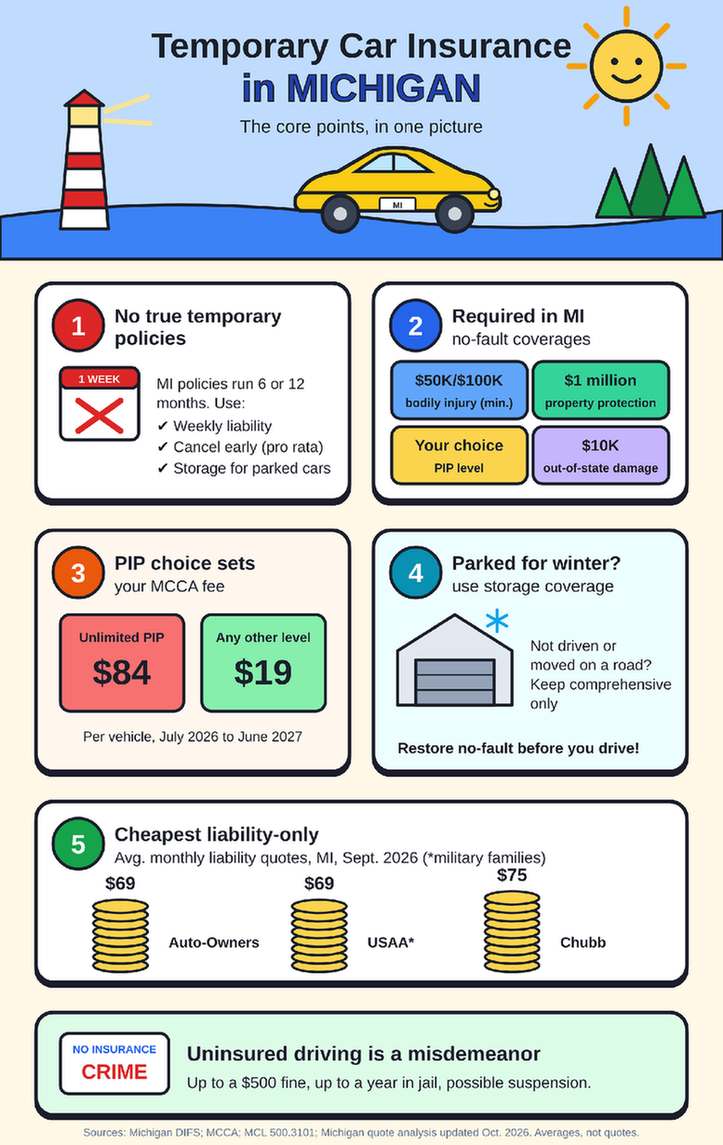
Michigan temporary car insurance at a glance. Sources: Michigan DIFS; MCCA; MCL 500.3020 and 500.3101; Michigan quote analysis updated October 2026. Averages, not quotes.
Frequently asked questions
Can you get temporary car insurance in Michigan?
Not as a short policy term, since most Michigan policies run six or 12 months. But Michigan drivers can buy weekly liability coverage, cancel a standard policy early for a refund that is generally pro rata, use non-owner or rental coverage, or keep comprehensive-only storage coverage on a parked car.
What insurance is required in Michigan?
Michigan requires personal injury protection at a level you choose, $1 million in property protection insurance, and residual liability of at least $50,000 per person and $100,000 per crash, plus $10,000 for property damage in other states. If you do not choose liability limits, the default is $250,000 and $500,000.
Do I get a refund if I cancel early in Michigan?
Generally, yes. MCL 500.3020 requires insurers to refund premium above the pro rata amount when you cancel. An insurer may file a rule for a minimum premium it keeps on a new auto policy, so ask about any minimum retention before you buy.
Can I drop no-fault coverage on a stored car in Michigan?
Yes, if the car will not be driven or moved on a highway. The Michigan Court of Appeals has read MCL 500.3101 as letting owners keep only comprehensive coverage on such a vehicle. You must restore full no-fault coverage before the car goes back on the road.
What is the MCCA fee in Michigan?
The Michigan Catastrophic Claims Association fee is a per-vehicle charge on every policy. From July 1, 2026, through June 30, 2027, it is $84 per vehicle with unlimited PIP and $19 per vehicle for all other PIP levels, including drivers who opt out of PIP medical.
What is the penalty for driving uninsured in Michigan?
Driving without insurance is a misdemeanor with a fine of up to $500, up to one year in jail, or both. A court may suspend your license for 30 days or until you show proof of insurance, and you can be sued personally for a crash you cause.
How much is weekly car insurance in Michigan?
A Michigan real-quote analysis updated November, 2026, put Insurify Car's weekly coverage at an average of $147 a month, or about $34 a week. It covers liability only and excludes collision, comprehensive, SR-22 filings, and rideshare coverage, so compare it with a cancelable standard policy.
What is the cheapest car insurance in Michigan?
In real-quote data current to September 30, 2026, Auto-Owners was cheapest at $69 a month for liability-only and $117 for full coverage. In a separate rate study, Travelers led minimum coverage at $33, and GEICO led full coverage at $82. Your own price depends heavily on your city and PIP choice.
The final word on temporary car insurance in Michigan
Michigan is expensive, but its rules reward careful short-term buyers. For a few weeks of liability, weekly coverage works. For anything longer, or for full coverage, a low-cost standard policy canceled early is usually the best value, since refunds are generally pro rata. For a car parked through winter, switch to storage coverage instead of canceling. Whatever you choose, pick your PIP level on purpose and never drive a car without full no-fault coverage.
NEXT STEPWrite down the dates you need coverage, the car you will drive, and your PIP choice. Price weekly coverage and two low-cost standard policies at the same PIP level, and ask each insurer about minimum retention and storage coverage.
Prices, availability, cancellation terms, and state rules can change. The figures in this article are averages, published rules, and hypothetical calculations, not quotes. This article is for information only and is not legal or financial advice. The publisher is not an insurance company or a licensed insurance agency.
The bottom line on temporary car insurance in Michigan: no policy runs for just a week, but weekly coverage, a cancelable policy with a pro rata refund, and storage coverage for a parked car can match almost any short-term need.
Sources
- Michigan DIFS, Quick Facts (FIS-PUB 0202A) and auto insurance FAQ (accessed October 2026).
- MCL 500.3020, cancellation and refunds (accessed October 2026).
- Warner Norcross + Judd, Meemic Insurance Co. v. Michigan Millers Mutual (October 30, 2015).
- AAIS, MCCA Issues New Assessment Fee for 2026–2027.
- Insurify, Michigan Car Insurance Laws (updated October 13, 2026).
- Insurify, Temporary Car Insurance in Michigan (updated October 17, 2026) and Michigan Car Insurance (updated October 18, 2026).
- MoneyGeek, Cheapest Car Insurance in Michigan (updated October 16, 2026).
- Insurance Information Institute, Uninsured Motorists, citing the Insurance Research Council.
- Insurify, Car Insurance Coverage for Stored Vehicles (November 17, 2025).
- Insurify, Allstate Milewise review, Nationwide, SmartMiles, and Insurify, Mile Auto review (accessed October 2026).
- CarInsurance.com, New Car Grace Period (June 26, 2026).
- Insurify, One-Week Car Insurance (updated September 30, 2026) and First Alert 4, Understanding Rental Car Insurance (June 23, 2026).
- Ohio BMV (BMV 3101), 215 ILCS 5/143.12a, and Pennsylvania Insurance Department, Auto Insurance Guide.