
Temporary Car Insurance In Ohio
Whether you are driving a borrowed car for a summer in Columbus, keeping a project car in a Toledo garage, or covering a car until it sells, finding temporary car insurance in Ohio comes down to a handful of flexible options. Ohio insurers rarely sell policies shorter than six months, but the state has weekly coverage, three pay-per-mile programs, and some of the lowest average prices in the Midwest.
This guide covers Ohio's insurance requirements, how the state actually checks for coverage, the Bureau of Motor Vehicles (BMV) penalties for driving uninsured, every short-term option with 2026 Ohio prices, and a step-by-step plan. Every figure is sourced and dated, and hypothetical examples are labeled.
- No true temporary policies. Ohio policies usually run six or 12 months, but weekly coverage, pay-per-mile, and early cancellation fill the gap.
- Pay-per-mile is strong in Ohio. Mile Auto, Allstate Milewise, and Nationwide SmartMiles all sell here.
- Penalties climb fast. The BMV charges $100, $300, and then $600 to reinstate a license suspended for no insurance.
- Cheapest Ohio coverage: State Farm averaged $35 a month for liability-only and $57 for full coverage in 2026 real-quote data.
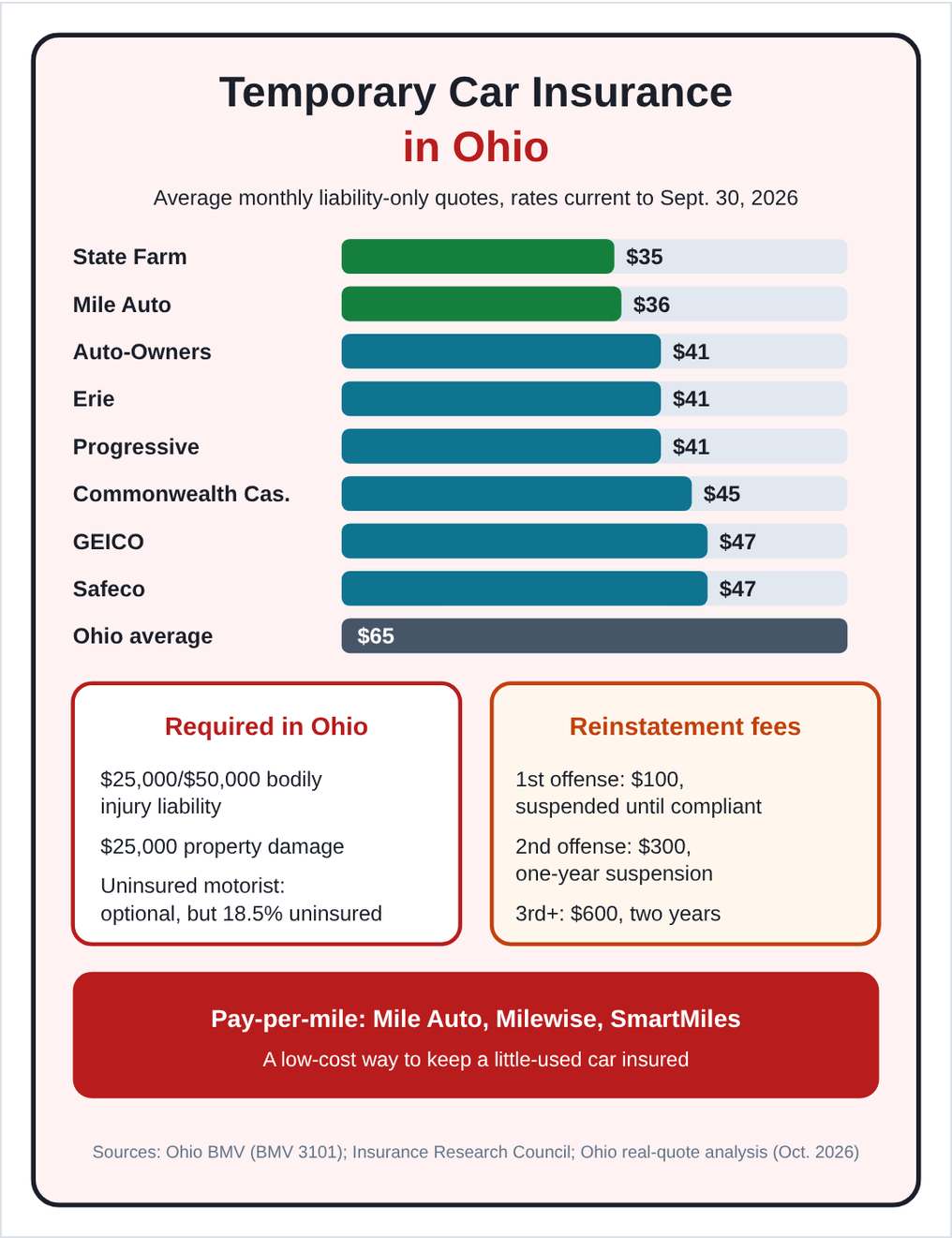
Average monthly liability-only quotes in Ohio from a real-quote analysis updated November, 2026 (rates current to September 30, 2026), plus required coverage and BMV reinstatement fees. Averages, not quotes.
Does temporary car insurance exist in Ohio?
Not as a short policy term. An Ohio quote analysis updated November, 2026, says you typically cannot buy an Ohio car policy for fewer than six months, and that temporary car insurance "doesn't really exist in Ohio." It points instead to weekly coverage, month-to-month payment plans, non-owner insurance, rental coverage, and canceling a six-month policy early, possibly with a fee.
The same analysis lists average monthly liability-only prices from companies with flexible terms: $36 for Mile Auto, $63 for Hugo, $66 for Allstate, and $107 for Insurify Car's weekly coverage.
Short-term car insurance options in Ohio
Option | How it works | Covers your own car? | Best for |
|---|---|---|---|
Weekly coverage (Insurify Car) | State-minimum liability in seven-day increments; cancel anytime | No | A few weeks of driving |
Pay-per-mile insurance | Monthly base rate plus a per-mile charge | Yes, with full coverage | Cars that barely move |
Pay-as-you-go (Hugo) | Prepaid coverage you can pause | Varies by plan | Irregular drivers |
Standard policy, canceled early | Six-month policy canceled when done | Yes, with full coverage | Owners who need collision and comprehensive |
Non-owner insurance | Liability when you drive cars you do not own | No | People who borrow or rent |
Rental car coverage | Bought for the rental period | Yes, with a damage waiver | Short rentals |
Ohio quote analysis updated November 5, 2026. Availability and terms change; confirm for your ZIP code.
Ohio car insurance requirements
Ohio calls its insurance law financial responsibility. According to the Ohio BMV's financial responsibility pamphlet (BMV 3101), every driver and vehicle owner must carry at least:
Ohio required coverage
Coverage | Minimum |
|---|---|
Bodily injury liability, one person | $25,000 |
Bodily injury liability, two or more people | $50,000 |
Property damage liability | $25,000 |
Ohio BMV, Financial Responsibility pamphlet (BMV 3101). A surety bond, BMV bond, deposit with the Treasurer of State, or self-insurance certificate can also satisfy the law, but nearly all drivers use an insurance policy.
Uninsured motorist coverage is not part of Ohio's required minimum, yet it matters more here than in most states. About 18.5% of Ohio drivers were uninsured in 2023, the 12th-highest rate in the country, according to the Insurance Research Council. Short-term policies often leave it out, so ask for it when you get a quote.
How Ohio checks for insurance
Ohio is unusual. It has no electronic system that checks registered vehicles against insurer records. The BMV's random selection program, which once asked thousands of owners a week to prove coverage, ended in 2019, when language in the state transportation budget eliminated it. Today, according to the BMV pamphlet, you must show proof when an officer issues a traffic ticket, at vehicle inspection stops, and at traffic court appearances. You also affirm coverage when you get a license or register a vehicle.
That may change. In March 2026, House Bill 678 received its first hearing in the Ohio House Transportation Committee. It would create a real-time online insurance verification system and require people flagged as uninsured to respond to the BMV. As of this writing, it has not become law.
For short-term buyers, the takeaway is simple: Ohio may not catch a gap right away, but the penalties are severe when it does. A ticket, an inspection stop, or a crash can expose a lapse, and the consequences follow.
Penalties for driving uninsured in Ohio
BMV penalties for failing to show proof of insurance
Offense | License suspension | Reinstatement fee |
|---|---|---|
First | Until requirements are met | $100 |
Second | One year | $300 |
Third or later | Two years | $600 |
Ohio BMV, Financial Responsibility pamphlet (BMV 3101). Every offense also requires high-risk proof of coverage on file for three to five years.
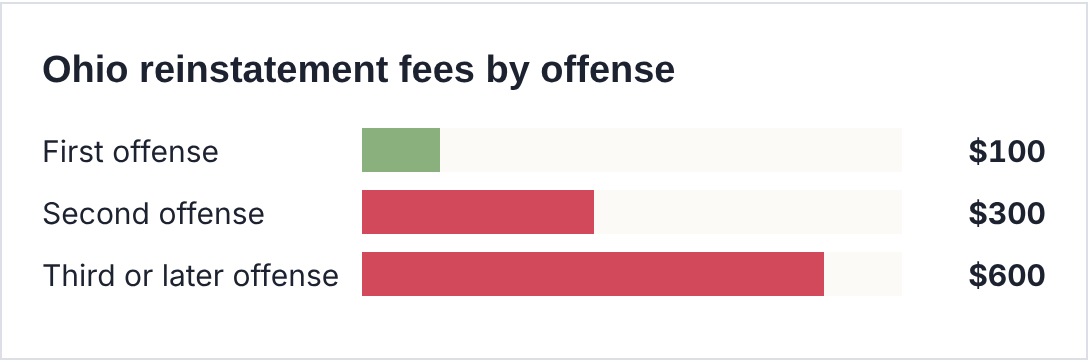
Ohio BMV, Financial Responsibility pamphlet (BMV 3101). Excludes court costs, impound fees, and the higher cost of high-risk coverage.
The pamphlet lists more consequences. You can lose your license plates and registration, and there is a $50 penalty for failing to surrender a license, plates, or registration when required. Driving after a suspension takes effect leads to vehicle immobilization and plate confiscation for at least 30 days on a first offense, or 60 days on a second. On a third or later offense, the vehicle is forfeited, and the owner cannot register a vehicle in Ohio for five years.
Crashes carry their own risk. An uninsured driver in a crash may face a security suspension of two years or more, plus a judgment suspension that lasts until damages are paid.
PRO TIP #1Do not count on Ohio's lack of electronic checks. A single traffic ticket can trigger a suspension, a $100 fee, and three to five years of high-risk filings, which raise the cost of every policy you buy afterward. A low-cost weekly or pay-per-mile policy is far cheaper than a lapse.
What counts as proof of insurance in Ohio
The BMV pamphlet lists several ways to show financial responsibility. Most drivers use an insurance policy or an insurance ID card showing the same coverage. Less common options include a $30,000 surety bond, a BMV bond secured by real estate with at least $60,000 in equity, a BMV certificate showing $30,000 in money or government bonds on deposit with the Treasurer of State, and a self-insurance certificate for owners of at least 26 vehicles.
The pamphlet also notes that signing a financial responsibility statement when you get a license or register a vehicle does not exempt you from showing proof later. Keep your ID card in the car or on your phone, especially on a short-term policy you may have bought recently.
If an uninsured driver hits you in Ohio
With nearly one in five drivers uninsured, Ohio gives crash victims a way to involve the BMV. If you are in a crash involving injury, death, or property damage over $400 and believe the other driver was uninsured, you may file a Motor Vehicle Crash Report (form BMV 3303) within six months. The other driver then gets a chance to show coverage before a suspension begins. Supporting documents can include a repair estimate, confirmation of your own insurance, and details about the other party.
That process can suspend the other driver's license, but it does not pay your bills. Uninsured motorist coverage on your own policy is what pays for your injuries, which is one more reason to add it even to a short-term policy.
Your temporary car insurance options in Ohio
1. Weekly coverage
Insurify Car sells state-minimum liability coverage in Ohio in seven-day increments, and you can cancel anytime. The Ohio analysis says it is underwritten by Bristol West and First Acceptance. The page's headline cites prices as low as $35 a week, while its table lists an average of $107 a month, so get your own quote. Weekly coverage is liability-only and will not pay to repair your own car.
2. Pay-per-mile insurance
Ohio is one of the best states for pay-per-mile insurance. Mile Auto operates in only seven states, and Ohio is one of them. An Insurify review updated October 18, 2026, puts Mile Auto's base rate at about $48 a month plus 8 cents a mile, with mileage reported by a monthly odometer photo instead of a tracking device. Allstate Milewise lists Ohio among its 22 states, and Nationwide SmartMiles does not exclude Ohio.
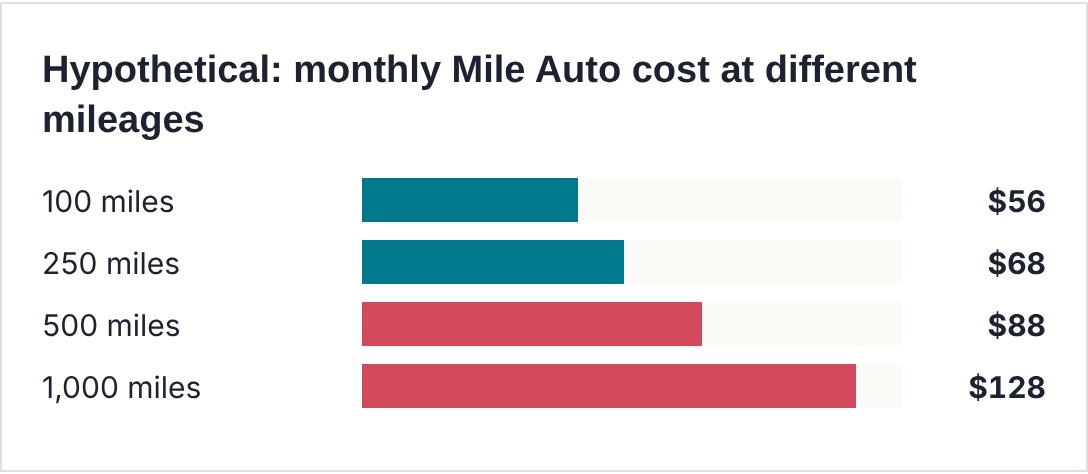
Our calculation: $48 base rate + $0.08 per mile, using the typical figures in an Insurify review updated October 18, 2026. Your rates will differ.
The chart shows why pay-per-mile suits a car that mostly sits. At a few hundred miles a month, the cost stays close to the base rate, and the car stays insured for the whole time.
3. Pay-as-you-go coverage
The Ohio analysis lists Hugo at an average of $63 a month for liability. Hugo's older flex plans stopped selling new policies in March 2025, according to a June 2026 review, so check current terms for your ZIP code.
4. A standard policy canceled early
This is the most reliable way to get full coverage for a few months. Most insurers refund unused premium. With a pro rata refund, you get all of it back; with a short-rate refund, an insurer may keep 10% to 15% of the unearned premium, according to an analysis updated August 31, 2026. The Ohio analysis also warns that canceling early may carry a fee.
Hypothetical: one month on an Ohio liability-only policy
Refund method | Six-month premium | Premium used (1 month) | Penalty | Cost for one month |
|---|---|---|---|---|
Pro rata, no fee | $210 | $35 | $0 | $35 |
Short-rate, 10% of unearned | $210 | $35 | $17.50 | $52.50 |
Short-rate, 15% of unearned | $210 | $35 | $26.25 | $61.25 |
Hypothetical; our calculation, using State Farm's $35 monthly liability-only average in an Ohio real-quote analysis (rates current to September 30, 2026) × 6 = $210. Unearned premium after one month: $175.
5. Non-owner insurance
If you do not own a car but drive borrowed or rented ones, a non-owner policy gives you liability coverage. A national analysis put non-owner coverage at $29 to $74 a month. It does not pay for damage to the car you drive.
6. Rental car coverage
For a short rental, one national analysis put rental car insurance at $9 to $30 a day, and a June 2026 consumer report said counter coverage often costs $30 to $60 a day. Check your own policy and card benefits first, since most cards offer only secondary coverage and usually exclude liability.
7. Being added to someone else's policy
A college student home for the summer or a relative staying a few weeks can often be added to the owner's policy. That may raise the owner's premium, so compare it with weekly or non-owner coverage.
8. The Ohio Automobile Insurance Plan
Drivers who cannot find coverage in the regular market can apply to the Ohio Automobile Insurance Plan, the state's assigned-risk plan, through a licensed agent. It is based in Columbus.
How much does short-term car insurance cost in Ohio?
Ohio is one of the more affordable states. In real-quote data, Ohio averaged $65 a month for liability-only and $117 for full coverage, compared with about $99 and $187 nationally. Two 2026 analyses show the cheapest companies. Study A is a rate study updated November, 2026, using a 40-year-old driver. Study B is a real-quote analysis with rates current to September 30, 2026. Compare each only with itself.
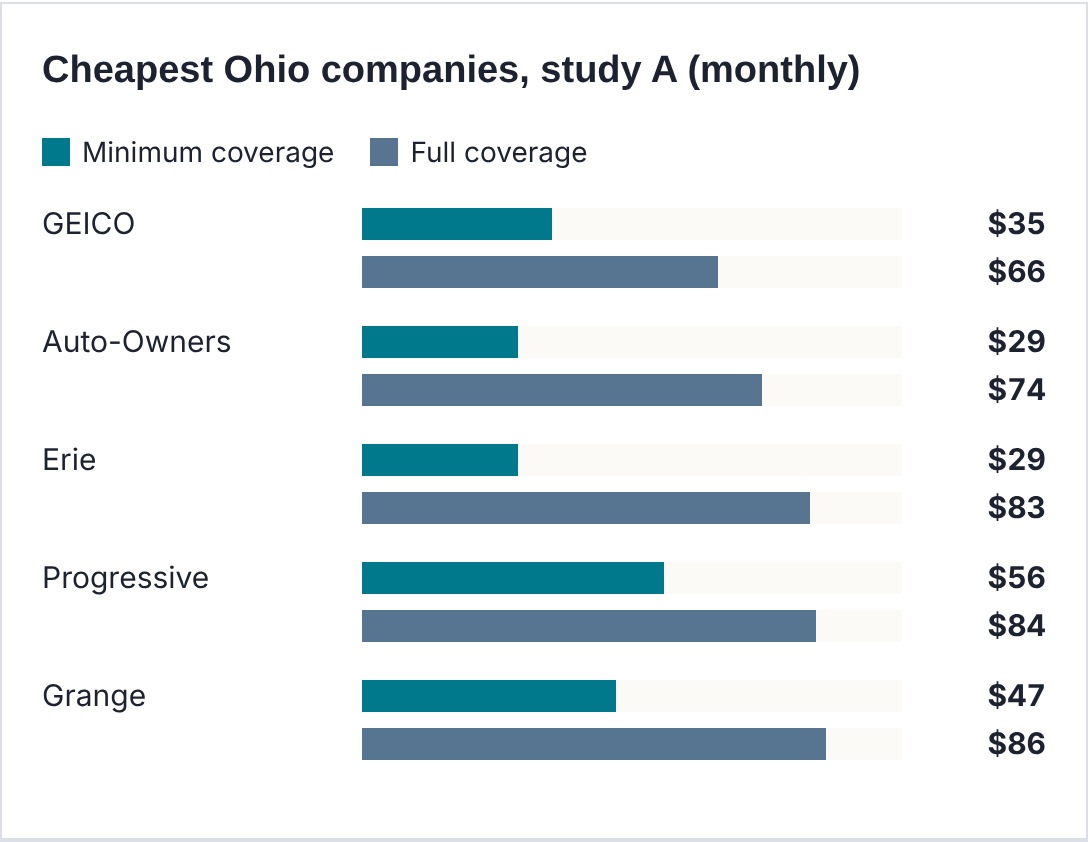
Study A: Ohio rate study updated November, 2026; 40-year-old driver, 2012 Toyota Camry; full coverage at 100/300/100 with a $1,000 deductible.
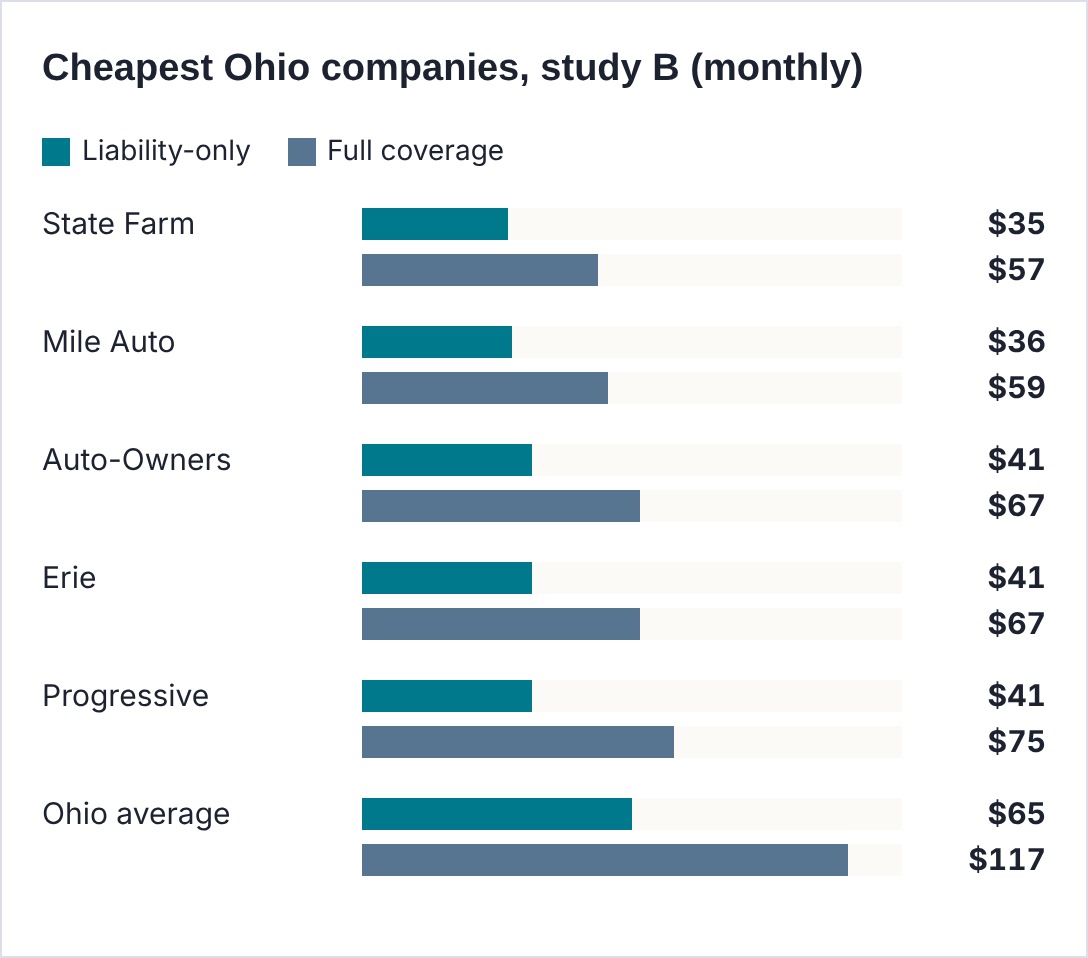
Study B: Ohio real-quote analysis updated November, 2026; rates current to September 30, 2026.
Hypothetical: monthly savings vs. the Ohio average, study B
Coverage | Ohio average | Cheapest company | Savings per month (our calculation) |
|---|---|---|---|
Liability-only | $65 | $35 (State Farm) | $30 |
Full coverage | $117 | $57 (State Farm) | $60 |
Our calculation within study B. Averages, not quotes.
Which short-term option costs least for one month?
Insurify's two Ohio pages make a rough comparison possible for liability-only coverage. For one month, weekly coverage averaged $107, Mile Auto's pay-per-mile coverage averaged $36, and State Farm's standard coverage averaged $35, which you would pay for one month if the insurer refunds the rest pro rata. Weekly coverage costs more, but it needs no long-term commitment and no cancellation call.
Hypothetical: one month of liability-only coverage in Ohio
Option | Average monthly cost | Commitment |
|---|---|---|
Weekly coverage (Insurify Car) | $107 | Seven days at a time |
Pay-per-mile (Mile Auto) | $36 | Ongoing; cancel when done |
Standard policy (State Farm), pro rata refund | $35 | Six-month term; cancel early |
Our calculation uses Insurify's Ohio averages (temporary insurance page updated November, 2026, and Ohio page with rates current to September 30, 2026). Refund terms and fees vary by insurer.
Temporary coverage for special situations in Ohio
College students. Ohio has many large campuses. A student who brings a car to school usually does best on a parent's policy, while a student who borrows or rents may want weekly or non-owner coverage.
Teens. In study A, GEICO had the cheapest full coverage on a family policy at every age from 16 to 25, and the price falls quickly with age. Study B put average teen rates at $139 for liability and $251 for full coverage.
Cheapest full coverage for young drivers on a family policy, study A
Age | Female (GEICO) | Male (GEICO) |
|---|---|---|
16 | $169 | $175 |
17 | $135 | $139 |
18 | $121 | $125 |
20 | $97 | $100 |
22 | $83 | $86 |
25 | $70 | $72 |
Study A: Ohio rate study updated November, 2026; monthly full coverage on a family policy.
Seniors. In Study A, GEICO was cheapest for a 70-year-old at $68 a month for full coverage, followed by Auto-Owners at $77.
Drivers with an OVI or SR-22. Ohio calls drunk driving an OVI. Study A found GEICO cheapest after an OVI at $96 a month for full coverage. Study B put OVI drivers at $132 on average and SR-22 drivers at $120.
Poor credit. Study A found Grange cheapest for drivers with poor credit, at $125 a month for full coverage.
Cheapest full coverage by driver profile, Study A
Driver profile | Cheapest company | Monthly |
|---|---|---|
Clean record, age 40 | GEICO | $66 |
Age 70 | GEICO | $68 |
At-fault accident | GEICO | $81 |
OVI (DUI) | GEICO | $96 |
Poor credit | Grange | $125 |
Study A: Ohio rate study updated November, 2026. Averages, not quotes.
Visitors and new residents. If you are visiting Ohio with your own car, your home-state policy generally travels with you; confirm with your insurer. If you move to Ohio and register a car here, line up a policy that meets Ohio's limits first, then cancel the old one so you do not pay for two.
Buying a car. Many insurers give a grace period of about 7 to 30 days to add a newly bought car, according to a June 2026 rate study, but some give only a few days. Call your insurer before you drive away.
Best temporary option by Ohio situation
Your situation | Best option | Why |
|---|---|---|
Borrowing a car for a few weeks | Weekly or non-owner coverage | Liability without a long policy |
Car that will barely be driven | Pay-per-mile insurance | Stays insured at low cost |
Owning a car for a few months | Standard policy canceled early | Includes full coverage |
Student home for summer | Be added to a parent's policy | No new policy needed |
Short rental | Rental coverage or your own policy | Covers the rental car |
Turned down by insurers | Ohio Automobile Insurance Plan | Assigned-risk coverage |
Storing or selling a car in Ohio
If a car will sit for months, Ohio's lack of electronic checks may tempt you to drop coverage. The safer move is to keep at least a low-cost policy, because the law requires coverage on any vehicle that is driven, and you never know when you may need to move it. Pay-per-mile insurance is the natural fit: in the hypothetical above, 100 miles a month costs about $56 with Mile Auto's typical rates.
If you have a loan or lease, the lender will usually require collision and comprehensive, so ask your insurer about reduced coverage for a stored car. If you are selling, keep the car insured until the title transfers, then cancel and ask how your refund will be calculated.
How Ohio compares with other states
Insurance checks: Ohio vs. other states
State | How coverage is checked | Penalty highlights |
|---|---|---|
Ohio | Traffic tickets, inspection stops, and court; no electronic system | $100, $300, or $600 reinstatement; suspensions up to two years |
Illinois | Electronic checks of registered vehicles | $500 minimum fine; $100 reinstatement |
Pennsylvania | Insurers report cancellations to PennDOT | Three-month suspension or $500 civil penalty |
New York | Insurers report electronically; plates must be surrendered | Daily penalties of $8 to $12 |
Ohio BMV (BMV 3101); Illinois Secretary of State; PennDOT; New York DMV. Summarized.
How to get temporary car insurance in Ohio, step by step
- Decide what you need to cover: your own car, a borrowed car, or a rental.
- Price weekly coverage if you need liability for only a few weeks.
- Get a pay-per-mile quote from Mile Auto, Milewise, or SmartMiles if the car will barely move.
- Get standard quotes from Ohio's cheapest companies, such as State Farm, Auto-Owners, Erie, and GEICO.
- Add uninsured motorist coverage, given Ohio's high uninsured rate.
- Ask about the refund method and any cancellation fee.
- Carry proof of insurance every time you drive.
Questions to ask an Ohio insurer
- Is the refund pro rata or short-rate, and is there a cancellation fee?
- How much does uninsured motorist coverage add?
- Do you offer pay-per-mile or reduced coverage for a stored car?
- Can I get digital proof of insurance right away?
Pros and cons of temporary coverage in Ohio
Pros | Cons |
|---|---|
Low prices; liability from $35 a month on average | No policies shorter than six months |
Three pay-per-mile programs | Weekly coverage is liability-only |
Weekly and pay-as-you-go options | Early cancellation may carry a fee |
No plate surrender when canceling | High uninsured rate makes UM coverage important |
Compare pay-per-mile with weekly before you buy. In the Ohio analysis, Mile Auto averaged $36 a month for liability, while Insurify Car's weekly coverage averaged $107 a month. If you will drive only a little for a month or more, pay-per-mile may cost far less.
Common mistakes to avoid
Assuming no checks means no risk. A traffic ticket or crash can expose a lapse.
Skipping uninsured motorist coverage. Nearly one in five Ohio drivers was uninsured in 2023.
Thinking weekly coverage protects your car. It is liability-only.
Forgetting the refund terms. A short-rate refund can turn a cheap month into an expensive one.
Ignoring the mileage on a pay-per-mile policy. A long road trip adds up at 8 cents a mile, so check the per-mile rate before you travel.
Ohio temporary car insurance at a glance
This illustrated summary pulls together the rules and options covered above.
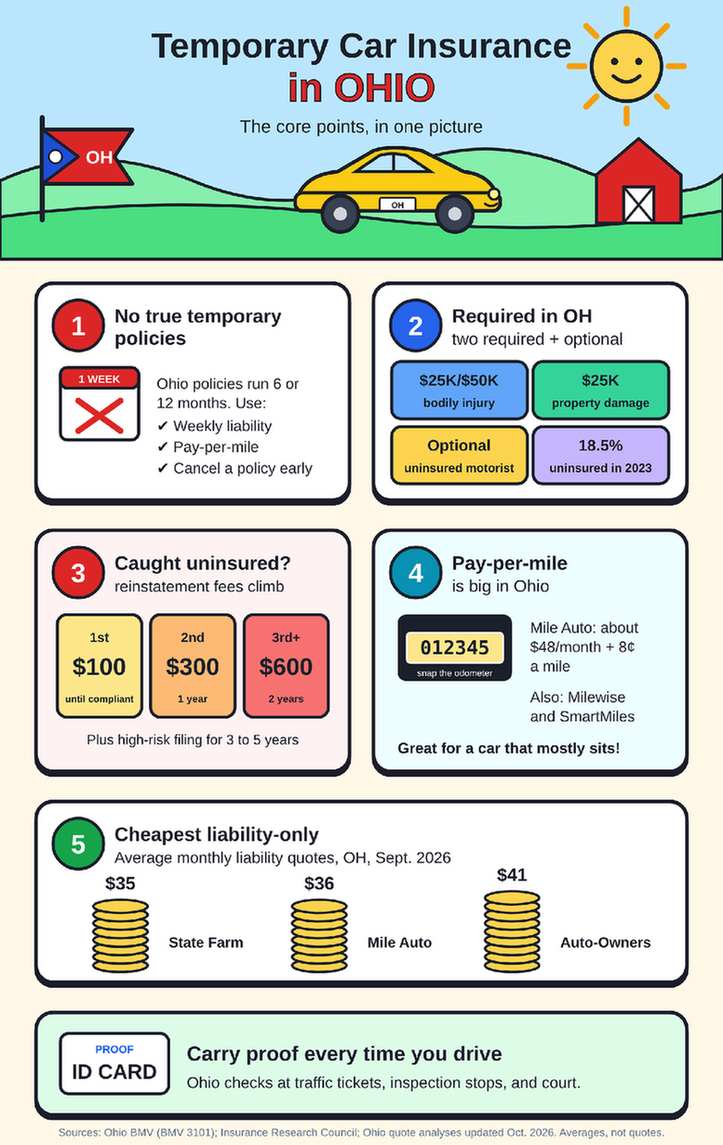
Ohio temporary car insurance at a glance. Sources: Ohio BMV (BMV 3101); Insurance Research Council; Ohio quote analyses updated October 2026. Averages, not quotes.
Frequently asked questions
Can you get temporary car insurance in Ohio?
Not as a short policy term, since Ohio policies usually run six or 12 months. But Ohio drivers can buy weekly liability coverage, use pay-per-mile or pay-as-you-go plans, buy non-owner or rental coverage, or cancel a standard policy early when they no longer need it.
What insurance is required in Ohio?
Ohio requires $25,000 per person and $50,000 per crash in bodily injury liability, plus $25,000 in property damage liability. Uninsured motorist, collision, and comprehensive coverage are not required by the state, though lenders usually require collision and comprehensive on financed cars.
What happens if you drive without insurance in Ohio?
A first offense suspends your license until you meet the requirements and pay a $100 reinstatement fee. A second offense brings a one-year suspension and a $300 fee, and a third brings two years and $600. Each also requires high-risk proof of coverage for three to five years.
Does Ohio check insurance electronically?
No. Ohio ended its random selection program in 2019 and has no electronic verification system. Proof is checked at traffic tickets, inspection stops, and court. House Bill 678, which would create online verification, had its first committee hearing in March 2026 but has not become law.
Is pay-per-mile insurance available in Ohio?
Yes. Mile Auto sells in Ohio, one of only seven states, at a typical base rate of about $48 a month plus 8 cents a mile. Allstate Milewise lists Ohio among its 22 states, and Nationwide SmartMiles does not exclude Ohio. Confirm pricing for your ZIP code.
How much is weekly car insurance in Ohio?
Insurify Car sells weekly state-minimum liability coverage in Ohio. Its Ohio page cites prices as low as $35 a week, while its table lists an average of $107 a month. Because the figures differ, get your own quote and compare it with a monthly policy.
What is the cheapest car insurance in Ohio?
In real-quote data current to September 30, 2026, State Farm was cheapest at $35 a month for liability-only and $57 for full coverage. In a separate rate study, GEICO led full coverage at $66, and Auto-Owners and Erie tied for minimum coverage at $29.
Do I need uninsured motorist coverage in Ohio?
It is not required, but it is worth considering. About 18.5% of Ohio drivers were uninsured in 2023, the 12th-highest rate in the country. Uninsured motorist coverage pays for your injuries when an at-fault driver has no insurance, so ask for a quote with and without it.
The final word on temporary car insurance in Ohio
Ohio gives short-term drivers more choices than most states. For a few weeks of liability, weekly coverage works. For a car that mostly sits, pay-per-mile insurance from Mile Auto, Milewise, or SmartMiles is often the smartest buy. For full coverage over a few months, a low-cost standard policy canceled early is the most reliable route. Whatever you choose, add uninsured motorist coverage and never let a car you drive go uninsured.
NEXT STEPWrite down the dates you need coverage and how many miles you expect to drive. Price a weekly option, a pay-per-mile policy, and two low-cost standard policies, and choose the lowest total cost for your situation.
Prices, availability, cancellation terms, and state rules can change. The figures in this article are averages, published rules, and hypothetical calculations, not quotes. This article is for information only and is not legal or financial advice. The publisher is not an insurance company or a licensed insurance agency.
The bottom line on temporary car insurance in Ohio: policies run at least six months, but weekly, pay-per-mile, and cancelable coverage can match a short need, and they cost far less than the BMV's penalties for a lapse.
Sources
- Ohio BMV, Financial Responsibility pamphlet (BMV 3101) (accessed October 2026).
- Ohio Insurance Agents Association, random verification program eliminated (2019) and A Modern Approach to Ohio's Growing Uninsured Motorist Crisis (2026).
- Insurance Journal, Ohio Bill Would Establish Online Auto Insurance Verification (March 6, 2026).
- Ohio Automobile Insurance Plan (AIPSO) (accessed October 2026).
- Insurify, Temporary Car Insurance in Ohio (updated October 5, 2026) and Ohio Car Insurance (updated October 18, 2026).
- Insurify, Mile Auto review (updated October 18, 2026).
- MoneyGeek, Cheapest Car Insurance in Ohio (updated October 6, 2026).
- Insurance Information Institute, Uninsured Motorists, citing the Insurance Research Council.
- Insurify, Allstate Milewise review and Nationwide, SmartMiles (accessed October 2026).
- OCHO, Hugo Insurance Reviews (June 2026).
- MoneyGeek, Car Insurance Refund (August 31, 2026) and CarInsurance.com, New Car Grace Period (June 26, 2026).
- Insurify, One-Week Car Insurance (updated September 30, 2026) and First Alert 4, Understanding Rental Car Insurance (June 23, 2026).
- Illinois Secretary of State and 215 ILCS 5/143.12a, PennDOT, Insurance Overview, and New York DMV, Auto Liability Insurance.