
Top 10 Cheapest Cars to Insure: Rates, SUVs, EVs & More
Before buying a car, comparing the cost of insuring several models can reveal meaningful differences in your total ownership costs. In one published 2026 full-coverage rate study (Study A), a Honda CR-V averaged $1,932 a year and a Maserati Quattroporte averaged $7,090 for the same hypothetical driver profile—a $5,158 difference. These are sample averages, not individual quotes.
This comparison presents published insurance-rate rankings for cars, SUVs, sedans, minivans, electric vehicles, hybrids and pickup trucks, plus selected teen-driver examples and vehicles with strong safety ratings that older drivers might consider. Because the studies use different samples and coverage assumptions, each category winner is identified within its own study rather than presented as a guaranteed national cheapest vehicle.
KEY TAKEAWAYS
- The Honda CR-V had the lowest annual full-coverage premium in Study A, at $1,932; another study placed the Subaru Crosstrek first. Actual prices depend on the driver, address, vehicle and insurer.
- Small SUVs and crossovers occupied most spots in Study A’s low-premium list, but that does not mean every SUV costs less to insure than every sedan or minivan.
- The cheapest electric car to insure is the Fiat 500e, at $2,447 a year, and the cheapest truck is the Jeep Gladiator, at $2,460, in Study B.
- The Subaru Outback was cheapest among selected vehicles for adding an 18-year-old to a parent’s policy in an Illinois study. The Honda HR-V was inexpensive in the 40-year-old-driver study and earned a 2026 IIHS Top Safety Pick+ award; no cited model-by-model pricing study is specific to seniors.
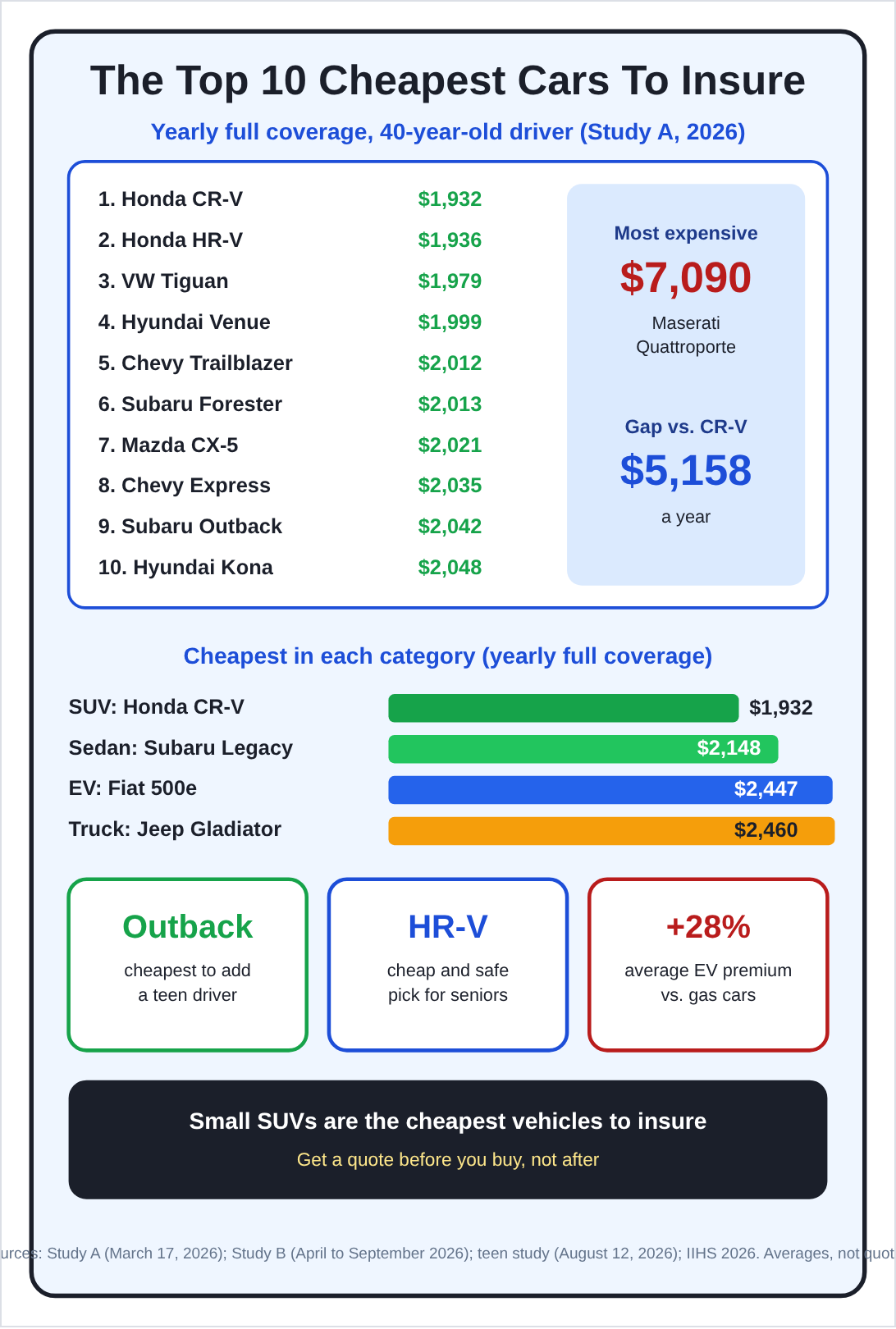
The 10 cheapest vehicles to insure, the cheapest model in each category, and the gap to the most expensive car. Averages for a 40-year-old driver with full coverage, not quotes.
Editorial note: Rankings and rates below belong to the named 2025–2026 studies. The same model can cost more or less with another insurer or driver, and a 2026 safety award is separate from a price ranking.
How we ranked the cheapest cars to insure
Rate studies disagree on which car is cheapest, because each prices a different driver, coverage level, and set of ZIP codes. So we use several studies and name each one. Study A, updated March 17, 2026, priced full coverage with 100/300/100 liability limits and $500 deductibles for a 40-year-old driver with good credit, a clean record, a 12-mile commute, and 10,000 miles a year. Its rankings drive our main top 10 lists. Quotes for commercial vans, specific trims and vehicles no longer sold new may not be directly comparable to a typical private-passenger purchase. Verify the study vehicle and use your own VIN when requesting prices.
Study B is a separate national analysis that uses the same type of 40-year-old driver and coverage, with lists updated from April to September 2026; we use it for electric cars, hybrids, trucks, and a second opinion on cars and SUVs.

Study C, updated August 28, 2025, priced a 40-year-old driver covering about 13,000 miles a year. Study D, updated October 29, 2026, is based on more than 50 million real quotes and covers minivans and sedans. For teens, we use a study updated August 12, 2026, that priced the cost of adding an 18-year-old to a parent’s policy.
For context only, separate national rate studies published full-coverage averages of about $2,361 and $2,237 a year for their respective samples. Those studies did not necessarily price the same driver or coverage as Study A, so subtracting them from a specific car’s Study A premium does not produce a reliable individual saving.
Top 10 cheapest cars to insure
These were the ten lowest-premium models in Study A for its specified driver and full-coverage assumptions. Most are small SUVs or crossovers; one is a full-size van, for which commercial use and underwriting may differ. The ranking is not a guarantee that these models are the ten cheapest for every buyer.
Ten lowest premiums in Study A (same driver and coverage assumptions)
| Rank | Vehicle | Yearly premium | Monthly premium | Type |
|---|---|---|---|---|
| 1 | Honda CR-V | $1,932 | $161 | Compact SUV |
| 2 | Honda HR-V | $1,936 | $161 | Small SUV |
| 3 | Volkswagen Tiguan | $1,979 | $165 | Compact SUV |
| 4 | Hyundai Venue | $1,999 | $167 | Small SUV |
| 5 | Chevrolet Trailblazer | $2,012 | $168 | Small SUV |
| 6 | Subaru Forester | $2,013 | $168 | Compact SUV |
| 7 | Mazda CX-5 | $2,021 | $168 | Compact SUV |
| 8 | Chevrolet Express | $2,035 | $170 | Full-size van |
| 9 | Subaru Outback | $2,042 | $170 | Wagon or SUV |
| 10 | Hyundai Kona | $2,048 | $171 | Small SUV |
Study A: rate study updated March 17, 2026; 40-year-old driver, good credit, clean record, full coverage with 100/300/100 limits and $500 deductibles. Model year not stated. These figures describe the study sample; the Chevrolet Express may be subject to different underwriting when used commercially.
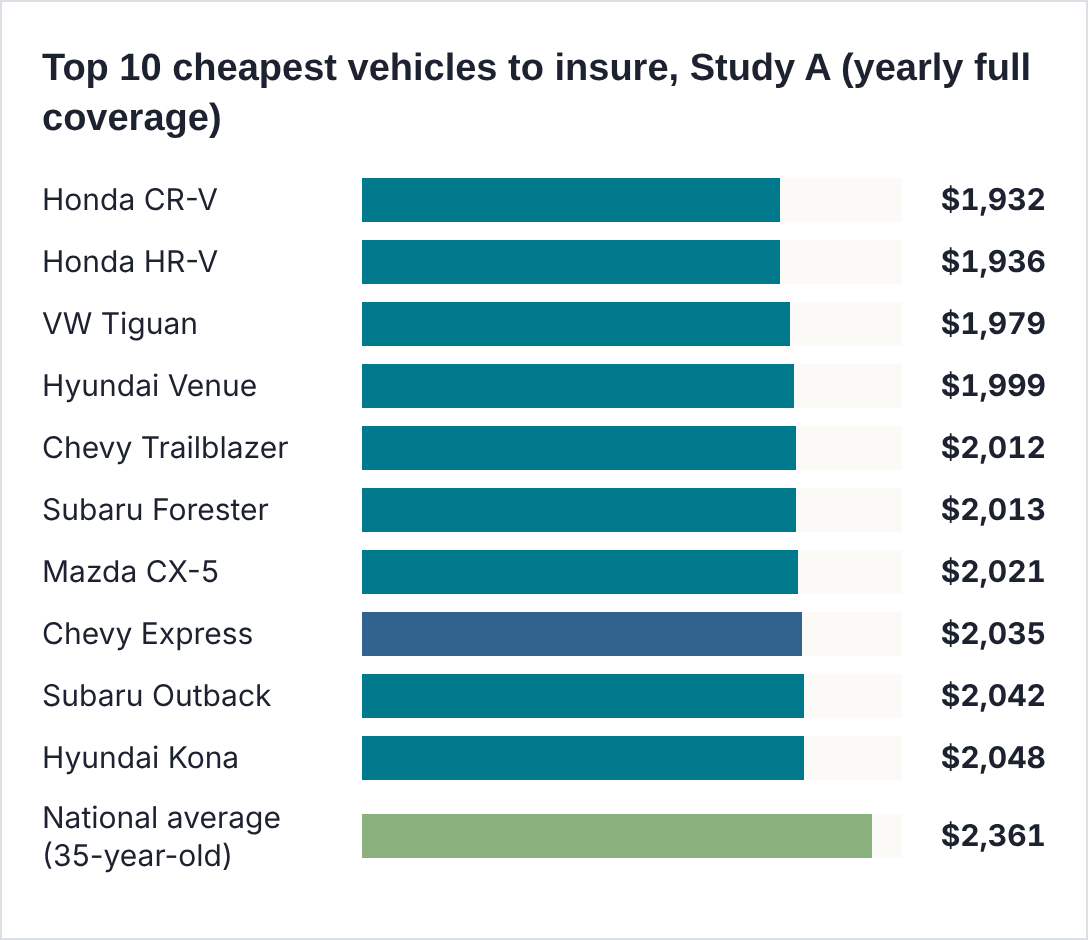
Study A: updated March 17, 2026, 40-year-old driver. National average from a separate rate study updated March 2, 2026, for a 35-year-old driver, shown for context.
Only $116 a year separated the first and tenth entries in Study A. That gap is small enough that a different ZIP code, insurer or trim could change their order. The larger $5,158 difference between the CR-V and Maserati Quattroporte is within Study A’s same driver profile; national-average comparisons drawn from other studies are less directly meaningful.
A closer look at the top 10
The examples below describe the models and relevant considerations. Insurance prices are Study A averages, while safety ratings and theft totals come from separate sources and should not be interpreted as proof of why any individual insurer charges a particular premium.
- Honda CR-V ($1,932/year in Study A). Lowest premium in that sample, but it earned a Poor rating in the IIHS updated moderate-overlap frontal crash test for the 2026 model. The NICB ranked the CR-V ninth by total U.S. vehicle thefts in 2025; that is a count, not a model-specific theft rate.
- Honda HR-V ($1,936/year). Just $4 above the CR-V in Study A. The 2026 model earned an IIHS Top Safety Pick+ award. Compare trim, visibility and occupant protection as well as price.
- Volkswagen Tiguan ($1,979/year). Lowest-priced European-brand model in Study A. Another published study quoted a different average; do not compare the two prices as identical quotes.
- Hyundai Venue ($1,999/year). A smaller SUV with a comparatively low published premium in Study A. Ask the insurer for a price on the exact trim and year.
- Chevrolet Trailblazer ($2,012/year). Included among low-premium SUVs in multiple published samples. Repair and theft costs can vary by year and trim.
- Subaru Forester ($2,013/year). The 2026 model earned an IIHS Top Safety Pick+ award. All-wheel drive and safety features do not automatically guarantee an insurance discount.
- Mazda CX-5 ($2,021/year). Appeared near the top in more than one study and earned 2026 IIHS Top Safety Pick+ recognition. Confirm the specific model year and equipment.
- Chevrolet Express ($2,035/year). The only full-size van on this list. Because these vans can be used commercially, a personal-use quote is not interchangeable with commercial auto coverage.
- Subaru Outback ($2,042/year). A midsize wagon/crossover recognized by IIHS in 2026. A separate Illinois study also found it relatively inexpensive among the selected models when adding an 18-year-old to a parent’s policy.
- Hyundai Kona ($2,048/year). Completed Study A’s ten lowest-priced vehicles. The qualifying 2026 Kona earned the IIHS Top Safety Pick+ award; the Kona Electric is priced separately.
Lowest-premium vehicle in Study A: Honda CR-V
The Honda CR-V was the lowest-premium model in Study A, at $1,932 per year ($161 per month). It also appeared among the less expensive models in several other studies, though rankings and sample assumptions differed. One important safety qualification: IIHS rated the 2026 CR-V Poor in the updated moderate-overlap frontal crash test, and it did not earn a 2026 Top Safety Pick award.
If a Top Safety Pick+ award is an important purchasing criterion, the 2026 Honda HR-V, Subaru Forester and Mazda CX-5 are alternatives recognized by IIHS. The HR-V cost $4 more annually than the CR-V in Study A; that $4 is not a reliable prediction of the gap on a personal quote.
How the top picks compare across studies
Cheapest vehicles in four 2025 to 2026 studies
| Rank | Study A | Study B | Study C | Study D |
|---|---|---|---|---|
| 1 | Honda CR-V | Subaru Crosstrek | Mazda CX-5 | Subaru Forester |
| 2 | Honda HR-V | Jeep Wrangler | Honda CR-V | Subaru Outback |
| 3 | VW Tiguan | Honda CR-V | Hyundai Kona | Subaru Crosstrek |
| 4 | Hyundai Venue | Subaru Outback | Subaru Outback | Subaru Ascent |
| 5 | Chevy Trailblazer | VW Tiguan | Subaru Crosstrek | Honda Passport |
Study A: March 17, 2026. Study B: May 5, 2026, $2,299 to $2,381 a year for its top 10. Study C: August 28, 2025, $1,912 to $1,950. Study D: October 29, 2026, $100 to $113 a month.
The Honda CR-V, Subaru Forester, Subaru Outback and Mazda CX-5 recur across published low-cost-vehicle rankings, but not in the same order or necessarily within the top ten of every sample. Use this overlap to create a shortlist, not to assume one model will be cheapest with every insurer.
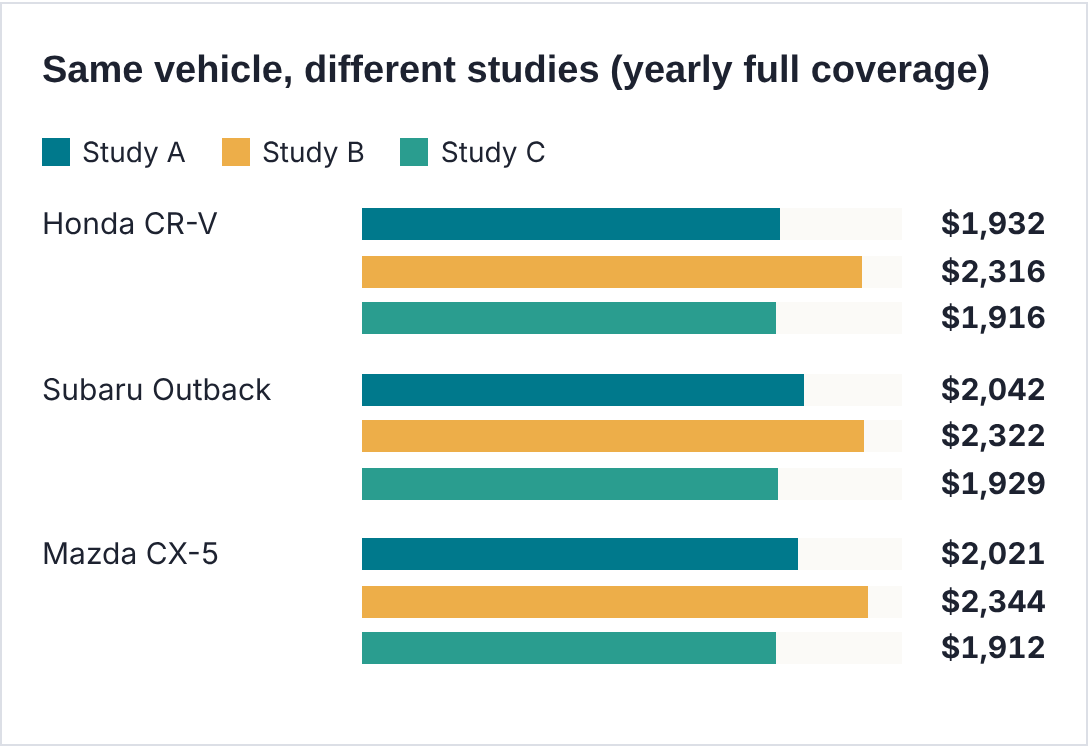
Study A: March 17, 2026. Study B: May 5, 2026. Study C: August 28, 2025. Compare each study only with itself.
Top 10 cheapest SUVs to insure
Small SUVs and crossovers were prominent in the lower-priced vehicles in the studies reviewed, but insurance prices depend on claims, repair costs, vehicle year, location and driver characteristics. The category averages shown below are from a particular study and should not be generalized to every sedan or SUV.
Top 10 cheapest SUVs to insure, two studies
| Rank | Study A SUV | Yearly | Study B SUV | Yearly |
|---|---|---|---|---|
| 1 | Honda CR-V | $1,932 | Subaru Crosstrek | $2,299 |
| 2 | Honda HR-V | $1,936 | Jeep Wrangler | $2,307 |
| 3 | VW Tiguan | $1,979 | Honda CR-V | $2,316 |
| 4 | Hyundai Venue | $1,999 | VW Tiguan | $2,329 |
| 5 | Chevy Trailblazer | $2,012 | Mazda CX-5 | $2,344 |
| 6 | Subaru Forester | $2,013 | VW Taos | $2,362 |
| 7 | Mazda CX-5 | $2,021 | Honda HR-V | $2,376 |
| 8 | Hyundai Kona | $2,048 | Subaru Forester | $2,377 |
| 9 | Hyundai Tucson | $2,062 | Chevy Trailblazer | $2,381 |
| 10 | VW Taos | $2,064 | Mazda CX-30 | $2,381 |
Study A: March 17, 2026. Study B: SUV list updated September 16, 2026; Study B’s average SUV premium was $2,976 a year. Both use a 40-year-old driver with full coverage and $500 deductibles.
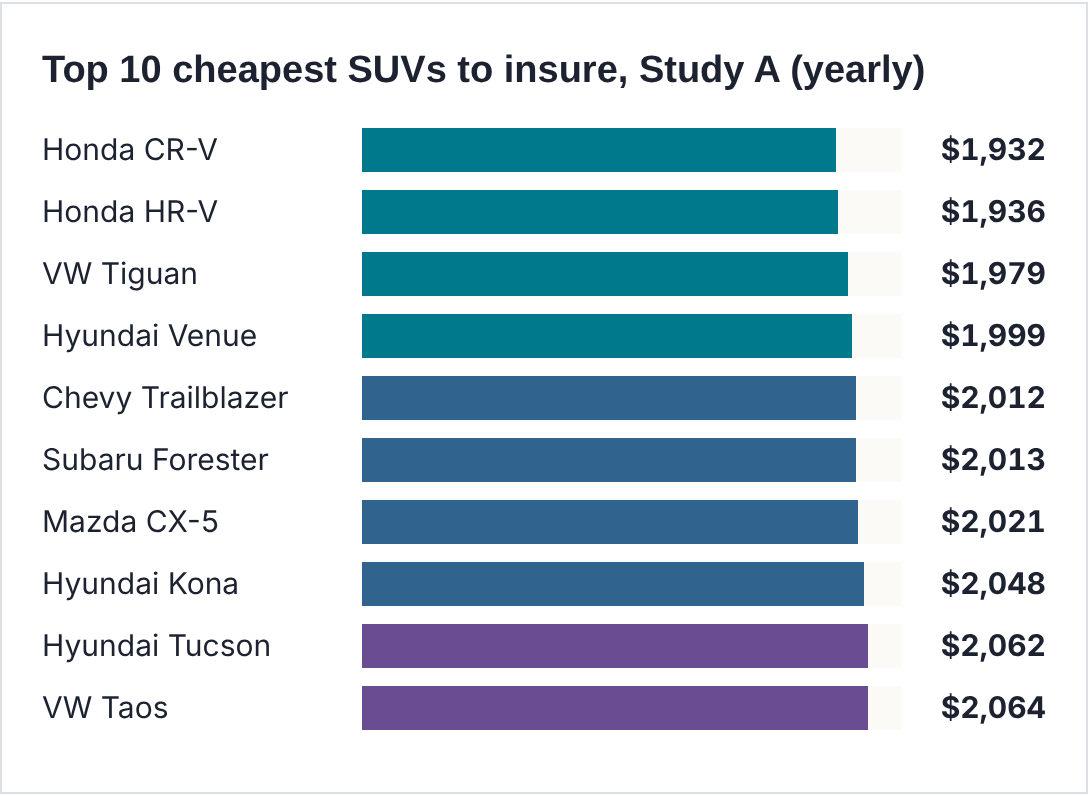
Study A: updated March 17, 2026; 40-year-old driver; full coverage.
The Honda CR-V led the SUV sample in Study A at $1,932 a year; Study B instead put the Subaru Crosstrek first at $2,299, ahead of the CR-V at $2,316. Study B reported category averages of about $2,976 for SUVs and $3,781 for sedans, but the two vehicle groups may have different model-year and price mixes. That does not establish that SUVs are uniformly cheaper to insure.
Larger SUVs cost more. In Study A, the next 10 cheapest SUVs included the Subaru Crosstrek at $2,064, the Toyota Corolla Cross at $2,066, the Kia Sportage at $2,069, the Honda Pilot at $2,076, and the Toyota RAV4 at $2,085, all still below the national average.
Small, midsize, and large SUVs
SUV size affects weight, repair costs and potential damage to other road users, but size alone does not determine the premium. Insurers evaluate the individual model and policyholder, and the lowest-priced vehicles in Study A happened to be mostly small or compact SUVs.
Midsize three-row SUVs such as the Honda Pilot, at $2,076, still cost less than the national average, but large luxury SUVs cost far more. If you need three rows, compare the Pilot and the Subaru Ascent, which ranked fourth in Study D at $109 a month.
Cheapest sedans and minivans to insure
Sedans generally cost more to insure than small SUVs, but some are still bargains. The Subaru Legacy was the cheapest sedan to insure in three separate studies.
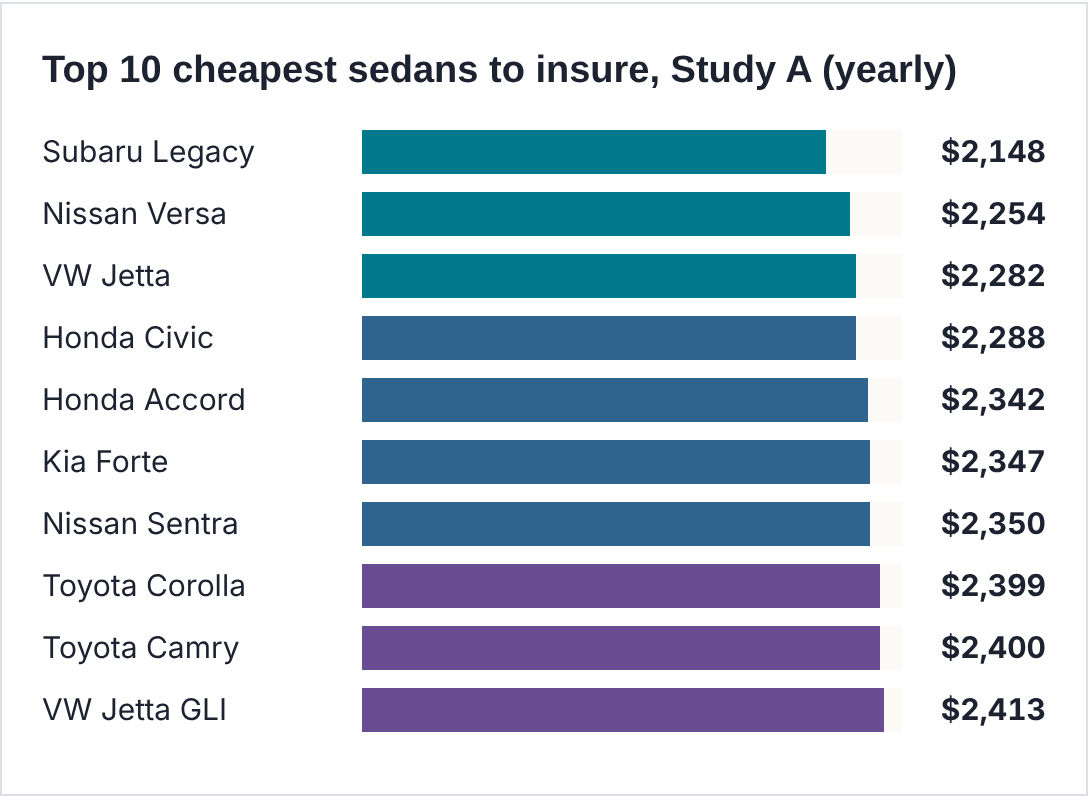
Study A: updated March 17, 2026; 40-year-old driver; full coverage with $500 deductibles.
The Subaru Legacy had the lowest sedan premium in Study A, at $2,148 a year, but Subaru discontinued the Legacy after the 2025 model year; it is not a current new-car option in the U.S. Honda Civic and Toyota Corolla are alternatives with published rate estimates in the same study. Do not attribute any one sedan’s premium entirely to theft without a comparable theft-rate analysis for the exact vehicle.
Cheapest minivans to insure, Study D (monthly)
| Rank | Minivan | Monthly premium |
|---|---|---|
| 1 | Chrysler Voyager | $113 |
| 1 (tie) | Honda Odyssey | $113 |
| 3 | Chrysler Pacifica | $116 |
| 4 | Kia Carnival | $119 |
| 5 | Toyota Sienna | $123 |
Study D: updated October 29, 2026, based on more than 50 million real quotes; driver profile not stated.
Minivans are some of the cheapest family vehicles to insure. The Chrysler Voyager and Honda Odyssey tied for cheapest at $113 a month in Study D, and the Voyager also ranked No. 6 overall in Study C, at $1,933 a year. Insurance research groups note that minivans and wagons tend to have fewer claims, in part because they appeal to less aggressive drivers.
Across these samples, the Honda Odyssey and Chrysler Voyager had relatively low premiums for minivans. They are useful quote candidates, but their rank in a study does not establish that they will be least expensive, or safer than all alternatives, for any particular family.
Ten lower-premium electric cars in Study B
Electric vehicles can cost more to insure because of model price, repair procedures, parts and claim severity. However, the difference depends on which models are compared and should not be assumed to hold for every EV and gasoline car.
Top 10 cheapest electric cars to insure, Study B
| Rank | Electric vehicle | Yearly premium | Monthly premium |
|---|---|---|---|
| 1 | Fiat 500e | $2,447 | $204 |
| 2 | Hyundai Kona Electric | $2,544 | $212 |
| 3 | Kia Niro EV | $2,654 | $221 |
| 4 | Nissan Leaf | $2,735 | $228 |
| 5 | Toyota bZ4X | $2,768 | $231 |
| 6 | Chevrolet Equinox EV | $2,772 | $231 |
| 7 | Subaru Solterra | $2,818 | $235 |
| 8 | Mini Countryman Electric | $2,824 | $235 |
| 9 | Ford Mustang Mach-E | $3,001 | $250 |
| 10 | Nissan Ariya | $3,040 | $253 |
Study B: EV list updated April 17, 2026; 40-year-old driver; full coverage with 100/300/100 limits and $500 deductibles; 10,000 miles a year.
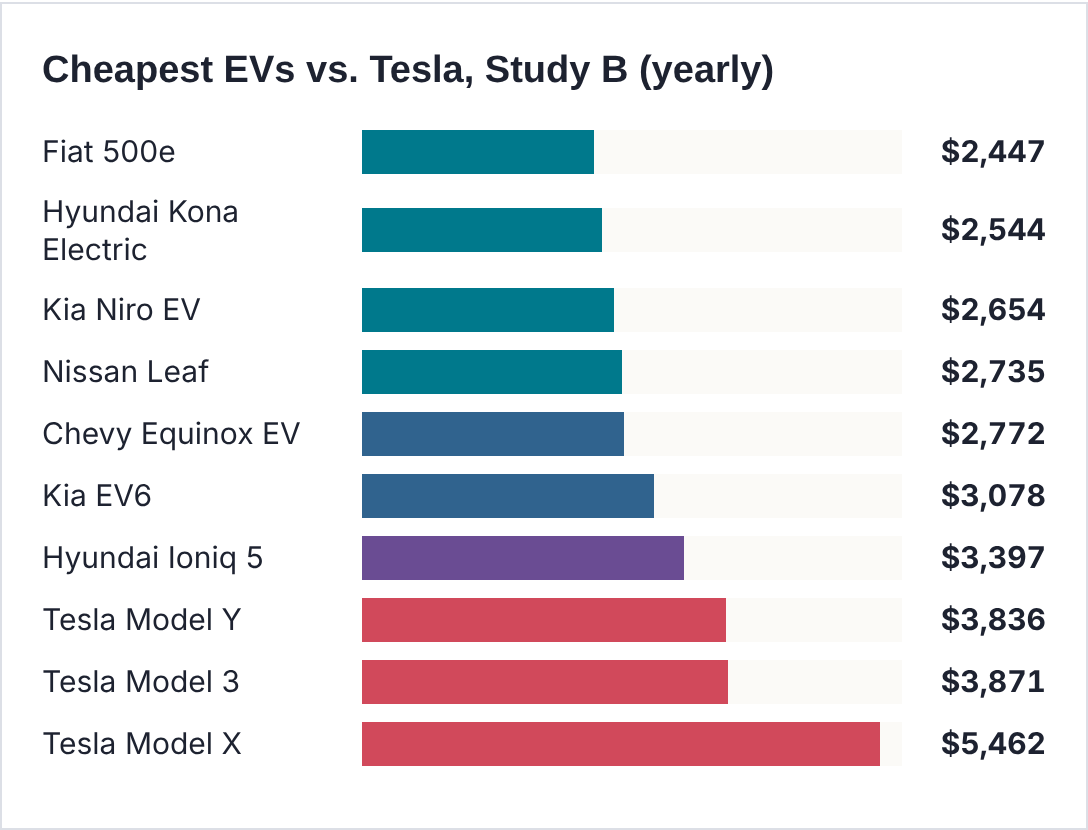
Study B: updated April 17, 2026; 40-year-old driver; full coverage.
Within Study B’s published EV sample, the Fiat 500e had the lowest estimated full-coverage premium at $2,447 a year, followed by the Hyundai Kona Electric ($2,544) and Kia Niro EV ($2,654). Vehicle availability, model year and discounts differ, so obtain a quote for the specific EV you can actually purchase.
Other studies rank EVs differently. In a quote-based study updated October 29, 2026, the Hyundai Ioniq 5 was cheapest at $187 a month, followed by the Nissan Leaf at $196 and the Chevy Bolt EV at $203. Another study updated the same day put the Chevy Equinox EV first at $2,512 a year.
The cheapest EVs at a glance
The Fiat 500e is a small city-oriented EV, but a lower sticker price does not by itself explain its insurance ranking. The Hyundai Kona Electric and Kia Niro EV are alternative models in the same study; differences in repair networks, claims and equipment should be checked with insurers rather than assumed.
The Nissan Leaf, Toyota bZ4X and Subaru Solterra appeared in Study B’s list with premiums below $2,820 annually. Their repair and replacement costs may change by model year and location; quotes should use the exact vehicle and coverage.
At the other end, Teslas and luxury EVs cost the most. The Tesla Model X averaged $5,462 a year in Study B, and the Audi e-tron GT $6,413, about two and a half times the Fiat 500e.
How much more do EVs cost to insure?
The Q2 2026 repair-severity figures show a smaller average claim-cost difference between repairable battery-electric and gasoline vehicles than in some earlier periods. That does not prove that every EV insurance premium, or the overall premium gap, is shrinking.
Should you buy an EV to save money?
Fuel, charging, maintenance, depreciation, purchase price and insurance all affect the total cost of an EV. The Fiat 500e, Kona Electric, Niro EV and Leaf were among the lower-premium electric models in Study B, but that alone is not sufficient to recommend buying any particular vehicle.
Older research from the Highway Loss Data Institute also found that EVs had about 20% fewer collision claims than their gas twins, though each claim cost slightly more, so the extra premium is mostly about repair costs, not riskier drivers.
Cheapest hybrids to insure
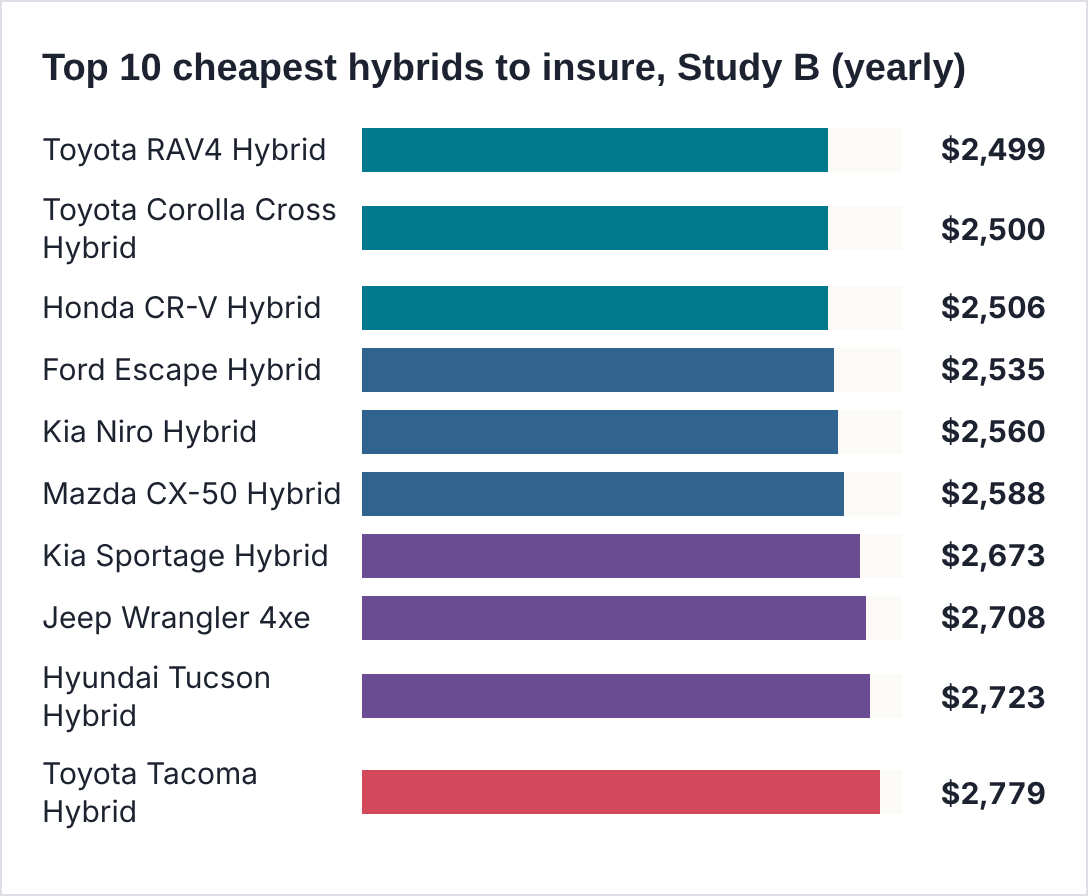
Study B: hybrid list updated September 3, 2026; 40-year-old driver; full coverage. Average hybrid premium $2,907 a year.
In Study B’s sampled models, the average hybrid premium was close to the gasoline-vehicle average. The Toyota RAV4 Hybrid was listed at $2,499 annually, only $85 more than the gas RAV4 in the same source. Those results do not prove equal premiums for every hybrid or trim.
Ten lower-premium pickup trucks in Study B
Study B reported averages of about $2,892 for pickups, $2,976 for SUVs and $3,781 for sedans in its sampled vehicles. Because those categories may have different model mixes, the result should not be read as a universal advantage for trucks.
Top 10 cheapest pickup trucks to insure, Study B
| Rank | Truck | Yearly premium | Monthly premium |
|---|---|---|---|
| 1 | Jeep Gladiator | $2,460 | $205 |
| 2 | Ford Maverick | $2,488 | $207 |
| 3 | Nissan Frontier | $2,539 | $212 |
| 4 | Toyota Tacoma | $2,542 | $212 |
| 5 | Chevrolet Colorado | $2,546 | $212 |
| 6 | Honda Ridgeline | $2,547 | $212 |
| 7 | GMC Canyon | $2,558 | $213 |
| 8 | Ford Ranger | $2,564 | $214 |
| 9 | Hyundai Santa Cruz | $2,613 | $218 |
| 10 | Ram 1500 | $2,691 | $224 |
Study B: truck list updated August 12, 2026; 40-year-old driver; full coverage with 100/300/100 limits and $500 deductibles.
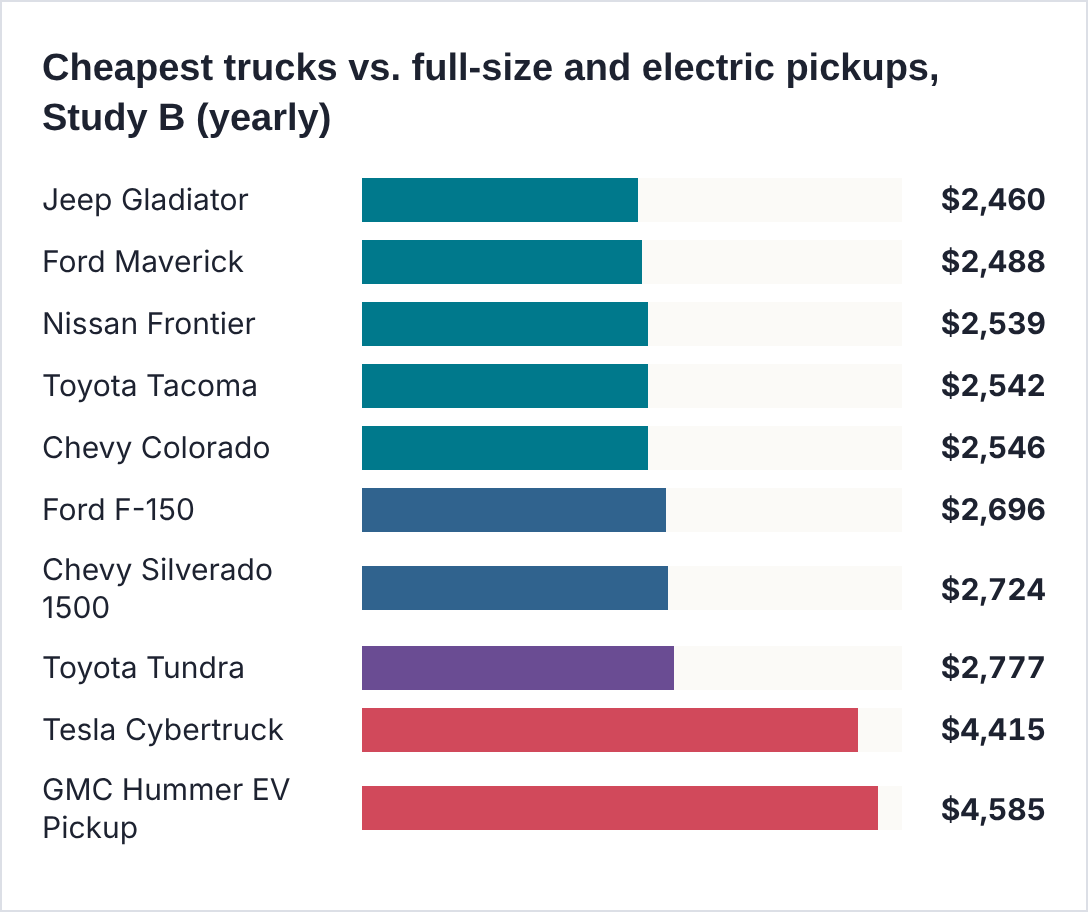
Study B: updated August 12, 2026; 40-year-old driver; full coverage.
The Jeep Gladiator had the lowest pickup premium in Study B at $2,460 per year, with the Ford Maverick next at $2,488. Nissan Frontier, Toyota Tacoma and Chevrolet Colorado also ranked toward the lower end of that study, but no one pickup is guaranteed to be cheapest across insurers and states.
The cheapest trucks at a glance
Within Study B, the Jeep Gladiator cost $2,460 annually for full coverage; the Ford Maverick cost $2,488, and both had separate liability-only estimates. Compare all coverage types and actual deductibles before ranking offers.
Study B put the Nissan Frontier and Toyota Tacoma at $2,539 and $2,542 for full coverage. Liability-only rankings differed, illustrating why the coverage level needs to be specified when naming a cheapest truck.
Compact trucks vs. full-size trucks
Smaller pickups were prominent among the lower-priced trucks in Study B, while some full-size and heavy-duty vehicles cost more. These patterns depend on repair costs, usage, trim and the insurer’s loss experience; they are not a rule for every pickup.
Cheapest truck quotes from one low-cost insurer (monthly)
| Rank | Truck | Full coverage | Liability only |
|---|---|---|---|
| 1 | Nissan Frontier | $86 | $41 |
| 2 | Chevrolet Colorado | $87 | $42 |
| 3 | Ford F-Series | $88 | $42 |
| 4 | Toyota Tacoma | $90 | $43 |
| 5 | Toyota Tundra | $92 | $44 |
Quote-based truck study updated October 29, 2026. These are USAA quotes, which are available only to military members, veterans, and their families; the same study’s national truck average was $188 a month for full coverage.
The quote data shows that your insurer matters as much as your truck. For military families with USAA, a Nissan Frontier cost just $86 a month for full coverage, less than half the national truck average.
Truck buyers should also watch theft. The Chevrolet Silverado 1500 was the fourth most stolen vehicle in America in 2025, and the Ford F-150 was seventh, according to the National Insurance Crime Bureau, and theft risk feeds directly into comprehensive premiums.
Cheapest cars to insure for teens
Teen drivers pay more than any other group, so the car they drive matters enormously. The study we used for teens added an 18-year-old to a 45-year-old parent’s full coverage policy in Illinois and measured the extra cost for each of 24 teen-suitable cars priced around $30,000 or less with good crash ratings.
Cheapest cars to insure for teens
| Rank | Car | Added monthly cost (new) | Added yearly cost | Added monthly cost (2017 used) |
|---|---|---|---|---|
| 1 | Subaru Outback | $435 | $5,220 | $377 |
| 2 | Honda CR-V | $438 | $5,256 | $376 |
| 3 | Mazda CX-5 | $439 | $5,268 | $381 |
| 4 | Honda HR-V | $447 | $5,364 | $391 |
| 5 | Hyundai Kona | $449 | $5,388 | Not listed |
Teen study updated August 12, 2026; 18-year-old added to a 45-year-old parent’s full coverage policy; Illinois averages. Yearly figures are our calculation. The study published only its five cheapest models.
The Subaru Outback had the lowest additional premium among the 24 selected vehicles in one Illinois study of an 18-year-old added to a parent’s policy, at $435 per month. A 2017 Outback cost $377 per month to add in that study, while a 2017 Honda CR-V cost $376. Neither result establishes the cheapest car for every teenager nationwide.
Cheapest used cars to insure for an 18-year-old on their own policy
| Rank | Used car | Yearly full coverage |
|---|---|---|
| 1 | 2016 Honda CR-V | $6,032 |
| 2 | 2016 Mazda CX-5 | $6,061 |
| 3 | 2017 Honda CR-V | $6,120 |
| 4 | 2018 Mazda CX-5 | $6,495 |
| 5 | 2017 Toyota RAV4 | $6,535 |
| 6 | 2015 Toyota Prius | $6,957 |
| 7 | 2018 Kia Sportage | $7,068 |
| 8 | 2019 Chevrolet Equinox | $7,203 |
| 9 | 2016 Honda Civic | $7,279 |
| 10 | 2017 Toyota Corolla | $7,285 |
Teen rate study updated June 1, 2026; 18-year-old male; full coverage with 100/300/100 limits and $500 deductibles.
Adding a teen to an eligible parent or household policy was cheaper than a separate policy in the study cited: for an 18-year-old male, $3,865 versus $5,565 per year, respectively. Eligibility to be listed on a household policy and the resulting premium depend on the insurer and household circumstances.
Safety should guide the choice too. The Insurance Institute for Highway Safety and Consumer Reports publish a list of safe used vehicles for teens, updated May 27, 2026, which includes the Mazda CX-5 from 2018 to 2025 at a median of about $13,100 and the Subaru Forester from 2019 to 2025 at about $15,900. The IIHS advises families to avoid high-horsepower engines, very small cars under 2,750 pounds, and large SUVs and pickups, and to get an insurance quote before buying.
How much a teen adds to a family policy
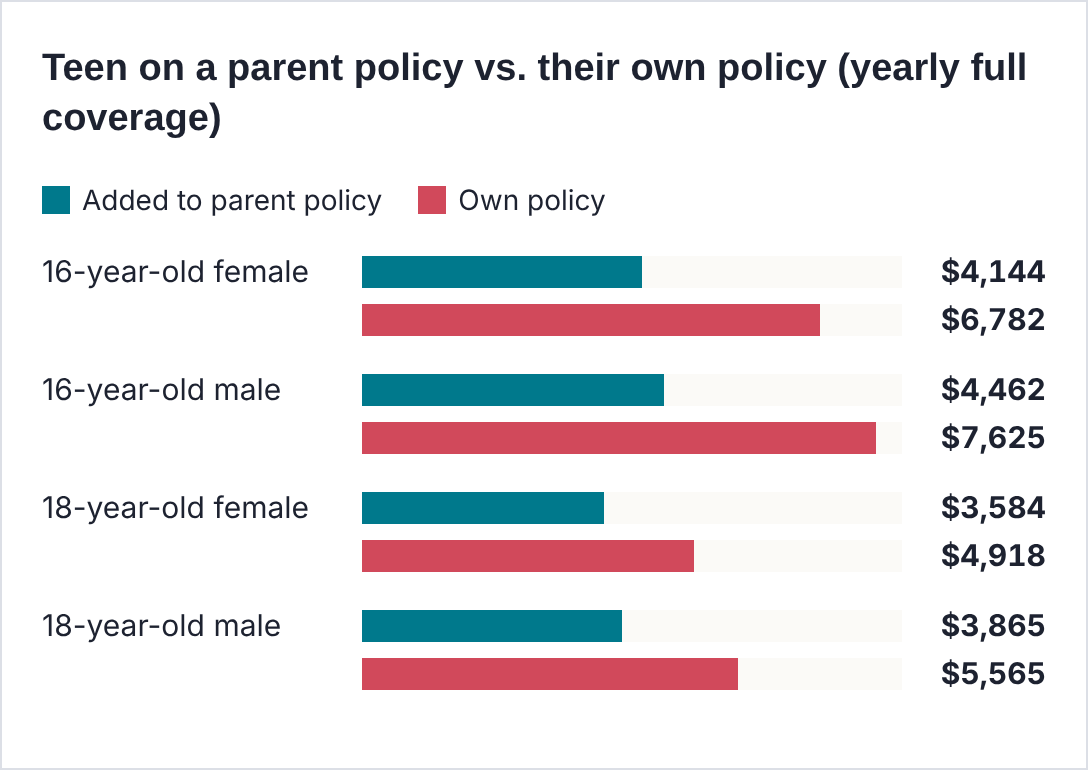
Teen rate study updated June 1, 2026; full coverage with 100/300/100 limits and $500 deductibles.
The difference between a separate policy and an eligible family policy varied by age in the cited study. These illustrations cannot be added to the Illinois car-model table, which used different vehicles and driver assumptions. Driver training and good-student discounts may reduce the premium, subject to carrier and state conditions.
IIHS and Consumer Reports picks for teens (examples)
| Category | Example vehicles | Typical used price |
|---|---|---|
| Best Choices (under $20,000) | Mazda CX-5 2018 to 2025 | About $13,100 |
| Best Choices (under $20,000) | Subaru Forester 2019 to 2025 | About $15,900 |
| Best Choices (under $20,000) | Toyota Camry 2019 to 2025 | About $17,300 |
| Good Choices (under $10,000) | Honda Civic 2014 to 2025 | About $8,100 |
| Good Choices (under $10,000) | Subaru Impreza | About $8,000 |
IIHS and Consumer Reports, safe vehicles for teens (May 27, 2026); prices are median retail values from April 2026.
Lower-premium vehicles with strong safety ratings for older shoppers
No senior-specific model ranking was identified among the studies cited here. The table combines the premiums for a 40-year-old driver in Study A with 2026 IIHS Top Safety Pick+ awards. It is a vehicle shortlist for older shoppers interested in safety and comparative premium levels, not a ranking of rates actually paid by senior drivers.
2026 IIHS-awarded vehicles with premiums quoted for a 40-year-old driver
| Rank | Car | Study A yearly premium | IIHS 2026 award |
|---|---|---|---|
| 1 | Honda HR-V | $1,936 | Top Safety Pick+ |
| 2 | Subaru Forester | $2,013 | Top Safety Pick+ |
| 3 | Mazda CX-5 | $2,021 | Top Safety Pick+ |
| 4 | Subaru Outback | $2,042 | Top Safety Pick+ |
| 5 | Hyundai Kona | $2,048 | Top Safety Pick+ |
| 6 | Hyundai Tucson | $2,062 | Top Safety Pick+ |
| 7 | Mazda CX-30 | $2,086 | Top Safety Pick+ |
Study A: March 17, 2026, priced for a 40-year-old driver; seniors’ prices will differ, but the ranking shows which models cost less to insure. IIHS 2026 Top Safety Pick awards (accessed October 30, 2026).
The Honda HR-V had the lowest premium among the IIHS Top Safety Pick+ vehicles selected from Study A, at $1,936 a year for a 40-year-old driver. Its 2026 safety award is independently verifiable, but a senior’s insurance premium and practical needs—entry height, seat adjustability and visibility—must be assessed separately.
Safety ratings matter for older drivers because injury risk rises with age. According to the IIHS, drivers aged 80 to 84 had 5.3 fatal crashes per 100 million miles in 2022, more than double the 2.5 average for all ages, mainly because older people are more fragile. A vehicle with top crash-test results helps protect against that risk, and the safest small SUVs also happen to be among the cheapest to insure.
Lowest-premium models by category and study
Lowest-premium model within each comparison group (different studies)
| Category | Overall cheapest | Price | Study |
|---|---|---|---|
| All vehicles | Honda CR-V | $1,932 a year | Study A |
| SUVs | Honda CR-V | $1,932 a year | Study A |
| Sedans | Subaru Legacy | $2,148 a year | Study A |
| Minivans | Chrysler Voyager and Honda Odyssey (tie) | $113 a month | Study D |
| Electric cars | Fiat 500e | $2,447 a year | Study B |
| Hybrids | Toyota RAV4 Hybrid | $2,499 a year | Study B |
| Pickup trucks | Jeep Gladiator | $2,460 a year | Study B |
| Teens | Subaru Outback | $435 a month added | Teen study |
| Safety shortlist (not senior rates) | Honda HR-V | $1,936 a year | Study A plus IIHS |
The most expensive cars to insure
For contrast, high-performance luxury cars cost three to four times as much to insure as the cheapest small SUVs, because they are expensive to repair, powerful, and costly to replace.
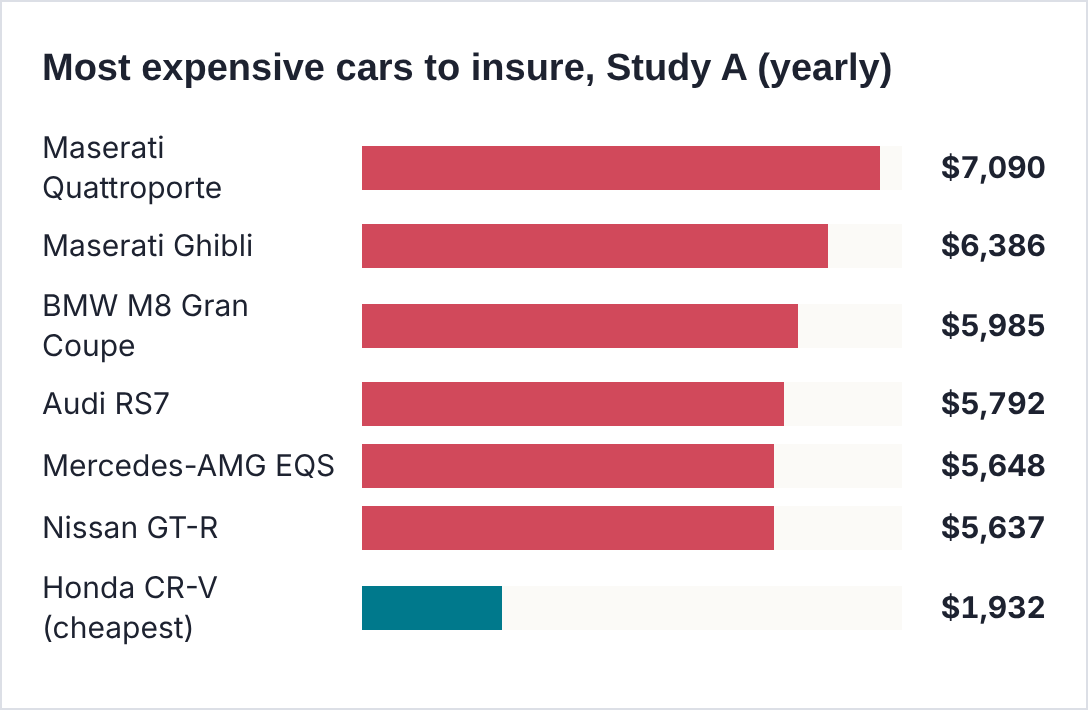
Study A: updated March 17, 2026; 40-year-old driver; full coverage.
The Maserati Quattroporte cost $7,090 a year to insure in Study A, about $5,158 more than the Honda CR-V. Even outside the luxury class, performance versions cost more than base models, which is one reason the IIHS recommends base engines for teen drivers.
Cheap to buy is not the same as cheap to insure
Some of the least expensive cars to buy are not the cheapest to insure. In Study A, the Nissan Versa, one of the lowest-priced new cars in America, cost $2,254 a year to insure, about $320 more than the CR-V. The Mitsubishi Mirage G4 cost $2,563. Small, inexpensive cars may attract younger, higher-risk drivers, and the IIHS notes that very small, light cars offer less crash protection.
That is why insurers price each model on its own claims history, not its sticker price. Before you buy a car because it is cheap, compare its insurance quote with a similar small SUV, which may cost less to own over five years. California buyers should also plan for proof of insurance before driving a newly purchased vehicle.
New vs. used cars
Used cars can cost less to insure for collision and comprehensive coverage because their replacement values may be lower. Liability premiums do not necessarily fall in the same way. In the cited Illinois teen example, a 2017 Subaru Outback cost $377 a month to add to a parent’s policy versus $435 for the newer comparison vehicle.
New cars have advantages too: many insurers offer a new car discount, and newer models often have better crash protection and automatic emergency braking. If you buy new, ask about new car and safety feature discounts, and consider gap insurance if you finance. An existing policy may provide a limited new-car grace period, which is different from an advertised free first month; check the actual terms before purchase.
Why the same car costs different amounts
Insurance cost depends on the exact vehicle and trim, driving record, location, annual mileage, coverage and permitted rating factors. The Honda CR-V appears at different prices across Study A, Study B and Study C because the samples and methodologies differ. Treat differences between studies as methodological, not as guaranteed savings from switching insurers. A useful quote comparison also starts with understanding how vehicle type, location and driver characteristics affect insurance costs.
Use the rankings to shortlist vehicles, then request actual quotes. The order of cheaper models is not fixed: a different insurer or driver profile may reorder the list significantly.
What makes a car cheap to insure?
Insurers price each vehicle based on how often similar vehicles are in claims and how much those claims cost. The Insurance Information Institute says premiums depend partly on a car’s price, its repair costs, its overall safety record, and the likelihood of theft.
Vehicle factors that raise or lower insurance costs
| Factor | Effect on premium | Example |
|---|---|---|
| Repair costs | Higher parts and labor costs raise collision premiums | Luxury and electric cars cost more to fix |
| Advanced safety sensors | Can add up to 37.6% to repair costs after a crash | Radar and camera repairs of $500 to $1,600 |
| Theft rates | Frequently stolen models cost more for comprehensive | Hyundai Elantra was the most stolen car of 2025 |
| Safety record | Safer cars cut injury claims | IIHS Top Safety Pick+ models |
| Vehicle size and power | Large or powerful vehicles cause costlier claims | Sports cars and large pickups |
| Driver profile | Some models attract lower-risk buyers | Minivans and wagons have fewer claims |
| Purchase price | Costlier cars cost more to replace | Maserati vs. Honda |
Insurance Information Institute; IIHS-HLDI insurance loss data (April 2026); AAA research on advanced driver assistance system repair costs (December 2023); NICB 2025 theft data.
Theft: the hidden cost of some popular cars
Vehicle theft can affect comprehensive premiums. The National Insurance Crime Bureau reported 659,880 thefts in the United States in 2025, a substantial decrease from 2024. The frequently stolen models below are ranked by total thefts across model years, not thefts per registered vehicle, so a common vehicle may appear high simply because many are on the road.
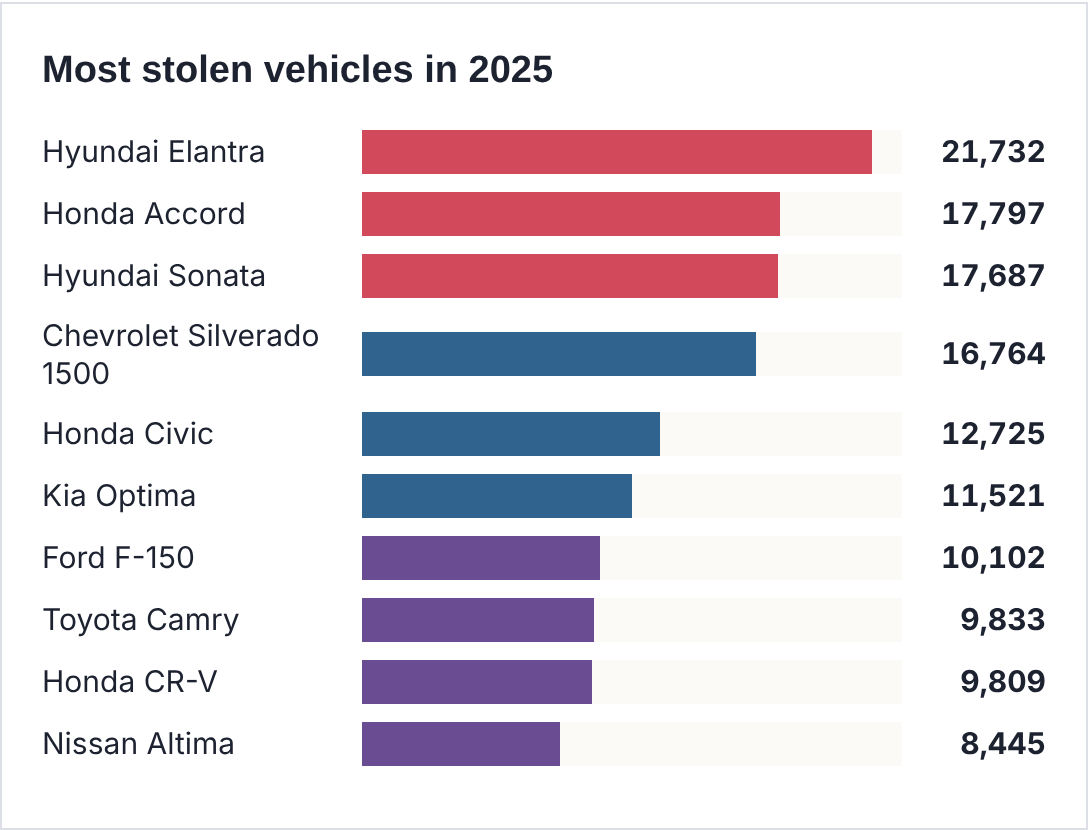
National Insurance Crime Bureau 2025 data, as reported in March 2026. Figures are total thefts, not theft rates.
Hyundai and Kia thefts surged after social media videos showed how to steal models without immobilizers; insurance data showed their theft claims ran about seven times those of other makes in early 2023. A software update became available in February 2023, and their share of thefts has fallen from 21% in 2023 to 14% in 2025. If you own an affected model, make sure the update is installed and tell your insurer.
What the cheapest cars save over five years
Annual insurance differences can be multiplied across a hypothetical ownership period, but doing so assumes stable rates, coverage and vehicles. The table below should use only within-study comparisons for defensible arithmetic; real premiums change from year to year.
Five-year insurance cost comparison (our calculation)
| Comparison | Yearly difference | Five-year difference |
|---|---|---|
| Subaru Legacy vs. Hyundai Sonata (sedans) | $491 | $2,455 |
| Jeep Gladiator vs. Ford F-150 (trucks) | $236 | $1,180 |
| Fiat 500e vs. Tesla Model 3 (EVs) | $1,424 | $7,120 |
| Honda CR-V vs. Maserati Quattroporte | $5,158 | $25,790 |
Calculations multiply selected annual premium differences from the same rate study by five; this assumes no rate changes over five years. Cross-study comparisons were excluded because they price different drivers or vehicle sets. These are not guaranteed savings.
In Study B, the Fiat 500e–Tesla Model 3 premium difference was $1,424 per year, or $7,120 over five unchanged years; in Study A, the CR-V–Maserati difference was $5,158 annually. These are modeled differences, not money a particular buyer is assured of saving.
How to check a car’s insurance cost before you buy
- Write down the exact year, make, model, and trim of each car you are considering, plus its VIN if you have it.
- Ask your current insurer for a quote on each car, then compare car insurance quotes online using the same coverage limits and deductibles.
- Get at least two more quotes from different insurers. If National General is among your candidates, compare the vehicle details and coverage questions used for a National General quote with the information you give other carriers.
- Compare the base and sport trims; bigger engines often cost more to insure.
- Ask which safety and anti-theft features earn discounts on each model.
- Check whether the model is a frequent theft target in your area.
- Add the yearly premium to your total cost of ownership before you decide.
Car insurance discounts that lower your premium
Choosing a lower-premium vehicle is one way to control insurance costs. Discounts, liability limits and deductibles also matter. Published maximum discounts are not typical savings and may apply only to selected coverage components or states.
Major car insurance discounts and published amounts
| Discount | Published amount | Example insurer |
|---|---|---|
| Safe-driving telematics | Up to 40% | Nationwide SmartRide |
| Safe-driving telematics | Up to 30% | State Farm Drive Safe and Save |
| Multi-vehicle | Up to 25% | GEICO |
| Multi-vehicle | About 12% on average | Progressive |
| Clean driving record | Up to 22% | GEICO |
| Good student | Up to 25% | State Farm |
| Airbags (passive restraint) | Up to 40% on medical coverages | State Farm |
| Anti-lock brakes | 5% on certain coverages | GEICO |
| Home and auto bundle | Average $1,032 a year | Nationwide |
| Home and auto bundle | Over $1,000 on average for new customers | Progressive |
| Online quote or signing online | About 7% to 10% | Progressive |
Official insurer discount pages (accessed October 30, 2026). Discounts vary by state, and most insurers do not publish exact amounts for every discount.
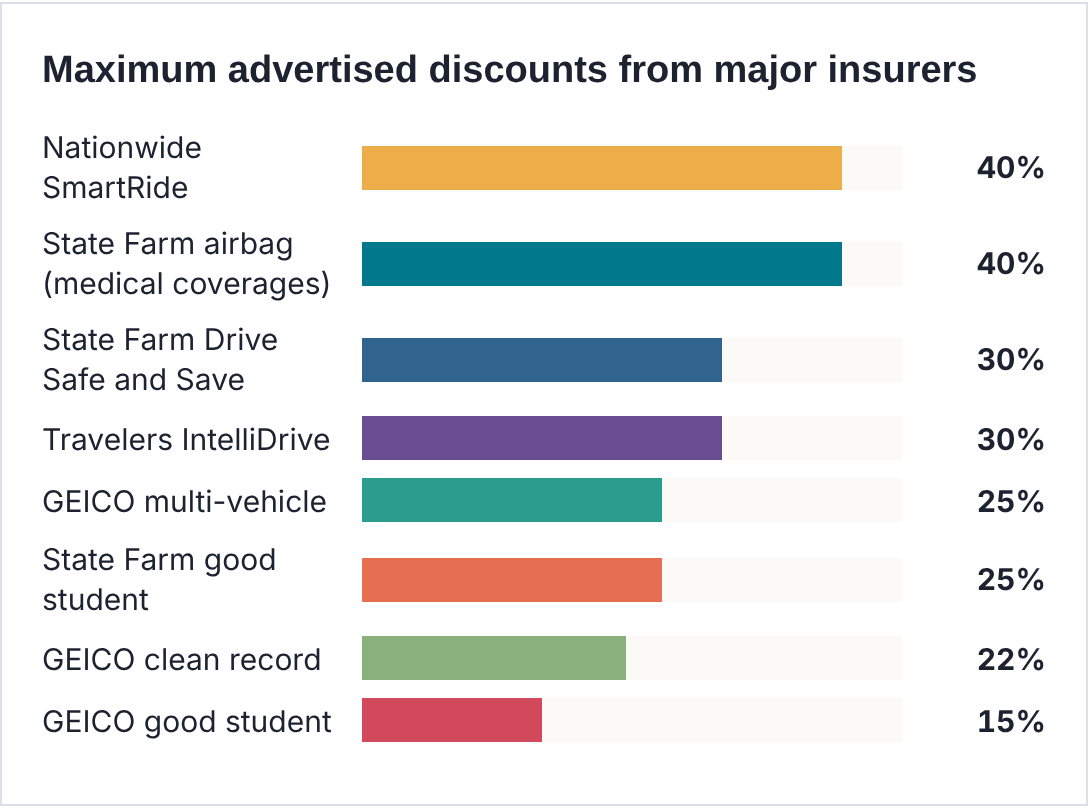
Official insurer pages (accessed October 30, 2026). Maximums; most drivers earn less.
Telematics programs compared
Safe-driving programs from major insurers
| Program | Maximum or average savings | Can rates go up? |
|---|---|---|
| Nationwide SmartRide | 10% to enroll; up to 40% | No, according to Nationwide |
| State Farm Drive Safe and Save | Up to 30% | Recalculated at renewal |
| Travelers IntelliDrive | Up to 30% (40% in Nevada) | Yes, in most states |
| Progressive Snapshot | $164 at sign-up; $328 at completion, on average | Yes, for about 2 in 10 drivers |
| GEICO DriveEasy | Typically 5% to 15% | Depends on the state |
Official insurer pages (accessed October 30, 2026).
Discounts New York requires
Some states require certain discounts by law. In New York, every auto insurer must offer premium discounts for anti-theft devices, VIN-etched glass, anti-lock brakes, daytime running lamps, front seat belts and airbags, and an approved accident prevention course, which takes at least 10% off liability, collision, and no-fault premiums for three years. Check your own state’s insurance department website for similar rules.
Vehicle-related discounts to ask about
Ask whether anti-theft equipment, anti-lock brakes, airbags or other vehicle features qualify for a discount. New York has statutory discounts for selected safety equipment and approved accident-prevention courses, while other states and insurers use different rules. Do not assume the entire policy receives the advertised percentage. If you drive very little, review how mileage-based policies use a base premium and a per-mile charge before assuming they save money.
PRO TIP #1
Get an insurance quote on the exact year, model, and trim before you buy. Two similar SUVs can differ by hundreds of dollars a year, and performance trims or bigger engines often cost much more to insure than the base model.
10 ways to save more on car insurance
These steps work with any car and any insurer, and they can matter as much as the vehicle you choose.
1. Choose a vehicle that is cheap to insure
Start with the CR-V, HR-V, Forester, Outback, or CX-5, which appear near the top of nearly every study. Avoid luxury performance cars and frequently stolen models if price matters most. Choosing the base engine and trim rather than a sport version can also trim the premium.
2. Raise your deductible
Raising your collision or comprehensive deductible can reduce premiums, but the reduction is insurer- and state-specific. Compare written quotes at $500 and $1,000 deductibles, and select only an amount you could readily pay after a loss.
3. Drop collision on an older car
The “car value below ten times the annual physical-damage premium” rule is a rough screening tool, not a rule for dropping coverage. Review your car’s value, likely deductible, ability to replace it, theft and weather exposure, and any loan or lease requirements before removing collision or comprehensive coverage.
4. Bundle your policies
Bundling home or renters coverage with auto can produce a discount, but the total combined price can still exceed quotes from separate insurers. Published average dollar savings from insurer advertising are based on selected customers and should not be assumed for a new applicant.
5. Try a safe-driving program
Telematics programs reward smooth, safe driving. Nationwide SmartRide offers up to 40%, and State Farm Drive Safe and Save up to 30%. Some programs, such as Progressive Snapshot, can raise rates for risky driving, so read the terms first. Programs that only lower rates are the safest choice for nervous drivers.
6. Insure all your vehicles together
Insuring eligible household vehicles together may qualify for a multi-car discount—GEICO and Progressive publish promotional averages or maximums—but one combined policy is not always cheaper. Compare identical driver assignments and limits before deciding.
7. Ask about every discount
Good student, clean record, anti-theft, paperless, autopay, paid-in-full, military, and affinity discounts can add up. Insurers do not always apply them automatically, so ask at every renewal, especially after a life change such as a new job, a move, or a child leaving for college.
8. Keep your record clean
Tickets and at-fault accidents may affect premiums for multiple years; the lookback period varies by state, insurer and violation. Ask when each incident will stop affecting your quote, and check for approved defensive-driving or safe-driver discounts.
9. Improve your credit
Most states let insurers use credit-based insurance scores, so paying bills on time and lowering balances can bring your premium down at renewal. California, Hawaii, and Massachusetts restrict the use of credit in auto pricing.
10. Shop around every year
Drivers are shopping more than ever: a record 47.3% of policies were shopped in the 12 months before the first quarter of 2026, according to LexisNexis. The Insurance Information Institute recommends getting at least three quotes, because the cheapest insurer for the same car can change from year to year. Comparing renewal quotes before the effective date may help avoid a coverage gap and uncover changing rate offers.
PRO TIP #2
When you compare quotes, keep the same liability limits, deductibles, and optional coverages on every quote. A quote that looks cheaper because it quietly lowered your coverage is not a real saving. A general explanation of online auto insurance quote details can help you spot differences in limits, deductibles and excluded coverage.
Cheapest-car study results at a glance
This clean, illustrated summary pulls together the main points of this guide.
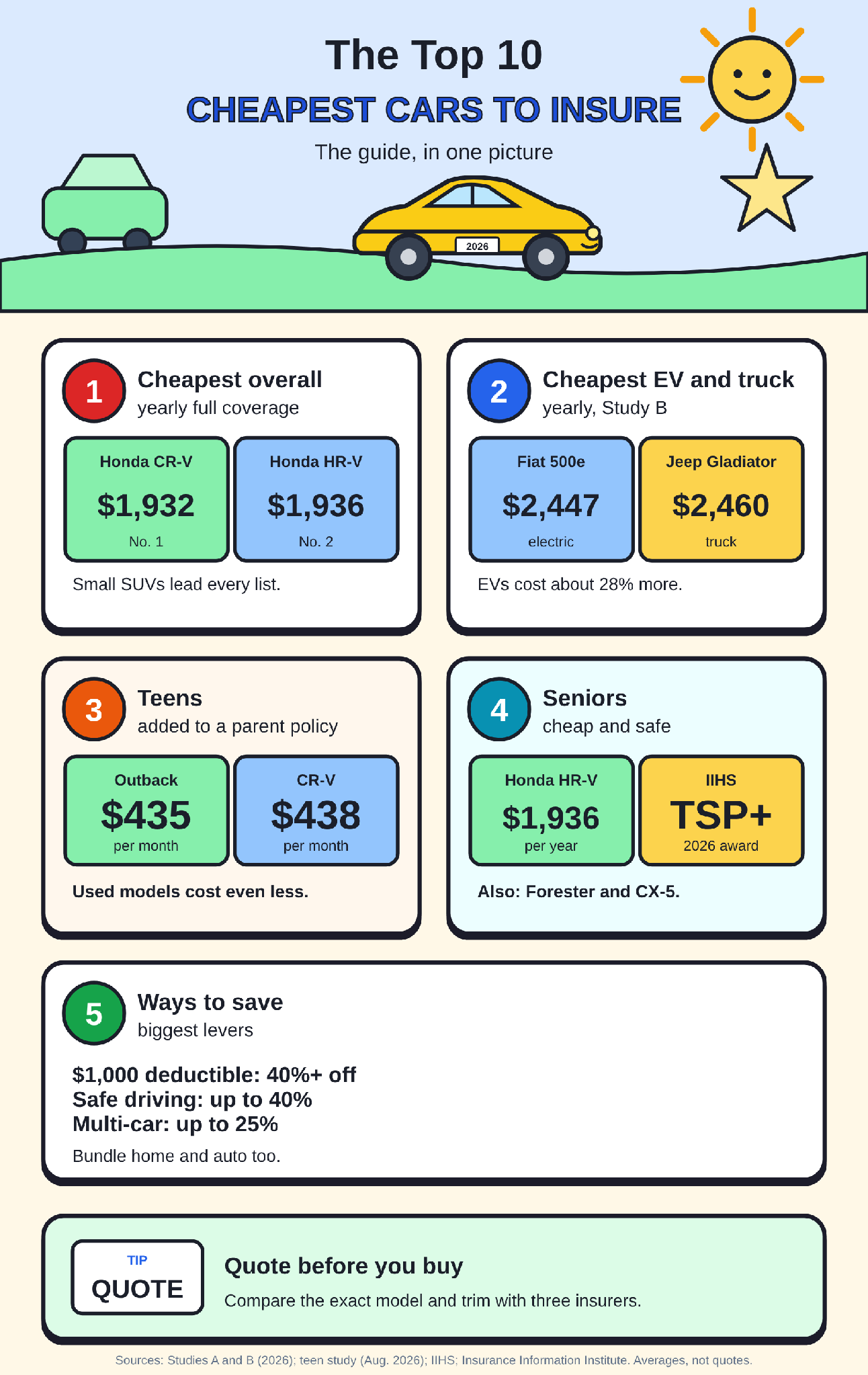
The cheapest cars to insure at a glance. Sources: Studies A and B (2026); teen study (August 2026); IIHS; Insurance Information Institute. Averages, not quotes.
Frequently asked questions
What is the cheapest car to insure in 2026?
In Study A, the Honda CR-V had the lowest published premium at $1,932 a year for the specified 40-year-old driver profile. Other studies used different samples and sometimes ranked another model first; obtain a quote for your actual vehicle and location.
What is the cheapest SUV to insure?
In Study A, the Honda CR-V led the sampled SUVs at $1,932 annually, with the HR-V close behind at $1,936. In Study B, the Subaru Crosstrek ranked first at $2,299, demonstrating that the result depends on the study.
What is the cheapest electric car to insure?
In Study B, the Fiat 500e was the lowest-premium EV in the vehicles surveyed at $2,447 a year, followed by the Hyundai Kona Electric and Kia Niro EV. Prices and availability depend on vehicle year, location and driver.
What is the cheapest truck to insure?
In Study B’s pickup sample, the Jeep Gladiator had the lowest full-coverage estimate at $2,460 a year, followed by the Ford Maverick at $2,488 and Nissan Frontier at $2,539.
Is a used car cheaper to insure than a new one?
Usually, yes, because a used car is worth less and costs less to replace. In a 2026 teen study, a 2017 Subaru Outback added $377 a month to a parent’s policy, compared with $435 for a new one. Once a car is worth little, dropping collision and comprehensive coverage saves even more.
Do sedans or SUVs cost more to insure?
In Study B’s data, sedans cost more on average, at $3,781 a year, compared with $2,976 for SUVs and $2,892 for trucks. Small SUVs fill nearly every spot on the cheapest-cars lists, while the cheapest sedan, the Subaru Legacy, cost $2,148 in Study A.
What is the cheapest car to insure for a teenager?
Among selected vehicles in an Illinois study, adding an 18-year-old to a parent’s policy cost the least with a Subaru Outback, at $435 monthly. This is not a nationwide ranking of all teen vehicles.
What is the cheapest safe car for seniors to insure?
The Honda HR-V averaged $1,936 in Study A for a 40-year-old driver and earned the 2026 IIHS Top Safety Pick+ award. The study did not quote seniors specifically, so it cannot identify the cheapest insured car for that age group.
Are electric cars more expensive to insure?
In Study B’s sampled vehicles, EVs averaged $3,708 per year and gasoline vehicles $2,891, a 28% difference. The size and direction of that difference depends on the models, driver profiles and coverage; it is not a universal EV surcharge.
Which car brands are cheapest to insure?
Honda, Subaru and Mazda models appeared frequently near the lower end of the sources reviewed, but the results rank individual vehicles—not entire brands. Premiums for sporty, luxury or high-theft trims can differ greatly within the same make.
Does the color of a car affect insurance?
No. Insurers price vehicles on factors such as repair costs, safety record, theft rates, and purchase price, along with your own driving record, location, and coverage. Color is not part of the price.
The final word on the top 10 cheapest cars to insure
In the rate studies reviewed here, several small SUVs—including the Honda CR-V, Subaru Forester and Mazda CX-5—appeared near the lower end of the premium rankings. The best model for an individual driver depends on the exact car, safety needs, location and insurer.
Category leaders differed by study: the Subaru Legacy led Study A’s sedan sample but is no longer sold new in the United States; the Fiat 500e led Study B’s EV sample; the Toyota RAV4 Hybrid led Study B’s hybrid sample; and the Jeep Gladiator led its truck sample. The teen comparison was an Illinois family-policy study, and senior-specific model rates were unavailable.
Car choice matters, but discounts and coverage decisions can materially change the final quote. Compare the exact model and trim at several insurers using matching limits and deductibles; avoid selecting a lower limit solely to make the premium look smaller.
NEXT STEP
Pick two or three models from our lists, get full coverage quotes for each with the same limits and deductibles, and let the insurance cost help decide which vehicle you buy.
Prices, rankings, discounts, and safety ratings change and vary by driver, state, vehicle, and insurer. The figures in this article are published averages and our calculations, not quotes or offers. This article is for information only and is not legal or financial advice. The publisher is not an insurance company or a licensed insurance agency.
The bottom line: these rankings identify lower-priced models in specified studies, not guaranteed winners for everyone. A quote for the exact vehicle and your coverage is the deciding evidence.
Sources
- Insurance.com, The cheapest cars to insure in 2026 (March 17, 2026); CarInsurance.com, Cheapest cars to insure (May 5, 2026); CarInsurance.com, Cheapest SUVs (September 16, 2026).
- CarInsurance.com, Cheapest EVs and hybrids to insure (April 17, 2026); Insurance.com, Hybrid car insurance (September 3, 2026); CarInsurance.com, Cheapest trucks to insure (August 12, 2026).
- CarEdge, Cheapest cars to insure (August 28, 2025); Compare.com, Cheapest cars to insure (October 29, 2026); Compare.com, Electric car insurance (October 29, 2026); Insurify, Electric car insurance (October 29, 2026).
- ValuePenguin, Cheapest cars to insure for teens (August 12, 2026); CarInsurance.com, Best cars for teens (June 1, 2026); IIHS and Consumer Reports, Safe vehicles for teens (May 27, 2026).
- IIHS, 2026 Top Safety Picks; IIHS-HLDI, Auto insurance losses (April 2026); AAA, ADAS repair costs (December 14, 2023); AAA, Smart Features for Older Drivers.
- CarPro, NICB most stolen vehicles of 2025 (March 18, 2026); HLDI, Hyundai and Kia theft bulletin (December 2023); CollisionWeek, Mitchell EV claims data (August 20, 2026).
- Insurance Information Institute, Nine ways to lower your auto insurance costs; Insurance Information Institute, How to save money on car insurance; New York DFS, Ways to save on auto insurance (February 2026).
- Official discount pages: GEICO, State Farm, Progressive, Nationwide, and Travelers; NerdWallet, Average car insurance cost (March 2, 2026); Repairer Driven News, LexisNexis shopping data (May 14, 2026).
- IIHS, 2026 Honda CR-V crash-test ratings; NICB, 2025 most-stolen vehicles and total thefts; Subaru, 2025 Legacy—no longer available as a new model