
Pay As You Go Car Insurance in New York
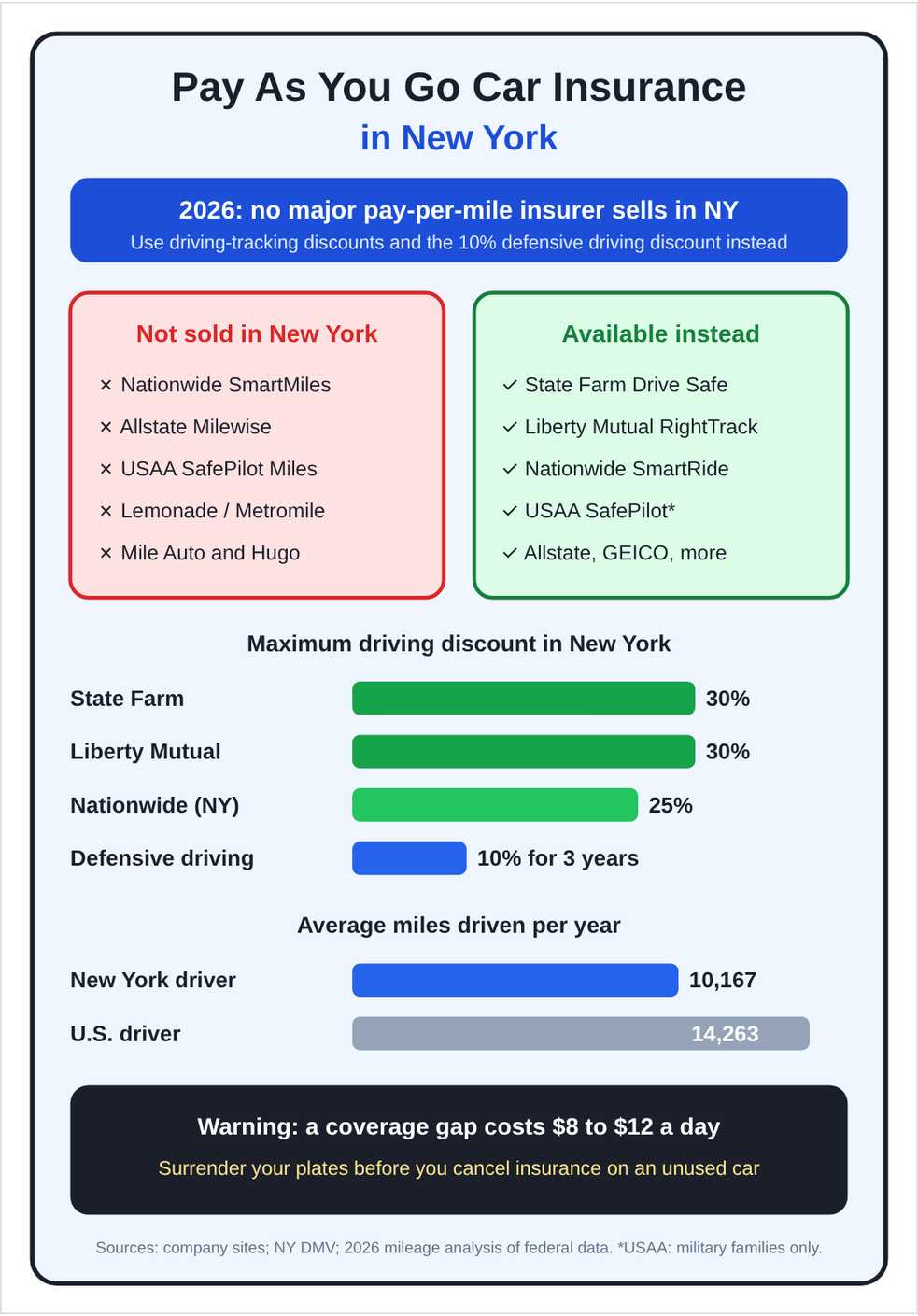
New Yorkers drive less than almost anyone in the country, so it makes sense that so many search for pay as you go car insurance in New York. The catch is that, as of November 2026, no major pay-per-mile insurer sells in the state: Nationwide SmartMiles, Allstate Milewise, USAA SafePilot Miles, Lemonade, Mile Auto, and Hugo all leave New York off their lists.
That does not mean low-mileage drivers are stuck paying full price. This guide explains why pay-per-mile has not reached New York, which driving-tracking discounts you can get instead, how the state's defensive driving discount works, and how to stop paying for a car you are not using without triggering New York's daily lapse fines. It also covers what car insurance costs across the state and a step-by-step plan to pay less.
KEY TAKEAWAYS
- No major pay-per-mile or pay-per-day insurer accepts new New York customers in 2026, and most ranking pages do not say so.
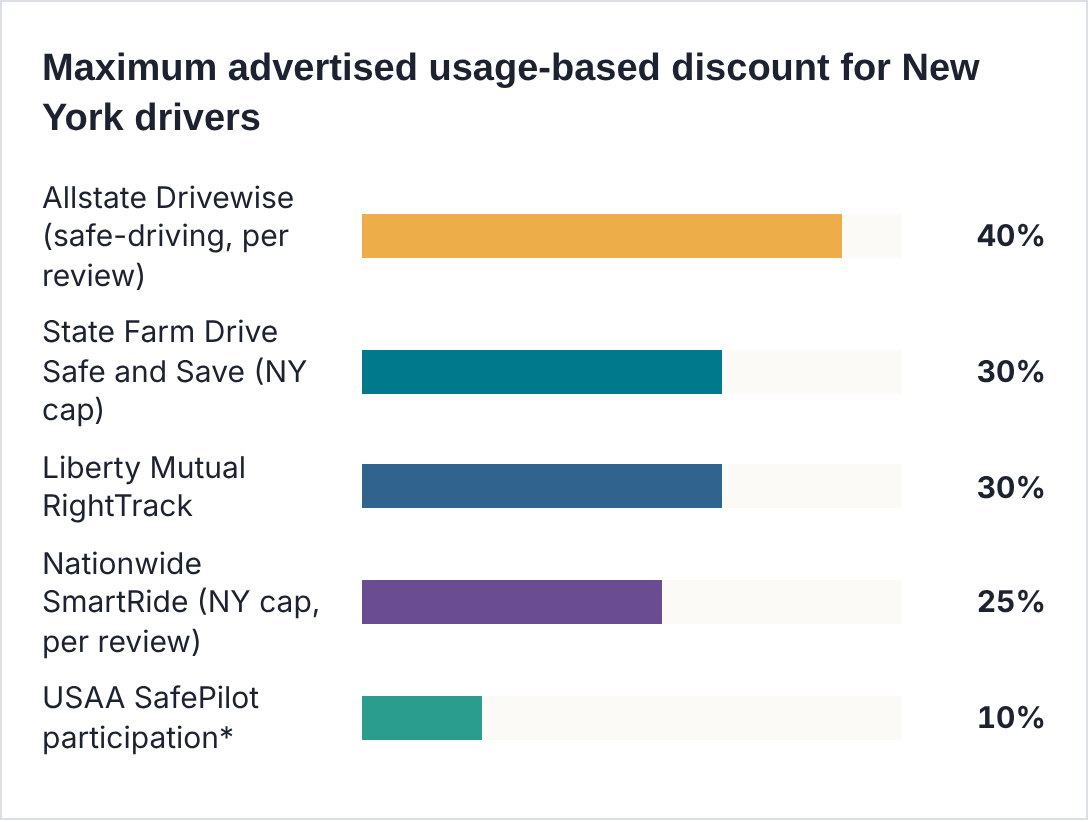
- Usage-based programs are available instead: State Farm offers up to 30% in New York, Liberty Mutual up to 30%, Nationwide up to 25%, and several insurers say their New York programs will not raise your rate.
- New York fines you $8 to $12 a day for a gap in coverage on a registered car, so the only safe way to stop paying for an unused car is to surrender its plates first.
The short answer: pay-per-mile insurance is not sold in New York
Pay as you go car insurance usually means pay-per-mile coverage: a monthly base rate plus a few cents for each mile you drive. It is sold in many states, but we checked every major program's official availability page or state list on November 12, 2026, and none includes New York.
Pay-per-mile and pay-as-you-go programs and New York, November 2026
Program | How it charges | New York status |
|---|---|---|
Nationwide SmartMiles | Base premium plus a per-mile rate; first 250 miles a day counted | Not available (excluded on Nationwide's page) |
Allstate Milewise | Daily base rate plus a per-mile rate | Not on any published state list |
USAA SafePilot Miles* | Fixed rate plus a monthly mileage adjustment | Not available (excluded on USAA's page) |
Lemonade Car (formerly Metromile) | Base rate plus a per-mile rate | Not available |
Mile Auto | Base rate plus per-mile, by odometer photo | Not available |
Hugo | Pay-by-the-day coverage | Not available |
Liberty Mutual | Uses RightTrack, not pay-per-mile | RightTrack is available |
Noblr | Pay-per-mile | Retired by USAA in 2025 |
Nationwide SmartMiles and USAA SafePilot Miles official pages; company state lists and 2025 to 2026 reviews (accessed November 12, 2026). *USAA is available only to military members, veterans, and their families. Availability can change, so confirm with a quote.
Several national ranking pages still list one of these programs as available in New York. One major 2026 review, for example, lists USAA SafePilot Miles in New York, but USAA's own page excludes the state. When a comparison site and an insurer disagree, trust the insurer.
Why New York is different
No law we found bans pay-per-mile insurance outright, but New York's rules make it harder to launch. In a 2002 opinion, the state's insurance regulator said a pay-as-you-drive policy would need its rates approved in advance and could not simply expire when the prepaid miles ran out; the insurer would have to cancel it formally under the state's cancellation rules.
Those rules are strict. Under New York Insurance Law Section 3425, the required policy period for auto insurance is one year, and after a policy has been in force for 60 days, an insurer can cancel only for reasons such as nonpayment, certain license suspensions, or fraud. That structure fits poorly with coverage you switch on and off.
The legislature has noticed. Senate bill S5342, introduced in February 2025 and still in committee in 2026, would allow fuller use of telematics pricing, and its sponsor's memo says the bill would permit pay-per-mile programs. Its memo also says New York currently does not allow "an up/down pricing approach" to telematics. A separate 2026 Assembly bill, A10364, would require insurers to disclose how their telematics scores work. Neither had become law as of November 2026.
What would change if S5342 passes
If the bill becomes law, insurers could file programs that raise or lower rates based on driving data, and pay-per-mile pricing would be expressly allowed. That could bring national programs such as SmartMiles or Milewise to New York, but each insurer would still need its rates approved by the Department of Financial Services before selling. Even under the best case, expect months between a new law and the first policies.
Short-term and temporary coverage
Drivers who want coverage for only a few weeks face the same hurdle. Because New York treats auto policies as one-year contracts for cancellation purposes, true day-by-day or week-long policies are rare. If you need to drive occasionally without owning a car, a non-owner liability policy or the insurance included with a rental or car-sharing membership is usually the practical route.
If you own the car, keeping a full-year policy and lowering its cost with discounts is safer than buying and canceling short policies, which can leave gaps the DMV will catch.
What New York drivers can use instead
The goal of pay as you go insurance is simple: pay less when you drive less or drive well. New Yorkers can get much of that benefit through other tools that are available today.
Pay-as-you-go alternatives for New York drivers
Option | How it saves | Best for |
|---|---|---|
Usage-based (telematics) program | Discount for safe driving, often with a sign-up discount | Careful drivers of any mileage |
Low-mileage rating | Lower premium when you report fewer annual miles | Drivers under about 7,500 miles a year |
Defensive driving course (PIRP) | 10% off for three years, plus point reduction | Almost every driver |
Plate surrender while a car is stored | Lets you end coverage without lapse fines | Cars parked for months |
Non-owner policy | Liability coverage when you drive cars you do not own | City residents who borrow or rent |
Monthly payments | Spreads the cost over the year | Tight budgets; total cost may not drop |
NY DMV; company pages and 2026 reviews (accessed November 29, 2026). Low-mileage thresholds vary by insurer.
Usage-based programs available in New York
Usage-based insurance, also called telematics, tracks how you drive through a phone app, a plug-in device, or a connected car. It rewards smooth braking, safe speeds, little late-night driving, and, in many programs, fewer miles. In New York, several programs use a plug-in device instead of an app, and the maximum discount can differ from what the same insurer offers elsewhere.
Usage-based programs and New York terms
Program | New York details | Can your rate go up? |
|---|---|---|
State Farm Drive Safe and Save | Discount capped at 30% in New York; sign-up discount offered | Not stated for New York |
Progressive Snapshot | No participation discount in New York | Possible nationally; not confirmed for New York |
GEICO DriveEasy | Offered; scores older than three years cannot be used in New York | GEICO says it depends on the state |
Allstate Drivewise | Offered in New York since 2012; plug-in device | Reviews disagree |
Nationwide SmartRide | Plug-in device only in New York; discount capped at 25% | No; Nationwide calls it a discount |
Liberty Mutual RightTrack | Plug-in device; 90-day review; 5% to 30% | No, according to Liberty Mutual |
USAA SafePilot* | New York terms effective April 1, 2025 | No; scoring "can never" raise the premium |
NYCM inControl | Plug-in device for six months | Not published |
Travelers IntelliDrive | Not offered in New York | Not applicable |
State Farm New York discounts page; Progressive Snapshot page; GEICO DriveEasy help center; USAA New York SafePilot terms; Travelers IntelliDrive state list; 2025 to 2026 reviews (accessed November 12, 2026). *USAA is available only to military members, veterans, and their families.
Can a tracking program raise your rate in New York?
Usually not, but read the terms. The sponsor memo for bill S5342 says New York does not allow up-and-down telematics pricing, and USAA, Liberty Mutual, and Nationwide all describe their programs as discount-only. A 2014 state circular letter encouraged insurers to file these programs and said participation must be voluntary.
We found no regulation stating the rule outright, though, and GEICO's terms say higher rates are possible "depending on the state." Before you enroll, ask the insurer in writing whether your New York premium can rise because of your driving data.
Who does best with a tracking program?
Drivers who avoid hard braking, speeding, phone use, and late-night trips earn the biggest discounts, and many programs also give credit for low mileage. That favors many suburban and upstate commuters with predictable routes. Drivers in dense city traffic may find hard-braking events harder to avoid, so a discount-only program that cannot penalize them is the safer choice there.
Defensive driving: New York's built-in discount
New York has a discount every driver can earn, no tracking required. Under the state's Point and Insurance Reduction Program, completing an approved defensive driving course cuts the base rate of your auto liability and collision premiums by 10% each year for three years. The course runs 320 minutes and can be taken in a classroom or online.
The course can also remove up to four points from violations in the 18 months before you take it, though it cannot bring your record below zero. To keep the insurance discount, you must retake the course every 36 months, and the discount applies to the principal operator on the policy. Because it is set by the state, the discount works with any insurer and can stack with a telematics discount.
New York car insurance requirements
Whatever kind of policy you choose, it must meet New York's minimums. New York is a no-fault state, so every policy includes personal injury protection that pays medical costs regardless of who caused the crash.
New York minimum car insurance
Coverage | Minimum required |
|---|---|
Bodily injury liability | $25,000 per person; $50,000 for two or more people |
Death liability | $50,000 per person; $100,000 per accident |
Property damage liability | $10,000 |
No-fault personal injury protection | $50,000 |
Uninsured motorist | $25,000 per person; $50,000 per accident |
NY Department of Financial Services (accessed November 12, 2026); death liability limits from a 2026 summary of state requirements. New York does not accept insurance from another state for a New York-registered car.
Insurers must also offer supplementary uninsured and underinsured motorist coverage at limits matching your liability limits unless you decline in writing, a rule the state extended through June 30, 2029. A bill to raise the 25/50/10 minimums, A5053, remained in committee in 2026. New York's uninsured driver rate was 8.6% in the latest Insurance Research Council study, well below the 15.4% national rate.
Storing a car? Surrender the plates first
The most common pay-as-you-go goal is to stop paying for a car you are not driving, such as a convertible in winter or a car left behind during a long trip. In New York, you must keep liability insurance for as long as a vehicle is registered, and insurers report coverage to the DMV electronically. If the coverage stops while the car is still registered, the DMV treats it as a lapse.
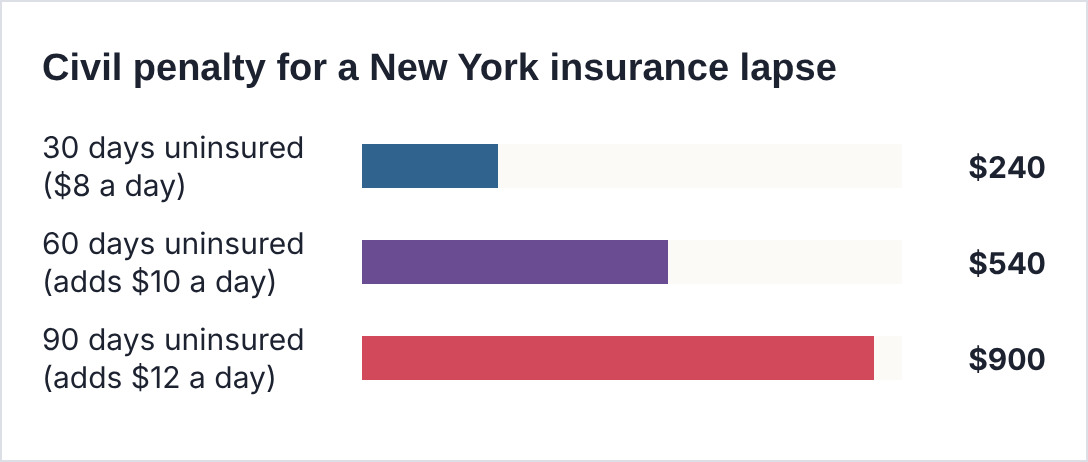
The penalty is $8 a day for the first 30 days, $10 a day for days 31 to 60, and $12 a day for days 61 to 90. A 90-day gap costs $900 (our calculation). If the lapse runs 91 days or longer, or you used the penalty option in the past 36 months, you cannot pay the penalty; your registration is suspended for as many days as the car was uninsured, and a suspension over 90 days also suspends your driver's license.
Driving without insurance is worse: a fine of up to $1,500, a $750 civil penalty to restore a revoked license, and at least a one-year revocation if you crash while uninsured. The safe route is to surrender your plates at a DMV office, or by mail with Form PD-7, before coverage ends. Some insurers will keep comprehensive-only coverage on a stored, unregistered car to protect it from theft or damage, so ask before you cancel.
PRO TIP #1
Get the plate surrender receipt before you call your insurer. Cancel coverage on or after that date, never before, and keep the receipt; it is your proof that the car was not registered during the gap.
What car insurance costs in New York
Rate studies disagree sharply on New York prices, so we name each one. Study A, a national rate study updated November 2, 2026, priced full coverage with 100/300/50 limits for a 35-year-old driving 12,000 miles a year and found a statewide median of $2,673 a year, or $223 a month. Study B, updated August 15, 2026, found $120 a month for full coverage and $63 for minimum coverage, using a different driver and car.
A third analysis, based on real quotes rather than one sample driver, put full coverage at $288 a month. The gap shows why your own quote matters more than any average.
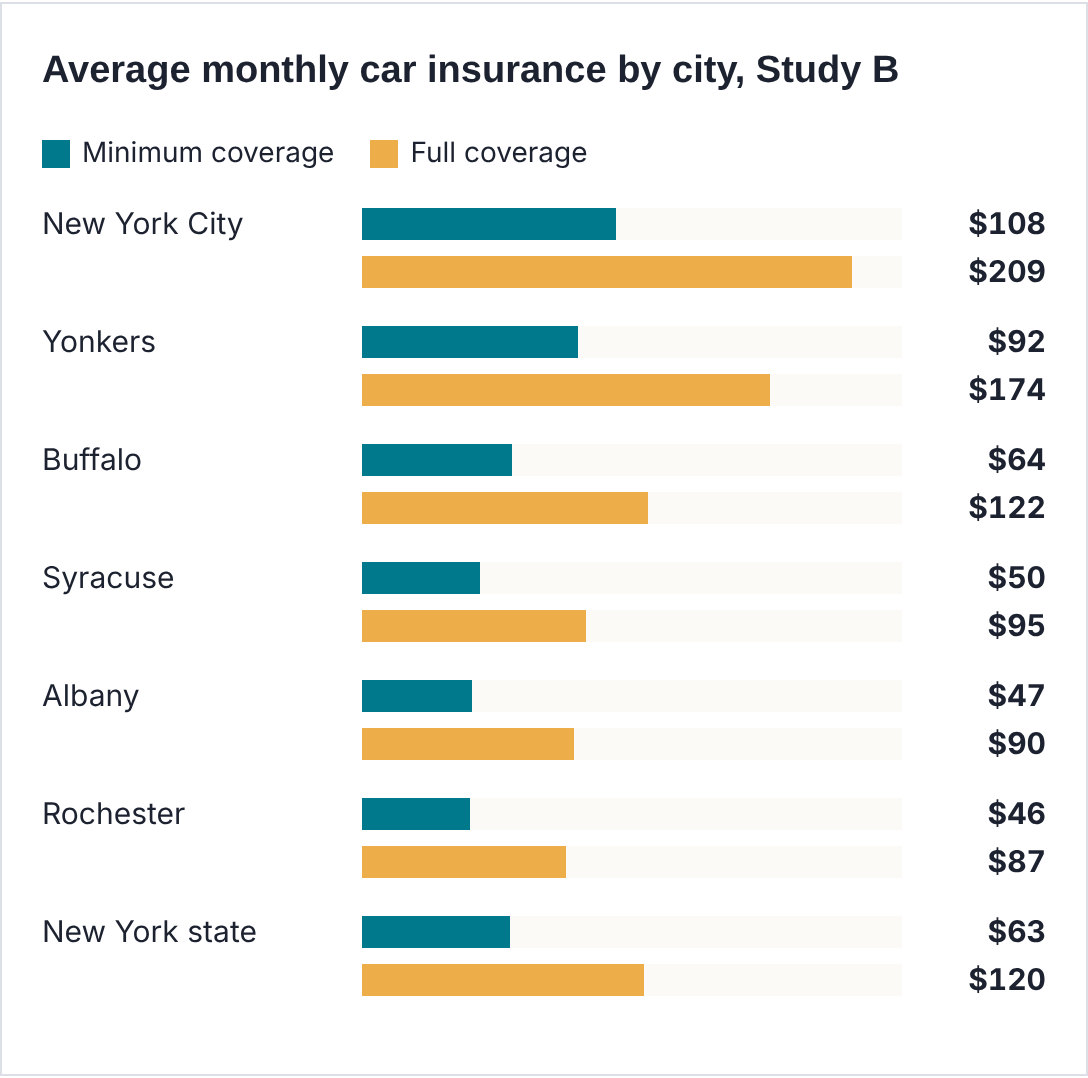
Location is the biggest price factor, driven by traffic density, theft, and repair costs. In Study B, full coverage in New York City cost $209 a month, more than double the $87 in Rochester. Ironically, the drivers who pay the most per mile are often city residents who drive the least, which is exactly why pay-per-mile insurance would help them most.
Cheapest companies in New York, Study A (monthly)
Driver | Cheapest | Next cheapest |
|---|---|---|
Full coverage | NYCM, $117 | Progressive, $120 |
Minimum coverage | NYCM, $35 | Progressive, $46 |
Age 20, full coverage | NYCM, $173 | Progressive, $197 |
Age 70, full coverage | Progressive, $96 | NYCM, $129 |
After an at-fault accident | NYCM, $141 | Progressive, $151 |
After a DUI | Progressive, $131 | NYCM, $167 |
Poor credit | Preferred Mutual, $190 | Utica National, $207 |
Study A: national rate study updated November 2, 2026; median rates by ZIP code. Your price will differ.
NYCM, a regional insurer that sells only in New York, led most categories in Study A, and Progressive was close behind. Neither offers pay-per-mile coverage in New York, but both are worth quoting for low-mileage drivers, especially if you report your true annual miles.
Low mileage is common in New York
New York has one of the lowest driving rates in the country. One 2026 analysis of federal highway data put the average New York driver at 10,167 miles a year, third-lowest of any state and far below the 14,263 national average; another source, using different data, put it at 11,871.
In New York City, only 43.8% of households owned a vehicle in 2023, compared with 91.6% nationally, according to the New York State Comptroller, and about 48% of city households relied on transit to get to work.
How much could a low-mileage New Yorker save?
Without pay-per-mile insurance, savings come from stacking what is available. This hypothetical example starts with Study A's $2,673 annual full coverage median and applies each tool. It is an illustration, not a quote; real discounts depend on your insurer, driving, and policy.
Hypothetical yearly savings for a New York driver (our calculation)
Step | Example saving | Running cost |
|---|---|---|
Starting premium (Study A median) | None | $2,673 |
Report true low mileage (example: 5%) | $134 | $2,539 |
Defensive driving course (10% of an example $1,800 liability and collision base) | $180 | $2,359 |
Usage-based discount (example: 15%) | $354 | $2,005 |
Total example savings | $668 (25%) | $2,005 |
Hypothetical example; percentages are illustrations, not company offers. The defensive driving discount applies only to the base rate of liability and collision premiums. Figures are our calculations.
A driver who also stores a second car for four months a year could save more by surrendering its plates and suspending its liability coverage during that time, instead of paying for a car that never moves. Compare that saving with the cost and hassle of re-registering and getting new plates before you decide, since a short storage period may not be worth it.
Who benefits from these options in New York
Which New York option fits you?
Driver | Best option | Why |
|---|---|---|
City resident who drives a few times a month | Low-mileage rating plus a discount-only telematics program | Pays for light, careful driving |
City resident with no car | Non-owner policy, or the insurance included with car sharing | No need to insure a vehicle |
Suburban or upstate commuter | Telematics program plus defensive driving | Steady routes earn high scores |
Owner of a seasonal car | Plate surrender during storage | Avoids lapse fines and premiums |
Senior or retiree | Defensive driving plus low-mileage rating | Course discount applies at any age |
Military family | USAA SafePilot* | Discount-only scoring in New York |
Pros and cons of usage-based insurance in New York
Pros and cons
Pros | Cons |
|---|---|
Several programs promise not to raise your rate | No true pay-per-mile option |
Discounts of up to 25% to 30% at some insurers | Plug-in devices required by many New York programs |
Stacks with the 10% defensive driving discount | City traffic can hurt braking scores |
Rewards low mileage at many insurers | Your driving data is shared with the insurer |
Works with any coverage level | Progressive offers no sign-up discount in New York |
Privacy and your driving data
Tracking programs collect speed, braking, mileage, and time of day, and app-based programs may also use phone location and motion data. Ask what is collected, how long it is kept, and whether it is shared outside the insurer. The proposed bill A10364 would require insurers to disclose more about how their scores are calculated, but for now, the program's terms are your best guide.
Questions to ask before you enroll
- Is the program available in New York, and does it use an app or a plug-in device?
- Is there a sign-up discount, and what is the maximum discount in New York?
- Can my premium go up because of my driving data, now or at renewal?
- Does the program reward low mileage, or only driving behavior?
- Who sees my data, and how long is it kept?
How to pay less as a low-mileage driver in New York
- Check your real mileage from two odometer readings or past inspection records.
- Tell every insurer your true annual miles and ask whether it has a low-mileage tier.
- Take a state-approved defensive driving course and send your certificate to the insurer.
- Ask which usage-based programs are offered in New York and whether they can raise your rate.
- Get at least three quotes with identical coverage, including NYCM and Progressive.
- If a car will sit for months, surrender its plates before changing coverage.
- Recheck pay-per-mile availability at renewal, since bill S5342 could change the rules.
PRO TIP #2
Retake the defensive driving course on schedule. The 10% discount lasts three years, so set a reminder about 34 months after your course to sign up again before it expires.
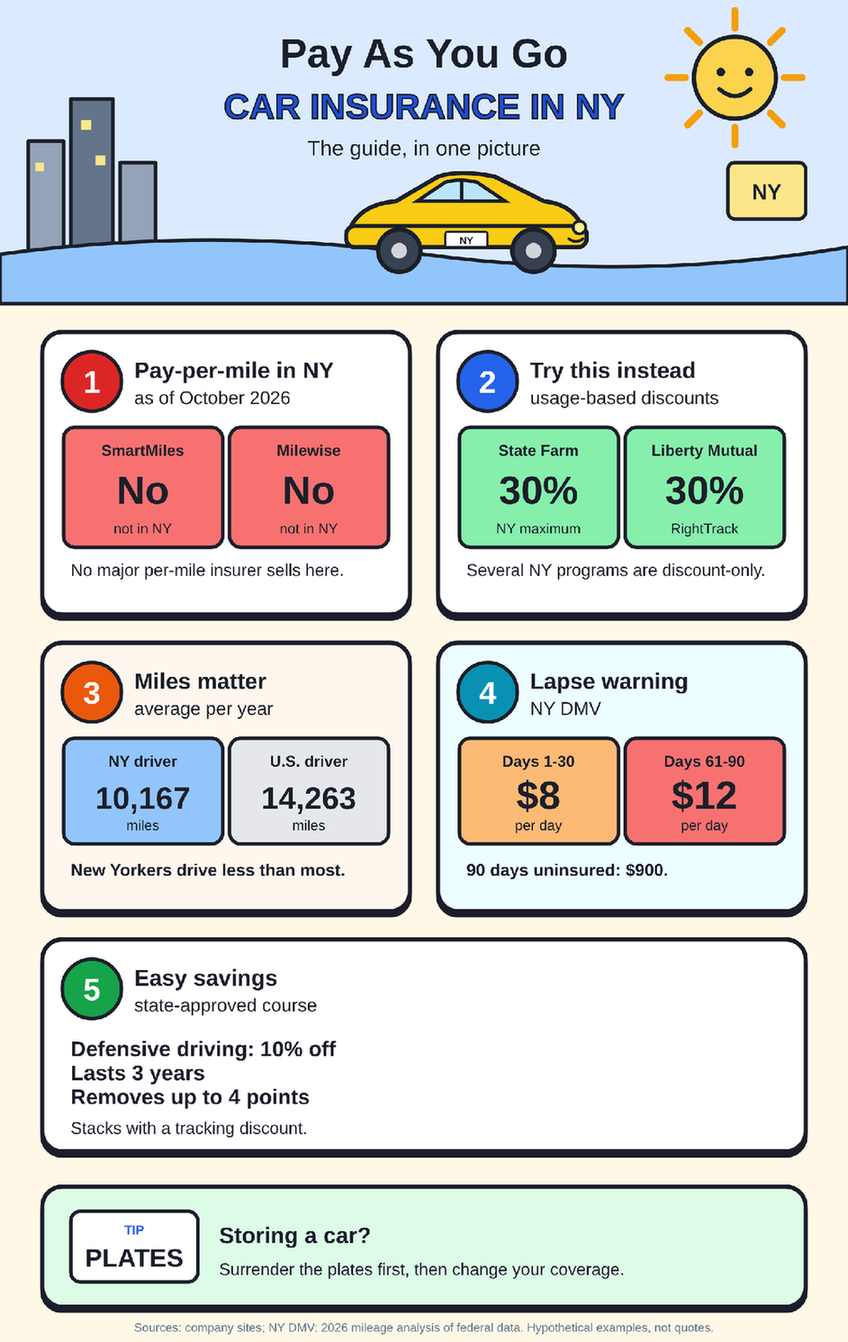
Pay as you go car insurance in New York at a glance
This illustrated summary pulls together the main points of this guide.
Frequently asked questions
Is pay-per-mile car insurance available in New York?
Not from any major insurer as of November 2026. Nationwide SmartMiles and USAA SafePilot Miles exclude New York on their own pages, and Allstate Milewise, Lemonade, Mile Auto, and Hugo do not list the state. Usage-based discount programs from State Farm, Liberty Mutual, Nationwide, and others are available instead.
Is pay-per-mile insurance illegal in New York?
We found no law banning it. A 2002 state opinion said such a policy needs approved rates and cannot simply expire when miles run out, and New York's one-year policy rules make on-and-off coverage difficult. Senate bill S5342 would expressly allow fuller telematics pricing, including pay-per-mile.
Can I pause my car insurance in New York?
Not while the car is registered. New York fines you $8 to $12 a day for a coverage gap and can suspend your registration. To stop paying, surrender the plates at the DMV or by mail first, then change your coverage. Some insurers will keep comprehensive-only coverage on a stored car.
Is Metromile available in New York?
No. Metromile became part of Lemonade, and Lemonade Car does not sell in New York. Metromile's former states did not include New York either, so any page listing Metromile as a New York option is out of date.
Can a driving app raise my rate in New York?
Usually not. USAA, Liberty Mutual, and Nationwide describe their New York programs as discount-only, and a sponsor memo for a 2025 Senate bill says New York does not allow up-and-down telematics pricing. Terms vary, so ask the insurer in writing before you enroll.
How much does the defensive driving discount save?
Completing a state-approved course cuts the base rate of your liability and collision premiums by 10% each year for three years. It can also remove up to four points from recent violations. You must retake it every 36 months to keep the discount.
What is the cheapest car insurance in New York?
In Study A, NYCM was cheapest for both full coverage, at $117 a month, and minimum coverage, at $35, with Progressive close behind. Progressive led for drivers over 70 and after a DUI, and Preferred Mutual for poor credit.
What is the minimum car insurance in New York?
New York requires $25,000 per person and $50,000 per accident for bodily injury, $10,000 for property damage, $50,000 of no-fault personal injury protection, and uninsured motorist coverage of $25,000 and $50,000. Death liability limits are $50,000 and $100,000.
The final word on pay as you go car insurance in New York
Pay as you go car insurance in New York is still more promise than product. No major pay-per-mile insurer sells in the state, even though New Yorkers drive less than almost anyone, because the state's pricing and cancellation rules have kept those programs out. Until the legislature acts, low-mileage drivers can capture much of the same savings with a discount-only tracking program, an honest low-mileage rating, and the 10% defensive driving discount.
If your car will sit for months, surrender the plates before you change coverage, because New York's daily lapse fines add up fast. Then compare at least three quotes, including the regional insurers that led Study A, and recheck pay-per-mile availability at each renewal.
NEXT STEP
Write down your real annual mileage, sign up for a state-approved defensive driving course, and ask three insurers for quotes that include their New York usage-based program and low-mileage discount.
Prices, discounts, program availability, and laws change and vary by driver, vehicle, and ZIP code. The figures in this article are published averages, official rules, and our calculations, not quotes or offers. This article is for information only and is not legal or financial advice. The publisher is not an insurance company or a licensed insurance agency.
The bottom line on pay as you go car insurance in New York: true pay-per-mile is not here yet, but careful, low-mileage drivers can still cut their premiums by stacking the discounts New York does allow.
Sources
- Nationwide, SmartMiles and SmartRide; USAA, SafePilot Miles, New York SafePilot terms (accessed November 12, 2026).
- State Farm, New York discounts; Progressive, Snapshot; GEICO, DriveEasy help center; Travelers, IntelliDrive programs (accessed November 12, 2026).
- NY Office of General Counsel, Pay-As-You-Drive Auto Insurance opinion (November 12, 2002); DFS Circular Letter No. 4 (2014); NY Insurance Law Section 3425.
- NY Senate, bill S5342; Insurance Business, bill A10364 (March 4, 2026); NY Senate, bill S10581.
- NY DMV, insurance lapse civil penalty; NY DMV, auto liability insurance; NY DMV, Point and Insurance Reduction Program (accessed November 12, 2026).
- NY DFS, How much auto insurance must I carry?; Insurify, New York minimum requirements (November 9, 2026).
- NerdWallet, Cheap car insurance in New York (November 2, 2026); MoneyGeek, Average cost of car insurance in New York (August 15, 2026); Experian, Average cost of car insurance in New York (November 13, 2026).
- Policygenius, Average miles driven by state (July 20, 2026); NY State Comptroller, NYC transportation report (2024); Insurance Information Institute, uninsured motorists.