
Top 10 Home Insurance Companies (2026): Prices, Pros and Cons
Americans paid about $188.7 billion for homeowners coverage in 2025, and the top 10 home insurance companies collected about 62% of it, so these are the names most homeowners will see on a quote. Yet size says little about price: in one 2026 rate study, the same home cost $1,940 a year with one top-10 insurer and $4,235 with another.
This guide ranks the 10 largest homeowners insurers by 2025 premiums and reviews each one: what it specializes in, its average annual price, its strengths and weaknesses, its discounts, and features such as extended replacement cost, shrinking deductibles, and free fire or leak sensors. It also shows which company was cheapest for homeowners with poor credit, a recent claim, a new home, or a high-value home, and where each insurer has stopped selling new policies.
KEY TAKEAWAYS
- State Farm is the clear No. 1, with 18.7% of the U.S. homeowners market in 2025, about twice the share of No. 2 Allstate, followed by USAA, Liberty Mutual, and Farmers.
- USAA had the lowest average price in Study A, at $1,940 a year, for military families; among insurers open to everyone, State Farm was cheapest at $2,415, against a $2,490 national average.
- Price studies disagree sharply, so quotes matter: American Family was the most expensive top-10 insurer in one study and the cheapest open to everyone in another.
- State Farm was the cheapest company open to everyone in 10 states, more than any other insurer; our state-by-state section lists the cheapest company in all 50 states and D.C.
- Chubb, Erie, and Liberty Mutual led the top 10 for claims satisfaction in J.D. Power’s 2026 study, while Allstate and Auto-Owners trailed.
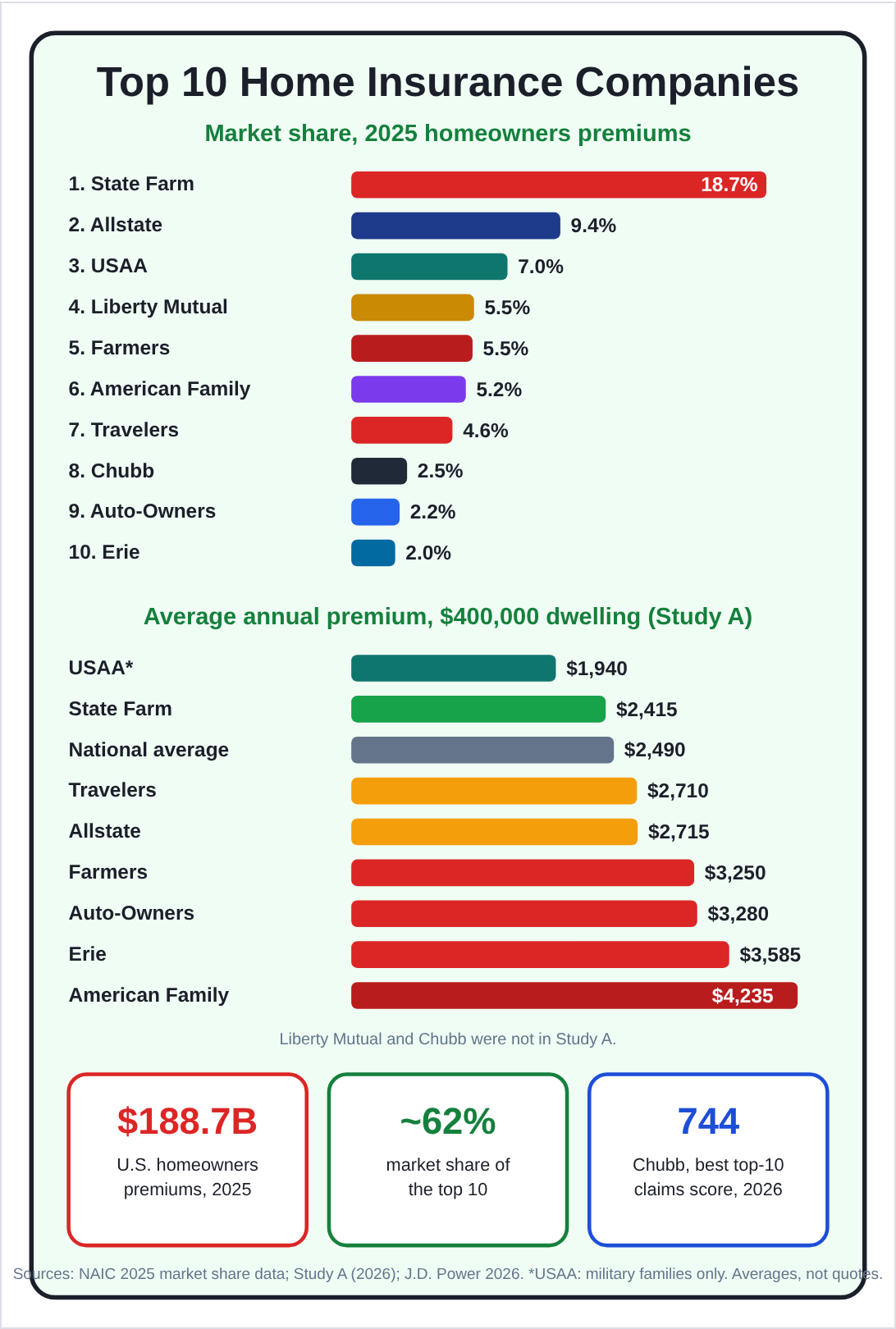
The 10 largest U.S. homeowners insurers by 2025 premiums written, and average annual premiums from Study A, a national rate study updated in 2026 using $400,000 of dwelling coverage and a $1,000 deductible.
How we ranked and reviewed the top 10
We ranked companies by 2025 direct premiums written for homeowners multiple peril insurance, from the National Association of Insurance Commissioners’ 2025 top 25 report. U.S. homeowners paid $188.69 billion in premiums in 2025, up from $172.73 billion in 2024, and the 10 groups below wrote about 62.5% of it (our calculation).
Because each rate study prices a different house and set of ZIP codes, we use three.
Study A is a national rate study updated in 2026 that prices $400,000 of dwelling coverage, $300,000 of liability, and a $1,000 deductible for a 40-year-old with good credit and a home built in 1984; its national average was $2,490 a year. Study B, updated October 21, 2026, prices $300,000 of dwelling coverage on a 1980 home and averaged $2,808. Study C, updated September 25, 2026, prices $350,000 of dwelling coverage and averaged $2,151.
The top 10 U.S. homeowners insurers by 2025 premiums
| Rank | Company | 2025 premiums written | Market share |
|---|---|---|---|
| 1 | State Farm | $35.27 billion | 18.69% |
| 2 | Allstate | $17.77 billion | 9.42% |
| 3 | USAA | $13.26 billion | 7.02% |
| 4 | Liberty Mutual | $10.40 billion | 5.51% |
| 5 | Farmers | $10.31 billion | 5.46% |
| 6 | American Family | $9.72 billion | 5.15% |
| 7 | Travelers | $8.62 billion | 4.57% |
| 8 | Chubb | $4.71 billion | 2.50% |
| 9 | Auto-Owners | $4.14 billion | 2.19% |
| 10 | Erie | $3.71 billion | 1.97% |
NAIC, 2025 Top 25 Groups and Companies by Countrywide Premium, homeowners multiple peril (2026). Nationwide ranked 11th, with 1.85%, and Progressive 12th, with 1.77%.
The top eight held the same spots in 2024 and 2025. The change came at the bottom: Auto-Owners and Erie passed Nationwide, which slipped from ninth to 11th. We cover Nationwide and Progressive as honorable mentions.
What changed in 2026
After years of steep increases, home insurance prices finally cooled. S&P Global data put the average approved homeowners rate change at about 13.6% in 2024, 6.3% in 2025, and just 1.8% in 2026 through July. Insurers also had their best year in a long time: AM Best reported a $16.5 billion underwriting profit for homeowners coverage in 2025, the first since 2019, after a quiet hurricane season.

The damage from the earlier crisis has not gone away, though. An NAIC report released August 5, 2026, found that the average premium per policy rose 18.3% to 43.3% above inflation from 2018 to 2024, depending on the region, and that insurer-initiated nonrenewals rose between 96% and 216%. Several top-10 companies still limit new policies in California, Florida, and other high-risk states, as the table later in this guide shows, and the cheapest company varies widely from state to state.
How each company sells
How the top 10 sell homeowners insurance
| Company | Main sales channel | Online quote? |
|---|---|---|
| State Farm | Local exclusive agents, plus online | Yes |
| Allstate | Local agents and online | Yes |
| USAA | Online and phone | Yes |
| Liberty Mutual | Online, phone, and independent agents | Yes, in most states |
| Farmers | Exclusive agents and online | Yes |
| American Family | Agents and online | Starts online; an agent finishes |
| Travelers | Independent agents and online | Yes |
| Chubb | Independent agents and brokers | Limited |
| Auto-Owners | Independent agents only | No |
| Erie | Independent agents | No |
Average home insurance prices for the top 10
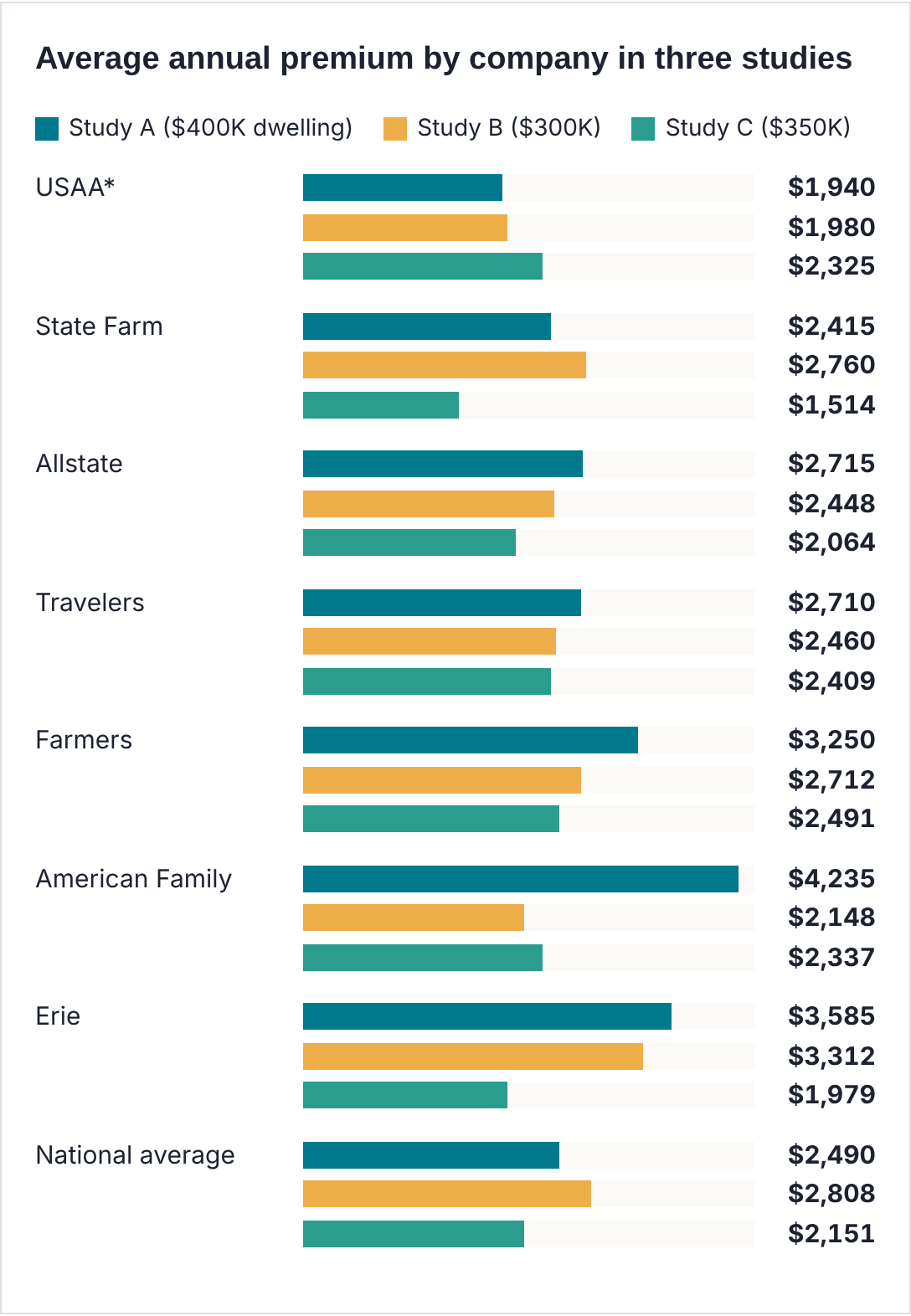
Study A: national rate study updated in 2026, $400,000 dwelling. Study B: updated October 21, 2026, $300,000 dwelling. Study C: updated September 25, 2026, $350,000 dwelling. All use a $1,000 deductible and good credit. *USAA is available only to military members, veterans, and their eligible family members.
Read this chart company by company, because each study prices a different house. USAA was cheap in every study. State Farm was the cheapest top-10 insurer in Study C, at $1,514, and the cheapest open to everyone in Study A, at $2,415, but slightly above average in Study B. American Family swung the most: the most expensive in Study A, at $4,235, but the cheapest top-10 insurer open to everyone in Study B, at $2,148.
Erie swung from $1,979 in Study C to $3,585 in Study A, partly because it sells in only 12 states and D.C. A national average can point you toward candidates, but only a quote on your own house tells you the price.
Average annual premiums for all 10 companies
| Company | Study A | Study B | Study C |
|---|---|---|---|
| USAA* | $1,940 | $1,980 | $2,325 |
| State Farm | $2,415 | $2,760 | $1,514 |
| Allstate | $2,715 | $2,448 | $2,064 |
| Travelers | $2,710 | $2,460 | $2,409 |
| Farmers | $3,250 | $2,712 | $2,491 |
| American Family | $4,235 | $2,148 | $2,337 |
| Erie | $3,585 | $3,312 | $1,979 |
| Auto-Owners | $3,280 | Not rated | $2,167 |
| Chubb | Not rated | $3,612 | Not rated |
| Liberty Mutual | Not rated | Not rated | Not rated |
| National average | $2,490 | $2,808 | $2,151 |
Study A: 2026, $400,000 dwelling; Study B: October 21, 2026, $300,000 dwelling; Study C: September 25, 2026, $350,000 dwelling. Compare each column only with itself. Liberty Mutual’s rates did not appear in any of the three studies. *USAA is available only to military members, veterans, and their eligible family members.
Cheapest top-10 insurer for each type of homeowner
The cheapest company changes as soon as your profile changes. This table shows the lowest-priced company in Study A for common situations, both overall and among the top 10 open to all homeowners. Progressive, an honorable mention, beat every top-10 insurer for poor credit.
Cheapest company by homeowner type, Study A (annual)
| Homeowner | Cheapest overall | Cheapest top-10 open to everyone | National average |
|---|---|---|---|
| Good credit, home built in 1984 | USAA, $1,940 | State Farm, $2,415 | $2,490 |
| Poor credit | Progressive, $3,920 | Allstate, $4,790 | $4,290 |
| One prior wind claim | USAA, $2,140 | State Farm, $2,840 | $2,750 |
| New home, built in 2025 | USAA, $815 | State Farm, $1,370 | $1,425 |
| High-value or custom home | Not priced | Chubb (specialist) | Not priced |
Study A: national rate study updated in 2026; $400,000 dwelling, $1,000 deductible. *USAA is available only to military members, veterans, and their eligible family members. Chubb was not in Study A; we list it because it specializes in high-value homes.
A new home is far cheaper to insure: Study A’s average fell from $2,490 for a 1984 home to $1,425 for one built in 2025, thanks to current building codes and newer roofs, wiring, and plumbing. One claim raised the average about 10%, to $2,750, but some insurers add much more.
Poor credit: the biggest price gap
Credit matters more than almost anything else in states that allow insurers to use it. In Study A, the average for a homeowner with poor credit was $4,290 a year, about 72% more than with good credit. The spread among the top 10 was enormous, from $4,115 at USAA to $7,915 at Auto-Owners, more than $3,800 a year for the same house (our calculation).
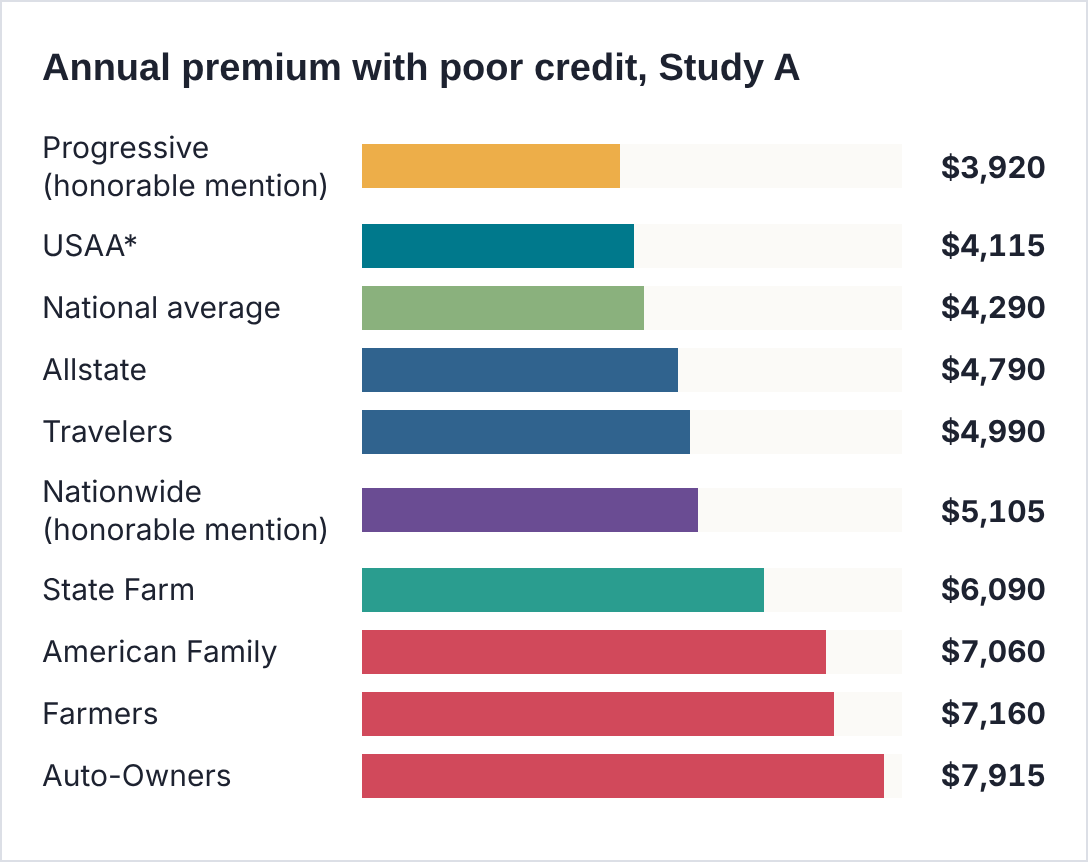
Study A: national rate study updated in 2026; $400,000 dwelling, poor credit. California, Maryland, and Massachusetts do not allow credit-based home insurance pricing. *USAA is available only to military members, veterans, and their eligible family members.
State Farm shows how credit reshuffles the ranking: cheapest open to everyone with good credit, but $6,090 with poor credit, about 2.5 times as much. Allstate moved the other way, so homeowners with weak credit should quote Allstate, Travelers, and Progressive first.
Ratings scorecard: financial strength, complaints, and satisfaction
Top 10 ratings scorecard
| Company | AM Best rating | J.D. Power 2026 overall (avg. 644) | J.D. Power 2026 claims (avg. 702) | NAIC complaints |
|---|---|---|---|---|
| State Farm | A+ (Superior) | 665 | 690 | About average |
| Allstate | A+ (Superior) | 638 | 672 | About average |
| USAA* | A++ (Superior) | 741 (not ranked) | 757 (not ranked) | Fewer than expected |
| Liberty Mutual | A (Excellent) | 608 | 722 | About average |
| Farmers | A (Excellent) | 615 | 691 | Fewer than expected |
| American Family | A (Excellent) | 656 | 700 | Fewer than expected |
| Travelers | A++ (Superior) | 614 | 700 | Fewer than expected |
| Chubb | A++ (Superior) | 676 | 744 | Far fewer than expected |
| Auto-Owners | A+ (Superior) | 628 | 681 | Far fewer than expected |
| Erie | A (Excellent) | 678 | 719 | Fewer than expected |
AM Best rating actions from November 2024 to October 2026; J.D. Power 2026 U.S. Home Insurance Study (September 15, 2026) and 2026 U.S. Property Claims Satisfaction Study (March 17, 2026), with full scores from a September 18, 2026 summary; NAIC complaint levels from 2026 company reviews. State Farm was downgraded from A++ in November 2025, Erie from A+ in September 2025, and Auto-Owners from A++ in October 2024.
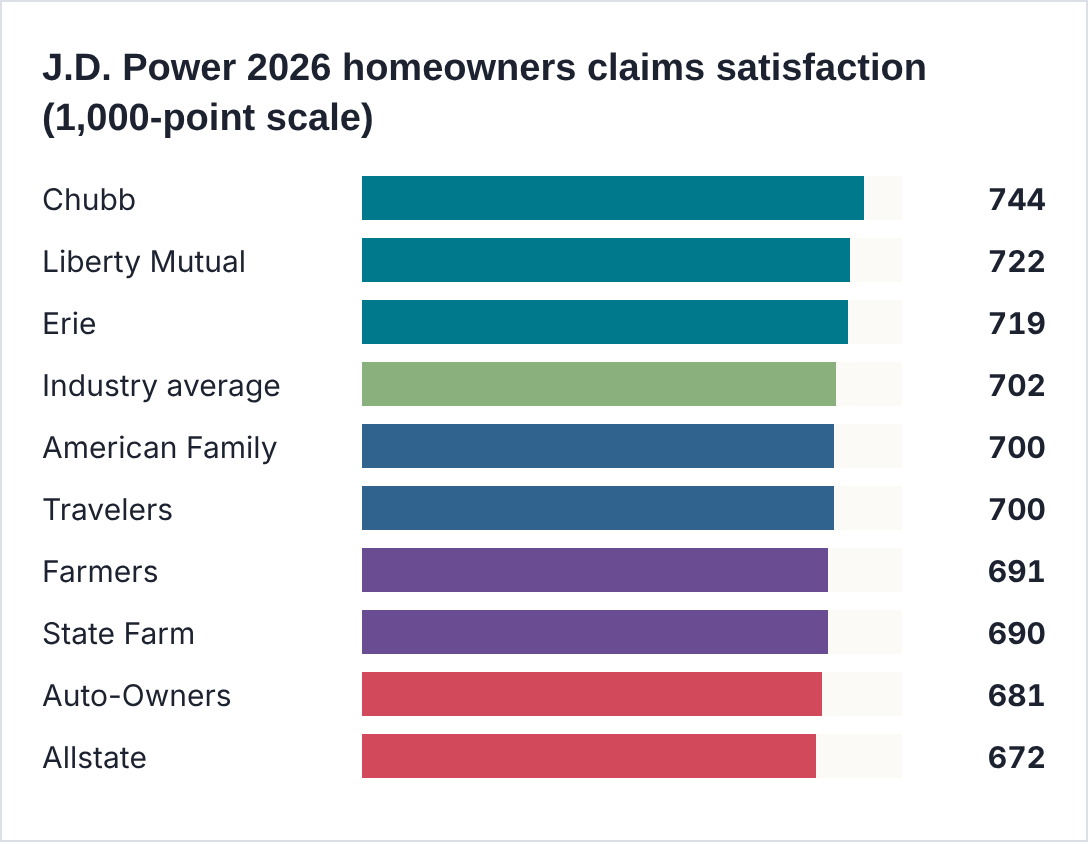
J.D. Power 2026 U.S. Property Claims Satisfaction Study (March 17, 2026); full scores from a September 18, 2026 summary. Amica led overall at 773. USAA scored 757 but is not rank-eligible.
Claims service is where the top 10 split most clearly. Chubb scored 744 in J.D. Power’s 2026 claims study, third in the nation, with Liberty Mutual and Erie also well above the 702 average. Allstate, at 672, and Auto-Owners, at 681, trailed the group. In J.D. Power’s broader 2026 Home Insurance Study, which covers billing, price, and service, Erie scored 678 and Chubb 676, second and third nationally behind Amica, while Liberty Mutual ranked lowest of the top 10, at 608. In Florida, Citizens and Universal Property hurricane claims processes are another useful point of comparison beyond the annual premium.
Financial strength is solid but less uniform than it was. AM Best downgraded State Farm, Erie, and Auto-Owners in 2024 and 2025, though all remain rated A or better. Only USAA, Travelers, and Chubb hold the top A++ rating among the top 10.
1. State Farm: best for agent service and good-credit homeowners
State Farm is the largest home insurer, with $35.27 billion in 2025 homeowners premiums and 18.69% of the market. It sells through local agents nationwide but is not writing new homeowners policies in California, Massachusetts, or Rhode Island. In California, it stopped new business in 2023, began nonrenewing about 72,000 policies in 2024, and won a 17% emergency rate increase. In September 2026, it proposed new California policies only for homes built to the strictest wildfire standards.
Its California company, State Farm General, carries a B (Fair) rating from AM Best, well below the A+ of its national companies.
Elsewhere, State Farm is often a bargain: the cheapest top-10 insurer open to everyone in Study A, at $2,415 a year, and the cheapest top-10 insurer in Study C, at $1,514. It also led open-to-all insurers after a wind claim, at $2,840, and for a new home, at $1,370. Its weak spot is poor credit, where Study A’s price jumped to $6,090. It scored 665 in J.D. Power’s 2026 Home Insurance Study, above average, but 690 for claims, below average.
- Bundling with auto: one 2026 review estimated savings of up to $1,429 a year
- Impact-resistant or Class 4 roof: available in 26 listed states
- Wildfire mitigation in California, Colorado, and Oregon; in Colorado, 4% to 18% off the wildfire portion of the premium for an IBHS Wildfire Prepared Home
- Home security, wind mitigation, hurricane-resistant windows, and claim-free discounts
State Farm’s standout perk is its free Ting program: an electrical fire sensor that plugs into an outlet, three years of monitoring, and up to $1,000 toward an electrician’s repair, offered at no cost in most states (not Alaska, Delaware, North Carolina, South Dakota, or Wyoming). Its policies can include an increased dwelling limit of up to 20% above your coverage amount when the home is insured to value. Optional coverages include water backup, service line, equipment breakdown, identity restoration, and earthquake insurance.
2. Allstate: best for discounts and homeowners with poor credit
Allstate is the second-largest home insurer, with $17.77 billion in 2025 premiums and 9.42% of the market. It sells through local agents and online and offers more perks and discount programs than most rivals. It is not writing new homeowners policies in California, Connecticut, or Florida, though it filed in September 2026 to reopen California. A Citizens, Allstate, and Progressive home insurance comparison illustrates Florida-specific differences, although current eligibility must be confirmed directly.
Allstate’s prices were about average: $2,715 a year in Study A, $2,448 in Study B, and $2,064 in Study C. It stood out for poor credit, at $4,790 in Study A, the cheapest top-10 insurer open to everyone. Its weakness is service. Allstate scored 672 in J.D. Power’s 2026 claims study, the lowest of the top 10, and 638 in the Home Insurance Study, just under average. AM Best affirmed its A+ (Superior) rating in September 2026.
- Bundling home and auto: up to 25%
- Early signing: quote and sign at least seven days before your current policy ends
- New home, recent home buyer, claim-free, protective device, and responsible payer discounts
- Easy Pay automatic payments and paying in full
Allstate’s optional perks can save real money over time. Claim RateGuard keeps your rate from rising after one claim, Deductible Rewards gives $100 off your deductible at sign-up and $100 more each claim-free year, up to $500, and Claim-Free Rewards is worth 5% each claim-free year, though reviewers describe it differently, so ask how it works in your state. HostAdvantage covers damage or theft by short-term rental guests, and add-ons include yard and garden, green improvement reimbursement, electronic data recovery, and musical instrument coverage.
3. USAA: best for military families
USAA is the third-largest home insurer, with $13.26 billion in 2025 premiums and 7.02% of the market, but only active-duty and former military members, some federal employees, and their eligible families can buy it. It sells in all 50 states and Washington, D.C. If you qualify, it is usually the price leader: in Study A, it charged $1,940 a year, the lowest of any company, and it also led after a claim, at $2,140, and for a new home, at $815.
Service is just as strong. USAA scored 741 in J.D. Power’s 2026 Home Insurance Study and 757 in the claims study, both far above average, though it is not officially ranked because of its eligibility rules. AM Best affirmed its A++ rating in June 2026, and its complaints run below expected levels. Its only real weakness is who it serves.
- Claims-free for five or more years: up to 15%
- Bundling with USAA auto: up to 10%; other USAA products: up to 9%
- Connected Home: up to 8% for at least two connected water leak detectors, an average of $133 a year
- Protective devices: up to 5%; loyalty after three years: up to 5%
USAA builds military needs into its policies. Uniforms and military equipment are covered with no deductible while you are on active or reserve duty, and the deductible is waived for losses from war in most states. Replacement cost coverage for belongings, with no depreciation, is standard. Its Home Protector option adds up to 25% more for rebuilding, debris removal, and code upgrades when your home is insured to at least 95% of its rebuilding cost.
4. Liberty Mutual: best for add-ons and claims service
Liberty Mutual is the fourth-largest home insurer, with $10.40 billion in 2025 premiums and 5.51% of the market. It sells online, by phone, and through independent agents. Availability is unclear: one February 2026 review listed 46 states and Washington, D.C., excluding California, North Dakota, South Dakota, and Wyoming, while other sources say it sells nationwide. In California, it stopped new condo and renters business and began nonrenewing those policies in 2026, so confirm what is available at your address.
Liberty Mutual’s rates did not appear in Study A, B, or C, so you will need a quote to judge price. Its service scores are split. It scored 722 in J.D. Power’s 2026 claims study, second among the top 10, but 608 in the Home Insurance Study, the lowest of the group, reflecting complaints about price and renewals. AM Best rates it A (Excellent), and recent reviews put its NAIC complaints near average, an improvement from earlier years.
- Bundling: Liberty Mutual says home and auto customers save an average of $950 a year
- Claims-free (five years with a prior insurer) and safe homeowner (three years claim-free with Liberty Mutual)
- Early shopper, newly purchased home, new or renovated home, and new roof
- Insured to value, Inflation Protection, preferred payment, and paperless
Liberty Mutual’s add-on menu is one of the deepest. Inflation Protection raises your coverage limits automatically at renewal, which helps keep up with rebuilding costs, and earns a discount. Blanket jewelry coverage protects rings and watches with no deductible and no appraisal. Other options include water backup, service line, equipment breakdown, identity theft, and extended replacement cost.
5. Farmers: best for coverage packages and deductible rewards
Farmers is the fifth-largest home insurer, with $10.31 billion in 2025 premiums and 5.46% of the market. It sells mainly through exclusive agents and is not available in Alaska, Delaware, Florida, Hawaii, Maine, New Hampshire, Rhode Island, South Carolina, Vermont, West Virginia, or Washington, D.C. It left Florida’s agency market in 2023. In California, Farmers lifted its monthly cap on new homeowners policies in November 2025 and filed to raise its home and auto bundle discount from 15% to 22%. Farmers home insurance options in California deserve a separate look because underwriting and wildfire exposure can differ sharply by address.
Price is the drawback. Farmers charged $3,250 a year in Study A, well above average, though $2,712 in Study B and $2,491 in Study C were closer to the middle. Its poor-credit price of $7,160 in Study A was among the highest. It scored 615 in J.D. Power’s 2026 Home Insurance Study and 691 for claims, both below average, but its NAIC complaints run below expected levels, and AM Best rates it A (Excellent).
- Bundling: 10% or more
- Claim-free for three years, good payer, preferred payment, and ePolicy
- Protective devices, connected home, home safety (such as leak or gas shutoff), and UL-approved roofing
- Green certification, new home (under 14 years old), affinity group, and GroupSelect for employer groups
Farmers sells home coverage in tiered packages, with the richest features in its top tier. Its Declining Deductible takes $50 off your deductible each year without a claim, and Claim Forgiveness applies after five claim-free years. Guaranteed replacement cost, which pays the full cost to rebuild even above your limit, comes with its top package, though not in California. Other options include emergency mortgage assistance for up to three months, homeshare coverage, and water backup.
6. American Family: best for Midwest and West homeowners who bundle
American Family, often called AmFam, is the sixth-largest home insurer, with $9.72 billion in 2025 premiums and 5.15% of the market. It sells in 19 states, mostly in the Midwest and West: Arizona, Colorado, Georgia, Idaho, Illinois, Indiana, Iowa, Kansas, Minnesota, Missouri, Nebraska, Nevada, North Dakota, Ohio, Oregon, South Dakota, Utah, Washington, and Wisconsin. It also owns Homesite, which sells home insurance through partners in other states.
AmFam’s prices depend heavily on the study. It was the most expensive top-10 insurer in Study A, at $4,235 a year, but the cheapest top-10 insurer open to everyone in Study B, at $2,148, and below average in Study C, at $2,337. With poor credit, Study A put it at $7,060. Service is a strength: it scored 656 in J.D. Power’s 2026 Home Insurance Study, above average, and 700 for claims, just under. AM Best affirmed its A (Excellent) rating on October 22, 2026.
- Bundling: American Family says customers could save up to 40% on both policies together
- Early bird: quote at least seven days before your current policy ends
- Age of home (under 15 years) and renovated home (plumbing, electrical, and heating updated within 15 years)
- Loyalty, generational (ages 18 to 30 with a parent who is a customer), smart home, and payment discounts
AmFam’s Diminishing Deductible gives a $100 credit on day one and $100 more at each renewal, up to $1,000, for an extra charge; it is not available in Minnesota. Extended replacement cost is standard when the home is insured to its full rebuilding value, and matching siding coverage helps when only part of a wall is damaged. Wildfire Defense Services is included in Arizona, Colorado, Nevada, Oregon, and Washington, and add-ons include hidden water, service line, equipment breakdown, and home business coverage.
7. Travelers: best for green homes and independent-agent buyers
Travelers is the seventh-largest home insurer, with $8.62 billion in 2025 premiums and 4.57% of the market. It sells through independent agents and online. One 2026 review listed it in 45 states and Washington, D.C., with gaps that include Florida and Louisiana. In April 2026, Travelers joined California’s Sustainable Insurance Strategy, saying it would expand homeowners availability across the state and increase discounts for wildfire mitigation, such as ember-resistant vents and Class A roofs.
Travelers’ prices were close to average: $2,710 a year in Study A, $2,460 in Study B, and $2,409 in Study C. It was the second-cheapest top-10 insurer open to everyone for poor credit, at $4,990, and below average after a wind claim, at $2,995. AM Best affirmed its A++ (Superior) rating in August 2026, and its complaints run below expected levels. Service is its weak spot: it scored 614 in J.D. Power’s 2026 Home Insurance Study and 700 for claims, both below average.
- Green home: up to 5% for a LEED-certified home
- Homebuyer: for a home bought within 12 months before the policy starts
- Multi-policy, loss-free, and protective device discounts, including smart-home technology
Travelers is the best-known choice for eco-conscious homeowners. Its Green Home Coverage pays to rebuild or repair with environmentally friendly materials after a covered loss, and its green home discount rewards LEED certification. Its identity fraud expense coverage pays up to $25,000, and options include water backup, extended replacement cost, contents replacement cost, and extra coverage for valuables.
8. Chubb: best for high-value homes and claims service
Chubb is the eighth-largest home insurer, with $4.71 billion in 2025 premiums and 2.50% of the market, and it focuses on high-value homes through its Masterpiece policy. It sells in all 50 states and Washington, D.C., mainly through independent agents and brokers, though eligibility in Florida and California depends on the home and its location. AM Best affirmed its A++ (Superior) rating in January 2026.
Chubb is not built to be cheap: in Study B, it averaged $3,612 a year for a $300,000 home, the most of any company listed there. But for expensive homes, its coverage and service are hard to match. It scored 744 in J.D. Power’s 2026 claims study, the best of the top 10, and 676 in the Home Insurance Study, third in the nation. Its complaints run far below expected levels.
- Portfolio and loyalty discounts for bundling home, auto, and valuables
- Alarm systems, fire sprinklers, and automatic water shutoff leak detectors
- Gated community, new or renovated home, and claims-free discounts
Chubb’s Masterpiece coverage includes features most insurers charge extra for. Extended replacement cost can pay to rebuild even if the cost exceeds your limit, and a cash settlement option pays up to your limit if you choose not to rebuild after a total loss. In most states, Chubb waives your deductible for losses over $100,000. HomeScan uses infrared cameras to find hidden leaks, and Wildfire Defense Services sends crews to protect enrolled homes in 19 states at no extra charge.
9. Auto-Owners: best for low complaints and independent-agent service
Auto-Owners is the ninth-largest home insurer, with $4.14 billion in 2025 premiums and 2.19% of the market. Based in Lansing, Michigan, it sells only through independent agents in about 25 states, mostly in the Midwest and South. You cannot get a quote or file a claim online; an agent handles both. AM Best rates it A+ (Superior), after a downgrade from A++ in October 2024 tied to auto losses.
Auto-Owners’ prices vary by study: $3,280 a year in Study A, above average, but $2,167 in Study C, about average. Its poor-credit price in Study A was $7,915, the highest of the top 10. Its strongest point is its complaint record, which is far better than expected for its size. It scored 628 in J.D. Power’s 2026 Home Insurance Study and 681 for claims, both below average.
- Mortgage-free: a discount for homes with no mortgage
- Paperless, on-time payments for three years, paying in full, and quoting before your policy expires
- Bundling, no claims, safety equipment, automatic water shutoff, and wind damage protection
- Backup generator: a discount for a qualifying generator
Auto-Owners offers optional guaranteed replacement cost, which pays the full cost to rebuild your home even above your limit. Its Homeowners Plus package covers appliance leaks, spoiled food after a power outage, and other everyday problems. Other add-ons include identity theft coverage up to $15,000, cyber protection, equipment breakdown, service line, and inland flood coverage, which most insurers do not sell.
10. Erie: best for customer satisfaction and built-in coverage
Erie is the 10th-largest home insurer, with $3.71 billion in 2025 premiums and 1.97% of the market. It sells through independent agents in 12 states and Washington, D.C.: Illinois, Indiana, Kentucky, Maryland, New York, North Carolina, Ohio, Pennsylvania, Tennessee, Virginia, West Virginia, and Wisconsin. AM Best lowered its rating from A+ to A (Excellent) in September 2025, citing years of weather losses.
Erie’s customers are among the happiest in the country. It scored 678 in J.D. Power’s 2026 Home Insurance Study, second only to Amica nationally and the best of the top 10, and 719 for claims, well above average. Prices vary by study: $1,979 a year in Study C, the second-cheapest of the top 10 there, but $3,585 in Study A and $3,312 in Study B.
- Multi-policy: bundling home with Erie auto or life insurance
- Advance quote: for quoting at least a week before your policy starts
- Protective devices, such as alarms and sprinklers
Erie offers fewer discounts than most rivals, but more coverage in the base policy. Guaranteed replacement cost on the home is a signature feature, though it may not be available in every state. The standard policy also covers lost cash up to $500, pets up to $500, mold up to $10,000, gift cards when a business closes, and the cost of replacing documents such as deeds and passports. Options include water backup, service line, equipment breakdown, and home-sharing coverage.
Honorable mentions: Nationwide and Progressive
Nationwide ranked 11th in 2025, with 1.85% of the market, and sells in about 46 states. It charged $3,345 a year in Study A, but it scored 720 in J.D. Power’s 2026 claims study and 646 in the Home Insurance Study, both above average.
Nationwide’s Brand New Belongings replaces damaged items with new ones, Better Roof Replacement installs a stronger roof after a covered loss, and most customers can get a free Ting fire sensor with five years of monitoring.
Progressive ranked 12th, with 1.77%, and works differently: it writes some policies itself and places others with partner insurers. It was the cheapest insurer in Study A for poor credit, at $3,920, and for a new home among companies open to everyone, at $840. When one storm damages your home and car, a policy written by Progressive Home charges only one deductible. It stopped selling new home policies in Texas in August 2024 and has cut back in Florida.
Strengths and weaknesses side by side
Top 10 strengths and weaknesses
| Company | Biggest strength | Biggest weakness |
|---|---|---|
| State Farm | Low good-credit prices; agents everywhere | Very expensive with poor credit; no new CA policies |
| Allstate | Many perks; cheapest top-10 option for poor credit | Lowest claims score of the top 10 |
| USAA | Lowest prices and top service | Military families only |
| Liberty Mutual | Deep add-on menu; strong claims score | Lowest overall satisfaction of the top 10 |
| Farmers | Packages, Declining Deductible, and claim forgiveness | Above-average prices; 10 states and DC excluded |
| American Family | Bundling of up to 40% and rich coverage | Sold in only 19 states |
| Travelers | A++ rating; green home coverage | Below-average satisfaction |
| Chubb | Best claims score; high-value coverage | Not built for budget homes |
| Auto-Owners | Very few complaints; inland flood option | No online quotes; highest poor-credit price |
| Erie | Top satisfaction; generous base policy | Only 12 states and DC; few discounts |
Which type of home insurance is cheapest?
The biggest factor you control is the dwelling amount, because premiums rise with the cost to rebuild. In Study A, the national average rose from $1,480 a year for $200,000 of dwelling coverage to $3,005 for $500,000. Study B showed the same pattern at higher prices, partly because it used different ZIP codes and an older home.
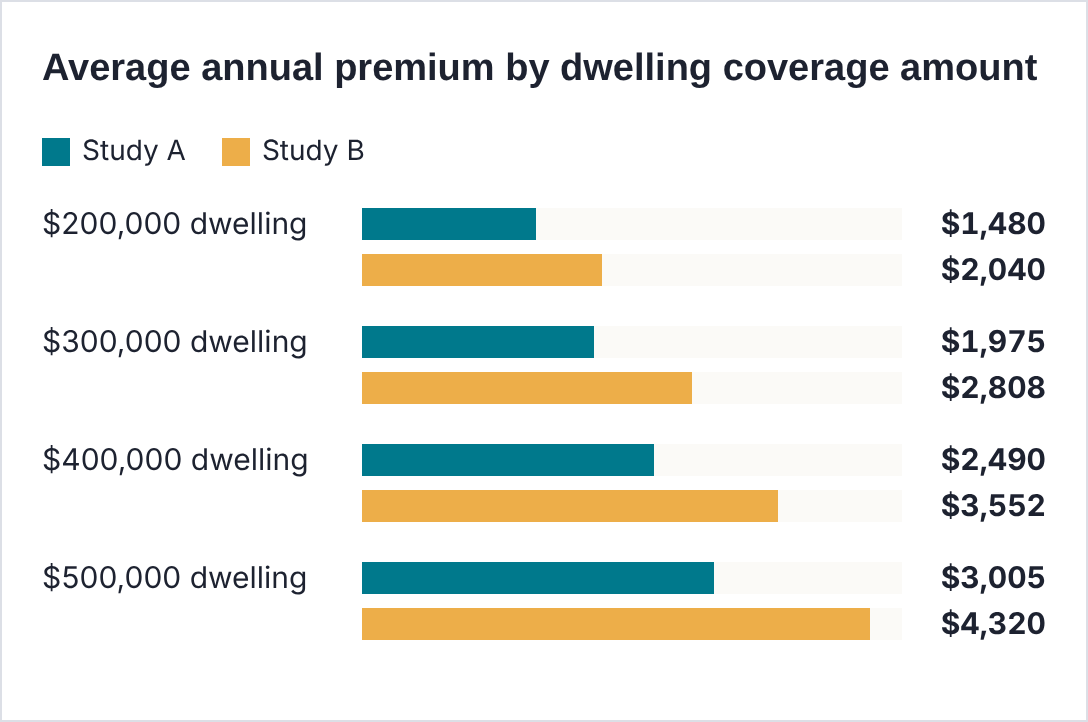
Study A: national rate study updated in 2026. Study B: national rate study updated October 21, 2026. Both use a $1,000 deductible.
Beyond the dwelling amount, three choices drive cost. An actual cash value policy, which subtracts depreciation from claim payments, costs less than replacement cost coverage but can leave you thousands short after a loss. A higher deductible, such as $2,500 instead of $1,000, lowers the premium, and many coastal policies use a separate percentage deductible for wind or hurricanes. Finally, a basic named-perils form such as HO-2 covers less than an HO-3, while an HO-5 covers belongings more broadly and costs more. For an example of why storm exclusions and deductibles matter, compare Citizens and State Farm hurricane coverage in Florida.
For most homeowners, the best value is an HO-3 policy with replacement cost on the house and belongings, a deductible you could pay from savings, and a dwelling limit that matches the true rebuilding cost. A home insurance coverage checklist can help identify gaps before requesting quotes.
Where the top 10 limit new policies
Availability matters as much as price in 2026. Several top-10 insurers have stopped or limited new policies in high-risk states. The factors that matter when choosing Florida homeowners insurance include roof age, storm exposure, deductibles, and whether a carrier is accepting new policies.
Where top-10 insurers limit homeowners coverage
| Company | States not sold or limited | Recent change |
|---|---|---|
| State Farm | No new policies in CA, MA, or RI | 17% CA rate increase upheld in 2026 settlement |
| Allstate | No new policies in CA, CT, or FL | Filed in September 2026 to reopen CA |
| USAA* | Sold in all 50 states and DC | No market exits found |
| Liberty Mutual | Some sources exclude CA, ND, SD, and WY | Nonrenewing CA condo and renters policies |
| Farmers | Not sold in 10 states and DC, including FL | Lifted CA cap on new policies in 2025 |
| American Family | Sold in 19 states only | No pullbacks found |
| Travelers | About 45 states and DC | Expanding in CA under 2026 state plan |
| Chubb | All 50 states; FL and CA eligibility varies | Tighter brush-distance rules in CA |
| Auto-Owners | About 25 states only | No pullbacks found |
| Erie | 12 states and DC only | No pullbacks found |
Company pages, 2026 reviews, and news reports (accessed October 29, 2026). Availability changes often; confirm with the insurer or an agent.
Replacement cost, water backup, and deductible rewards
Two policies with the same price can pay very differently after a loss. These features decide whether you can fully rebuild and whether your deductible shrinks over time.
Money-saving features at the top 10
| Company | Rebuilding protection | Deductible or claim reward | Free safety device |
|---|---|---|---|
| State Farm | Increased dwelling limit up to 20% | None found | Ting fire sensor, most states |
| Allstate | Extended replacement cost option | Deductible Rewards, up to $500; Claim RateGuard | None found |
| USAA* | Home Protector, up to 25% more | Claims-free discount up to 15% | None; leak sensor discount |
| Liberty Mutual | Inflation Protection; extended replacement cost | Claims-free discounts | None found |
| Farmers | Guaranteed replacement cost (top package) | Declining Deductible, $50 a year; Claim Forgiveness | None found |
| American Family | Extended replacement cost standard if insured to value | Diminishing Deductible, up to $1,000 | None found |
| Travelers | Extended replacement cost option | Loss-free discount | None found |
| Chubb | Extended replacement cost above your limit | Deductible waived for losses over $100,000 | HomeScan; wildfire crews |
| Auto-Owners | Guaranteed replacement cost option | No-claims discount | Generator discount |
| Erie | Guaranteed replacement cost | None found | None found |
Company pages and 2026 reviews (accessed October 29, 2026). Features vary by state and policy package.
PRO TIP #1
Add water backup coverage. A backed-up sewer or failed sump pump is one of the most common basement losses, and most standard policies exclude it unless you buy the endorsement. It usually costs far less than one uncovered cleanup.
Cheapest home insurance company in all 50 states
The cheapest company in your state is often not a national brand. In Study A’s state data, regional insurers such as Vermont Mutual, Buckeye, and Grange Insurance Association beat every top-10 company in several states. Still, State Farm was the cheapest company open to everyone in 10 states, more than any other insurer, and Travelers led in four states and Washington, D.C.
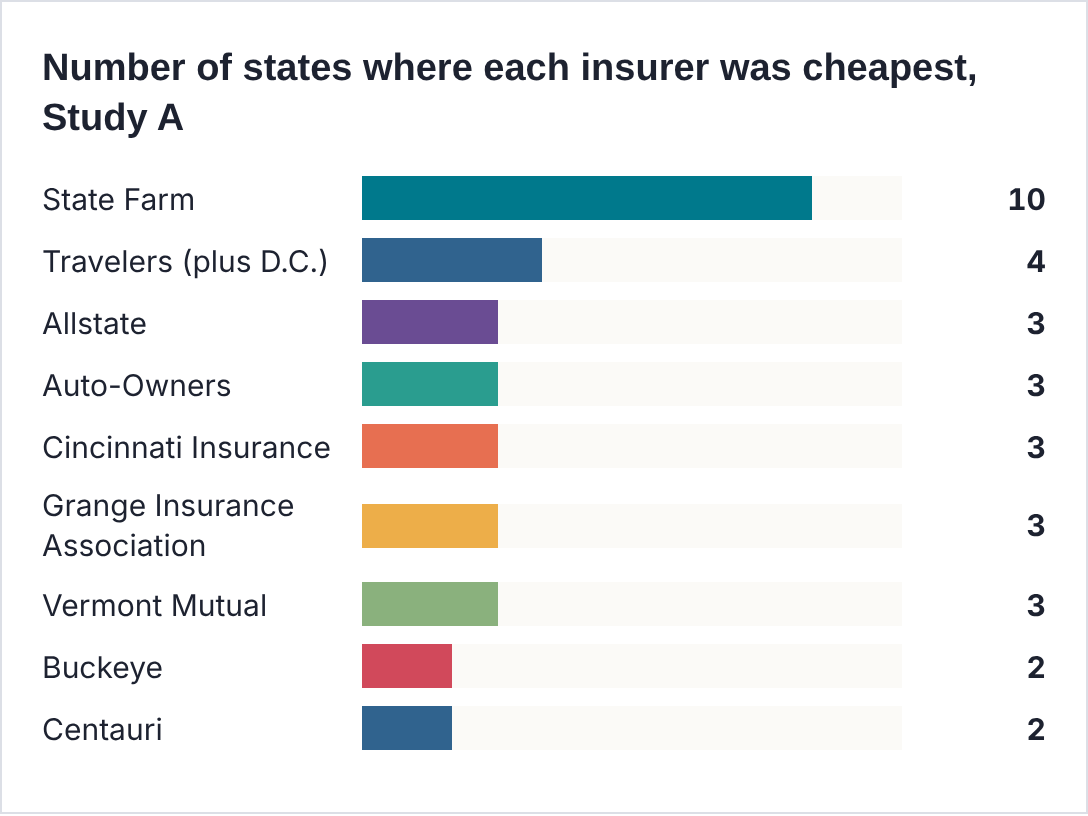
Study A: state-by-state cheapest company for $400,000 of dwelling coverage, good credit, and a $1,000 deductible (February 20, 2026). USAA was excluded because of its eligibility rules.
Each figure below is the average annual premium Study A found for the cheapest company in that state, for $400,000 of dwelling coverage, $300,000 of liability, a $1,000 deductible, and good credit. USAA was cheaper still in Alaska, Arkansas, Connecticut, Illinois, Mississippi, Oklahoma, Tennessee, West Virginia, and Washington, D.C., but it was left out because only military families can buy it. Your own price will depend on your ZIP code, home, and credit.
Alabama
Centauri, a regional property insurer, was cheapest in Alabama at $2,525 a year. Coastal homes pay far more than inland ones here, so homeowners near the Gulf should also ask about wind mitigation credits for a FORTIFIED roof.
Alaska
Umialik, an Alaska-based insurer, was cheapest at $1,285 a year, and Alaska ranks among the cheapest states for home insurance. USAA was even cheaper for military families, which matters in a state with several large military bases.
Arizona
State Farm was cheapest in Arizona at $1,745 a year. American Family also sells here and includes Wildfire Defense Services in Arizona, so compare it if you live near brush or forest land.
Arkansas
Travelers was the cheapest company open to everyone in Arkansas at $3,700 a year, and USAA was lower for military families. Arkansas is one of the most expensive states in Study A, with an average of $4,955, largely because of severe storms.
California
Pacific Specialty was cheapest in California at $1,130 a year. Shopping is harder here: State Farm and Allstate are not writing new homeowners policies, so many buyers compare regional insurers, Travelers, Farmers, and, as a last resort, the California FAIR Plan.
Colorado
Grange Insurance Association was cheapest in Colorado at $2,180 a year. Hail drives prices in much of the state, and State Farm offers Colorado wildfire mitigation discounts of 4% to 18% on the wildfire portion of the premium for qualifying homes.
Connecticut
State Farm was the cheapest company open to everyone in Connecticut at just $585 a year, one of the lowest prices in the country, and USAA was lower for military families. Allstate is not writing new homeowners policies in Connecticut.
Delaware
Travelers was cheapest in Delaware at $1,075 a year, well below the state’s $1,365 average in Study A. Delaware is among the five cheapest states for home insurance in that study.
Florida
People’s Trust, a Florida-based insurer, was cheapest at $1,715 a year. Florida has the most expensive coverage in some national studies, and Farmers and Allstate are not writing new homeowners policies there, so wind mitigation inspections and roof credits are essential for saving. A Florida homeowners insurance comparison should check quotes from actively writing insurers and account for windstorm deductibles.
Georgia
Auto-Owners was cheapest in Georgia at $2,520 a year. It sells only through independent agents, so ask an agent who represents Auto-Owners to quote it alongside State Farm, Allstate, and American Family.
Hawaii
DB Insurance was cheapest in Hawaii at just $415 a year, the lowest price in any state. Hawaii is the cheapest state overall in Study A, with a $900 average, but many standard policies there exclude hurricane damage, which often needs separate coverage.
Idaho
State Farm was cheapest in Idaho at $1,635 a year. American Family also sells in Idaho, so homeowners who bundle home and auto should compare both companies.
Illinois
Allstate was the cheapest company open to everyone in Illinois at $2,260 a year, and USAA was lower for military families. Illinois is one of the few states where Erie, American Family, and Auto-Owners all compete, so independent agents have many options to quote.
Indiana
Buckeye, a regional mutual insurer, was cheapest in Indiana at $1,050 a year. Indiana homeowners can also compare Erie, American Family, and Auto-Owners, which all sell in the state.
Iowa
Integrity, a regional insurer, was cheapest in Iowa at $2,655 a year. Hail and windstorms push Iowa prices up, so ask about impact-resistant roof discounts, which State Farm offers in Iowa.
Kansas
State Farm was cheapest in Kansas at $2,665 a year, about half the state’s $5,455 average in Study A. Kansas is one of the most expensive states because of hail, so roof type and age matter a great deal.
Kentucky
Cincinnati Insurance was cheapest in Kentucky at $2,925 a year. It sells through independent agents, who can also quote Erie and Auto-Owners, both of which sell in Kentucky.
Louisiana
Centauri was cheapest in Louisiana at $1,275 a year. Hurricane risk keeps the state’s average high in some studies, so coastal homeowners should check their separate wind or hurricane deductible before choosing the cheapest policy.
Maine
Vermont Mutual was cheapest in Maine at $975 a year. Maine is one of the least expensive states for home insurance, and a New England regional insurer led there, as it did in New Hampshire and Vermont.
Maryland
Travelers was cheapest in Maryland at $1,595 a year. Maryland does not allow insurers to use credit in home insurance pricing, so homeowners with weaker credit are not penalized the way they are in most states.
Massachusetts
N&D Group was cheapest in Massachusetts at $750 a year. State Farm is not writing new homeowners policies in Massachusetts, and the state bans credit-based home insurance pricing.
Michigan
Auto-Owners, which is based in Lansing, was cheapest in Michigan at $1,415 a year. Its independent agents can also bundle auto insurance, which is especially valuable in Michigan, where car insurance is expensive.
Minnesota
Western National was cheapest in Minnesota at $2,160 a year. American Family sells in Minnesota but does not offer its Diminishing Deductible or hidden water coverage there.
Mississippi
State Farm was the cheapest company open to everyone in Mississippi at $2,995 a year, and USAA was lower for military families. Coastal homeowners should compare wind deductibles carefully.
Missouri
AAA’s Auto Club insurer was cheapest in Missouri at $2,465 a year, though you typically need a club membership to buy it. American Family and Auto-Owners also sell in Missouri.
Montana
State Farm was cheapest in Montana at $3,035 a year. Hail and wildfire risk both affect prices in Montana, so ask about roof and wildfire mitigation discounts.
Nebraska
State Farm was cheapest in Nebraska at $5,015 a year, the highest cheapest-company price of any state. Nebraska averages $6,015 in Study A, second only to Oklahoma, because of frequent hail and severe storms.
Nevada
CIG, a regional insurer, was cheapest in Nevada at $980 a year. American Family includes Wildfire Defense Services for Nevada homeowners, a useful feature in fire-prone areas near Reno and Lake Tahoe.
New Hampshire
Vermont Mutual was cheapest in New Hampshire at $900 a year. New Hampshire is one of the least expensive states for home insurance in national studies.
New Jersey
Cumberland Mutual, a New Jersey insurer, was cheapest at $1,030 a year. New Jersey’s average of $1,480 in Study A makes it one of the five cheapest states, though shore homes cost much more to insure.
New Mexico
State Farm was cheapest in New Mexico at $2,095 a year. One national forecast expected New Mexico premiums to rise more than 10% in 2026, so homeowners there should shop at renewal.
New York
Preferred Mutual was cheapest in New York at $920 a year. Erie also sells in New York, and its high customer satisfaction makes it worth a quote, especially upstate.
North Carolina
Lititz Mutual was cheapest in North Carolina at $1,535 a year. Erie and Auto-Owners both sell in the state, but USAA’s Connected Home discount is not available there.
North Dakota
North Star, a regional mutual insurer, was cheapest in North Dakota at $2,490 a year. Some sources say Liberty Mutual does not sell home insurance in North Dakota, so check before requesting a quote.
Ohio
Buckeye was cheapest in Ohio at $885 a year. Ohio has one of the most competitive markets in the country, with State Farm, Allstate, Erie, Liberty Mutual, American Family, and Auto-Owners all among its largest home insurers.
Oklahoma
State Farm was the cheapest company open to everyone in Oklahoma at $4,610 a year, and USAA was lower for military families. Oklahoma is the most expensive state in Study A, at $7,255, because of hail, tornadoes, and windstorms.
Oregon
Grange Insurance Association was cheapest in Oregon at $1,130 a year. American Family includes Wildfire Defense Services in Oregon, and State Farm offers wildfire mitigation discounts there.
Pennsylvania
Selective was cheapest in Pennsylvania at $960 a year. Erie, which is based in Pennsylvania, and Auto-Owners also sell there, so independent agents can compare several strong regional options.
Rhode Island
NLC Insurance was cheapest in Rhode Island at $1,195 a year. State Farm is not writing new homeowners policies in Rhode Island, and Farmers does not sell there.
South Carolina
Cincinnati Insurance was cheapest in South Carolina at $2,160 a year. Coastal homeowners should compare wind deductibles, and Farmers does not sell in the state.
South Dakota
Auto-Owners was cheapest in South Dakota at $3,020 a year. American Family also sells in the state, but some sources say Liberty Mutual does not, and State Farm’s Ting sensor program is not offered there.
Tennessee
Allstate was the cheapest company open to everyone in Tennessee at $2,365 a year, and USAA was lower for military families. Erie and Auto-Owners also sell in Tennessee through independent agents.
Texas
Mercury was cheapest in Texas at $1,905 a year, well below the state’s $4,915 average in Study A. Progressive stopped writing new home policies in Texas in 2024, so homeowners there rely more on State Farm, Allstate, and regional insurers.
Utah
Travelers was cheapest in Utah at $1,115 a year. American Family and Auto-Owners also sell in Utah, which makes it a good state to compare agent-sold and direct options.
Vermont
Vermont Mutual was cheapest in its home state at $720 a year. Vermont is the second-cheapest state in Study A, with an average of $1,170.
Virginia
Cincinnati Insurance was cheapest in Virginia at $1,095 a year. Virginia homeowners can also compare Erie and Auto-Owners, both of which sell in the state.
Washington
Grange Insurance Association was cheapest in Washington at $1,330 a year. American Family includes Wildfire Defense Services in Washington, a plus for homes east of the Cascades.
West Virginia
State Farm was the cheapest company open to everyone in West Virginia at $1,910 a year, and USAA was lower for military families. Erie sells in West Virginia, but Farmers does not.
Wisconsin
Allstate was cheapest in Wisconsin at $1,420 a year. Wisconsin is the home state of American Family, which also competes closely there, along with Erie and Auto-Owners.
Wyoming
Nationwide was cheapest in Wyoming at $1,765 a year. Some sources say Liberty Mutual does not sell home insurance in Wyoming, and State Farm’s Ting program is not offered there.
Washington, D.C.
Travelers was the cheapest company open to everyone in the nation’s capital at $1,535 a year, and USAA was lower for military families. Erie also sells in Washington, D.C.
Which top-10 insurer is best for you?
Best top-10 insurer by homeowner type
| If you are… | Start with | Why |
|---|---|---|
| Military, a veteran, or a family member | USAA | Lowest prices and highest satisfaction |
| A homeowner with good credit | State Farm | Cheapest top-10 option open to everyone in Study A |
| A homeowner with poor credit | Allstate or Travelers | $4,790 and $4,990, lowest top-10 options open to everyone |
| The owner of a high-value home | Chubb | Masterpiece coverage and the best claims score |
| A homeowner in the Midwest or West | American Family | Bundling of up to 40% and rich coverage |
| A homeowner in Erie’s 12 states | Erie | Top satisfaction and guaranteed replacement cost |
| A buyer of a newly built home | State Farm or USAA | $1,370 and $815 for a 2025 home in Study A |
| A homeowner who wants an independent agent | Travelers, Auto-Owners, or Erie | Agents can compare insurers for you |
| A homeowner who wants many add-ons | Allstate, Liberty Mutual, or Farmers | Deep coverage menus and perks |
| An eco-conscious homeowner | Travelers | Green home discount and coverage |
Discounts every homeowner should ask about
Every top-10 insurer offers some version of the same core discounts, and the largest published ones are tied to bundling and staying claim-free. Most insurers do not publish exact percentages, so the chart shows only the maximums companies state on their own sites. Florida home insurance discounts from Citizens and private insurers are worth reviewing separately because wind-mitigation credits can be especially important there.
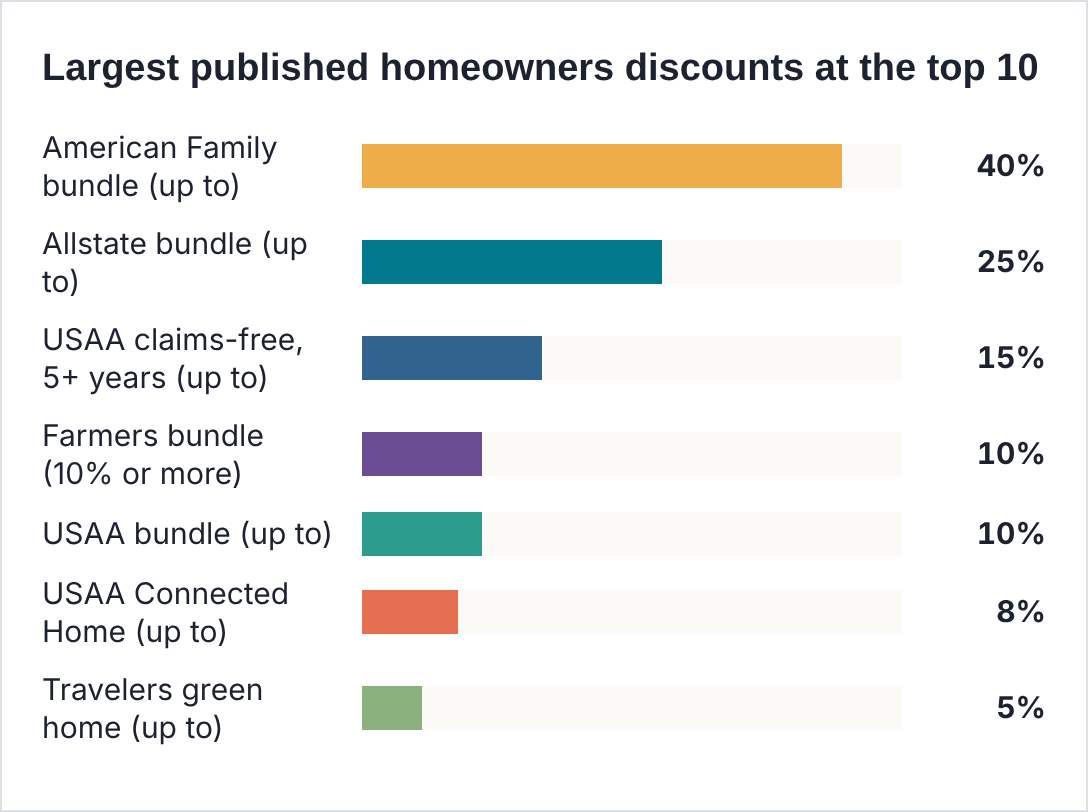
Company pages and 2026 reviews (accessed October 29, 2026). Discounts vary by state and are not always combinable.
- Bundling home and auto, often the single biggest discount
- Claim-free discounts, after three to five years without a claim
- Protective devices: monitored alarms, smoke detectors, sprinklers, and deadbolts
- Smart home and leak detection: connected water sensors and automatic shutoff valves
- Roof discounts for new, impact-resistant, or Class 4 roofs, and wind or wildfire mitigation credits
- New home, recent home buyer, and renovated home discounts
- Early quote, paying in full, autopay, and paperless billing
More ways to save with any top-10 insurer
Raising your deductible from $1,000 to $2,500 lowers your premium, as long as you could pay the higher amount after a loss. Better credit helps everywhere except California, Maryland, and Massachusetts. Paying off a mortgage can earn a discount at Auto-Owners, and buying a newer home or replacing an old roof can cut costs at nearly every insurer.
Small claims can cost more than they pay, since one claim raised Study A’s average by about 10%. Mitigation pays too: wind-resistant roofs, storm shutters, and wildfire defensible space earn credits in many states, and State Farm’s Colorado wildfire discount reaches 18% of the wildfire portion of the premium.
How to compare the top 10 home insurance companies
- Check which of the 10 sell new policies at your address; State Farm, Allstate, and Farmers have major gaps.
- Get a rebuilding cost estimate, not a market value, and set the dwelling limit to match it.
- Choose your form and deductible: HO-3 with replacement cost is the usual choice.
- Get at least three quotes with identical limits, deductibles, and endorsements.
- Ask each insurer to apply every discount, especially bundling and protective devices.
- Compare claims satisfaction, complaint levels, and AM Best ratings, not just price.
- Start the new policy before canceling the old one, and tell your mortgage lender about the switch.
PRO TIP #2
Shop about 30 days before renewal, not after. Allstate, American Family, Progressive, and Erie all reward quoting at least a week in advance, and starting early gives your lender time to update its escrow account so a payment is not missed.
Top 10 home insurance companies at a glance
This illustrated summary pulls together the main points of this guide.
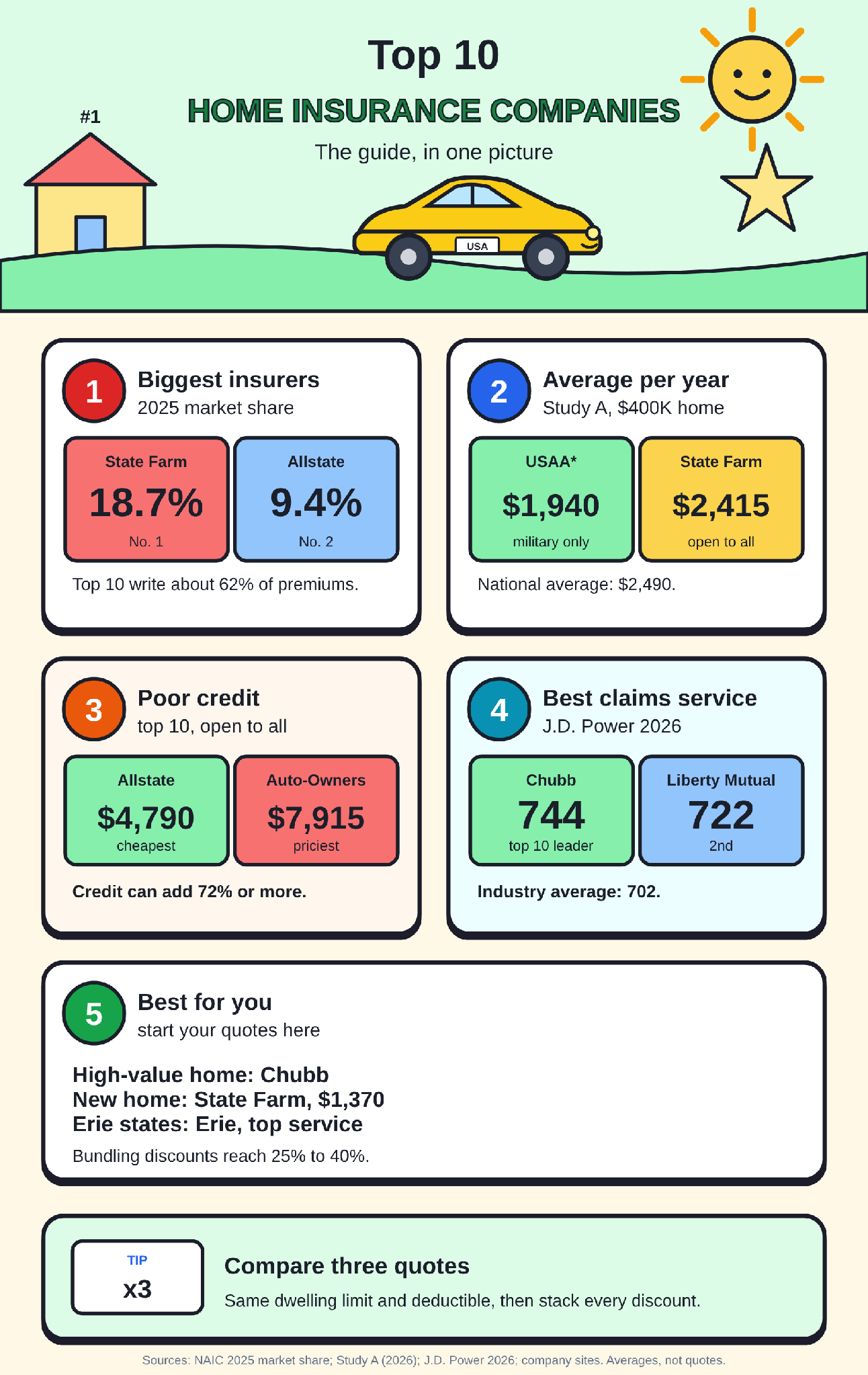
Top 10 home insurance companies at a glance. Sources: NAIC 2025 market share data; Study A (2026); J.D. Power 2026; company sites. Averages, not quotes.
Frequently asked questions
What are the top 10 home insurance companies?
By 2025 homeowners premiums written, the top 10 are State Farm, Allstate, USAA, Liberty Mutual, Farmers, American Family, Travelers, Chubb, Auto-Owners, and Erie. Together they wrote about 62.5% of the $188.69 billion in U.S. homeowners premiums. Nationwide ranked 11th and Progressive 12th.
Which is the largest home insurance company?
State Farm, by a wide margin. It wrote $35.27 billion in homeowners premiums in 2025, or 18.69% of the market, about twice as much as No. 2 Allstate, at $17.77 billion. State Farm is not writing new homeowners policies in California, Massachusetts, or Rhode Island.
Which top-10 home insurer is cheapest?
For military families, USAA, at $1,940 a year in Study A. Among insurers open to everyone, State Farm was cheapest in Study A, at $2,415, and in Study C, at $1,514. In Study B, American Family was cheapest at $2,148. Because studies disagree, compare quotes on your own home.
How much is homeowners insurance on average?
It depends on the dwelling amount and the study. Study A averaged $2,490 a year for $400,000 of dwelling coverage, Study B $2,808 for $300,000, and Study C $2,151 for $350,000. Prices in Oklahoma, Nebraska, Kansas, Texas, and Florida run far above average.
Which insurer has the best home claims service?
Among the top 10, Chubb scored 744 in J.D. Power’s 2026 claims study, followed by Liberty Mutual at 722 and Erie at 719, against a 702 average. USAA scored 757 but is not officially ranked. Allstate scored lowest of the top 10, at 672.
Which company is best for poor credit?
In Study A, Progressive, an honorable mention, was cheapest at $3,920 a year, followed by USAA at $4,115 for military families. Among the top 10 open to everyone, Allstate, at $4,790, and Travelers, at $4,990, were the cheapest. State Farm charged $6,090, and Auto-Owners $7,915.
Which home insurer is best for an expensive home?
Chubb specializes in high-value homes. Its Masterpiece policy includes extended replacement cost that can exceed your limit, a cash settlement option after a total loss, a deductible waiver on losses over $100,000 in most states, and free wildfire defense in 19 states. It also had the best top-10 claims score in 2026.
Is a bigger home insurance company always better?
No. Size brings financial strength, but the largest insurers are also the ones pulling back in high-risk states, and prices vary widely. In Study A, top-10 averages ranged from $1,940 to $4,235 a year. Compare price, claims service, and coverage features together.
The final word on the top 10 home insurance companies
The top 10 home insurance companies protect most American homeowners, but they are far from interchangeable. USAA is the clear value for military families, State Farm leads on price for many good-credit homeowners where it still sells, Allstate is the top-10 bargain for poor credit, and Chubb is the specialist for expensive homes. Erie and American Family shine in their regions, while Liberty Mutual, Farmers, and Allstate offer the deepest menus of add-ons.
The right choice depends on your state, your credit, your home’s age, and how much you value claims service. Use the tables in this guide to build a short list, set your dwelling limit to the true rebuilding cost, then get at least three quotes with identical coverage and apply every discount.
NEXT STEP
Pick the three top-10 insurers that match your profile in our “best for” table, confirm each one is writing new policies at your address, and compare the total yearly cost, discounts, replacement cost terms, and claims ratings before you switch.
Prices, discounts, features, ratings, and availability change and vary by state, home, and homeowner. The figures in this article are published averages, ratings, and our calculations, not quotes or offers. This article is for information only and is not legal or financial advice. The publisher is not an insurance company or a licensed insurance agency.
The bottom line on the top 10 home insurance companies: there is no single best insurer for every house, but there is a best one for yours, and a few quotes from this list will show you which it is.
Sources
- NAIC, 2025 Top 25 Groups and Companies by Countrywide Premium (2026); 2025 homeowners market share, top 100 (2026); 2024 homeowners market share.
- NerdWallet, Average home insurance cost (May 6, 2026), Cheapest home insurance (February 20, 2026), and credit and home insurance rates (February 20, 2026).
- Insurify, Average cost of homeowners insurance (October 21, 2026); ValuePenguin, Average cost of homeowners insurance (September 25, 2026).
- J.D. Power, 2026 U.S. Home Insurance Study (September 15, 2026); 2026 U.S. Property Claims Satisfaction Study (March 17, 2026); Insurance.com, full J.D. Power scores (September 18, 2026).
- Insurance Journal, homeowners rate changes (S&P Global data) (August 13, 2026); Insurance Journal, AM Best 2025 homeowners results (October 19, 2026); NAIC, homeowners market dynamics report (August 5, 2026).
- AM Best rating actions for State Farm, USAA, Liberty Mutual, Farmers, American Family, Travelers, Chubb, Auto-Owners, and Erie, 2024 to 2026.
- Official discount and coverage pages: State Farm, USAA, Farmers, American Family, Travelers, Chubb, Nationwide, and Progressive (accessed October 29, 2026).
- NerdWallet homeowners reviews of Allstate, State Farm, Liberty Mutual, and Auto-Owners (February 20, 2026); MoneyGeek, Allstate review (September 7, 2026).
- News: State Farm California settlement (March 9, 2026); Allstate California filing (September 4, 2026); Farmers California plan (November 21, 2025); Travelers California expansion (April 24, 2026); Liberty Mutual and Safeco in California (December 20, 2024).
Disclaimer
This website provides independent reviews. It is not affiliated with, endorsed by, sponsored by, or connected to any of the insurance companies named in this article, including State Farm, Allstate, USAA, Liberty Mutual, Farmers, American Family, Travelers, Chubb, Auto-Owners, Erie, Nationwide, or Progressive.
All company names, brand names, and trademarks are the property of their respective owners and are used here only to identify the companies and products discussed. Their use does not imply any affiliation or endorsement.
The information on this page is provided for general informational and educational purposes only. It is not insurance, legal, tax, or financial advice, and it is not an offer, quote, or solicitation to buy or sell insurance. We are not an insurance company, insurance agency, or licensed insurance producer.
Prices, discounts, ratings, and company details can change at any time and vary by state, home, and homeowner. While we make reasonable efforts to keep this article accurate, we make no representations or warranties, express or implied, about its completeness, accuracy, or reliability. Always confirm details directly with the insurer before making a decision. Your use of this information is at your own risk.