
Good Car Insurance Companies: Top 10 Insurers Compared
Finding good car insurance companies is harder than it looks, because the cheapest insurer is not always the one that treats you well after a crash. A good company does three things at once: it charges a fair price for your kind of driver, it pays claims quickly and fairly, and it has the money to pay them even in a bad year.
This guide compares 10 insurers that performed well on at least some important measures in 2026; none is best for every driver or every state. We compared prices from three national rate studies, financial strength ratings from AM Best, complaint data reported to state regulators, and the J.D. Power satisfaction and claims studies released in June and October 2026. Then we picked the best companies for teens, students, seniors, bundling, SR-22 filings, clean records, bad credit, temporary needs, liability-only coverage, and full coverage.
KEY TAKEAWAYS
- Travelers is the cheapest full coverage company for most drivers in two of three 2026 rate studies, at $1,652 a year in Study A against a $2,361 national average.
- Amica ranked first in the J.D. Power 2026 claims study with 775 points, and Erie won three regions in the 2026 auto insurance satisfaction study.
- State Farm is the best pick for teens and bundling, while GEICO is the cheapest for liability-only coverage at $492 a year in Study A.
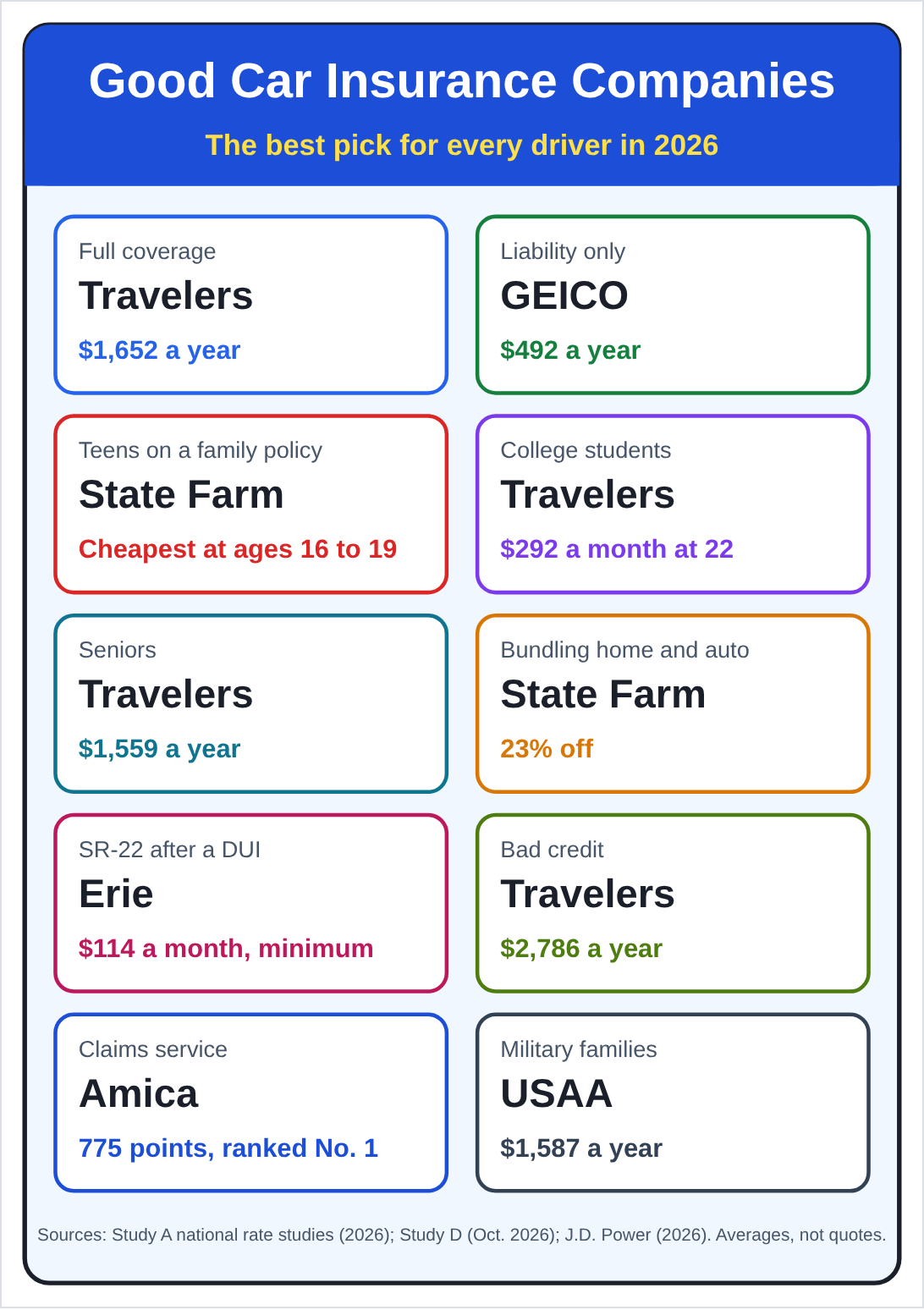
The best good car insurance company for each type of driver in 2026. Yearly prices are full coverage unless noted; teen, student, and SR-22 prices are monthly. Averages, not quotes.
How we picked good car insurance companies
A low price alone does not make a company good. We assessed insurers across five factors that matter before and after a claim. This is a qualitative editorial selection, not a mathematically weighted score: the data sources do not measure identical populations, and no single published metric determines the order.
What we measured
| Factor | What it tells you | Data used |
| Price | What drivers like you pay on average | Three national rate studies updated in 2026 |
| Financial strength | Whether the company can pay claims in a bad year | AM Best ratings, 2025 to 2026 |
| Complaints | How often customers complain to regulators | NAIC complaint index, reported August 2026 |
| Satisfaction | How customers rate service and value | J.D. Power 2026 U.S. Auto Insurance Study |
| Claims service | How well the company handles claims | J.D. Power 2026 U.S. Auto Claims Satisfaction Study |
Study A: national rate study updated October 2026, which reports medians. Study B: national rate study updated August and September 2026. Study C: national quote analysis updated October 21, 2026.
The three rate studies use different drivers, cars, and ZIP codes, so their averages never match. We name the study behind every price in this guide, and we favor companies that look good in more than one study. The insurer-specific internal reviews linked below are written in Spanish.
Rate-data date check (November 17, 2026): Study A figures and illustrations below reproduce the October 2026 NerdWallet snapshot, including Travelers at $1,652 and a $2,361 national benchmark. NerdWallet’s November 2026 update reports $1,588 for Travelers and $2,357 for the national full-coverage benchmark. The October values remain here for internal consistency with the original tables and graphics; they are historical sample rates, not the newest available prices. Current NerdWallet comparison.
What makes a car insurance company good
Most drivers judge an insurer by its price, because that is the only number they see before buying. The real test comes later, when you file a claim, need a policy change, or want help after a storm. A credible comparison weighs both the quote and evidence about complaints, claims satisfaction and financial strength; none of those metrics alone proves how a future claim will be handled.
Financial strength is the base of that promise. AM Best financial-strength ratings are an assessment of an insurer’s ability to meet ongoing obligations; even an A-level rating is not a guarantee that every claim will be covered or paid. Check the rating of the actual underwriting company on your policy, not just its parent brand.
Complaints are the next clue. The NAIC complaint index compares the number of complaints filed with state regulators to the size of each company. A score of 1.00 is the expected benchmark, while 0.50 and 2.00 represent roughly half and twice the expected complaint frequency for the relevant comparison group. A low complaint index is a useful screening signal, but it does not establish that claims are handled fairly or promptly. Complaint indexes depend on the reporting year, line of business and legal insurer; the figures below were supplied by a secondary comparison, not individually reconciled against the NAIC database.
Satisfaction studies fill in the rest. J.D. Power surveys thousands of policyholders each year about price, service, digital tools, and claims. Because the results are reported by region, they also show which companies are good where you live, not just on average.
Finally, a good company fits your situation. A teen driver, a retiree, and a driver who needs an SR-22 will each find different companies at the top of their list, which is why this guide includes a best pick for each group.
The 10 good car insurance companies at a glance
Top 10 good car insurance companies in 2026
| Company | Best for | AM Best | Complaint index | Study A full coverage |
| Travelers | Cheap full coverage | A++ | 0.52 | $1,652 |
| State Farm | Teens and bundling | A+ | 0.79 | $1,985 |
| GEICO | Liability only | A++ | 0.69 | $2,020 |
| USAA | Military families | A++ | 1.18 | $1,587 |
| Erie | Satisfaction and SR-22 | A | 0.89 | Not rated |
| Amica | Claims service | A+ | 0.75 | $3,167 |
| Nationwide | Usage-based savings | A | 0.63 | Not rated |
| Progressive | High-risk drivers | A+ | 0.71 | $2,277 |
| Auto-Owners | Low prices via local agents | A++ (historical; recheck) | 0.54 | Not rated |
| American Family | Fewest complaints | A | 0.33 | Not rated |
Financial-strength grades are attributed to the listed insurance groups in the cited secondary sources; the Auto-Owners affirmation noted here dates back to 2019 and should not be treated as a current verification. Complaint indexes are reproduced from an August 2026 secondary report whose underlying NAIC complaint year and company/group scope were not independently reconciled. Study A is an October 2026 rate snapshot, not a quote.
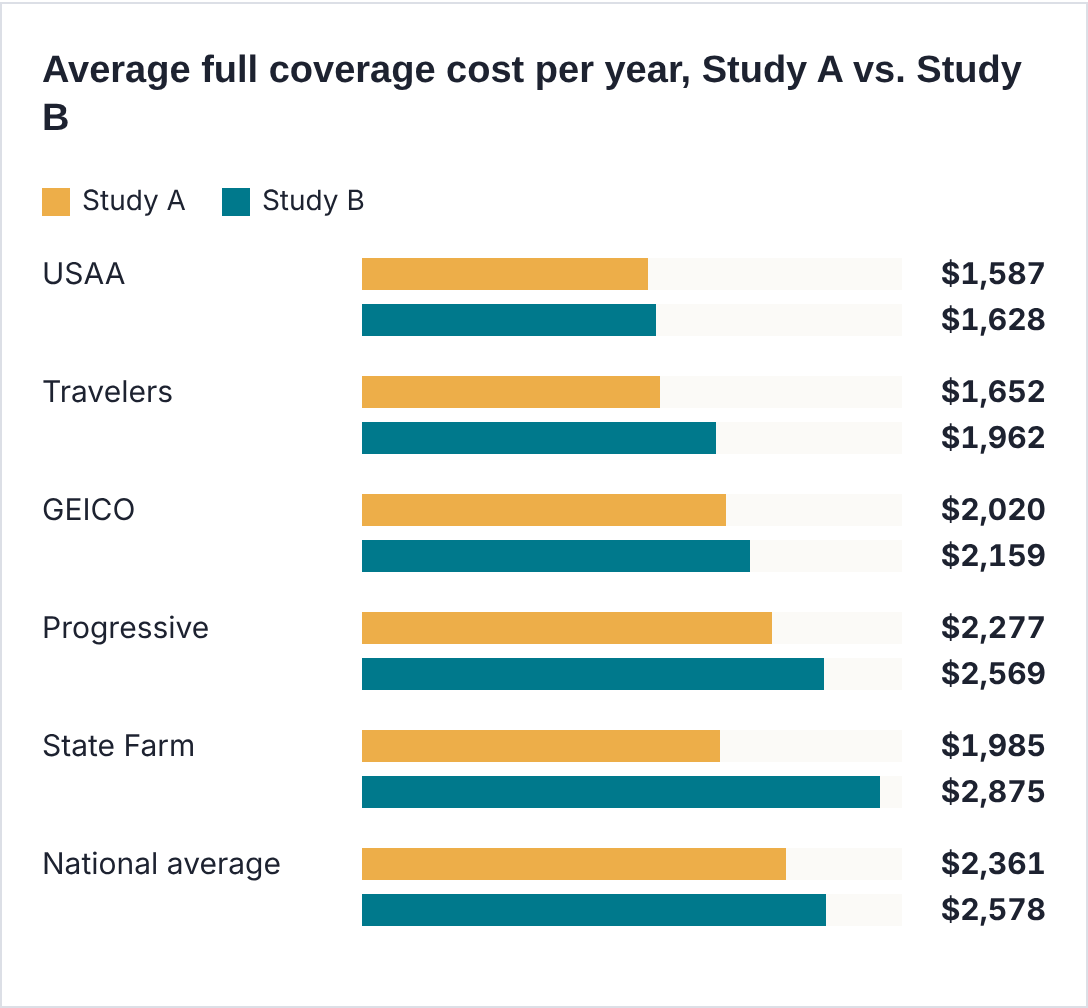
Study A: national rate study updated October 2026 (medians). Study B: national rate study updated August and September 2026. Averages, not quotes.
Travelers had the lowest full-coverage average among the nationally available companies examined in Studies A and B; that does not make it the cheapest option for every driver. USAA is cheaper still, but only military members, veterans, and their families can join. State Farm shows the widest gap between studies, from $1,985 to $2,875, which is a good reminder that your own quote can land far from any average.
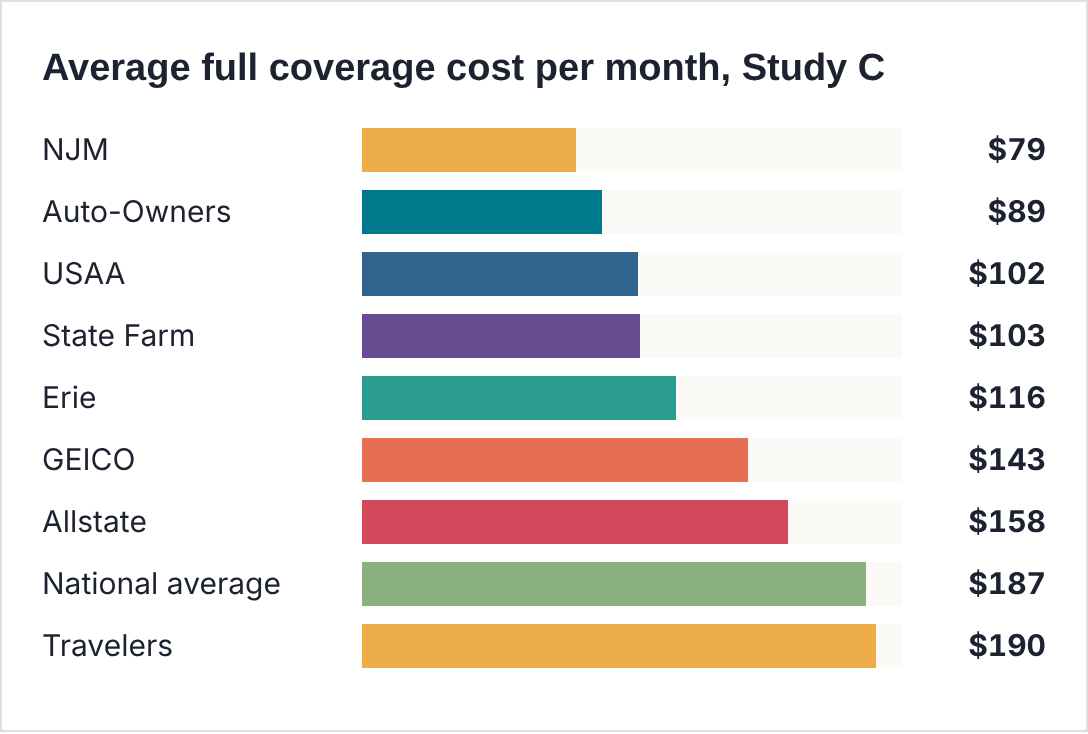
Study C: national quote analysis updated October 21, 2026. Monthly medians. Averages, not quotes.
Study C, which uses real quotes from its shoppers, tells a different story. Regional companies such as NJM, Auto-Owners, and Erie are the cheapest, and Travelers lands slightly above the $187 national average. If you live where a regional company sells, it deserves a quote.
Reviews of the 10 good car insurance companies
1. Travelers: best for cheap full coverage
Travelers is the cheapest full coverage choice in Study A, at $1,652 a year, and in Study B, at $1,962. It is also the cheapest company in Study A for drivers with a speeding ticket, an accident, or bad credit, and for seniors. AM Best rates Travelers A++ (Superior), its top grade, and a secondary comparison reported a complaint index of 0.52, indicating fewer complaints than expected relative to premium volume in that dataset.
Travelers won the New York region in the J.D. Power 2026 satisfaction study with 657 points. Its weak spot is Study C, where it averaged $190 a month, slightly above the national figure. Travelers sells through independent agents and online, and its bundle discount saved an average of 11% in Study D.
2. State Farm: best for teens and bundling
State Farm is the largest auto insurer in the country, with 18.62% of the market in 2025. Its coverage and discount options should be compared for the driver and state involved. It was the cheapest large company for teens added to a parent’s policy at every age from 16 to 19 in Study A’s teen analysis, and its home and auto bundle saved 23% in Study D, the most of any company tested.
Its good student discount reaches up to 25%, and Drive Safe and Save can cut up to 30%. State Farm won the Northwest region of the J.D. Power study with 667 points. One change to note: AM Best lowered its rating from A++ to A+ in November 2025, which is still Superior. Prices vary widely, from $1,985 a year in Study A to $2,875 in Study B.
3. GEICO: best for liability-only coverage
GEICO is the cheapest company open to everyone for minimum coverage in Study A, at $492 a year, and in Study B, at $539. It is the third-largest auto insurer, with 11.54% of the market, and AM Best affirmed its A++ rating in April 2026. Its complaint index of 0.69 is better than average.
GEICO stands out for its discounts. It offers up to 25% for insuring more than one car, up to 23% for air bags, up to 15% for military members, and up to 12% for federal employees. It is a strong choice for drivers who want a low price and do most of their business online or in an app.
4. USAA: best for military families
USAA has the lowest full coverage average in Study A, at $1,587 a year, and in Study B, at $1,628, along with the lowest minimum coverage price in Study A, at $352. The scope of USAA membership eligibility and coverage matters because these sample prices are unavailable to most nonmembers. It earned 747 points in the J.D. Power claims study, but it is not ranked because membership is limited to military members, veterans, and their families.
AM Best rates USAA A++. Its complaint index, 1.18, is slightly above average, so service is not perfect. SafePilot, its driving app, can save up to 30%, and USAA says it never raises your premium.
5. Erie: best for customer satisfaction
Erie won three regions in the J.D. Power 2026 auto insurance study: the Mid-Atlantic with 704 points, North Central with 688, and the Southeast with 691. It also topped the J.D. Power 2026 shopping study with 719 points, and Consumer Reports named it one of six recommended insurers in its September 2025 survey. Its regional agent network and coverage choices also depend on where the driver lives.
Erie is often cheap, too. It averaged $116 a month for full coverage in Study C and was the cheapest company for an SR-22 in Study D. The catches are that Erie sells in only some states, and AM Best lowered its rating from A+ to A in September 2025.
6. Amica: best for claims service
Amica ranked first in the J.D. Power 2026 U.S. Auto Claims Satisfaction Study, released October 27, with 775 points versus an overall industry score of 700. It also won the New England region of the satisfaction study with 702 points and is rated A+ by AM Best. Consumer Reports recommended it in 2025.
That service comes at a price. Amica averaged $3,167 a year for full coverage in Study A, well above average. It makes more sense as a bundle, where it was the second-cheapest company in Study D at $3,156 a year for home and auto together, and Amica says bundling can save up to 30%.
7. Nationwide: best for usage-based savings
Nationwide won the usage-based insurance segment of the J.D. Power 2026 study with 711 points, ranked second in the claims study with 743, and scored 715 in the shopping study. SmartRide can save up to 40%, with 10% just for signing up, and SmartMiles charges by the mile for people who drive little. Both SmartRide and SmartMiles have state-specific terms.
Its full coverage average was $2,524 a year in Study B, slightly below the national figure, and it was the cheapest company for ages 55 to 75 in Study B’s senior analysis, at $1,134 a year. AM Best rates Nationwide A, and its complaint index is a low 0.63.
8. Progressive: best for high-risk drivers
Progressive holds 18.58% of the market, nearly tied with State Farm. Beyond market share, Progressive’s coverage options and policy terms deserve comparison. Its prices are near average, at $2,277 a year in Study A, but it is often among the cheapest for drivers who need an SR-22 or have a DUI. It ranked second after a DUI in Study A, at $3,122 a year.
Snapshot, its driving app, saves an average of $322 a year, but about 2 in 10 drivers pay more. Its bundle discount was the smallest tested, at 5% in Study D. AM Best rates Progressive A+, and its complaint index is 0.71.
9. Auto-Owners: best for low prices through local agents
Auto-Owners sells only through independent agents in some states, but where it is available, it is hard to beat. It averaged $89 a month for full coverage in Study C, the second-lowest figure, and its complaint index is 0.54. It also had the cheapest non-owner policy in Study D, at $24 a month.
AM Best has rated Auto-Owners A++, though the most recent dated affirmation we could confirm is from 2019. It was among the cheapest after a DUI in Study C, at $128 a month, and after a speeding ticket in a separate study.
10. American Family: best for fewest complaints
American Family has the lowest complaint index of the companies we reviewed, at 0.33, meaning about one-third of the expected complaints for its size. AM Best affirmed its A rating in October 2026. Its coverage and agent-based service also matter independently of complaint statistics. It says bundling home and auto can save up to 40%, and its good student discount averages 18% to 19% in two studies.
Its prices are higher for young drivers, at $5,201 a year for full coverage in Study A’s young-driver data. American Family is also the insurer behind the Costco member program, so Costco shoppers may already be eligible for its member discount.
Pros and cons of the top companies
Strengths and weaknesses
| Company | Biggest strength | Biggest weakness |
| Travelers | Cheapest full coverage in two studies | Above average in Study C |
| State Farm | Best teen prices and 23% bundle discount | Prices vary widely between studies |
| GEICO | Cheapest liability coverage | Large rate jump after an accident |
| USAA | Lowest prices overall | Military families only |
| Erie | Top satisfaction and cheap SR-22 | Sold in only some states |
| Amica | No. 1 for claims | Expensive on its own |
| Nationwide | SmartRide up to 40% with no rate hikes | Average prices in Study B |
| Progressive | Good for high-risk drivers | Smallest bundle discount |
| Auto-Owners | Very low prices and few complaints | Agents only, in some states |
| American Family | Fewest complaints | Expensive for young drivers |
Our assessment, based on Study A, Study B, Study C, Study D, AM Best, NAIC, and J.D. Power data.
Ratings that show how good a company really is
Price is only half the story. These ratings show whether a company can pay claims, how often customers complain, and how happy they are after a claim.
AM Best financial strength ratings
| Rating | What it means | Companies |
| A++ | Superior, top grade | GEICO, USAA, Travelers, Auto-Owners |
| A+ | Superior | State Farm, Progressive, Allstate, Amica, NJM |
| A | Excellent | Nationwide, American Family, Erie, Farmers, Liberty Mutual |
AM Best ratings from affirmations dated 2024 to October 2026; Auto-Owners confirmed in 2019. State Farm moved from A++ to A+ in November 2025, and Erie from A+ to A in September 2025.
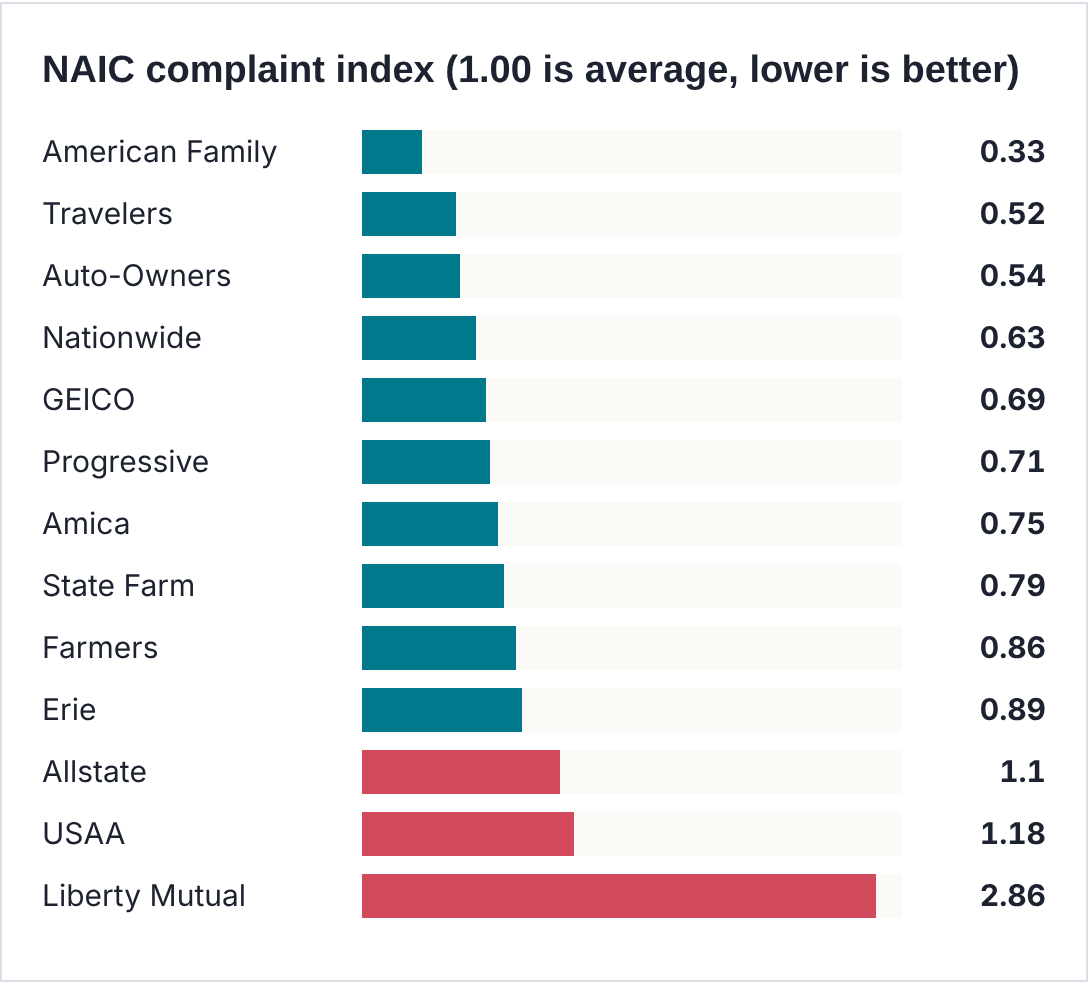
NAIC complaint index as reported in August 2026. The data year was not stated.
Every company we recommend sits below or near the 1.00 average except Liberty Mutual, whose 2.86 index means nearly three times the expected complaints. That is why it is not on our top 10 list, even though its RightTrack program can save 5% to 30%.
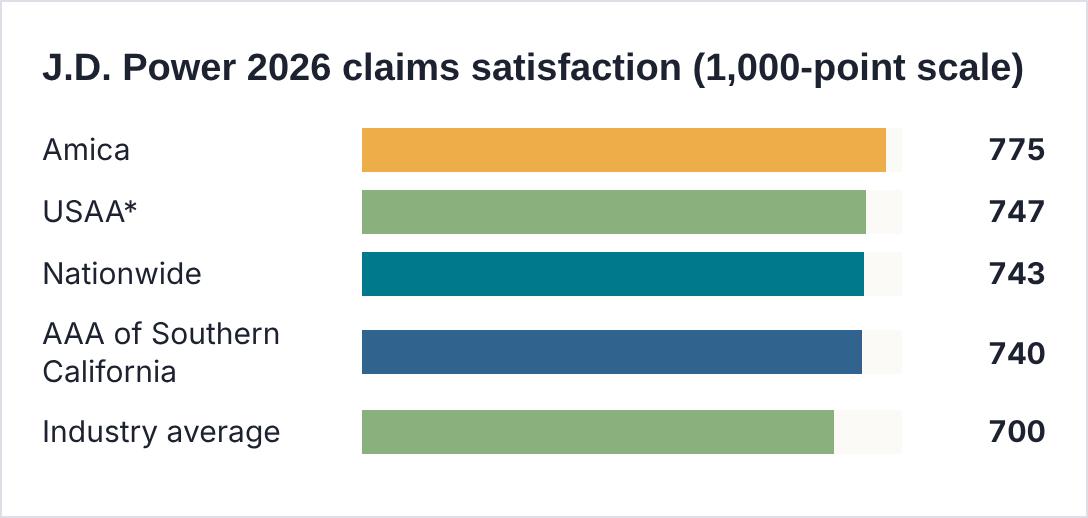
J.D. Power 2026 U.S. Auto Claims Satisfaction Study, released October 27 and 28, 2026. *USAA is not eligible to be ranked.
The 2026 claims study found that satisfaction with total-loss claims fell 12 points, and 26% of claims are now total losses. Customers who got less than they still owed on their car loan scored just 490. If you have a loan, gap insurance is worth a look.
J.D. Power 2026 regional winners for auto insurance satisfaction
| Region | Winner | Score |
| Mid-Atlantic | Erie | 704 |
| New England | Amica | 702 |
| Florida | Florida Farm Bureau | 693 |
| Southeast | Erie | 691 |
| North Central | Erie | 688 |
| California | Wawanesa | 678 |
| Central | Shelter | 674 |
| Texas | AAA of Southern California | 673 |
| Northwest | State Farm | 667 |
| New York | Travelers | 657 |
| Southwest | CSAA | 653 |
J.D. Power 2026 U.S. Auto Insurance Study, released June 9, 2026. The overall industry score was 644, unchanged from 2025.
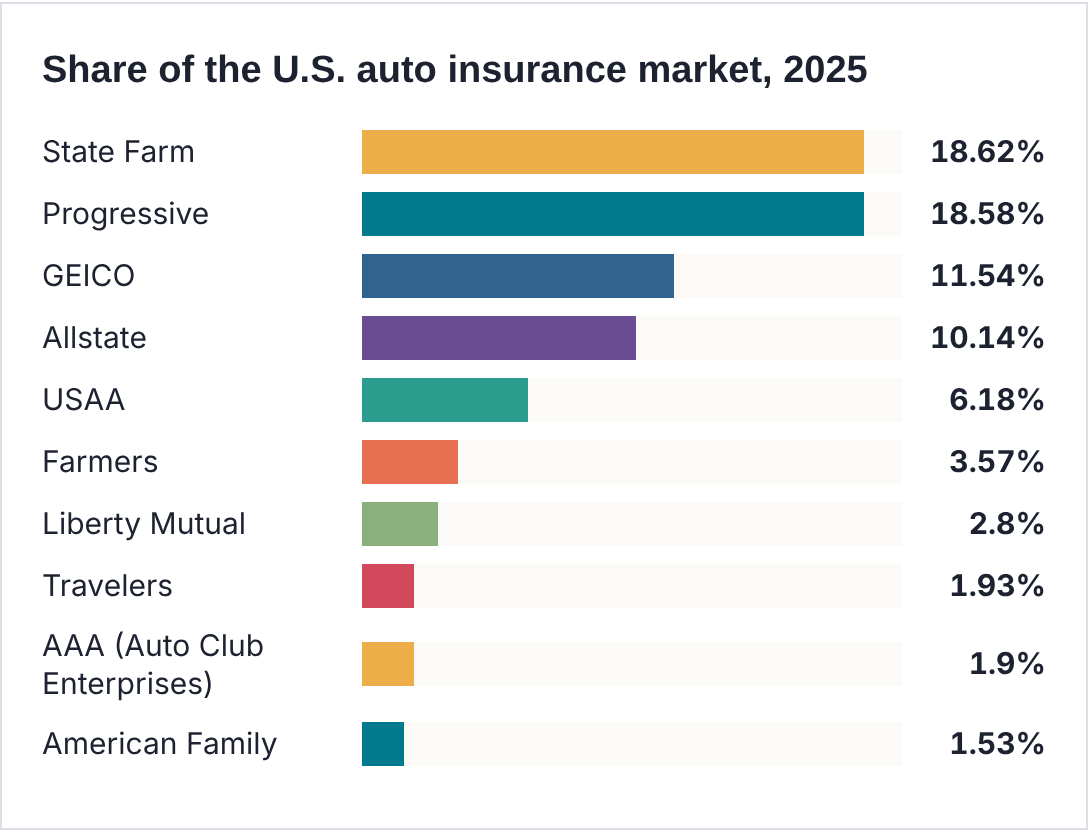
Direct premiums written in 2025, from NAIC data. The top 10 hold 76.77% of a $371.58 billion market.
Big is not the same as good. Travelers and American Family have small market shares but lower prices or fewer complaints than some larger rivals.
Good regional car insurance companies
Some of the best values in car insurance come from companies that sell in only part of the country. They rarely advertise nationally, so many drivers never get a quote, but they often beat the big names on price and service where they sell.
Regional car insurance companies worth a quote
| Company | Why it stands out |
| NJM | Cheapest full coverage in Study C, at $79 a month; Consumer Reports recommended |
| Auto-Owners | $89 a month in Study C; 0.54 complaint index |
| Erie | Won three J.D. Power regions; cheapest SR-22 in Study D |
| COUNTRY Financial | Among the cheapest after a DUI and with poor credit in Study C |
| Mapfre | $35 a month for minimum coverage in Study A, where it sells |
| Shelter | Won the J.D. Power Central region with 674 points |
| Wawanesa | Won the J.D. Power California region with 678 points |
| Florida Farm Bureau | Won the J.D. Power Florida region with 693 points |
Study A; Study C; Study D; J.D. Power 2026 U.S. Auto Insurance Study; Consumer Reports (September 2025).
Consumer Reports’ September 2025 survey of 40,566 policyholders and 36 insurers named six recommended companies: Erie, NJM, Amica, NYCM, USAA, and Cincinnati. Four of the six are regional or membership-only insurers, which shows how often smaller companies lead on service.
Regional insurers usually sell through local independent agents. An independent agent can quote several of them at once, which saves time and often turns up a company you have never heard of with a lower price than the national brands.
Car insurance coverage types explained
Before you compare companies, it helps to know what you are buying. Every policy is built from the same basic parts, and the ones you choose affect your price more than the company does.
The main parts of a car insurance policy
| Coverage | What it pays for | Required? |
| Bodily injury liability | Injuries you cause to other people | Required in nearly every state |
| Property damage liability | Damage you cause to other people’s property | Required in nearly every state |
| Collision | Damage to your car in a crash | Optional; lenders usually require it |
| Comprehensive | Theft, fire, weather, animals, and glass | Optional; lenders usually require it |
| Uninsured motorist | Your costs when the other driver has no insurance | Required in some states |
| Personal injury protection | Medical bills regardless of fault | Required in no-fault states |
| Gap insurance | The difference between your loan and the car’s value | Optional |
| Roadside assistance | Towing, jump-starts, and lockouts | Optional add-on |
General coverage definitions; requirements vary by state.
Liability-only coverage includes just the first two lines, plus anything else your state requires. Full coverage adds collision and comprehensive. Limits are written as three numbers, such as 100/300/100, which means $100,000 per injured person, $300,000 per crash for injuries, and $100,000 for property damage.
Good car insurance companies for full coverage
Full coverage adds collision and comprehensive to the liability insurance your state requires, so it pays to repair or replace your own car. Lenders require it on financed and leased cars. It costs much more than minimum coverage, so the gap between companies is worth hundreds of dollars a year.
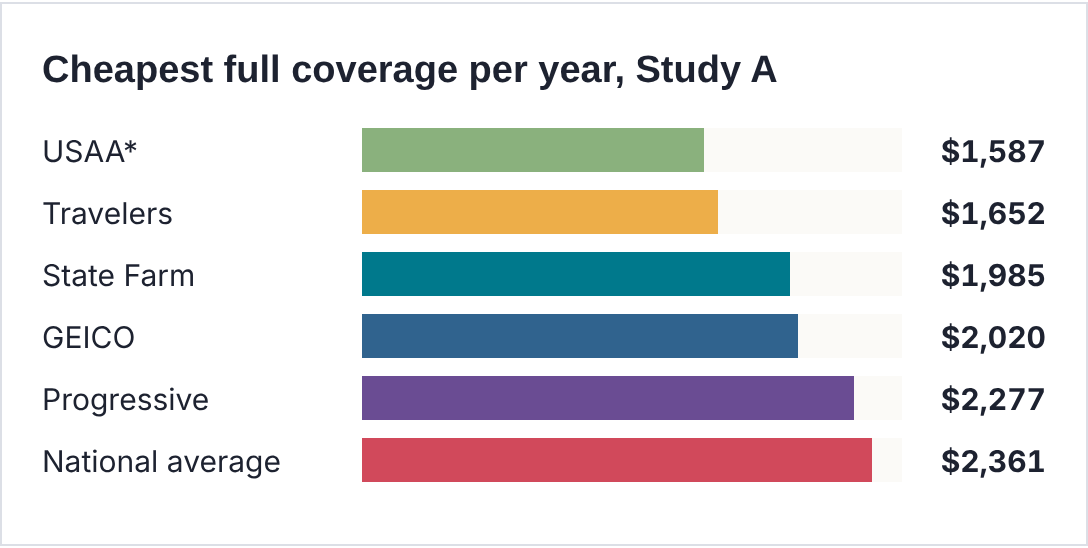
Study A: national rate study updated October 2026 (medians). *USAA is for military families only. Averages, not quotes.
The difference between Travelers’ October Study A rate and that study’s benchmark is $709 a year; State Farm’s difference is $376 (arithmetic comparisons, not guaranteed savings). In Study B, Travelers saves $616 against a $2,578 average. Study C puts the national full coverage figure at $187 a month and finds NJM, Auto-Owners, and COUNTRY Financial cheapest, at roughly $80 to $91 a month, where they sell.
PRO TIP #1
Full coverage is worth it when your car is worth more than you could easily replace. For an older paid-off car, compare its value, annual collision/comprehensive premium, deductibles and your ability to replace it before dropping coverage; the often-cited 10-times-premium threshold is only a rule of thumb.
Good car insurance companies for liability-only coverage
Liability-only coverage, often sold as state minimum coverage, pays for injuries and damage you cause to other people. It does not fix your car. It is the cheapest way to drive legally, and it suits older cars that are paid off and worth little.
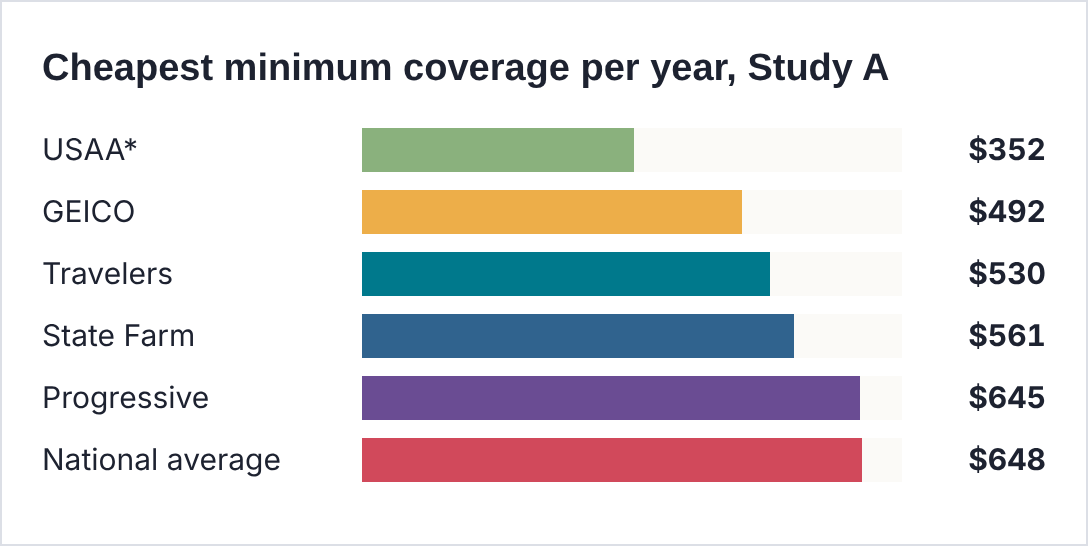
Study A: national rate study updated October 2026 (medians). *USAA is for military families only. Averages, not quotes.
GEICO is the cheapest liability-only company open to all drivers, at $492 a year in Study A and $539 in Study B, against national averages of $648 and $738. In Study A’s clean-record data, smaller insurers Mapfre, at $35 a month, and Auto-Owners, at $37, came in even lower than GEICO’s $40 where they sell.
State minimum limits are often too low to cover a serious crash, and you are personally responsible for the rest. If you own a home or have savings, ask for quotes at higher limits, such as 100/300/100, which usually cost only a little more.
Good car insurance companies for drivers with no tickets
A clean record, with no tickets, accidents, or claims, earns the lowest rates at every company. The chart shows how much one violation adds at the four big insurers in Study A.
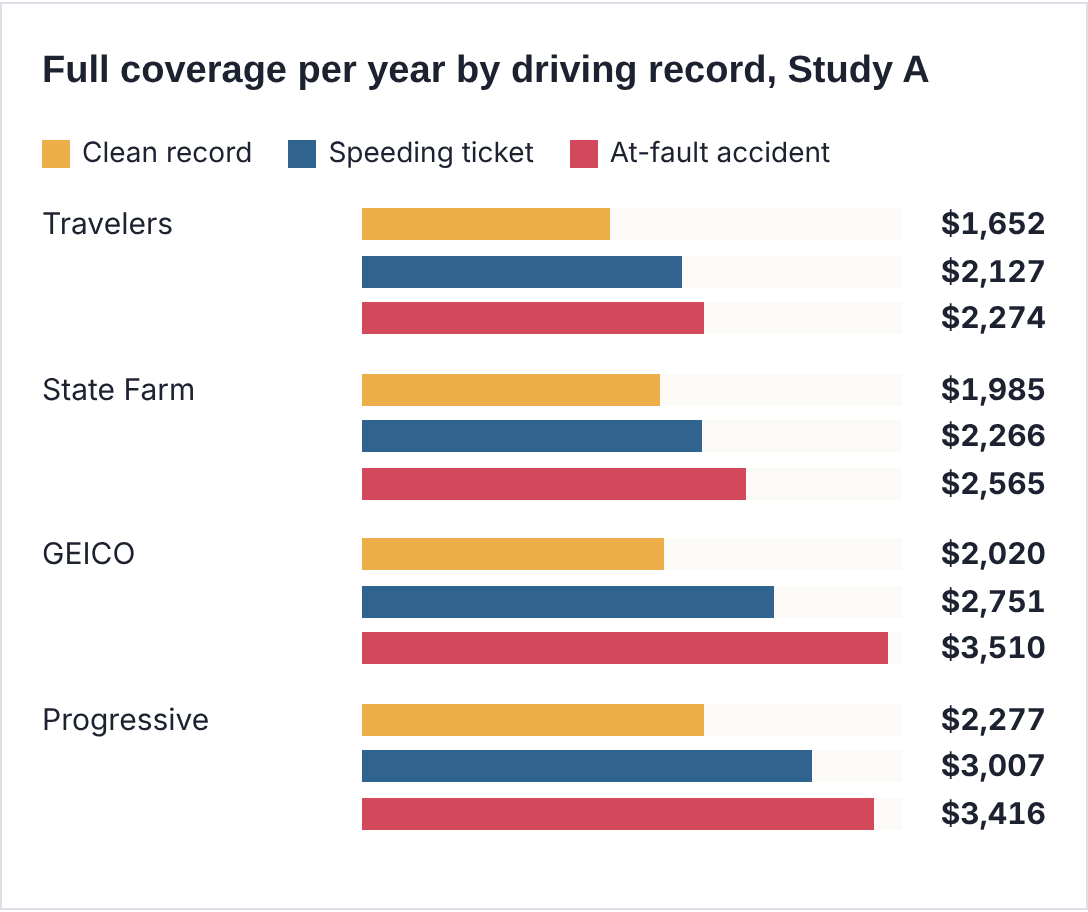
Study A: national rate study updated October 2026 (medians). Ticket is 16 mph over the limit; accident caused $10,000 in property damage. Averages, not quotes.
Travelers is the cheapest of the four with a clean record, a ticket, or an accident. State Farm is the most forgiving in dollar terms, adding $281 a year after a ticket, compared with $731 at GEICO (our calculation). Many companies also give a safe driver discount after three to five years without a claim.
If you have a ticket or accident, the gap between companies widens. In Study D, State Farm and GEICO were cheapest for minimum coverage after a ticket, at $56 a month, and State Farm after an accident, at $62. A separate study found Auto-Owners cheapest for full coverage after a ticket, at $182 a month.
Good car insurance companies for teens
Teens pay more than any other age group because they crash more often. The cheapest way to insure a teen is almost always to add them to a parent’s policy, rather than buy a separate one.
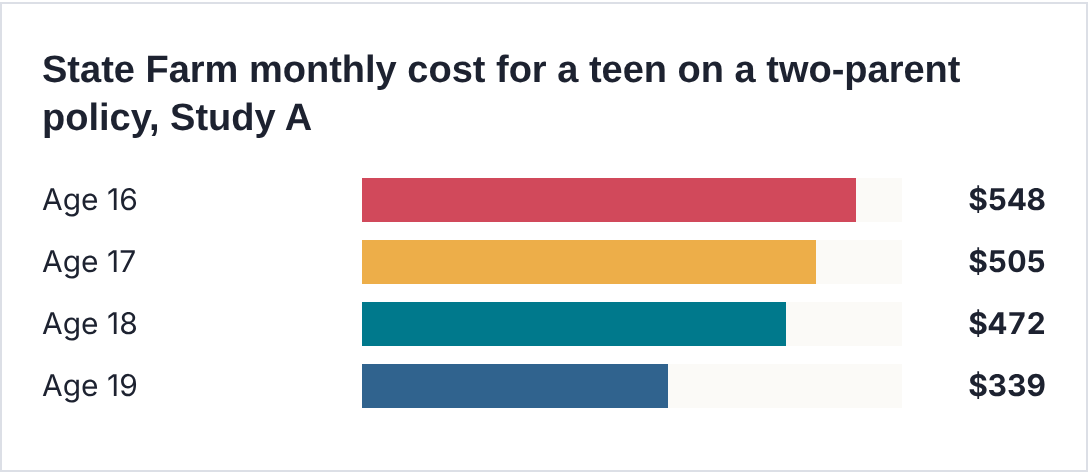
Study A teen analysis updated July 6, 2026: teen sharing a parent’s car, full coverage, no discounts. Cheapest large insurer at each age. Averages, not quotes.
In Study A’s teen analysis, State Farm was the cheapest large company at every age when a teen shared a car on a two-parent policy. Adding a teen raised the family’s bill from $293 to $479 a month, about $186 more, or $5,747 a year in total. With a single parent, Nationwide was cheapest at ages 16 and 17.
Cheapest companies for teens, Study C (monthly)
| Company | Liability only | Full coverage |
| USAA | $52 | $102 |
| State Farm | $53 | $103 |
| GEICO | $79 | $143 |
| Teen on own policy, average | $186 | $351 |
Study C: teen analysis updated October 29, 2026. A teen on a parent’s policy pays about 24% less than on their own.
Study B’s teen data, for ages 16 to 19 with full coverage, found GEICO cheapest at $6,507 a year. To cut the cost, ask about good student discounts, driver training courses, and a safe-driving app, and put your teen on the oldest, safest car in the household.
Good car insurance companies for students
College students and drivers in their early 20s still pay high rates, but prices fall quickly with each birthday. Staying on a parent’s policy is usually cheapest, and two student discounts can make a big difference.
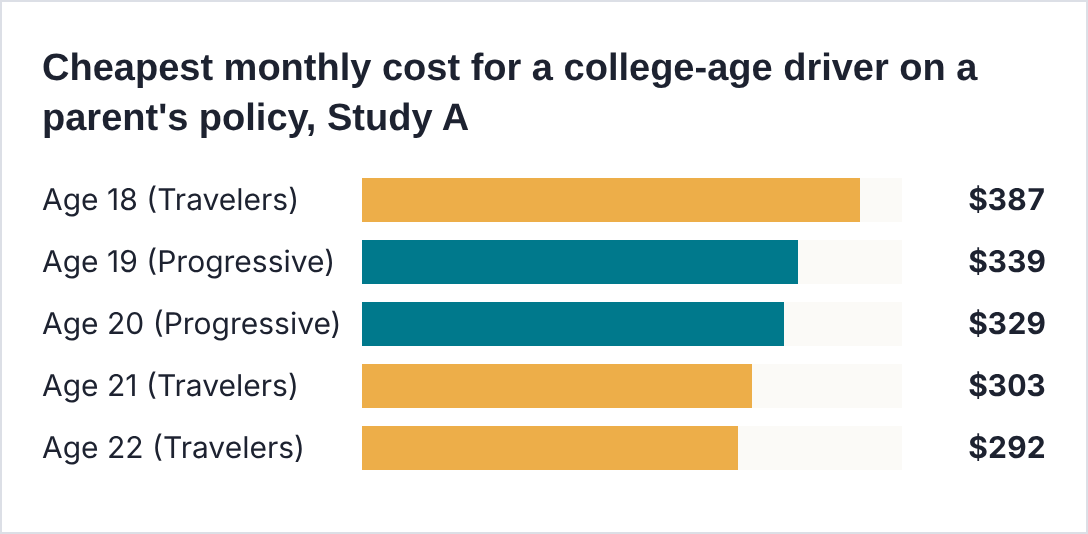
Study A college analysis: two-parent policy, shared 2023 Camry LE, full coverage, no discounts, USAA excluded. Averages, not quotes.
Travelers and Progressive trade places as the cheapest for college-age drivers in Study A. In Study D, GEICO was cheapest on a family policy at $42 a month for minimum coverage, and on a student’s own policy, GEICO dropped to $34 a month by age 21. Study B found Travelers cheapest for ages 20 to 24, at $3,057 a year for full coverage.
Good student discounts by company
| Company | Discount | Notes |
| State Farm | Up to 25% | 3.0 GPA or top 20%; can last to age 25 |
| Allstate | 15% to 22.5% | Accepts a 2.7 GPA |
| American Family | 18% to 19% | Average in two studies |
| Nationwide | 15% to 20% | Average in two studies |
| Auto-Owners | 18% | Average in one study |
| GEICO | 7% to 15% | Up to 15% on some coverages |
| Amica | 12% | Average in one study |
| Progressive | 5% to 8% | Under 23; not offered in California |
| USAA | 5% to 10% | Up to 10% |
statefarm.com and three national discount studies (2026). Percentages vary by state and study.
Most good student discounts require full-time students between 16 and 25 with a B average, a 3.0 GPA, or a class rank in the top 20%. A student away discount helps when your child attends school more than 100 miles from home without a car. Study D says it can save 10% to 30%.
Good car insurance companies for seniors
Drivers in their 50s and early 60s get some of the lowest rates of their lives, but prices rise again after about 70. Shopping around matters more as you age, because each company prices older drivers differently.
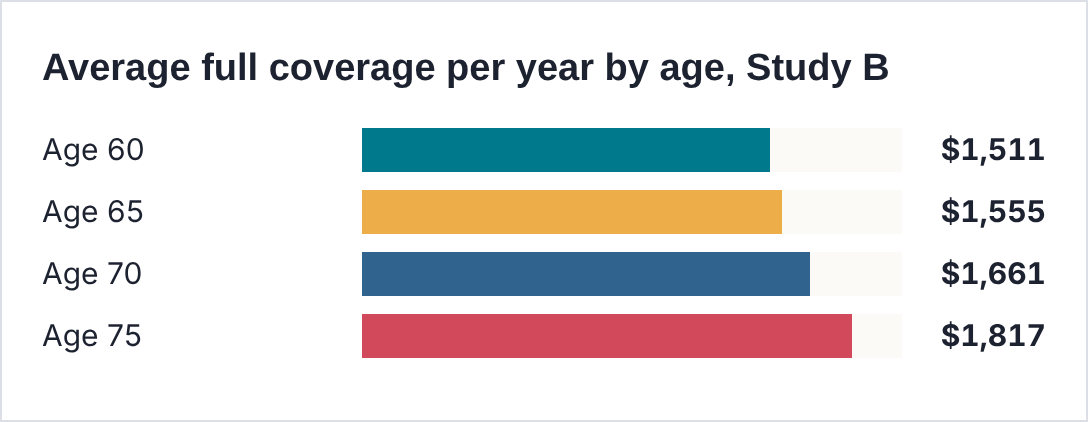
Study B senior analysis updated April 22, 2026: male drivers, good record, 2021 Honda Accord LX. Averages, not quotes.
The average rose $306 a year between ages 60 and 75 in Study B. Study B found Nationwide cheapest for ages 55 to 75, at $1,134 a year, and Study A found Travelers cheapest for seniors, at $1,559 a year.
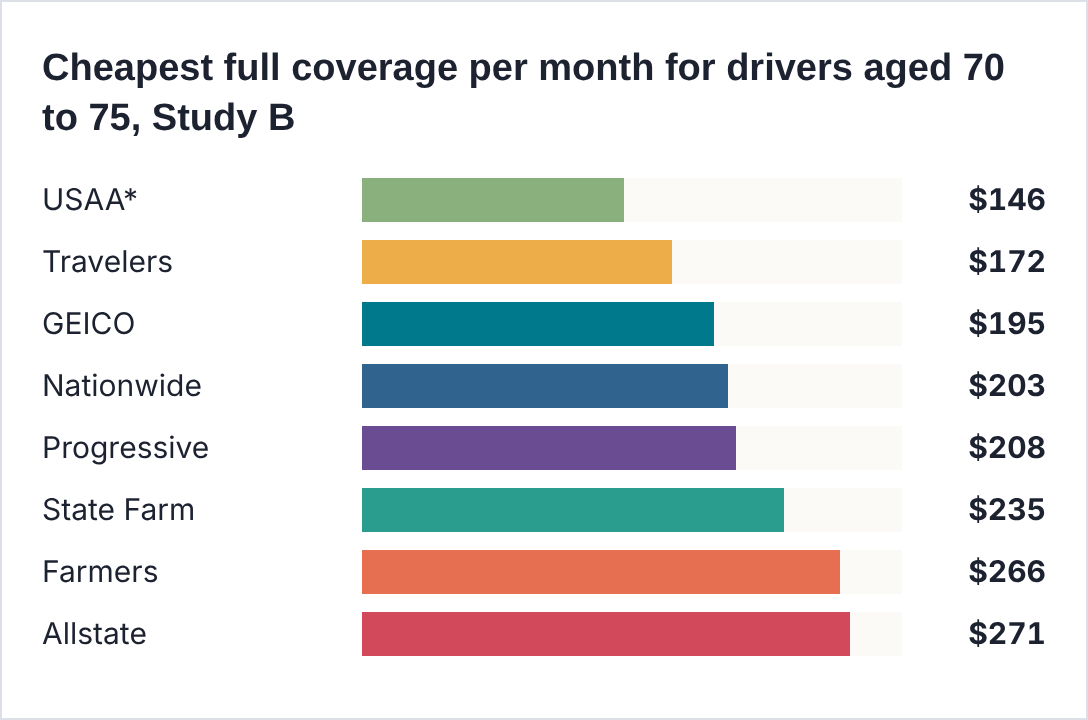
Study B analysis updated July 23, 2026: 100/300/100 limits, $500 deductibles, clean record. *USAA is for military families only.
Seniors can cut costs with a mature driver course. In 34 states and Washington, D.C., insurers must give a discount of 5% to 15% for an approved course, usually from age 55, and it typically lasts three years. GEICO, Travelers, and Nationwide are good first quotes for drivers over 70.
PRO TIP #2
If you drive far less since retiring, tell your insurer your new mileage. A low-mileage discount or a pay-per-mile plan can save more than any senior discount.
Good companies for bundling car and home insurance
Buying car and home insurance from the same company is one of the biggest discounts available. A bundle may simplify billing, but policies usually retain separate deductibles unless the insurer explicitly offers a combined-deductible feature.
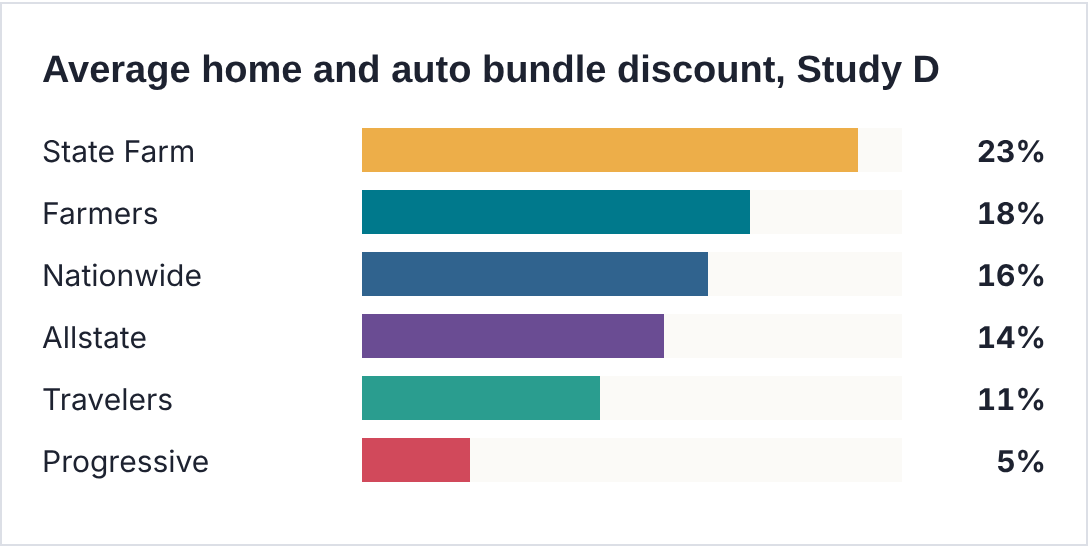
Study D: national bundling analysis updated October 1, 2026. Averages, not quotes.
State Farm’s 23% bundle discount was the biggest in Study D, and Study E, a second bundling analysis updated September 25, 2026, found the same 23%. Study D also found the cheapest bundles overall at AAA, $2,682 a year, Amica, $3,156, and State Farm, $3,387.
Bundle savings by company
| Company | Average yearly savings (Study D) | What the company says |
| State Farm | $1,010 | Not stated on its site |
| Nationwide | $802 | Average savings of $1,032 |
| Travelers | $928 | Not stated |
| Farmers | $888 | Not stated |
| Allstate | $701 | Not stated |
| Progressive | $292 | Average 5% on auto; $1,099 for new bundlers |
| American Family | Not tested | Up to 40% |
| Amica | Not tested | Up to 30% |
| USAA | Not tested | Up to 10% |
Study D: national bundling analysis updated October 1, 2026; company websites (accessed October 2026).
Bundling is not automatically cheaper. A big discount on an expensive policy can still cost more than two separate policies from cheaper companies, so get bundled and unbundled quotes and compare the totals.
Good car insurance companies for an SR-22
An SR-22 is not insurance. State-specific SR-22 filing requirements determine the documentation and duration needed. It is a form your insurer files with the state to prove you carry at least the required liability coverage, usually after a DUI, driving without insurance, or a string of serious violations. The filing fee is usually about $25, but the violation behind it raises your rate a lot.
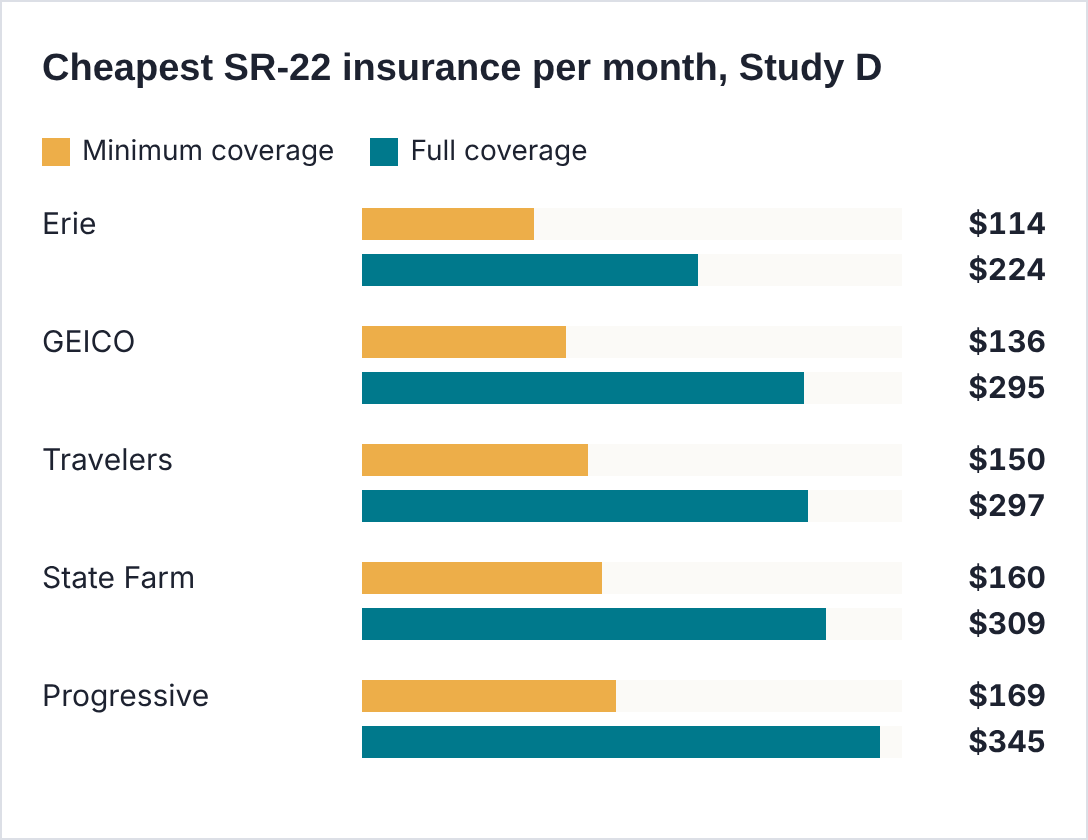
Study D: SR-22 analysis updated October 1, 2026; 40-year-old man, 2010 Toyota Camry. Erie is not sold in every state. Averages, not quotes.
Erie was the cheapest SR-22 insurer in Study D, at $114 a month for minimum coverage, with GEICO next at $136. The average SR-22 policy after a DUI cost $184 a month, or $2,212 a year. If you do not own a car, a non-owner SR-22 policy is cheaper still, from $28 a month at USAA and $33 at State Farm.
SR-22 basics
| Question | Answer |
| Who files it? | Your insurer files it with your state |
| Filing fee | Usually about $25 |
| How long? | Usually about three years, set by your state |
| Companies that file it | Allstate, American Family, GEICO, Progressive, State Farm, USAA, and high-risk insurers such as Dairyland and The General |
| FR-44 | Required after some DUIs in Florida and Virginia, with higher liability limits |
| If coverage lapses | Your insurer must tell the state, and your license can be suspended |
Study D; Study A SR-22 guide (2024). Rules vary by state.
After a DUI without an SR-22 requirement, Study A found Travelers cheapest for full coverage, at $2,783 a year, followed by Progressive and State Farm. Study C found COUNTRY Financial, at $125 a month, and Auto-Owners, at $128, cheapest, against a $269 national average after one DUI.
Good car insurance companies for drivers with bad credit
In most states, insurers use a credit-based insurance score to set prices, and poor credit can cost more than an accident. In Study A, a clean-record driver with poor credit paid $3,954 a year for full coverage, compared with $2,361 with good credit.
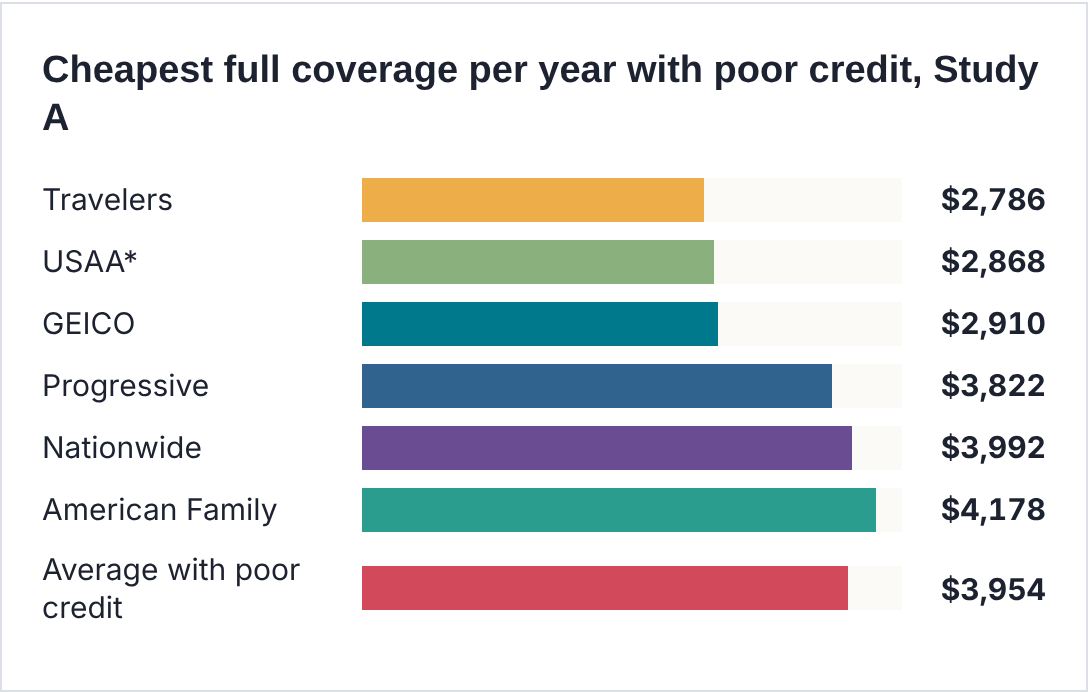
Study A: national rate study updated October 2026 (medians), clean record, poor credit. *USAA is for military families only.
Travelers and GEICO were the cheapest companies open to everyone for drivers with poor credit in Study A. Study B also found GEICO cheapest, at $3,555 a year. For liability-only coverage, Study C found COUNTRY Financial, at $55 a month, and NJM, at $57, cheapest.
States that ban or limit credit in car insurance pricing
| State | Rule |
| California | Credit cannot be used to set auto rates |
| Hawaii | Credit cannot be used to set auto rates |
| Massachusetts | Credit cannot be used to set auto rates |
| Michigan | Credit cannot set rates; may affect payment plan options |
| Maryland | Can help set a new policy rate, but not raise renewals or cancel |
| Oregon | Cannot cancel or refuse renewal because of credit |
| Utah | Cannot be the only factor; limited after 60 days |
Experian (March 2025), confirmed by a 2026 national credit study. Laws can change, so check with your state.
California, Hawaii, Massachusetts and Michigan prohibit use of credit scores to set auto insurance rates; restrictions elsewhere differ. Elsewhere, paying bills on time and keeping card balances low can lower your premium at your next renewal.
Good car insurance companies for temporary car insurance
Most major U.S. insurers sell standard six- or twelve-month policies rather than standalone one-day coverage; limited prepaid or short-duration arrangements exist in certain states. Confirm the actual policy term and continuity requirements before buying. If you need coverage for a short time, these options work better.
Ways to get temporary car insurance
| Option | Best for | Typical cost |
| Non-owner policy | Borrowing or renting cars often | About $46 a month on average (Study C) |
| Rental counter coverage | A short rental | $10 to $30 a day for a damage waiver |
| Six-month policy, canceled early | Owning a car for a few months | Refund of unused premium; some charge $25 to $50 |
| Pay-per-mile insurance | Driving very little | Base rate plus a few cents a mile |
| Hugo | Prepaying a few days at a time | 3, 7, or 30 days; limited states |
| Adding a driver to a policy | A visitor or new driver | Varies by company |
Study C non-owner analysis; Study D temporary insurance guide (August 2026); company sites. Costs vary by state.
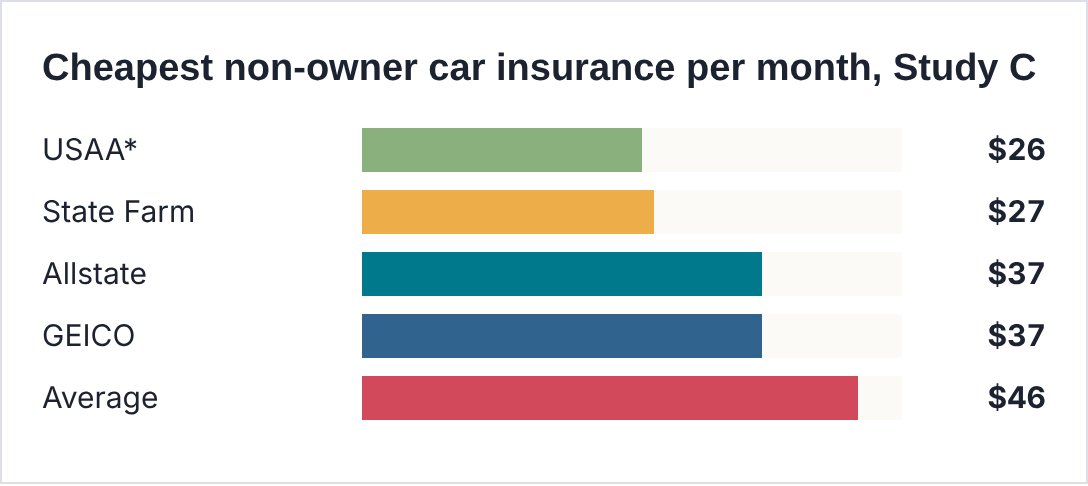
Study C: non-owner analysis (2026). *USAA is for military families only. Study D found Auto-Owners at $24 a month.
A non-owner policy covers your liability when you drive a car you do not own. State Farm, at $27 a month, and Auto-Owners, at $24 in Study D, are the cheapest options open to most drivers. Among pay-per-mile plans, Nationwide SmartMiles charges a base rate plus a per-mile rate and counts no more than 250 miles a day, and Mile Auto charges about $48 a month plus 8 cents a mile in its seven states.
Good car insurance companies for low-mileage drivers
If you work from home, are retired, or keep a second car that rarely leaves the garage, you may be paying for miles you never drive. Pay-per-mile insurance charges a monthly base rate plus a small fee for each mile, so your bill shrinks when you drive less.
Pay-per-mile options
| Company | How it works | Availability |
| Nationwide SmartMiles | Base rate plus a per-mile rate; no more than 250 miles a day counted | Not sold in AK, HI, LA, MI, NC, NY, or OK |
| Mile Auto | About $48 a month plus 8 cents a mile | Seven states |
| Allstate Milewise | Daily base rate plus a per-mile rate | Select states |
| Lemonade Car | Pay-per-mile plans from the former Metromile | Select states |
Nationwide; Study C (2026); Study D pay-per-mile guide (2026). Check each company for your state.
Pay-per-mile policies can be competitive for low-mileage drivers, but a 10,000-mile cutoff is not universal: compare annual totals using your quoted base charge, mileage rate, fees and projected miles. If you drive more, a standard policy with a low-mileage discount, or a driving app such as Nationwide’s SmartRide, may cost less.
Usage-based programs that reward good drivers
Almost every good car insurance company now offers an app or plug-in device that tracks how you drive. Safe drivers can save a lot, but some programs can also raise your rate.
Driving-tracking programs compared
| Company | Program | Savings | Can your rate go up? |
| Nationwide | SmartRide | Up to 40%; 10% to sign up | No |
| State Farm | Drive Safe and Save | Up to 30%; 10% to sign up | Yes, at renewal |
| USAA | SafePilot | Up to 30% | No |
| Liberty Mutual | RightTrack | 5% to 30% | Studies disagree |
| GEICO | DriveEasy | 5% to 15% | Yes, in some states |
| Progressive | Snapshot | $322 a year on average | Yes, for about 2 in 10 drivers |
| Allstate | Drivewise | 10% to sign up | Yes |
Company websites and two national discount studies (2026). GEICO’s rate-increase rule varies by state.
Nationwide says its SmartRide program will not surcharge drivers based on the program score; that is a meaningful feature, but its advertised maximum discount is not a prediction of what you will save. If you often drive late at night, brake hard, or use your phone behind the wheel, skip programs that can raise your price.
Car insurance discounts to ask every company about
Discounts can cut your bill by hundreds of dollars, but companies do not always apply them automatically. Use this list when you call or quote online.
Common car insurance discounts
| Discount | Who qualifies | Typical savings |
| Bundling | Home, renters, or condo plus auto | 7% to 25% |
| Multi-car | Two or more cars on one policy | Up to 25% at GEICO |
| Good student | Students with a B average | 10% to 25% |
| Student away | School 100+ miles away, no car | 10% to 30% |
| Telematics | Drivers who share driving data | 10% to 40% |
| Military | Active duty and veterans | Up to 15% at GEICO |
| Federal employee | Government workers | Up to 12% at GEICO |
| Mature driver course | Usually 55 and older | 5% to 15% |
| Safety features | Air bags, anti-theft devices | Up to 23% at GEICO |
| Autopay and paperless | Electronic billing and payment | 3% to 15% |
| Pay in full | Paying the full term up front | Varies by company |
A national discount study updated October 29, 2026; GEICO; Study D. Savings vary by company and state.
PRO TIP #3
Ask each company to list every discount on your quote. If a discount you qualify for is missing, such as good student or paid in full, ask to have it added before you buy.
What good claims service looks like
A claim is the moment that shows whether your company is good. The best insurers make it easy to report a claim by app, phone, or website, assign an adjuster quickly, explain each step, and pay a fair amount without a fight.
Total losses are becoming more common. In the J.D. Power 2026 claims study, 26% of claims ended with the car declared a total loss, and satisfaction with those claims fell 12 points. When a car is totaled, the company pays its actual cash value, which can be far less than what you paid or what you still owe.
That is why gap insurance matters for anyone with a new car loan or lease. Customers in the J.D. Power study who received less than their loan balance gave a satisfaction score of just 490, far below the 700 average.
- Take photos of the damage, the scene, and the other car right away.
- Get the other driver’s name, insurer, policy number, and plate.
- Report the claim within a day or two, even if you were not at fault.
- Ask for your adjuster’s name and direct contact details.
- Keep receipts for towing, rental cars, and medical bills.
- If a total-loss offer seems low, share listings for similar cars and ask for a review.
Red flags of a bad car insurance company
A very low quote deserves closer scrutiny if the proposed coverage, carrier or complaint record is unclear. Watch for these warning signs before you buy.
Warning signs and how to check
| Red flag | How to check |
| Low financial strength | Rating below A or an outdated/unconfirmed rating |
| Many complaints | NAIC complaint index well above 1.00 |
| Slow or unfair claims | J.D. Power claims study and online reviews |
| Hidden fees | Ask for installment, cancellation, and SR-22 fees in writing |
| Rates that jump at renewal | Compare your renewal with new quotes every year |
| Unlicensed seller | Check the license with your state department of insurance |
Our assessment, based on AM Best, NAIC, and J.D. Power data.
Liberty Mutual is a useful example. It is a large company with an A rating, but its 2.86 complaint index means far more complaints than expected for its size. Price and size do not guarantee a good experience, so check more than one measure.
Car insurance prices in 2026
After big increases in 2023 and 2024, car insurance prices have mostly leveled off. Study C found rates fell 6% in 2025 and rose about 1% in the first half of 2026, and it projects an average of $2,242 a year by the end of 2026, with increases in 32 states. Study B measured a 2.6% rise this year.
The main risk is repair costs. Tariffs on car parts could push repair bills higher, and those costs could show up at renewal in late 2026 and 2027. Shop at renewal rather than assuming national price trends apply to your insurer or ZIP code.
Buying online, by phone, or through an agent
Good car insurance companies sell in three main ways. Direct writers such as GEICO and Progressive let you buy online or by phone. Captive agents, such as those at State Farm and Allstate, sell only their own company’s policies. Independent agents sell for many companies, including regional insurers such as Auto-Owners, Erie, and Travelers.
Online sales are a major purchase channel. J.D. Power’s 2026 shopping study found that 48% of new auto policies are bought online, and Erie, at 719 points, and Nationwide, at 715, led that study for the buying experience. An agent can still be worth it if you have a teen driver, an SR-22, a home to bundle, or a claim history that makes online quotes confusing.
How much car insurance you really need
The cheapest policy is not always the best value. State minimum liability limits vary widely and can be far below the costs of a serious crash. Some states have unusual alternatives to standard bodily-injury liability requirements. Anything above your limits can be taken from your savings or wages.
- Drivers with few assets: compare a budget-based liability limit above the state minimum where feasible; minimum limits can still leave substantial personal exposure.
- Homeowners and drivers with savings: consider higher limits, such as 100/300/100, based on assets and available quotes.
- Drivers with high net worth: 250/500/100 plus an umbrella policy.
- Financed or leased cars: meet the lender’s collision/comprehensive requirements and evaluate whether gap coverage is necessary.
- Older cars worth little: liability only, with uninsured motorist coverage.
Raising your deductible from $500 to $1,000 is a good way to pay for higher liability limits. You take on a little more risk for small claims, but you gain much better protection against the large ones that can upset your finances.
How to choose a good car insurance company
Use these steps to find the company that is good for you, not just good on average.
- Get at least three quotes, including one regional company if one sells in your state.
- Quote the same limits and deductibles at each company, so the prices are comparable.
- Check the company’s AM Best rating, aiming for A or better.
- Look at the complaint index, aiming for 1.00 or lower.
- Read the J.D. Power claims and regional results for your area.
- Ask about every discount, including bundling and driving apps.
- Recheck prices every year, or after a birthday, move, or ticket falls off your record.
Shoppers now collect about 3.5 quotes before buying, a record, and 48% of new policies are bought online, according to J.D. Power’s 2026 shopping study. Online quotes can simplify initial comparisons, but underwriting questions, specialized coverage and agent follow-up can take longer.
Our picks by driver type
| Driver or need | Best pick | Runner-up |
| Full coverage | Travelers | State Farm |
| Liability only | GEICO | Travelers |
| Clean record | Travelers | State Farm |
| Teens | State Farm | GEICO |
| Students | Travelers | GEICO |
| Seniors | Travelers | Nationwide |
| Bundling | State Farm | Nationwide |
| SR-22 | Erie | GEICO |
| Bad credit | Travelers | GEICO |
| Temporary needs | State Farm (non-owner) | Auto-Owners (non-owner) |
| Claims service | Amica | Nationwide |
| Military families | USAA | GEICO |
Our assessment, based on Study A, Study B, Study C, Study D, and J.D. Power 2026 results.
Good car insurance companies at a glance
This illustrated summary pulls together the main points of this guide.
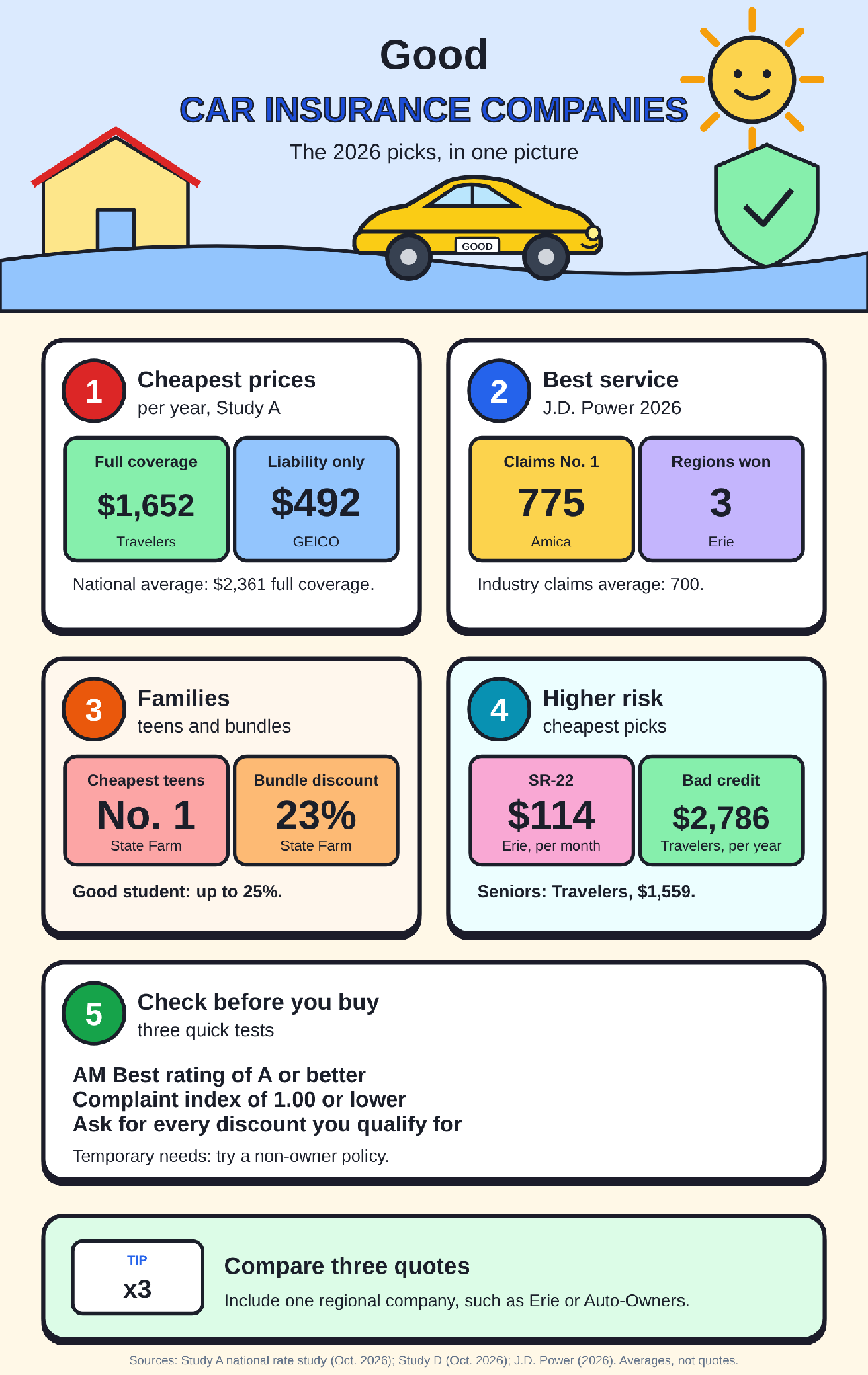
Good car insurance companies at a glance. Sources: Study A; Study D; J.D. Power 2026. Averages, not quotes.
Frequently asked questions
What are good car insurance companies in 2026?
Travelers, State Farm, GEICO, USAA, Erie, Amica, Nationwide, Progressive, Auto-Owners, and American Family are our top 10. Each combines fair prices, strong AM Best ratings, and below-average complaints or high J.D. Power scores. USAA is open only to military families.
Which car insurance company is the cheapest?
Travelers is the cheapest full coverage company for most drivers in Study A, at $1,652 a year, and in Study B, at $1,962. GEICO is cheapest for liability-only coverage, at $492 a year in Study A. Regional insurers such as NJM and Auto-Owners can be cheaper where they sell.
Which company has the best claims service?
Amica ranked first in the J.D. Power 2026 claims study with 775 points, followed by Nationwide at 743 and AAA of Southern California at 740. USAA scored 747 but is not eligible to be ranked. The industry average was 700.
What is the best car insurance company for teens?
State Farm was the cheapest large insurer for teens added to a two-parent policy at every age from 16 to 19 in Study A’s teen analysis. It also offers a good student discount of up to 25%. GEICO and USAA were also cheap in Study C.
Which companies are good for an SR-22?
Erie was cheapest in Study D, at $114 a month for minimum coverage, followed by GEICO at $136 and Travelers at $150. Progressive, State Farm, Allstate, American Family, and USAA also file SR-22 forms. The filing fee is usually about $25.
Can I get good car insurance with bad credit?
Yes. Travelers, at $2,786 a year, and GEICO, at $2,910, were the cheapest companies for full coverage with poor credit in Study A. California, Hawaii, Massachusetts and Michigan prohibit the use of credit scores to set auto insurance rates. Other states also limit how insurers may use credit-based information. Rules for payment options may differ from rating rules.
Can I buy car insurance for just a few days?
Major U.S. insurers do not sell one-day or one-week policies. Good options include a non-owner policy, from about $24 to $27 a month at Auto-Owners and State Farm, rental counter coverage, pay-per-mile plans, or Hugo’s prepaid days in some states.
Is State Farm or GEICO better?
It depends on your needs. State Farm was cheaper for full coverage in Study A, at $1,985 a year against GEICO’s $2,020, and it is better for teens and bundling. GEICO is cheaper for liability-only coverage, at $492 a year, and has more discounts for military and federal workers.
How much can bundling home and auto save?
In Study D, bundle discounts ranged from 5% at Progressive to 23% at State Farm, worth about $1,010 a year at State Farm. American Family says bundling can save up to 40%, and Amica up to 30%. Compare bundled and separate quotes before you decide.
The final word on good car insurance companies
Good car insurance companies combine fair prices with strong finances and reliable claims service. In the cited 2026 studies, Travelers had a low full-coverage price, GEICO performed well for minimum coverage, and State Farm was competitive for certain teen and bundle scenarios. None is a guaranteed winner for an individual quote. Amica and Erie lead on service, and USAA is hard to beat for military families.
No company is the best for everyone, and rates in these studies varied substantially because the samples, drivers and coverage assumptions differed. Get at least three comparable quotes, including a regional insurer where available, and verify discounts, the legal insurer, complaints and financial-strength ratings before buying. Then repeat the process every year to make sure your company is still a good one.
Sources
- Study A: NerdWallet, average car insurance cost, cheapest car insurance, young drivers (July 6, 2026), student discounts, SR-22 insurance (2024), and temporary car insurance (2024).
- Study B: CarInsurance.com, how much is car insurance (August 5, 2026), cheapest car insurance (September 2026), seniors (April 22, 2026), seniors over 70 (July 23, 2026), good student discount, and insurers ranked by NAIC complaint data (August 2026).
- Study C: Insurify, cheap car insurance (October 21, 2026), teens (October 29, 2026), seniors, DUI insurance, non-owner insurance, discounts (October 29, 2026), and 2026 car insurance report.
- Study D: MoneyGeek, home and auto bundles (October 1, 2026), cheapest SR-22 insurance (October 1, 2026), students (August 2026), bad driving record, non-owner insurance, temporary insurance (August 2026), and senior driving guide (September 29, 2026).
- Study E: ValuePenguin, home and car insurance bundles (September 25, 2026); good student discount; bad driving record; state of auto insurance 2026.
- J.D. Power via Business Wire: 2026 U.S. Auto Insurance Study (June 9, 2026) and 2026 U.S. Insurance Shopping Study (June 4, 2026).
- Insurance.com, J.D. Power 2026 regional results (June 23, 2026).
- Insurance Journal, J.D. Power 2026 claims study (October 28, 2026); Claims Journal (October 27, 2026); Insurance Business, total-loss claims (October 2026).
- Amica, J.D. Power 2026 recognition and bundle insurance.
- AM Best ratings: GEICO (April 16, 2026), Travelers (August 8, 2025), Nationwide (November 7, 2025), Progressive, Allstate, Auto-Owners, and American Family (October 22, 2026).
- StatRanker, U.S. auto insurance market share 2025, citing NAIC data.
- Consumer Reports, best car insurance companies (September 2025).
- Experian, states that restrict credit-based insurance scores (March 2025).
- Company sites: State Farm discounts, GEICO discounts, Nationwide SmartRide, Nationwide SmartMiles, Progressive Snapshot, USAA bundling, American Family multi-policy discount, Travelers discounts, and Hugo plans (accessed October 2026).
- Mile Auto pricing and pay-per-mile insurance (2026).
Disclaimer
This website provides independent reviews and comparisons. It is not affiliated with, endorsed by, sponsored by, or connected to Travelers, State Farm, GEICO, USAA, Erie Insurance, Amica, Nationwide, Progressive, Auto-Owners Insurance, American Family Insurance, Allstate, Liberty Mutual, Farmers, NJM, or any other insurer named here, or any of their affiliates.
All company names, brand names, trademarks, and logos are the property of their respective owners and are used here only to identify the companies being reviewed. Their use does not imply any affiliation or endorsement.
The information on this page is provided for general informational and educational purposes only. It is not insurance, legal, tax, or financial advice, and it is not an offer, quote, or solicitation to buy or sell insurance. We are not an insurance company, insurance agency, or licensed insurance producer, and we cannot bind coverage, change a policy, or handle claims.
Prices, discounts, ratings, and company details are drawn from public sources and third-party studies that use specific driver profiles, and they can change at any time. They are estimates and averages, not guarantees of what you will pay. Coverage, eligibility, and discounts vary by state, driver, and vehicle, and are subject to each insurer’s underwriting rules and policy terms.
While we make reasonable efforts to keep this guide accurate and current, we make no representations or warranties, express or implied, about its completeness, accuracy, or reliability. Opinions here are our own. Always confirm details directly with the insurer, read your policy documents, and consult your state’s department of insurance or a licensed professional before making a decision. Your use of this information is at your own risk, and we are not liable for any loss or damage arising from reliance on it.