
Oregon Mobile Home Insurance: Costs, Companies & Wildfire Coverage
Oregon mobile home insurance requires close attention to both price and policy design. One third-party price table estimates an Oregon manufactured-home premium of about $553 annually, but that figure lacks a transparent policy profile. The 2026 wildfire season also burned more than 2.1 million acres according to Oregon Public Broadcasting, underscoring the need to compare dwelling coverage, exclusions and total-loss settlement terms at the actual address.
This guide compares potential insurers and insurance-shopping channels rather than claiming a verified statewide cheapest-company ranking. It explains which published rates are for manufactured homes outside Oregon and which are for conventional houses, then examines wildfire, earthquakes, winter storms, flooding, the Oregon FAIR Plan, park-resident protections, tax deferral and city-specific considerations.
KEY TAKEAWAYS
- One third-party table estimates approximately $553 per year for Oregon mobile home insurance, but it does not provide enough underwriting detail to treat this as a verified statewide average or an obtainable quote.
- The $969 Assurant, $1,025 American Modern and $1,607 Foremost sample prices come from other states, not Oregon manufactured-home quotes.
- Oregon DFR identifies actual cash value versus replacement cost as a crucial difference for manufactured homes. The Oregon FAIR Plan offers a limited manufactured-home product, with a $600,000 ordinary combined coverage limit.
- For 2026, the statutory park-space rent cap is generally 6% in facilities with more than 30 spaces; Oregon also has a senior/disabled property-tax deferral program that charges interest.
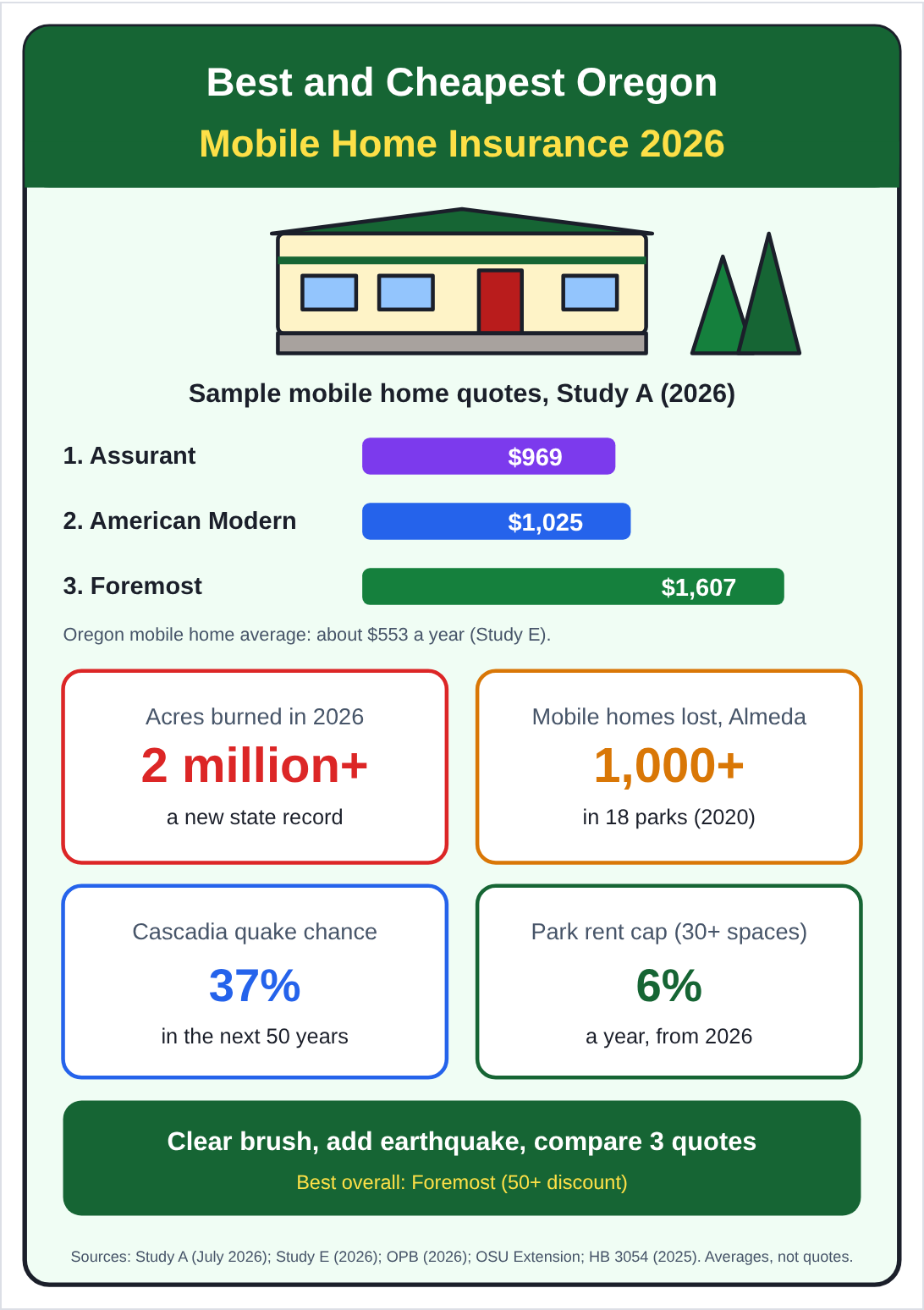
Editorial correction: This archived graphic contains sample prices or a ranking that has not been verified for Oregon manufactured-home policies. It is preserved for layout continuity; rely on the updated tables and the Oregon-specific written quote instead.
Oregon mobile home insurance at a glance. Company prices are Study A’s 2026 sample quotes, not Oregon quotes.
How much mobile home insurance costs in Oregon
The published studies used here do not provide a like-for-like price comparison of Oregon manufactured-home policies by company. Study E’s October 2026 table lists about $553 annually and its separate Oregon article lists approximately $480–$1,500, but the quoted home profile and coverage terms are not transparent enough to establish an expected premium. Understanding how insurance quotes depend on coverage limits, deductibles and underwriting is a useful starting point; the figures here are third-party estimates rather than Oregon quotes.
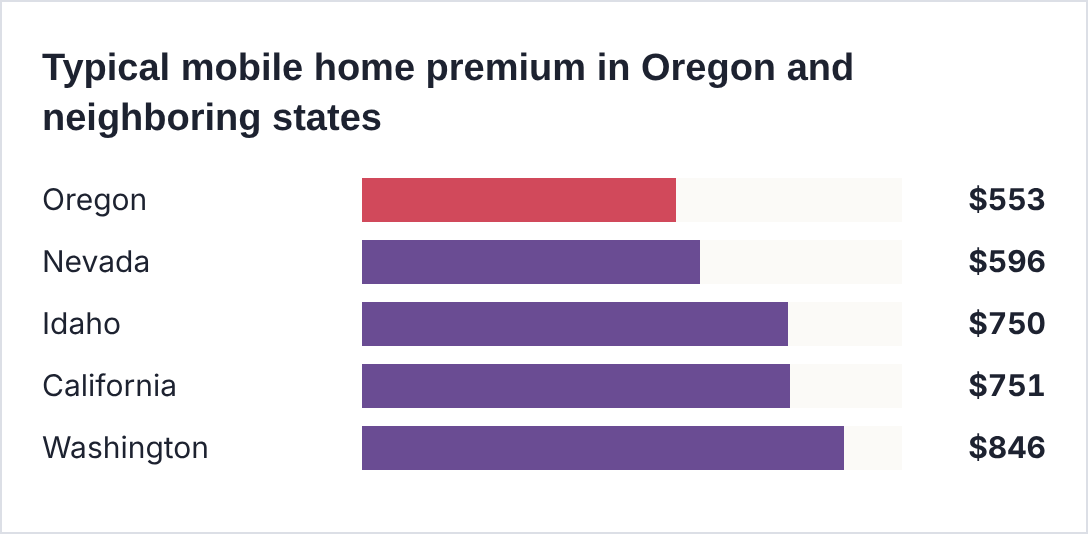
Study E national table (October 18, 2026). Method and coverage amount not published, so treat as rough estimates.
Study A, updated July 6, 2026, collected manufactured-home premiums for a 2016 single-wide in Austin, Indianapolis and Mesa, with dwelling coverage around $51,000–$63,000. The examples were $969 with Assurant, $1,025 with American Modern and $1,607 with Foremost. Because none is an Oregon quote, even their order does not establish which insurer would be cheapest for an Oregon owner.
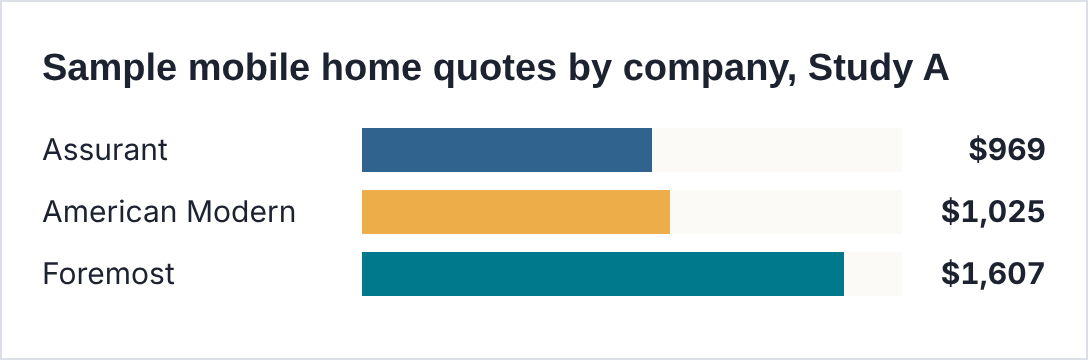
Study A: national mobile home quote study updated July 6, 2026, for a 2016 single-wide in a park in Austin, Indianapolis, and Mesa. Not Oregon quotes.
Study C reports a $732 average for a conventional Oregon house with $100,000 of dwelling coverage, with insurer examples such as USAA at $594 and American Family at $638. These are not manufactured-home policy premiums. Different construction, installation, age, fire risk and settlement terms prevent using those amounts to rank Oregon mobile-home insurers.
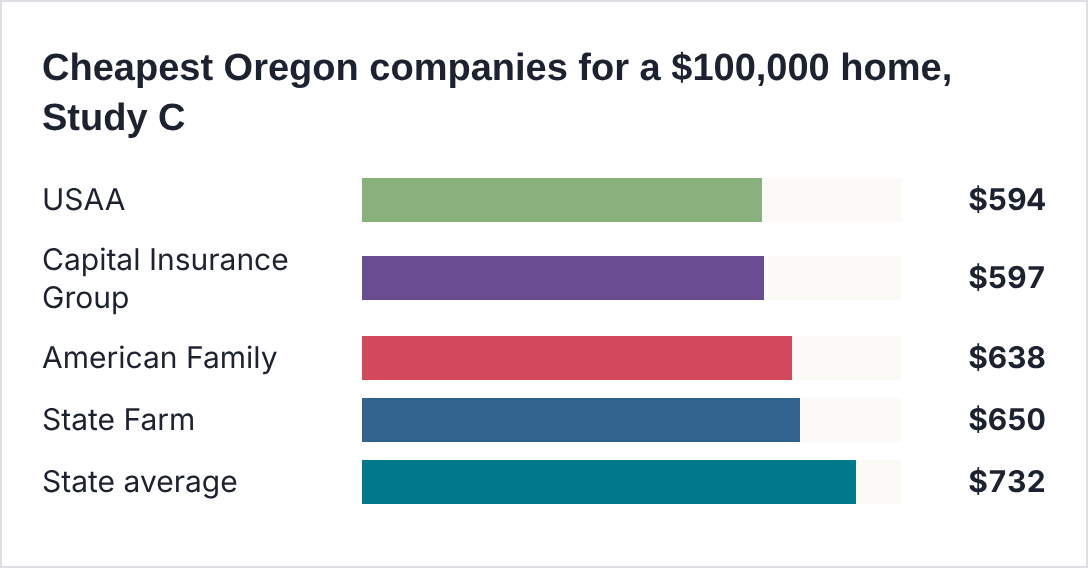
Study C, updated October 2026, $100,000 dwelling. Standard-home policies, not mobile home policies. Averages, not quotes.
Oregon mobile home insurance price evidence
| Source | Yearly cost | Notes |
| Study E, Oregon average | $553 | State table; method not published |
| Study E, Oregon range | $480 to $1,500 | Oregon mobile home guide |
| Study A, Assurant | $969 | Sample single-wide, not in Oregon |
| Study A, American Modern | $1,025 | Sample single-wide, not in Oregon |
| Study A, Foremost | $1,607 | Sample single-wide, not in Oregon |
| Study C, $100,000 home | $732 | Oregon standard-home average |
| Study D, State Farm, $200,000 home | $1,087 | Oregon standard home |
Study A (July 6, 2026); Study C (October 2026); Study D (October 5, 2026); Study E (October 18, 2026).
What standard Oregon homeowners pay
Separate 2026 studies of conventional Oregon houses report different annual averages because they use different dwelling limits and policy assumptions—for example, Study B’s $1,353 for $350,000 dwelling coverage and other studies covering $250,000–$500,000 homes. These figures belong in a conventional-home comparison only. Do not use them to predict a manufactured-home premium or a wildfire-specific surcharge.
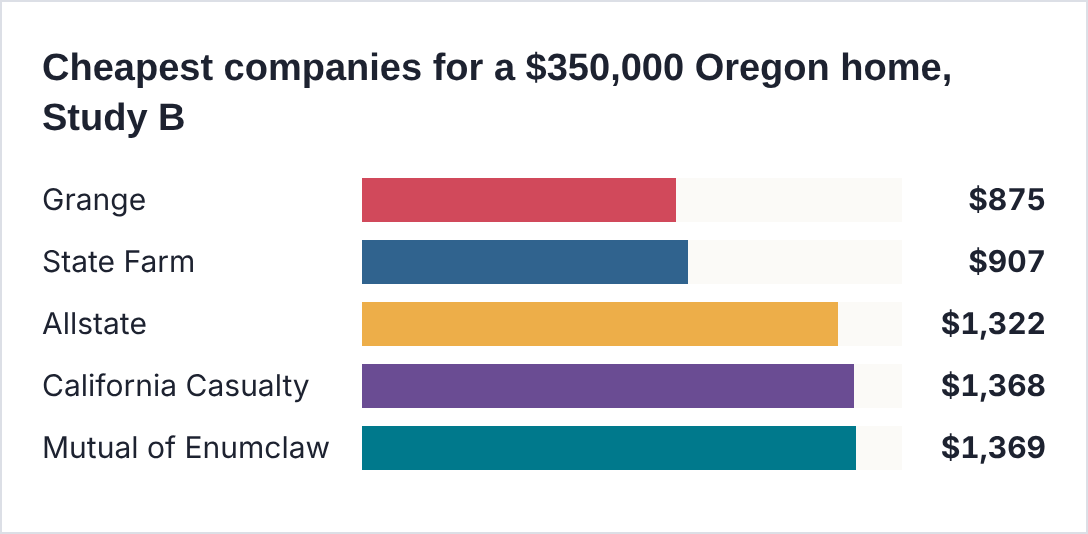
Study B, updated September 25, 2026, $350,000 dwelling. Standard homes, not mobile homes. Averages, not quotes.
Oregon mobile homes by the numbers
Manufactured homes are an important part of Oregon’s housing stock. The article’s published 8% share and roughly 116,500 households are estimates drawn from different years and definitions. They should be used only as background context, not as current counts of insurable units. Households that own a home but rent its park space also face a separate exposure to space-rent increases and community closure.
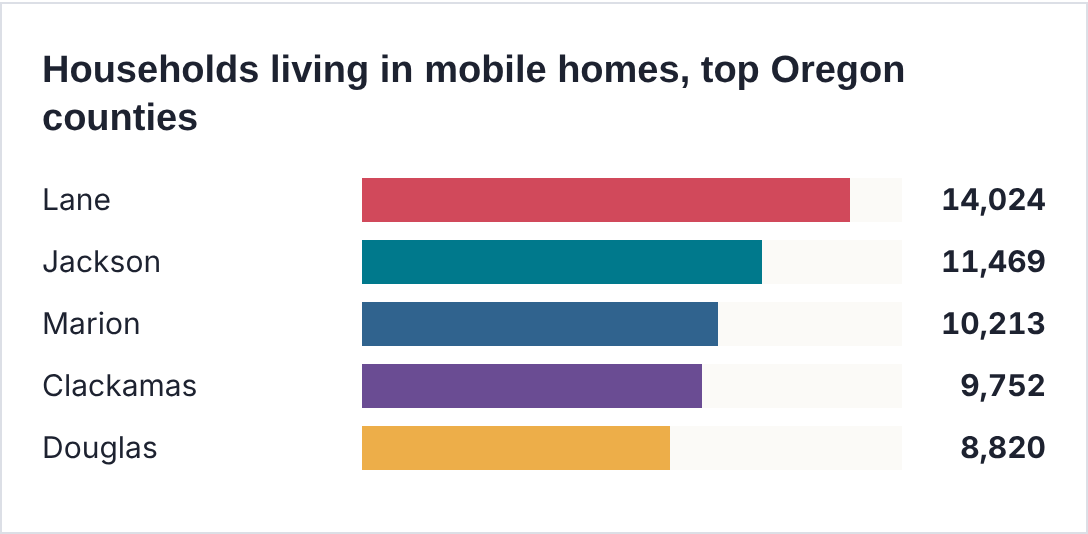
American Community Survey 2008-2012, via a 2016 University of Oregon report. Newer county data not published.
Manufactured housing has an especially significant role in several rural Oregon counties, while park closures can reduce replacement options. Older county-share figures and the 2000–2016 closure counts cited in historical sources should not be mistaken for 2026 inventory. Homeowners should confirm whether a damaged unit can be replaced within their community before choosing a settlement limit.
Oregon manufactured housing at a glance
| Measure | Figure |
| Share of Oregon housing | About 8% |
| Households in mobile homes (2022) | About 116,500 |
| Manufactured home parks | About 1,000 |
| Park spaces | About 62,000 |
| Owners who rent their land | About 40% |
| Resident-owned or nonprofit parks | 38 (2024) |
2025 legislative staff summary and testimony on HB 3054; 2022 ACS data via NAR; OHCS (January 2024).
Oregon mobile home insurance companies and quote channels to compare
The table below is a checklist of insurers and distribution channels—not a ranking from cheapest to most expensive. Only the Assurant, American Modern and Foremost examples involve manufactured homes, and those samples were outside Oregon. The other published figures concern conventional Oregon houses or bundle studies. Every company must confirm that it currently accepts the specific manufactured home, ZIP code, age, installation and wildfire exposure.
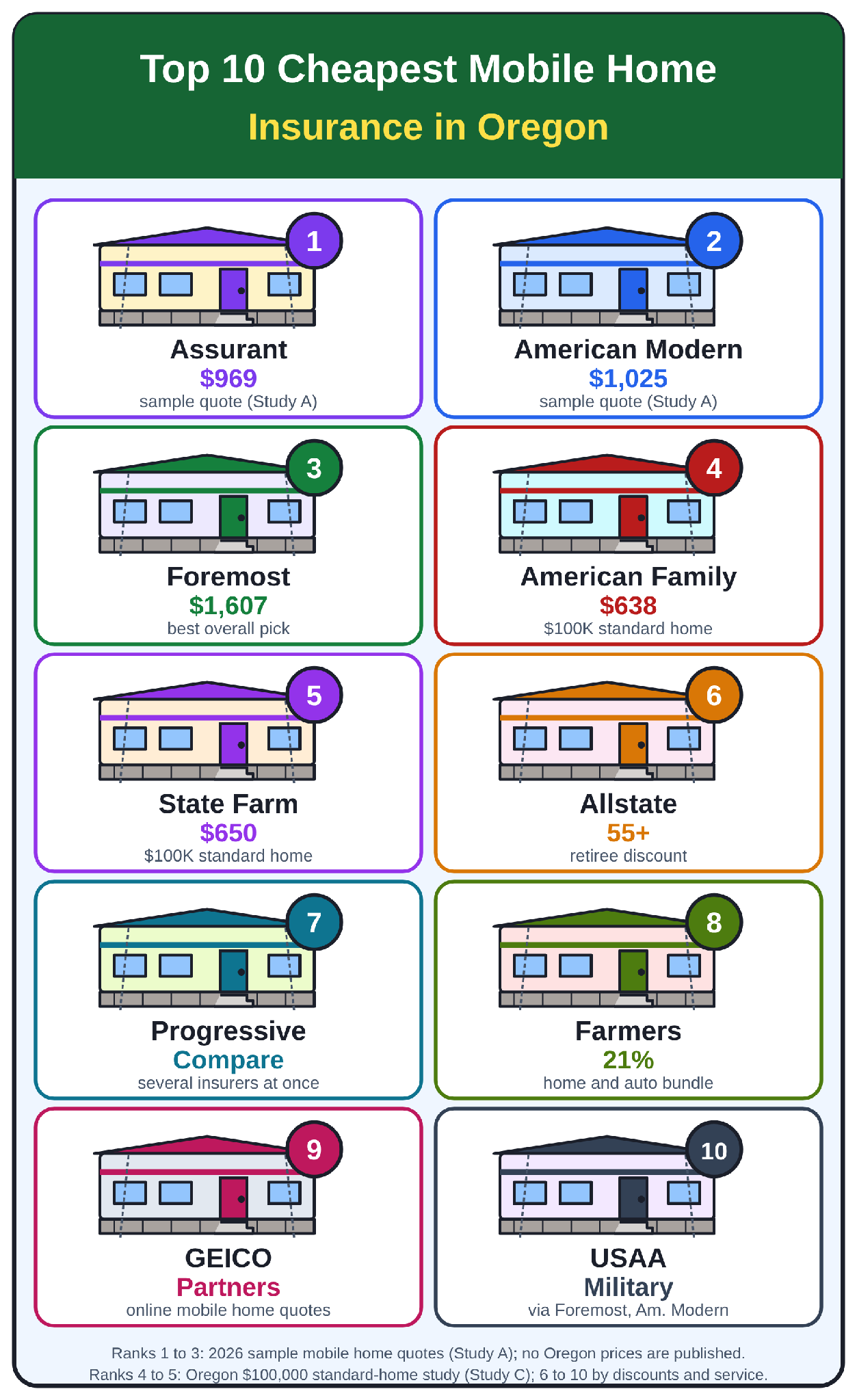
Editorial correction: This archived graphic contains sample prices or a ranking that has not been verified for Oregon manufactured-home policies. It is preserved for layout continuity; rely on the updated tables and the Oregon-specific written quote instead.
Archived graphic: figures combine out-of-state manufactured-home samples and conventional Oregon homes. Not an Oregon cheapest-company ranking.
Oregon manufactured-home insurers: evidence and eligibility questions
| Insurer / channel | Evidence available | What an Oregon homeowner must confirm |
|---|---|---|
| Assurant | Manufactured-home specialist; $969 in out-of-state Study A samples | Oregon program, issuing company, quote, wildfire terms and settlement basis |
| American Modern | Manufactured-home specialist; $1,025 in out-of-state Study A samples | Acceptance of the actual Oregon home and written policy limits |
| Foremost | Manufactured-home program; $1,607 in out-of-state Study A samples | Agent availability, agreed-loss terms and wildfire underwriting |
| American Family | Company offers manufactured-home insurance in selected states | Oregon product eligibility; do not substitute its standard-house $638 figure |
| State Farm | Manufactured-home product at company level | Eligible age, home type and replacement-cost terms in Oregon |
| Allstate | Manufactured-home coverage described by company | Local availability and any conditional retiree discount |
| Progressive | Marketplace or partner placement | Name of actual issuing insurer and exact policy form |
| Farmers / Foremost | Agent channels and affiliated manufactured-home products | Whether a Foremost or another product is being quoted |
| GEICO | Partner placement for manufactured-home coverage | Actual underwriting company and exclusions |
| USAA | Military-eligibility channel and possible partner placement | Membership rules, partner carrier and Oregon availability |
Study A (July 6, 2026); Study C (October 2026); Study D (April 21, 2026); 2025 NAIC complaint index from a national mobile home review updated September 15, 2026. 1.0 is average, and lower is better.
Assurant: an out-of-state sample, not an Oregon rate
Assurant’s $969 figure was the lowest price for the particular out-of-state manufactured-home sample in Study A, not a quote from Oregon. Distribution through a partner such as GEICO does not establish availability for a given Oregon property. Ask which company would issue the policy and whether wildfire, smoke, flood, earthquake and rebuilding expenses are included or excluded.
American Modern: specialist underwriting to confirm
American Modern’s $1,025 annual figure also comes from Study A’s mainland sample. Its specialized products may offer different ways of valuing an older manufactured home; request the actual Oregon policy form, exclusions, available dwelling limit and total-loss settlement wording before comparing it against a competitor’s offer.
Foremost: manufactured-home expertise, not a verified winner
Foremost has a long history insuring manufactured homes and may be worth contacting through a licensed Oregon agent. But $1,607 was an out-of-state sample, and a national complaint index does not independently prove that Foremost delivers the best service for manufactured-home claims in Oregon. Ask about the actual policy, wildfire risk acceptance, replacement or agreed-loss settlement and any discounts available for this home.
American Family: verify Oregon manufactured-home eligibility
American Family’s $638 quote in Study C was for a conventional $100,000 Oregon house, not a manufactured home. The company advertises manufactured-home insurance in some states, but an agent must first confirm it is available for the specific Oregon address. Complaint figures reported for company groups are not a standalone score of the Oregon mobile-home product.
State Farm: check policy form and replacement cost
State Farm has a significant share of Oregon conventional-home insurance and also advertises a manufactured-home product. Its $650 figure in Study C is a standard-house example, not a manufactured-home offer. An Oregon agent should confirm whether the home qualifies and whether a total loss would be paid at actual cash value or replacement cost.
Allstate: ask about retiree eligibility
Allstate advertises manufactured-home insurance products, with coverage and discounts subject to underwriting. Its conventional Oregon homeowners figures should not be repurposed as mobile-home premiums. Retiree benefits may require specific age and work-status criteria; verify eligibility in the quote rather than assuming a discount applies.
Progressive, Farmers, GEICO and USAA: distinguish partner insurers
Progressive and GEICO may connect applicants with a partner that writes manufactured-home insurance; Farmers and USAA may also distribute partner products for qualifying consumers. A comparison of four brands may therefore produce fewer than four independent insurers. Record the actual underwriting company, coverage form, deductibles and wildfire conditions in each offer.
PRO TIP #1
When comparing partner-distributed policies, ask for the legal name of the issuing insurer and the declarations page. Two shopping sites may route the same manufactured home to the same company, leaving you with duplicate quotes rather than a true comparison.
Companies not on our list
A company’s departure from a manufactured-home program, or a national review of its products, does not establish which alternatives will accept a particular Oregon home. The relevant evidence is an active Oregon manufactured-home product, written eligibility confirmation and a current quote—not a price study for conventional houses.
Can we identify the cheapest Oregon mobile home insurance company?
No: the cited studies do not support naming a statewide cheapest manufactured-home insurer in Oregon. Assurant’s $969, American Modern’s $1,025 and Foremost’s $1,607 are samples in other states, while American Family and State Farm prices are for conventional homes. One third-party Oregon estimate of about $553 also lacks enough methodology to be treated as a reliable market average.
Start by requesting Oregon-specific manufactured-home quotes from any insurer willing to underwrite the address. Assurant, American Modern, Foremost and a local agent are contacts to investigate, not preselected winners. Compare the same limits, fire terms, deductibles and settlement method; the core elements of an insurance quote are relevant, but no general comparison tool guarantees manufactured-home availability.
Oregon mobile home insurance by need
Oregon manufactured-home insurance options by need (conditional)
| Need | Option to investigate | Important qualification |
|---|---|---|
| Price comparison | Assurant, American Modern, Foremost | No comparable Oregon manufactured-home rates are established by the cited studies |
| Older manufactured home | Specialists or Oregon FAIR Plan | Actual cash value may apply; check underwriting and total-loss limit |
| Higher-risk wildfire area | Independent agent / admitted or surplus-lines markets | Availability, exclusion terms and total cost need written confirmation |
| Conventional-home comparison | State Farm or American Family | Published conventional-home rates do not predict mobile-home premiums |
| Retirement discount | Foremost / Allstate, where eligible | Verify age and eligibility directly on a manufactured-home quote |
| Multiple online inquiries | Progressive / GEICO, where available | Confirm that offers come from different underlying companies |
| Cannot find private coverage | Oregon FAIR Plan | Limited property-only product; no homeowners liability package |
Our assessment, based on Study A, Study C, Study D, and company information.
Cheapest mobile home insurance for seniors in Oregon
For older Oregon owners, compare manufactured-home eligibility first and then ask about conditional age-based and retirement credits, including those advertised by Foremost or Allstate. A Spanish-language review of Allstate insurance addresses the insurer more broadly, not this specific Oregon home policy. A lower actual-cash-value premium can leave an owner unable to replace the home after a total loss.
Oregon’s Senior and Disabled Property Tax Deferral is a tax-payment loan, not a discount or forgiveness program. For 2026, the household-income threshold is $70,000. The $301,000 real-market-value figure is a statewide minimum cap used in a county- and tenure-dependent eligibility calculation, not a universal maximum. Applications are normally due April 15; qualifying late applications are accepted with a fee through December 1. Deferred amounts accrue 6% annual simple interest, and a lien or security interest is recorded. Manufactured structures may be eligible, subject to ownership and other rules.
Oregon senior help for mobile home owners
| Program | Who qualifies | Benefit |
| Foremost discount | Owners 50+ | Lower premium |
| Allstate credit | Retired owners over 55 | Lower premium |
| Senior/Disabled Property Tax Deferral | 2026 income ≤ $70,000; additional rules | Tax-payment loan at 6% simple annual interest; lien; later repayment |
| Space rent cap | Generally parks with more than 30 spaces | 6% for 2026, subject to statutory exceptions |
Company websites; Oregon Department of Revenue (2026); HB 3054 (2025).
PRO TIP #2
Ask whether any senior discount is available on an Oregon-issued manufactured-home policy, then evaluate the tax-deferral program separately. Deferral can improve short-term cash flow but creates a repayable balance with interest and a state lien; confirm long-term consequences with the county assessor or a qualified tax adviser.
Wildfire and mobile homes in Oregon
Wildfire is a major driver of insurance availability and property-loss risk in Oregon. OPB reported in October 2026 that Oregon Department of Forestry data showed approximately 2.1 million acres burned in 2026, exceeding the 2024 record; other reports use broader geographic datasets and may report higher totals. The same report described 56 homes destroyed by large fires in 2026. These are statewide incident statistics, not manufactured-home insurance claim frequencies.
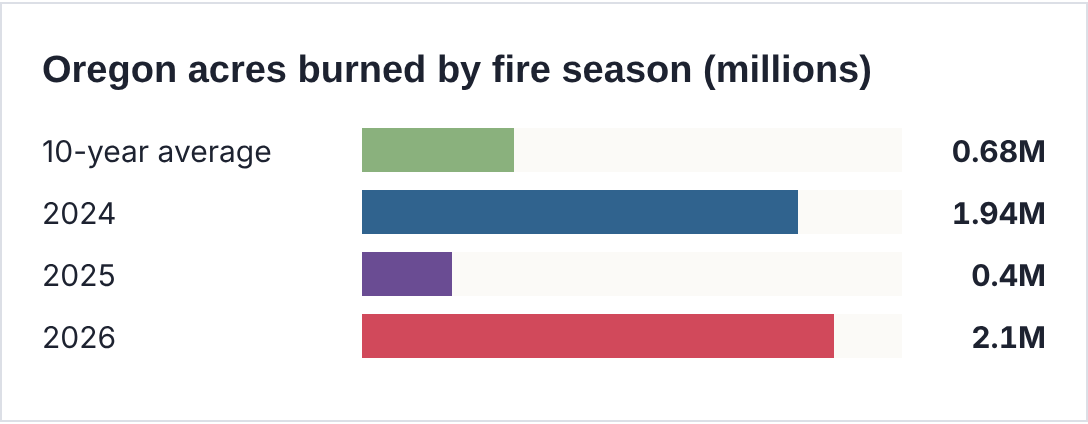
KTVZ (October 2024); Willamette Week (November 2025); OPB (October 24, 2026). 2025 was below 400,000 acres; 2026 counts vary by source.
The September 2020 Labor Day fires were especially devastating for housing, including thousands of homes statewide. The Almeda fire moved through Talent and Phoenix and destroyed numerous manufactured-home communities; historical reporting describes more than 1,000 mobile homes lost across multiple parks. This makes replacement-cost valuation, site reinstallation costs and debris removal especially important for Oregon manufactured-home owners.
Major Oregon wildfires that hit homes
| Year | Fire | Homes lost |
| 2020 | Labor Day fires (statewide) | More than 4,000 homes; 11 deaths |
| 2020 | Almeda fire (Talent and Phoenix) | More than 1,000 mobile homes in 18 parks |
| 2021 | Bootleg fire | 161 houses; 413,765 acres |
| 2025 | Rowena fire (near The Dalles) | 56 homes |
| 2026 | Record season | 56 homes in large fires; 2 million+ acres |
KLCC/OPB (August 2025); OPB (October 2020); Bootleg fire records; Willamette Week (November 2025); OPB (October 2026).
Insured wildfire losses, rising replacement costs and property-specific underwriting have put pressure on the Oregon home insurance market. Statewide loss and reinsurance figures do not tell us how much a specific manufactured-home renewal will change. Compare the current written quote, including its wildfire exclusions, insured value, deductible and whether smoke damage is a covered cause of loss.
Oregon’s wildfire insurance protections
Oregon’s SB 82 requires more transparency about certain wildfire-related rating and underwriting actions and addresses how insurers consider risk mitigation. For qualifying fire losses connected to specified declared emergencies, the law provides at least 24 months for certain repair, replacement or rebuilding activities; it does not guarantee 36 months in every case. The state’s former wildfire hazard map was repealed in 2025, but insurers may still use lawful property-level wildfire risk models. Ask for a written explanation of how home-hardening work affects underwriting or premiums rather than assuming a discount.
PRO TIP #3
Maintain defensible space and document roof, vents, siding and skirting improvements. Compare this Oregon-specific process with home insurance premium-reduction factors discussed for Florida only as a different-state example; Florida law and discounts do not govern Oregon. Ask each Oregon insurer which mitigation steps affect eligibility or its filed rates, rather than assuming a guaranteed premium reduction.
The Oregon FAIR Plan
If private coverage is unavailable, the Oregon FAIR Plan Association has a specific DP-1 program for eligible manufactured/mobile homes of any age. It is a limited property-only form, not a package with personal liability. Fire, lightning and internal explosion are basic perils; extended coverage such as wind or hail is optional, and vandalism requires extended coverage. It does not cover ordinary weight-of-snow, freezing or water-discharge perils. Loss settlement is actual cash value, and the usual combined coverage limit is $600,000, with special reinsurance potentially available case by case. Confirm application eligibility and required underwriting documents with a licensed agent.
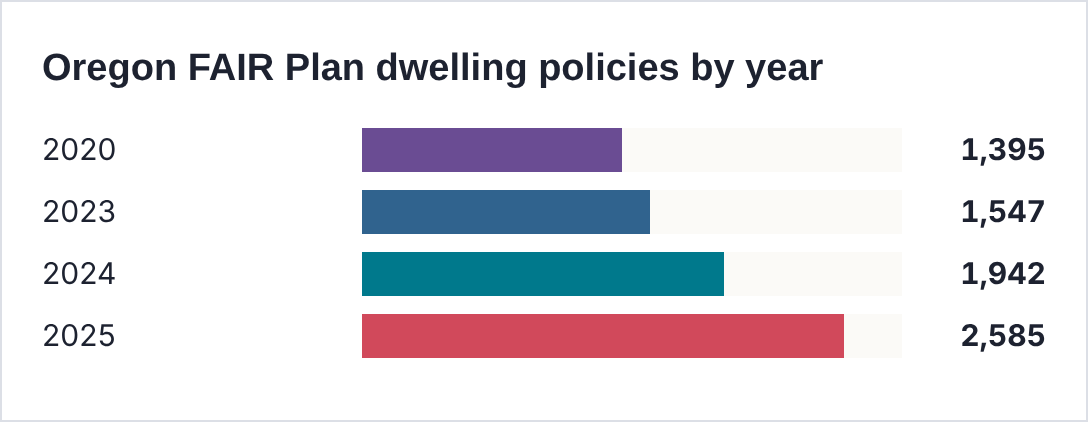
Oregon Division of Financial Regulation SB 85 report (February 2, 2026). Average premium rose from 474 in 2020 to 921 in 2025.
Earthquakes, ice storms, and floods
The Cascadia Subduction Zone creates a material earthquake and possible coastal-tsunami hazard. One often-cited projection estimates roughly a 37% chance of a very large Cascadia earthquake over 50 years; it is not a prediction for an individual home. Earthquake coverage may be optional and commonly carries a 10% or 15% percentage deductible. Consider how deductibles affect out-of-pocket claim costs before choosing the insured amount or comparing premiums.
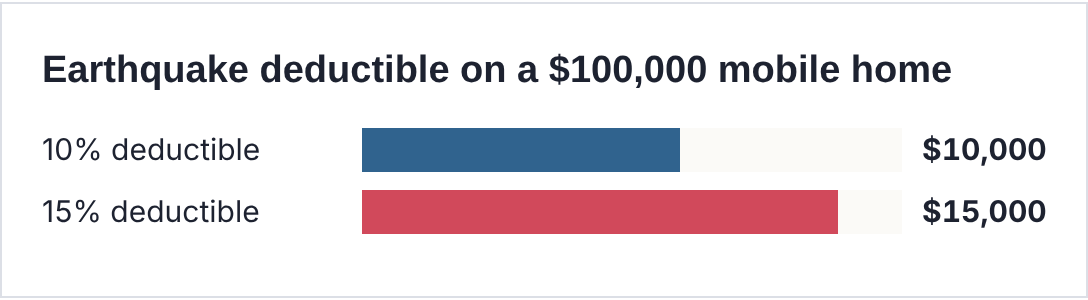
Our calculation. Oregon Division of Financial Regulation says most earthquake deductibles are 10% or 15%.
Ice storms, frozen pipes, floods and post-fire debris flows can also cause severe losses. Oregon DFR cautions that special hazards such as flood, earthquake and sewer backup are commonly excluded from manufactured-home policies. NFIP flood policies can cover eligible, properly anchored manufactured homes subject to the program’s rules, usually with a 30-day waiting period and standard residential limits up to $250,000 for buildings and $100,000 for contents.
Coverage for other Oregon natural risks
| Risk | Covered by standard policy? | Where to get it |
| Wildfire | Yes | Standard policy or FAIR Plan |
| Wind and ice storms | Yes | Standard policy |
| Earthquake | No | Endorsement; 10% to 15% deductible |
| Flood | No | Federal flood insurance |
| Tsunami | No | Federal flood insurance |
Oregon Division of Financial Regulation; FEMA; Oregon Emergency Management.
Portland mobile home insurance
Published Portland premiums in the cited studies are for conventional houses, not manufactured homes. For a manufactured-home community near Portland, prioritize actual property-specific underwriting: ice-storm damage, falling trees, flood conditions, occupancy rules and replacement or actual-cash-value settlement. A lower conventional-home average cannot establish that mobile-home coverage is inexpensive.
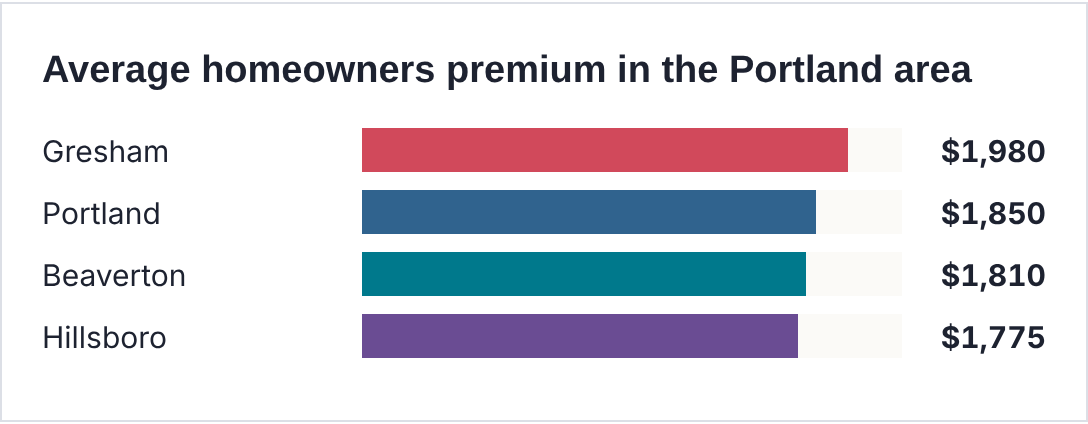
February 2026 Oregon homeowners study, $500,000 dwelling. Standard homes, not mobile homes. Averages, not quotes.
Salem and Eugene mobile home insurance
Some conventional-home studies show lower modeled premiums for Salem and Eugene than for high-fire-risk parts of central and southern Oregon. The city figures in this guide are not manufactured-home quotes. Park residents in Lane and Marion counties should request coverage estimates using their home’s age, roof, skirting, location and potential flood or wildfire exposure.
Average homeowners premium in Salem, Eugene, and Corvallis
| City | February 2026 study ($500K) | Study C ($250K) |
| Salem | $1,855 | $1,119 |
| Eugene | $1,815 | $1,078 |
| Corvallis | $1,910 | Not listed |
February 2026 Oregon homeowners study; Study C (October 2026). Standard homes, not mobile homes.
Medford, Talent, and Phoenix mobile home insurance
Conventional homeowners studies often show higher average prices for Medford, Grants Pass and Klamath Falls than for some Willamette Valley cities, but those comparisons are not mobile-home rates. In Jackson County, wildfire risk and private-market availability can be particularly important. When coverage is declined, compare specialist options and the Oregon FAIR Plan’s limited manufactured-home form.
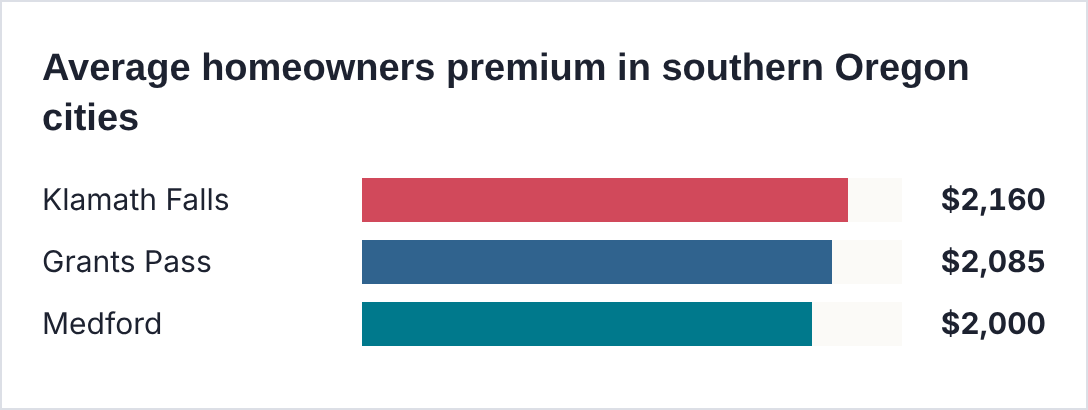
February 2026 Oregon homeowners study, $500,000 dwelling. Standard homes, not mobile homes. Averages, not quotes.
The Almeda fire demonstrates the importance of enough dwelling coverage, debris removal, delivery and installation, and temporary living expenses. A California-focused discussion of the Farmers home-claim adjustment process describes documenting property damage, but does not establish Oregon claims rules. For certain losses connected to declared wildfire emergencies, Oregon law provides a minimum 24-month recovery window under SB 82; check the precise policy and legal conditions.
Bend and Central Oregon mobile home insurance
Bend can present high wildfire exposure, but the conventional-home averages quoted in 2026 studies do not determine a manufactured-home price. Owners in central Oregon should document defensible space, verify rebuilding and wildfire settlement terms, and ask an independent agent whether specialist or last-resort coverage is available before a renewal is declined.
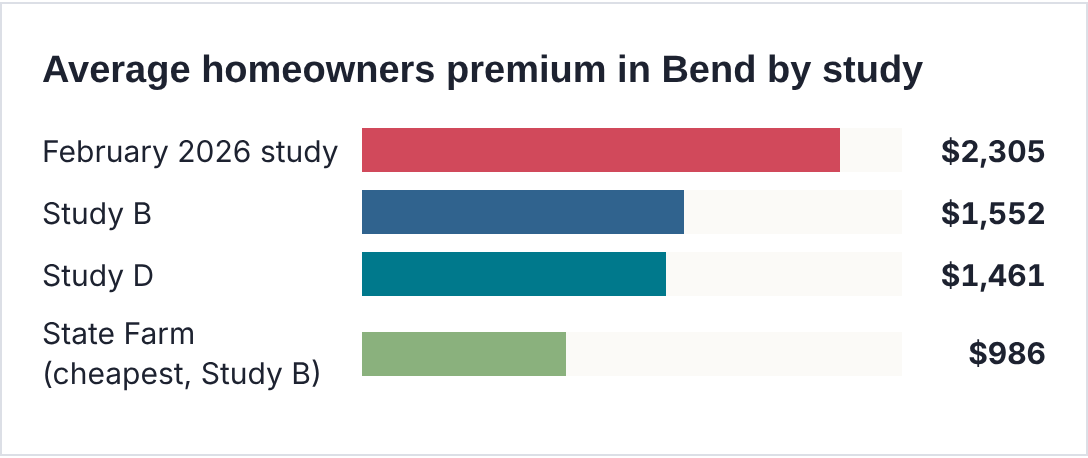
2026 Oregon homeowners studies. Standard homes, not mobile homes. Averages, not quotes.
Oregon park residents’ rights
Oregon HB 3054, effective September 2025, generally sets a 6% annual space-rent increase limit in manufactured-home facilities with more than 30 spaces starting in 2026. Certain significant infrastructure projects can justify a special increase of up to 12% no more than once in five years, subject to notice and approval by 51% of occupied tenant spaces. Smaller facilities generally use the lesser of 10% or 7% plus CPI; the 2026 ceiling was published as 9.5%. Rent increases are generally limited in frequency and require notice, but statutory exceptions—including newer facilities—can apply. These are landlord-tenant rules, not insurance premium limits.
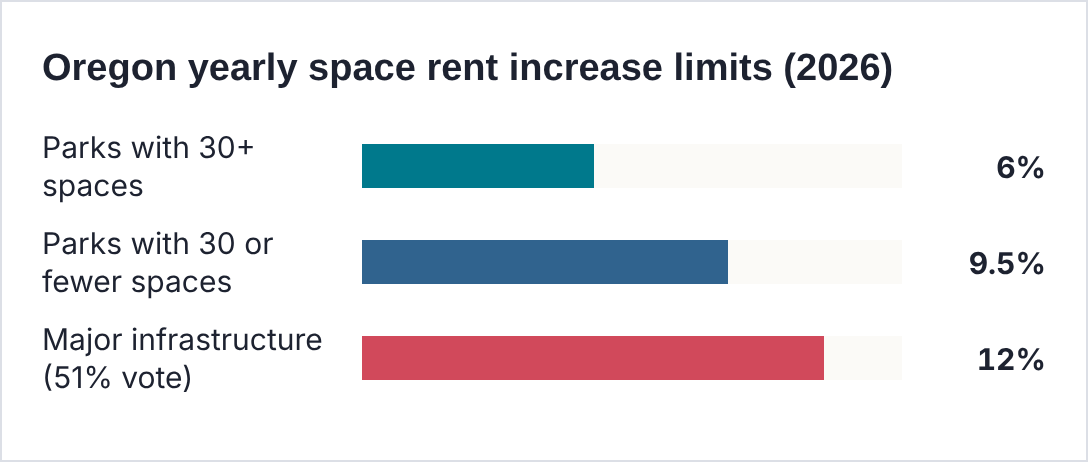
HB 3054 (2025); Oregon Office of Economic Analysis (2026 maximum of 9.5%). Parks under 15 years old are exempt.
Oregon park resident protections
| Protection | Details |
| Rent increase notice | 90 days, once a year |
| Park closure notice | One year, with payments per home |
| Closure payments (2016 rates) | $6,000 single-wide; $8,000 double-wide; $10,000 larger |
| Park sale | Residents may form a committee to compete to buy |
| Help line | Manufactured Communities Resource Center, 800-453-5511, option 2 |
HB 3054 (2025); Oregon Housing and Community Services; Oregon Law Center testimony (February 2025). Closure payments are adjusted yearly for inflation.
Oregon laws every mobile home owner should know
- Mobile home insurance is not required by Oregon law, but lenders and many parks require it.
- Oregon no longer issues titles for manufactured homes; the Building Codes Division issues ownership documents instead, and most transfers cost $55.
- Homes are taxed as personal property unless merged with the land as real property.
- Installers must be licensed by the Building Codes Division, and local building departments issue permits and inspect.
- All of Oregon is in HUD Wind Zone I and the south roof-load zone.
- Insurers must give 30 days’ written notice, with a reason, before non-renewing a policy.
Why Oregon home insurance costs are rising
Some Oregon conventional-home premium studies and FAIR Plan statistics show higher costs over recent years, including a rise in average FAIR Plan dwelling premiums reported by the regulator. Differences in risk composition, coverage and insured values mean these figures should not be used as a forecast for any particular manufactured home’s future premium.
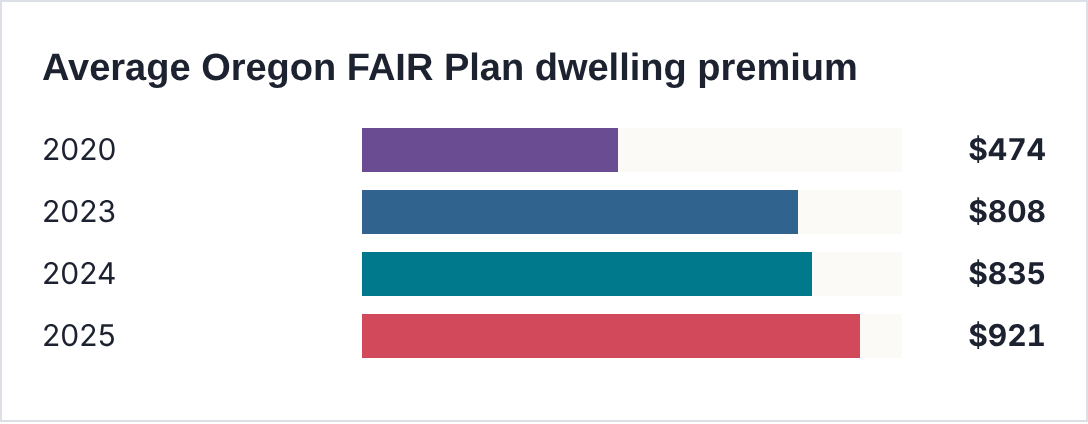
Oregon Division of Financial Regulation SB 85 report (February 2, 2026).
What Oregon mobile home insurance covers
Main coverage parts of an Oregon mobile home policy
| Coverage | What it pays for |
| Dwelling | Repairs or replacement of the home |
| Other structures | Carports, decks, sheds, and skirting |
| Personal property | Furniture, clothes, and belongings |
| Loss of use | Living costs after a covered loss |
| Personal liability | Injuries or damage you cause to others |
| Not usually covered | Earthquake, flood, and tsunami |
Company policy descriptions; coverage varies by insurer.
How to check an insurer’s service record
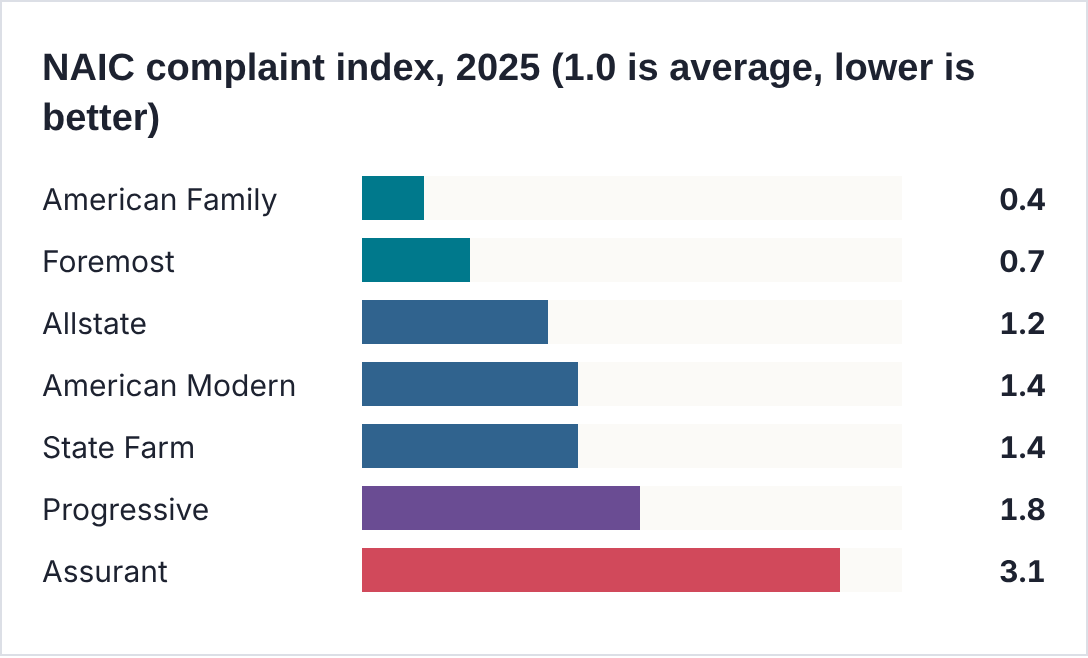
NAIC complaint index for 2025, as reported in a national mobile home review updated September 15, 2026.
Bundling mobile home and auto insurance in Oregon
The home-auto bundle percentages shown in the cited studies apply to conventional houses, not Oregon manufactured-home policies. Multi-policy insurance discounts are worth checking only after an insurer confirms the home is eligible. Compare the combined annual bill with a specialist manufactured-home policy plus a separate automobile policy.
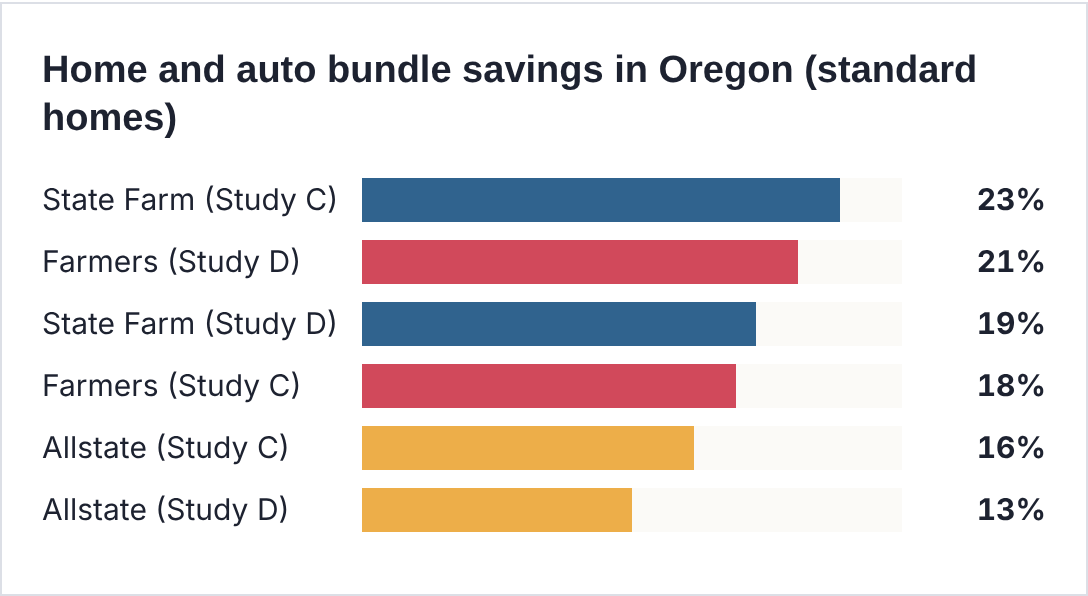
Study C: Oregon bundle study updated July 28, 2026; Study D: Oregon bundle study updated April 21, 2026. Standard homes, not mobile homes.
A high bundle percentage is not proof of lower overall cost: the undiscounted premiums, issuing companies, coverage terms and eligibility all matter. On the auto-insurance side, a Spanish-language analysis of Farmers and multi-policy coverage provides company context, but does not establish an Oregon manufactured-home discount. If the mobile-home policy is written by a partner, ask which policy actually receives a credit.
Mobile home insurance discounts in Oregon
Discounts to ask for in Oregon
| Discount | Who offers it |
| Age 50+ or retired 55+ | Foremost (50+); Allstate (retired, over 55) |
| Newer home | Foremost, State Farm |
| Approved park | Foremost |
| Diminishing deductible | American Family |
| Home alarms | State Farm |
| Multi-policy | Most insurers |
Company websites (2025 to 2026). Discount amounts vary.
Mobile home insurance vs. homeowners insurance in Oregon
How Oregon mobile home and homeowners policies compare
| Feature | Mobile home policy | Homeowners policy |
| Typical yearly cost | Study E ~$553 (profile/method unclear) | About $1,124 to $2,065 on average |
| Main insurers | Foremost, American Modern, Assurant | State Farm, Grange, Allstate, Travelers |
| Tax | Personal property unless merged with land | Real property |
| Ownership record | Building Codes Division ownership document | Deed |
| Earthquake and flood | Separate coverage | Separate coverage |
Study B; Study C; Study E; Oregon Building Codes Division; Lane County.
Insuring older and pre-1976 mobile homes in Oregon
Manufactured homes built before the federal HUD code took effect on June 15, 1976 are commonly referred to as mobile homes and may face more restrictive underwriting. Oregon DFR explains that older units are often insured for actual cash value, while eligible newer units may qualify for replacement cost. The FAIR Plan explicitly considers mobile and manufactured homes of any age but offers limited DP-1 coverage. Keep documentation of roof, wiring, heating and installation updates.
Park homes vs. homes on private land
Park location and lot lease rules can affect ownership risk and replacement options. A claimed approved-park insurance discount must be verified in the actual policy. Homes on private land may require additional coverage for outbuildings and site infrastructure, and both settings need a clear wildfire plan, debris-removal limits and an accurate rebuilding or cash-value estimate.
How much coverage you need
Estimate the cost to replace the manufactured home with a comparable code-compliant unit, including delivery, siting, permits and installation, then check whether the policy offers replacement cost, agreed value or actual cash value. A general breakdown of home insurance protection can help distinguish dwelling, belongings and liability, but the manufactured-home policy controls. Do not add land value to the dwelling limit. Basic FAIR Plan protection does not supply a homeowners liability package.
Questions to ask before you buy
- Does the policy pay replacement cost or actual cash value?
- What credit do I get for defensible space and fire-resistant skirting?
- Is earthquake coverage available, and what is the deductible?
- Does the policy cover debris removal and tree removal?
- Which insurer will actually handle my claims?
How to compare Oregon mobile home insurance quotes
- Use the same dwelling limit, liability limit, and deductible for every quote.
- Check whether each quote pays replacement cost or actual cash value.
- Ask which discounts are already applied.
- Price earthquake and flood coverage separately and add them to the total.
- Compare the full bundle bill if you also need car insurance.
Tips to save money on mobile home insurance in Oregon
- Get at least three quotes, starting with Assurant, American Modern, and Foremost.
- Add American Family and State Farm for comparison.
- Make sure your quotes come from different underlying insurers.
- Ask for senior, park, newer-home, and alarm discounts.
- Document wildfire mitigation and ask what credit it earns.
- Add earthquake coverage before a quake, not after.
- Apply for the senior property tax deferral by April 15.
- Shop again every year, since Oregon rates have risen fast.
What to do after a wildfire or storm
- Get to safety, then call your insurer or agent as soon as you can.
- Take photos and video of all damage before cleaning up.
- Keep receipts for hotels, meals, and temporary repairs.
- Ask your insurer about Oregon SB 82: certain qualifying declared-fire claims must allow at least 24 months for repair or replacement; coverage and timing vary by case.
- If you have a problem, call the Oregon Division of Financial Regulation at 888-877-4894.
Oregon mobile home insurance at a glance
This archived illustration preserves the original study figures but must not be read as an Oregon-specific price ranking. The editorial comparison and verified public-program details appear in the updated text and tables.
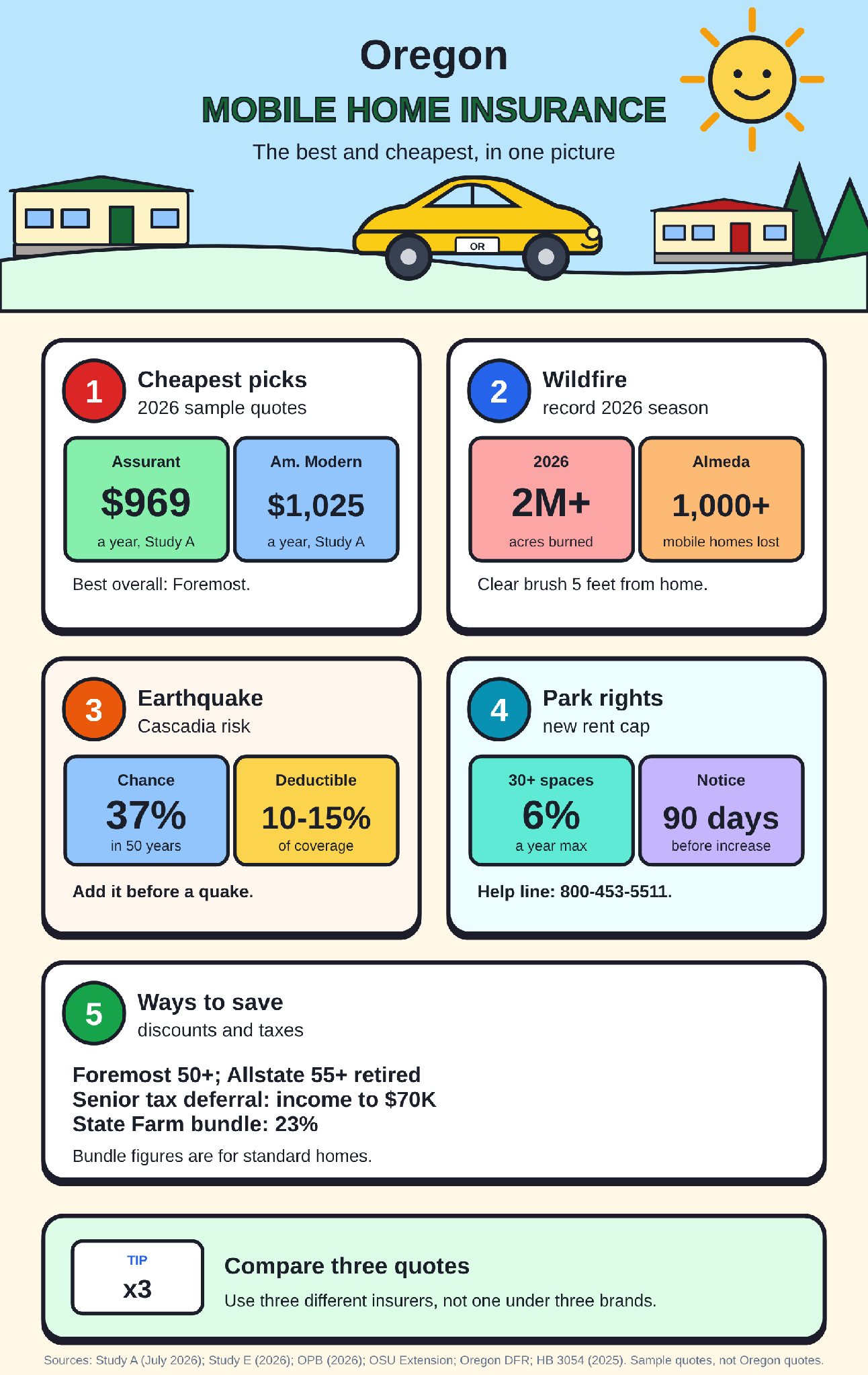
Editorial correction: This archived graphic contains sample prices or a ranking that has not been verified for Oregon manufactured-home policies. It is preserved for layout continuity; rely on the updated tables and the Oregon-specific written quote instead.
Archived illustration: source figures and an unverified ranking are preserved; consult updated analysis and primary regulatory sources above.
Frequently asked questions about Oregon mobile home insurance
How much is mobile home insurance in Oregon?
One third-party table lists roughly $553 annually, but it does not disclose enough information to establish a verified statewide average. The cost of a real policy depends on location, construction, age, insured value, claims experience and coverages.
Who has the cheapest mobile home insurance in Oregon?
The cited studies do not establish a cheapest Oregon manufactured-home insurer. Assurant’s $969 and American Modern’s $1,025 examples came from mainland test cities outside Oregon. Request comparable Oregon quotes before deciding.
What is the best mobile home insurance company in Oregon?
There is no proven universal winner. Compare insurer eligibility, wildfire and smoke coverage, total-loss valuation, deductible, customer service and price. Foremost, American Modern, Assurant and locally available alternatives can be investigated without declaring a ranking.
What is the best mobile home insurance for seniors in Oregon?
An eligible owner should compare actual manufactured-home quotes and ask about age- or retirement-related discounts. Oregon’s senior/disabled property tax deferral is a separate repayable program with interest, not a policy discount.
Does mobile home insurance cover wildfire in Oregon?
Fire is a commonly covered peril under manufactured-home policies, but exclusions, policy limits and settlement provisions vary. Confirm wildfire, smoke, debris removal and additional living expenses in the declarations and policy.
Does mobile home insurance cover earthquakes in Oregon?
Usually not automatically. Earthquake insurance often requires a separate policy or endorsement, with a substantial percentage deductible. Verify that the coverage accepts manufactured homes.
How much can my park raise space rent in Oregon?
For 2026, most parks with more than 30 spaces are subject to a 6% limit, with a restricted infrastructure exception. Smaller parks typically follow a 9.5% ceiling for 2026, subject to statutory exemptions and notice requirements.
Final considerations for Oregon manufactured-home owners
The article’s cited prices do not establish a cheapest or best manufactured-home insurer for Oregon. Assurant, American Modern, Foremost and other licensed options may be worth checking, but availability and value depend on the actual home and the exact contract. A reliable comparison must use Oregon manufactured-home quotations with matching limits, valuation methods and excluded perils.
Prioritize coverage quality over an unsupported lowest-price claim. Confirm wildfire and smoke coverage, whether an earthquake or flood policy is needed, and the cost to replace a manufactured home and reinstall it. Keep a defensible-space record, compare written policies and check whether park rent protections or a repayable tax deferral apply to your situation.
Sources
- Study A: ValuePenguin, mobile home insurance (July 6, 2026).
- Study B: ValuePenguin, cheap homeowners insurance in Oregon (September 25, 2026).
- Study C: MoneyGeek, cheap homeowners insurance in Oregon (October 2026); average cost of home insurance in Oregon (October 29, 2026); and best home and auto bundle in Oregon (July 28, 2026).
- Study D: Insurance.com, best homeowners insurance in Oregon (October 5, 2026), and cheapest home and auto bundle in Oregon (April 21, 2026).
- Study E: Insuranceopedia, mobile home insurance by state and mobile home insurance in Oregon (October 18, 2026).
- NerdWallet, Oregon homeowners insurance (February 2026); LendingTree, Oregon homeowners insurance (July 2026); LendingTree, best mobile home insurance companies (September 15, 2026); and Insurify, Oregon homeowners insurance (October 2026).
- Oregon DFR, homeowners insurers; Oregon DFR, 2024 homeowners market; Oregon DFR, manufactured home insurance; Foremost, mobile home; Progressive, availability; State Farm, manufactured homes; American Family, manufactured home; GEICO, mobile home; BudgetSeniors, Allstate senior discounts; and Coverager, Homesite withdrawal.
- Kin, states served; NerdWallet, Nationwide review; OPB, wildfire and insurers (January 2026); and Lookout Eugene-Springfield, rising premiums (August 2025).
- HB 3054 staff summary (2025); Oregon Law Center testimony (February 2025); NAR, Oregon profile; University of Oregon, manufactured housing (2016); OHCS, preserved parks (2024); and KOBI, Jackson County parks.
- KLCC, Labor Day fires (August 2025); OPB, Almeda fire (October 2020); JPR, mobile home parks burned (October 2020); KOBI, Almeda structures (2020); Bootleg Fire; KTVZ, 2024 fire season; Willamette Week, 2025 fire season; and OPB, 2026 fire season (October 2026).
- Governor Kotek, wildfire emergency order (July 2026); Oregon DFR, order extension (August 2026); Oregon DFR, SB 85 report (February 2026); Nugget News, SB 82 (January 2024); Ballard Spahr, SB 83 (July 2025); Insurance Business, SB 1540 (March 2026); and Oregon DFR, FAIR Plan limits (May 2023).
- OSU Extension, Cascadia FAQ; Oregon Emergency Management, Cascadia; Oregon DFR, earthquake insurance; KOIN, 2024 ice storm; Sen. Merkley, ice storm (March 2024); OPB, 2021 heat wave; Reed College, flood insurance decline (April 2025); and FEMA, flood insurance brochure.
- 24 CFR 3280.305; Oregon Office of Economic Analysis, rent stabilization; OHCS, resource center FAQ; OHCS, park closings; OregonLawHelp, rent increase laws; Building Codes Division, ownership documents; Lane County, manufactured structures FAQ; and Oregon DOR, senior tax deferral.
Disclaimer
This website provides independent reviews and comparisons. It is not affiliated with, endorsed by, sponsored by, or connected to Assurant, American Modern, Foremost, Farmers, American Family, State Farm, Allstate, Progressive, GEICO, USAA, Grange, Capital Insurance Group, Oregon Mutual, Nationwide, Homesite, Kin, the Oregon FAIR Plan, or any of their affiliates.
All company names, brand names, trademarks, and logos are the property of their respective owners and are used here only to identify the companies being reviewed. Their use does not imply any affiliation or endorsement.
The information on this page is provided for general informational and educational purposes only. It is not insurance, legal, tax, or financial advice, and it is not an offer, quote, or solicitation to buy or sell insurance. We are not an insurance company, insurance agency, or licensed insurance producer, and we cannot bind coverage, change a policy, or handle claims.
Prices, discounts, ratings, and company details are drawn from public sources and third-party studies that use specific home profiles, and they can change at any time. They are estimates and averages, not guarantees of what you will pay. Coverage, eligibility, and discounts vary by location, home, and owner, and are subject to each insurer’s underwriting rules and policy terms.
While we make reasonable efforts to keep this guide accurate and current, we make no representations or warranties, express or implied, about its completeness, accuracy, or reliability. Opinions here are our own. Always confirm details directly with the insurer, read your policy documents, and consult the Oregon Division of Financial Regulation or a licensed professional before making a decision. Your use of this information is at your own risk, and we are not liable for any loss or damage arising from reliance on it.