
Best Car Insurance for Uber and DoorDash: Coverage & Costs
For drivers who alternate between Uber rides and DoorDash deliveries, the starting point is a personal auto policy that explicitly covers every app and activity, usually through an appropriate endorsement or another approved policy arrangement. Progressive publicly states that its rideshare endorsement extends to delivery services such as DoorDash and Uber Eats in most states; State Farm offers rideshare protection and may cover some deliveries under particular personal policies, but drivers must confirm the wording and state availability. State Farm reports an added cost of about 15%–20% for its rideshare coverage, not a universal increase for every insurer. Personal insurance can exclude commercial activity, and app-provided insurance has important gaps.
For covered U.S. passenger trips, Uber generally maintains at least $1 million in third-party liability after a ride is accepted, and Lyft maintains at least $1 million in most markets, subject to notable state and livery exceptions. While waiting, the common baseline is $50,000 per person / $100,000 per accident for bodily injury and $25,000 for property damage. Their contingent coverage for the driver’s own vehicle generally requires comprehensive and collision on the personal policy and has a $2,500 deductible, subject to company and program exceptions.
Delivery coverage is different. DoorDash and Uber Eats maintain limited third-party liability protection under their applicable terms but do not insure repairs to the delivery driver’s own car; we could not confirm platform-provided auto coverage for Instacart shoppers. This comparison separates passenger rides from deliveries, shows sample rideshare premiums rather than claiming verified DoorDash-inclusive quotes, and explains which questions to ask before binding coverage.
KEY TAKEAWAYS
- Many personal policies exclude paid rides or deliveries; an insurer must confirm, preferably in writing, whether each app, waiting period, and active trip is covered.
- Uber and Lyft generally have a $2,500 deductible for contingent vehicle-damage coverage during passenger trips, and require comprehensive and collision on the personal policy, subject to exceptions.
- Uber Eats covers up to $500,000 in liability during a delivery but does not pay for damage to your own car.
- USAA was lowest in LendingTree’s May 2026 sample of rideshare policies at $139 per month; Travelers was $143. Those are not verified prices for coverage that includes both Uber and DoorDash.
- Progressive is a strong first comparison for multi-app drivers because it explicitly mentions delivery coverage in most states. State Farm is worth comparing, but its delivery protection must be checked for your policy.
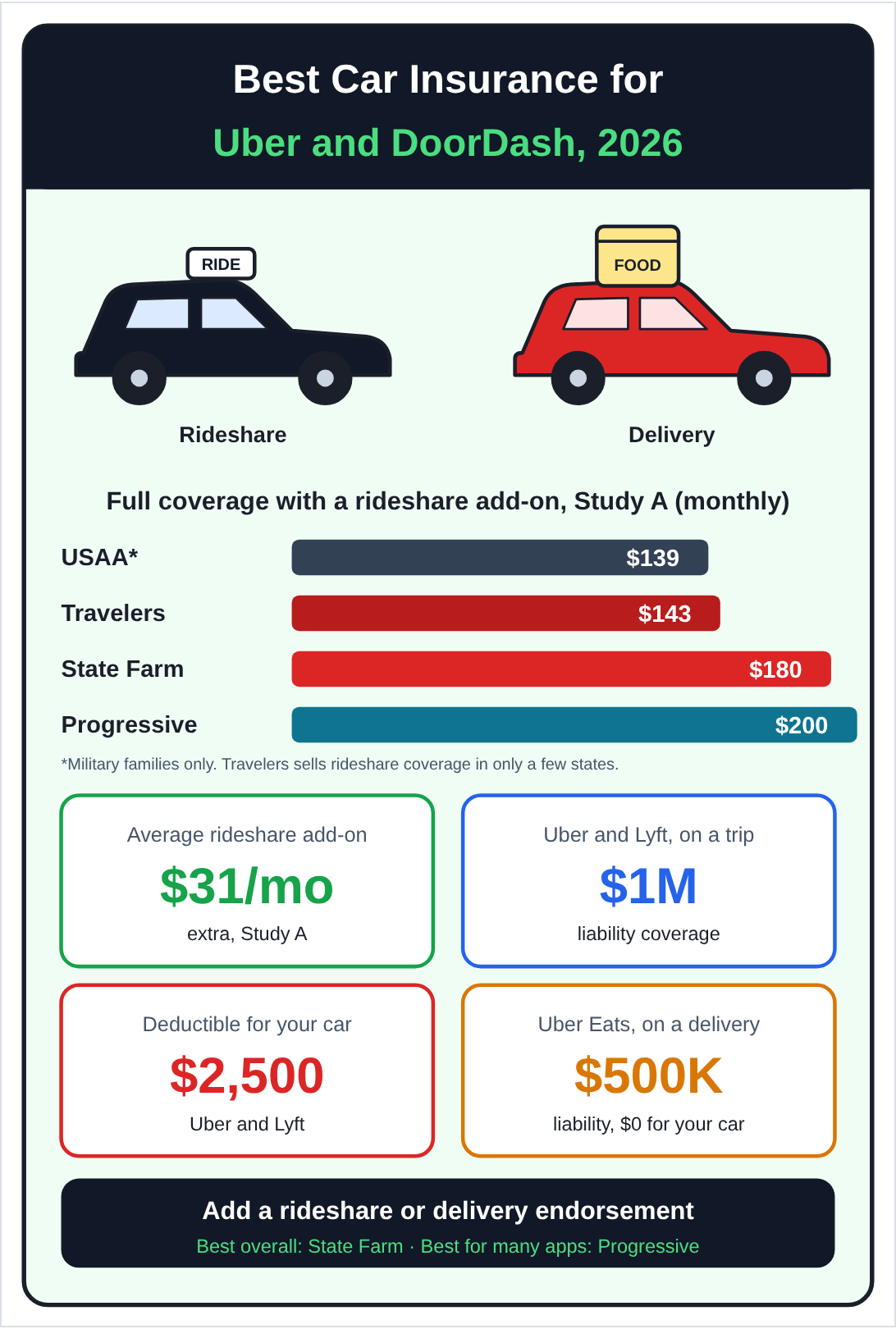
Graphic context: This introductory graphic reflects the original comparison. Provider rankings and insurance prices must be read alongside the revised state-specific coverage explanations; an endorsement for rideshare may not include deliveries.
Best car insurance for Uber and DoorDash at a glance. Sources: Study A (May 2026), Uber, and Lyft (2026).
Why gig drivers need special car insurance
A standard personal auto policy is priced for commuting, errands, and road trips. Most policies have what is called a “public or livery conveyance” exclusion, which removes coverage when you carry people or goods for a fee. The National Association of Insurance Commissioners (NAIC) says it is not uncommon for personal policies to exclude driving for pay, and that this exclusion can affect liability, injury, collision, and uninsured motorist coverage.
Before choosing a gig-work endorsement, understand the liability, comprehensive, and collision protections in the underlying personal policy.
Insurance policy forms and endorsements have evolved as ridesharing expanded, and insurers differ in how they treat time spent logged into an app. Some personal-auto forms exclude app-on or paid-driving activity; an endorsement may restore selected personal-policy protections. A driver should not assume that an endorsement designed for passenger rides also covers food or grocery delivery.
State laws set the minimum rules
In March 2015, Uber, Lyft, and major insurers, including State Farm, Allstate, Farmers, and USAA, agreed on a model bill for rideshare insurance. Lawmakers’ group NCOIL adopted its own model act that July.
U.S. jurisdictions have adopted different rideshare insurance rules. Common waiting-period limits are $50,000 per person / $100,000 per accident for bodily injury and $25,000 for property damage, and many require $1 million of liability once a passenger trip is accepted. These figures are not universal: the actual applicable limits depend on the jurisdiction, platform and trip status. Delivery-platform rules are distinct from passenger-rideshare laws.
The three periods of gig driving, explained
Rideshare insurance is built around three periods, plus the time the app is off. Knowing them is the key to understanding where you are covered and where you are not.
The gap matters even more when comparing the difference between minimum and full coverage, because minimum liability limits do not pay to repair your own car.
Who covers what during each period of rideshare driving
| Period | What you are doing | Primary coverage | Your risk |
|---|---|---|---|
| App off | Personal driving | Your personal policy | Low, if your policy is in force |
| Period 1 | App on, waiting for a request | Uber or Lyft: $50,000/$100,000/$25,000 liability only | High: no coverage for your car, and your personal policy may exclude this time |
| Period 2 | Request accepted, driving to pickup | Uber or Lyft: at least $1 million liability, plus your car with a $2,500 deductible | Medium: $2,500 deductible |
| Period 3 | Passenger in the car | Uber or Lyft: at least $1 million liability, plus your car with a $2,500 deductible | Medium: $2,500 deductible |
The waiting period can create a major gap in vehicle-damage protection. Uber and Lyft commonly provide third-party liability during this phase but do not provide the same contingent comprehensive and collision coverage available after accepting a passenger trip. A compatible personal-policy endorsement can help, but the precise coverage and coordination with platform insurance depend on the insurer and state.
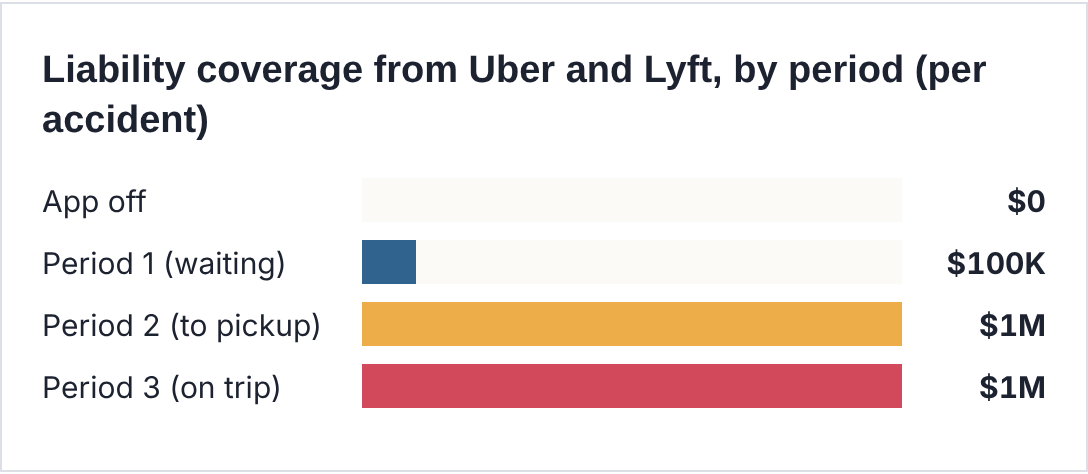
Period 1 shows the $100,000 per-accident bodily injury limit. Sources: Uber and Lyft insurance pages (2026). Some states differ.
Uber car insurance: what Uber covers and what it does not
Uber’s insurance for drivers in the U.S. follows the three-period model, according to its 2026 insurance pages. When the app is off, Uber provides nothing, and your personal policy applies. You must carry a personal policy that meets your state’s minimum requirements to drive for Uber.
Uber rideshare insurance, 2026
| Period | Liability | Your own car | Notes |
|---|---|---|---|
| App off | None from Uber | None | Personal policy only |
| App on, waiting | $50,000 per person, $100,000 per accident injuries, $25,000 property damage | None | Applies only if you are at fault |
| En route to pickup | At least $1,000,000 | Up to actual cash value, $2,500 deductible | Requires your own comprehensive and collision |
| On trip | At least $1,000,000 | Up to actual cash value, $2,500 deductible | Same as en route |
Uber’s coverage for your car is called contingent comprehensive and collision. It pays up to your car’s actual cash value, regardless of who caused the crash, but only if you already carry comprehensive and collision on your personal policy. The deductible is $2,500, or $1,000 for cars rented or bought through Uber’s Vehicle Marketplace. Several competing guides still list a $1,000 deductible for all Uber drivers, which is out of date.
Uber’s uninsured/underinsured motorist, personal injury protection and medical payments arrangements vary by state and policy; some protections apply because state law requires them, and additional programs may be available. Its contingent passenger-trip coverage is not a substitute for a separate rental-reimbursement benefit, regular maintenance coverage or the commercial insurance required for black-car and livery services.
Uber’s optional protection for drivers
Uber offers optional Injury Protection and, for some eligible drivers and locations, vehicle-interruption products, but the benefits, premiums and eligibility can change. California and certain other states also have automatic occupational accident arrangements. Drivers should check the applicable in-app documents rather than relying on one nationwide price or payout figure. Uber reported that its U.S. mobility insurance costs per trip increased by more than 50% over the preceding years as of early 2025.
Uber state differences
| State | What is different |
|---|---|
| California | Occupational accident insurance applies automatically while online, en route, and on trips |
| Massachusetts | Occupational accident insurance since October 1, 2024 |
| Minnesota | Occupational accident insurance since January 1, 2025, en route and on trips |
| Washington | Workers’ compensation applies automatically en route and on trips |
| New York | The Black Car Fund provides workers’ compensation and other benefits |
Uber’s vehicle rules also matter for insurance. In Philadelphia, for example, UberX cars must have four doors, five factory seats, and be 15 years old or newer, with no salvage or rebuilt title. Uber Black requires a car six years old or newer and commercial insurance. Rules vary by city, so check your local Uber requirements page.
PRO TIP #1
Uber and Lyft pay for your car only if you already carry comprehensive and collision. If you drop those coverages to save money, a crash on a trip could leave you paying for all of your own repairs, even when the other driver is at fault and uninsured.
Lyft car insurance: what Lyft covers and what it does not
Lyft’s 2026 insurance page uses different labels, calling app-off time “Period 1,” but the coverage lines up with Uber’s. While you wait for a request, Lyft provides $50,000 per person, $100,000 per accident, and $25,000 in property damage liability, if your personal insurance does not apply. Once you accept a ride, Lyft provides at least $1 million in liability in most markets, plus contingent comprehensive and collision up to actual cash value with a $2,500 deductible, as long as you carry those coverages yourself.
Lyft insurance, 2026
| Lyft label | Industry period | Liability | Your own car |
|---|---|---|---|
| Period 1 | App off | Your personal policy | Your personal policy |
| Period 2 | Waiting for a request | $50,000/$100,000/$25,000 | None listed |
| Period 3 | En route to pickup | At least $1 million in most markets | Up to actual cash value, $2,500 deductible |
| Period 4 | Ride in progress | At least $1 million in most markets | Up to actual cash value, $2,500 deductible |
Lyft’s limits are lower in a few states. In Maryland, en route coverage is $125,000 combined, and in Arizona it is $250,000. During rides in Arizona and Nebraska, liability follows state requirements at $25,000, $50,000, and $20,000. Lyft does not buy insurance for TLC drivers in New York City or several nearby counties, and livery drivers anywhere must buy their own policies. Lyft names Liberty Mutual, State Farm, Progressive, Allstate, and others as insurance partners, but it does not say which covers which state.
PRO TIP #2
Drive for both Uber and Lyft? Tell your insurer about both apps. Many endorsements cover all rideshare apps on one add-on, but you must disclose each one, and running both apps at once can make it harder to prove which company’s coverage applied after a crash.
Gig apps by the numbers
Gig driving is no longer a niche. Uber says it has 9.7 million drivers and couriers worldwide, DoorDash says more than 9 million people dashed in 2025, Lyft says more than 1 million drivers earned on its platform in 2025, and Instacart reported about 600,000 shoppers in December 2025. A 2021 Pew Research Center survey found 16% of U.S. adults had earned money through an online gig platform.
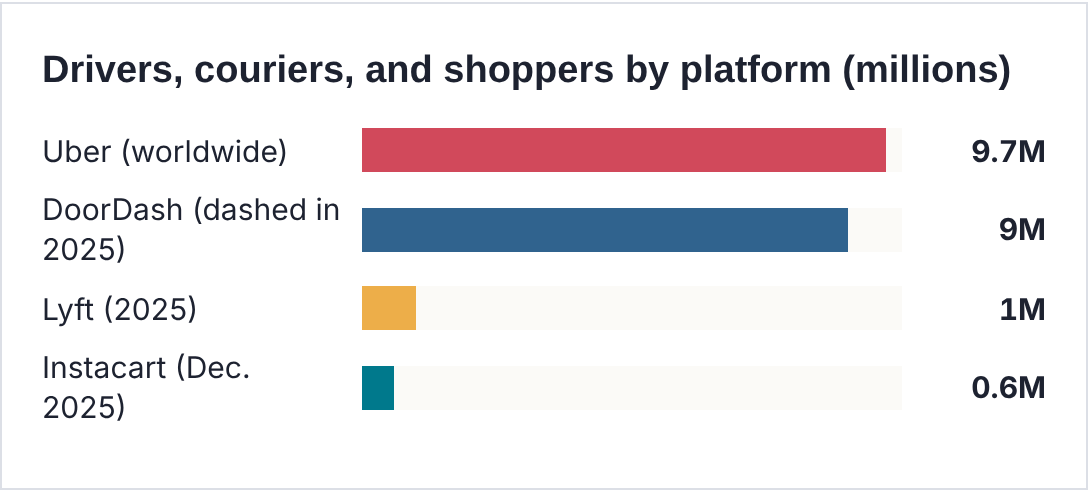
Sources: Uber 2026 proxy statement; DoorDash and Instacart 2025 annual reports; Lyft 2025 economic impact report. Counts use different definitions.
Many of these drivers may be underinsured. Older, informal surveys by a popular rideshare driver site found that most of its readers did not tell their insurers about rideshare driving, with 2015 and 2017 polls putting the share at roughly 60% to 84%. These polls were not scientific, but they show how common the coverage gap has been.
DoorDash car insurance: what DoorDash covers
DoorDash provides third-party auto liability insurance for covered delivery activity, but not for damage to the Dasher’s own car. In most U.S. states, DoorDash says the applicable delivery-service period runs from acceptance to completion, cancellation or unassignment of an order. In North Dakota, Indiana, Kentucky and West Virginia, it also specifies some liability protection while available for deliveries; Boston has its own rules. The maximum liability amount varies by location, including a $250,000 combined limit during active deliveries in Kentucky rather than the $1 million often shown for other states.
DoorDash insurance for Dashers, 2026
| Coverage | What DoorDash provides | When it applies |
|---|---|---|
| Liability to others | Up to $1,000,000 in most states; $250,000 combined in Kentucky | Offer accepted through drop-off |
| Damage to your own car | None; it is the Dasher’s responsibility | Never |
| Occupational accident | Up to $1,000,000 medical; 50% of weekly wages, up to $500 a week | Injuries during a delivery |
| While waiting for an order | None in most states | Specified waiting-period coverages in ND, IN, KY and WV; Boston has separate rules |
| Your personal policy | Required, at least state minimums | At all times |
Two details matter most. First, DoorDash does not pay for damage to the Dasher’s own car. Second, DoorDash liability can be excess over an applicable driver policy, and the precise limits and waiting-period protection vary by location. Always check the current DoorDash state-specific insurance documentation and confirm with your own insurer that the activity is covered.
DoorDash also describes occupational accident benefits for eligible U.S. Dashers injured during active deliveries, potentially including medical expenses of up to $1 million and disability payments of 50% of average weekly earnings, up to $500 per week. Eligibility, waiting periods, exclusions and claim conditions apply; these benefits are not auto liability or collision coverage.
What happens when a Dasher crashes without delivery coverage
Real cases show the risk. In 2024, an Omaha Dasher’s car suffered about $17,000 in damage in a hit-and-run during a delivery, and local TV reported that his insurer denied the claim because he had not disclosed delivery work.
In 2023, a Massachusetts Dasher’s insurer reportedly denied a claim for a parked car he backed into because he was driving commercially. In June 2026, Progressive asked a federal court in Minnesota to declare that it owes nothing for a 2024 crash it says happened while the driver was making DoorDash deliveries, and a Michigan appeals court let a Progressive unit cancel a policy in 2025 because the applicant hid her food delivery work.
PRO TIP #3
Always tell your insurer you deliver, even part time. Hiding delivery work can do more than get one claim denied. It can let your insurer cancel the whole policy for misrepresentation, as a Michigan court allowed in 2025.
Uber Eats car insurance
Uber Eats coverage is different from Uber’s rideshare coverage, even though it is the same app company. Uber’s delivery insurance page says it provides no coverage while you are offline, liability up to at least state minimums while you are online and available, and up to $500,000 in liability once you are en route to pick up or deliver an order. That liability covers only damage you cause to others.
Uber rides vs. Uber Eats insurance
| Coverage | Uber rides | Uber Eats |
|---|---|---|
| Liability on a trip or delivery | At least $1,000,000 | Up to $500,000 |
| Liability while waiting | $50,000/$100,000/$25,000 | At least state minimums |
| Your own car | Up to actual cash value, $2,500 deductible | None |
| Bikes and walking | Not applicable | Not covered unless law requires it |
| Optional injury coverage | Available in most states | Available in most states |
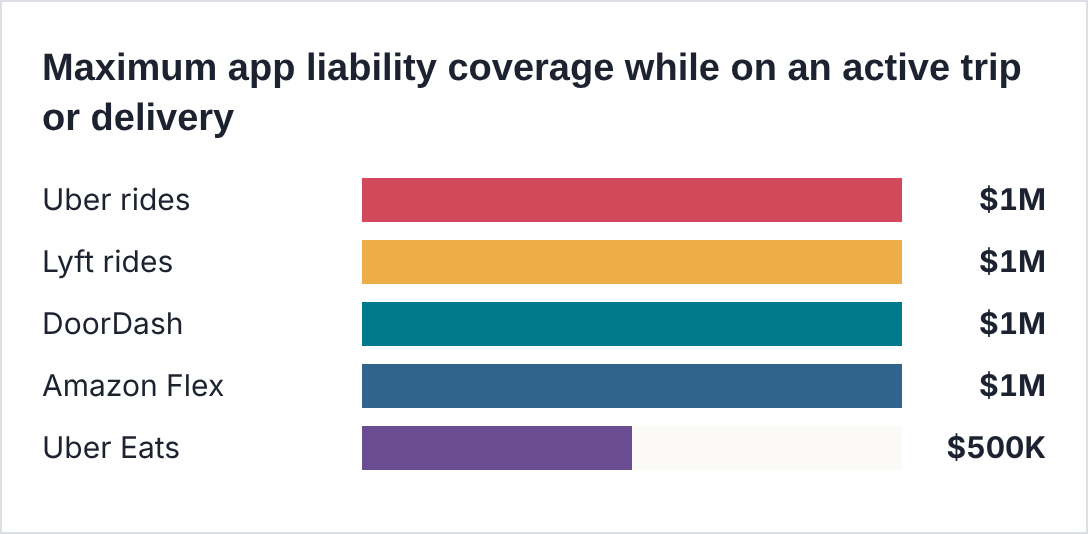
Limits vary by state. DoorDash says its coverage “may cover up to” $1 million in most states. Sources: company insurance pages (2026).
Uber’s delivery page names State Farm among insurers that may cover some delivery work on personal policies, and Progressive and Farmers among those that may offer suitable endorsements. This is not confirmation of coverage for any particular State Farm policy. Uber Eats does not insure repairs to the delivery driver’s own car; the driver must confirm that their own collision/comprehensive coverage applies to deliveries.
Instacart car insurance
We could not verify an Instacart-maintained auto liability or vehicle-damage policy for full-service shoppers in the public information reviewed. Instacart reports that shoppers generally bear their vehicle and insurance costs. This lack of published coverage details should not be presented as proof that no special state-specific arrangement could exist; shoppers should obtain written confirmation of delivery coverage from their insurer and check current platform terms.
Instacart has described Shopper Injury Protection for eligible full-service shoppers, but a shopper injury benefit is different from auto liability or collision insurance. If available, verify the program’s current terms before relying on published benefit amounts. Because platform auto protection was not confirmed, grocery delivery drivers should not assume their standard personal policy will cover them while shopping and delivering.
PRO TIP #4
If you shop for Instacart, ask your insurer the exact question: “Does my policy cover grocery delivery for Instacart while the app is on and while I am delivering?” Get the answer in writing, since many rideshare endorsements cover only passenger trips.
Insurance from other gig apps
What other delivery apps provide
| App | Auto liability | Your car | Injury coverage | Personal policy |
|---|---|---|---|---|
| Amazon Flex | $1,000,000 while actively delivering (not in NY) | Contingent comprehensive and collision | Not stated | Required |
| Grubhub | None | None | Occupational accident | Required; must cover delivery |
| Walmart Spark | None | None | None found | Proof of insurance required |
| Shipt | None | None | Up to $1,000,000 medical | Not stated |
| Roadie | None found | None | None found | Must cover gigs |
| GoPuff | None found | None | Occupational accident | Required |
Amazon Flex describes insurance for eligible active deliveries, with important requirements and a New York exception. Other delivery platforms differ significantly, and we could not verify comprehensive current policy terms for every app in the table above. Treat “none found” as “not verified in the reviewed sources,” not as proof that no policy exists; ask each platform for its current certificates and your agent about any exclusions.
California’s Prop 22 protections
In California, Prop 22 requires app companies to provide occupational accident coverage of at least $1 million in medical expenses, disability pay of 66% of average weekly earnings for up to 104 weeks, and accidental death benefits. Delivery companies must also carry at least $1 million in auto liability for injuries to others during engaged time. The per-mile payment is 37 cents for 2026, according to the California State Treasurer. Prop 22 does not pay for damage to your own car.
Which insurers cover rideshare, delivery, or both
This is the question competing guides often skip. Many rideshare endorsements cover only passenger trips, so a driver who switches between Uber and DoorDash could be covered for one app and not the other.
Rideshare and delivery coverage by insurer
| Insurer | Rideshare add-on | Delivery coverage | Source |
|---|---|---|---|
| Progressive | Yes | Yes, in most states (confirm each state and app) | Official page |
| State Farm | Yes, about 15% to 20% more | Some policies may cover delivery; confirm in writing | Uber delivery page; confirm with agent |
| USAA | Yes, from $6 a month | Mentions delivery; verify exact coverage | Official page |
| Allstate | Yes, Ride for Hire | Not addressed; one review says no | Official page; review |
| Farmers | Yes, in 23 states | Optional endorsement | Official page; Uber delivery page |
| GEICO | Yes, in some states | Says delivery requires rideshare insurance | Official page |
| American Family | Yes | One review says no | Review |
| Liberty Mutual | Not found | Excluded; points to commercial | Official page |
| Nationwide | No, per reviews | Not found | Reviews |
PRO TIP #5
If you use both passenger rideshare and delivery platforms, Progressive is an evidence-supported starting point because its official page explicitly mentions DoorDash and Uber Eats in most states. Compare written quotes from other insurers, including State Farm where the agent confirms delivery coverage, and make sure each quoted endorsement names the activities you perform.
10 car insurance companies to compare for Uber and DoorDash driving
This is an editorial comparison, not a verified ranking of the cheapest policies covering both Uber and DoorDash. Most displayed monthly rates are from LendingTree’s May 2026 sample of a driver with a rideshare endorsement; American Family’s figure comes from a differently constructed Insurify study updated in November 2026. Delivery coverage, app combinations, deductible differences and state availability were not tested on identical quotes. Farmers and Erie have no comparable published prices in these studies.
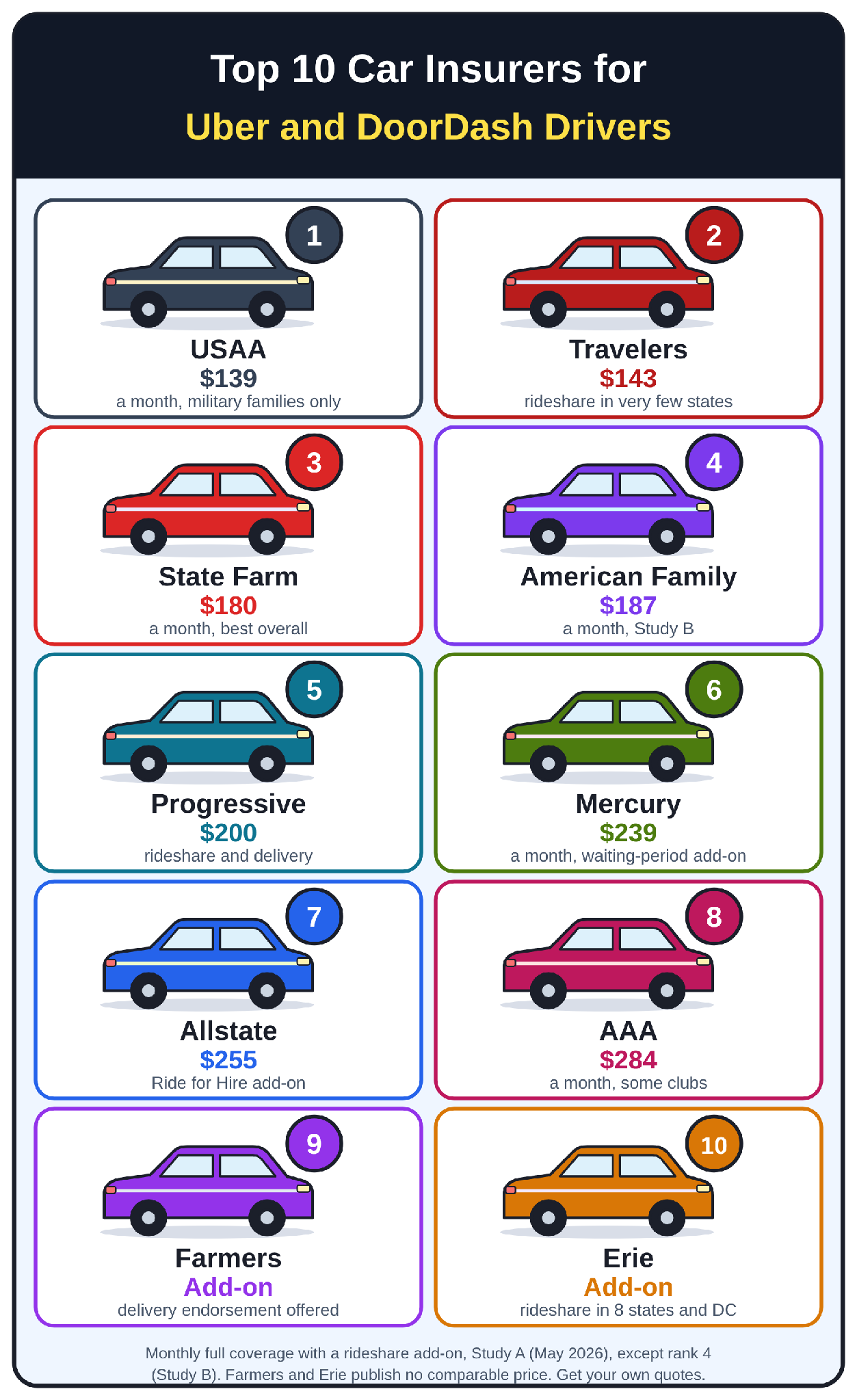
Graphic context: This original graphic ranks companies as though all rates cover both Uber and DoorDash. They do not: most numbers are rideshare-only samples, one comes from a different methodology, and two companies have no quoted sample price. Replace this image before publication.
Archived price illustration: several monthly figures are for rideshare-only sample policies and do not establish which insurer is cheapest for drivers using both Uber and DoorDash.
10 insurers to compare: sample rideshare rates (not combined-app quotes)
| Illustrative order (not cost rank) | Company | Sample monthly rideshare premium (delivery not verified) | Covers delivery? | Best for |
|---|---|---|---|---|
| 1 | USAA | $139 | Wording includes delivery | Military families |
| 2 | Travelers | $143 | Not stated | Drivers in its few rideshare states |
| 3 | State Farm | $180 | May be covered automatically | Rideshare; delivery terms need written confirmation |
| 4 | American Family | $187 (Study B) | Not verified in official terms | Rideshare-only drivers in its 19 states |
| 5 | Progressive | $200 | Yes, in most states | Drivers using several apps |
| 6 | Mercury | $239 | Check with Mercury | Western and Sun Belt drivers |
| 7 | Allstate | $255 | Not verified in official terms | Deductible gap coverage |
| 8 | AAA | $284 | Varies by club | AAA members |
| 9 | Farmers | Not published | Yes, optional endorsement | Delivery drivers |
| 10 | Erie | Not published | Business-use options | Drivers in Erie states |
1. USAA: cheapest if you are eligible
USAA had the lowest monthly sample in LendingTree’s May 2026 comparison, at $139 for full coverage with a rideshare endorsement, and its published gap protection discusses waiting before a passenger pickup or delivery. It is restricted to eligible military members and families. A $139 rideshare quote is not proof that all DoorDash delivery periods or vehicle damage are covered; eligibility, state and written policy terms must be checked.
2. Travelers: cheap, but hard to get
Travelers had the lowest non-USAA sample rate in LendingTree’s May 2026 rideshare comparison, at $143 monthly, but its rideshare endorsement is unavailable in many states. Delivery work was not verified by that study. Confirm both the state and the delivery app before treating Travelers as an alternative for Uber plus DoorDash.
3. State Farm: competitive rideshare coverage; check delivery
State Farm offers a rideshare endorsement that extends selected personal-policy protections during rideshare activity. Its official description says liability from the personal policy is extended while the app is on and no ride has been accepted; other protections follow the coverage and state-specific terms. State Farm estimates the endorsement generally adds about 15%–20% to its base premium. The study’s $180 monthly figure applies to the cited rideshare driver profile, not necessarily delivery.
Uber says some State Farm personal policies may automatically cover deliveries, but State Farm’s rideshare page focuses on passenger rides. Do not infer food-delivery coverage from a rideshare quote alone: obtain confirmation directly from State Farm about each delivery app, the waiting period and damage to your own car. Uber Black and similar livery services require different commercial protection.
4. American Family: low prices for rideshare-only drivers
American Family averaged $187 a month for full coverage in Study B and offers a rideshare endorsement in 19 states, according to one review. Another review found its endorsement does not cover delivery driving, so it fits drivers who only do Uber or Lyft.
5. Progressive: best for drivers on several apps
Progressive states that its rideshare endorsement can extend selected personal-policy coverages during the waiting period and, in most states, also applies to delivery platforms such as DoorDash and Uber Eats. Its program may help with the difference between a platform’s contingent-coverage deductible and the personal-policy deductible under applicable terms. Its $200 monthly figure is from a sample rideshare profile; obtain a written quote confirming the delivery apps and coverage periods.
6 to 10. Mercury, Allstate, AAA, Farmers, and Erie
Mercury, at $239 a month, sells a waiting-period endorsement in states such as Arizona, California, Florida, Georgia, Nevada, New Jersey, New York, Oklahoma, and Texas, according to one rideshare driver site. It ends once you accept a ride.
Drivers considering Mercury can compare its underlying policy features through the Spanish-language review of Mercury auto insurance and its coverage options; the company must still confirm gig endorsements separately.
Allstate’s Ride for Hire program can address waiting-period or deductible gaps for eligible rideshare drivers, and the $255 rate is a study sample rather than a guaranteed premium. Delivery eligibility was not confirmed by the official source reviewed. AAA coverage varies among regional clubs. Farmers offers rideshare arrangements and may have delivery solutions in some areas; Erie provides selected business-use or rideshare solutions subject to state and underwriting. Ask for written delivery terms before relying on any of these.
WHAT ABOUT GEICO, LIBERTY MUTUAL, AND NATIONWIDE?
GEICO says cars used for ridesharing or delivery apps such as Uber, Lyft, Amazon Flex, or Grubhub require rideshare insurance, and that in some states you can amend a personal policy for rideshare.
The Spanish-language review of Liberty Mutual auto insurance coverages and discounts describes the regular policy, but it should not be interpreted as confirmation of delivery coverage.
Reviews disagree about where its product is sold, so call GEICO’s rideshare line before you buy. Liberty Mutual’s own guide says personal policies exclude delivery and rideshare driving and points drivers to commercial coverage. Study B listed GEICO at $167 a month and Liberty Mutual at $244 for rideshare drivers. Nationwide does not offer rideshare coverage, according to two reviews.
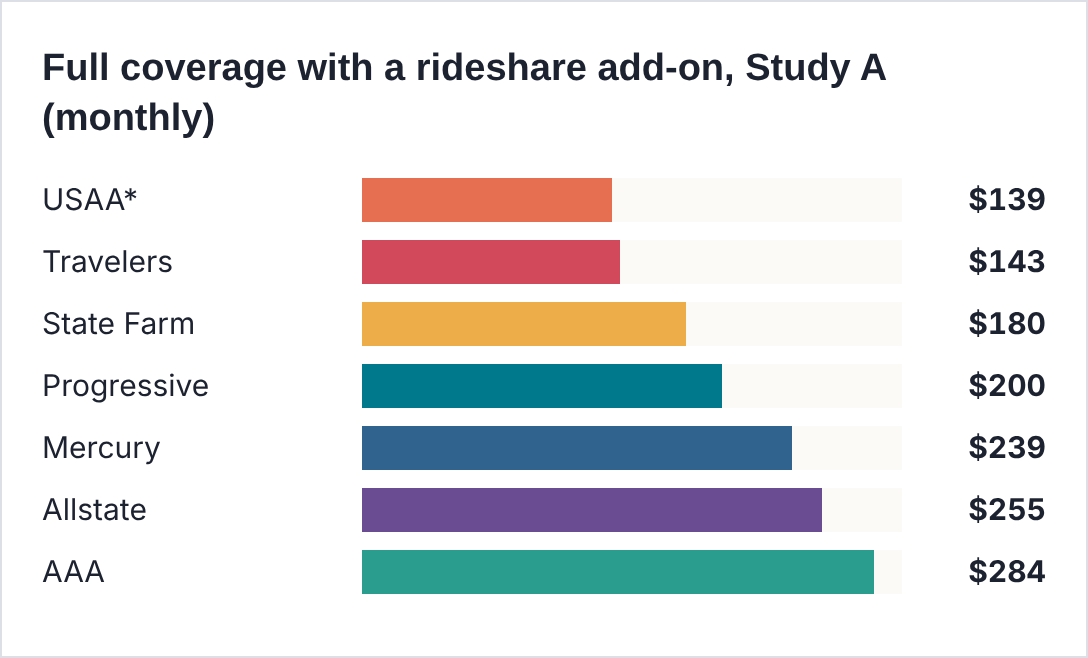
Graphic context: Illustrative rideshare pricing from Study A. It does not establish policy availability or coverage for DoorDash and Uber Eats.
*Military families only. Profile: 30-year-old, good credit, clean record, 2018 Honda CR-V, $500 deductibles. Source: Study A, May 2026.
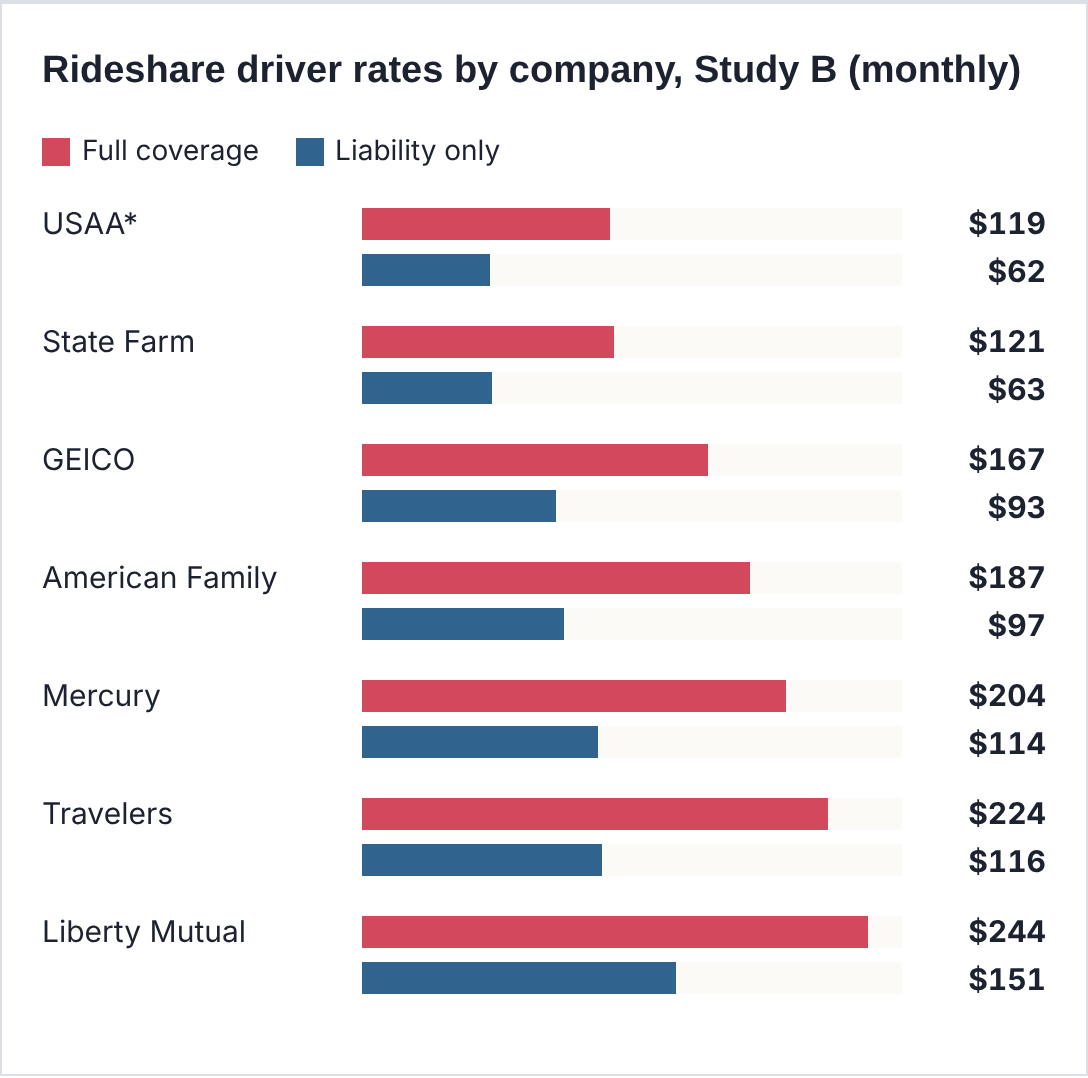
*Military families only. Median quotes for drivers with clean records. Source: Study B, November 2026.
Best insurance options for Uber and DoorDash: what the evidence supports
BEST FOR VERIFIED MULTI-APP ELIGIBILITY: PROGRESSIVE (MOST STATES)
Progressive is the most defensible first quote for drivers who combine passenger rides and food delivery, because its current official coverage page explicitly mentions Uber Eats and DoorDash in most states. That does not establish that Progressive is the cheapest, or that every state and app combination is accepted. State Farm is a reasonable alternative where an agent confirms delivery in writing; no overall price winner for drivers doing both activities has been established.
LOWEST PUBLISHED RIDESHARE SAMPLE: USAA
USAA was the lowest in the May 2026 rideshare sample at $139 per month and in the November Insurify dataset at $119, subject to membership eligibility and different study methods. Neither figure independently verifies combined passenger and food-delivery coverage. Travelers and State Farm were competitive in different studies and profiles, but the lowest quote for a specific multi-app driver must be determined individually.
RUNNER-UP TO COMPARE: STATE FARM (DELIVERY SUBJECT TO APPROVAL)
State Farm is a worthwhile price comparison for rideshare drivers, and its own website estimates a 15%–20% rideshare premium addition. Its delivery coverage is less explicitly described in the rideshare product language, so only consider it a combined-app solution after the insurer confirms the exact delivery work and coverage periods in writing.
Best car insurance for gig drivers, by need
| Need | Best pick | Why |
|---|---|---|
| Multi-app eligibility to verify | State Farm | Low prices; may cover delivery, per Uber |
| Lowest rideshare sample | USAA | $139/month in Study A; delivery scope not established |
| Rideshare with agent support | State Farm | Delivery may be covered by some policies; obtain written confirmation |
| Deductible gap | Allstate | Check that the app, state and claim type qualify |
| Delivery only | Farmers or Progressive | Optional delivery endorsements |
| West Coast and Sun Belt | Mercury | Waiting-period add-on at a daily price |
| Uber Black or full-time | Commercial auto policy | Required for black car and livery work |
How much rideshare and delivery insurance costs
A personal-policy rideshare endorsement can cost less than a commercial auto policy when it is actually eligible for the driver’s work. LendingTree’s May 2026 sample estimated that adding rideshare coverage cost about $31 per month on average, while State Farm lists a typical 15%–20% premium increase on its own policy. These estimates should not be used as a universal delivery endorsement or commercial insurance price.
Consider practical ways to reduce personal auto insurance costs, but evaluate these separately from the rideshare or delivery endorsement.
Rideshare add-on cost estimates
| Source | Estimate |
|---|---|
| Study A | About $31 a month extra on average |
| State Farm | About 15% to 20% more |
| Study B | About 10% to 20% more |
| USAA | About 10% to 15% more; from $6 a month |
| Mercury (2016, California launch) | Historical 2016 launch claim; not a current quote |
| Commercial auto policy (one review) | Not representative; commercial rates require individual quotes |
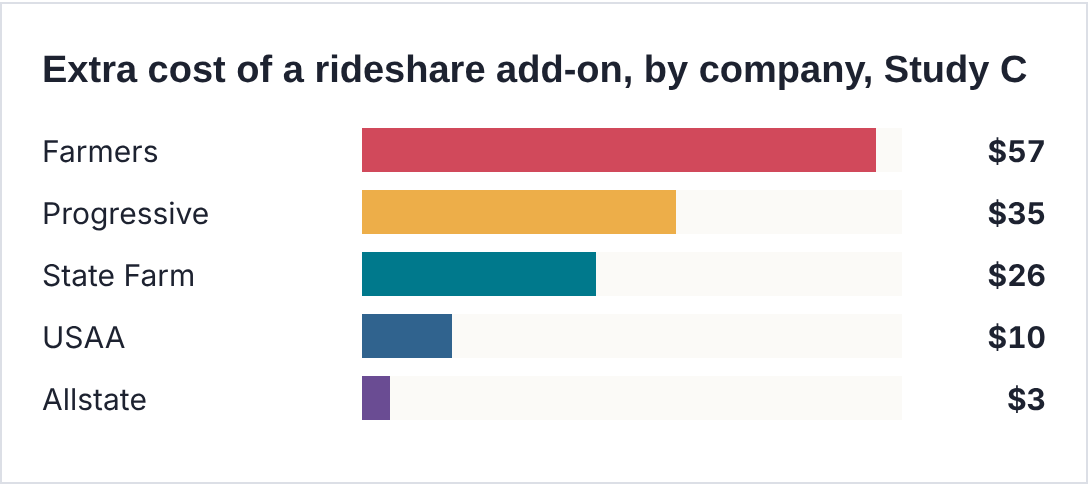
Difference between rates with and without the endorsement. Study C does not state the billing period, so compare companies rather than dollar amounts.
Study C’s figures are useful for comparing how much each company raises its price for rideshare drivers, but the page did not state whether its prices are monthly or for a six-month term, so we do not treat them as monthly costs.
PRO TIP #6
Compare the total price, not just the add-on. A company with a cheap endorsement but an expensive base policy can cost more overall. In Study C, Allstate’s add-on was tiny, but its total price was among the highest.
Insurance requirements for each gig app
Every major app requires you to carry your own personal auto insurance, but the details differ. Uber says your policy must meet your state’s minimum requirements, DoorDash requires primary auto insurance with at least local minimum limits, and Roadie goes further by requiring a policy that covers completing gigs. Some driver sites report that Lyft accepts insurance only if your name is on the policy as a listed driver, so check that your name appears on your insurance card before you apply.
If you are choosing a vehicle for app work, review how car models compare on insurance costs, then check your actual commercial-use eligibility and quotes.
Insurance and vehicle requirements by app
| App | Personal insurance | Other requirements |
|---|---|---|
| Uber | Must meet state minimums | Four doors; often 15 years old or newer; no salvage title |
| Lyft | Required; name should be on the policy | Four doors; model year varies by city |
| DoorDash | Primary policy at local minimum limits | Coverage must meet local law |
| Uber Eats | State minimums while on the app | Bikes and walking get no Uber coverage |
| Instacart | Your own coverage | Shoppers pay their own vehicle costs |
| Amazon Flex | Must keep personal insurance | Amazon policy not provided in New York |
| Walmart Spark | Proof of valid insurance | Each vehicle must be insured |
| Roadie | Must cover completing gigs | Drivers without it can be removed |
Recommended coverage for Uber and DoorDash drivers
Coverage needs depend on the app, state, time spent driving, vehicle value and personal finances. The limits below are editorial shopping suggestions rather than legal requirements or a guarantee that an endorsement covers every part of each trip. Have the insurer identify which coverages apply while waiting, driving to pickup and completing a trip.
Knowing how liability limits and deductibles affect an auto policy helps evaluate the recommendations below without mistaking them for universal minimums.
Recommended coverage for gig drivers
| Coverage | Our recommendation | Why it matters |
|---|---|---|
| Rideshare or delivery endorsement | Use if required by your insurer; must cover each app and activity | Fills the waiting-period gap and keeps your personal policy valid |
| Liability | Consider 100/300/100 if affordable; match needs and state law | App coverage while waiting is only $50,000 per person |
| Comprehensive and collision | Keep both if your car is worth more than a few thousand dollars | Uber and Lyft pay for your car only if you carry them |
| Deductible gap coverage | Add it if your insurer offers it | Covers the gap between the $2,500 app deductible and yours |
| Uninsured and underinsured motorist | Match your liability limits | App coverage is only where state law requires it |
| Rental reimbursement | Add it if you rely on your car for income | Uber does not pay for a rental while your car is repaired |
| Medical payments or PIP | Add where available | Helps with injuries during personal and waiting-period driving |
| Roadside assistance | Inexpensive add-on | Heavy mileage means more breakdowns |
Allstate’s own example shows why deductible gap coverage matters: if your personal deductible is $500 and the app’s deductible is $2,500, its Ride for Hire endorsement may help pay the $2,000 difference. Progressive’s endorsement also pays this difference.
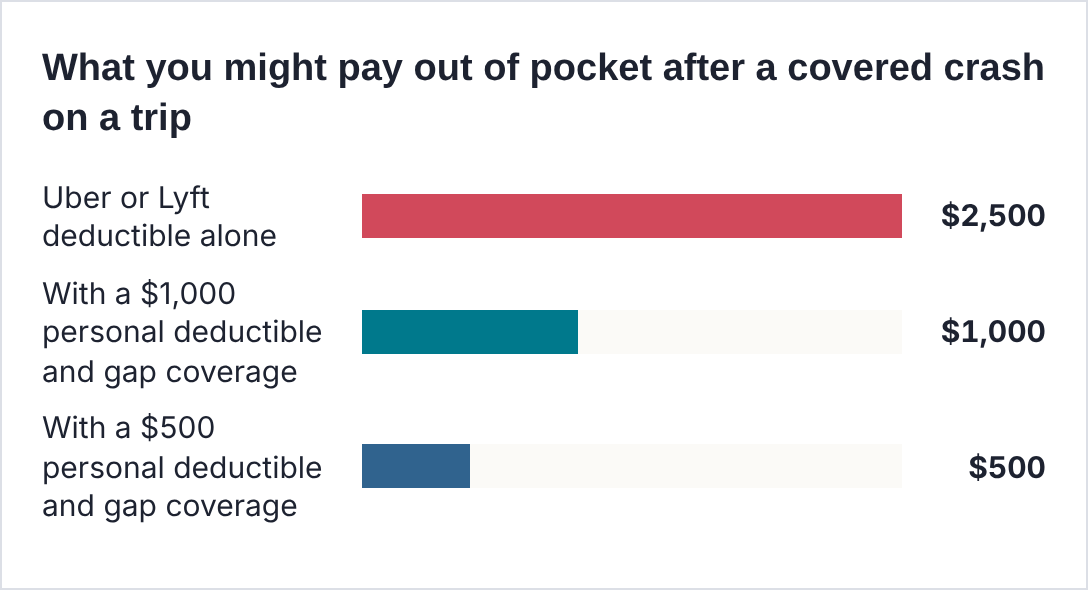
Illustration based on Uber’s and Lyft’s $2,500 deductible and Allstate’s published example. Your policy terms decide what is paid.
Endorsement, hybrid, or commercial policy?
Gig drivers may be offered a personal policy with a compatible rideshare/delivery endorsement, a state-specific hybrid arrangement, or a commercial auto policy. An endorsement may be suitable for part-time work where explicitly permitted, while livery and some other operations require commercial coverage. Do not treat older national commercial price examples as reliable rates for current full-time delivery drivers.
Endorsement vs. hybrid vs. commercial auto
| Type | Best for | Typical cost | Covers Uber Black? |
|---|---|---|---|
| Rideshare or delivery endorsement | Part-time Uber, Lyft, or delivery drivers | About 10% to 20% more, or about $31 a month in Study A | No |
| Hybrid rideshare policy | Drivers in states where it is sold | Varies | No |
| Commercial auto policy | Uber Black, livery, limo, and some full-time delivery | Varies substantially by business use, state and vehicle | Yes, and required |
You need commercial coverage for Uber Black, limousine, livery, or taxi work, which Uber says requires your own commercial insurance and permits. Amazon Flex drivers in New York may also need commercial coverage. No insurer we checked publishes a set number of hours or miles at which delivery driving requires a commercial policy, so ask your agent if you deliver full time.
Discounts for gig workers and how to get them
Platform rewards and insurer discounts change frequently. This review did not establish a universally available Uber, Lyft or DoorDash discount that directly reduces every driver’s auto insurance premium. Gas, roadside-assistance or tax-software perks generally are not premium reductions; compare the final written insurance quote and review eligibility for any insurer discount.
Comparing usage-based auto insurance and driving-data programs may help clarify which mileage and driving-behavior factors matter, especially for high-mileage gig work.
Telematics discounts that can help gig drivers
| Program | Discount | Notes |
|---|---|---|
| State Farm Drive Safe and Save | 10% for enrolling; up to 30% | Not available in some states |
| Progressive Snapshot | Drivers who save average $328 a year | About 2 in 10 drivers may see a higher rate |
| Nationwide SmartRide | Instant enrollment discount; up to 40% | Does not raise rates, except possible changes in VA and WA |
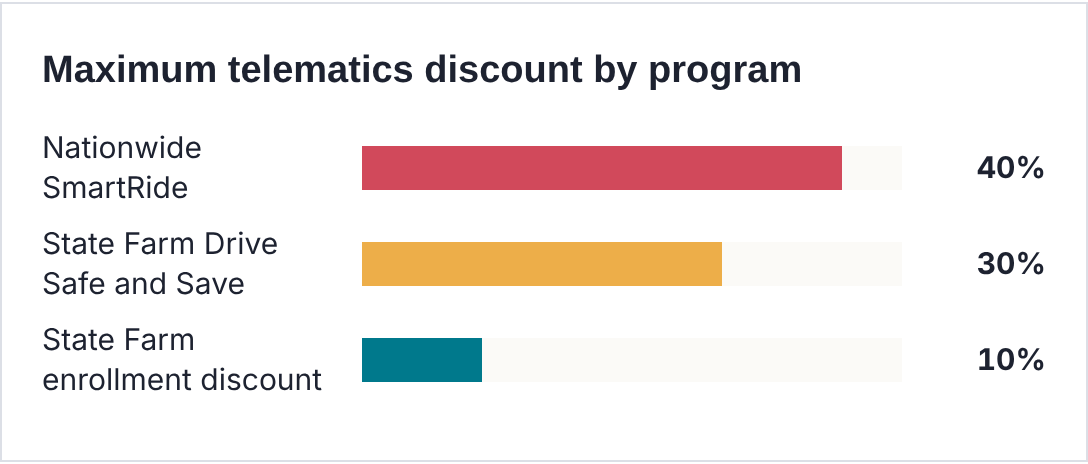
Sources: Nationwide and State Farm (2026). Confirm whether app-on driving is scored.
Before enrolling in a telematics or usage-based program, ask whether miles, time of day, stops and phone handling during gig work affect the score, and whether the insurer permits the commercial activity. High-mileage, frequent-stop driving may not yield the same advertised savings as low-mileage personal driving, and programs differ on whether premiums can increase.
How to get discounts as a gig driver
- Bundle your car policy with renters or homeowners insurance for a multipolicy discount.
- Pay your premium in full or set up automatic payments to avoid installment fees.
- Ask for safe driver, defensive driving course, good student, and anti-theft discounts.
- Choose a newer car with strong safety ratings, which can lower collision and injury costs.
- Raise your personal deductible only if you have deductible gap coverage and savings to cover it.
- Shop again at every renewal, since rideshare pricing varies widely between companies.
PRO TIP #7
If a platform offers eligible fuel or operating-cost benefits, account for them separately from the actual insurance premium. Do not assume a reward will offset a rideshare endorsement or that the roughly $31 monthly study average is available to your driver profile.
Can gig drivers deduct car insurance on taxes?
Only in certain cases. The IRS says that if you use the standard mileage rate, you cannot also deduct actual car expenses such as insurance, though you can still deduct business tolls and parking.
To deduct the business share of your insurance, you must use the actual expense method. For 2026, the business standard mileage rate is 72.5 cents a mile from January 1 to June 30 and 76 cents a mile from July 1 to December 31, after a mid-year increase. The 2025 rate was 70 cents.
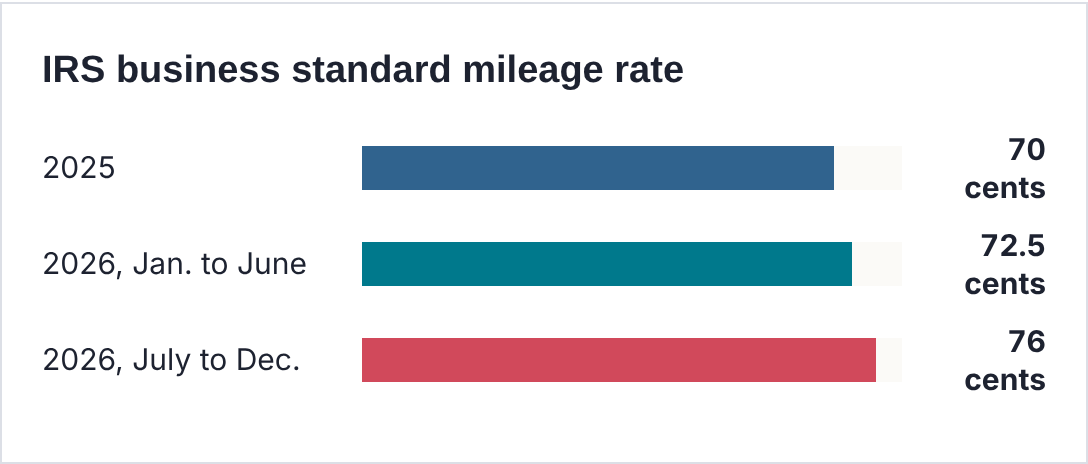
Source: IRS standard mileage rates (updated July 2026). Talk to a tax professional about your situation.
How to buy the best car insurance for Uber and DoorDash
- List every app you use, including Uber, Lyft, DoorDash, Uber Eats, Instacart, and Amazon Flex.
- Check each app’s insurance page so you know what it covers and when.
- Get quotes from at least three insurers, starting with State Farm, Progressive, and USAA if you qualify.
- Ask each one whether its endorsement covers rideshare, delivery, or both, and for which apps.
- Ask about deductible gap coverage and rental reimbursement.
- Compare the total price, not just the cost of the add-on.
- Upload your new insurance card to each app before your next shift.
Common mistakes gig drivers make
- Driving with the app on under a personal policy that excludes business use.
- Buying a rideshare endorsement that does not cover delivery.
- Dropping comprehensive and collision, which disqualifies you from Uber’s and Lyft’s coverage for your car.
- Assuming DoorDash, Uber Eats, or Instacart will pay for your car after a crash.
- Hiding gig work from your insurer, which can lead to a canceled policy.
- Deducting both the standard mileage rate and insurance on your taxes.
PRO TIP #8
After any crash while an app is on, report it to the app and your insurer right away, and take screenshots showing your app status, the time, and the trip or order. Proof of which period you were in decides whose insurance pays.
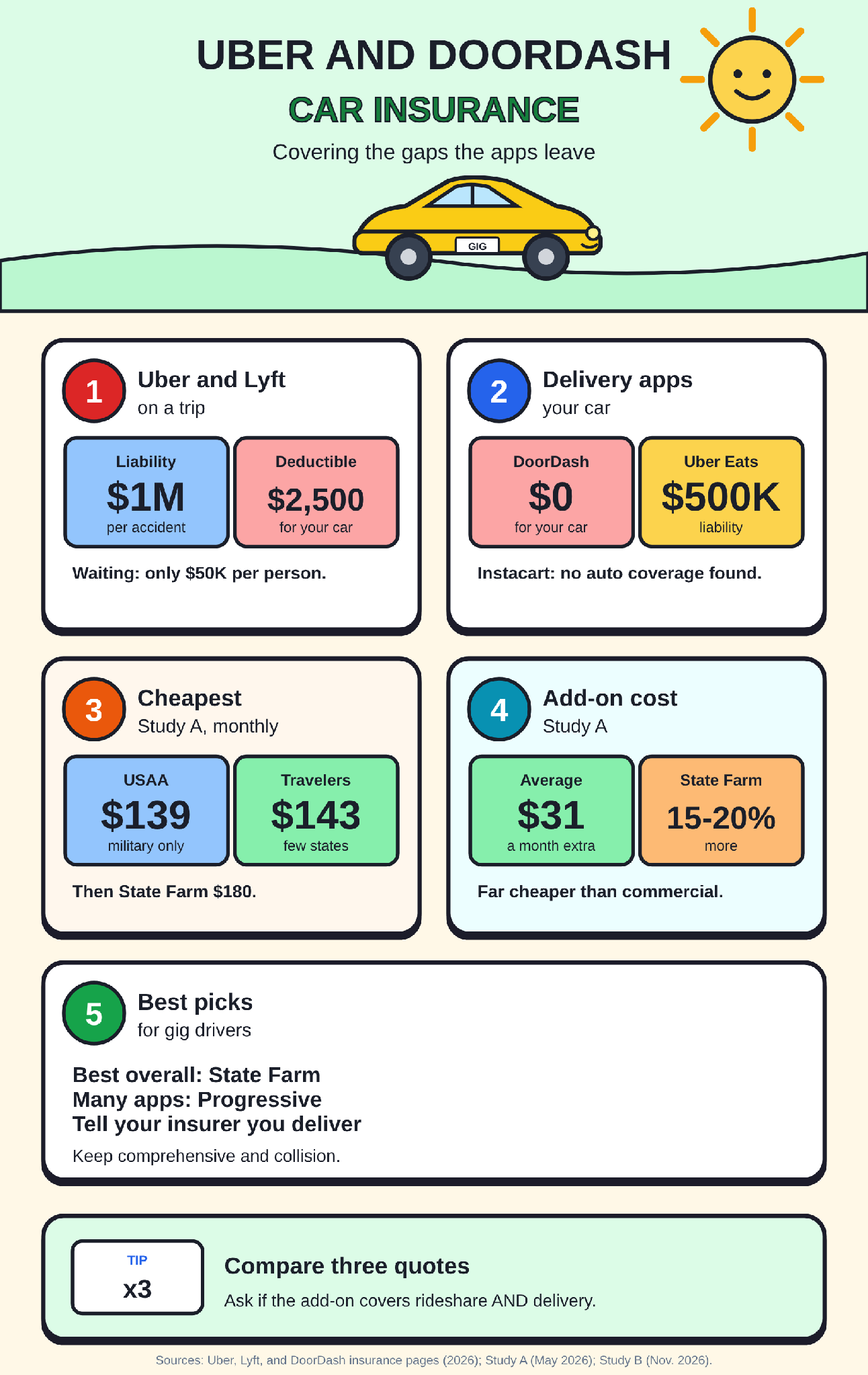
Graphic context: This original infographic describes State Farm as the universal best and combines rideshare prices with delivery needs. The revised text treats Progressive as a first comparison for documented multi-app eligibility and does not declare a nationwide cheapest provider.
Car insurance for Uber and DoorDash drivers, explained in pictures.
Frequently asked questions about insurance for Uber and DoorDash
What is the best car insurance for Uber and DoorDash drivers?
Progressive is an evidence-supported starting point for drivers who use both rideshare and delivery apps, because its published endorsement description includes food delivery in most states. State Farm may also fit, but confirm delivery coverage in writing. The cheapest provider requires comparing quotes for your own apps and state.
Does my personal car insurance cover DoorDash?
Usually not. Many personal policies exclude delivery for pay, so you need a delivery or rideshare endorsement that covers delivery.
Does DoorDash pay for damage to my car?
No. DoorDash says damage to your own vehicle is your responsibility and should be handled by your own insurer.
How much does rideshare insurance cost?
Study A found the add-on cost about $31 a month on average. State Farm says it generally adds 15% to 20%.
Who has the cheapest insurance for Uber drivers?
USAA was $139 per month in LendingTree’s 2026 rideshare sample for eligible military families; Travelers was $143 in that study, subject to availability. Neither result proves the lowest price for a driver using both Uber and DoorDash.
Does Instacart provide car insurance?
We found no Instacart auto coverage. It provides injury protection for full-service shoppers, so you need your own delivery coverage.
Do I need commercial insurance for Uber?
Not for UberX or Uber Eats in most cases, but Uber Black, limousine, and livery drivers must carry commercial insurance.
Final recommendations for Uber and DoorDash insurance
The most important feature of auto insurance for Uber and DoorDash drivers is not a brand name: it is written confirmation that the policy covers each platform, each driving period, third-party liability and any damage to the driver’s own vehicle. Progressive explicitly describes rideshare and delivery coverage in most states, while State Farm may be a workable alternative where its policy covers the particular delivery activity. The published sample prices are not comparable combined-app quotes.
The apps’ own policies contain significant conditions and exclusions. Uber and Lyft generally apply a $2,500 deductible to eligible contingent passenger-trip vehicle damage; DoorDash and Uber Eats do not themselves cover repairs to the delivery driver’s car. Tell your insurer about all platforms, consider comprehensive and collision if appropriate for your vehicle, and compare several written quotes with identical limits and deductibles.
Sources
- Study A: LendingTree, cheapest rideshare insurance (May 14, 2026).
- Study B: Insurify, rideshare insurance (November 1, 2026).
- Study C: The Zebra, rideshare insurance (2026).
- Other reviews: ValuePenguin, ridesharing and auto insurance (July 2, 2026); MoneyGeek, best rideshare insurance (2026); WalletHub, commercial policy cost estimate; Jerry, Nationwide rideshare insurance; The Rideshare Guy, rideshare insurance (September 1, 2025); and The Rideshare Guy, Instacart insurance (April 11, 2025).
- App companies: Uber, rideshare insurance; Uber, delivery insurance; Uber, commercial coverage; Uber, Philadelphia vehicle requirements; Uber Pro (February 11, 2026); Lyft, driver insurance; Lyft Rewards; DoorDash, Dasher insurance; DoorDash, auto insurance maintained by DoorDash; DoorDash, occupational accident policy; DoorDash, Dasher Deals; Instacart, shopper perks (August 18, 2021); Amazon Flex, safety and insurance; Walmart Spark, FAQs (May 7, 2026); Shipt, occupational accident insurance (December 19, 2025); and Roadie, driver sign-up (July 26, 2023).
- Company filings: Uber 2026 proxy statement; DoorDash 2025 annual report; Instacart 2025 annual report; and Lyft, 2025 economic impact report (March 27, 2026).
- Insurers: State Farm, rideshare coverage; Progressive, rideshare insurance; Allstate, Ride for Hire; USAA, rideshare coverage; USAA, gig economy insurance (September 30, 2026); Farmers, rideshare; GEICO, how your vehicles are used; Liberty Mutual, when car insurance may not cover you (September 14, 2026); American Family, rideshare; Mercury, rideshare launch (January 27, 2016); State Farm, Drive Safe and Save; Progressive, Snapshot; and Nationwide, SmartRide.
- Laws, regulators, and research: NAIC, commercial ride-sharing (October 23, 2023); NCOIL, TNC model act; TNC insurance compromise model bill (March 24, 2015); IA Magazine, ISO ridesharing endorsements (June 12, 2015); California Business and Professions Code 7455; California State Treasurer, Prop 22; IRS, standard mileage rates (July 28, 2026); IRS Publication 463; and Pew Research Center, the state of gig work (December 8, 2021).
- News: Insurance Business, Progressive DoorDash case (June 3, 2026); Law360, Michigan delivery misrepresentation ruling (September 23, 2025); WOWT, Omaha DoorDash driver (June 17, 2024); NBC10 Boston, DoorDash claim (October 30, 2023); KDKA, delivery driver insurance (October 2, 2023); Insurance Business, ridesharing survey (June 24, 2015); and Insurance Journal, rideshare coverage gap (December 8, 2017).
Disclaimer
This article is an independent review provided for general information only. We are not affiliated with, endorsed by, or paid by Uber, Lyft, DoorDash, Instacart, Amazon, Walmart, Grubhub, Shipt, Roadie, GoPuff, or any insurer named here, including USAA, Travelers, State Farm, American Family, Progressive, Mercury, Allstate, AAA, Farmers, Erie, GEICO, Liberty Mutual, and Nationwide. All trademarks belong to their owners.
This article is not insurance, legal, or tax advice, and it is not an offer to sell insurance. We are not an insurance company or licensed agent. App insurance terms, insurer products, prices, and availability vary by state and change often. Prices come from third-party studies using sample driver profiles and are not quotes. Always read your policy and the app’s current insurance terms, confirm coverage in writing with your insurer, and consult a licensed agent or tax professional before you decide.