
Best and Cheapest Car Insurance Companies in Oregon (2026–2027)
One name keeps surfacing when you compare car insurance companies in Oregon, and it is not a regional discounter. State Farm, the state’s largest auto insurer, had the cheapest full coverage in Study E, the lowest minimum price in Studies B and H, and the best customer satisfaction score in J.D. Power’s 2026 Northwest study. Travelers and Progressive each led at least one other study, so the three together make the strongest starting shortlist.
Oregon requires personal injury protection (PIP) and uninsured motorist coverage on auto policies alongside liability insurance. PIP helps cover qualifying injury expenses regardless of fault, but Oregon still uses an at-fault framework for liability claims. Your price also varies widely by ZIP code, driving record and insurer.
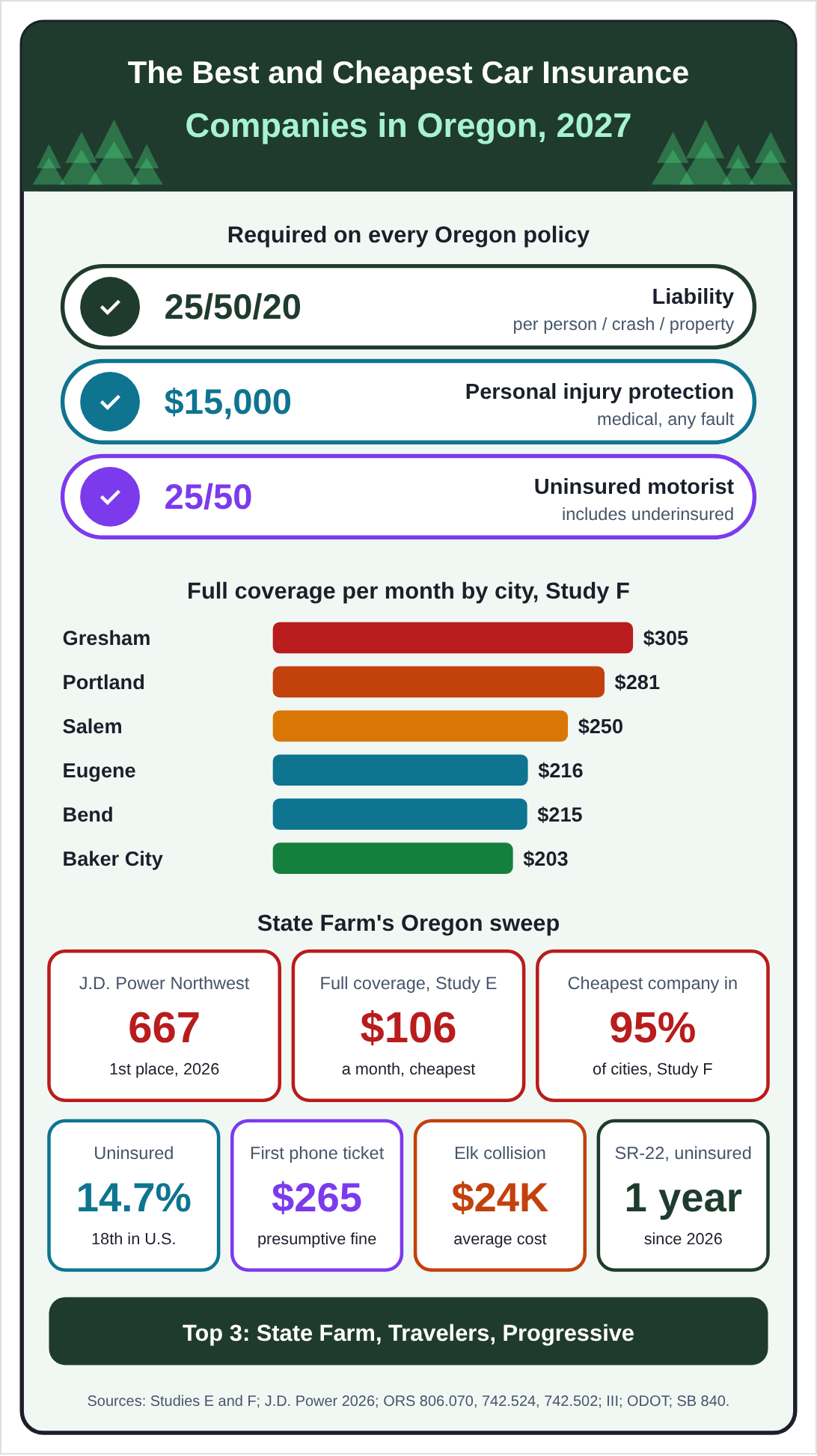
Oregon car insurance at a glance.
The State Farm pattern, and where it breaks
In most states, the cheapest insurer and the best-rated insurer are different companies. Oregon is an exception. Study F found State Farm the cheapest company open to the public for both full and minimum coverage, and the cheapest company in 95% of the Oregon cities it priced. Study E put it first for drivers aged 20, 30, 50, and 70, and after a ticket, an accident, or a DUI.
The pattern breaks for certain profiles and data sets. In Study F, State Farm’s published full-coverage example for a driver with poor credit was $682 a month versus Progressive at $218. Study A named Travelers as its lowest-priced insurer, while Study H placed Progressive below State Farm for full coverage. These examples are not standardized across studies, so use them to decide whom to quote—not to predict your personal rate. Also consider practical ways to reduce car insurance costs before your next renewal.
How much Oregon drivers pay
Oregon sits a little below the national average in most studies. Study B found full coverage at $157 a month against $187 nationally; Study F found $199 against $208, and Study A described Oregon as 12% cheaper than the U.S. average. Each study prices a different driver, so the figures below should be read as a range rather than a single answer. For background on how to compare insurance quotes, see the discussion of quote terms and coverage assumptions.
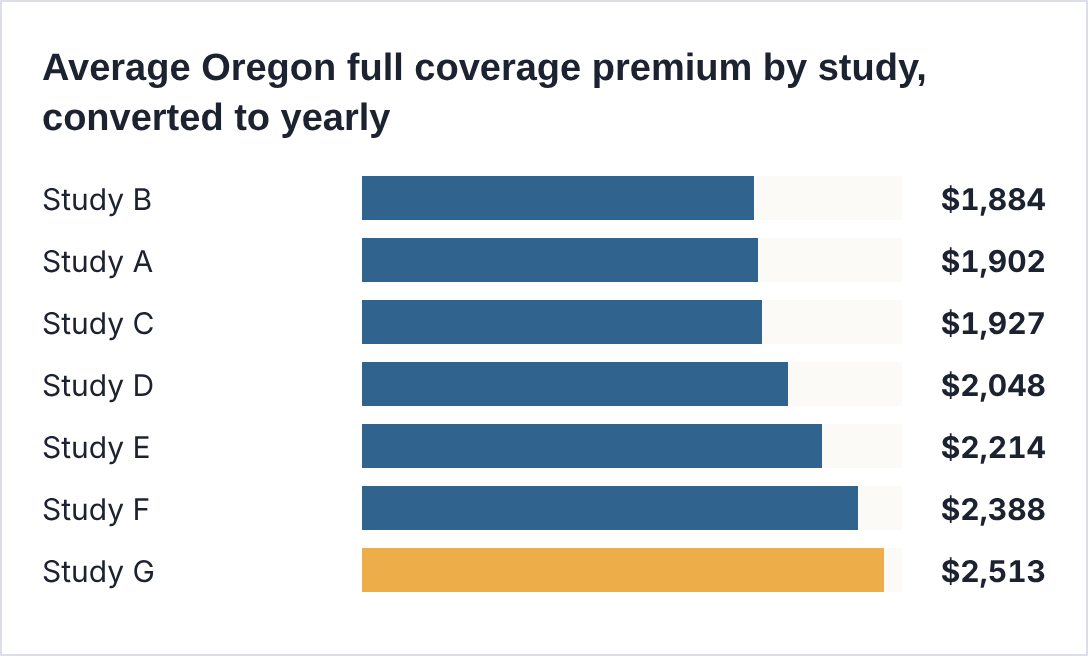
Study A reports $951 per six months, Study B $157 a month, Study D $2,048 a year, Study E $2,214 a year, Study F $199 a month, and Study G $2,513 a year. Each study uses its own driver, limits, and deductibles. Sources: Studies A through G.
Study A’s history shows Oregon prices falling from $1,885 a year in 2015 to a low of $1,325 in 2021, then climbing to $1,636 in 2023 and $1,611 in 2024. For 2026, forecasts disagree. Study B measured a 0.2% dip in the first half of the year and projects a 0.4% decline for 2026, while news coverage of Study A’s annual report in early 2026 cited projected increases of roughly 9% to 17%.
A NOTE ON OREGON MUTUAL
Two of the studies we reviewed, C and D, still list McMinnville-based Oregon Mutual as the cheapest company in the state. Study D’s figures were collected in 2023, and Oregon Mutual announced in 2022 that it would stop writing personal lines and begin non-renewing those policies in January 2023. AM Best withdrew its ratings at the company’s request in October 2025, after downgrading it to C++. We left it out of our ranking.
Our top 10 car insurance companies in Oregon
Our editorial ordering weighs how often an insurer appears inexpensive in the cited studies, then considers J.D. Power customer satisfaction, Oregon complaint statistics and financial-strength ratings. There is no published numerical weighting model behind this ranking; it is a qualitative editorial assessment. Different study samples should not be pooled into a mathematically precise league table. The wider question is how to compare insurer quality beyond the premium.
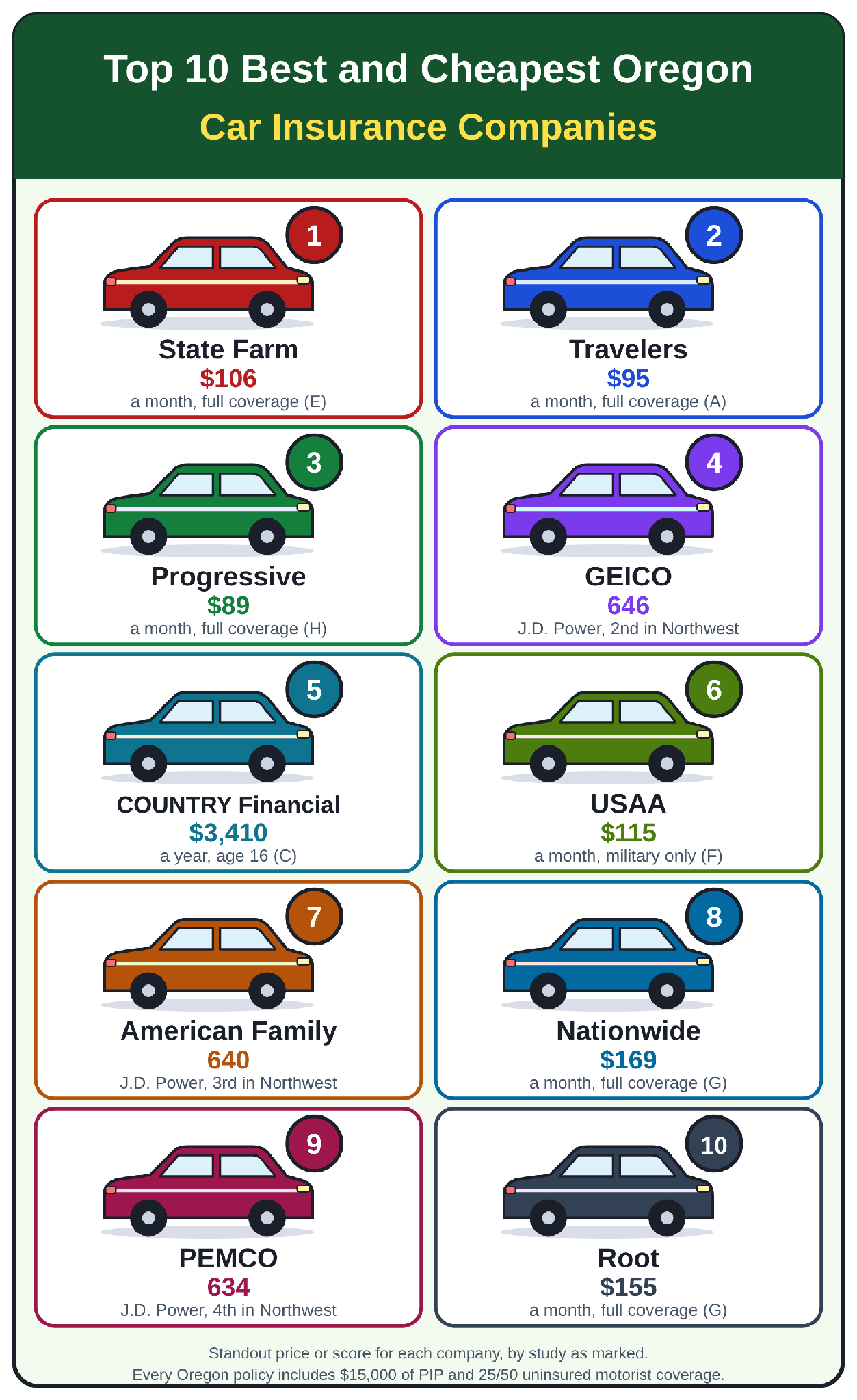
Our top 10 best and cheapest car insurance companies in Oregon, with the number behind each pick.
Top 10 Oregon car insurers: ratings snapshot
| Rank | Company | Lowest-price wins | J.D. Power 2026 Northwest | AM Best |
| 1 | State Farm | Studies B, E, F, H | 667 (1st) | A+ |
| 2 | Travelers | Study A; seniors in Study G | 596 | A++ |
| 3 | Progressive | Study H; DUI and poor credit in Study F | 604 | A+ |
| 4 | GEICO | Minimum coverage in Portland-area cities, Study H | 646 | A++ |
| 5 | COUNTRY Financial | Teens in Studies C and H | Not rated | A+ |
| 6 | USAA | Studies C and F (military only) | 726* | A++ |
| 7 | American Family | Second-tier price in Study F | 640 | A |
| 8 | Nationwide | Second in Study G | Not rated | A |
| 9 | PEMCO | Northwest-based service | 634 | B++ |
| 10 | Root | Study G | Not rated | Not confirmed |
*USAA is not eligible for official J.D. Power rankings. The Northwest average was 636. We could not confirm a current AM Best rating for Root.
1. State Farm
State Farm wrote about 21% of Oregon’s private passenger auto premium in 2024 and won J.D. Power’s Northwest region with 667. Study E priced its full coverage at $106 a month, the cheapest in that study, and Study F found it cheapest in nearly every city, from Portland at $156 a month to Baker City at $93.
Quote it if: you have a clean record or good credit. Skip it if: your credit is poor, since Study F priced that profile at $682 a month.
2. Travelers
Travelers led Study A at every level, at $95 a month for full coverage and $48 for liability, and stayed cheapest there after an accident and a DUI. Study G found it the cheapest choice for drivers 65 and older, at $89 a month, and its main Oregon company had one of the lowest complaint indexes in the state’s 2025 report, 0.33.
Quote it if: you are a senior or have a recent accident. Skip it if: you want a top service score, since its 596 was last in the Northwest.
3. Progressive
Progressive was the cheapest full coverage option in Study H, at $89 a month, and Study F’s cheapest company after a DUI, at $160, and for poor credit, at $218. Study D found it cheapest for drivers aged 60 to 75, and it cut Oregon rates 5.9% in 2026. Its two largest Oregon companies posted complaint indexes of 0.21 and 0.49.
Quote it if: you have a DUI, weak credit, or are over 60. Skip it if: you have a clean record and Study C’s price applies, $3,584 a year.

4. GEICO
GEICO scored 646 with J.D. Power, second in the Northwest, and was the cheapest minimum coverage option in several Portland-area cities in Study H, including Portland at $52 a month and Gresham at $75. It ranked third for full coverage in Study A, at $136 a month.
Quote it if: you want minimum coverage in the Portland metro. Skip it if: you have an at-fault accident, since its price jumped to $208 a month in Study A.
5. COUNTRY Financial
COUNTRY was by far the cheapest company for a 16-year-old in Study C, at $3,410 a year, less than half of GEICO’s $7,166, and Study H found it cheapest for drivers from 16 through 25. It cut Oregon rates 7.0% in 2026, the most of any company in Study F, and its preferred company scored 0.32 on Oregon’s complaint index.
Quote it if: you are adding a teen or young adult. Skip it if: you only want the lowest price for a middle-aged driver, where others ran cheaper.
6 to 10. USAA, American Family, Nationwide, PEMCO, and Root
USAA was cheaper than every other company for full coverage in Study F, at $115 a month, but serves only military members, veterans, and their families. American Family ranked fourth in Study F, scored 640 with J.D. Power, and had the lowest national complaint index among large insurers, 0.33.
Nationwide was the second-cheapest full coverage option in Study G, at $169 a month. Seattle-based PEMCO climbed to fourth in the Northwest with J.D. Power, though AM Best rates it B++, a step below most rivals. Root had the cheapest full and minimum quotes in Study G, at $155 and $97 a month.
SMALLER NAMES FROM THE STUDIES
California Casualty had the cheapest minimum coverage in Study E, at $38 a month, and Capital Insurance Group led there for poor credit. Mile Auto, a pay-per-mile insurer, edged out State Farm for full coverage in Study B, and Lemonade sells pay-per-mile car insurance in Oregon. Check each company’s financial rating before you switch; AM Best raised California Casualty to B+ in August 2026. Low-mileage drivers can also examine pay-per-mile insurance for infrequent drivers, checking program availability in Oregon.
Eight studies, eight scorecards
The table below lists the cheapest company open to the public in each study we used, for both full and minimum coverage. USAA, which only military families can buy, is left out, and so is Oregon Mutual, for the reasons explained above. Watch the units: the studies report six-month, monthly, and yearly prices.
Cheapest Oregon car insurance company in each study
| Study | Full coverage leader | Price | Minimum coverage leader | Price |
| Study A | Travelers | $95 a month | Travelers | $48 a month |
| Study B | Mile Auto | $86 a month | State Farm | $56 a month |
| Study C | Travelers | $1,657 a year | COUNTRY Financial | $416 a year |
| Study D | State Farm | $1,502 a year | COUNTRY Financial | $481 a year |
| Study E | State Farm | $106 a month | California Casualty | $38 a month |
| Study F | State Farm | $123 a month | State Farm | $59 a month |
| Study G | Root | $155 a month | Root | $97 a month |
| Study H | Progressive | $89 a month | State Farm | $43 a month |
Excludes USAA and Oregon Mutual. Study A and Study B minimum figures are liability-only policies. Study D’s rates were collected in 2023, and Study G uses marketplace quotes from drivers of all ages and records. Sources: Studies A through H.
Across the 16 full-coverage and minimum-coverage slots in the table, State Farm appears as the lowest-priced company six times. These are separate studies with different samples, not 16 equally reliable or independent trials. The practical takeaway is to quote State Farm, Travelers and Progressive using matching limits and deductibles.
Study E, updated in October 2026, shows how close the field can be behind the leader. For a 35-year-old with a clean record, State Farm’s median full coverage price was $106 a month, followed by California Casualty at $127, Kemper at $145, Capital Insurance Group at $157, and Nationwide at $165. The Oregon average in that study was $184 a month.
What a ticket, a crash, or a DUI does to the leaders
Study A priced the same driver at eight companies with a clean record, after an at-fault accident, and after a DUI. Travelers stayed cheapest in all three, and its prices rose less than most rivals’ did.
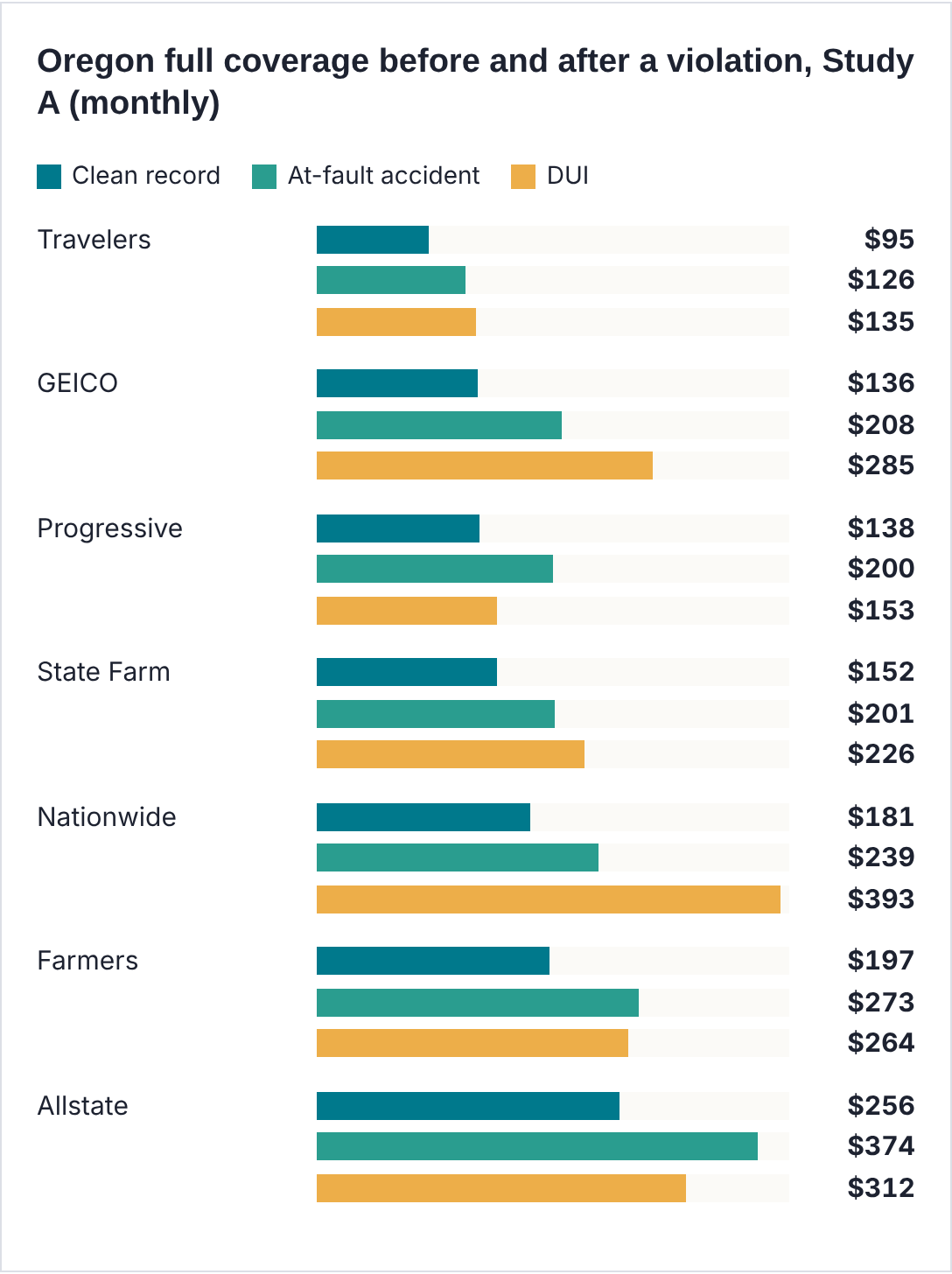
Six-month prices converted to monthly. USAA, open only to military families, charged $119, $174, and $188. Source: Study A.
Progressive’s DUI price was only $15 a month above its clean-record price in Study A, which matches its lead after a DUI in Study F. Nationwide moved the other way, more than doubling after a DUI. Study C, which priced a 40-year-old driver, found Travelers the cheapest company open to everyone after both an accident and a speeding ticket, at $2,399 and $2,482 a year.
PRO TIP #1
Got a ticket or a crash in the last three years? Ask Travelers, Progressive, and State Farm for quotes before your renewal. In Study A, Travelers charged $126 a month after an accident, while Allstate charged $374 for the same driver.
Oregon’s hybrid system: PIP on every policy, fault still matters
Oregon borrows from two systems. Like no-fault states, it makes every policy include personal injury protection, which pays your own injury costs no matter who caused the crash. Unlike no-fault states, it puts no threshold on lawsuits, so you can still pursue the at-fault driver for pain and suffering and for costs beyond your PIP limit. ORS 742.524 sets the minimum PIP benefits below.
Minimum personal injury protection benefits in Oregon
| Benefit | Minimum required |
| Medical and hospital expenses | $15,000, for costs within two years of the crash |
| Lost income | 70% of income, up to $3,000 a month for 52 weeks |
| Essential services (for people not working) | Up to $30 a day for 52 weeks |
| Funeral expenses | Up to $5,000 |
| Child care while a parent is hospitalized | $25 a day, up to $750 |
Income and essential-services benefits apply only when the disability lasts at least 14 days. Insurers may offer deductibles of up to $250. Source: ORS 742.524. Benefits depend on statutory conditions; amounts should not be interpreted as an automatic payout after every collision. The deductible is separate from the coverage limit; review how deductibles change what you pay after a claim before choosing one.
A worked example
Picture a driver who earns $4,000 a month before taxes, is rear-ended on I-5, and misses six weeks of work with $11,000 in medical bills. Because the disability lasts more than 14 days, PIP pays 70% of lost income, or $2,800 for each month of missed work, which falls under the $3,000 cap. The $11,000 in medical bills fits inside the $15,000 medical limit.
If eligible medical bills reached $22,000, the statutory $15,000 PIP medical benefit would not cover the entire amount. Other insurance, a liability claim against an at-fault driver, or coverage for injuries caused by an uninsured or underinsured motorist might be relevant, depending on fault, policy wording and legal requirements. Underinsured motorist coverage does not automatically pay every medical bill left beyond PIP.
Uninsured and underinsured motorist coverage
Under ORS 742.502, uninsured motorist coverage must match your bodily injury liability limits unless you choose lower limits in writing, and it can never fall below $25,000 per person and $50,000 per crash. Underinsured coverage is built in. Since 2016, it pays the damages you are legally owed, up to your own uninsured motorist limits, rather than simply topping up the other driver’s limits.
Uninsured motorist property damage coverage, under ORS 742.510, must be available for at least $20,000. You pay the first $200 of damage, or the first $300 when the other vehicle is a hit-and-run or cannot be identified.
The 51% rule
Oregon uses modified comparative fault under ORS 31.600. You can recover damages as long as your share of the blame is not greater than that of the other parties combined, so a driver 50% at fault still collects a reduced award, while a driver 51% at fault collects nothing.
If you drive without insurance in Oregon
About 14.7% of Oregon drivers were uninsured in 2023, according to the Insurance Research Council, close to the 15.4% national figure and 18th in its state table. Oregon checks coverage in several ways. You give a policy number every time you register a vehicle, and the DMV randomly selects up to 10% of registered vehicles each year for insurance verification, with 30 days to respond.
Consequences of driving uninsured in Oregon
| Situation | Penalty |
| Driving without insurance | Class B traffic violation: presumptive fine $265, maximum $1,000 |
| Stopped without insurance | Police may impound the vehicle |
| Conviction on or after January 1, 2026 | SR-22 proof of insurance for 1 year (previously 3 years) |
| Uninsured driver in a crash | SR-22 for 3 years; the automatic one-year suspension ended for crashes from January 1, 2026 |
Sources: ORS 806.010, ORS 153.019, ORS 809.720, and the Division of Financial Regulation’s December 2025 memo on SB 840.
The 2026 changes came from SB 840, the DMV’s 2025 omnibus bill. Some insurer and comparison pages still quote the older three-year SR-22 rule for a conviction, so ask your agent to confirm which applies to you.
Portland, the suburbs, and the rest of Oregon
Where you park at night moves your price more than almost anything else. In Study F, full coverage averaged $305 a month in Gresham and $281 in Portland, while Baker City, in eastern Oregon, was the cheapest city at $203. State Farm was the cheapest company in all but a few of the cities Study F priced.
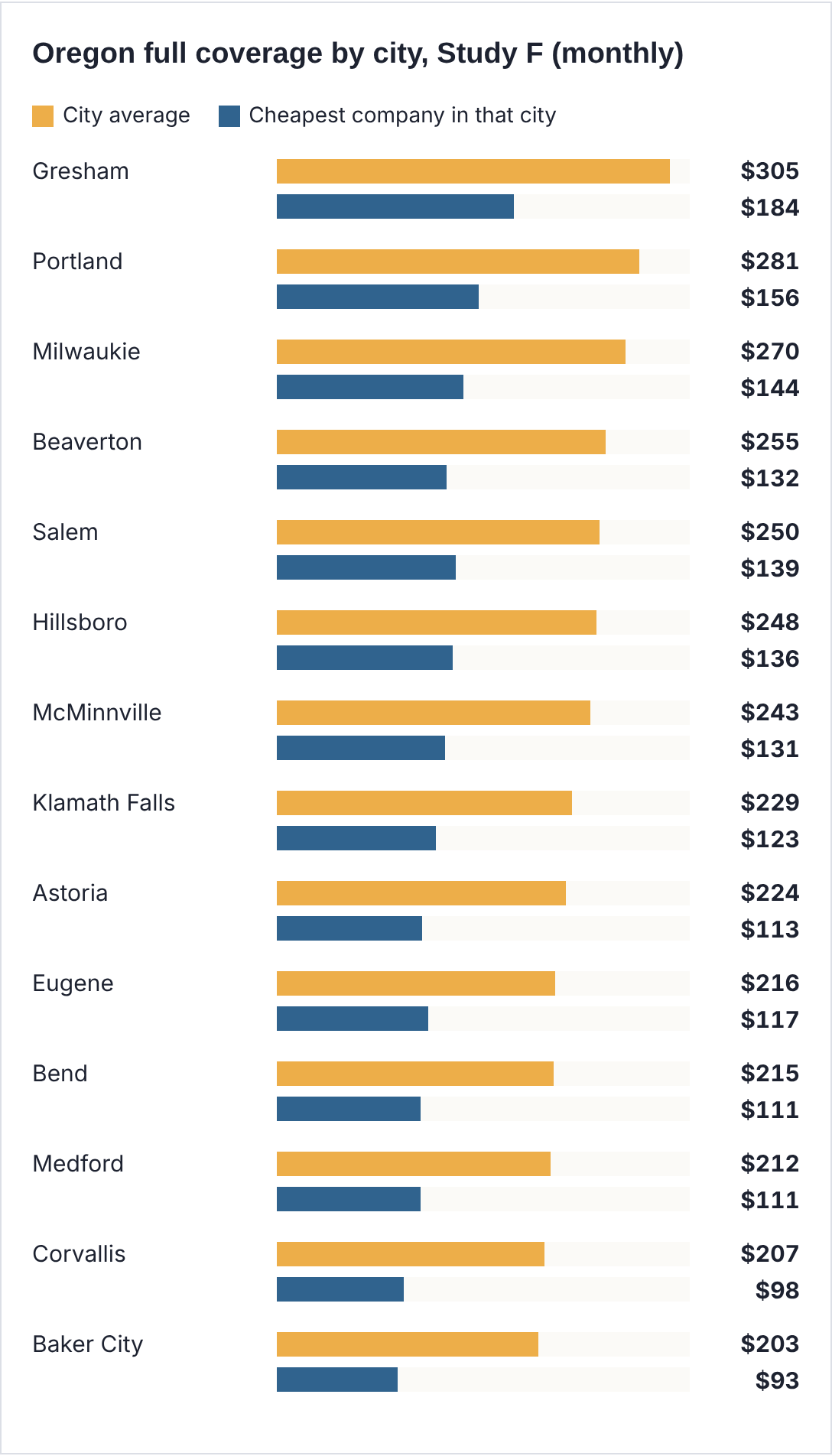
30-year-old man, 2018 Honda Civic EX, good credit, 50/100/50 limits with $15,000 PIP, $500 deductibles. State Farm was the cheapest company in every city shown. Maywood Park averaged $310. Source: Study F, October 2026.
Other studies rank the cities the same way. Study B’s average quotes ran from $207 a month in Portland down to $124 in Grants Pass, and Study A put Portland at $196 a month against $146 in Bend and Eugene. Within the Portland metro, Study H found the cheapest minimum coverage ranging from $41 a month in Lake Oswego to $75 in Gresham.
PRO TIP #2
Moving from Portland to Bend or the Willamette Valley? Requote before your renewal date. In Study F, State Farm’s cheapest full coverage price fell from $156 a month in Portland to $111 in Bend, a difference of $540 a year for the same driver.
No points, but plenty of consequences: your Oregon driving record
Oregon does not use a point system. The DMV’s Driver Improvement Program counts convictions and preventable crashes instead, and insurers see the same convictions when they price your renewal. The thresholds are much lower for teens than for adults.
Oregon Driver Improvement Program thresholds
| Driver | Offenses within 24 months | DMV action |
| Adult (18 and older) | 3 | 30-day restricted license, no driving midnight to 5 a.m. except for work |
| Adult (18 and older) | 5 | 30-day suspension, plus another 30 days for each further offense |
| Provisional (under 18) | 2 | 90-day restriction to work or school, parent or guardian as only passenger |
| Provisional (under 18) | 3 | 6-month suspension |
Offenses include traffic convictions and preventable crashes. Source: Oregon DMV and OAR 735-072.
Oregon’s strict phone law
Since October 1, 2017, Oregon drivers may not hold or use a mobile electronic device while driving. Adults 18 and older can use hands-free or built-in features and a single touch or swipe to turn a function on or off, but being stopped at a red light does not count as parked. Drivers under 18 may not use a phone at all, even hands-free.
Penalties for using a phone while driving in Oregon
| Offense | Class | Fine |
| First offense | Class B traffic violation | $265 presumptive, up to $1,000 |
| Second within 10 years, or a first that contributes to a crash | Class A traffic violation | $440 presumptive, up to $2,000 |
| Third within 10 years | Class B misdemeanor | $2,000 to $2,500, and up to 6 months in jail |
On a first conviction, the court may suspend the fine if you complete an approved distracted driving avoidance course within 120 days, but the conviction stays on your record. Source: ORS 811.507 and ODOT.
The law exists for a reason. ODOT reported that distracted-driving crashes in 2024 ran 58% above the 2019 to 2023 average. Study A measured what a texting conviction does to a premium: an average increase of $470 a year.
Cameras, speed limits, and the Move Over law
Since HB 2095 took effect in 2023, any Oregon city may run photo radar in residential areas and school zones, and Portland now operates more than 30 speed and intersection cameras on its high-crash streets. On the highway, the default interstate limit is 65 mph, with 70 mph allowed on I-84 east of The Dalles and a few other eastern routes. Driving 100 mph or faster carries a presumptive $1,150 fine and a 30- to 90-day suspension.
Oregon’s Move Over law applies to any stopped vehicle showing hazard lights, flares, or warning signs, not just police cars and tow trucks. On a multi-lane road, you must change to a lane that is not next to the stopped vehicle or slow to at least 5 mph under the limit.
DUII in Oregon
Oregon calls drunk or drugged driving DUII, and the limit is 0.08%. A first conviction is a Class A misdemeanor with a minimum fine of $1,000, or $2,000 with a blood alcohol level of 0.15% or more, at least 48 hours in jail or community service, a one-year license suspension, and an ignition interlock. Refusing a breath test brings a one-year suspension and a presumptive $650 fine.
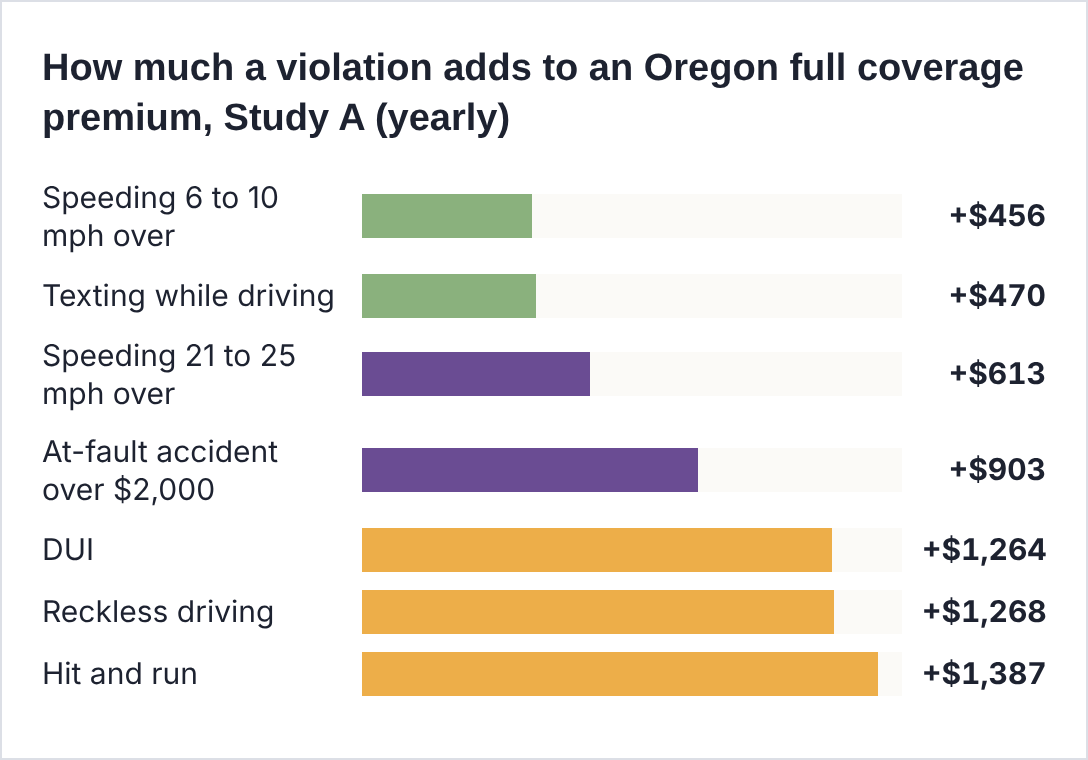
Increase over an average clean-record premium of $1,693 a year. Source: Study A.
Teens, older drivers, and credit
Teen drivers
Oregon teens can get an instruction permit at 15 and must hold it for six months while logging 100 hours of supervised driving, or 50 hours plus an approved driver education course. During the first six months with a provisional license, they may carry no passengers under 20 outside the immediate family, and in the next six months no more than three. They may not drive between midnight and 5 a.m. for the first year, with exceptions for work and school.
COUNTRY Financial was the standout price for young drivers. Study H found it the cheapest company for drivers from 16 through 25, and its prices for young men fell by almost half over those years.
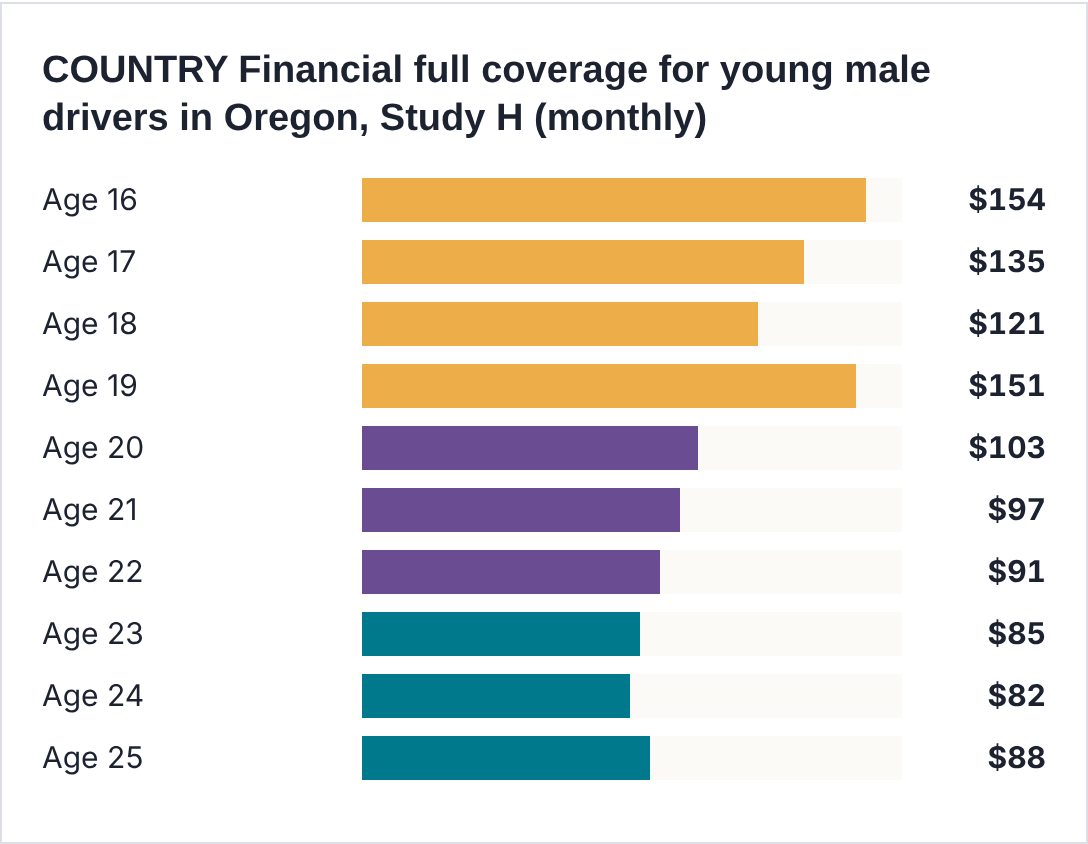
COUNTRY was the cheapest company at every age shown. Prices for young women ran lower, from $114 at 16 to $61 at 25. Source: Study H, July 2026.
Other studies confirm the pattern. Study C priced a 16-year-old at $3,410 a year with COUNTRY, less than half of the next-cheapest company, and Study F found COUNTRY second only to USAA for an 18-year-old buying full coverage, at $357 a month. Study A, which looked at teen drivers as a group, named Travelers the cheapest.
Drivers 55 and older
Oregon law, ORS 742.490 through 742.496, requires insurers to reduce premiums for a principal driver 55 or older who completes an ODOT-approved accident prevention course, as long as no one under 25 regularly drives the vehicle. The reduction lasts three years, or two years for drivers 70 and older, and insurers may require a clean record. The law does not set a percentage.
Oregon seniors already pay less than seniors nationally: Study D put the state’s senior average at $1,970 a year, against $2,531. The cheapest company varied by study, with Travelers at $89 a month in Study G, Progressive at $114 a month at age 65 in Study D, COUNTRY at $69 a month at age 70 in Study H, and State Farm at $101 a month at 70 in Study E. National comparisons of car insurance options for older drivers can provide additional context, but they do not replace Oregon quotes.
Credit and your renewal
Oregon limits how insurers use credit after a policy is in force. Under ORS 746.661, an insurer may not cancel or non-renew a policy that has been in effect for more than 60 days because of your credit, and at renewal it may re-rate you only on other factors unless you ask for a credit re-rate, which cannot raise your premium. Credit can still shape the price of a new policy.
That matters when you shop. Study F found poor credit nearly doubled the average full coverage premium, and State Farm’s price for poor credit, $682 a month, was the highest of any company it priced. Progressive was the cheapest for that profile in Study F, at $218, and Capital Insurance Group led in Study E.
Service, complaints, and financial strength
J.D. Power’s 2026 U.S. Auto Insurance Study places Oregon in its Northwest region. State Farm won it again with 667, GEICO finished second, and Seattle-based PEMCO jumped from eighth to fourth. Travelers, one of our cheapest picks, finished last among ranked companies.
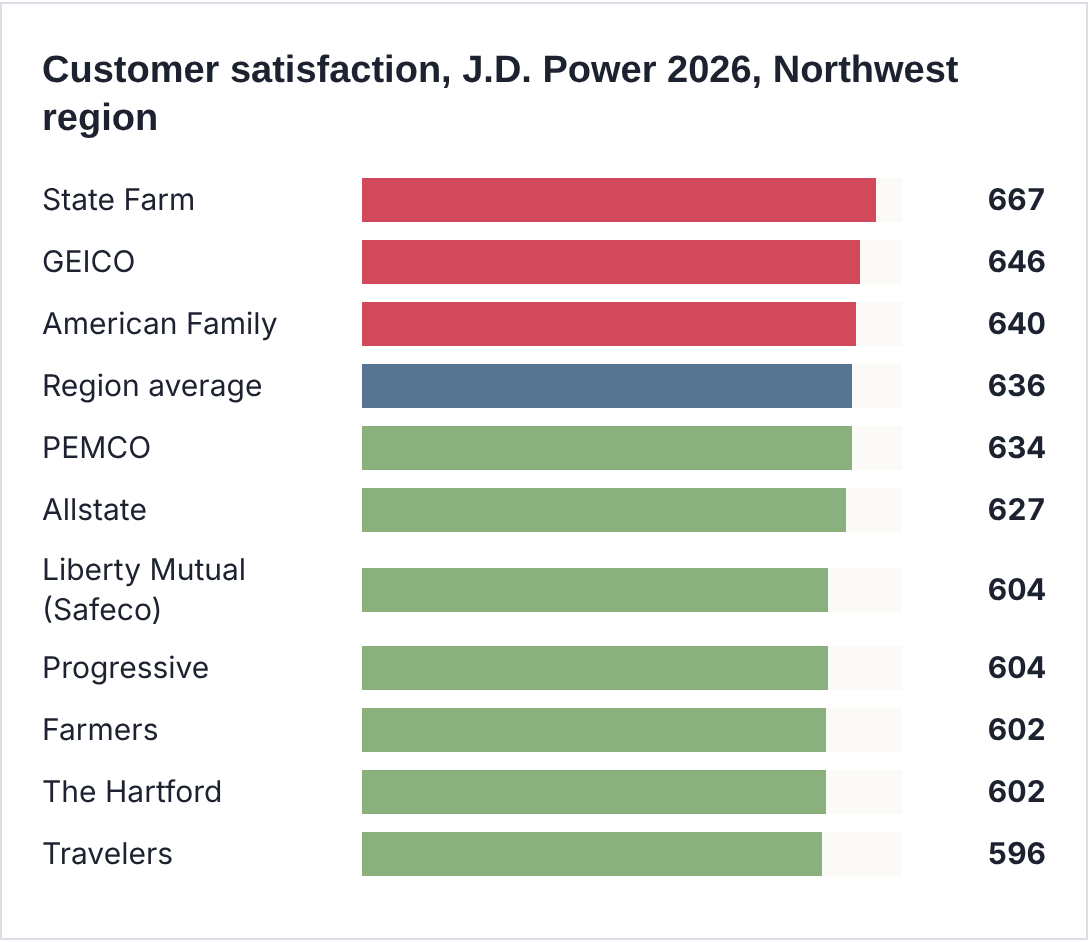
Score on a 1,000-point scale. USAA scored 726 but is not eligible for official rankings. Source: J.D. Power 2026 U.S. Auto Insurance Study, as reported by Study C.
Oregon’s complaint index
The Division of Financial Regulation publishes yearly complaint figures for every auto insurer, listing each company’s Oregon premium, total complaints, confirmed complaints, and a complaint index. The report does not define the index, but lower numbers go with fewer confirmed complaints for a company’s size. Because each underwriting company is listed separately, several groups appear more than once.
Oregon auto complaint index by company, 2025
| Company (as listed) | Oregon auto premium | Confirmed complaints | Index |
| Artisan and Truckers (Progressive) | $504.7 million | 3 | 0.21 |
| Country Preferred | $112.4 million | 1 | 0.32 |
| Standard Fire (Travelers) | $109.2 million | 1 | 0.33 |
| Progressive Universal | $581.5 million | 8 | 0.49 |
| Farmers Insurance Co. of Oregon | $186.5 million | 3 | 0.58 |
| GEICO Secure | $174.0 million | 3 | 0.62 |
| State Farm Mutual Automobile | $953.5 million | 17 | 0.64 |
| Safeco Insurance Co. of Oregon | $178.5 million | 4 | 0.80 |
| American Family Insurance Co. | $64.2 million | 2 | 1.12 |
| GEICO Casualty | $141.0 million | 6 | 1.53 |
| USAA Casualty | $92.8 million | 4 | 1.54 |
| Allstate Fire and Casualty | $196.6 million | 9 | 1.64 |
| USAA General Indemnity | $71.7 million | 10 | 5.00 |
PEMCO, Mutual of Enumclaw, and Root had no confirmed complaints. Source: Oregon Division of Financial Regulation, 2025 auto complaint report.
If you have a dispute with your own insurer, the division, led by Insurance Commissioner TK Keen since December 2025, takes complaints through an online form, by email, or through its consumer hotline at 888-877-4894. Its consumer advocates recovered $3.88 million for Oregonians across all types of insurance in the first half of 2026.
AM Best financial strength ratings for Oregon insurers
| Company | Rating | Latest action we found |
| GEICO | A++ (Superior) | Affirmed April 2026 |
| USAA | A++ (Superior) | Affirmed June 2026 |
| Travelers | A++ (Superior) | Affirmed August 2026 |
| State Farm | A+ (Superior) | Lowered from A++, November 2025 |
| Progressive | A+ (Superior) | Affirmed May 2026 |
| Allstate | A+ (Superior) | Affirmed September 2026 |
| COUNTRY Financial | A+ (Superior) | Affirmed August 2026 |
| American Family | A (Excellent) | Affirmed October 2026 |
| Nationwide | A (Excellent) | Affirmed November 2025 |
| Liberty Mutual (Safeco) | A (Excellent) | Affirmed September 2025 |
| Farmers | A (Excellent) | Affirmed August 2025 |
| Mutual of Enumclaw | A- (Excellent) | Affirmed, outlook negative, February 2026 |
| PEMCO | B++ (Good) | Affirmed April 2026 |
Sources: AM Best announcements and company releases. Several Oregon comparison pages still list State Farm at A++.
Who writes Oregon’s auto policies?
Oregon drivers paid $4.17 billion in private passenger auto premiums in 2024, according to the Division of Financial Regulation, up from $3.81 billion in 2023. State Farm’s main company held the largest share, and Progressive’s two companies together came close behind.
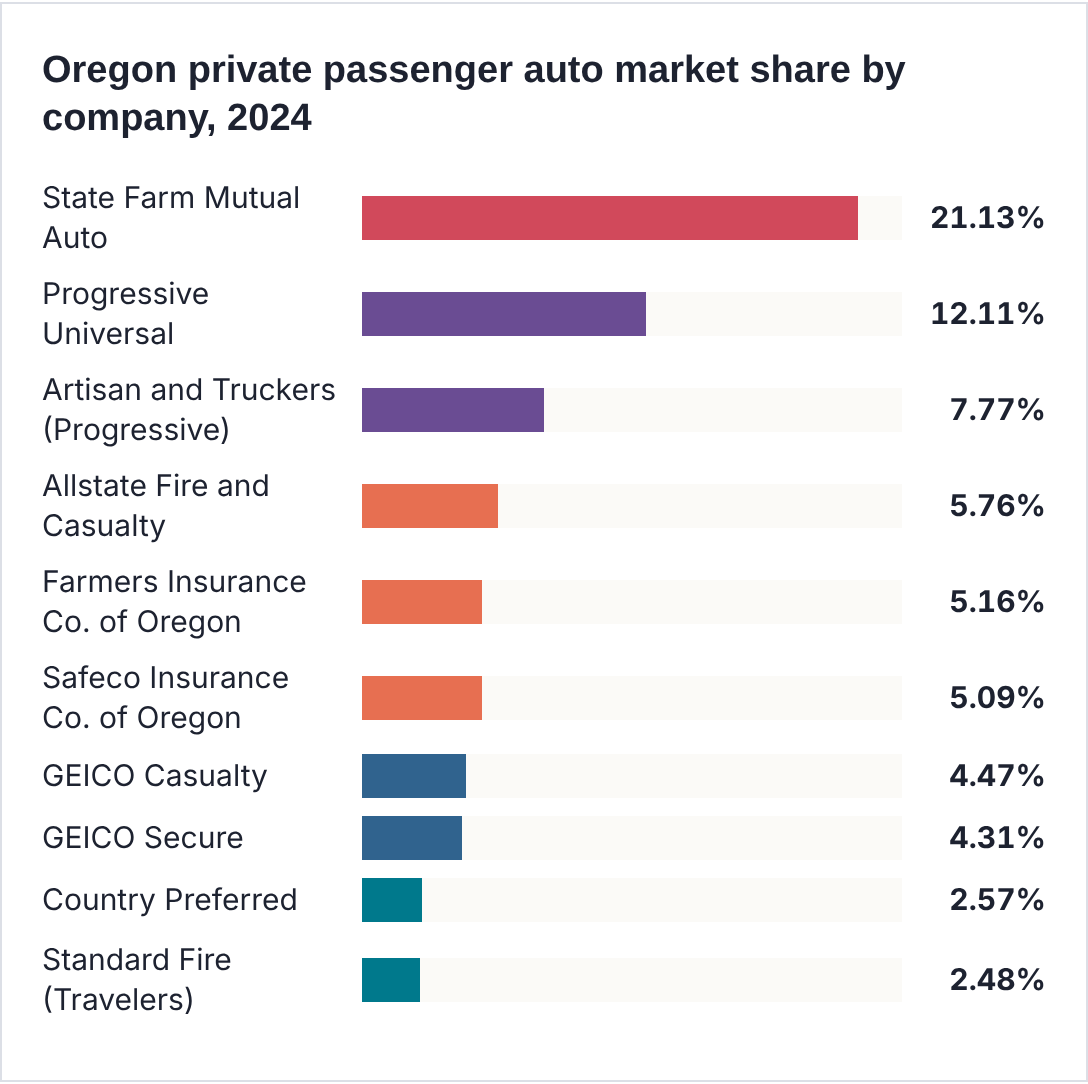
Shares as printed for each underwriting company. Source: Oregon Division of Financial Regulation, 2024 annual insurance report.
Subarus, Toyotas, and EVs: the vehicles Oregonians insure
Oregon’s driveways lean toward all-wheel drive and fuel economy. In a dealer sales snapshot from October 2026, Toyota held seven of the state’s 10 best-selling new vehicles, led by the RAV4, Tacoma, and Camry, and the Subaru Crosstrek and Forester ranked fourth and fifth. That works in drivers’ favor, because the Forester was the cheapest vehicle to insure in Oregon in Study D.
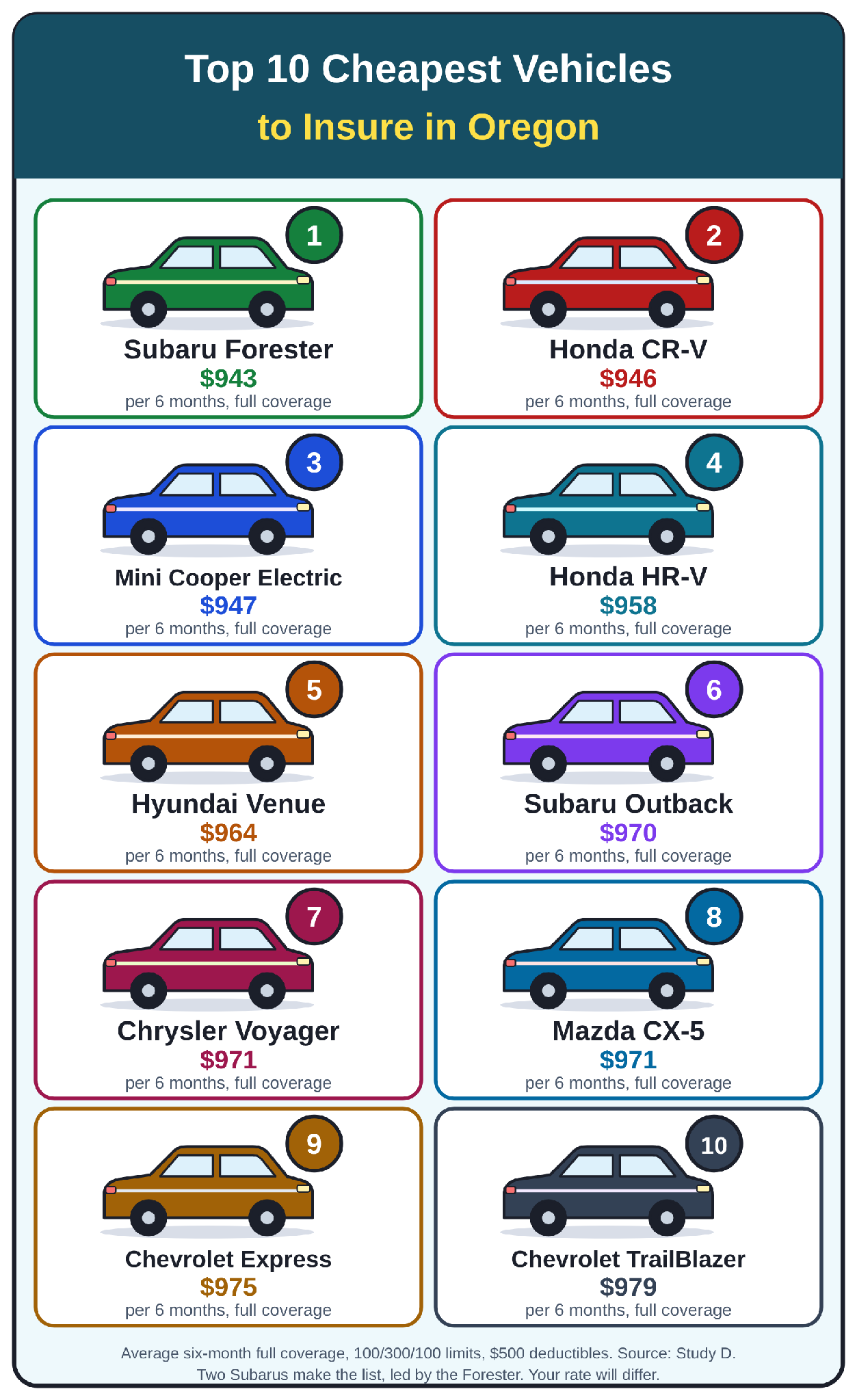
The 10 cheapest vehicles to insure in Oregon, per six months, from Study D.
Outside the top 10, the Subaru Legacy was the cheapest sedan at $1,052 per six months, the Mazda MX-5 Miata the cheapest sports car at $1,014, and the Acura RDX the cheapest luxury model at $1,016. The Porsche 911 Turbo was the most expensive vehicle listed, at $2,302. For an 18-year-old, the Forester still cost $3,979 per six months.
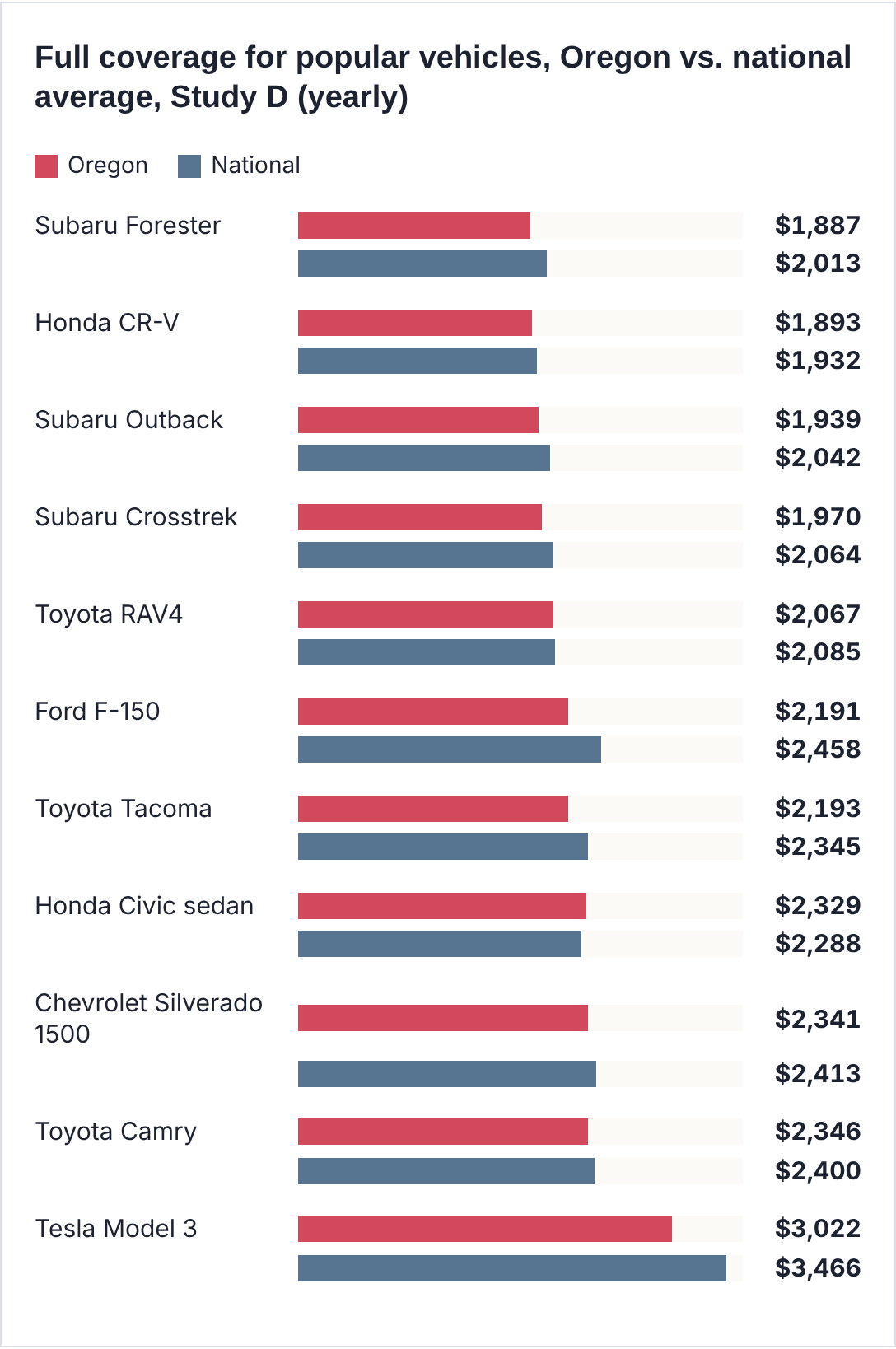
40-year-old driver, 100/300/100 limits, $500 deductibles. Source: Study D vehicle pages.
Most popular models cost a little less to insure in Oregon than nationally, though the gaps are smaller than in many states. The Honda Civic sedan was the exception, at $41 a year more than the national figure, and it was also Oregon’s most stolen vehicle in 2025.
Electric vehicles
Oregon had about 98,000 registered all-electric vehicles in 2025 according to the cited federal data. Tesla Insurance has been offered in Oregon, and Lemonade introduced a mileage-based car insurance program there in 2023. Separately, the Oregon Department of Transportation says that starting July 1, 2027, used EV owners renewing registration will choose between a flat road-usage fee and paying by the mile. This is a vehicle-registration/road-funding charge, not an auto insurance premium.
Theft, elk, ice, and wildfire
Vehicle theft has fallen sharply but remains a real risk. Oregon recorded 11,812 stolen vehicles in 2024, according to the National Insurance Crime Bureau, a 30% drop from 2023 that still left the state with the 10th-highest theft rate in the country.
Portland has seen the biggest change, from a peak of 10,903 stolen vehicle reports in 2022 to 4,204 in 2024 as of late December. In 2025, the most stolen models in Oregon were the Honda Civic, with 285 thefts, the Hyundai Elantra, with 252, and the Honda Accord, with 246. Kia and Hyundai models were a particular target in Portland in early 2023, when they made up about a third of stolen cars, according to police data reported by Willamette Week.
Wildlife collisions are more expensive than most drivers expect. ODOT documents more than 6,000 crashes with deer and elk each year, and it puts the average cost at $9,000 for a deer and $24,000 for an elk. Its crossings are helping: the Lava Butte undercrossings on US 97 cut deer and elk crashes by 66.1%, and a $37 million overcrossing on I-5 near the California border is expected to begin construction in 2028.
Weather adds the rest. The January 2024 ice storm closed I-84 between Troutdale and Hood River, and the 2026 wildfire season burned more than 2 million acres by early August, closing stretches of I-84, US 20, and US 26. Studded tires are legal from November 1 through March 31, and ODOT’s chain signs apply on mountain passes when posted.
PRO TIP #3
Comprehensive insurance generally covers theft, animal strikes, falling trees and wildfire damage, subject to the policy and deductible. However, ODOT’s reported average elk-collision loss should not be treated as what every driver would pay or as the value of collision coverage on a low-value car. Compare a comprehensive quote with your vehicle’s replacement value and ability to absorb a loss.
On the brighter side, traffic deaths have fallen two years in a row, from 587 in 2023 to 539 in 2024 and 487 in 2025, according to ODOT’s preliminary data. Portland recorded 39 traffic deaths in 2025, its lowest since 2018, with more than 30 speed and intersection cameras now operating on its high-crash streets.
The 2027 outlook for Oregon premiums
Study F reports several Oregon rate decreases during 2026 alongside increases at other insurers. These are insurer-level filings or sampled averages, not a forecast for any specific renewal. A new quote should be compared with the same deductibles, liability limits, PIP and uninsured motorist coverage. A useful next step is to compare renewal prices before rates change without assuming rates will fall.
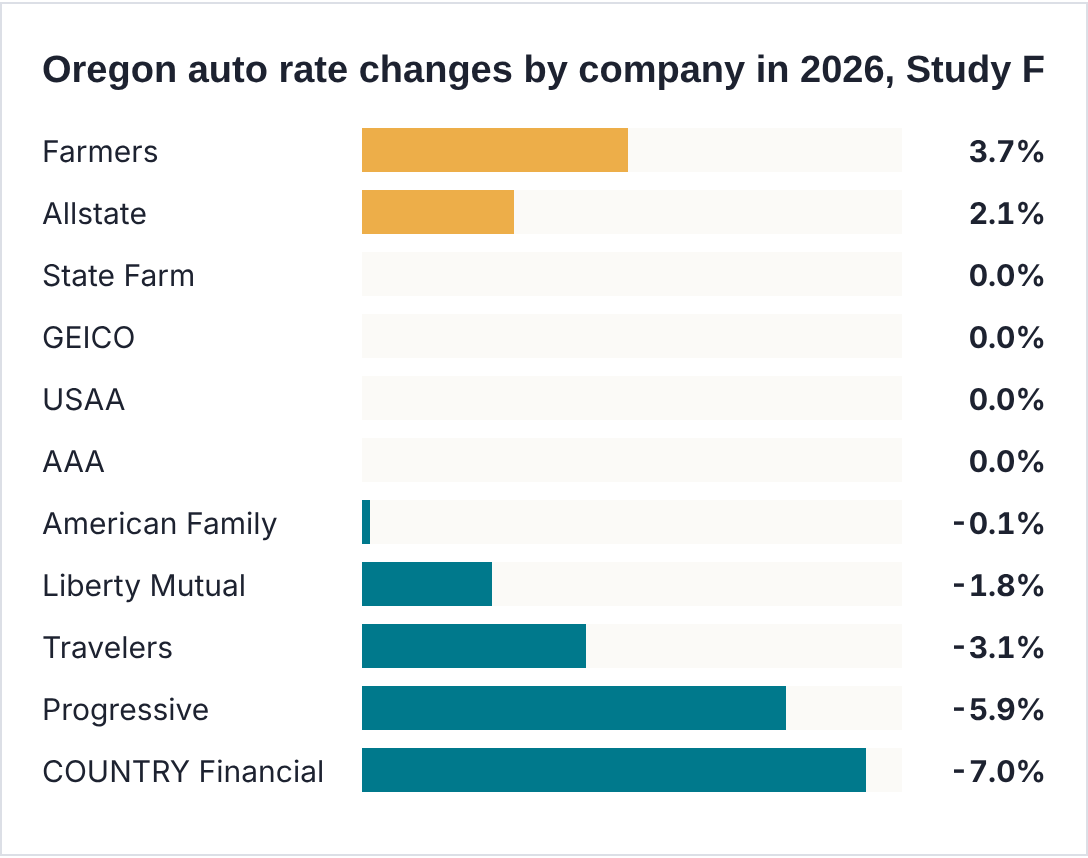
Five-year changes ranged from 18.1% at Travelers to 86.4% at COUNTRY Financial. Source: Study F, October 2026.
Nationally, WTW’s October 2026 forecast calls for personal auto rates to range from 2% lower to 4% higher in 2027. Oregon’s basic insurance requirements are unchanged heading into 2027: a 2025 bill that would have made PIP optional from 2027, HB 3636, never left committee, and voters rejected the gas tax and fee increases in Measure 120 in May 2026.
Discounts that move Oregon premiums
Study D measured how much common discounts and rating factors were worth to an Oregon driver. Experience mattered most: a long history as a licensed driver cut the average premium 31%, and a long record of continuous coverage cut it 20%. Its data was collected in 2023, so treat the percentages as a guide to which questions to ask rather than a promise.
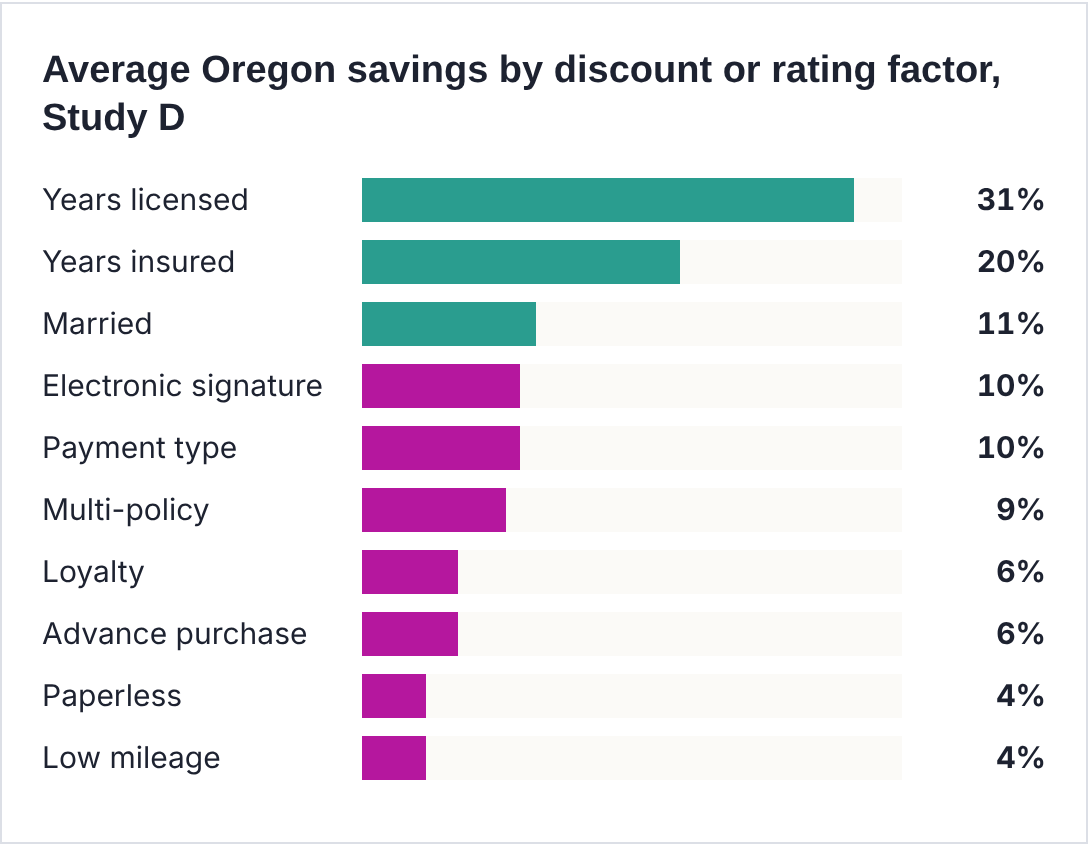
Percentage savings on an average Oregon premium for a 40-year-old driver. Source: Study D.
Insurers’ own discount pages add a few specifics. State Farm advertises up to 30% through Drive Safe & Save, GEICO says DriveEasy typically saves 5% to 15% and that a clean driving record can be worth up to 22%, and Travelers’ IntelliDrive program offers 10% at sign-up. Remember too that Oregon law requires a discount for drivers 55 and older who complete an approved accident prevention course. Ask about common auto insurance discount categories and confirm which discounts are available in Oregon.
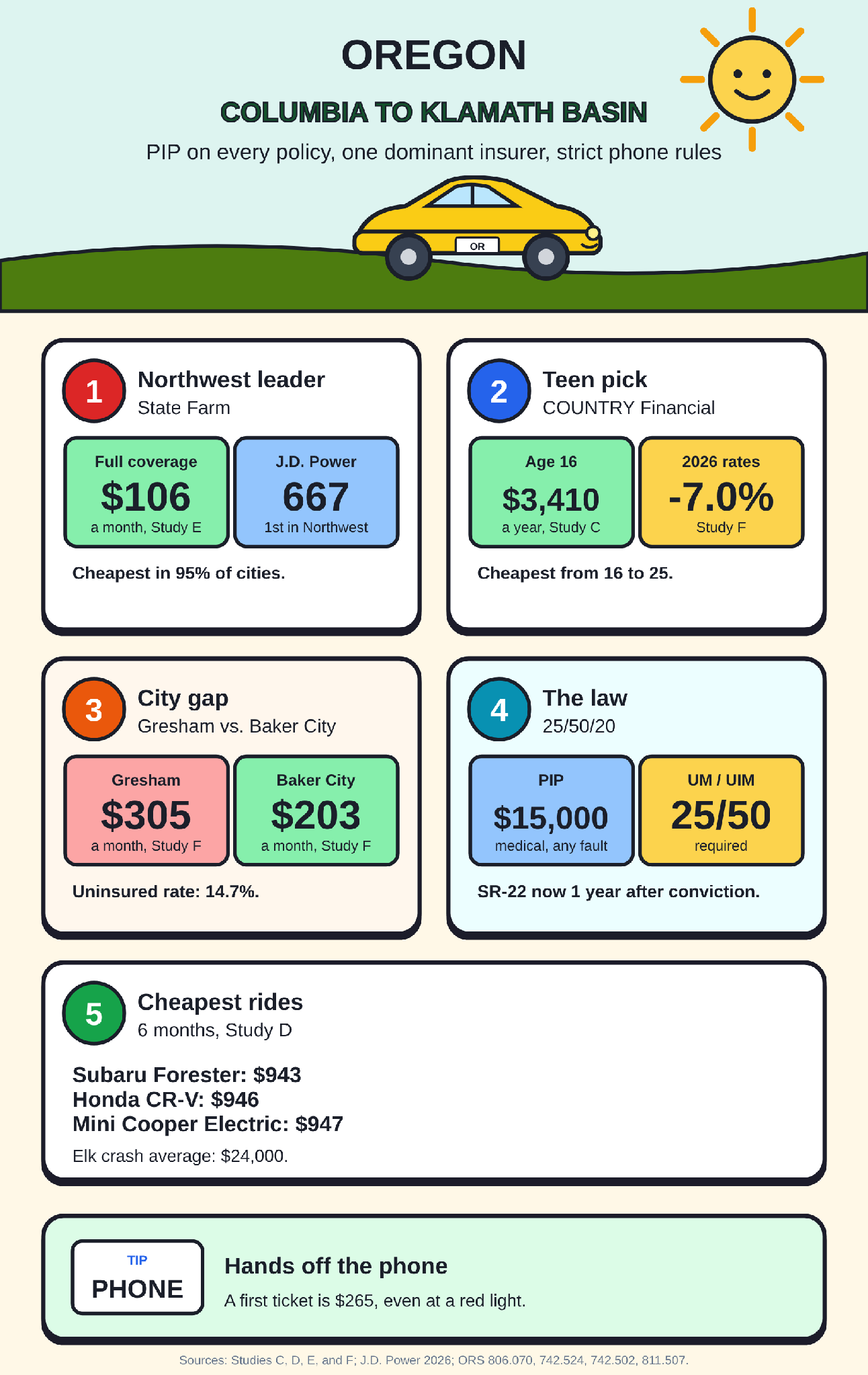
Oregon car insurance in six panels, from the Columbia to the Klamath Basin.
Car insurance companies in Oregon: frequently asked questions
What is the cheapest car insurance company in Oregon?
State Farm was cheapest most often, leading Studies E and F for full coverage and Studies B, F, and H for minimum coverage. Travelers led Study A, and Progressive led Study H for full coverage.
How much car insurance is required in Oregon?
Liability of 25/50/20, personal injury protection with $15,000 of medical coverage, and uninsured motorist coverage of at least $25,000 per person and $50,000 per crash, which includes underinsured coverage.
Is Oregon a no-fault state?
Not exactly. Every policy includes PIP, which pays your injury costs regardless of fault, but the at-fault driver remains responsible for damages, and you can still sue for pain and suffering.
How long do I need an SR-22 in Oregon?
For a conviction for driving uninsured on or after January 1, 2026, one year. Uninsured drivers involved in a crash still face a three-year SR-22, and DUII and some other offenses carry their own requirements.
Is Oregon Mutual still a good option for auto insurance?
Be cautious. The company announced in 2022 that it would stop writing personal lines, and AM Best withdrew its ratings in 2025. Some comparison sites still list it as Oregon’s cheapest insurer based on older data.
Can I use my phone at a red light in Oregon?
No. Oregon’s distracted driving law counts a stop at a light as driving, so holding your phone there can bring a $265 presumptive fine. Adults may use hands-free features, but drivers under 18 may not use a phone at all.
Which company has the best customer service in Oregon?
State Farm, which won J.D. Power’s 2026 Northwest study with 667. GEICO, at 646, and American Family, at 640, also beat the regional average of 636.
The final word on car insurance companies in Oregon
For most Oregon drivers, the search can start in one place: State Farm combined the region’s best satisfaction score with the lowest price in more studies than any rival. But a strong first quote is not the whole job. Travelers and Progressive beat it for seniors, drivers with a violation, and drivers with weaker credit, and COUNTRY Financial was the clear value for families adding a teenager.
Whichever company you choose, check the parts of an Oregon policy that matter most after a serious crash: your PIP and uninsured motorist limits, a comprehensive deductible you could afford after an elk strike or a wildfire, and every discount you qualify for. Compare again at each renewal, since prices from Portland to Baker City keep moving.
Editorial methodology: The rate comparisons above use different model drivers, dates, insurers and coverage. Rankings are editorial, not the result of a standardized statewide quote experiment. Charts reproduced from the supplied article retain their original values and require individual visual verification before publication.
Sources
- Study A: The Zebra, Oregon car insurance.
- Study B: Insurify, Oregon car insurance (November 1, 2026) and Insurify, rate report (August 11, 2026).
- Study C: Insurance.com, best and cheapest car insurance in Oregon (January 7, 2026) and Insurance.com, J.D. Power 2026 results (June 23, 2026).
- Study D: CarInsurance.com, cheapest car insurance in Oregon; CarInsurance.com, Oregon average rates (April 23, 2026); CarInsurance.com, Oregon seniors (June 4, 2026); CarInsurance.com, cheapest cars to insure in Oregon; CarInsurance.com, NAIC complaint data (August 13, 2026); and vehicle pages for the Subaru Forester, Honda CR-V, Subaru Outback, Subaru Crosstrek, Toyota RAV4, Ford F-150, Toyota Tacoma, Honda Civic sedan, Chevrolet Silverado 1500, Toyota Camry, and Tesla Model 3.
- Study E: NerdWallet, cheapest car insurance in Oregon (October 2, 2026).
- Study F: ValuePenguin, cheapest car insurance in Oregon (October 13, 2026).
- Study G: Experian, cheapest car insurance in Oregon (October 13, 2026).
- Study H: MoneyGeek, cheapest car insurance in Oregon (July 15, 2026) and MoneyGeek, best car insurance in Oregon (August 30, 2026).
- Oregon law: ORS 806.070; ORS 742.524; ORS 742.502; ORS 742.510; ORS 31.600; ORS chapter 806; ORS 153.019; ORS 809.720; ORS 811.507; ORS chapter 813; ORS 746.661; ORS 742.480 to 742.496, insurance discounts; SB 411 (2015); DFR memo on SB 840 (December 2025); and HB 3636 (2025).
- Oregon agencies: DMV, insurance requirements; DMV, suspension reasons; OAR 735-072-0027; OAR 735-050-0080; DMV, teen licenses; ODOT, distracted driving; ODOT, State of the System safety; ODOT, I-5 wildlife crossing grant (December 20, 2024); ODOT, wildlife crossing report (September 2026); ODOT, chains and traction tires; ODOT, HB 3991; Division of Financial Regulation, 2025 auto complaints; Division of Financial Regulation, 2024 private passenger auto report; and Portland Bureau of Transportation, 2025 traffic deaths.
- Ratings and companies: AM Best, State Farm; AM Best, GEICO; AM Best, USAA; AM Best, American Family; COUNTRY Financial, AM Best rating; AM Best, PEMCO; AM Best, Mutual of Enumclaw; Insurance Journal, California Casualty upgrade; AM Best, Oregon Mutual withdrawal; PIA Western Alliance, Oregon Mutual personal lines; State Farm, discounts; GEICO, discounts; Drive Tesla, Tesla Insurance in Oregon; and Lemonade Car launches in Oregon (March 29, 2023).
- Market, risk, and vehicles: Insurance Information Institute, uninsured motorists; KTVZ, 2024 Oregon auto thefts; KOIN, most stolen vehicles in Oregon (March 24, 2026); OPB, Portland vehicle thefts (December 23, 2024); Willamette Week, Kia and Hyundai thefts (March 5, 2023); ORS chapter 811; ORS 810.438; DFR, new insurance commissioner; Insurance Journal, DFR recoveries (September 2026); OPB, January 2024 ice storm; KVAL, 2026 wildfire acreage; KPTV, I-84 wildfire closure (July 27, 2026); Portland Bureau of Transportation, safety cameras; Alternative Fuels Data Center, Oregon; CarEdge, Oregon best-selling new cars (October 2026); Oregon Capital Chronicle, Measure 120 (May 19, 2026); Autobody News, Oregon rate projections (February 5, 2026); and WTW, 2027 personal lines outlook (October 2026).
Disclaimer
This Oregon guide compares auto insurers using published studies and public records, and it is offered for general education only. Nothing here is legal, financial, or insurance advice, and your actual coverage depends on the policy you buy and the terms an insurer offers you.
Rates in this article are averages for sample drivers, so expect your own quotes to differ. State Farm, Travelers, Progressive, GEICO, COUNTRY Financial, USAA, American Family, Nationwide, PEMCO, Root, Oregon Mutual, and the other companies mentioned have no business relationship with us and did not commission, review, or endorse this article. We are equally independent of J.D. Power, AM Best, the Oregon Division of Financial Regulation, and the Oregon DMV. Brand names and logos belong to their respective owners.