
California Mobile Home Insurance
Buying California mobile home insurance has become harder since 2023, as big insurers stopped writing new policies and wildfire losses pushed prices up. The good news is that coverage is still available, it costs about half as much as a regular homeowners policy, and a new state law that took effect January 1, 2026, gives mobile home owners better access to replacement-cost fire coverage through the California FAIR Plan.
This guide uses the California Department of Insurance's own data, released July 3, 2026, to show what owners really pay. It ranks the 10 cheapest mobile home insurance companies selling in California, names the overall cheapest, and explains how wildfire, earthquake, and flood coverage work for manufactured homes. It also covers park rules, bundling with auto insurance, discounts, and pro tips to lower your bill.
KEY TAKEAWAYS
- The average California mobile home policy cost about $1,165 in 2025, up 8.8% from 2024, compared with about $2,340 for a homeowners policy (our calculation from state data).
- Assurant is the overall cheapest pick, at $969 a year in Study A's 2026 quotes, followed by American Modern at $1,025 and Foremost at $1,607.
- Only 18.95% of California mobile home owners carry earthquake coverage, and a certified bracing system cuts the earthquake premium by 21%.
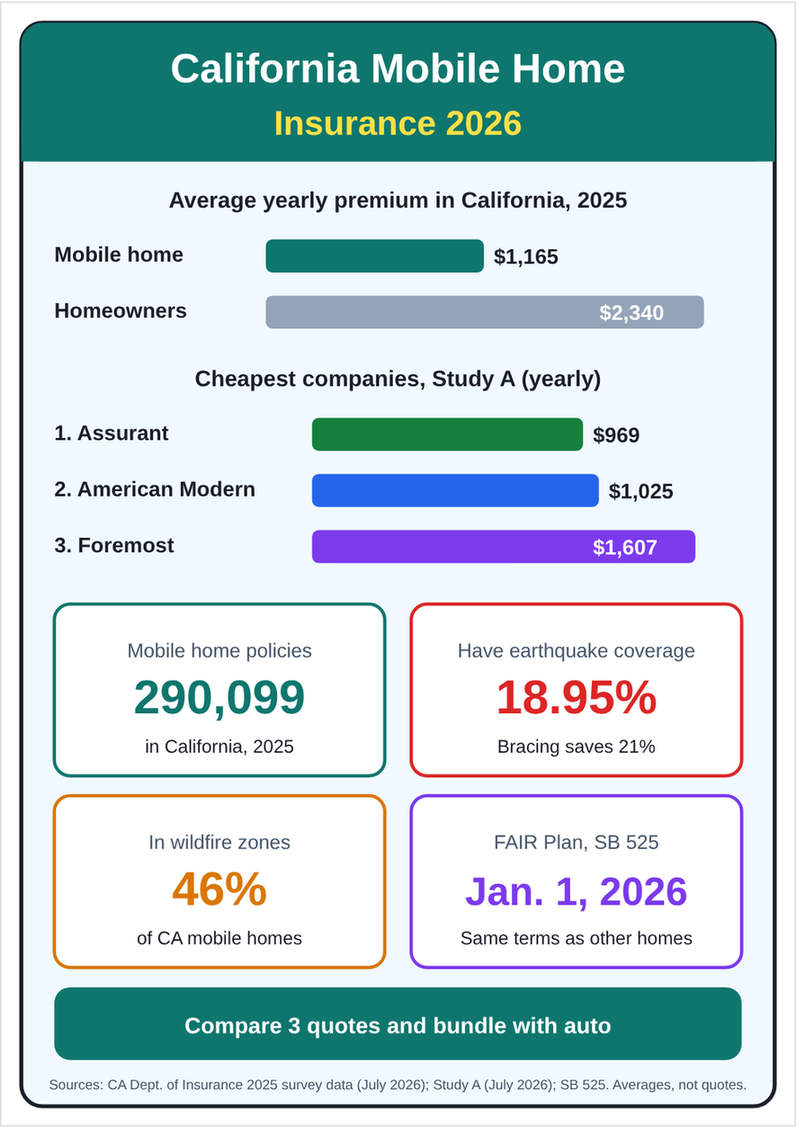
California mobile home insurance at a glance. State averages are our calculation from California Department of Insurance survey data; company prices are Study A's 2026 sample quotes. Averages, not quotes.
How much mobile home insurance costs in California
The California Department of Insurance surveys every insurer each year about the policies it has in force. Its 2025 data, published July 3, 2026, counted 290,099 mobile home policies in the state. Dividing total premiums by policies gives an average of about $1,165 a year, up 8.8% from about $1,071 in 2024 (our calculation).
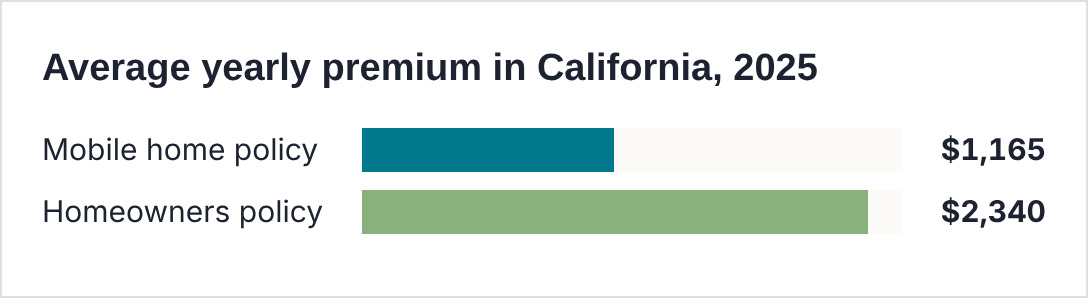
Our calculation is based on California Department of Insurance earthquake premium and policy surveys, 2025 data (July 3, 2026). Averages, not quotes.
Mobile home insurance costs about half as much as a homeowners policy because the homes are smaller and cost less to rebuild. It also rose more slowly. Homeowners premiums climbed about 18.9% from 2024 to 2025, more than twice the 8.8% increase for mobile homes.
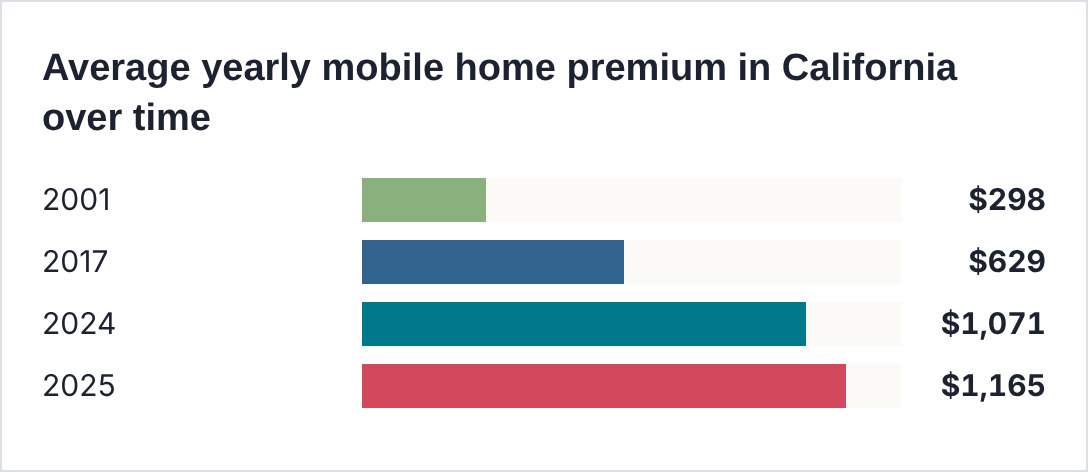
California Department of Insurance mobile home data (2001 and 2017); our calculation from the department's survey data for 2024 and 2025. Older figures may use a different method.
Prices have nearly doubled since 2017 and almost quadrupled since 2001. Owners are also paying more for each dollar of coverage than other homeowners. The Terner Center for Housing Innovation at UC Berkeley found that in 2023, California mobile home owners paid a median $483 a year for every $100,000 of home value.
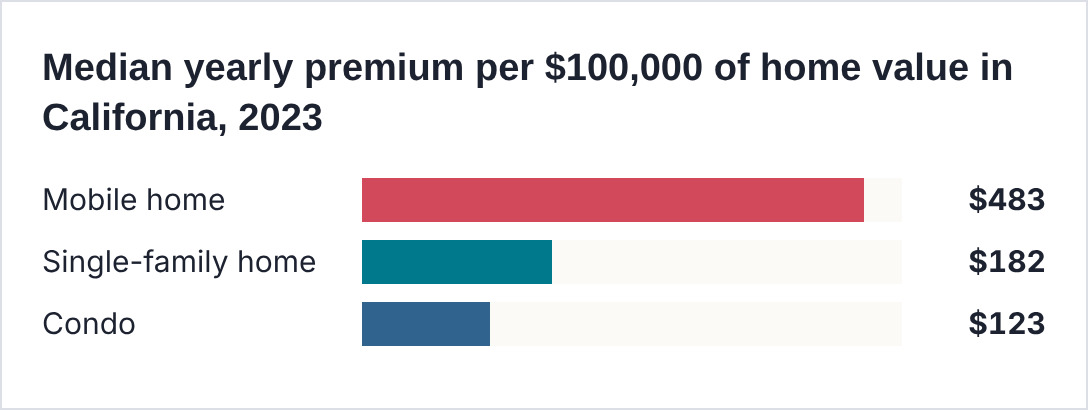
Terner Center for Housing Innovation, UC Berkeley (December 5, 2025), using 2023 Census survey data.
The same research found that about 40% of mobile homes without a mortgage were uninsured, roughly 98,000 of 247,000 homes. Without a lender requiring coverage, many owners on fixed incomes drop it. That leaves them exposed to a total loss from a single fire.
What sets your mobile home insurance price in California
Two neighbors in the same park can pay very different prices. Insurers look at the home, the location, and the owner, and each company weighs these factors differently.
Main factors in your mobile home premium
| Factor | Why it matters |
|---|---|
| Wildfire risk | Homes near brush or forest cost more to insure, and some companies decline them |
| Location | Park homes often get lower rates than homes on private rural land |
| Age of the home | Newer homes built to HUD code earn discounts; pre-1976 homes cost more |
| Home value and size | Single-wides cost less to rebuild than double- or triple-wides |
| Valuation method | Replacement cost costs more than actual cash value but pays far more |
| Tie-downs and skirting | Anchored, fully skirted homes earn credits |
| Deductible | A $1,000 deductible usually costs less than $500 |
| Claims history | Recent claims raise the price; claims-free years lower it |
| Age of the owner | Many insurers give discounts from age 50 or 55 |
Company discount lists and the California Department of Insurance mobile home guide. Factor weights vary by insurer.
The single biggest factor is usually wildfire risk, which is why mitigation steps can pay off quickly. Ask each company which factors affect your quote the most.
Mobile home insurance vs. homeowners insurance
How mobile home and homeowners policies compare in California
| Feature | Mobile home policy | Homeowners policy |
|---|---|---|
| Average yearly premium, 2025 | About $1,165 | About $2,340 |
| Price per $100,000 of home value, 2023 | $483 median | $182 median (single-family) |
| Earthquake coverage take-up, 2025 | 18.95% | 12.48% (all residential) |
| Transit coverage | By endorsement | Not applicable |
| Common extras | Skirting, carports, awnings, steps | Garages, fences, pools |
| FAIR Plan access | Equal terms since January 1, 2026 | Long available |
Our calculation from California Department of Insurance 2025 survey data; Terner Center (December 2025).
Mobile home owners pay less in total but more per dollar of value. That gap is why discounts and comparison shopping matter so much more for mobile home owners than for other homeowners.
The top 10 cheapest mobile home insurance companies in California
California does not publish an easy list of mobile home prices by company, and no national rate study breaks out California company prices for 2026. We ranked the companies below using the best evidence available. Ranks 1 to 3 use Study A, a 2026 national quote study that priced the same single-wide home at three major mobile home insurers. Ranks 4 to 10 use bundle savings, how each company sells in California, and the size of recent approved rate increases.
The 10 cheapest mobile home insurance companies in California
| Rank | Company | Evidence on price | AM Best |
|---|---|---|---|
| 1 | Assurant | $969 a year in Study A; also sold through GEICO | A+ |
| 2 | American Modern | $1,025 a year in Study A; also sold through Progressive | A+ |
| 3 | Foremost (Farmers) | $1,607 in Study A; company average about $1,267 | A |
| 4 | Progressive | Shops partner insurers; average 5% bundle savings on auto | A+ |
| 5 | GEICO | Partner policies; tie-down and new-home discounts | Partner rating |
| 6 | Farmers | Up to 10% off both policies when bundled | A |
| 7 | California Casualty | Manufactured home product; committed to grow in California | Not confirmed |
| 8 | Stillwater | Approved rate increase of 16% | Not confirmed |
| 9 | Grange | Mobile home rates up 25% from January 1, 2026 | Not confirmed |
| 10 | Wawanesa | Approved rate increase of 35% from July 1, 2025 | Not confirmed |
Study A: national mobile home quote study updated July 6, 2026, for a 2016 single-wide in a park with $51,000 to $63,000 of dwelling coverage and a $1,000 deductible. Rate increases from California Department of Insurance approvals as reported in 2025. Your price will vary.
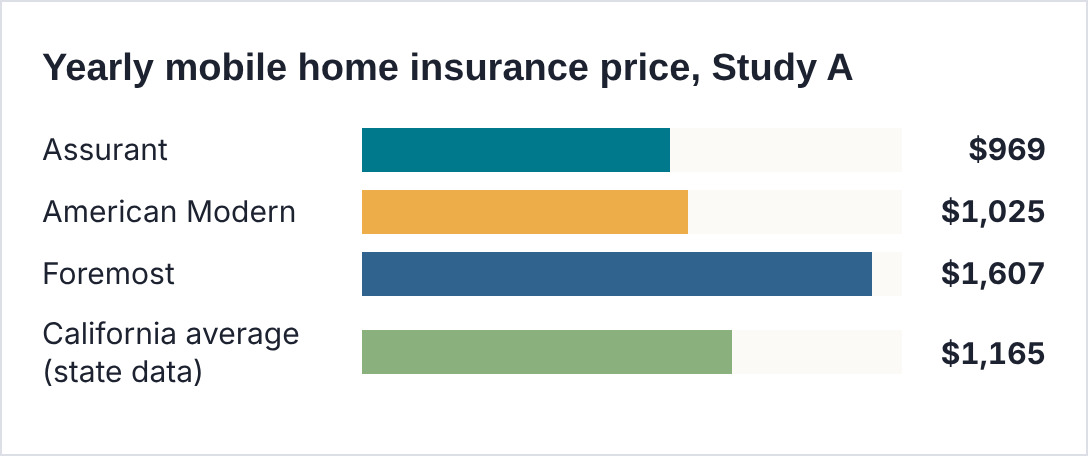
Study A: national quote study updated July 6, 2026. California average is our calculation from California Department of Insurance 2025 data. Averages, not quotes.
1. Assurant: the overall cheapest
Assurant had the lowest price in Study A, at $969 a year, which is about $196 below the California average from state data (our calculation). Its policies are written by American Bankers Insurance Company, rated A+ by AM Best, and it sells in every state except Florida, Hawaii, and Washington, D.C. GEICO's mobile home quotes are also placed with Assurant, so you may see the same policy under the GEICO name.
Assurant is a good fit for owners of newer homes in parks who want a simple policy at a low price. Ask whether your quote uses replacement cost or actual cash value, because that choice changes both the price and what you collect after a total loss.
2. American Modern: best for pairing with the FAIR Plan
American Modern, owned by Munich Re, quoted $1,025 a year in Study A and is rated A+. It insures manufactured homes worth $5,000 to $300,000 with no age limit, which helps owners of older homes. It also offers a California difference-in-conditions policy, which adds theft, water, and liability coverage to a FAIR Plan fire policy.
Discounts include up to 5% for bundling, plus savings for three claim-free years, paying in full, paperless billing, alarms and deadbolts, and association membership. It sells through independent agents and through Progressive.
3. Foremost: best for older homes and high-risk areas
Foremost, part of the Farmers group, is one of the broadest mobile home insurers in California. It quoted $1,607 in Study A, but the company says its national average is about $1,267 a year. It covers homes of any age, including pre-1976 units, and writes in high fire-risk areas where others decline.
Foremost offers discounts for owners aged 50 and older, newer homes, homes in approved parks, multiple policies, and members of groups such as USAA and AFI. AM Best rates it A. Farmers lifted its California policy cap in late 2025 and joined the state's Sustainable Insurance Strategy in May 2026, which signals it plans to keep writing.
4. Progressive: best for comparing several insurers at once
Progressive does not write most mobile home policies itself. Its site says coverage is "provided and serviced by a trusted, third party in most states," which in Study A meant a Foremost quote. The benefit is convenience: one application can turn up American Modern or Foremost, and bundling a home policy saves an average of 5% on Progressive auto insurance.
5. GEICO: best for well-secured homes
GEICO places mobile home policies with partner insurers, and its quote links lead to Assurant. GEICO lists discounts for tie-downs and full skirting, newer homes, a recent purchase, a loss-free history, and bundling with GEICO auto. If your home is properly anchored and skirted, ask for those credits.
6. Farmers: best for bundling through a local agent
Farmers sells mobile home coverage mainly through Foremost, and its agents can bundle it with auto. Farmers says bundling home and auto can save up to 10% on both policies, and customers who switched saved an average of $1,232 a year in its survey. Farmers is the state's second-largest home insurer and has committed to market to at least 300,000 policyholders in wildfire-distressed areas.
7. California Casualty: worth a quote for eligible groups
California Casualty offers a manufactured home product and is one of the 11 insurance groups that had committed to grow in California under the Sustainable Insurance Strategy by August 2026. Ask whether you qualify and whether it writes in your area. We found no published mobile home price.
8. Stillwater: a smaller rate increase
Stillwater's approved California filing covers mobile and manufactured homes, with a 16% increase on new policies. That is smaller than the increases at Grange and Wawanesa, which is why it ranks above them on our list.
9. Grange: still writing mobile homes
Grange writes mobile and manufactured homes in California. Its mobile home rates rose 25% on January 1, 2026, in a filing that raised regular homeowners rates by 40%. Even after the increase, it may be competitive in some areas, so it is worth one quote.
10. Wawanesa: an option if others decline
Wawanesa won the California region of the J.D. Power 2026 auto insurance study and has an approved filing that includes mobile and manufactured homes. Its 35% increase from July 1, 2025, is the largest on our list, so it ranks last on price, but it can still be a solid choice if your home is in an area other companies avoid.
PRO TIP #1
Use the California Department of Insurance premium comparison tool at insurance.ca.gov. It shows sample mobile home premiums by company for your city, using the same home for every insurer, which is the fairest way to compare prices before you call.
The overall cheapest mobile home insurance in California
Assurant is our pick for the overall cheapest California mobile home insurance. It had the lowest price in Study A, it is rated A+, and you can buy it directly or through GEICO. American Modern is a close second, only $56 more a year in Study A, and is the better pick if you also need FAIR Plan wraparound coverage.
Keep in mind that Study A priced homes in three other states, not California. Prices here depend on your county, wildfire risk, the age of your home, and whether it sits in a park. That is why the cheapest company for your neighbor may not be the cheapest for you.
Companies not writing new policies in California
Two of the biggest names in insurance are not taking new property customers in California, which is why many mobile home owners struggle to find coverage.
Major insurers closed to new California property business
| Company | Status | Latest news |
|---|---|---|
| State Farm | No new property applications since May 27, 2023 | Filed September 16, 2026, to reopen for wildfire-hardened homes; not yet approved |
| Allstate | No new homeowners policies since late 2022 | Filed August 31, 2026, to reopen; pending |
| Farmers | Reopened; cap removed in late 2025 | Joined the Sustainable Insurance Strategy May 12, 2026 |
California Department of Insurance alerts (May 12, September 18, 2026); State Farm newsroom (May 26, 2023). Neither reopening filing says whether it covers mobile homes.
If you already have a State Farm or Allstate policy, you can usually keep renewing it. If you are shopping for a new policy, focus on the companies in our top 10 and an independent agent who works with several of them.
Why California mobile home insurance is harder to buy
California's home insurance market has been under strain since 2023. Large wildfire losses, higher reinsurance costs, and rate rules that insurers said did not reflect those costs led several big companies to stop selling or cap new policies. Mobile homes were hit especially hard because so many sit in fire-prone areas.
More than 46% of California mobile homes are in the wildland-urban interface, where homes meet brush and forest, compared with 31% of all housing. The January 2025 Palisades Fire destroyed Palisades Bowl Mobile Estates, with about 150 homes, and Tahitian Terrace, and many residents were uninsured or underinsured.
The state responded with its Sustainable Insurance Strategy. It lets insurers use catastrophe models and reinsurance costs when setting rates, and in return they must write at least 85% of their statewide market share in wildfire-distressed areas. By August 3, 2026, 11 insurance groups had committed to grow under the plan, including Farmers, Mercury, CSAA, USAA, and California Casualty.
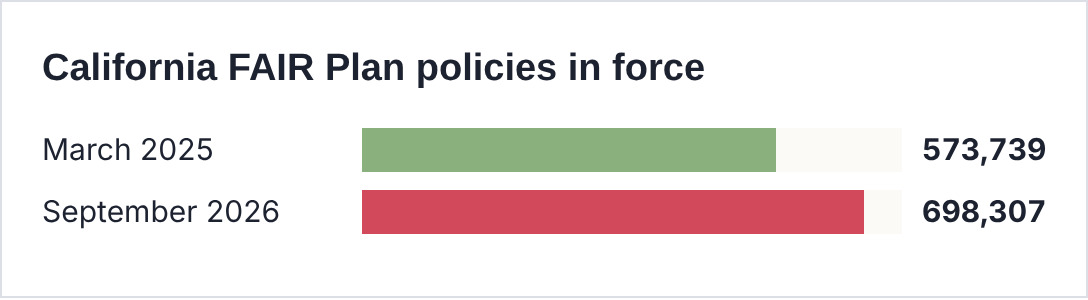
Assembly Insurance Committee analysis of SB 525 (July 2025); California FAIR Plan key statistics (November 13, 2026). Dwelling and commercial policies.
The FAIR Plan, the state's insurer of last resort, grew to 698,307 policies by September 2026, up 157% since 2022. Growth is slowing, though. It rose just 1.9% in the second quarter of 2026, the smallest gain since 2022, as more private insurers return.
The California FAIR Plan for mobile homes
If no private company will insure your home, the California FAIR Plan will. It is a basic fire policy covering fire, lightning, internal explosion, and smoke. It does not include liability, theft, or water damage, so most owners add a difference-in-conditions policy, often called a DIC or wraparound policy, from a private insurer.
A major change took effect January 1, 2026. Senate Bill 525 requires the FAIR Plan to offer mobile and manufactured homes basic property insurance "under the same terms and conditions" as other homes. Before the law, owners could often insure their home only for its original purchase price, which could be far below the cost to replace it today. The bill's author said the change affects more than 500,000 mobile homes.
FAIR Plan facts for mobile home owners
| Item | Details |
|---|---|
| What it covers | Fire, lightning, internal explosion, and smoke |
| What it excludes | Liability, theft, water damage, and most other losses |
| SB 525 | Same terms as other homes from January 1, 2026 |
| Rate change | Average dwelling increase of 29.1% from November 5, 2026 |
| Policies in force | 698,307 as of September 2026 |
| How to fill the gaps | Add a DIC policy, such as American Modern's California DIC |
SB 525 (Chapter 476, Statutes of 2025); California FAIR Plan (November 13, 2026); California Department of Insurance rate approval, as reported May 22, 2026.
FAIR Plan dwelling rates rose an average of 29.1% on October 15, 2026, after the plan asked for 35.8%. Rates went up more in high-risk areas and down for some policies. After the 2025 Los Angeles fires, the plan also collected a $1 billion assessment from member insurers, who may pass half of it on to their own policyholders.
PRO TIP #2
If you are on the FAIR Plan, shop for a private policy every year. As more insurers return under the state's new rules, many FAIR Plan customers are moving back to standard policies with broader coverage.
Earthquake insurance for California mobile homes
Standard mobile home policies do not cover earthquakes. You can add an earthquake policy from the California Earthquake Authority through any participating insurer, at any time, and no retrofit is required to buy it.
California Earthquake Authority mobile home policy
| Feature | Details |
|---|---|
| Dwelling coverage | Same limit as your mobile home policy |
| Deductible choices | 5%, 10%, 15%, 20%, or 25% of the dwelling limit |
| Personal property | Up to $25,000 on the standard policy |
| Loss of use | Up to $100,000, with no deductible |
| Emergency repairs | Up to 5% of limits; no deductible on the first $1,500 |
| Building code upgrade | $10,000 included; $20,000 or $30,000 optional |
| Bracing discount | 21% for a certified bracing system or approved foundation |
California Earthquake Authority mobilehome coverages and deductibles (2026).
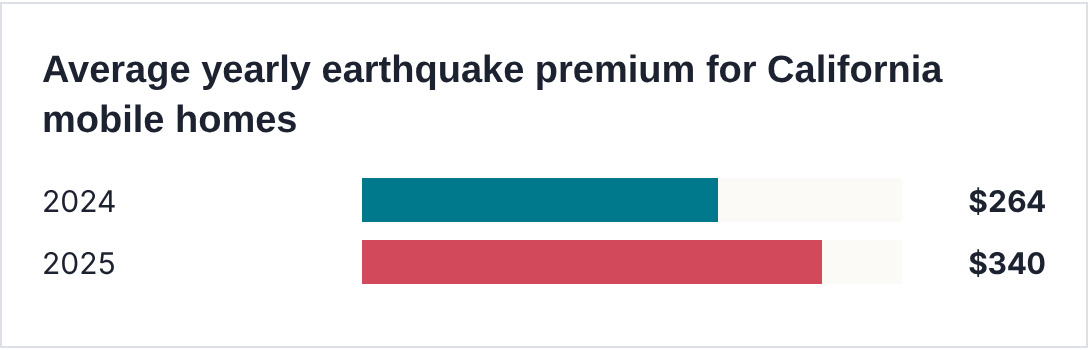
Our calculation from California Department of Insurance earthquake premium and policy surveys (2024 and 2025 data). Averages, not quotes.
Only 18.95% of mobile home owners had earthquake coverage in 2025, about 54,960 policies, and the average earthquake premium rose 28.6% to about $340 a year. That works out to $1.99 for every $1,000 of coverage. Even so, mobile home owners buy earthquake coverage more often than California homeowners overall, whose take-up rate is 12.48%.
Bracing matters. Homes on piers that are not braced slid off their supports in the 2014 South Napa and 2019 Ridgecrest earthquakes. An earthquake-resistant bracing system certified by the state housing department typically costs less than $5,000, needs a permit, and earns the 21% discount.
Wildfire coverage and discounts
Fire is covered by every standard mobile home policy and by the FAIR Plan. The challenge is finding a company willing to write in high-risk areas and keeping the price down. California's Safer from Wildfires rules call for insurers to offer discounts for proven safety steps at the home and community level.
- Clear dry brush, leaves, and firewood away from the home.
- Install ember-resistant vents and enclose the space under the home with noncombustible skirting.
- Keep gutters and roofs free of needles and debris.
- Ask whether your park is a recognized Firewise community.
- Keep receipts and photos of each improvement to show your insurer.
In August 2026, the state Board of Forestry adopted emergency Zone 0 rules for the first five feet around homes in the highest fire hazard areas. They ban combustible mulch, firewood, and attached wooden fences close to structures, with existing homes given three to five years to comply. Mobile home parks are tightly spaced, so ask your park manager how the rules will apply.
Flood insurance for manufactured homes
Flood damage is not covered by standard mobile home policies or the FAIR Plan. The National Flood Insurance Program covers manufactured homes that sit on a permanent chassis and are anchored to a permanent foundation, with limits of $250,000 for the building and $100,000 for contents. The average flood premium in California is $779 a year for all home types, and only about 1.4% of California homes have flood coverage.
What California mobile home insurance covers
A mobile home policy works much like a homeowners policy, with a few differences for homes that sit on piers or in parks.
Main coverage parts of a mobile home policy
| Coverage | What it pays for |
|---|---|
| Dwelling | Repairs or rebuilding of the home itself |
| Other structures | Carports, decks, skirting, sheds, and awnings |
| Personal property | Furniture, clothes, and belongings |
| Loss of use | Hotel and living costs while the home is repaired |
| Personal liability | Injuries or damage you cause to others |
| Medical payments | Small medical bills for guests hurt at your home |
| Trip or transit | Damage while the home is moved, by endorsement only |
California Department of Insurance mobile home guide (2023); company policy descriptions.
The biggest choice is how your home will be valued after a loss. Replacement cost pays to replace the home with a similar new one. Actual cash value subtracts depreciation, which can leave you thousands short after a total loss. Some insurers pay a stated value on a total loss and actual cash value on partial losses, so read the valuation section of every quote.
Most standard policies do not cover your home while it is being moved. If you plan to relocate it, ask for a trip or transit endorsement before the move.
Insuring older and pre-1976 homes
In California law, a home built before June 15, 1976, is a mobile home, and one built on or after that date to federal HUD standards is a manufactured home. More than a third of the state's manufactured housing was built before 1976, according to an Urban Institute estimate. Older homes can be harder to insure, and some companies offer only actual cash value coverage on them.
Foremost and American Modern both insure older homes, and SB 525 means the FAIR Plan must now treat these homes like any other dwelling. If you own an older home, ask about updates to wiring, plumbing, and roofing, which can help you qualify for better coverage.
Mobile home park rules and California law
About 1.6 million Californians live in roughly 560,000 mobile homes, and the state counts about 4,500 mobile home parks. Life in a park is governed by the Mobilehome Residency Law, which sets the rules between residents and park owners.
Under that law, parks may not require residents to carry liability insurance to use common facilities such as pools or clubhouses, unless alcohol is served. If you have a loan on your home, your lender will usually require dwelling coverage, and your park lease may have its own requirements, so read it closely. The state's Mobilehome Residency Law Protection Program, funded by a $10 per-lot fee, helps residents with complaints and runs through January 1, 2027.
Mobile home insurance for California seniors
Many California mobile home parks are home to retirees on fixed incomes, and they are among the owners most likely to drop coverage when prices rise. That is risky, because a single fire can wipe out a home that is also a person's main savings.
Seniors have several ways to keep coverage affordable. Foremost offers a discount from age 50, and Allstate offers one for owners aged 55 and older who are retired, if you already have an Allstate policy. Membership groups can also help, since Foremost gives discounts to members of groups such as USAA and AFI. Paying in full, going paperless, and keeping a claims-free record add more savings at some companies.
- Ask every insurer about age, retirement, and association discounts.
- Review your personal property limit, since many retirees own less than when they bought the policy.
- Keep liability coverage, which protects your savings if a guest is hurt.
- Ask a family member to be listed as a contact so a missed bill does not cancel your policy.
Park homes vs. homes on private land
Where your home sits changes both the price and the coverage you need. Foremost and other companies give discounts for homes in approved parks, partly because parks often have hydrants, paved roads, and on-site managers.
Homes on private land, especially in rural areas, usually cost more to insure because they may be farther from a fire station and closer to brush. They also need more coverage for other structures, such as sheds, garages, fences, and wells, and the owner is responsible for liability on the whole lot. If you own the land, make sure your policy covers every structure on it.
How much coverage to buy
Buying too little coverage is one of the most common and costly mistakes. Use these guidelines when you request quotes.
Coverage guidelines for a California mobile home
| Coverage | Suggested amount |
|---|---|
| Dwelling | Full cost to replace the home with a similar new one, including delivery and setup |
| Other structures | Enough for carports, decks, skirting, steps, and sheds |
| Personal property | The cost to replace everything you own |
| Loss of use | At least several months of rent and living costs nearby |
| Personal liability | $100,000 at minimum; $300,000 if you have savings to protect |
| Deductible | The most you could pay out of pocket without hardship |
General guidance: ask your insurer or agent about limits for your home.
Replacement cost should include more than the price of the home itself. Transporting a new home, setting it up, connecting utilities, and installing skirting and steps can add thousands of dollars, so ask a local dealer for a full estimate before you set your dwelling limit.
What to do after a wildfire or other loss
- Get to safety first, then call your insurer or agent as soon as you can.
- Ask about loss-of-use coverage for hotel and living costs right away.
- Take photos and video of the damage before you clean up.
- Make a list of damaged belongings, with receipts or photos if you have them.
- Keep every receipt for hotels, meals, and emergency repairs.
- Get the adjuster's name, phone number, and email, and keep notes of every call.
- If you disagree with the settlement, ask for a written explanation and contact the California Department of Insurance consumer hotline.
Before a disaster, keep a home inventory and a copy of your policy stored online or away from home. Owners who can show what they had and what the home was worth usually settle claims faster.
Bundling mobile home and auto insurance
Bundling your mobile home policy with your car insurance is one of the easiest ways to save. You get one company to call after a storm or fire, and both policies usually cost less.
Bundling discounts for mobile home and auto insurance
| Company | Bundle savings | Notes |
|---|---|---|
| Farmers | Up to 10% on both policies | Switchers saved an average of $1,232 a year |
| Progressive | Average 5% on auto | Home policy placed with a partner insurer |
| American Modern | Up to 5% | Includes an auto policy with your agent |
| Foremost | Multi-policy discount | No percentage published |
| GEICO | Multi-policy discount | No percentage published |
| State Farm | Up to 17% | Closed to new California property business |
| Allstate | About 13% on average nationally | Closed to new California home business |
Company websites (2026); a national bundling study updated May 7, 2026, for Allstate.
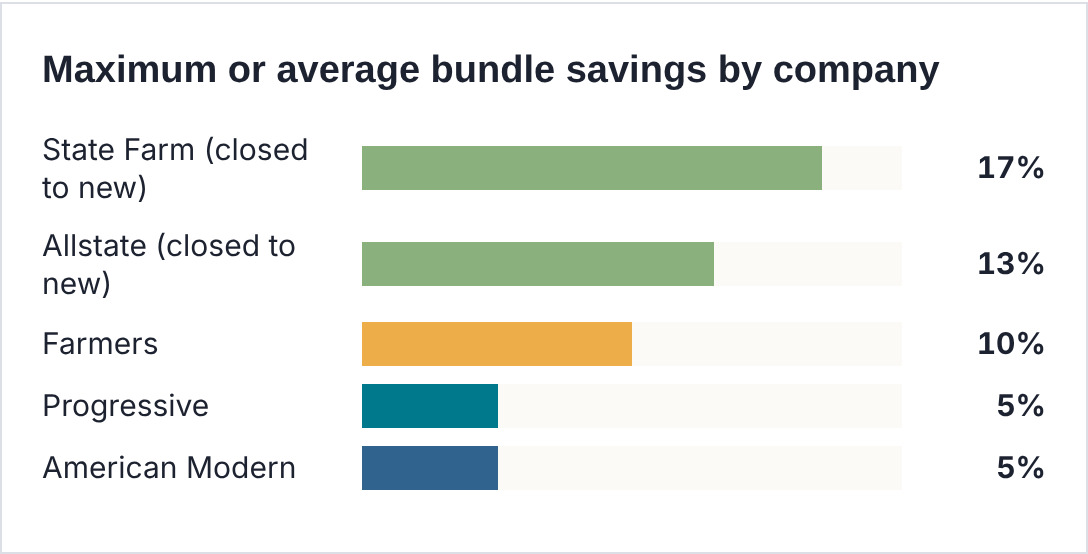
Company websites (2026); national bundling study (May 7, 2026). Farmers applies its discount to both policies; Progressive's is on auto.
Farmers is the strongest bundling option still open to new California customers, because its discount applies to both the home and the auto policy. If you already have State Farm or Allstate auto insurance, ask whether they will add an existing mobile home policy, since those companies are not writing new property business.
PRO TIP #3
Always price the bundle against separate policies. A 10% bundle discount from an expensive insurer can still cost more than Assurant’s mobile home policy paired with a cheap auto policy from another company.
Mobile home insurance discounts in California
Discounts to ask for
| Discount | Who offers it |
|---|---|
| Bundling with auto | Farmers, Progressive, American Modern, Foremost, GEICO |
| Age 50+, 55+, or retired | Foremost (50+), Allstate (55+ and retired) |
| Newer home | Foremost, GEICO, State Farm |
| Approved or gated park | Foremost |
| Tie-downs and full skirting | GEICO |
| Claims-free history | American Modern (three years), GEICO |
| Alarms and deadbolts | American Modern, Allstate, State Farm |
| Paid in full and paperless | American Modern |
| Association membership | Foremost (USAA, AFI), American Modern |
| Earthquake bracing | California Earthquake Authority, 21% |
| Wildfire mitigation | Insurers under California's Safer from Wildfires rules |
Company websites and quick-fact sheets (2021 to 2026); California Earthquake Authority; California Department of Insurance.
Tips to save money on mobile home insurance in California
- Get quotes from at least three companies, starting with Assurant, American Modern, and Foremost.
- Use an independent agent who can quote several mobile home insurers in one call.
- Check the state's premium comparison tool to see sample prices for your city.
- Bundle with your auto policy, and compare the total against separate policies.
- Raise your deductible from $500 to $1,000 if you have savings to cover it.
- Install tie-downs, full skirting, alarms, and deadbolts, and report them.
- Brace your home for earthquakes to earn 21% off earthquake coverage.
- Clear brush and add ember-resistant vents to qualify for wildfire discounts.
- Avoid small claims, since a claims-free history earns discounts.
- Insure for the right amount, not more than the cost to replace the home.
- If you are on the FAIR Plan, shop for a private policy at every renewal.
How to compare mobile home insurance quotes
Comparing mobile home quotes takes a little more care than comparing car insurance, because companies value homes in different ways. Follow these steps to make sure you are comparing the same coverage.
- Start with the California Department of Insurance premium comparison tool, which lists sample mobile home premiums by company for your city.
- Ask each company for the same dwelling limit, deductible, and liability limit.
- Check whether each quote pays replacement cost, actual cash value, or stated value.
- Compare limits for other structures, personal property, and loss of use.
- Ask which discounts are already included and which you could still add.
- Confirm the insurer's AM Best rating, aiming for A or better.
- Ask whether earthquake coverage is available through the company.
An independent agent can do much of this work for you, because one agent can quote American Modern, Assurant, Foremost, and other mobile home insurers at the same time. Once you have three comparable quotes, the cheapest good policy is usually easy to spot.
California mobile home insurance at a glance
This illustrated summary pulls together the main points of this guide.
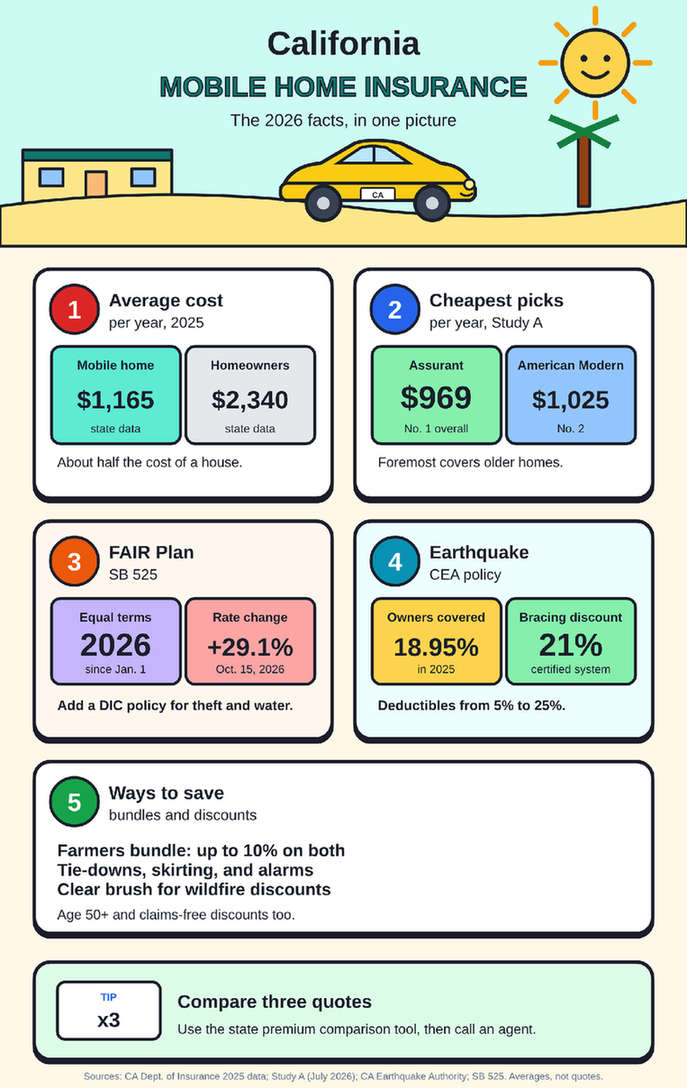
California mobile home insurance at a glance. Sources: California Department of Insurance; Study A; California Earthquake Authority; SB 525.
Frequently asked questions about California Mobile Home Insurance
How much is mobile home insurance in California?
The average California mobile home policy costs about $1,165 a year in 2025, based on California Department of Insurance data, up 8.8% from 2024. That is about half the roughly $2,340 average for a homeowners policy. Your price depends on your county, fire risk, home age, and coverage.
Who has the cheapest mobile home insurance in California?
Assurant is our overall cheapest pick, at $969 a year in Study A's 2026 quotes, followed by American Modern at $1,025. Foremost covers more older and high-risk homes. Compare all three, since prices vary by location.
Is mobile home insurance required in California?
State law does not require it, but lenders usually do if you have a loan. Under the Mobilehome Residency Law, parks cannot require liability insurance to use common facilities unless alcohol is served. Check your lease for other requirements.
Does the FAIR Plan cover mobile homes?
Yes. Since January 1, 2026, SB 525 requires the FAIR Plan to cover mobile and manufactured homes on the same terms as other homes. The policy covers fire, lightning, internal explosion, and smoke, so most owners add a DIC policy for theft, water, and liability.
Does mobile home insurance cover earthquakes?
No. You need a separate earthquake policy, such as one from the California Earthquake Authority, with deductibles of 5% to 25%. A certified bracing system or approved foundation earns a 21% discount. The average earthquake premium was about $340 in 2025.
Can I bundle mobile home and auto insurance?
Yes. Farmers offers up to 10% off both policies, Progressive an average of 5% on auto, and American Modern up to 5%. Foremost and GEICO also offer multi-policy discounts. Compare the bundle with separate policies before you buy.
Why is mobile home insurance so expensive in California?
Wildfire risk is the main reason. More than 46% of California mobile homes are in the wildland-urban interface, and several large insurers have stopped writing new policies. Mobile home owners paid a median $483 per $100,000 of value in 2023, more than twice the rate for single-family homes.
Are State Farm and Allstate selling mobile home insurance in California?
Not to new customers. State Farm has taken no new property applications since May 2023, and Allstate stopped new homeowners policies in 2022. Both filed in 2026 to reopen, but neither plan was approved as of November 2026.
Can I insure a mobile home built before 1976?
Yes, but fewer companies will. Foremost and American Modern insure older homes, and the FAIR Plan must now cover them on equal terms. Some insurers offer only actual cash value on older homes, so ask about replacement cost.
The final word on California mobile home insurance
California mobile home insurance costs about $1,165 a year on average, roughly half the price of a homeowners policy, but rising wildfire risk has made it harder to find. Assurant is the overall cheapest pick, with American Modern and Foremost close behind, and the FAIR Plan now offers mobile homes the same fire coverage as other homes.
To get the best price, compare at least three quotes, bundle with your auto policy, and claim every discount for tie-downs, alarms, bracing, and wildfire safety. Add earthquake coverage if you can, and recheck your coverage every year. With the right steps, you can protect your home without overpaying.
Sources
- California Department of Insurance, earthquake premium and policy survey, 2025 data (July 3, 2026).
- California Department of Insurance, mobile homes data, 2001 to 2017.
- California Department of Insurance, residential premium comparison survey and comparison tool.
- California Department of Insurance, Is Your Mobile Home Protected? (June 2023).
- California Department of Insurance, Sustainable Insurance Strategy summary (October 2025).
- California Department of Insurance, FAIR Plan growth slows (August 3, 2026), and Farmers joins the Sustainable Insurance Strategy (May 12, 2026).
- California Department of Insurance, Safer from Wildfires FAQ.
- California FAIR Plan, key statistics (November 13, 2026).
- KRCR, FAIR Plan rate increase (May 22, 2026).
- Insurance Journal, $1 billion FAIR Plan assessment (February 11, 2025).
- Assembly Insurance Committee, SB 525 analysis (July 9, 2025), and Senator Jones, SB 525 signed into law (October 10, 2025).
- California Earthquake Authority, mobilehome coverages and deductibles and mobilehome earthquake risk.
- Terner Center for Housing Innovation, The California Home Insurance Challenge in Eight Charts (December 5, 2025).
- Department of Housing and Community Development, Codes and Standards overview (2023), and Mobilehome Residency Law Protection Program FAQ.
- Senate Housing Committee, 2026 Mobilehome Residency Law handbook.
- CalMatters, mobile homes and the Los Angeles fires (February 2025), and Inside Climate News, mobile homes and wildfires (October 2, 2022).
- Best Best & Krieger, Zone 0 emergency regulations (September 9, 2026).
- FEMA, manufactured homes flood coverage fact sheet (August 2025), and California flood insurance costs (October 21, 2026).
- Study A: ValuePenguin, mobile home insurance (July 6, 2026).
- NerdWallet, mobile home insurance (May 28, 2025), citing Foremost's average.
- California home insurance rate increases, Grange, Stillwater, and Wawanesa (July 10, 2025).
- The Mortgage Point, Farmers lifts its cap (December 5, 2025).
- Manufactured Housing Insurance Services, California carriers; California Casualty, mobile home; and American Modern review (May 31, 2024).
Disclaimer
This website provides independent reviews and comparisons. It is not affiliated with, endorsed by, sponsored by, or connected to Assurant, American Bankers Insurance Company, American Modern, Foremost, Farmers, Progressive, GEICO, California Casualty, Stillwater, Grange, Wawanesa, State Farm, Allstate, the California FAIR Plan, the California Earthquake Authority, or any of their affiliates.
All company names, brand names, trademarks, and logos are the property of their respective owners and are used here only to identify the companies and programs being reviewed. Their use does not imply any affiliation or endorsement.
The information on this page is provided for general informational and educational purposes only. It is not insurance, legal, tax, or financial advice, and it is not an offer, quote, or solicitation to buy or sell insurance. We are not an insurance company, insurance agency, or licensed insurance producer, and we cannot bind coverage, change a policy, or handle claims.
Prices, discounts, ratings, and company details are drawn from public sources and third-party studies that use specific home profiles, and they can change at any time. They are estimates and averages, not guarantees of what you will pay. Coverage, eligibility, and discounts vary by location, home, and owner, and are subject to each insurer's underwriting rules and policy terms.
While we make reasonable efforts to keep this guide accurate and current, we make no representations or warranties, express or implied, about its completeness, accuracy, or reliability. Opinions here are our own. Always confirm details directly with the insurer, read your policy documents, and consult the California Department of Insurance or a licensed professional before making a decision. Your use of this information is at your own risk, and we are not liable for any loss or damage arising from reliance on it.