
Cheapest Honda Prologue Insurance: Rates, Companies & EV Coverage
Published sample studies put full-coverage Honda Prologue insurance at $3,103 per year for a 40-year-old driver in Study C. Another study listed Travelers at $1,614 for its own 40-year-old sample. Those figures are not directly comparable: each company and study prices different assumptions, locations and coverage. For background on why quotes vary, see the factors that influence car insurance costs.
The Prologue is a competitive electric SUV in some model-based comparisons, although its position depends on the study. It was priced below several EV rivals in one published sample, but that is not a universal result. Honda confirmed that production ends with the 2026 model year; there is no 2027-model Prologue. Availability of unsold 2026 inventory is a separate question.
This guide compares Prologue-specific sample rates from several insurers, not a universally valid top-10 ranking. It also covers liability-only and full coverage, the 2026 MSRP reduction, trim and model-year differences, EV repair coverage, teenage drivers, older drivers, military families and discounts. We distinguish model-specific prices from national figures for drivers of other vehicles.
The Honda Prologue insurance picture
| What | Figure | Source |
| Average full coverage, 40-year-old | $3,103 a year ($259 a month) | Study C, Oct 2026 |
| Average liability-only (50/100/50) | $1,124 a year | Study C, Oct 2026 |
| Cheapest full coverage, 2025 Prologue | Progressive, $1,504 a year | Study A |
| Cheapest quote, 40-year-old | Travelers, $1,614 a year | Study D, Apr 2026 |
| Cheapest liability-only quotes | USAA, $66 a month | Study B, Nov 2026 |
| Rank among 56 EVs (1 = cheapest) | 13th | Study D, Apr 2026 |
| 18-year-old driver, average | $10,141 a year | Study D, Mar 2026 |
Each study uses its own driver, liability limits, and deductible amounts, so compare figures within one study. The studies are named in the Sources section.
Honda Prologue insurance companies: published comparisons
Two sources provide company-by-company Prologue prices for several insurers: Study A’s modeled 2024–2025 prices and Study B’s customer quote medians. Study D names Travelers at $1,614 but does not give a comparable full carrier table. Because the studies use different drivers, coverage terms and samples, this is a company comparison, not a combined price ranking. COUNTRY Financial’s $89 monthly EV-wide figure is excluded because it was not a Prologue price.
Honda Prologue sample full-coverage premiums by insurer
| Insurer | Study A, 2025 (year) | Study A, 2024 (year) | Study B (month) |
| Progressive | $1,504 | $1,493 | $211 |
| Travelers | — | — | $265 |
| USAA* | $2,249 | $2,237 | $137 |
| GEICO | $3,319 | $3,186 | $162 |
| State Farm | $2,731 | $2,639 | $163 |
| Nationwide | $2,015 | $2,059 | $251 |
| Allstate | $4,001 | $3,751 | $181 |
| Erie | $2,290 | $2,223 | — |
| American Family | $2,378 | $2,294 | $212 |
Full coverage sample premiums. Study A: 30-year-old male, annual rates by model year; Study B: median monthly customer quotes with a $1,000 deductible. Different sampling frames prevent cross-column ranking. Study D separately reports a Travelers figure for one 40-year-old sample but does not establish a Travelers market-wide price ranking. *USAA eligibility is restricted to qualifying military households. A dash means the insurer was not reported in that table.
Progressive
In Study A, Progressive was cheapest for the 2024 and 2025 sample Prologues at $1,493 and $1,504 per year, respectively. Study B placed it further down its own quote list at $211 per month. The disagreement should be resolved using same-coverage personal quotes, not by averaging the two results.
Travelers
Travelers was the only insurer identified for the Prologue in Study D’s comparison, at $1,614 per year for its sample driver. A one-company observation does not establish that Travelers was the cheapest in that study. Study B reports a materially higher Travelers median of $265 monthly, illustrating why direct comparisons are unreliable.
USAA
USAA had the lowest Prologue median in Study B: $137 per month for full coverage and $66 for liability-only. Access is limited to eligible military, veteran and family households; quoted premiums depend on individual underwriting.
GEICO
GEICO was second in Study B, at $162 a month for full coverage and $75 for liability-only. In Study A, though, it was among the priciest, at $3,319 a year for a 2025 model.
State Farm
State Farm was $1 a month above GEICO in Study B, with a $163 monthly Prologue median. Study A reported $2,731 annually for its separate 2025 Prologue sample. Coverage for a home charging station must be checked with the relevant home or auto insurer, not inferred from its Prologue prices.
Nationwide
Nationwide was second in Study A, at $2,015 a year for a 2025 Prologue and $2,059 for a 2024. Its price in Study B was higher, at $251 a month.

Allstate
Allstate is a split decision. It was fourth in Study B at $181 a month, but it was the second-most expensive company for a 2025 Prologue in Study A, at $4,001 a year, just $34 below Farmers.
Erie
Erie was fourth in Study A, at $2,290 a year for a 2025 Prologue and $2,223 for a 2024. It sells in a limited group of states.
American Family
American Family was fifth in Study A at $2,378 a year, and mid-pack in Study B at $212 a month. It also sells in fewer states than the national brands.
Other EV-wide insurers are not Prologue quotes
COUNTRY Financial was listed in a separate study of EVs overall, not in a Prologue-specific table. Its EV-wide average should not be used to rank its Prologue price. Ask for a VIN-specific quote if the carrier operates in your state.
The most expensive companies
Liberty Mutual charged the most in Study B, at $345 a month, with Farmers at $322. In Study A, Allstate and Farmers topped $4,000 a year for a 2025 Prologue, more than two and a half times Progressive’s price.
PRO TIP #1
Compare Progressive, Travelers, GEICO, State Farm and Nationwide on your actual Prologue VIN, and add USAA if eligible. Regional companies such as Erie or American Family may also be worth checking where available; no sample ranking guarantees an individual result.
Which company is cheapest in each Prologue study?
There is no single verified cheapest Prologue insurer across the studies. Progressive led Study A for its 2024 and 2025 sample Prologues; USAA led Study B among eligible households, while GEICO had the lowest Study B figure among insurers open to the general public. Study D published a Travelers example but did not compare a full field of insurers. Request actual quotes using the same VIN, liability limits and deductibles before selecting a company.
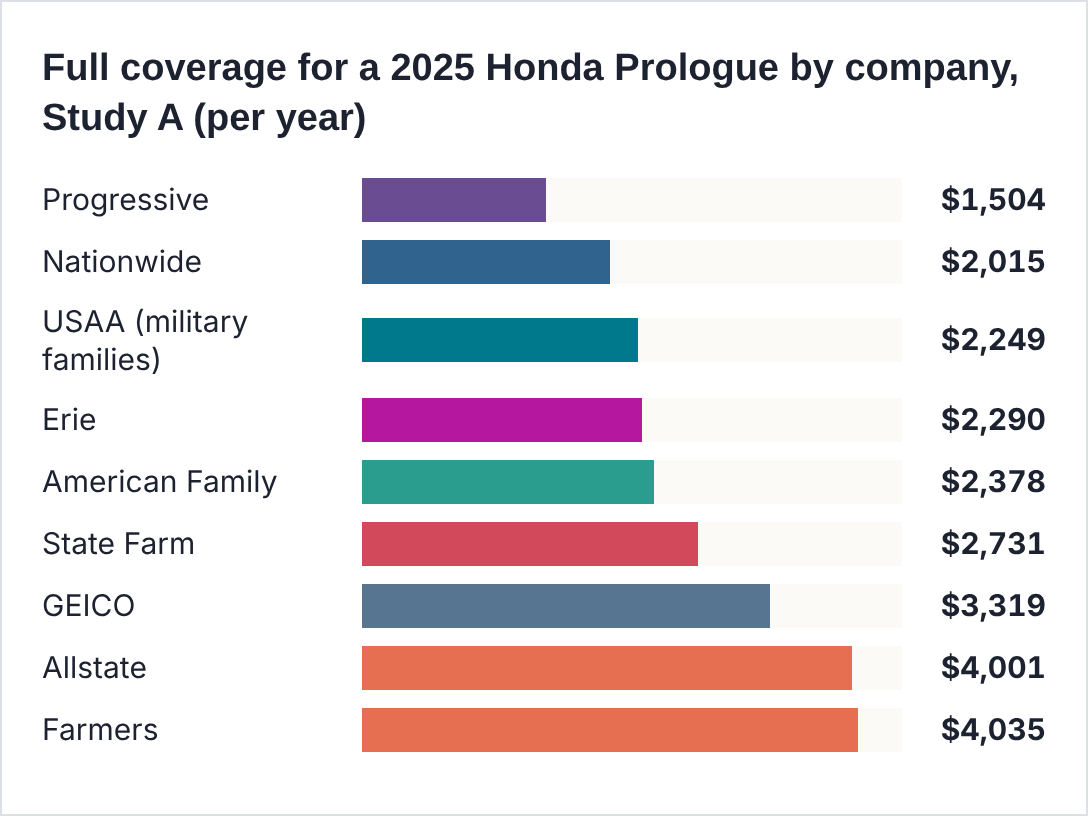
30-year-old male, full coverage, no violations. Source: Study A, Honda Prologue insurance.
Study A reported a $2,531 annual difference between Progressive and Farmers for its 2025 Prologue sample. This is a comparison of published sample premiums, not the amount an individual driver will necessarily save.
The cheapest Prologue insurer in each study
| Study | Driver and coverage | Travelers (only company reported) | Price |
| Study A, 2025 model | 30-year-old male | Progressive | $1,504 a year |
| Study A, 2024 model | 30-year-old male | Progressive | $1,493 a year |
| Study D | 40-year-old, 100/300/100 | Travelers (only company reported) | $1,614 a year |
| Study B | Real customer quotes, $1,000 deductible | USAA | $137 a month |
| Study B, open to all | Real customer quotes, $1,000 deductible | GEICO | $162 a month |
How to get the lowest Prologue quote
- Have the VIN, trim, and drive type ready, since an Elite and an AWD model are worth more than a front-wheel-drive EX.
- Select appropriate liability limits and a deductible you can afford, then obtain like-for-like insurance quotes for the same Prologue VIN and driver details. Higher limits can reduce your exposure but also change the premium.
- Quote Progressive, Travelers, and GEICO first, then State Farm and Nationwide, plus USAA or a regional company if you qualify.
- Ask each company how it handles battery damage and whether it offers coverage for a home charger.
- Compare the full-year price after discounts, not just the first monthly payment.
PRO TIP #2
The two largest studies put Progressive at opposite ends: first in Study A but fifth in Study B. That kind of swing is common with newer EVs, so get at least three quotes.
Cheapest liability-only coverage for a Prologue
Liability-only insurance generally pays for covered injuries and property damage you cause to others, within the policy limits, but does not repair your own Prologue. Study C lists $1,124 annually at 50/100/50 liability limits; Study B reports a $142 monthly median across its separate customer sample. If a displayed price is near $100 per month, read what low-cost car insurance actually includes before comparing it with a full-coverage quote.
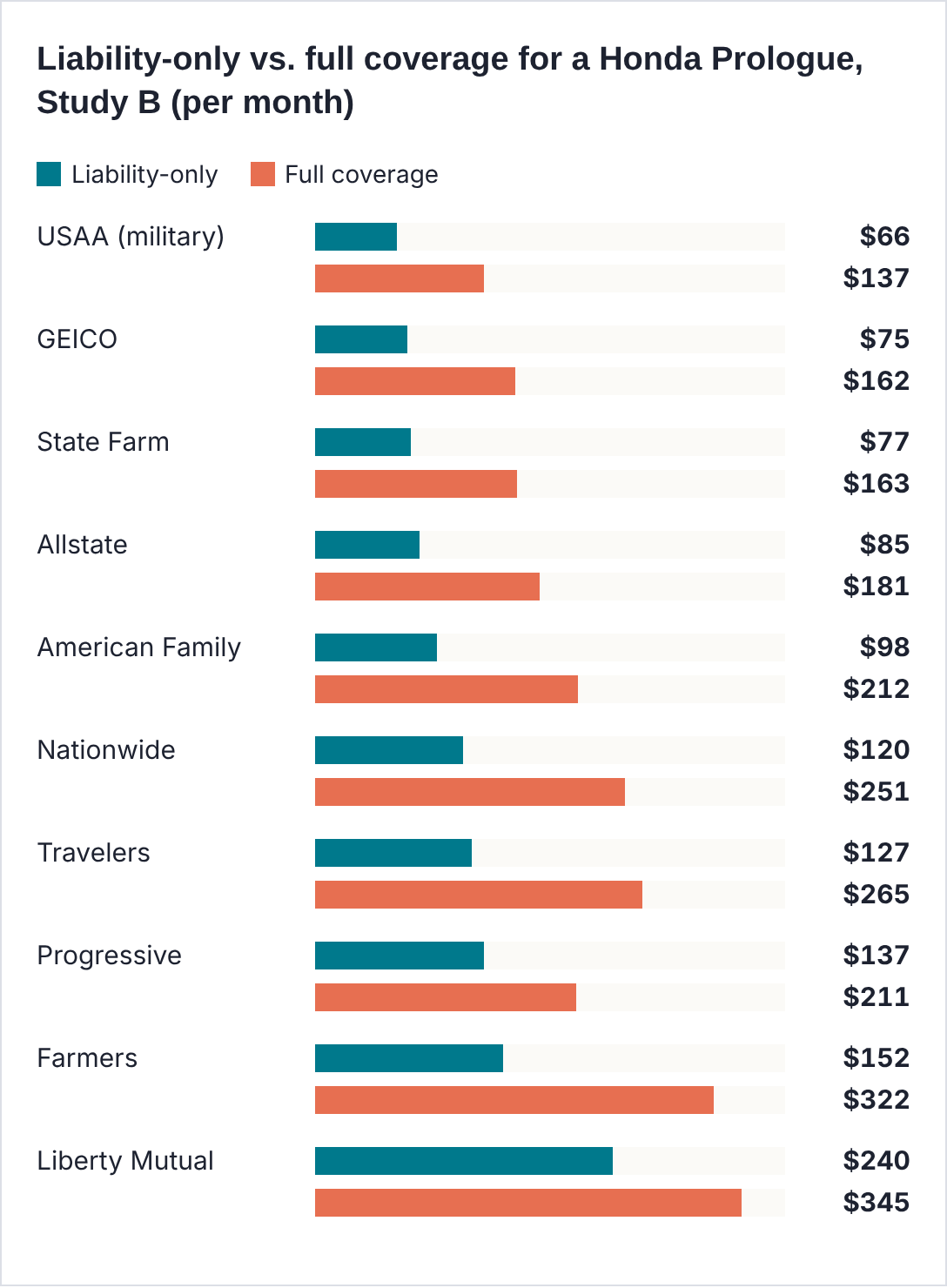
Median of real quotes from Study B users; full coverage with a $1,000 deductible. Source: Study B, Honda insurance by model, November 2, 2026.
USAA was cheapest for liability-only at $66 a month, followed by GEICO at $75 and State Farm at $77. Liberty Mutual charged $240, more than three times USAA’s price.
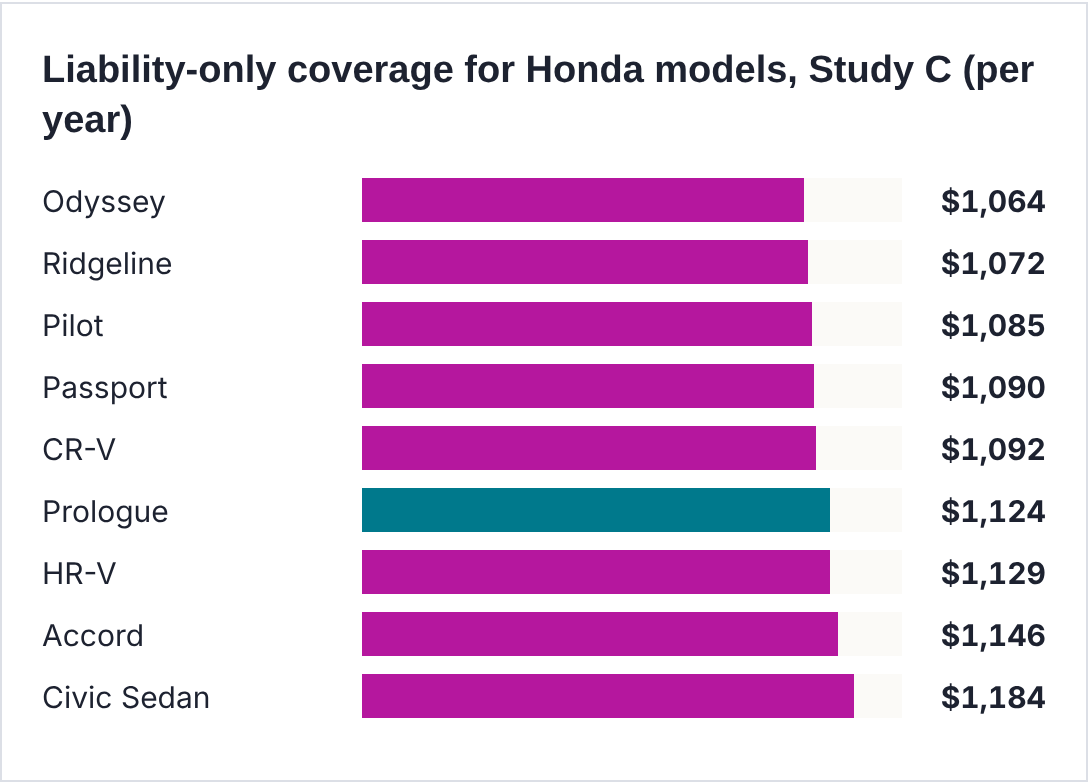
40-year-old driver, 50/100/50 liability limits. Source: Study C, Honda car insurance, October 26, 2026.
Why liability-only rarely fits a Prologue
The Prologue was sold in model years 2024–2026; whether a particular vehicle is financed, leased or owned outright is unknown. Lenders and lessors typically require collision and comprehensive. An owner who drops those coverages must pay for covered-type damage or theft out of pocket, subject to any other applicable protection.
- It can make sense if the Prologue is paid off and you could replace it from savings.
- It rarely makes sense on a leased or financed Prologue, where it is usually not allowed.
- Whatever you choose, keep liability limits well above the state minimum.
PRO TIP #3
If the Prologue is paid off and you want to control premiums, ask your insurer to reprice collision and comprehensive at several deductibles. Larger deductibles reduce what the insurer pays after covered losses, and the savings are not guaranteed. Compare coverage line by line in an online insurance quote.
Full coverage for a Prologue at the lowest price
Full coverage is an informal label that commonly refers to liability plus collision and comprehensive; state-required personal injury protection, medical payments and uninsured-motorist coverage may be included or separately selected. Check the actual declarations page, since EV battery claims depend on the cause of damage and policy exclusions.
Study B’s customer quotes show how widely full coverage prices vary. USAA charged $137 a month, GEICO $162, and State Farm $163, while Farmers charged $322 and Liberty Mutual $345, about two and a half times USAA’s price.
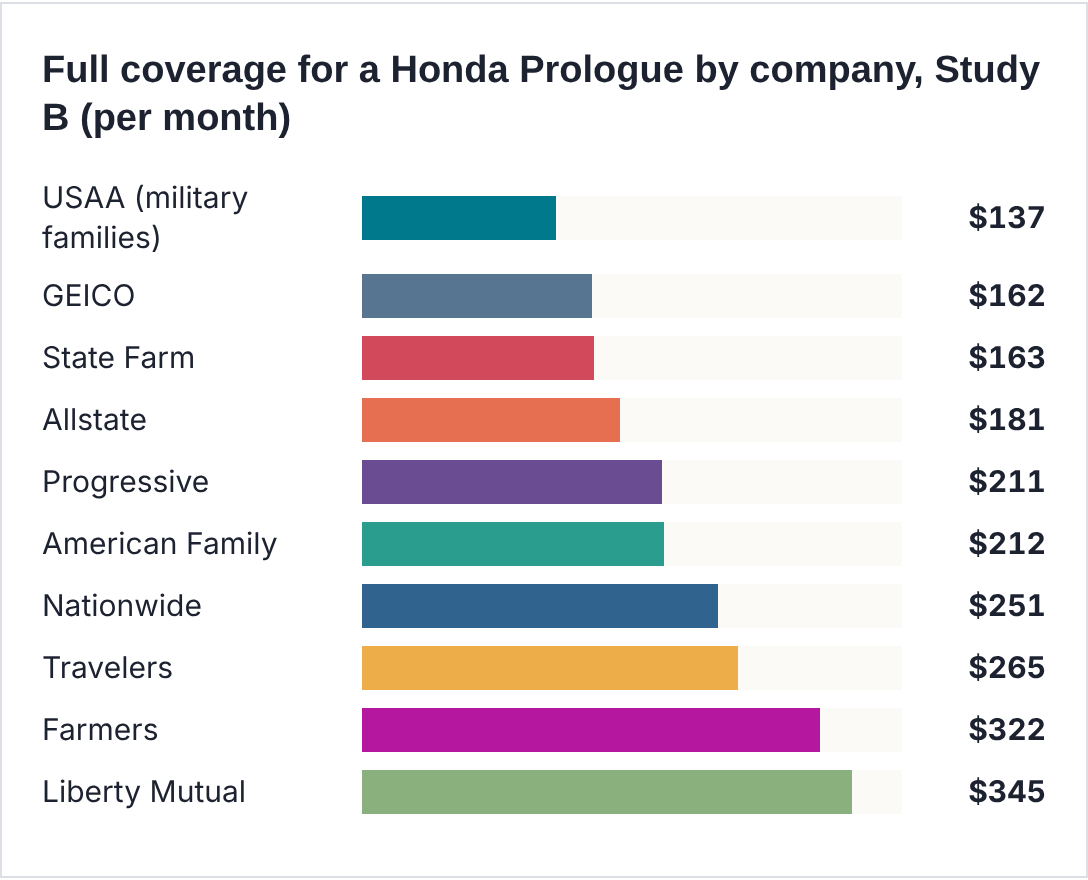
Median of real quotes from Study B users; full coverage with a $1,000 deductible. Source: Study B, November 2, 2026.
Why the averages differ
Full coverage averages for the Prologue range from about $2,682 a year in Study A to $3,216 in Study B. Study A prices a 30-year-old, Study B reflects real shoppers with a $1,000 deductible, and Study C uses a 40-year-old with a $500 deductible, landing at $3,103. Study B called the Prologue the most expensive Honda it researched.
What full coverage pays for on an EV
- Collision may pay for vehicle and battery damage caused by a covered crash, subject to the deductible and policy terms; battery warranty claims and mechanical failure are different issues.
- Comprehensive may pay for a covered noncollision loss such as theft, fire, flood or hail, subject to deductibles and exclusions.
- Liability for injuries and damage you cause to others.
- Uninsured motorist and, where required, personal injury protection or medical payments.
Normal battery aging and gradual range loss are generally not covered auto-insurance losses. Manufacturer battery warranties have separate eligibility terms and thresholds; do not assume every reduction in range qualifies for a free replacement.
Add-ons worth pricing for a Prologue
- Gap coverage, which is especially useful because EV values have fallen sharply in recent years.
- Rental reimbursement long enough for an EV repair, which can take longer than a gas-car repair.
- Roadside assistance with towing, and a check on whether it covers a battery that runs out of charge.
- Coverage for a home charger; permanently installed equipment may fall under homeowners coverage or need an endorsement, depending on ownership and the policy.
PRO TIP #4
Ask whether your policy pays for new manufacturer parts. The Hartford’s AARP program says its EV coverage pays for a new battery if one is damaged in a covered loss.
Insuring a new or late-model Prologue
Honda confirmed in July 2026 that Prologue production would end following model year 2026. Remaining new inventory may still be sold afterward, but no 2027 Prologue model was announced. Confirm current vehicle availability with a dealer; maintenance, warranty and parts terms remain subject to Honda’s published policies.
The published third-party studies used in this comparison did not provide a separate 2026 Prologue company-by-company table. Obtain a VIN-specific quote from the insurer rather than assuming the model-year premium follows the purchase-price reduction.
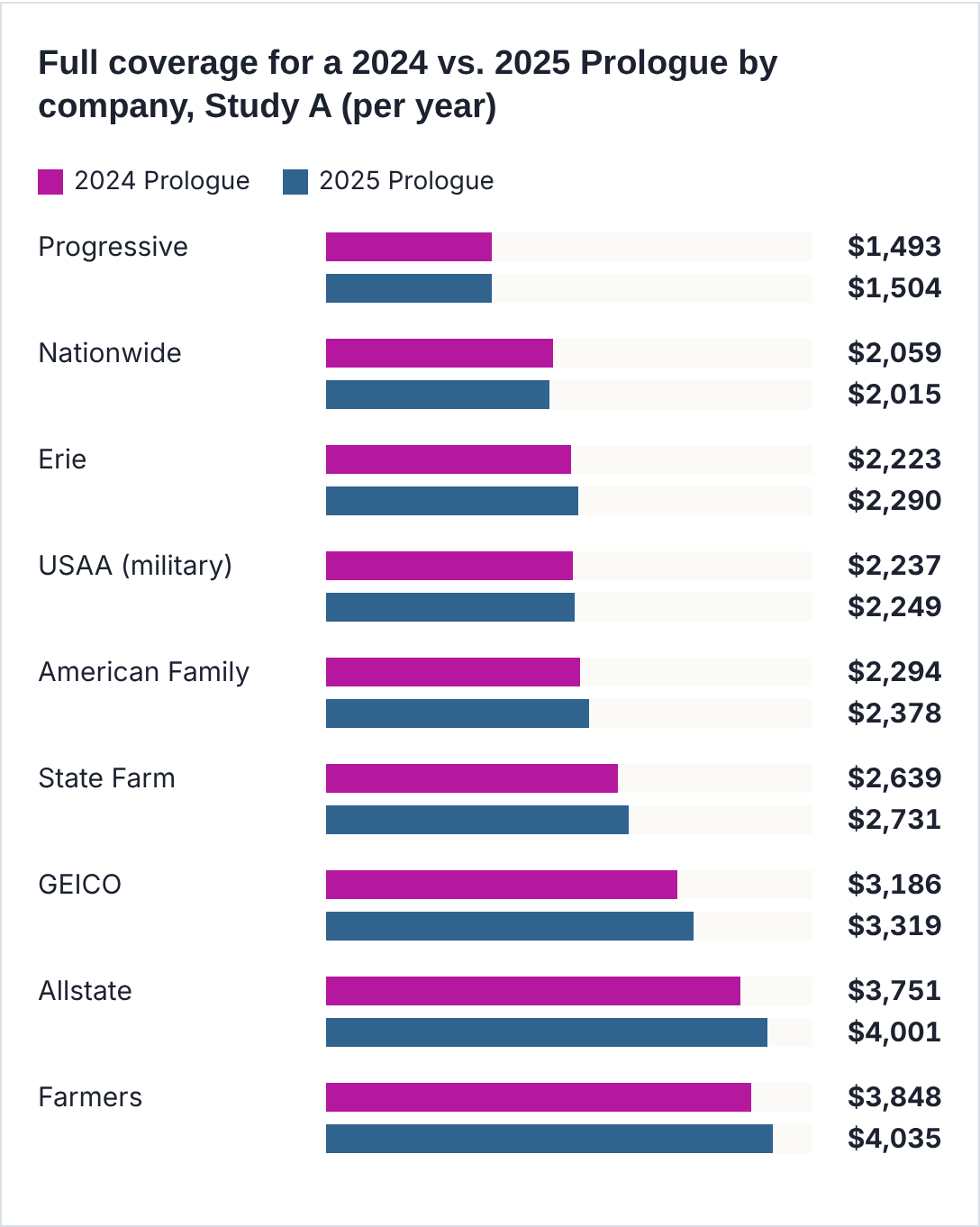
30-year-old male, full coverage, no violations. Source: Study A, Honda Prologue insurance.
The 2026 price cut
Honda announced a $7,500 across-the-line reduction effective April 1, 2026. The U.S. federal new-clean-vehicle credit ended for vehicles acquired after September 30, 2025, subject to the IRS transition rules. The MSRP table below uses Honda’s September 9, 2026 MSRP schedule before destination; the earlier MSRP column adds back the documented $7,500 cut. Do not assume lower MSRP produces a dollar-for-dollar insurance premium reduction.
2026 Honda Prologue prices before and after the April 2026 cut
| Trim | Before the cut | After the cut |
| EX, front-wheel drive | $47,400 | $39,900 |
| EX, all-wheel drive | $49,500 | $42,000 |
| Touring, front-wheel drive | $51,700 | $44,200 |
| Touring, all-wheel drive | $54,500 | $47,000 |
| Elite, all-wheel drive | $57,900 | $50,400 |
U.S. manufacturer suggested retail prices exclude destination, tax, title and dealer fees. After-cut MSRP verified from Honda’s September 9, 2026 release; before-cut MSRP is after-cut MSRP plus the announced $7,500 April 1 price reduction. Honda listed a $1,595 destination fee in its September release. See Honda’s official MSRP schedule.
The 2025 and 2026 Prologue share an 85-kilowatt-hour battery, a 220-horsepower single motor with front-wheel drive or a 300-horsepower dual-motor all-wheel-drive setup, and an EPA-rated range of up to 308 miles. GM builds the Prologue on its Ultium platform at the Ramos Arizpe plant in Mexico, which also builds the Chevrolet Equinox EV.
Safety ratings
In IIHS ratings applying to 2024–2026 Prologues, the model earned Good for the updated moderate-overlap and side tests, but Acceptable in the combined small-overlap front test, headlights, and pedestrian crash prevention. IIHS explains that the passenger-side small-overlap evaluation was Acceptable because of the test dummy’s airbag-positioning issue. These ratings do not imply a universal safety score or a guaranteed insurance discount.
PRO TIP #5
Buying a leftover 2026 Prologue at a discount? Ask the dealer for the VIN and get insurance quotes before you sign. Because no study has priced the 2026 model yet, your own quote is the only reliable number.
Prologue insurance costs across the U.S. and against other EVs
Published studies in this article show full-coverage averages of approximately $2,691–$3,216 a year, from different profiles and observation periods. The monthly Study B figure is converted to an annualized comparison by multiplying $268 by 12; it is not a renewal guarantee. Liability-only estimates range from $1,124 annually in Study C to an annualized $1,704 in Study B, but the coverage limits and drivers may differ.
Average Honda Prologue insurance by study
| Study | Updated | Profile | Full coverage | Liability-only |
| Study C | Oct 2026 | 40-year-old, $500 deductible | $3,103 a year | $1,124 a year (50/100/50) |
| Study D | Apr 2026 | 40-year-old, 100/300/100 | $3,103 a year | Not published |
| Study B | Nov 2026 | Real customer quotes, $1,000 deductible | $268 a month | $142 a month |
| Study A, 2025 model | Not dated | 30-year-old male | $2,780 a year | Not published |
| Study A, 2024 model | Not dated | 30-year-old male | $2,691 a year | Not published |
Study C places the Prologue among the more costly Honda models for its sample driver. Its $3,103 annual figure exceeds its CR-V figure of $2,316 by $787. For another Honda model comparison, see the Honda Odyssey insurance guide; neither comparison is a substitute for quotes on the same driver and policy.
The Prologue vs. other electric SUVs
Study D ranked the Prologue 13th cheapest of 56 EVs for a 40-year-old driver. It came in $158 a year below its GM-built twin, the Chevrolet Blazer EV, and $733 below the Tesla Model Y, but $331 above the Chevrolet Equinox EV.
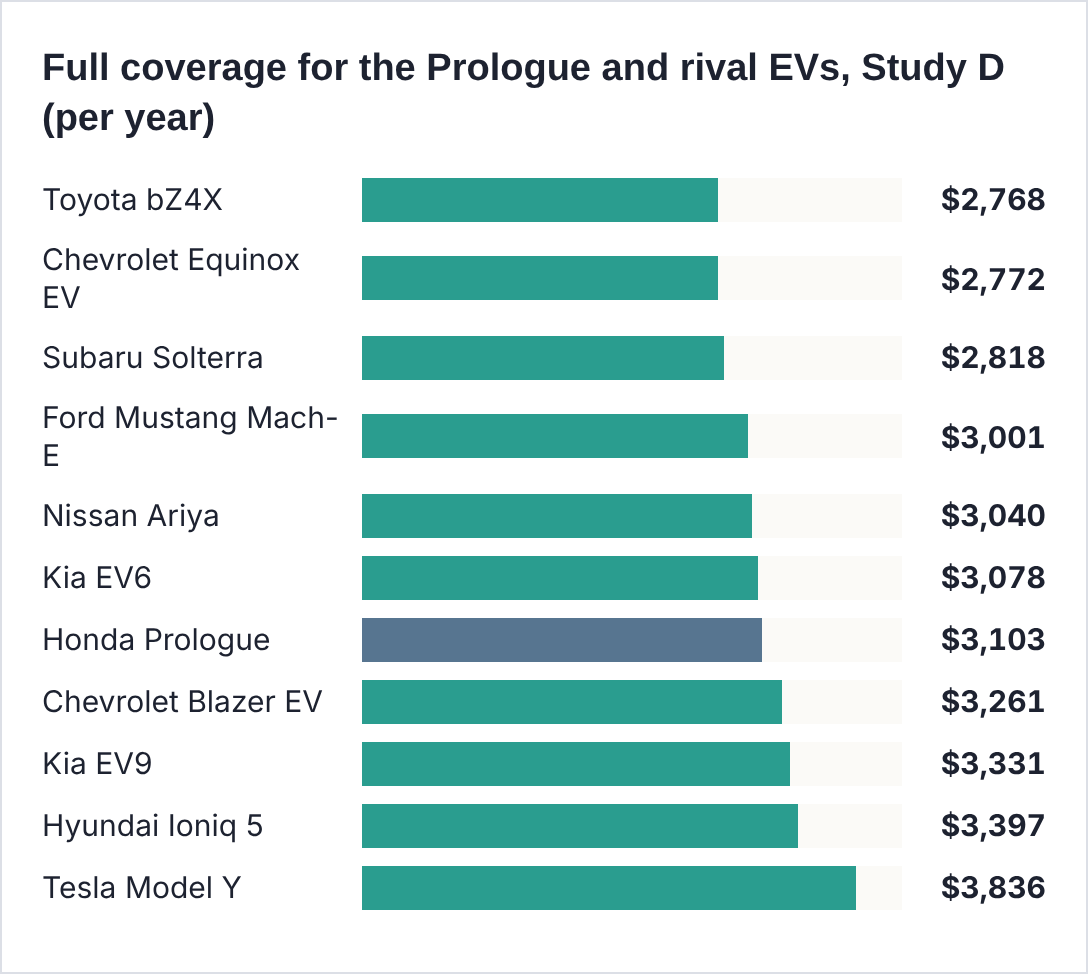
40-year-old driver, clean record, 100/300/100 with a $500 deductible. Source: Study D, cheapest EVs and hybrids to insure, April 17, 2026.
Study D published a newer EV data set in September 2026 that did not include the Prologue, so we compare it only with rivals from the same April data.
Why EVs cost more to insure
Published data suggest that repair severity, vehicle age, driver profile and the parts supply chain all matter, not simply crash frequency. Industry EV and gasoline-fleet comparisons are not controlled Prologue-versus-gasoline experiments:
- Mitchell’s second-quarter 2026 data put the average repairable EV claim at $5,684, against $4,955 for gas vehicles, the smallest gap it has recorded.
- LexisNexis Risk Solutions found in 2025 that when similar households swapped an older car for a new EV, collision claims were 20% more frequent and 30% more severe.
- A separate report counted 12.7% total-loss frequency for EV claims and 23.1% across the overall vehicle population in 2025. This is a descriptive comparison of different fleets and claim mixes; it should not be used to predict an individual Prologue total-loss probability.
- Older Highway Loss Data Institute research found EVs had fewer collision claims than their gas counterparts.
Prologue insurance by state
We did not find state-by-state Prologue premiums from an insurer quote dataset suitable for a like-for-like national ranking. Study E instead provides modeled state estimates for 15 states; these are not actual customer quotes or a comprehensive comparison of all 50 states.
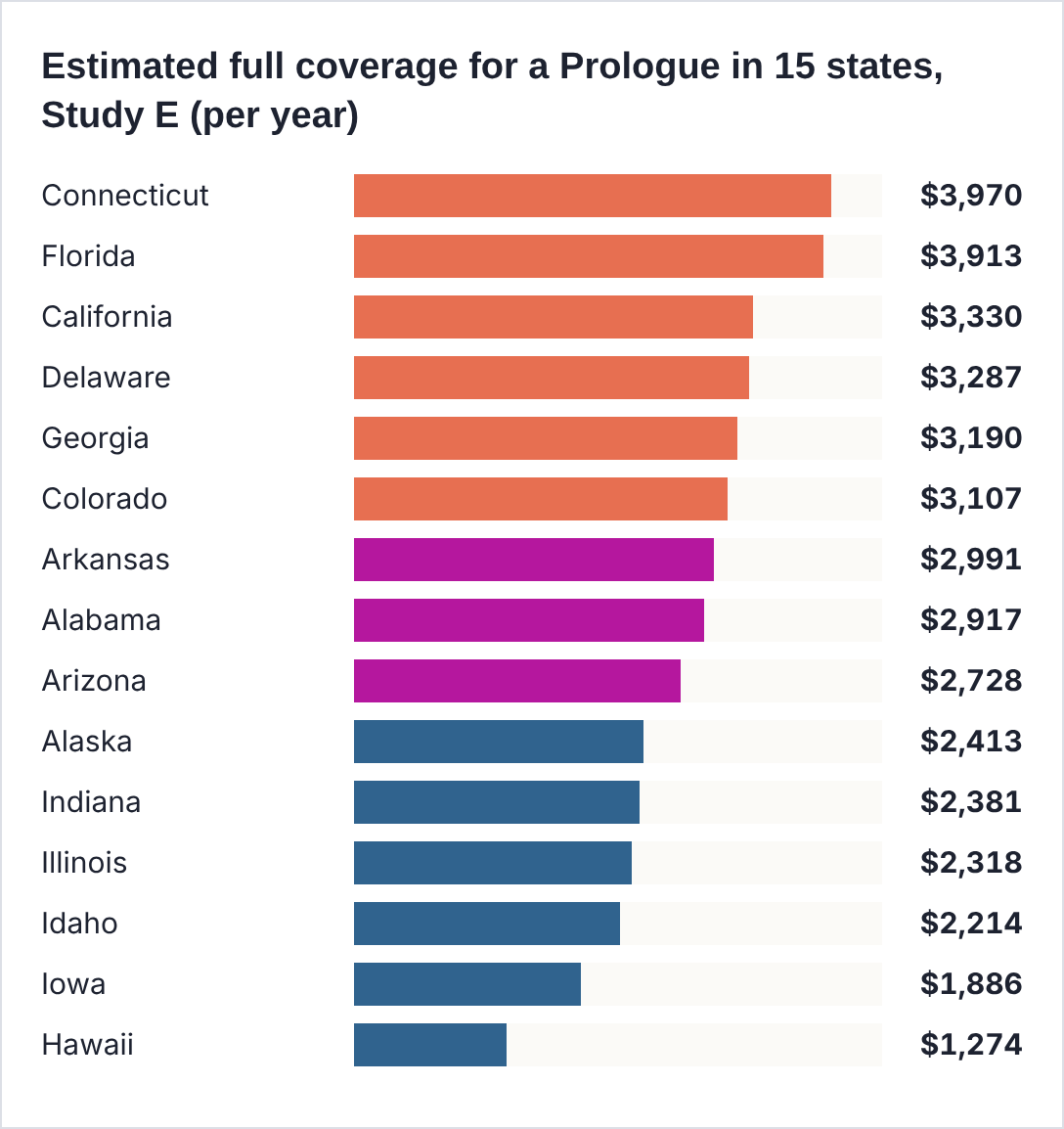
40-year-old good driver with good credit, full coverage, new vehicle; modeled estimates, not quotes. Only 15 states were published. Source: Study E, Honda Prologue insurance.
Theft and sales
- The Prologue was not on the National Insurance Crime Bureau’s 2025 list of the 10 most-stolen vehicles, and IIHS theft-claim research has found EVs among the least-stolen vehicles.
- Sales trackers counted 33,017 Prologues sold in the U.S. in 2024 and 39,194 in 2025, but only 13,289 through September 2026, down about 64% after the tax credit ended.
PRO TIP #6
Cross-shopping EVs? In Study D, the Equinox EV, built in the same Mexican plant, costs $331 a year less to insure than the Prologue. Get quotes on both before you decide.
Prologue rates by trim, model year, and generation
The EX and Touring have single-motor front-wheel-drive and dual-motor all-wheel-drive configurations. In Honda’s September 2026 U.S. MSRP schedule, AWD costs $2,100 more on EX and $2,800 more on Touring; Elite is AWD-only. None of the published model-wide insurer tables isolate the premium difference between drive configurations.
Rates by trim
Study C is the only study that priced Prologue trims, and it published two of them in its list of the most expensive Hondas to insure.
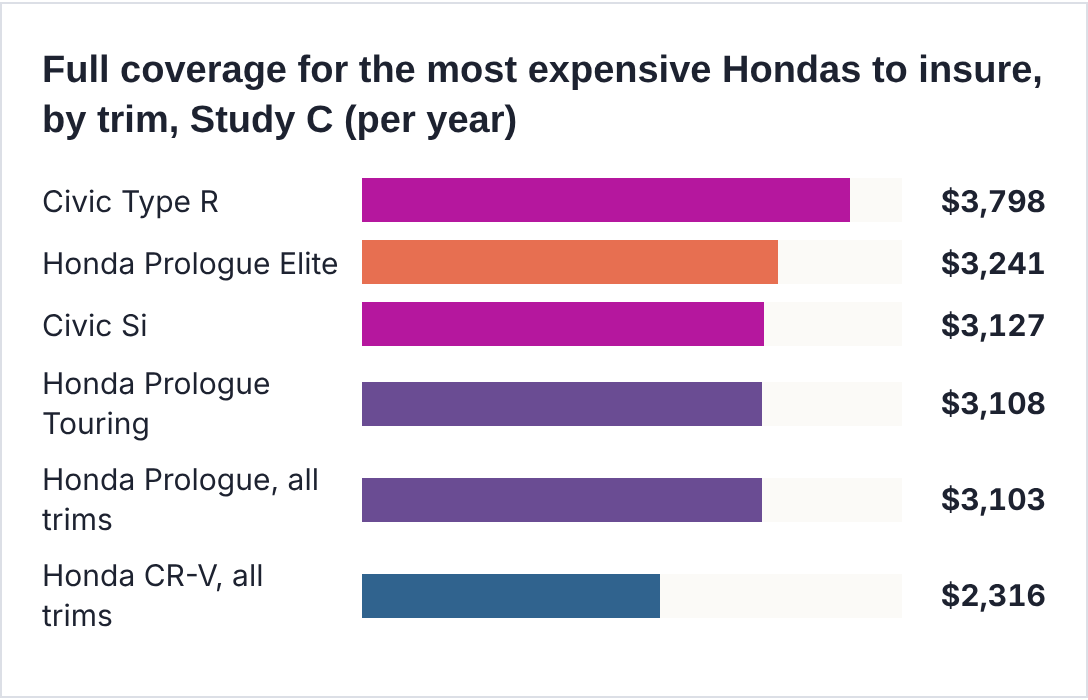
40-year-old driver, 100/300/100 with a $500 deductible. The CR-V is shown for comparison. Source: Study C, Honda car insurance, October 26, 2026.
Study C shows a $133 annual difference between its Elite and Touring sample figures. However, exact drivetrain configurations in the data are not fully specified, so this is not a controlled measure of an Elite trim surcharge. The September 2026 MSRP difference between the FWD Touring ($44,200) and AWD Elite ($50,400) is $6,200, but purchase-price differences do not translate proportionally into insurance costs.
Front-wheel drive or all-wheel drive?
All-wheel drive adds $2,100 to the MSRP of a 2026 EX or $2,800 to the Touring, based on the manufacturer’s September 2026 prices. It brings a second motor and greater output. Because no cited insurer study controls for drive configuration, no reliable AWD-versus-FWD insurance premium increase can be inferred; compare by VIN.
Rates by model year
Only Study A published Prologue prices by model year, and the 2026 model was not yet included.
Honda Prologue by model year
| Model year | Average full coverage, Study A | Cheapest company, Study A | Power and range (EPA) |
| 2026 | Not yet published | — | 220 hp FWD or 300 hp AWD; up to 308 miles |
| 2025 | $2,780 a year | Progressive, $1,504 | 220 hp FWD or 300 hp AWD; up to 308 miles |
| 2024 | $2,691 a year | Progressive, $1,493 | 212 hp FWD or 288 hp AWD; up to 296 miles |
Study A: 30-year-old male, full coverage. Power and range from published Honda specifications, with the Elite rated at 283 miles for 2025 and 2026 and 273 miles for 2024.
The 2025 update added power and range, and the 2025 model costs $89 a year more to insure on average in Study A. Several companies charged a little more for the 2025, led by Allstate at $250 more and Farmers at $187 more, while Nationwide charged $44 less.
One generation, three years
With only one generation, the Prologue has no older, cheaper version to fall back on. The oldest model, a 2024, saves only about $89 a year over a 2025 in Study A, so the company you choose matters far more than the year you buy.
PRO TIP #7
Weighing a used 2024 against a leftover 2026? In Study A, the average insurance cost differs by just $89 a year between the 2024 and 2025 models, so focus on the purchase price, the remaining warranty, and the newer model’s added range and power.
10 discounts that can lower Prologue premiums
EV owners have a few discounts of their own on top of the usual ones. These 10 are worth asking about, using only the amounts insurers print on their own websites. Where an insurer lists a discount without a percentage, we say so.
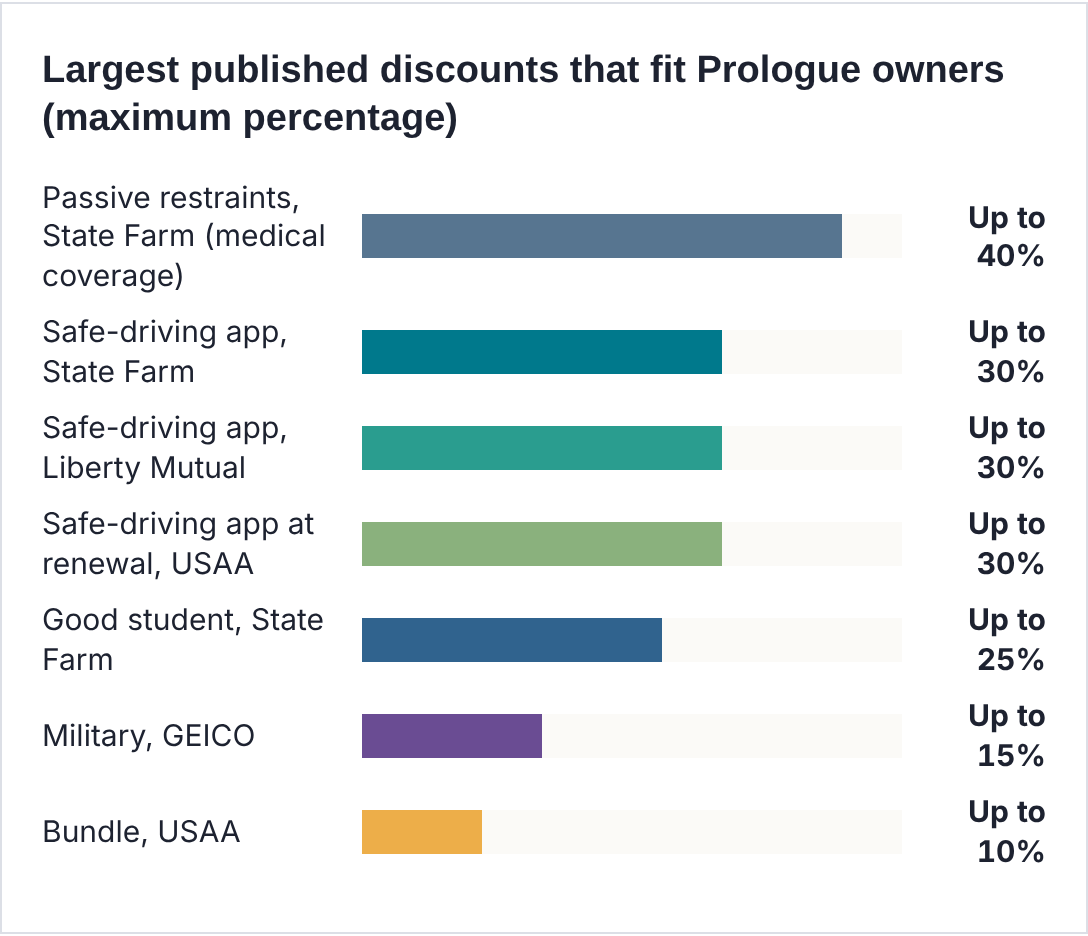
Maximum amounts printed on insurer websites; most apply only to certain coverages and vary by state. Sources: insurer discount pages, November 2026.
- Hybrid and electric vehicle. Travelers and The Hartford both list a discount for hybrid and electric vehicles, though neither prints a percentage, so ask for the amount.
- Bundling. Progressive reports average savings of $1,099 for customers who bundle, Nationwide reports $1,032, and USAA offers up to 10%.
- Multi-car. Progressive’s multi-car discount averages 12%.
- Safe-driving apps. State Farm’s Drive Safe and Save and Liberty Mutual’s RightTrack go up to 30%, and RightTrack gives 15% at sign-up when every driver joins. USAA’s SafePilot offers up to 10% for enrolling and up to 30% at renewal; Nationwide’s SmartRide gives 10% for signing up, and Progressive says Snapshot users save $328 on average.
- Good student. State Farm offers up to 25%, and Progressive’s discount starts at 5%.
- Passive restraints. State Farm offers up to 40% off medical-related coverage for vehicles with factory airbags.
- New vehicle. Travelers lists a new car discount, which a 2024 to 2026 Prologue may qualify for.
- Military. GEICO offers up to 15% to active-duty, retired, Guard, and Reserve members.
- Paperless and online. Progressive’s online quote and online signing discounts average 7% and 10%.
- Low mileage. Pay-per-mile options, such as USAA’s SafePilot Miles and Nationwide’s SmartMiles, can help if you drive the Prologue mostly around town.
Covering your home charger
State Farm warns that a permanently installed charger is not guaranteed coverage under a standard policy, and it suggests calling both your home and auto insurer. Safeco says a hardwired charger is typically covered under homeowners insurance. Ask before you install one, and add an endorsement if needed.
PRO TIP #8
Some websites claim specific EV discount percentages for Travelers, The Hartford, or Farmers, but those insurers’ own pages do not print them. Ask your agent for the exact amount in writing before you count on it.
Insuring a teen driver in a Prologue
The Prologue was not on the cited IIHS/Consumer Reports recommended teen-vehicle list. This does not make it categorically unsafe; IIHS publishes individual crash-test results showing some Good and some Acceptable categories. Teen insurance costs also depend on experience, vehicle access and policy structure.
A Prologue-specific estimate is available for an 18-year-old main driver, but not a consistent company-by-company Prologue table for ages 16, 17 and 19. The family-policy amounts that follow are national averages for unspecified test vehicles—not incremental costs of adding a teenager as a Prologue driver.
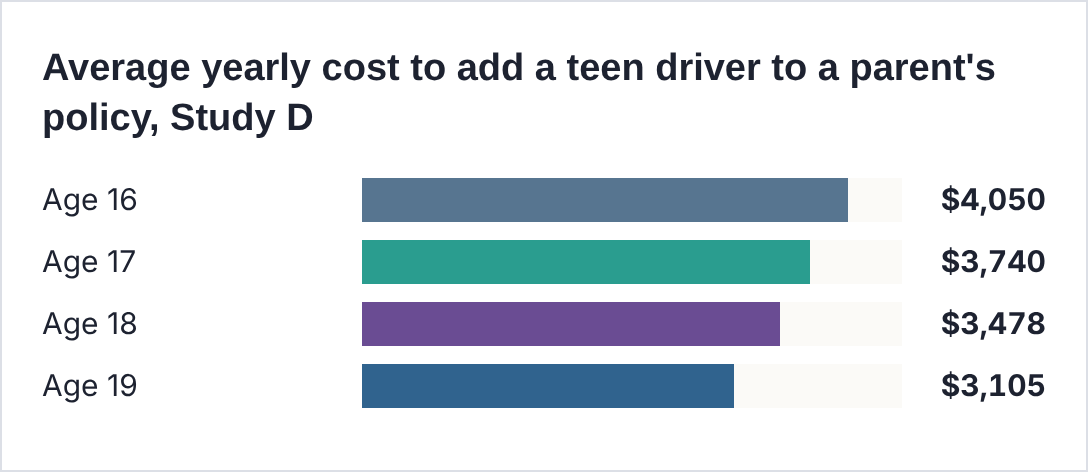
Average increase for full coverage at 100/300/100 with a $500 deductible; the study did not name a test vehicle, and its rates were collected in 2023. Source: Study D, cost of adding a teen driver, August 4, 2026.
Study C puts the average cost of adding a teen to a parent’s full coverage policy at $4,515 a year. The figures differ, but in both studies the cost falls with each birthday.
Family premium with a teen added, by company, Study D (per year)
| Company | Parents only | With a teen |
| USAA* | $1,101 | $2,419 |
| Nationwide | $1,538 | $2,441 |
| GEICO | $1,264 | $2,548 |
| State Farm | $1,671 | $3,046 |
| Travelers | $1,806 | $3,619 |
| Progressive | $1,913 | $3,857 |
| Allstate | $2,310 | $4,036 |
| Farmers | $2,939 | $4,872 |
Full coverage, 100/300/100 with a $500 deductible; teen ages combined; test vehicle not named. Source: Study D, August 4, 2026. *USAA sells only to military families.
Family-policy benchmark at age 16 (not Prologue-specific)
Study D estimated an average $4,050 annual increase when a 16-year-old was added to a family auto policy; it did not specify a Prologue. Its separate table shows Nationwide and GEICO with relatively low family totals under a different aggregated scenario. These figures cannot price a teenager who drives the household’s Prologue.
Family-policy benchmark at age 17 (not Prologue-specific)
At age 17, Study D reports a $3,740 average annual family-policy increase for a nonspecified vehicle. Because the policy, driver and vehicle mix differ from the Prologue-only estimate, this figure must not be presented as a Prologue quote or a verified lowest-carrier ranking.
Honda Prologue estimate for an 18-year-old driver
Age 18 is the only teen age for which the cited sources include a Prologue-specific main-driver estimate: $10,141 annually in Study D. Its separate national family-policy study reports a $3,478 average incremental premium at 18 without naming the family car. Do not subtract or compare those two estimates as if they describe the same insurance setup.
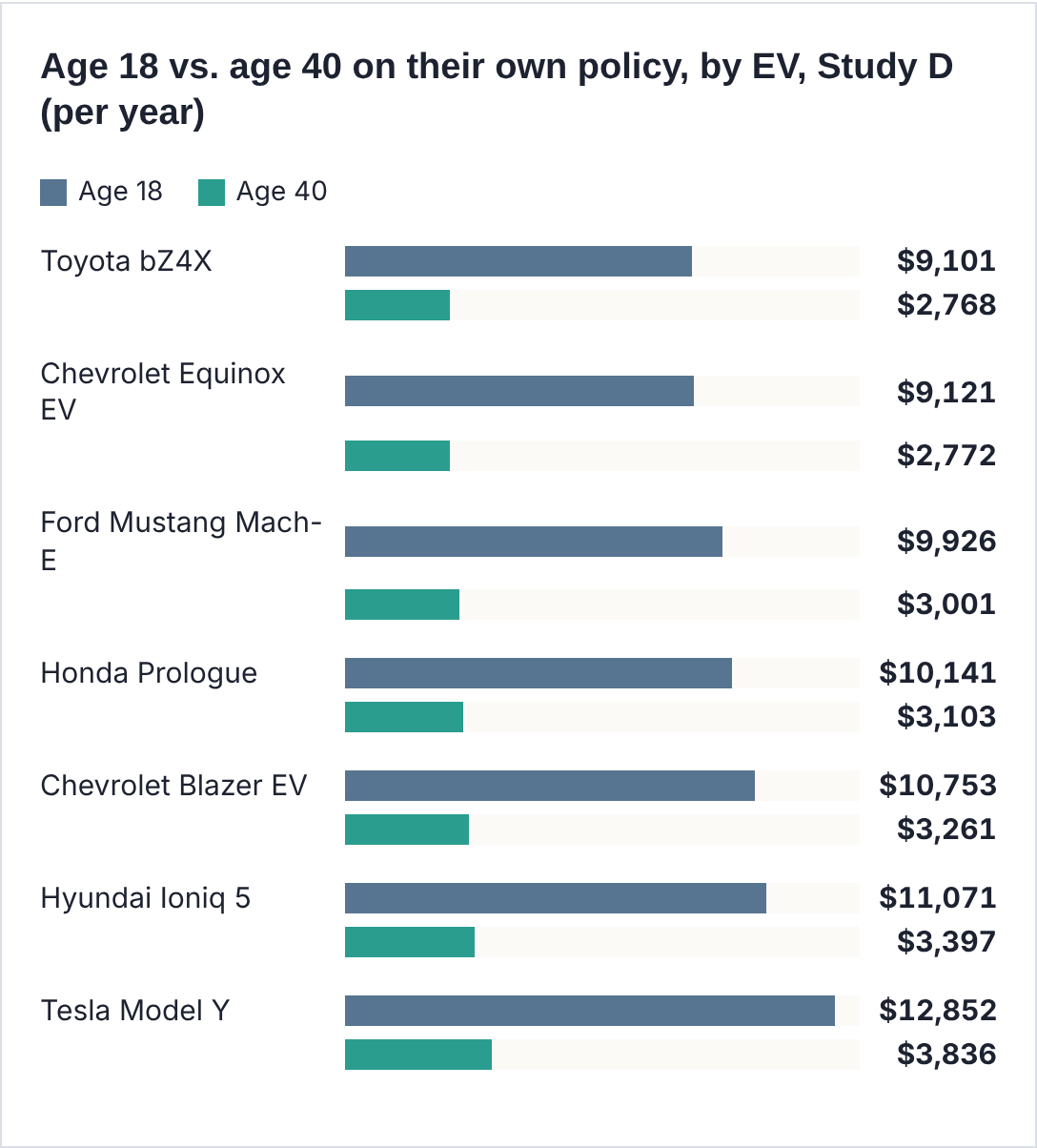
Full coverage at 100/300/100 for a male driver. Source: Study D, vehicle insurance pages, March 2026.
Separately, Study D reports an average $3,478 annual increase for adding an 18-year-old to a generic family auto policy. It is not the same driver, vehicle or coverage scenario as the Prologue estimate.
Family-policy benchmark at age 19 (not Prologue-specific)
At age 19, Study D reports a $3,105 average annual increase for an unspecified family vehicle. A Prologue-specific premium at 19 cannot be inferred; request an exact quote that lists all actual household drivers and vehicle use.
Keeping a teen’s Prologue costs down
- Tell the insurer which household members will actually drive each vehicle, who the principal operator is where requested, and how frequently the teen will use the Prologue. Do not reassign drivers inaccurately to obtain a lower premium.
- Claim the good student discount, worth up to 25% at State Farm.
- Use a safe-driving app such as Drive Safe and Save, RightTrack, or SafePilot.
- Requote at every birthday, since the cost of a teen falls each year.
PRO TIP #9
If the household has a less expensive vehicle as well as a Prologue, request properly disclosed quotes for the actual intended driving arrangements. A separate Prologue estimate for an 18-year-old cannot be used to predict the discount for a different vehicle.
Prologue insurance for seniors
A quiet, easy-to-drive EV can suit retirees who mostly drive locally and charge at home. No study we reviewed priced the Prologue by senior age, so Study D’s national averages are the best guide: full coverage costs $2,353 a year at 65, $2,498 at 70, and $2,742 at 75.
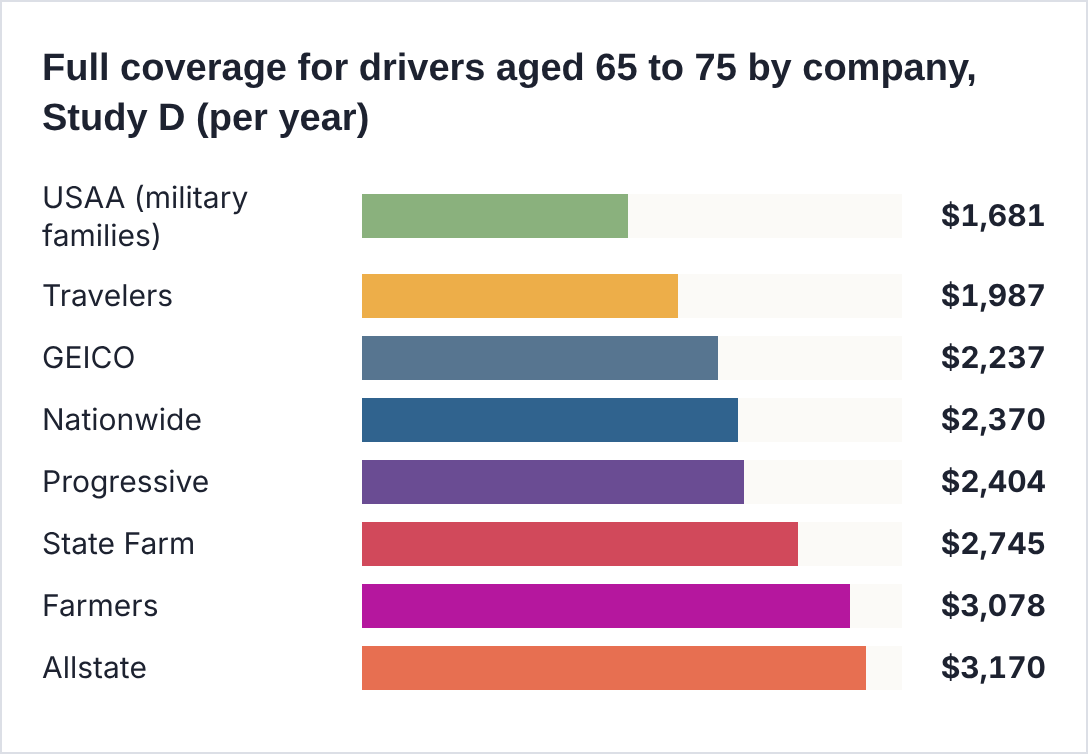
Full coverage at 100/300/100 with a $500 deductible; the study did not name a test vehicle. Source: Study D, car insurance for seniors, April 16, 2026.
Travelers was among the lowest-priced general-market senior carriers in Study D’s national sample, but that is not a Prologue-specific senior quote. Obtain quotes for your model year and actual driver profile.
Savings for older Prologue drivers
- Mature driver course discounts. AARP says they are mandatory in 33 states and Washington, D.C., and Kiplinger lists fixed minimums in some states, such as 10% for three years in New York.
- The Hartford’s AARP program advertises up to 10% for members, 5% for a defensive driving course, and up to 15% for joining TrueLane, and it lists a hybrid and electric vehicle discount.
- Low-mileage and pay-per-mile plans, which suit drivers who no longer commute.
PRO TIP #10
The Hartford’s AARP program says its EV coverage pays for a new battery if one is damaged in a covered loss. If you are over 50, compare that coverage with a standard policy before you buy.
Prologue insurance for military families
USAA is the first quote for service members, veterans, and their families. It had the lowest Prologue prices in Study B, at $137 a month for full coverage and $66 for liability-only, and it was third in Study A at $2,249 a year for a 2025 model.
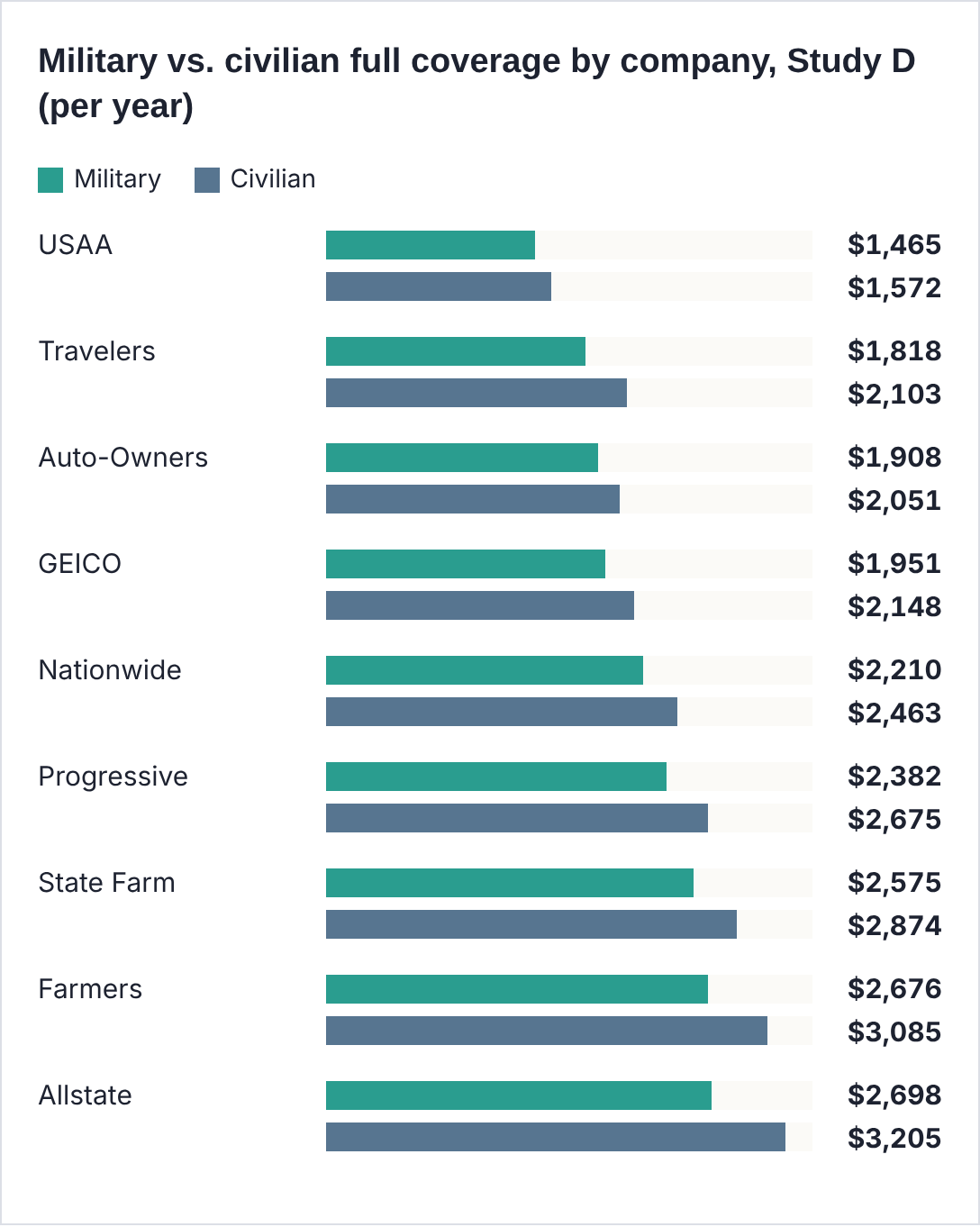
Full coverage; the study did not name a test vehicle. Source: Study D, best car insurance for military members, August 13, 2026.
Every company in Study D’s comparison charged military members less than civilians, with gaps from $107 a year at USAA to $507 at Allstate.
Military programs to ask about
- USAA advertises up to 60% off for storing a vehicle that will not be driven (not in North Carolina or Virginia), up to 15% off comprehensive for garaging on a base, and up to 30% at renewal through SafePilot.
- GEICO offers up to 15% for active-duty, retired, Guard, and Reserve members, and an emergency deployment discount when a vehicle is stored.
- Armed Forces Insurance compares auto policies from several carriers for military families.
PRO TIP #11
Storing the Prologue during a deployment? Ask about storage coverage rather than canceling, and follow Honda’s guidance on the battery’s state of charge for long-term storage.
FAQs about the cheapest Honda Prologue insurance
Which company has the cheapest Prologue insurance?
Progressive was lowest in Study A’s 2025 Prologue sample at $1,504 per year; Study B’s lowest median was USAA ($137/month, eligible households only) or GEICO ($162/month, other shoppers). Study D reported one Travelers figure and does not establish a lowest-insurer ranking.
How much is Prologue insurance per month?
The cited full-coverage studies imply approximately $224 to $268 per month when annual amounts are divided by 12, for different driver samples. Liability-only figures also come from distinct studies and should not be used as a direct, controlled coverage-price difference.
Why does the Prologue cost more to insure than other Hondas?
Study C estimates the Prologue at $787 more annually than the CR-V for the study driver; actual differences vary by insurer and location.
Is the Prologue cheaper to insure than a Tesla Model Y?
In Study D’s sample, the Prologue cost $3,103 annually versus $3,836 for the Tesla Model Y. It is not necessarily cheaper for every driver, trim, state or insurer.
Is Honda discontinuing the Prologue?
Yes. Honda said it will end Prologue sales after the 2026 model year, with remaining inventory sold into early 2027. Dealers will continue to provide service, parts, and warranty support.
Will the end of production affect my insurance?
Insurers generally price on repair costs, claims history, and the driver rather than on whether a model is still built. Honda says service and parts support will continue, but ask your insurer how it handles parts for discontinued models.
Does insurance cover the Prologue’s battery?
Collision and comprehensive cover battery damage from a covered event, such as a crash or flood. Normal wear and loss of range are not covered by insurance and fall under the warranty instead.
What does it cost to insure a teen in a Prologue?
Study D estimates $10,141 per year for an 18-year-old Prologue main driver. Its $4,050 and $3,105 national estimates for adding 16- and 19-year-olds to family policies are not Prologue-specific.
Who has the cheapest Prologue insurance for seniors?
The cited studies did not price a Prologue specifically for different senior ages. Study D’s nationwide averages ($2,353 at age 65, $2,498 at 70 and $2,742 at 75) cover unspecified vehicles and should be used only as general age-related context, not as Prologue rates.
The final word on the cheapest Honda Prologue insurance
In some published samples the Prologue costs more to insure than Honda’s gasoline SUVs, while individual quotes and comparison results vary. Study D estimated a lower premium than several other EV SUVs for the stated test driver. Repairs, vehicle value, policy terms and local markets can all influence premiums.
Compare actual Prologue quotes from Progressive, GEICO, Travelers, State Farm and Nationwide, plus USAA if eligible. Keep the vehicle and driver profile identical across quotes; confirm battery damage, charging equipment and replacement transport coverage in writing. Honda confirmed the Prologue ends with model year 2026, not that every owner faces the same insurance impact. For renewal shopping, see steps to review coverage before a premium increase.
Sources
- Study A: The Zebra, Honda Prologue insurance.
- Study B: Insurify, Honda insurance by model (November 2, 2026) and electric car insurance (November 2, 2026).
- Study C: Insurance.com, Honda car insurance (October 26, 2026) and which car to assign a teen driver (May 6, 2026).
- Study D: CarInsurance.com, Honda car insurance (March 23, 2026); cheapest EVs and hybrids to insure (April 17, 2026); electric car insurance cost (September 25, 2026); cost of adding a teen driver (August 4, 2026); car insurance for seniors (April 16, 2026); best car insurance for military members (August 13, 2026); and its Chevrolet, Ford, Hyundai, Kia, Toyota, Nissan, Subaru, and Tesla vehicle pages (March 2026).
- Study E: CarEdge, Honda Prologue insurance estimates.
- Insurer pages: State Farm discounts; State Farm, EV home charging and insurance; Safeco, EV battery and charging coverage (September 14, 2026); The Hartford AARP program, electric vehicle coverage (February 25, 2026); The Hartford discounts (September 22, 2026); Travelers discounts; Nationwide discounts; Liberty Mutual RightTrack; Progressive discounts; USAA discounts; GEICO military discounts; and Armed Forces Insurance.
- Vehicle sources: American Honda, Prologue (read November 4, 2026); Electrek, Prologue price cut (April 1, 2026); Kelley Blue Book, Prologue discontinued (July 17, 2026); Electrive, Honda to end Prologue sales (July 17, 2026); Cars.com, 2025 Prologue updates (March 3, 2025); Cars.com, 2024 Prologue launch (January 26, 2024); and Plante Moran, end of EV tax credits (September 11, 2025).
- Safety and claims sources: IIHS, 2026 Honda Prologue ratings; IIHS, four vehicles fall short (October 31, 2024); IIHS, vehicles for teens; Insurance Journal, LexisNexis 2025 auto insurance trends (June 16, 2025); Repairer Driven News, Mitchell EV claims data (August 21, 2026); Repairer Driven News, CCC EV claims report (June 2, 2026); Insurance Journal, NICB 2025 most-stolen vehicles (March 19, 2026); and Axios, EV theft rates (September 26, 2024).
- Other sources: AARP, auto insurance discounts; Kiplinger, defensive driving discounts by state; and GoodCarBadCar, Prologue sales.
- Primary verification: American Honda 2026 MSRP and EPA range (September 9, 2026); IIHS 2026 Prologue test results; IRS clean-vehicle credit deadlines; Honda representative confirmation of discontinuation.
Disclaimer
This article summarizes published insurance rate studies for the Honda Prologue and is intended as general information. It is not insurance, legal, or financial advice. The figures are averages, modeled estimates, or sample quotes for the drivers each study chose, and your premium will depend on your location, age, household drivers, driving and claims history, credit where permitted, model year and trim, and the coverage you buy.
We have no affiliation with American Honda Motor Co., Inc., General Motors, or any insurer named here, including Progressive, Travelers, USAA, GEICO, State Farm, Nationwide, Allstate, Erie, American Family, COUNTRY Financial, Farmers, Liberty Mutual, Safeco, The Hartford, and Armed Forces Insurance. No company paid for inclusion or reviewed this article before it was published, and our ranking is not an endorsement.
Rates, discounts, eligibility rules, vehicle prices, and Honda’s plans for the Prologue can change, and coverage varies by state. Check every detail with the insurer before you buy a policy. Honda, Prologue, and other names used here are trademarks of their owners.