
Temporary Car Insurance in New York
From a summer car in the Hudson Valley to a borrowed sedan in Brooklyn, finding temporary car insurance in New York takes more planning than in most states. No major insurer sells a true short-term policy here, popular weekly and pay-per-mile programs are not listed for the state, and New York is strict about coverage gaps: the DMV says to turn in your plates before your insurance ends. With the right approach, though, you can be legally covered for exactly as long as you need.
This guide explains New York's insurance requirements, the plate-surrender rule and lapse penalties, the 10% first-payment law, every short-term option with 2026 New York prices, the cheapest companies, and a step-by-step plan for starting and ending coverage cleanly. Every figure is sourced and dated, and hypothetical examples are labeled.
- No true temporary policies. New Yorkers use standard policies canceled early, non-owner coverage, rental coverage, or a household member's policy.
- Turn in your plates before coverage ends. Otherwise, the DMV can suspend your registration or charge civil penalties of $8 to $12 a day.
- New policies need at least 10% of the annual premium up front, under Vehicle and Traffic Law § 311.
- Cheapest New York coverage: Erie averaged $62 a month for liability-only in real-quote data, and NYCM $25 for minimum coverage in a separate rate study.
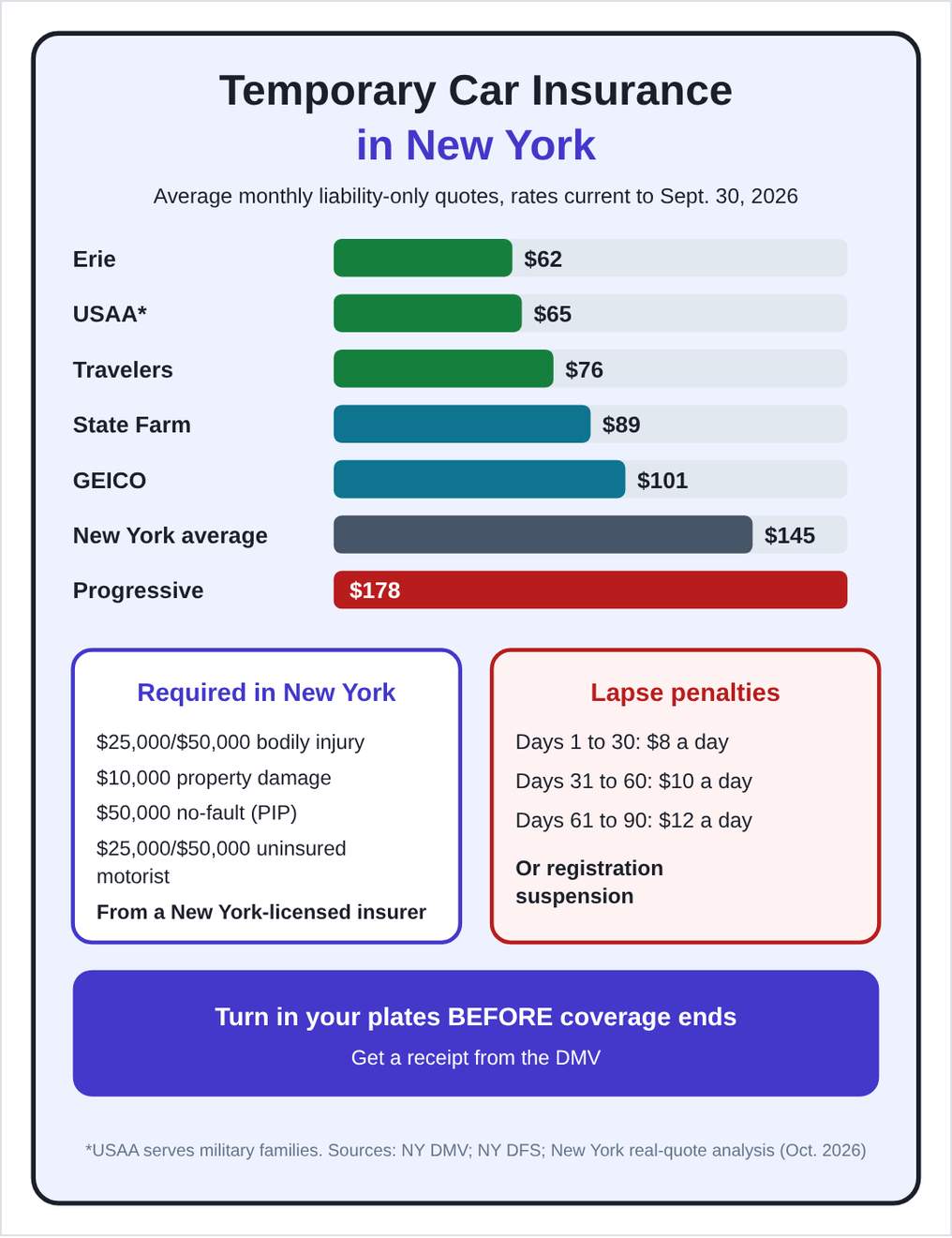
Average monthly liability-only quotes in New York from a real-quote analysis updated November, 2026 (rates current to September 30, 2026), plus required coverage and the DMV's lapse penalties. Averages, not quotes.
BEFORE YOU BUYDecide whether the coverage is for a car registered to you in New York, a borrowed car, or a rental. If it is your registered car, plan how you will handle the plates when the coverage ends.
Does temporary car insurance exist in New York?
Not as a standard product. Like most states, New York has no true one-week or one-month policy from major insurers. It is also missing some of the flexible programs sold elsewhere. Weekly-payment liability plans and pay-as-you-go plans sold in other states are not listed for New York in the 2026 sources we reviewed, and a New York quote analysis says pay-per-mile insurance is harder to find in the state. Nationwide SmartMiles, Allstate Milewise, Mile Auto, and USAA SafePilot Miles do not list New York.
That leaves New Yorkers with a smaller set of reliable options, each suited to a different situation.
Short-term car insurance options in New York
Option | How it works | Covers your own car? | Best for |
|---|---|---|---|
Standard policy, canceled early | Buy a six- or 12-month policy and cancel when done | Yes, with collision and comprehensive | Owners of New York-registered cars |
Non-owner insurance | Liability coverage when you drive cars you do not own | No | People who borrow or rent cars |
Rental and car-sharing coverage | Bought from the rental company, car-sharing program, or peer-to-peer service | Yes, with a damage waiver | Short rentals and car-sharing |
Added to someone else's policy | The owner adds you as a driver | Depends on their policy | Staying with family in New York |
Turn in plates and stop coverage | Surrender plates, then end the policy | Not applicable | Cars you will not drive for a while |
New York car insurance requirements
New York's minimums are broader than most states'. According to the Department of Financial Services (DFS), every registered vehicle must carry these coverages:
New York required coverage
Coverage | Minimum |
|---|---|
Bodily injury liability | $25,000 per person and $50,000 per accident |
Property damage liability | $10,000 |
No-fault personal injury protection | $50,000 |
Uninsured motorist | $25,000 per person and $50,000 per accident |
New York Department of Financial Services. Collision and comprehensive are optional by law but usually required by lenders and leasing companies.
Three New York rules shape every short-term plan:
- Coverage must come from a New York insurer. The DMV says out-of-state insurance is not acceptable for a New York-registered vehicle.
- Insurers report coverage electronically. The DMV says insurers must file coverage electronically, and paper or emailed proof is not accepted for DMV purposes.
- New York is a no-fault state. Your own no-fault coverage pays your medical bills and some lost wages after a crash, regardless of who caused it.
About 8.6% of New York drivers were uninsured in 2023, among the lowest rates in the country, according to the Insurance Research Council.
The plate-surrender rule: the key to ending coverage
This is the rule that makes temporary insurance in New York different. The DMV says that if your coverage is ending and you will not immediately replace it, you must turn in the license plates to the DMV before your coverage ends, and get a receipt. If you cannot visit a DMV office, you can mail a completed Plate Surrender Application (PD-7) with the plates.
If you do not surrender the plates and your coverage lapses, the DMV suspends your registration for as many days as the vehicle was uninsured. For lapses of 90 days or less, you may pay a civil penalty instead:
New York insurance-lapse civil penalties
Length of lapse | Penalty per day |
|---|---|
1 to 30 days | $8 |
31 to 60 days | $10 |
61 to 90 days | $12 |
New York DMV, Auto Liability Insurance (accessed October 2026). The penalty option is not available for lapses over 90 days or if you used it within the previous 36 months.
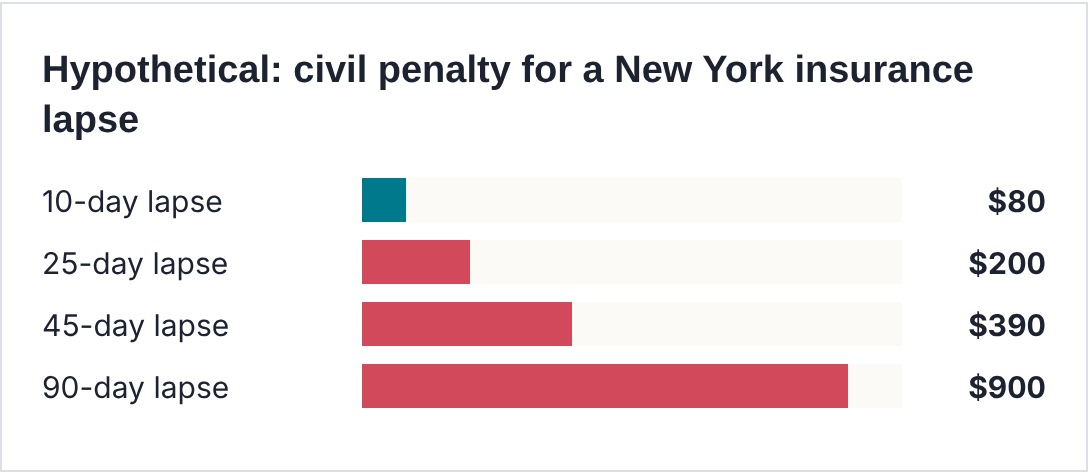
Our calculation from NY DMV daily rates: $8 a day for days 1 to 30, $10 for days 31 to 60, and $12 for days 61 to 90. A 25-day lapse costs $200, matching the DMV's own example.
Longer gaps get more serious. If a registration suspension lasts more than 90 days, your driver's license is also suspended until the registration suspension ends, with a $50 reinstatement fee. Driving uninsured can bring a traffic court fine of up to $1,500, and if you are in a crash while uninsured, your license and registration are revoked for at least one year, with a $750 civil penalty to get your license back.
PRO TIP #1In New York, the plates come off before the policy does. Surrender your plates at a DMV office, or mail them with form PD-7, and keep the receipt. Only then cancel your insurance. That order keeps you clear of daily penalties and suspensions.
New York's 10% first-payment rule
New York also controls how a new policy starts. Vehicle and Traffic Law § 311(5)(c) says the certificate of insurance for a new policy must state that "at least ten per cent of the annual premium due on the policy has been paid." DFS confirmed in a 2008 legal opinion that insurers must collect at least 10% of the annual premium on all new policies.
Two details matter for short-term buyers. First, on a six-month policy, 10% of the annual premium equals about 20% of the six-month premium. Second, the statute says a transfer of insurance from one company to another by an agent or broker is not treated as issuing a new policy, and renewals are not new policies either. NYCM, a New York insurer, publishes plans starting at 15% down, with no installment fees on its Auto-Pay option.
Your temporary car insurance options in New York
1. A standard policy canceled early
This is the most widely available route and the only one that reliably includes full coverage. You buy a policy, use it as long as you need, surrender the plates, and cancel. Most insurers refund unused premium. With a pro rata refund you get all of it back; with a short-rate refund, an insurer may keep 10% to 15% of the unearned premium, according to an analysis updated August 31, 2026.
A New York quote analysis also warns that canceling after a short term can bring cancellation fees and higher rates with your next insurer.
Hypothetical: one month on a New York liability-only policy
Step | Amount |
|---|---|
Annual premium ($62 × 12) | $744 |
Minimum first payment (10% of annual) | $74.40 |
Premium used in one month | $62 |
Cost for one month with a pro rata refund | $62 |
Cost for one month with a 10% short-rate penalty on the unearned premium | $130.20 |
Hypothetical; our calculation, using Erie's $62 monthly liability-only average in a New York real-quote analysis (rates current to September 30, 2026) on a 12-month policy. Unearned premium after one month: $682; 10% = $68.20. Your quote, policy term, and refund terms will differ.
The example shows why refund terms matter more in New York than in states with six-month policies. On a 12-month policy, a short-rate penalty applies to 11 months of unearned premium, which can more than double the cost of one month (our calculation). Ask whether a six-month term is available and how refunds are calculated before you buy.
Hypothetical: one month of coverage, six-month vs. 12-month term
Term | Premium | Unearned after 1 month | 10% short-rate penalty | Cost for one month |
|---|---|---|---|---|
Six-month | $372 | $310 | $31 | $93 |
12-month | $744 | $682 | $68.20 | $130.20 |
Hypothetical; our calculation at $62 a month. With a pro rata refund and no fee, either term would cost $62 for one month.
Keep every payment current while the policy is active, too. New York lets an insurer cancel for nonpayment with 15 days' notice, so a missed installment on a short-term arrangement can end your coverage, and the plate rules then apply.
2. Non-owner insurance
If you do not own a car but will drive borrowed or rented ones, a non-owner policy gives you liability coverage. The New York analysis says Travelers, Liberty Mutual, Progressive, and USAA offer non-owner coverage in the state, and that it is typically cheaper than standard liability or full coverage. It does not pay for damage to the car you drive. New York also requires no-fault and uninsured motorist coverage, so ask what a non-owner policy includes.
3. Rental and car-sharing coverage
Many New Yorkers, especially in New York City, rent or use car-sharing instead of owning.
The New York analysis notes that rental coverage is sold through rental companies, car-sharing programs, and peer-to-peer services. One national analysis put rental car insurance at $9 to $30 a day, and a June 2026 consumer report said counter coverage often costs $30 to $60 a day, while third-party providers sell primary rental coverage for under $20 a day. Check your own policy and card benefits first; most cards offer only secondary coverage and usually exclude liability.
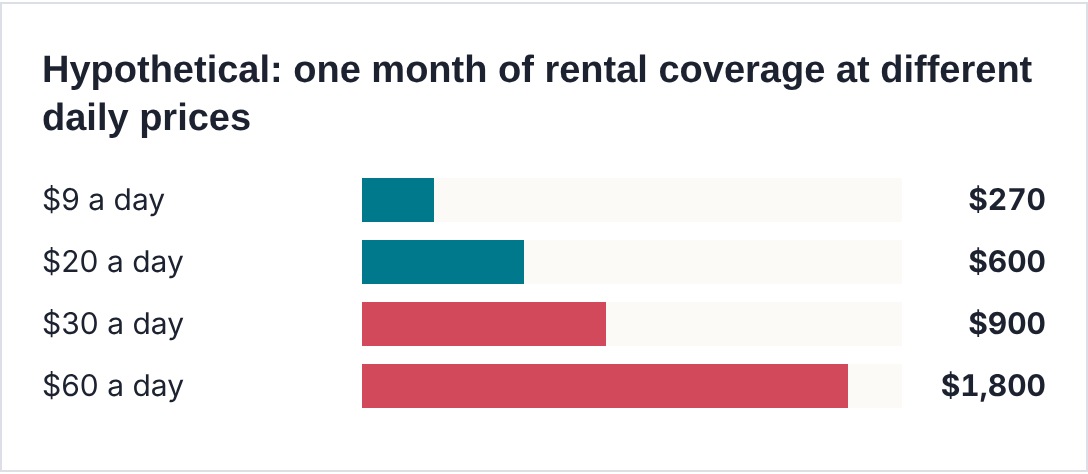
Our calculation: daily price × 30. Daily ranges from a national analysis (September 30, 2026) and a June 23, 2026, consumer report.
For a long rental, a non-owner policy plus a damage waiver or card benefit can cost far less than daily counter coverage, though the two protect different things.
Car-sharing and peer-to-peer rentals deserve a closer look. Each program sets its own protection levels and deductibles, and those can differ from a traditional rental counter's. Before your first trip, read what the program includes for liability, damage to the car, and your own injuries, and check whether your card benefit applies to car-sharing at all; many card benefits exclude it. If you use car-sharing often, a non-owner policy can add a consistent layer of liability protection.
4. Being added to someone else's policy
If you are staying with family in New York, ask to be added to their policy. It can cost less than a separate policy, and because it is not a new policy, the 10% first-payment rule does not apply to you. Adding a driver may raise the owner's premium, so compare. Occasional drivers with permission may already be covered under the owner's policy, but rules vary, so the owner should check first.
5. Turning in plates for a car you will not use
If your car will sit for months, the cleanest option in New York may be to stop insuring it for road use entirely. Surrender the plates first, then cancel the liability coverage. You can keep comprehensive-only coverage to protect against theft or damage while it is stored, if your insurer offers it. When you are ready to drive again, buy coverage and re-register.
6. The New York Automobile Insurance Plan
Drivers who cannot get coverage elsewhere can apply through the New York Automobile Insurance Plan, the state's assigned-risk plan. NYCM's published assigned-risk plans start at 25% down, and DFS says the broker's fee for assigned-risk policies is capped at $50. It is not short-term coverage, but it is a legal safety net.
How much does short-term car insurance cost in New York?
New York is expensive overall. A New York quote analysis put the full-coverage average at $2,618 a year, about 50% above the national average. Two 2026 analyses show the cheapest companies. Study A is a rate study updated August 13, 2026, using a 40-year-old driver averaged across New York ZIP codes. Study B is a real-quote analysis with rates current to September 30, 2026. Compare each only with itself.
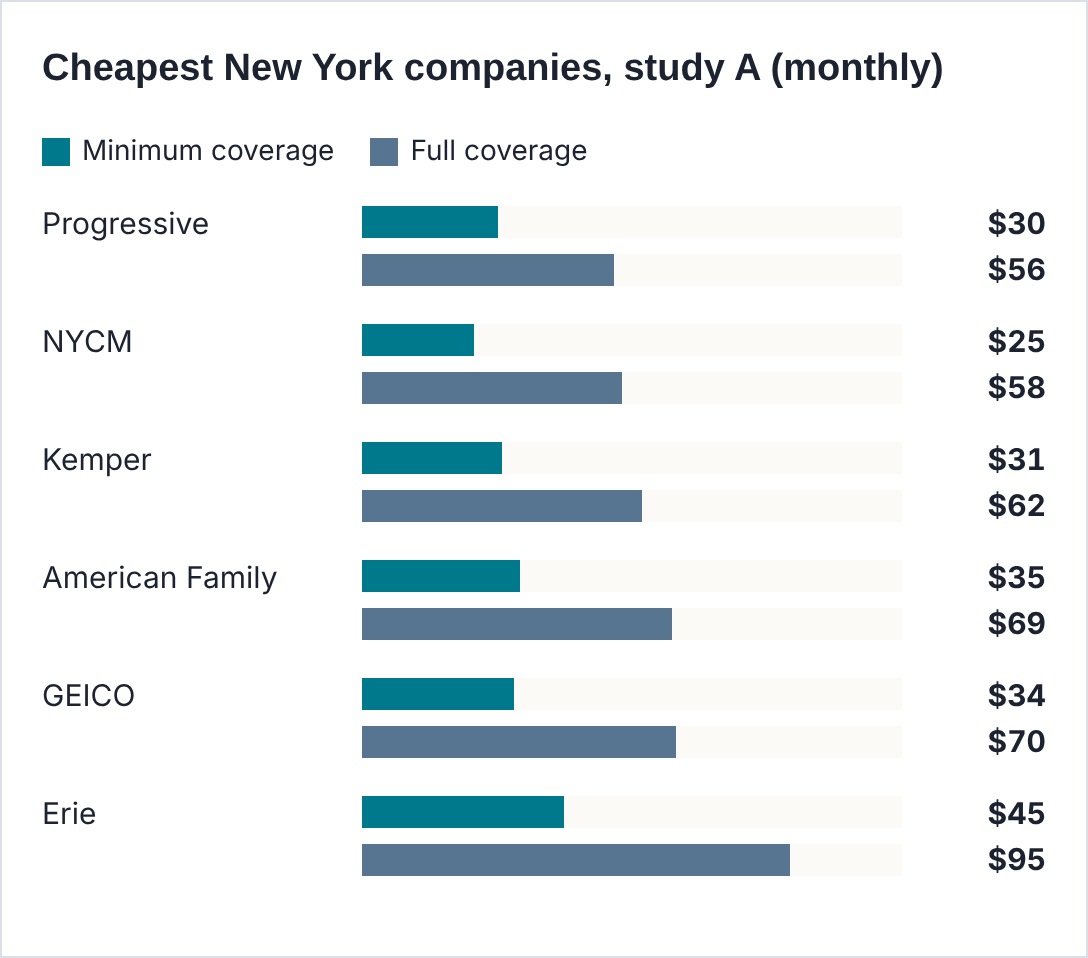
Study A: New York rate study updated August 13, 2026; 40-year-old driver; full coverage at 100/300/100. Study averages: $57 minimum, $108 full coverage. Statewide averages; New York City drivers should expect higher prices.
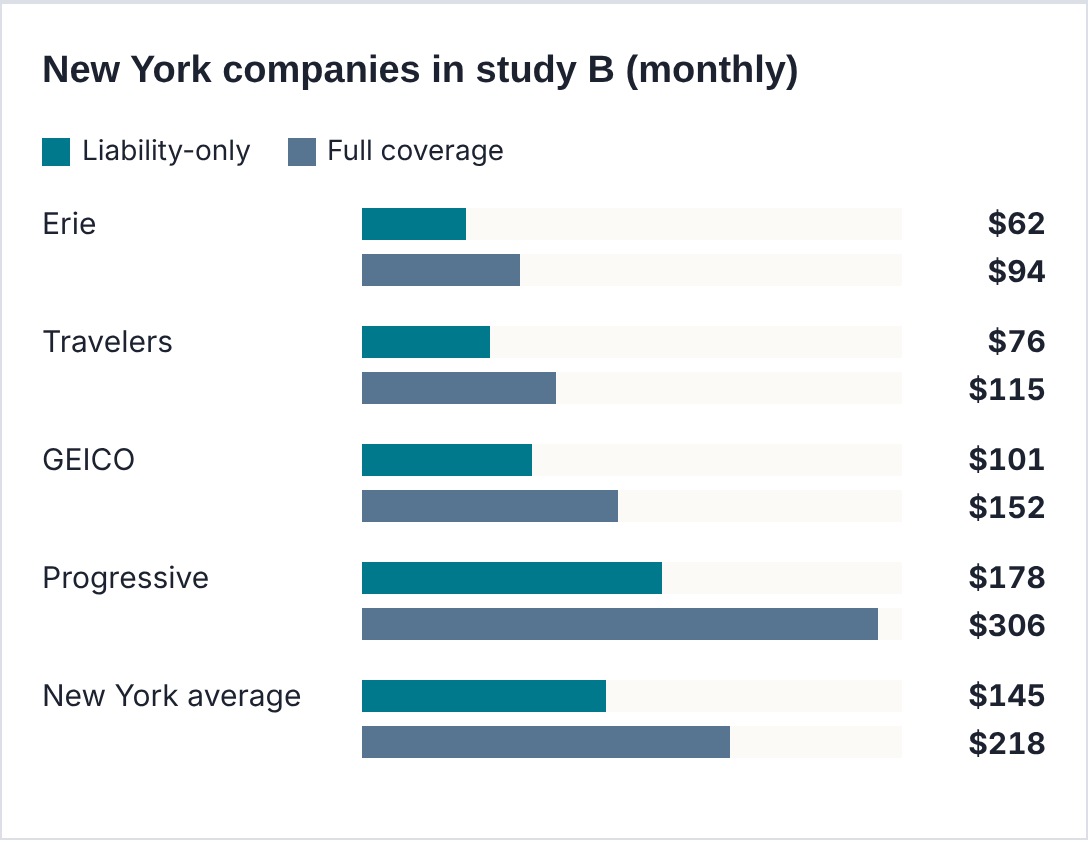
Study B: New York real-quote analysis updated October 18, 2026; rates current to September 30, 2026.
The two studies differ sharply. Study A uses one ideal driver averaged across the whole state, which keeps prices low. Study B uses real quotes from a broader group, many in higher-cost areas. Treat study A as a low-end benchmark, and expect New York City and its suburbs to cost more.
Study B also shows how much the company matters. Progressive's liability-only average, $178, was almost three times Erie's $62 (our calculation). Erie was also cheapest for seniors' liability-only coverage, at $42 a month, and for full coverage after a speeding ticket, at $151.
Prices may ease under New York's 2026 reforms
New York changed its auto insurance laws in 2026 with the goal of lowering premiums, targeting staged-crash fraud, revising the no-fault serious injury threshold, and limiting certain damages. On July 1, 2026, DFS told insurers to build the projected savings into their rate filings, and on September 9 it proposed a regulation requiring prior approval for private passenger auto rate increases, which DFS says takes effect November 27, 2026. No one can promise lower premiums, but it is worth getting fresh quotes.
Discounts that help short-term buyers
Completing a DMV-approved accident prevention course, called the Point and Insurance Reduction Program, reduces the base rate of your auto insurance by 10% each year for three years, according to the DMV. NYCM says its Auto-Pay has no installment fees and can save up to $55 a year.
Buying a car in New York: getting covered fast
When you buy a car, you need a New York insurance policy before you can register it, and your insurer must report the coverage to the DMV electronically. If you already have a policy, call your insurer before you drive away. Many insurers give a grace period of about 7 to 30 days to add a newly bought car, according to a June 2026 rate study, though some give only a few days and some give none.
If you need a new policy, expect to pay at least 10% of the annual premium up front. A rate study updated August 13, 2026, found the lowest average full-coverage premiums in New York for the Chrysler Voyager, Subaru Crosstrek, Honda HR-V, Honda CR-V, and Volkswagen Tiguan, with the Voyager well below the rest at $576 for six months.
Proof of insurance in New York
Because the DMV relies on your insurer's electronic filing, the DMV does not accept paper or emailed proof for its own records. You still need your insurance ID card for traffic stops, crashes, and registration paperwork, so download or print it as soon as the policy starts. If the DMV shows your car as uninsured when you believe it is covered, call your insurer and ask it to confirm the electronic filing, and check that the VIN on the policy matches your registration.
Temporary coverage for special situations in New York
Visitors. If you are visiting with your own car registered in another state, your home-state policy generally travels with you; confirm with your insurer. Without a car, use the owner's policy, rental coverage, or a non-owner policy.
New residents. Once you register a car in New York, it needs coverage from a New York-licensed insurer, reported electronically. Line up a New York policy before you register, and keep your old policy until the new one starts.
College students. A student bringing a car to a New York campus for a semester usually does best on a parent's policy. A student who borrows or rents may want non-owner coverage.
Young drivers. Study A found NYCM cheapest for an 18-year-old male on a family policy at $112 a month and a 21-year-old at $86, and Progressive cheapest at 25, at $65.
Seniors. The New York quote analysis found Erie cheapest for seniors' liability-only coverage at $42 a month. The DMV's accident prevention course discount is open to drivers of any age, so it can lower a senior's short-term premium too.
Drivers with a DWI. The New York quote analysis put DWI liability coverage at an average of $271 a month.
Best temporary option by New York situation
Your situation | Best option | Why |
|---|---|---|
Living in the city without a car | Rental or car-sharing coverage, or a non-owner policy | No vehicle of your own to insure |
Borrowing a car while visiting | Owner's policy or a non-owner policy | No vehicle coverage needed |
Owning a New York car for a few months | Standard policy canceled early | Surrender plates before canceling |
Storing a car for months | Surrender plates, then cancel liability | Avoids daily penalties |
Staying with family | Be added to their policy | Not a new policy, so no 10% start |
Turned down by insurers | New York Automobile Insurance Plan | Legal assigned-risk coverage |
How New York compares with other states
Ending coverage: New York vs. other states
State | What happens when coverage ends on a registered car | Cost |
|---|---|---|
New York | Plates must be surrendered first; otherwise suspension or daily civil penalties | $8 to $12 a day for up to 90 days |
Florida | Insurer reports within 10 days; license and registration can be suspended | $150, $250, or $500 to reinstate |
Georgia | A gap of 10 or more days is a lapse | $25 lapse fee, plus $60 or $160 to reinstate |
Texas | No automatic lapse fee; driving uninsured brings fines | $175 to $1,000 if ticketed |
New York DMV; Florida Statutes § 324.0221; Georgia Department of Revenue; Texas Transportation Code § 601.191. Summarized.
How to get temporary car insurance in New York, step by step
- Decide what you need to cover: your own car, a borrowed car, a rental, or car-sharing.
- Get quotes from New York's cheapest companies, such as Erie, Travelers, NYCM, Progressive, and GEICO.
- Use New York's full required limits, including no-fault and uninsured motorist coverage.
- Ask about the policy term and refunds: six-month terms and pro rata refunds keep short stays cheaper.
- Budget for the 10% first payment on a new policy.
- Take the accident prevention course if you will keep the policy for a while.
- Save your New York insurance ID card before you drive.
- When you are done, surrender the plates first, then cancel the policy.
Questions to ask a New York insurer
- Do you offer a six-month term, and is the refund pro rata or short-rate?
- Is there a cancellation fee?
- How much is due today, and does Auto-Pay change it?
- Does your non-owner policy include no-fault and uninsured motorist coverage?
- When will you report my coverage to the DMV?
Pros and cons of temporary coverage in New York
Pros | Cons |
|---|---|
Standard policies include full coverage and can be canceled | No weekly, pay-as-you-go, or common pay-per-mile programs |
Plate surrender lets you stop coverage legally | Forgetting the plates brings daily penalties or suspension |
Strong required coverage, including $50,000 no-fault | At least 10% of the annual premium due on new policies |
2026 reforms aim to lower premiums | Short-rate refunds on 12-month policies can be costly |
Ask for a six-month policy with a pro rata refund. In our hypothetical, a 10% short-rate penalty on a 12-month policy more than doubled the cost of one month of coverage. A shorter term and a pro rata refund keep a short stay close to the true monthly price.
Common mistakes to avoid
Canceling insurance before surrendering plates. That starts the penalty clock.
Using an out-of-state policy on a New York-registered car. The DMV does not accept it.
Ignoring the refund method. Short-rate penalties on a 12-month policy add up fast.
Assuming pay-per-mile is available. Major programs do not list New York.
Missing a payment on a short policy. An insurer can cancel for nonpayment with 15 days' notice.
New York temporary car insurance at a glance
This illustrated summary pulls together the rules and options covered above.
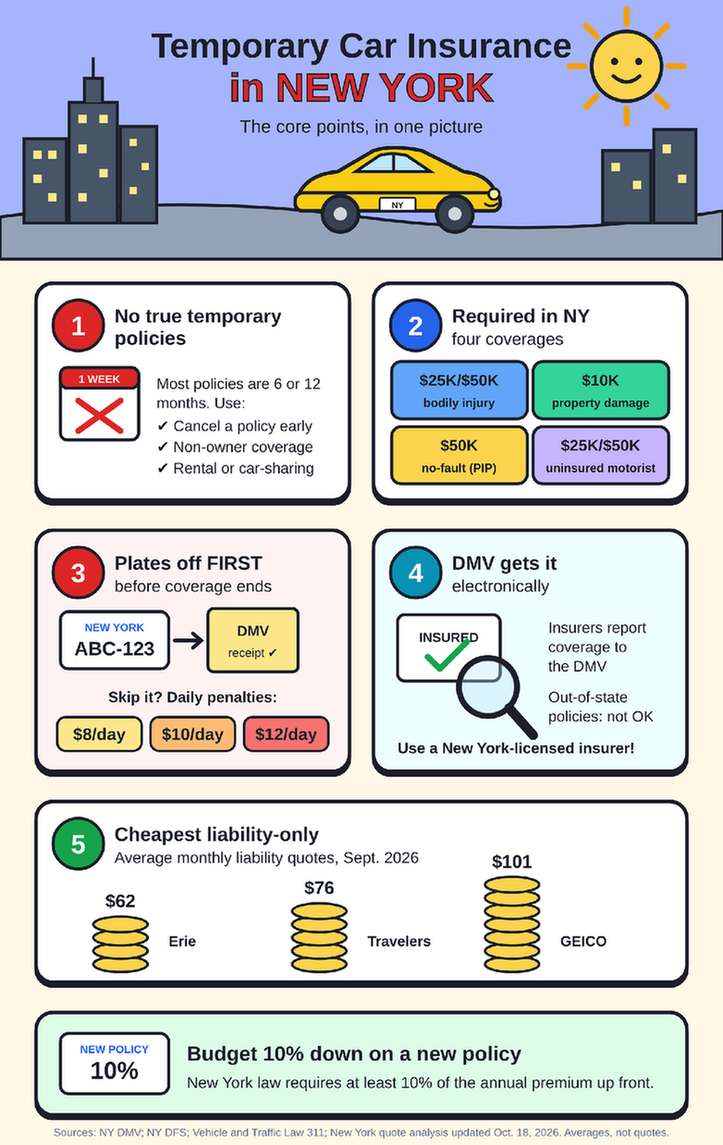
New York temporary car insurance at a glance. Sources: NY DMV; NY DFS; Vehicle and Traffic Law § 311; New York quote analysis updated October 18, 2026. Averages, not quotes.
Frequently asked questions
Can you get temporary car insurance in New York?
Not as a true short-term policy from major insurers, and weekly or pay-as-you-go plans sold elsewhere are not listed for New York. New Yorkers use a standard policy canceled early, non-owner coverage, rental or car-sharing coverage, or a household member's policy.
What insurance is required in New York?
Every registered vehicle needs $25,000/$50,000 bodily injury liability, $10,000 property damage liability, $50,000 of no-fault personal injury protection, and $25,000/$50,000 uninsured motorist coverage, from an insurer licensed in New York, according to the Department of Financial Services. Out-of-state policies are not accepted.
What happens if I cancel my New York car insurance?
If you keep the plates, your registration can be suspended for as many days as the car was uninsured. For lapses of 90 days or less, you may pay $8 to $12 a day instead. Surrender your plates before coverage ends to avoid both.
How do I surrender plates in New York?
Turn them in at a DMV office and get a receipt, or mail them with a completed Plate Surrender Application, form PD-7, to the DMV's Plate Surrender Office. Do this before your insurance ends, then cancel the policy, and keep the receipt in case questions come up later.
How much do I pay to start a New York policy?
At least 10% of the annual premium on a new policy, under Vehicle and Traffic Law § 311. On a six-month policy, that is about 20% of the six-month premium. Broker-arranged transfers between companies and renewals are not treated as new policies.
Is pay-per-mile insurance available in New York?
Not from the major programs we reviewed. Nationwide SmartMiles, Allstate Milewise, Mile Auto, and USAA SafePilot Miles do not list New York, and a 2026 analysis says pay-per-mile coverage is harder to find in the state. Ask insurers about low-mileage discounts instead.
Who sells non-owner car insurance in New York?
A New York quote analysis says Travelers, Liberty Mutual, Progressive, and USAA offer non-owner coverage in the state. It covers liability when you drive cars you do not own and is typically cheaper than a standard policy, but it does not cover damage to the car you drive.
What is the cheapest car insurance in New York?
In real-quote data current to September 30, 2026, Erie was cheapest at $62 a month for liability-only and $94 for full coverage. In a separate statewide study, NYCM was cheapest for minimum coverage at $25, and Progressive was cheapest for full coverage at $56.
The final word on temporary car insurance in New York
For most New Yorkers who need a few weeks or months of coverage on their own car, a standard policy from a low-cost insurer, ideally a six-month term with a pro rata refund, is the best temporary solution. If you do not own the car, use non-owner, rental, or car-sharing coverage. And whatever you choose, remember New York's golden rule: surrender the plates before the coverage ends.
NEXT STEPWrite down the dates you need coverage and the car you will drive. Get three quotes with New York's full required limits, ask about the term, refund method, and amount due today, and plan your plate surrender before you cancel.
Prices, availability, cancellation terms, and state rules can change. The figures in this article are averages, published rules, and hypothetical calculations, not quotes. This article is for information only and is not legal or financial advice. The publisher is not an insurance company or a licensed insurance agency.
The bottom line on temporary car insurance in New York: true short-term policies are not sold, but a cancelable low-cost policy, non-owner or rental coverage, and careful plate surrender can keep you legal for exactly as long as you need.
Sources
- New York DMV, Auto Liability Insurance and Point and Insurance Reduction Program (accessed October 2026).
- New York DFS, Consumer Automobile FAQ and Auto Insurance Checklist (2025).
- N.Y. Vehicle and Traffic Law § 311 and DFS OGC Opinion No. 08-10-04 (October 10, 2008).
- DFS press release on proposed auto rate regulation (September 9, 2026) and PIA Northeast, DFS guidance on 2026 reforms (July 8, 2026).
- NYCM Insurance, Payment Plans and Assigned Risk Plans (accessed October 2026).
- Insurify, Temporary Car Insurance in New York (updated October 18, 2026) and New York Car Insurance (rates current to September 30, 2026).
- MoneyGeek, Cheapest Car Insurance in New York (updated August 13, 2026).
- CarInsurance.com, Cheapest Cars to Insure in New York (updated August 13, 2026) and New Car Grace Period (updated June 26, 2026).
- Insurance Information Institute, Uninsured Motorists, citing the Insurance Research Council.
- MoneyGeek, Car Insurance Refund (August 31, 2026).
- Nationwide, SmartMiles, Allstate, Milewise, and Mile Auto (accessed October 2026).
- Insurify, One-Week Car Insurance (updated September 30, 2026) and First Alert 4, Understanding Rental Car Insurance (June 23, 2026).
- Florida Statutes § 324.0221, Georgia Department of Revenue, Lapse Fines, and Texas Transportation Code, Chapter 601.