
Dirt Cheap Car Insurance
Auto insurance rates have become unaffordable for many drivers. This is why so many people are looking for dirt cheap car insurance. If you just need bare bones coverage, then you’re looking for basic state minimum liability coverage with the lowest deposit.
The good news is that dirt cheap car insurance is possible, and you can even buy your policy online in less than ten minutes. The bad news is that the cheapest policy is not always the smartest policy. A driver with a clean record and an older, paid-off car may find very cheap liability insurance. However, that might not be enough coverage to fully protect a person’s assets. Also, drivers with a past DUI, who have SR-22 requirements, an expensive vehicle, or coverage lapses will usually pay a lot more.
Cheapest legal starting point
State-minimum liability is usually the lowest-cost policy available.
Cheap is not always enough
Very low limits can leave you personally responsible after a serious crash.
Comparison matters most
The cheapest company changes by driver, ZIP code, vehicle, and coverage level.
What Does Dirt Cheap Car Insurance Mean?
For many drivers, dirt cheap car insurance usually means state-minimum liability coverage from a licensed insurer. This is often the lowest-cost legal policy available. However, the cheapest company changes based on your state, ZIP code, age, driving record, vehicle, credit-based insurance factors, where allowed, and coverage needs.
For many drivers, that means:
| Goal | Best Starting Point |
|---|---|
| Lowest legal price | State-minimum liability |
| Cheap but better protection | Higher liability limits |
| Cheap for low-mileage drivers | Pay-per-mile or usage-based insurance |
| Cheap for safe drivers | Telematics discount programs |
| Cheap for financed cars | Compare full coverage quotes |
The cheapest policy for one driver may be expensive for another. That is why quote comparison is the most important step.
Cheapest Type of Car Insurance
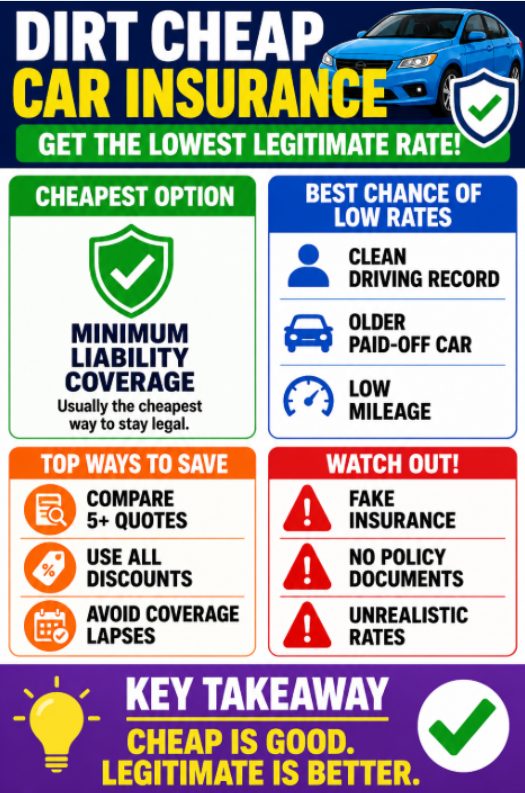
The cheapest type of car insurance is usually state minimum liability coverage.
Liability-only auto insurance helps pay for injuries or property damage you cause to other people in an accident. It does not usually pay to repair or replace your own vehicle. Minimum liability is cheaper because it provides less protection than full coverage. You can learn more about vehicle insurance and the different types of coverage available.
| Coverage Type | Usually Cheap? | Covers Your Car? | Best For |
|---|---|---|---|
| State-minimum liability | Yes | No | Lowest legal coverage |
| Liability-only with higher limits | Usually | No | Better protection without full coverage |
| Pay-per-mile insurance | Sometimes | Depends | Low-mileage drivers |
| Usage-based insurance | Sometimes | Depends | Safe drivers |
| Full coverage | Usually not | Yes | Financed or newer vehicles |
Dirt Cheap vs Cheap Enough vs Risky Cheap
| Policy Type | Cost Level | Protection Level | Risk |
|---|---|---|---|
| State minimum only | Lowest | Lowest | Higher |
| Higher liability limits | Moderate | Better | Lower |
| Full coverage | Higher | Stronger | Lower for your own vehicle |
| Fake or invalid policy | Looks cheap | None | Extreme |
Dirt cheap insurance can be fine if you understand what you are buying. Risky, cheap insurance is different. A policy that looks affordable but leaves you exposed after an accident can become extremely expensive.
Companies Worth Comparing for Dirt Cheap Car Insurance
No company is the cheapest for everyone. Insurance pricing depends too much on personal and local factors.
Still, these companies commonly appear in cheap-insurance comparisons and may be worth checking. You may also find individual company reviews, such as this Cash Register Insurance Company review or this AMCO Insurance review, useful when researching less familiar names:
| Company or Option | Why Compare |
|---|---|
| GEICO | Often competitive for minimum coverage |
| Progressive | Strong online quoting and broad availability |
| State Farm | Large agent network |
| Travelers | Often competitive for some full-coverage profiles |
| Auto-Owners | Strong regional option where available |
| Erie | Often affordable in states where available |
| American Family | Competitive in many cheap-insurance analyses |
| Nationwide | Worth comparing for discounts and usage-based options |
| USAA | Excellent option for eligible military families |
| Dairyland | Nonstandard and high-risk market |
| The General | High-risk driver options |
| Direct Auto | Flexible payment positioning in some markets |
| National General | Nonstandard auto options; see also this National General Insurance Company overview |
| Bristol West | Often used by higher-risk drivers |
Do not assume the cheapest national company is the cheapest in your ZIP code. Regional companies sometimes beat national brands.
Why the Cheapest Company Changes by Driver
Insurance companies use different rating models. One company may love your profile while another may quote you a much higher rate.
Factors that can affect your rate include:
| Factor | Why It Matters |
|---|---|
| ZIP code | Claim frequency, theft, traffic, and repair costs |
| Age | Younger drivers usually cost more |
| Driving record | Tickets and accidents raise risk |
| Prior insurance | Continuous coverage can help |
| Vehicle | Repair cost, theft risk, safety features |
| Mileage | More driving means more exposure |
| Coverage level | More coverage costs more |
| Deductible | A higher deductible can reduce premiums |
| Credit where allowed | May affect insurance pricing |
| State law | Requirements and rating rules vary |
How to Get Dirt Cheap Car Insurance Step by Step
Compare at Least Five Quotes
This is the most important step.
Car insurance prices vary widely by company. One insurer may quote you hundreds more than another for similar coverage.
Compare:
- Direct carrier quotes
- Independent agents
- Regional insurers
- Nonstandard insurers if needed
- Online comparison tools
Start With State-Minimum Liability
If your only goal is the lowest legal price, start by pricing state-minimum liability coverage.
This gives you a baseline.
Then compare that price against slightly higher liability limits. Sometimes increasing limits does not cost much more, and the added protection may be worth it.
Minimum coverage may be enough if:
- Your car is old
- Your car is paid off
- You have few assets
- You only need legal coverage
- You cannot afford full coverage with a very low upfront payment
It may not be enough if:
- You drive often
- You have assets to protect
- You could not handle a lawsuit
- Your state minimums are very low
- You want stronger financial protection
Drop Optional Coverages You Do Not Need
Optional coverages can be helpful, but they increase cost.
Review extras such as:
| Optional Coverage | Keep or Remove? |
|---|---|
| Rental reimbursement | Keep if you need a rental after a claim |
| Roadside assistance | Remove if you already have AAA or another plan |
| Custom equipment | Keep only if needed |
| New car replacement | Usually, for newer vehicles |
| Gap coverage | Important if the loan balance exceeds the vehicle value |
| Enhanced glass | Useful in some states, unnecessary in others |
Do not remove coverage randomly. Remove only what you understand.
Raise Deductibles Carefully
If you carry comprehensive and collision coverage, raising your deductible can lower your premium.
| Deductible Choice | Premium Effect | Out-of-Pocket Risk |
|---|---|---|
| Lower deductible | Higher premium | Lower claim cost |
| Higher deductible | Lower premium | Higher claim cost |
A higher deductible is useful only if you can afford it after an accident.
Ask for Every Discount
Discounts can make a major difference.
Common discounts include:
| Discount | Who May Qualify |
|---|---|
| Safe driver | Clean driving record |
| Multi-policy | Auto plus home or renters |
| Multi-vehicle | More than one car |
| Good student | Eligible students |
| Defensive driving | Approved course completion |
| Paperless billing | Electronic documents |
| Autopay | Automatic payments |
| Low mileage | Drivers who drive less |
| Telematics | Safe driving app/device |
| Anti-theft | Certain vehicle security features |
| Paid-in-full | Paying the policy upfront |
Some discounts are small. Others can be significant. Ask the insurer to confirm every discount applied.
Avoid Coverage Lapses
Coverage lapses often lead to higher premiums with many insurers.
A lapse may happen when:
- You missed a payment
- Your policy cancels
- You sell a car and do not keep coverage
- You stop driving temporarily
- You switch insurers incorrectly
If your current policy is about to be canceled, contact the insurer before the cancellation date. It is often easier to adjust a payment plan than restart coverage later.
Consider Usage-Based Insurance
Usage-based insurance uses a mobile app or device to measure driving behavior.
It may track:
- Mileage
- Hard braking
- Speeding
- Time of day
- Phone use
- Acceleration
Safe drivers and low-mileage drivers may save money.
However, not every program works the same way. Some programs may increase rates for risky driving where allowed.
Re-Shop Every 6 to 12 Months
Insurance prices change.
Your rate may change because of:
- Company-wide rate increases
- Your driving history is improving
- Tickets aging off
- A car getting older
- Moving ZIP codes
- Credit changes were allowed
- New discounts
- New competitors in your area
Re-shopping does not mean you must switch. It means you should know whether your current price is still competitive. Drivers considering limited-duration policies can also review top short-term car insurance providers and compare temporary car insurance options and rates.
Who Has the Best Chance of Getting Dirt Cheap Car Insurance?
Some drivers are simply easier to insure cheaply.
| Driver Profile | Chance of Dirt Cheap Rates | Why |
|---|---|---|
| Clean driving record | High | Lower risk |
| Older paid-off car | High | No lender full-coverage requirement |
| Low annual mileage | Higher | Less time on the road |
| Continuous insurance | Higher | Better insurance history |
| Good credit where allowed | Higher | May lower pricing |
| Low-cost ZIP code | Higher | Lower claim costs |
| Teen driver | Lower | Higher crash risk |
| DUI/SR-22 driver | Lower | High-risk classification |
| Expensive vehicle | Lower | Higher repair/replacement cost |
If you are in a higher-cost group, you may still find affordable insurance. You just need to compare more companies.
Who Usually Pays Higher Rates?
Drivers usually pay more when insurers see a higher risk.
Common higher-cost profiles include:
- Teen drivers
- New drivers
- Drivers with DUIs
- Drivers with at-fault accidents
- Drivers with multiple tickets
- Drivers needing SR-22 or FR-44 filings
- Drivers with coverage lapses
- Drivers in high-theft areas
- Drivers in high-traffic cities
- Owners of luxury or performance vehicles
- Drivers needing full coverage
The cheapest company for a high-risk driver may be completely different from the cheapest company for a clean driver.
Is Dirt Cheap Full Coverage Car Insurance Possible?
Sometimes, but full coverage is rarely dirt cheap. Full coverage usually means liability plus comprehensive and collision. It is not a specific legal term, but consumers use it to describe a policy that can cover both damage to others and damage to your own vehicle.
Full coverage costs more because it may help pay for your car after:
- Accidents
- Theft
- Vandalism
- Fire
- Weather damage
- Animal collisions
- Falling objects
If your vehicle is financed or leased, your lender will usually require comprehensive and collision coverage.
To lower full coverage costs:
| Strategy | How It Helps |
|---|---|
| Compare insurers | Full coverage rates vary widely |
| Raise deductible | Lowers the premium but increases the claim cost |
| Remove extras | Cuts optional costs |
| Bundle policies | May create discounts |
| Use telematics | Rewards safe driving |
| Choose a cheaper car | Lower repair costs can reduce rates |
Is Liability-Only Insurance the Best Cheap Option?
Liability-only insurance is usually the cheapest legal option, but it is not always the best.
It may be a smart choice if:
- Your car has low market value
- Your car is paid off
- You can replace your car if needed
- You only need legal coverage
It may be risky if:
- Your car is valuable
- You rely on your car for work
- You could not afford repairs
- You drive frequently
- You have assets to protect
A slightly higher liability limit may cost more, but it can provide much better protection.
State Minimum Insurance Requirements
Every state sets its own minimum insurance requirements.
Some states require only liability coverage. Others may require uninsured motorist coverage, personal injury protection, or medical payments coverage.
Requirements can change. For example, some states have increased minimum liability limits in recent years. Because laws vary, always verify your state’s current minimum requirements through your state DMV, insurance department, or licensed agent.
Why Your Car Affects the Price
The vehicle you drive can have a major impact on your rate.
Cheaper-to-insure cars usually have:
- Lower repair costs
- Moderate horsepower
- Good safety records
- Lower theft rates
- Common replacement parts
- Lower market value
More expensive-to-insure cars often include:
- Luxury vehicles
- Sports cars
- High-performance cars
- EVs with costly repairs
- Vehicles with expensive sensors
- High-theft models
If you want dirt cheap insurance, the cheapest vehicle to buy is often not the cheapest vehicle to insure. Always quote insurance before buying a car.
Dirt Cheap Car Insurance With Bad Credit
In many states, insurers may use credit-based insurance information when pricing auto coverage. In states where it is allowed, weaker credit can increase premiums.
Some states restrict or prohibit this practice, so rules vary.
If your credit is hurting your insurance price:
- Compare more companies
- Ask about usage-based programs
- Avoid lapses
- Pay on time
- Consider regional insurers
- Re-shop after your credit improves
Do not assume one expensive quote means every company will be expensive.
Dirt Cheap Car Insurance After an Accident or Ticket
Accidents and tickets usually increase premiums, but the impact varies.
After a violation:
- Compare quotes again
- Ask about defensive driving
- Avoid another ticket
- Avoid coverage lapses
- Re-shop when the violation ages
- Consider nonstandard insurers if needed
The cheapest company before your ticket may not be the cheapest after it.
Dirt Cheap Car Insurance With SR-22
An SR-22 is not a type of insurance. It is a certificate proving that you carry the required coverage.
Drivers may need an SR-22 after:
- Driving uninsured
- DUI
- License suspension
- Serious violations
- Multiple traffic offenses
SR-22 drivers often pay more because they are considered higher risk.
If you need SR-22 insurance, ask:
| Question | Why It Matters |
|---|---|
| Is the filing included? | Avoid surprise fees |
| What is due today? | Know the upfront cost |
| When is coverage effective? | Avoid legal problems |
| Can I pay monthly? | Helps cash flow |
| Does the insurer handle my state? | Not all do |
Dirt Cheap Car Insurance for Young Drivers
Young drivers usually pay more because they have less experience and a higher crash risk. College students may also want to compare the cheapest car insurance companies for college students, while newer drivers can review temporary car insurance options for new drivers.
Ways to save:
- Stay on a parent policy if possible
- Use good student discounts
- Take defensive driving if approved
- Drive an older, safe car that is cheap to insure
- Avoid tickets
- Use telematics
- Compare regional insurers
- Avoid unnecessary full coverage on low-value cars
For young drivers, staying accident-free is the biggest long-term savings strategy.
Dirt Cheap Car Insurance for Seniors
Many seniors can find competitive rates, especially if they drive less after retirement.
Savings ideas include:
- Low-mileage discounts
- Mature driver courses
- Bundling
- Defensive driving
- Usage-based insurance
- Re-shopping after retirement
- Removing commuting mileage
Some rates may rise later in life, so seniors should compare quotes regularly.
Best Quote Strategy
Before getting quotes, gather:
- Driver’s license
- VIN
- Address
- Prior insurance information
- Current declarations page
- Annual mileage estimate
- Desired coverage limits
- Lender information if financed
When comparing, keep everything consistent:
| Quote Item | Keep the Same |
|---|---|
| Liability limits | Yes |
| Deductibles | Yes |
| Drivers | Yes |
| Vehicles | Yes |
| Start date | Yes |
| Discounts | As similar as possible |
This prevents misleading comparisons.
Red Flags: When Dirt Cheap Insurance Is Too Cheap
Watch out for:
- No licensed insurer name
- No policy documents
- Proof of insurance before payment
- Gift card payments
- Crypto payments
- Wire-only payment requests
- Social media broker with no license
- Guaranteed approval at impossible rates
- No VIN requested
- No driver information requested
- High-pressure tactics
A real policy should clearly show:
- Insurer name
- Policy number
- Effective date
- Coverage limits
- Deductibles
- Payment schedule
- Fees
- Cancellation terms
Questions to Ask Before Buying the Cheapest Policy
Before buying, ask:
- What company is underwriting the policy?
- Is the insurer licensed in my state?
- What are my liability limits?
- What is due today?
- What is my monthly payment?
- Are there installment fees?
- Is there an agency fee?
- When does coverage become effective?
- What is excluded?
- What happens if I miss a payment?
- Can I cancel without penalty?
- Does my lender require full coverage?
These questions can prevent expensive mistakes.
Dirt Cheap Car Insurance FAQ
What is the cheapest type of car insurance?
Minimum liability coverage is usually the cheapest type of car insurance because it provides only the coverage your state requires.
Who has the cheapest car insurance?
It depends on your state, ZIP code, driver profile, vehicle, and coverage level. GEICO, Progressive, State Farm, Travelers, Erie, Auto-Owners, American Family, Nationwide, and USAA often appear in cheap-insurance comparisons, but no company is cheapest for everyone.
Can I get dirt cheap full coverage?
Sometimes, but full coverage is usually much more expensive than liability-only insurance. Compare several companies, raise deductibles carefully, remove extras, and ask for discounts.
Is minimum coverage enough?
Minimum coverage may be legal, but it may not be enough after a serious accident. If damages exceed your limits, you could be personally responsible.
How can I lower my car insurance fast?
Compare quotes, choose appropriate coverage, remove unnecessary extras, ask for discounts, raise deductibles carefully, use telematics, and avoid coverage lapses.
Is cheap car insurance a scam?
Cheap insurance from a licensed insurer is not a scam. Fake brokers, fake proof of insurance, and impossible rates can be scams.
Does ZIP code matter?
Yes. ZIP code can affect rates because theft, traffic, weather, lawsuits, repair costs, and claim frequency vary by area.
Can I get cheap insurance with bad credit?
Sometimes. It may be harder in states where credit-based insurance scoring is allowed, but comparing companies can still help.
The Final Word On Dirt Cheap Car Insurance
Dirt cheap car insurance is possible, but it must be approached carefully. The cheapest legitimate policy is usually state-minimum liability coverage from a licensed insurer. That may be enough if you only need to stay legal and drive an older, paid-off car.
But it may not be enough if you need full coverage, have assets to protect, or cannot afford to replace your vehicle after an accident. The smartest strategy is to compare several insurers, start with the minimum legal coverage, then decide whether slightly higher limits or added protection are worth the cost.
Avoid fake promises, impossible rates, and unlicensed brokers. A really cheap policy should still come from a real insurer, show clear coverage limits, and become effective only through a legitimate payment process. If you want dirt cheap car insurance, focus on the lowest legitimate rate, not the lowest advertised number.
Compare dirt cheap car insurance plans where you live. Just enter some basic info and compare up to ten free quotes in under five minutes. Save more money today on the coverage you need.