
Temporary Car Insurance in Texas
Whether you are visiting family in Houston, borrowing a truck in Lubbock, or driving a new car off a Dallas lot, finding temporary car insurance in Texas is mostly about knowing which workaround fits. True short-term policies are rare, but Texas has more flexible choices than most states, including weekly liability plans, a Texas-only insurer with short-term terms, non-owner coverage, and standard policies you can cancel early. Texas also checks coverage every week through TexasSure, so getting the details right matters.
This guide explains Texas's insurance rules, TexasSure, the penalties for driving uninsured, every short-term option with 2026 Texas prices, the cheapest companies, and a step-by-step plan for covering a few weeks or months. Every figure is sourced and dated, and hypothetical examples are labeled.
- True temporary policies are rare. Texans use weekly liability plans, short-term or month-to-month policies, non-owner coverage, rental coverage, or a standard policy canceled early.
- Texas requires 30/60/25 liability coverage, and insurers must include personal injury protection (PIP) and offer uninsured motorist coverage unless you reject them in writing.
- TexasSure checks coverage weekly. Insurers report every personal auto policy to the state database each week, and police can check it from the roadside.
- Cheapest Texas coverage: State Farm averaged $45 to $46 a month for minimum or liability-only coverage in two 2026 analyses.
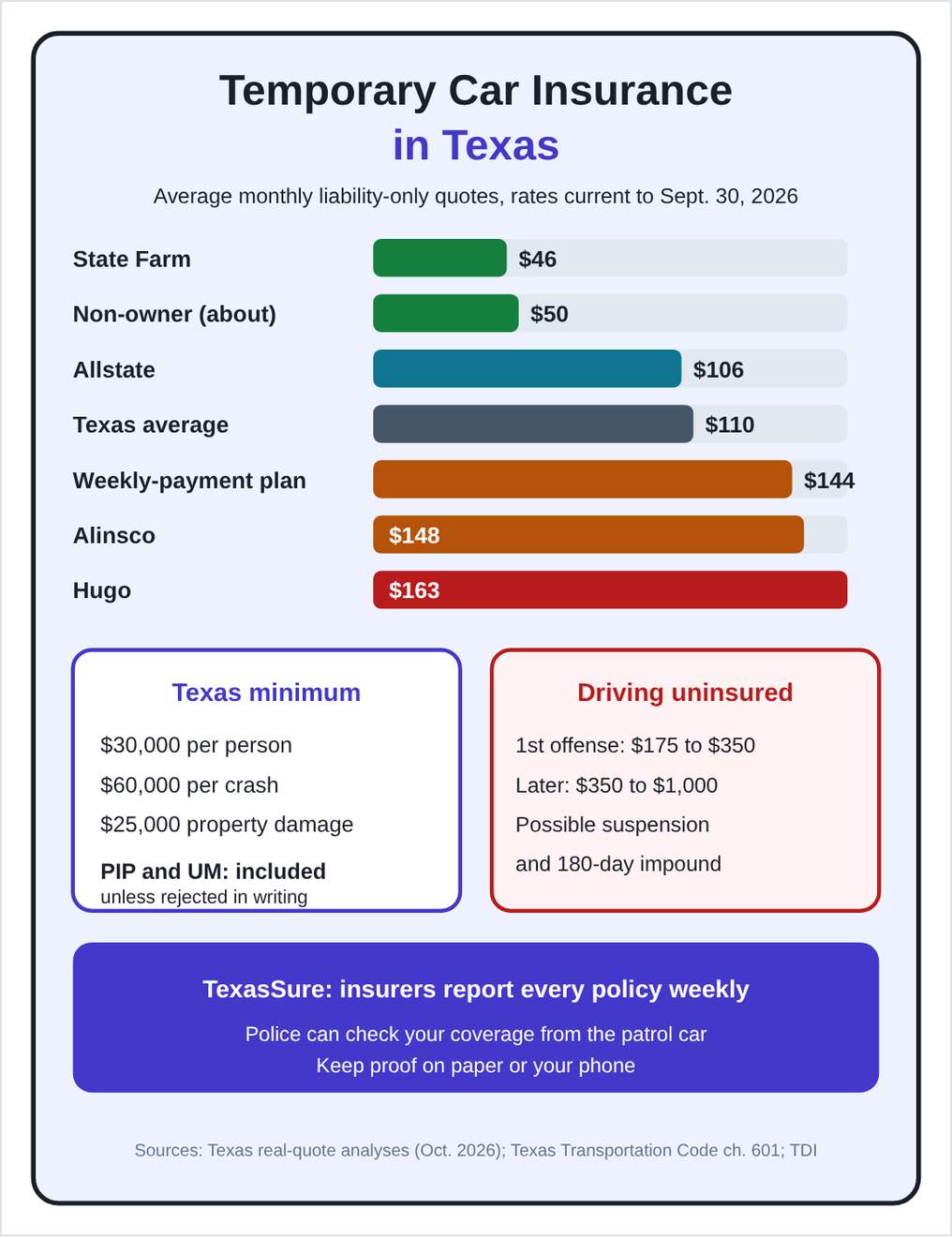
Average monthly liability-only quotes in Texas from real-quote analyses (rates current to September 30, 2026; non-owner figure approximate), plus Texas minimum limits, uninsured-driving penalties, and how TexasSure works. Averages, not quotes.
BEFORE YOU BUYDecide whether the coverage is for a car registered to you in Texas, a borrowed car, or a rental. That one answer narrows your choices to two or three options.
Does temporary car insurance exist in Texas?
Mostly not. A Texas quote analysis updated October 17, 2026, says "true temporary car insurance doesn't exist in Texas," and most policies run six or 12 months. Texas is unusual, though, because it has a few products that come close: a weekly-payment liability plan, a Texas-only insurer that has listed a short-term policy, and month-to-month billing on standard policies.
Short-term car insurance options in Texas
Option | How it works | Covers your own car? | Best for |
|---|---|---|---|
Standard policy, canceled early | Buy a six-month policy and cancel when done | Yes, with collision and comprehensive | Owners of Texas-registered cars |
Weekly-payment liability plan | Pay one week at a time; same-day coverage | No; basic liability | Short-term liability needs |
Texas-only short-term or month-to-month policy | A Texas insurer with short-term or monthly terms | Depends on the policy | Drivers who want a short term and a Texas specialist |
Non-owner insurance | Liability coverage when you drive cars you do not own | No | Visitors and people who borrow cars |
Rental car coverage | Bought for the length of the rental | Yes, with a damage waiver | Short rentals |
Added to someone else's policy | The owner adds you as a driver | Depends on their policy | Staying with family in Texas |
Texas car insurance rules you need to know
Texas requires liability coverage of at least $30,000 per injured person, $60,000 per crash for injuries, and $25,000 for property damage, under Transportation Code § 601.072. That is often written as 30/60/25. Any short-term option you use to drive must meet those limits.
Texas required and default coverage
Coverage | Requirement |
|---|---|
Bodily injury liability, per person | $30,000 minimum |
Bodily injury liability, per crash | $60,000 minimum |
Property damage liability | $25,000 minimum |
Personal injury protection (PIP) | Must be included unless you reject it in writing; $2,500 per person is the standard minimum |
Uninsured/underinsured motorist | Must be offered; you can reject it in writing |
Collision and comprehensive | Optional by law; lenders usually require them |
Texas Transportation Code § 601.072; Texas Insurance Code §§ 1952.152 and 1952.153; Texas Personal Automobile Insurance Consumer Bill of Rights.
Uninsured motorist coverage deserves a careful look even on a short-term policy. The Texas Department of Motor Vehicles estimated that 11.87% of Texas drivers were uninsured as of September 2025.
TexasSure: how the state checks your coverage
TexasSure is the state's automated insurance verification database, a joint project of the Texas departments of motor vehicles, insurance, public safety, and information resources. Under a Texas Department of Insurance bulletin, every insurer writing personal auto policies in Texas must report its full book of business to TexasSure every week. Police can check TexasSure from patrol car computers and get a "confirmed" or "unconfirmed" response.
An "unconfirmed" result is not proof that you are uninsured, especially for a brand-new policy that has not yet appeared in a weekly upload. Texas law accepts proof of insurance displayed on a phone under Transportation Code § 601.053, so keep your ID card on paper or in your insurer's app. If you had coverage when you were ticketed, you can show proof to the court, and the case can be dismissed.
Penalties for driving without insurance in Texas
Texas penalties for driving without insurance
Offense | Penalty |
|---|---|
First offense | Fine of $175 to $350 |
Later offense | Fine of $350 to $1,000 |
After a second conviction | License suspension unless you keep proof of insurance for two years |
Vehicle impoundment | Up to 180 days, with a $15-a-day fee |
SR-22 requirement | After a second or later conviction, kept for two years |
Texas Transportation Code § 601.191 and related sections; Texas Department of Public Safety, Financial Responsibility Insurance Certificate (SR-22). General information, not legal advice.
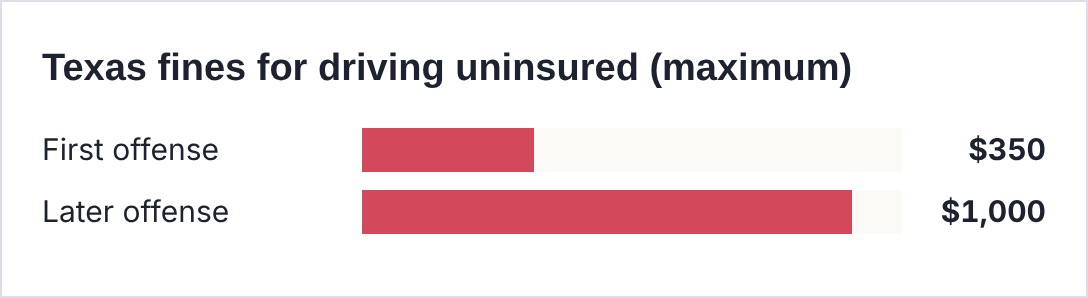
Texas Transportation Code § 601.191. First offense $175 to $350; later offense $350 to $1,000. Impound and suspension can add more.
Unlike Georgia and Florida, Texas does not charge an automatic lapse fee just because a policy ends. But driving without coverage is illegal, an uninsured result can cause problems at a traffic stop or registration renewal, and a gap can raise your future premiums. Short-term coverage should start before you drive and continue as long as you do.
Ending temporary coverage the right way
When you no longer need coverage, stop driving the car before the policy ends. If you sold it, file a Vehicle Transfer Notice with the Texas Department of Motor Vehicles, which also helps keep TexasSure from flagging you later. If you are switching insurers, have the new policy start the same day the old one ends.
PRO TIP #1Check that your VIN, name, and address match your Texas registration exactly. A mismatch is a common reason TexasSure shows a vehicle as unconfirmed. Your insurer can correct it, and the fix should appear in the next weekly upload.
Your temporary car insurance options in Texas
1. A standard policy canceled early
This is the most widely available route and the only one that reliably includes full coverage. You buy a six-month policy and cancel when you no longer need it. With a pro rata refund, you get back all unused premium; with a short-rate refund, an insurer may keep 10% to 15% of the unearned premium, according to an analysis updated August 31, 2026. Ask before you buy.
Hypothetical: one month on a Texas minimum-coverage policy
Refund method | Six-month premium | Premium used (1 month) | Penalty | Cost for one month |
|---|---|---|---|---|
Pro rata, no fee | $270 | $45 | $0 | $45 |
Short-rate, 10% of unearned | $270 | $45 | $22.50 | $67.50 |
Short-rate, 15% of unearned | $270 | $45 | $33.75 | $78.75 |
Hypothetical; our calculation, using State Farm's $45 monthly minimum-coverage average in a Texas rate study updated October 9, 2026 (× 6 = $270). Unearned premium after one month: $225. Your quote and refund terms will differ.
Texas also limits how much an insurer could historically ask up front. A 1997 Texas Department of Insurance rule required insurers to offer an installment plan with a down payment of no more than about two months of premium, a useful benchmark when you are comparing first payments.
2. Weekly-payment liability plans
Insurify Car, sold through an online agency, offers basic liability coverage in Texas paid one week at a time, with same-day coverage typically available. The Texas analysis advertises it "as low as $23/week," while its table lists an average monthly liability quote of $144. You can stop when you are done. It does not cover damage to your own car, and weekly plans generally do not file SR-22 forms.
3. Texas-only short-term and month-to-month insurers
Texas has insurers that sell only in the state. Alinsco, a Texas-only insurer, has listed a policy called Zoom that provides short-term coverage for as few as 30 days, according to an Insurify review, along with a standard six-month policy. Its average quotes in that review were $148 a month for liability-only and $232 for full coverage. The review also noted that Alinsco's parent company had a 1-out-of-5 BBB rating, so read reviews and confirm current terms before you buy.
Dillo, which is underwritten by Alinsco and sells only in Texas, does not check credit and offers month-to-month policies and SR-22 filings, according to two 2026 analyses. One noted that its rates are higher than mainstream insurers'. These companies can help drivers who want a short term or have credit or record problems, but compare them with the cheapest mainstream options below.
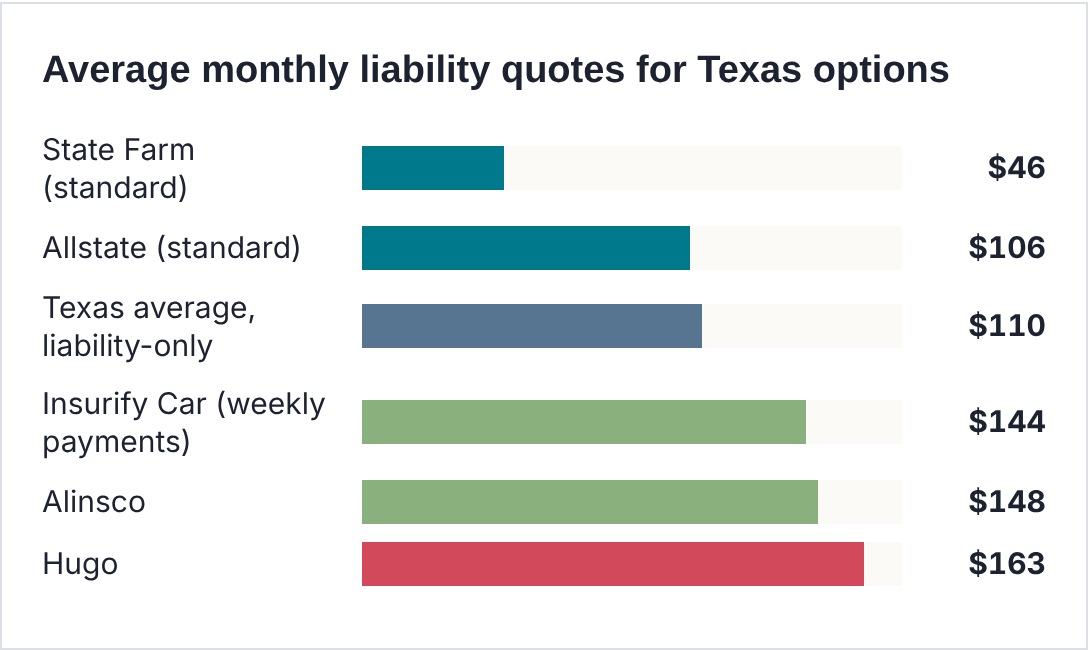
Insurify Texas analyses (rates current to September 30, 2026) and Insurify's Alinsco review. Hugo's Texas availability is disputed by another source; confirm before buying. Averages, not quotes.
The pattern is clear: flexibility costs more per month. State Farm's standard liability-only coverage averaged $46, about a third of the weekly-payment plan's $144 average in the same data (our calculation). For anything longer than a few weeks, a cancelable standard policy is usually cheaper.
4. Pay-as-you-go coverage
One Texas quote analysis lists Hugo at an average of $163 a month for liability-only coverage. Another 2026 source says Hugo is not offered in Texas, so confirm availability on Hugo's website before relying on it. Where Hugo is sold, you can start with as little as three days of coverage, per a September 2026 review.
5. Non-owner insurance
If you do not own a car but will drive borrowed or rented ones in Texas, a non-owner policy gives you liability coverage. The Texas analysis put non-owner coverage at about $50 a month, usually sold in terms of six months or longer. It does not pay for damage to the car you drive, but it meets state minimums and can satisfy an SR-22 requirement with insurers that offer it.
6. Rental car coverage
Texas welcomed 62 million visitors in 2024, according to the Texas analysis, and many of them rent cars. Rental companies offer coverage at pickup that lasts for the rental period. One national analysis put rental car insurance at $9 to $30 a day, and a June 2026 consumer report said counter coverage often costs $30 to $60 a day. Check your own auto policy and credit card first; most cards offer only secondary coverage and usually exclude liability.
7. Being added to someone else's policy
If you are staying with family in Texas, ask to be added to their policy. It can cost less than a separate policy, though it may raise the owner's premium. Occasional drivers with permission may already be covered under the owner's policy, but rules vary, so the owner should check with the insurer first.
8. The Texas Automobile Insurance Plan
Drivers no company will cover can apply through the Texas Automobile Insurance Plan Association (TAIPA), which assigns them to an insurer. Its plan offers an installment option with a deposit of at least 20% of the annual premium or $40 per vehicle, whichever is greater. It is not short-term coverage, but it is a legal safety net for hard-to-insure drivers.
Truly temporary coverage Texans can buy: Mexico auto insurance
There is one kind of genuinely temporary car insurance many Texans buy: coverage for a trip across the border. Your U.S. policy does not cover you in Mexico. GEICO says "your US insurance policy will not cover your vehicle while driving in Mexico," and that Mexican law requires vehicles on federal roads to carry third-party liability insurance. Progressive says that if you are at fault in a crash without it, authorities can detain you until liability coverage is verified.
These policies are sold by the day. GEICO's agency offers daily, six-month, and annual Mexico policies through a licensed broker, and Progressive points customers to a provider offering coverage periods "from one day up to a year." Progressive also says its Texas policyholders can get physical damage coverage for occasional trips into Mexico within 25 miles of the border, so ask your own insurer what applies before you go.
How Texas compares with other states
Texas is more forgiving than some states when a policy ends, but stricter than many about verification.
Ending coverage: Texas vs. Georgia and Florida
State | What happens when coverage ends on a registered car | Fees |
|---|---|---|
Texas | No automatic lapse fee; TexasSure flags uninsured vehicles, and driving uninsured brings fines | Fines of $175 to $1,000 if ticketed |
Georgia | A gap of 10 or more days is a lapse; registration can be suspended | $25 lapse fee, plus $60 or $160 to reinstate |
Florida | Insurer reports within 10 days; license and registration can be suspended | $150, $250, or $500 to reinstate |
Texas Transportation Code § 601.191; Georgia Department of Revenue; Florida Statutes § 324.0221. Summarized; see each state's rules for details.
Buying a car in Texas: buyer's tags and insurance
When you buy from a Texas dealer, the dealer issues a buyer's temporary tag. Under Transportation Code § 503.063, it is valid until the vehicle is registered or the 60th day after purchase, whichever comes first, and the dealer can charge a registration fee of no more than $5. The tag lets you drive, but it does not insure you.
If you already have a policy, call your insurer before you drive away. Many insurers give a grace period of about 7 to 30 days to add a newly bought car, according to a June 2026 rate study, though some give only a few days and some give none. If you do not have a policy, you can usually buy one the same day; have the VIN from the sales paperwork ready.
How much does short-term car insurance cost in Texas?
Texas costs a bit more than average. The Texas analysis put the average at $2,470 a year, about 15% above the U.S. average of $2,144, and said Texas average auto rates rose 4.8% in 2024 and 0.9% in 2025, citing the Texas Department of Insurance. Two 2026 analyses show the cheapest companies. Study A is a rate study updated October 9, 2026, using a 40-year-old driver. Study B is a real-quote analysis with rates current to September 30, 2026. Compare each only with itself.
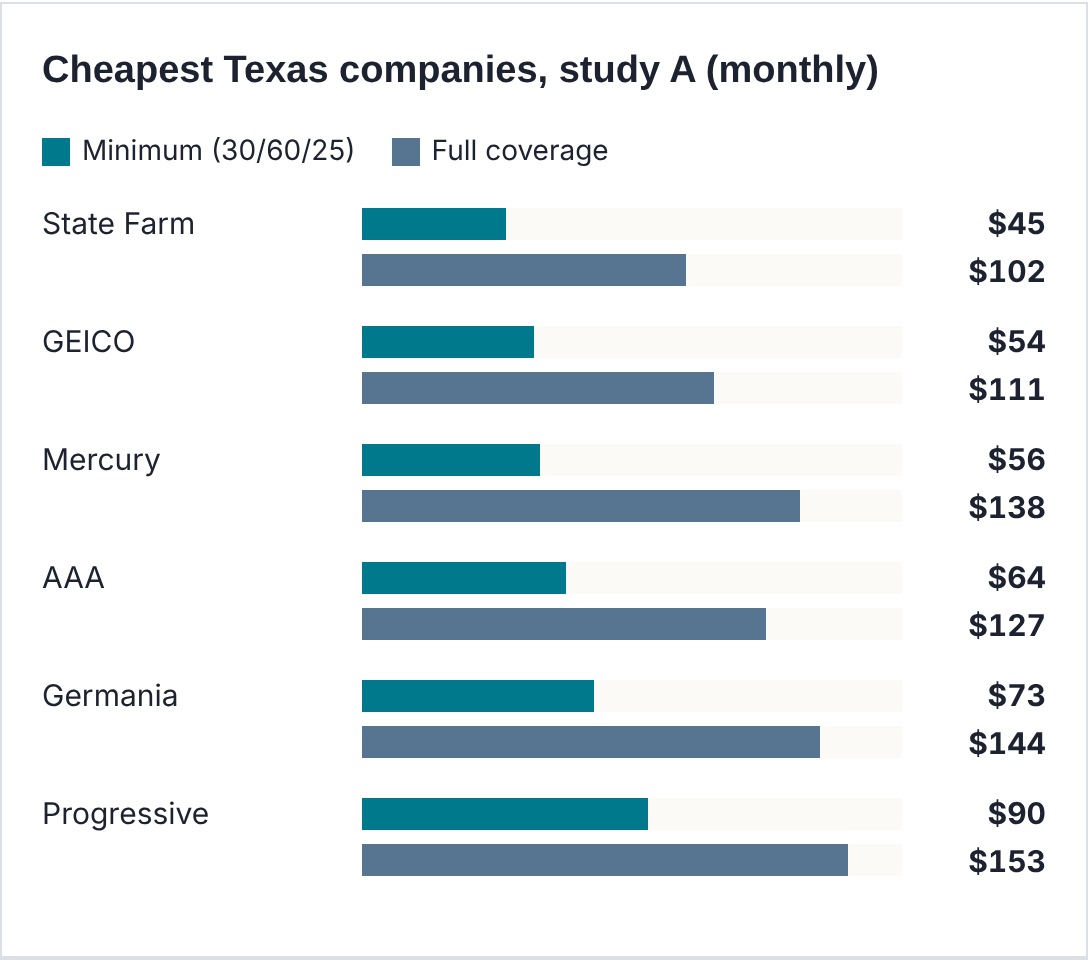
Study A: Texas rate study updated October 9, 2026; 40-year-old driver; full coverage at 100/300/100. Study averages: $73 minimum, $165 full coverage.
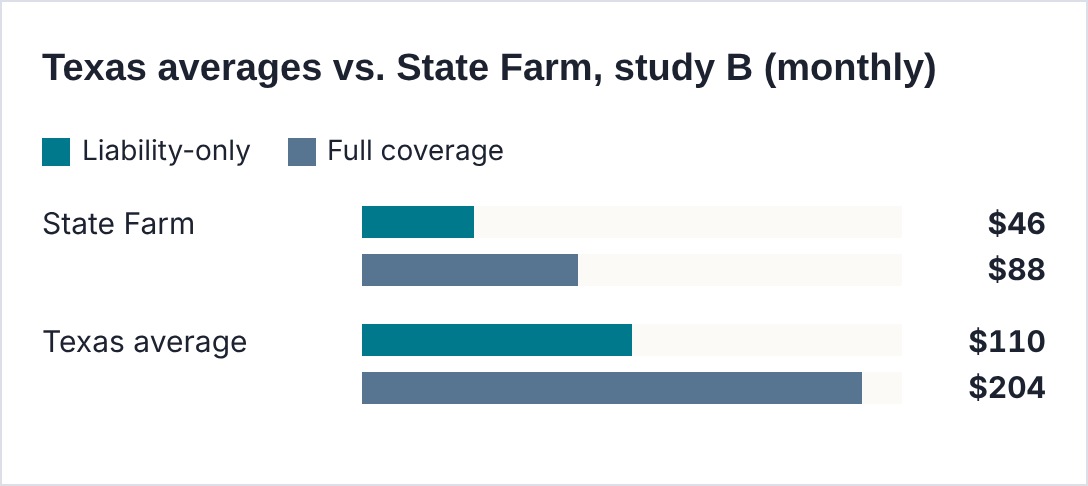
Study B: Texas real-quote analysis updated October 17, 2026; rates current to September 30, 2026.
Hypothetical: monthly savings vs. the Texas average
Coverage | Average (monthly) | State Farm (monthly) | Savings per month (our calculation) |
|---|---|---|---|
Study A: minimum coverage | $73 | $45 | $28 |
Study A: full coverage | $165 | $102 | $63 |
Study B: liability-only | $110 | $46 | $64 |
Study B: full coverage | $204 | $88 | $116 |
Our calculation within each study. Averages, not quotes.
Cars that are cheaper to insure in Texas
If you are buying a car for a short stretch, the model matters. A rate study updated August 13, 2026, found the lowest average full-coverage premiums in Texas for the Hyundai Venue, Chevrolet TrailBlazer, Honda HR-V, Volkswagen Taos, and Volkswagen Tiguan, all small SUVs within $49 of each other over six months.
Temporary coverage for special situations in Texas
Visitors. If you are visiting with your own car, your home-state policy generally travels with you; confirm with your insurer. Without a car, use the owner's policy, rental coverage, or a non-owner policy.
New residents. Once you register a car in Texas, it needs Texas liability coverage that TexasSure can verify. Line up a Texas policy before you register, and keep your old policy until the new one starts.
College students. A student bringing a car to a Texas campus for a semester usually does best on a parent's policy. A student without a car who borrows or rents may want non-owner coverage.
Seniors. The Texas analysis found State Farm cheapest for seniors at $36 a month.
Drivers with poor credit or a high-risk record. State Farm was also cheapest for drivers with bad credit ($67 a month) and high-risk drivers ($57) in the same analysis. Dillo does not check credit at all.
Drivers needing an SR-22. The Texas analysis put SR-22 coverage at about $198 a month. DPS requires an SR-22 after certain suspensions, a second or later uninsured-driving conviction, or an unpaid crash judgment, kept for two years. Weekly plans generally do not file SR-22s, but Dillo says it does.
Best temporary option by Texas situation
Your situation | Best option | Why |
|---|---|---|
Visiting and borrowing a car | Owner's policy or a non-owner policy | No vehicle coverage needed |
Renting for a trip | Rental coverage, your own policy, or a card benefit | Coverage for the rental period |
Owning a Texas-registered car for a few weeks | Weekly-payment plan or a cancelable standard policy | Weekly for very short; standard for longer |
Owning a car for a few months | Standard policy canceled early | Cheapest per month; full coverage available |
Needing an SR-22 | Standard policy or a Texas specialist that files SR-22s | Weekly plans generally do not |
Turned down by insurers | TAIPA | Legal coverage through an assigned insurer |
How to get temporary car insurance in Texas, step by step
- Decide what you need to cover: your own car, a borrowed car, or a rental.
- Get quotes from the cheapest Texas companies, such as State Farm, GEICO, Mercury, and AAA.
- Compare flexible options such as weekly-payment plans and Texas-only short-term insurers.
- Use at least 30/60/25 limits, and decide on PIP and uninsured motorist coverage before you reject anything in writing.
- Ask about cancellation: pro rata or short-rate refund, and any fee.
- Check your VIN, name, and address so TexasSure can match your policy.
- Save your proof of insurance on paper or your phone before you drive.
- When you are done, stop driving before coverage ends, and file a Vehicle Transfer Notice if you sold the car.
Questions to ask a Texas insurer
- What is the shortest term you sell, and can I cancel at any time?
- Is the refund pro rata or short-rate, and is there a fee?
- Does the price include PIP and uninsured motorist coverage?
- Do you file SR-22 forms?
- How soon will my policy appear in TexasSure?
Pros and cons of temporary coverage in Texas
Pros | Cons |
|---|---|
Weekly-payment and Texas-only short-term options exist | Flexible options averaged far more per month than standard liability |
Standard policies can include full coverage and be canceled early | Short-rate refunds or fees can raise the cost of a short stay |
No automatic lapse fee like some states | TexasSure flags uninsured vehicles, and fines reach $1,000 |
Non-owner coverage averaged about $50 a month | Some Texas-only insurers have weak customer ratings |
For more than a few weeks, price a standard six-month policy first. In study B, State Farm's liability-only coverage averaged $46 a month, versus $144 for the weekly-payment plan in the same analysis. Choose a pro rata refund policy and cancel when you are done.
Common mistakes to avoid
Rejecting PIP or uninsured motorist coverage without thinking. With about one in eight Texas drivers uninsured, that protection matters.
Driving before the policy starts. A buyer's tag lets you drive legally but does not insure you.
Assuming an "unconfirmed" TexasSure result means you are uninsured. Carry proof; new policies can take a weekly cycle to appear.
Choosing a weekly plan for a long stay. Over a month or more, a standard policy is often much cheaper.
Texas temporary car insurance at a glance
This illustrated summary pulls together the rules and options covered above.
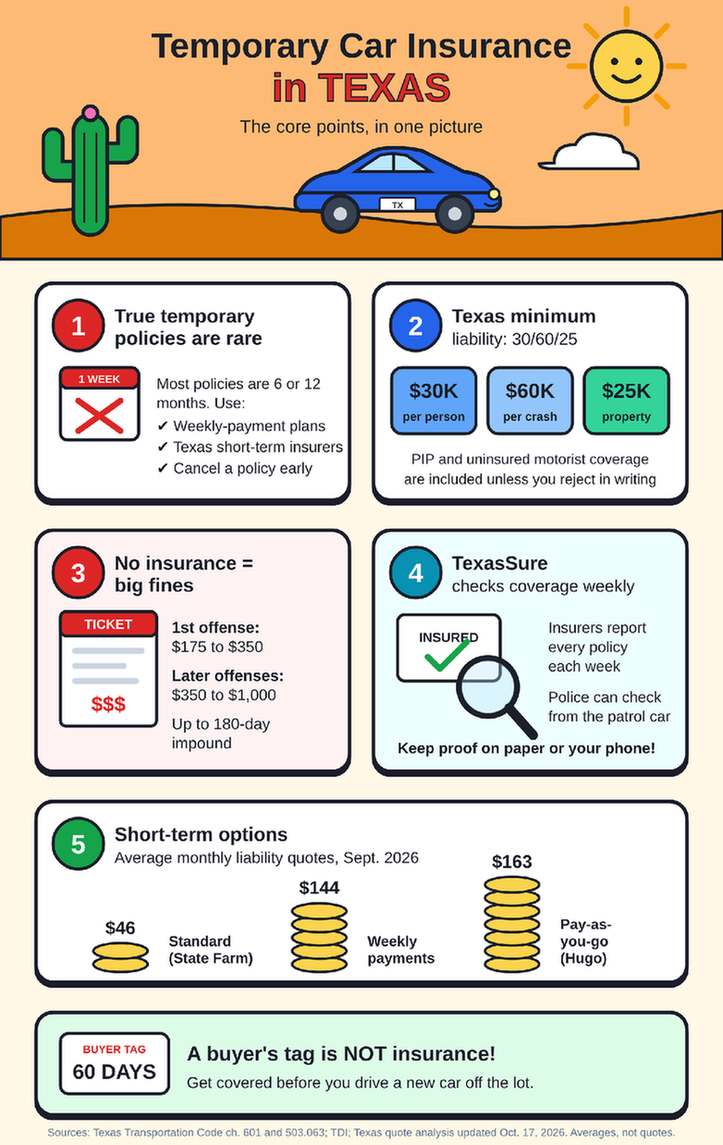
Texas temporary car insurance at a glance. Sources: Texas Transportation Code ch. 601 and § 503.063; TDI; Texas quote analysis updated October 17, 2026. Averages, not quotes.
Frequently asked questions
Can you get temporary car insurance in Texas?
Not as a standard product from major insurers, but Texas has close substitutes: weekly-payment liability plans, Texas-only insurers with short-term or month-to-month policies, non-owner coverage, rental coverage, and standard six-month policies you can cancel early with a refund of unused premium.
What is the minimum car insurance in Texas?
Texas requires $30,000 per injured person, $60,000 per crash for injuries, and $25,000 for property damage. Insurers must also include personal injury protection and offer uninsured motorist coverage, which you can decline only in writing. Lenders usually require collision and comprehensive.
How much is weekly car insurance in Texas?
A Texas quote analysis advertises Insurify Car's weekly-payment liability coverage "as low as $23/week," while its table shows an average monthly liability quote of $144 as of September 30, 2026. Prices depend on your profile, so get your own quote.
Is there 30-day car insurance in Texas?
Possibly. An Insurify review says Texas-only insurer Alinsco has listed a Zoom policy for as few as 30 days, and two 2026 analyses say Dillo offers month-to-month policies. Confirm current terms directly, check customer reviews, and compare prices with cancelable standard policies.
What is TexasSure?
TexasSure is the state's insurance verification database. Insurers report every personal auto policy to it weekly, and police can check it from patrol cars. An unconfirmed result is not proof you are uninsured, so keep your ID card on paper or your phone.
What is the penalty for driving without insurance in Texas?
A first offense carries a fine of $175 to $350, and a later offense $350 to $1,000. After a second conviction, your license can be suspended unless you keep proof of insurance for two years, and your vehicle can be impounded for up to 180 days.
Do I need insurance to drive with a Texas buyer's tag?
Yes. A dealer's buyer's tag lasts up to 60 days and lets you drive before registration, but it does not insure you. If you already have a policy, your insurer may cover a new car for a short grace period; call to confirm before you leave.
What is the cheapest car insurance in Texas?
In a Texas rate study updated October 9, 2026, State Farm was cheapest at $45 a month for minimum coverage and $102 for full coverage, followed by GEICO. In real-quote data, State Farm also led at $46 for liability-only and $88 for full coverage.
The final word on temporary car insurance in Texas
For most Texans who need a few weeks or months of coverage on their own car, a standard policy from a low-cost insurer, canceled with a pro rata refund, is the best temporary solution. Use a weekly-payment plan only for very short needs, a non-owner or rental policy if you do not own the car, and TAIPA if no one else will cover you. Whatever you choose, keep proof handy for TexasSure.
NEXT STEPWrite down the dates you need coverage and the car you will drive. Get three quotes with at least 30/60/25 limits, decide on PIP and uninsured motorist coverage, ask about refund terms, and save your proof of insurance before you drive.
Prices, availability, cancellation terms, and state rules can change. The figures in this article are averages, published rules, and hypothetical calculations, not quotes. This article is for information only and is not legal or financial advice. The publisher is not an insurance company or a licensed insurance agency.
The bottom line on temporary car insurance in Texas: true short-term policies are rare, but weekly-payment plans, Texas specialists, non-owner coverage, and cancelable standard policies can cover almost any short-term need, as long as your coverage shows up in TexasSure.
Sources
- Texas Transportation Code, Chapter 601 and § 503.063 (accessed October 2026).
- Texas Insurance Code § 1952.152, § 1952.153, and 28 Tex. Admin. Code § 5.9970.
- Texas Department of Insurance, TexasSure bulletin and Bulletin B-0039-97.
- Texas Department of Motor Vehicles, TexasSure Insurance Verification (accessed October 2026).
- LegalClarity, TexasSure Verification Errors and Fixes (accessed October 2026).
- Texas Department of Public Safety, Financial Responsibility Insurance Certificate (SR-22) (accessed October 2026).
- Texas Automobile Insurance Plan Association, Plan of Operation (2025).
- Insurify, Temporary Car Insurance in Texas (updated October 17, 2026) and Alinsco Auto Insurance Review (accessed October 2026).
- MoneyGeek, Cheapest Car Insurance in Texas (updated October 9, 2026) and Which Insurance Companies Don't Use Credit Scores? (updated October 1, 2026).
- CarInsurance.com, Cheapest Cars to Insure in Texas (updated August 13, 2026) and New Car Grace Period (updated June 26, 2026).
- GEICO, Car Insurance for Tourists Driving in Mexico and Progressive, Do You Need Car Insurance for Your Mexico Trip? (updated February 1, 2024).
- Georgia Department of Revenue, Lapse Fines and Florida Statutes § 324.0221.
- MoneyGeek, Car Insurance Refund (August 31, 2026).
- Credit Karma, Hugo Auto Insurance Review (updated September 17, 2026) and OCHO, Hugo Insurance Alternatives (June 22, 2026).
- Insurify, One-Week Car Insurance (updated September 30, 2026) and First Alert 4, Understanding Rental Car Insurance (June 23, 2026).