
Temporary Car Insurance in North Carolina
Whether you are home from college in Chapel Hill for the summer, borrowing a car for a few weeks in Charlotte, or parking a car while you deploy from Fort Bragg, finding temporary car insurance in North Carolina takes more planning than in most states. North Carolina has no daily, weekly, or monthly policies, and the Division of Motor Vehicles (NCDMV) fines owners who cancel coverage before returning their license plate.
The good news is that North Carolina is one of the cheapest states for car insurance, and a short-term need can still be covered well. This guide explains the state's new minimum limits, the plate-first rule, the lapse penalties, every short-term option with 2026 North Carolina prices, and a step-by-step plan. Every figure is sourced and dated, and hypothetical examples are labeled.
- No short-term policies. North Carolina insurers sell six- or 12-month terms, so short-term drivers cancel early or use non-owner, rental, or stored-vehicle coverage.
- Turn in the plate first. NCDMV says to cancel insurance only after you return the plate, or you face a fine.
- Lapse penalties are $50, $100, or $150, plus a $50 restoration fee if the registration is revoked.
- Cheapest coverage: Erie averaged $55 a month for liability-only, and Allstate $89 for full coverage, in 2026 real-quote data.
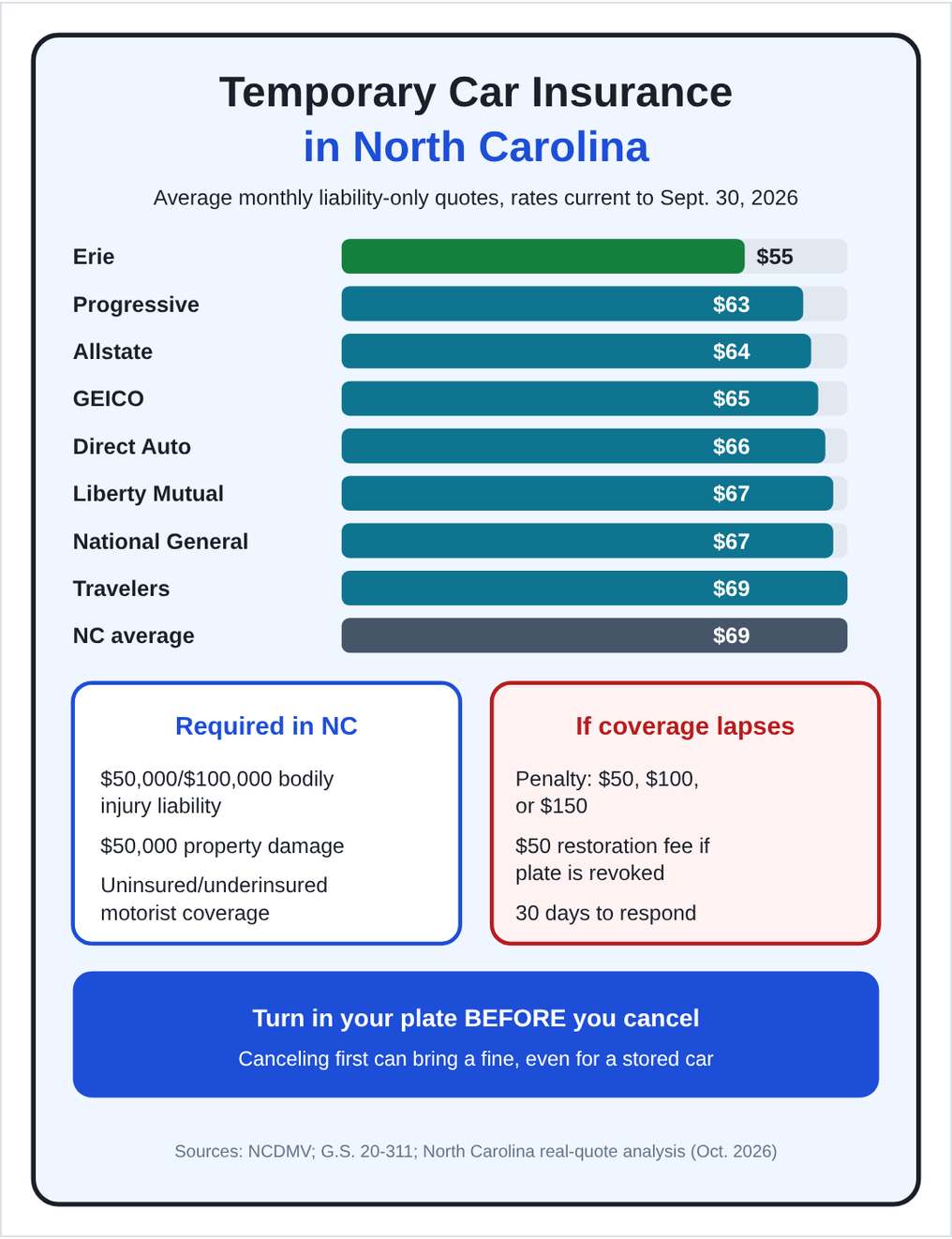
Average monthly liability-only quotes in North Carolina from a real-quote analysis updated November 5, 2026 (rates current to September 30, 2026), plus required coverage and NCDMV lapse rules. Averages, not quotes.
Does temporary car insurance exist in North Carolina?
No. A North Carolina analysis updated September 30, 2026, says plainly that "there isn't any short-term car insurance, such as daily, weekly, or monthly policies" in the state. Insurers offer six- or 12-month terms, usually paid monthly unless you prepay. Unlike some states, North Carolina has no weekly program in the sources we reviewed.
The same analysis lists the practical alternatives: canceling a six-month policy early, pay-per-mile or usage-based insurance, non-owner insurance, rental car coverage, joining someone else's policy, and comprehensive-only coverage for a stored vehicle.
Short-term car insurance options in North Carolina
Option | How it works | Covers your own car? | Best for |
|---|---|---|---|
Standard policy, canceled early | Six-month policy; return the plate, then cancel | Yes, with full coverage | Owners who need a car for a few months |
Non-owner insurance | Liability when you drive cars you do not own | No | People who borrow or rent |
Rental car coverage | Bought for the rental period | Yes, with a damage waiver | Short rentals |
Added to someone else's policy | The owner adds you, or covers you as a permitted driver | Depends on their policy | Students and visiting relatives |
Stored-vehicle coverage | Comprehensive only on a car that is not driven | Theft and damage only | Cars parked for months, with the plate returned |
North Carolina temporary insurance analysis updated September 30, 2026; NCDMV. Availability varies by insurer.
North Carolina car insurance requirements
North Carolina raised its minimum limits for policies issued or renewed on or after July 1, 2025. According to NCDMV, every vehicle with a valid North Carolina registration must carry continuous liability insurance from a company licensed in North Carolina, and out-of-state policies are not accepted.
North Carolina minimum coverage, old and new
Coverage | Before July 1, 2025 | On or after July 1, 2025 |
|---|---|---|
Bodily injury, one person | $30,000 | $50,000 |
Bodily injury, two or more people | $60,000 | $100,000 |
Property damage | $25,000 | $50,000 |
Uninsured/underinsured motorist | Required | Required |
NCDMV, Insurance Requirements (accessed October 2026); G.S. 20-309 and 20-279.21.
Uninsured and underinsured motorist coverage is required on every North Carolina policy, even one above the minimum limits. That is a real protection: about 11.8% of North Carolina drivers were uninsured in 2023, according to the Insurance Research Council. Collision and comprehensive coverage are optional by law, though lenders usually require them.
The plate-first rule: how to end coverage in North Carolina
This is the most important rule for anyone buying short-term coverage in North Carolina. Insurers must notify NCDMV when coverage is canceled or lapses. NCDMV's instruction is direct: cancel insurance only after you have turned in the plate. Canceling first can result in a fine for failing to keep continuous coverage, and that applies even if you are storing the car.
You can return a plate at any NCDMV license plate agency or mail it to NCDMV Vehicle Registration Section, Renewal Title & Plate Unit, 3148 Mail Service Center, Raleigh, NC 27697-3148. Receipts are available on request at an agency or by mail, but not from the drop box at Raleigh Central Services, so use an agency or mail if you want proof.
PRO TIP #1Get a receipt for your plate, then cancel. Return the plate at a license plate agency, keep the receipt, and only then call your insurer. That order is what keeps a short-term policy from turning into a lapse penalty.
What happens after a lapse notice
When NCDMV learns of a termination, it sends the owner a notice. NCDMV says owners have had 10 days from the notice date to respond, and starting October 1, 2026, the response window is 30 days. If the coverage never actually lapsed, the insurer can send NCDMV a Certificate of Insurance (Form FS-1) electronically, and NCDMV clears the record.
That is also why the FS-1 matters when you buy a new policy after a gap. Your North Carolina insurer files it with NCDMV, and once NCDMV receives an FS-1 showing continuous coverage, it updates its records and clears any fines. You can confirm a lapse has been cleared through NCDMV's Contact Us form or by calling 919-715-7000.
North Carolina lapse penalties
Penalties in the past three years | Civil penalty |
|---|---|
None | $50 |
One | $100 |
Two or more | $150 |
G.S. 20-311(b); NCDMV. A $50 restoration fee, plus the plate fee, is due to re-register a revoked vehicle.
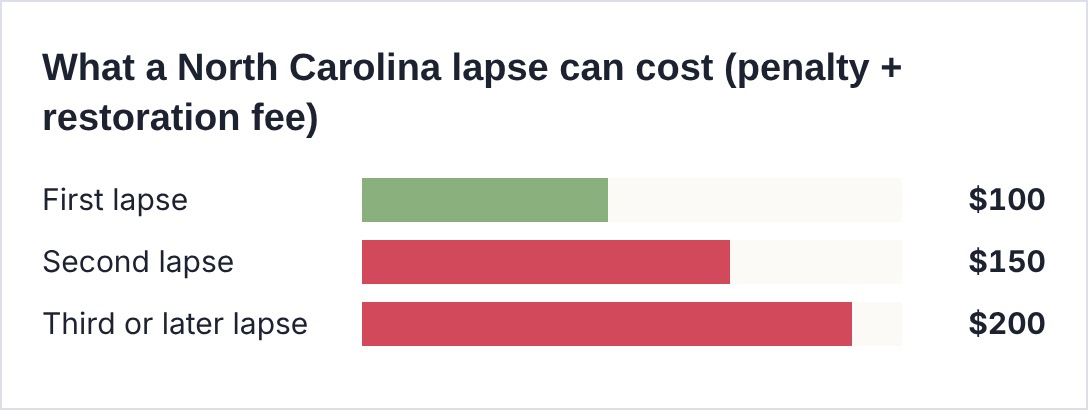
Our calculation: civil penalty ($50, $100, or $150) plus the $50 restoration fee required when registration is revoked, per G.S. 20-311. Excludes plate fees, online payment fees, and the cost of new coverage.
G.S. 20-311 also sets out what happens depending on your answer. If the lapse was cured, the car was not in an accident, and no one knowingly drove it uninsured, the owner pays a penalty only. If the owner is still uninsured, or the car was driven or in a crash while uninsured, the registration is also revoked.
A revocation for knowingly driving uninsured, or for a crash during a lapse, lasts 30 days. A revocation for having no coverage or not responding lasts until the problem is fixed.
Who avoids a penalty under G.S. 20-311
Situation | Result |
|---|---|
Car sold within 10 days of coverage ending, not driven, plate returned | No penalty |
Moved and registered in another state within 30 days; NC plate returned | Penalty and fee waived |
Military member deployed outside the continental U.S. for 45+ days | Penalty and fee waived |
Sole owner died while insured | No penalty or revocation |
G.S. 20-311; NCDMV. Summarized; read the statute or contact NCDMV for your situation.
Driving without insurance is a separate offense. A North Carolina analysis describes it as a Class 3 misdemeanor, and a gap in coverage can make future insurance harder to buy.
Your temporary car insurance options in North Carolina
1. A standard policy canceled early
For most people who own a North Carolina-registered car, this is the only practical route. Buy a six-month policy, use it as long as you need, return the plate, and then cancel. Ask about the refund method before you buy. A North Carolina agency writes that a short-rate penalty can apply when the policyholder cancels mid-term, using about 10% of the unearned premium in its example, while a pro rata refund returns all of it.
Hypothetical: one month on a North Carolina liability-only policy
Refund method | Six-month premium | Premium used (1 month) | Penalty | Cost for one month |
|---|---|---|---|---|
Pro rata, no fee | $330 | $55 | $0 | $55 |
Short-rate, 10% of unearned | $330 | $55 | $27.50 | $82.50 |
Hypothetical; our calculation, using Erie's $55 monthly liability-only average in a North Carolina real-quote analysis (rates current to September 30, 2026) × 6 = $330. Unearned premium after one month: $275. Your insurer's terms will differ.
2. Non-owner insurance
If you do not own a car but will borrow or rent one, a non-owner policy gives you liability coverage without a registered vehicle, so there is no plate to manage. A national analysis put non-owner coverage at $29 to $74 a month. It does not pay for damage to the car you drive.
3. Rental car coverage
For a short rental, one national analysis put rental car insurance at $9 to $30 a day, and a June 2026 consumer report said counter coverage often costs $30 to $60 a day. Check your own policy and card benefits first, since most cards offer only secondary coverage and usually exclude liability.
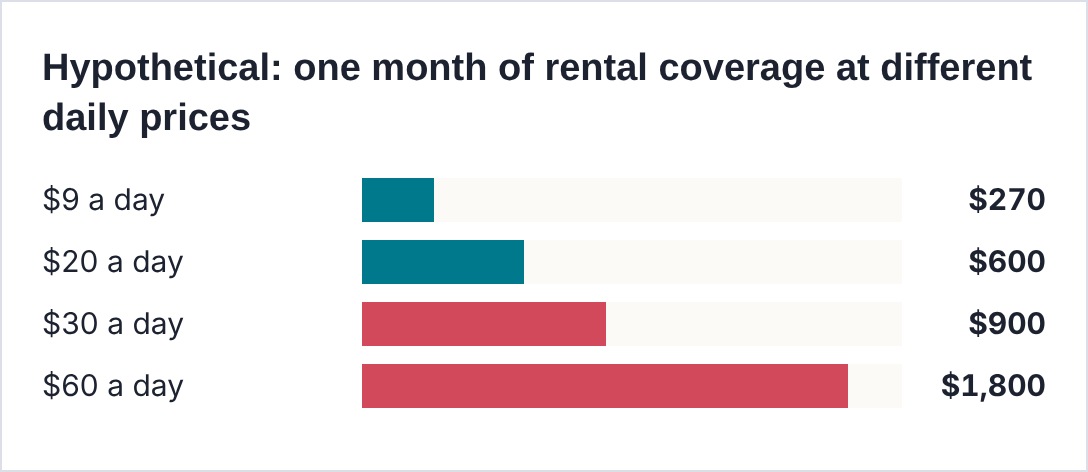
Our calculation: daily price × 30. Daily ranges from a national analysis (September 30, 2026) and a June 23, 2026, consumer report.
4. Being added to someone else's policy
College students home for the summer and relatives staying a few weeks can often be added to the owner's policy, or may already be covered as permitted drivers. The North Carolina analysis lists both. Check with the owner's insurer first.
5. Stored-vehicle coverage
If the car will sit for months, comprehensive-only coverage protects it against theft, fire, and other damage. Remember the plate rule: because liability is dropped, return the plate to NCDMV before you change the coverage.
6. Pay-per-mile insurance
The North Carolina analysis lists pay-per-mile insurance as an option, but the three major programs we checked do not cover the state. Nationwide SmartMiles is not available in North Carolina, Allstate Milewise does not list it among its 22 states, and Mile Auto's seven states do not include it. Ask local agents whether any insurer offers a usage-based option.
7. High-risk drivers and the Reinsurance Facility
North Carolina handles high-risk drivers differently from most states. Through the North Carolina Reinsurance Facility, created in 1973, licensed carriers and agents must accept statutorily eligible applicants for the coverages that can be ceded to the Facility, including liability, medical payments, and uninsured and underinsured motorist coverage. An insurer that does not want to keep the risk can cede it to the Facility, but you still deal with your own insurer.
How much does short-term car insurance cost in North Carolina?
North Carolina is one of the most affordable states. In real-quote data, North Carolina averaged $69 a month for liability-only and $113 for full coverage.
Rates are set differently here: the North Carolina Rate Bureau, which represents more than 100 insurers, files rate requests, and the Commissioner of Insurance reviews them. In 2025, the Bureau asked for an average increase of about 22.6%. A settlement announced that June instead produced an average 5% increase in base rates starting October 1, 2025, and the settled rates stay in effect for at least a year. Because rates move through this process, prices tend to change on a predictable schedule.
Two 2026 analyses show the cheapest companies. Study A is a rate study updated September 17, 2026, using a 40-year-old driver and the new 50/100/50 minimums. Study B is a real-quote analysis with rates current to September 30, 2026. Compare each only with itself.
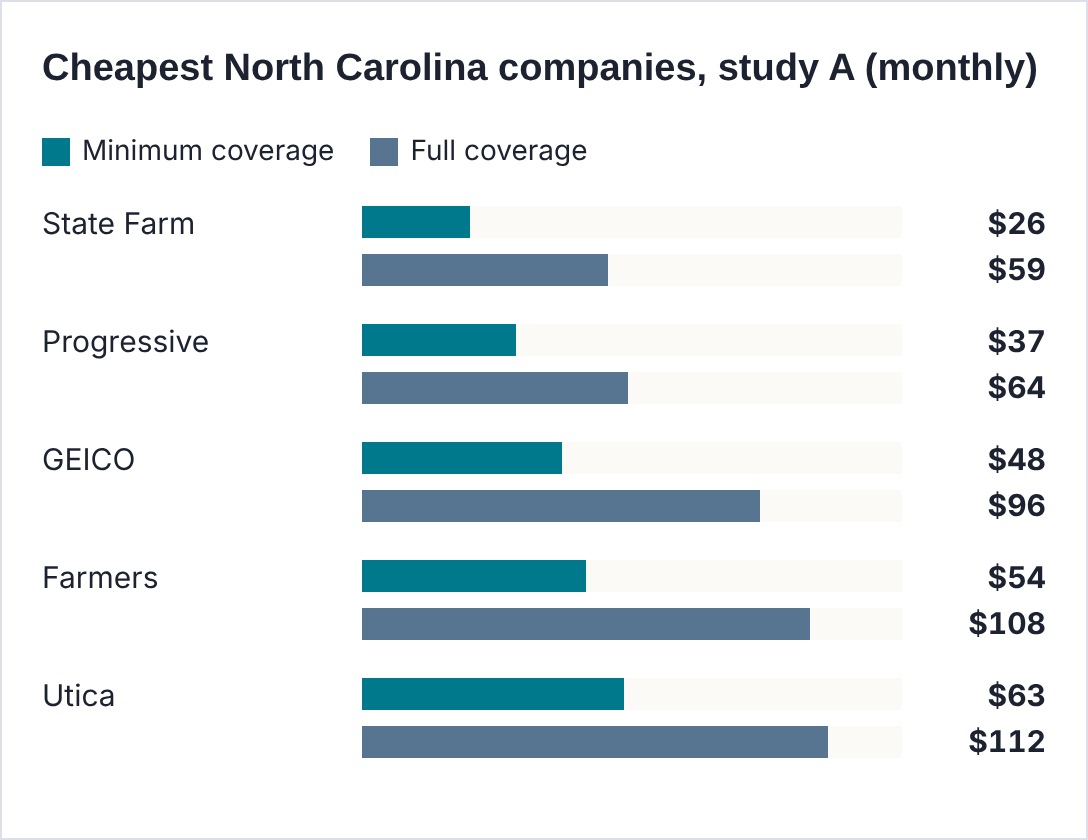
Study A: North Carolina rate study updated September 17, 2026; 40-year-old driver, 2012 Toyota Camry; minimum coverage at 50/100/50; full coverage at 100/300/100 with a $1,000 deductible.
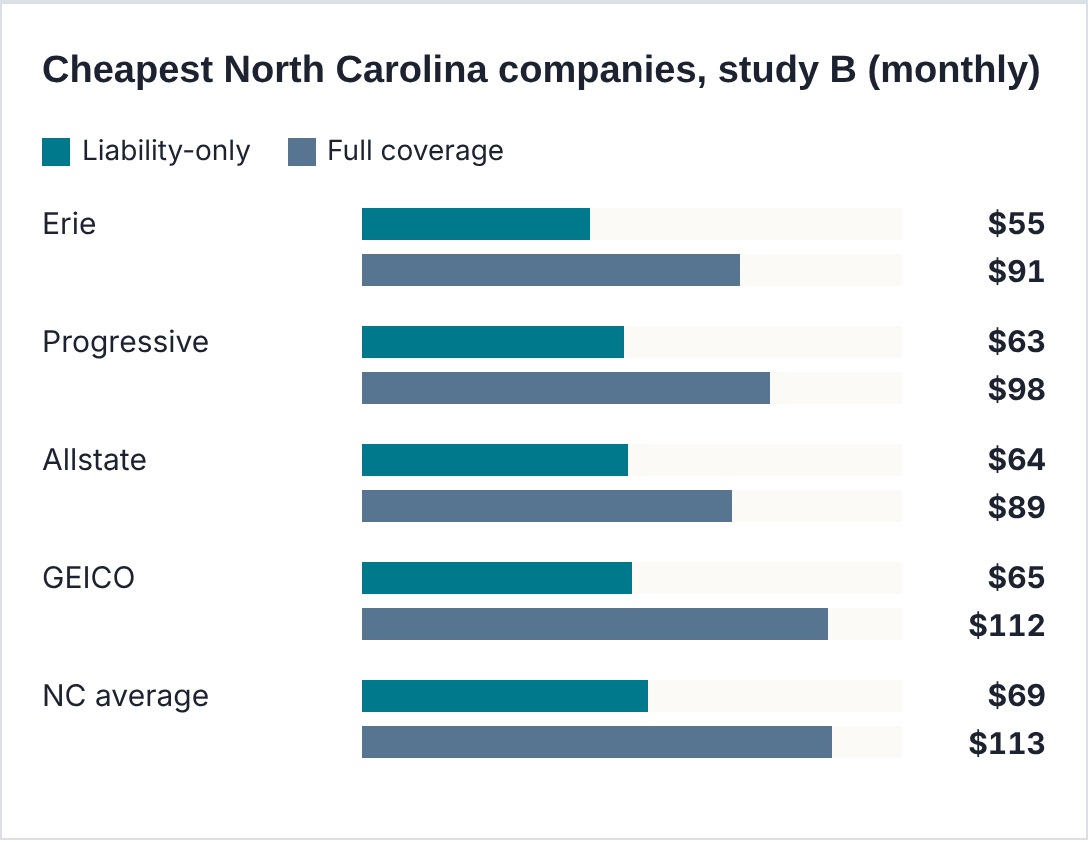
Study B: North Carolina real-quote analysis updated November 5, 2026; rates current to September 30, 2026.
Prices across North Carolina cities
In study A, State Farm had the cheapest minimum coverage in all 20 cities listed, from $19 a month in Apex to $32 in Charlotte.
Cheapest minimum coverage in selected North Carolina cities, study A
City | Cheapest company | Monthly |
|---|---|---|
Apex | State Farm | $19 |
Asheville | State Farm | $20 |
Chapel Hill | State Farm | $20 |
Winston-Salem | State Farm | $21 |
Durham | State Farm | $24 |
Greensboro | State Farm | $27 |
Raleigh | State Farm | $27 |
Fayetteville | State Farm | $29 |
Wilmington | State Farm | $29 |
Charlotte | State Farm | $32 |
Study A: North Carolina rate study updated September 17, 2026; minimum coverage. Averages, not quotes.
Temporary coverage for special situations in North Carolina
College students. With large campuses across the state, many students only need a car for a semester or a summer. A student on a parent's policy usually pays least. A student who borrows or rents may want non-owner coverage.
Teens. In study A, State Farm was cheapest for teens on a family policy at $184 a month at 16, $141 at 17, and $124 at 18. Study B found Erie cheapest for teens at $99 a month, with 16-year-olds averaging $166.
Seniors. In study A, State Farm was cheapest for drivers 70 and older at $62 a month for full coverage, followed by Progressive at $64.
Drivers with a DWI or accident. North Carolina calls drunk driving DWI. In study A, State Farm was cheapest after a DUI at $194 a month and after an at-fault accident at $75. Study B put DWI drivers at $174 a month for liability and SR-22 drivers at $79 for liability.
Military members. North Carolina is home to several large military bases. Under G.S. 20-311, lapse penalties and restoration fees are waived for members deployed outside the continental U.S. for 45 days or more at the time of the notice.
Buying a car. Many insurers give a grace period of about 7 to 30 days to add a newly bought car, according to a June 2026 rate study, but some give only a few days. Because North Carolina requires coverage before you register, line up a policy first.
Best temporary option by North Carolina situation
Your situation | Best option | Why |
|---|---|---|
Borrowing a car for a few weeks | Owner's policy or a non-owner policy | No plate or registration to manage |
Owning a car for a few months | Standard policy, then return plate and cancel | Avoids the lapse penalty |
Storing a car for months | Return the plate, then switch to comprehensive-only | Protects the car without a fine |
Student home for summer | Be added to a parent's policy | No new policy needed |
Short rental | Rental coverage or your own policy | Covers the rental car |
Moving out of state | Register in the new state within 30 days, return the NC plate | Penalties waived |
Parking a car for a few months in North Carolina
Many people searching for temporary coverage really have a car that will sit, such as a car stored during a deployment, a semester abroad, or a long work assignment. In North Carolina, the order of steps decides what it costs. The table compares three paths for a car parked for three months.
Hypothetical: a car parked for three months in North Carolina
Path | What you do | Approximate cost (our calculation) |
|---|---|---|
Keep liability coverage | Leave a low-cost policy in force; keep the plate | $165 (3 × $55) |
Return the plate, then switch coverage | Plate goes back to NCDMV; keep comprehensive only | Comprehensive premium only; plate fee to re-register |
Cancel without returning the plate | Coverage ends while the car is registered | $50 to $150 penalty, plus $50 restoration fee if revoked |
Hypothetical; our calculation using Erie's $55 monthly liability-only average in study B and the penalties in G.S. 20-311. Your quote will differ.
For a short layup of a month or two, keeping the liability policy is often simplest. For a longer one, returning the plate and keeping comprehensive-only coverage usually costs less, as long as you re-register and restore full coverage before you drive again.
Visitors and new residents
Visitors. If you are visiting North Carolina with a car registered in another state, your home-state policy generally travels with you; confirm it with your insurer. If you borrow a North Carolina car, the owner's policy usually covers permitted drivers.
New residents. Once you register a car in North Carolina, it needs a policy from a North Carolina-licensed insurer that meets the 50/100/50 minimums, including uninsured and underinsured motorist coverage. Buy the new policy before you register, then cancel the old one.
How North Carolina compares with other states
Ending coverage: North Carolina vs. other states
State | What to do before canceling | Penalty if you do not |
|---|---|---|
North Carolina | Return the plate to NCDMV first | $50, $100, or $150, plus a $50 restoration fee if revoked |
Pennsylvania | Return plate and card within 30 days of canceling | Three-month suspension or $500 civil penalty |
New York | Surrender plates before coverage ends | Daily penalties of $8 to $12 |
Michigan | Switch a parked car to storage coverage | No plate return required |
NCDMV; G.S. 20-311; PennDOT; New York DMV; Michigan DIFS. Summarized.
How to get temporary car insurance in North Carolina, step by step
- Decide what you need to cover: your own car, a borrowed car, a rental, or a parked car.
- Get quotes from North Carolina's cheapest companies, such as Erie, State Farm, Progressive, and Allstate.
- Make sure the policy is from a North Carolina-licensed insurer, since out-of-state policies are not accepted.
- Ask about the refund method and any short-rate penalty if you cancel early.
- When you are done, return the plate first and keep the receipt.
- Then cancel the policy or switch to comprehensive-only coverage.
- Answer any NCDMV notice within 30 days, and ask your insurer to send an FS-1 if coverage never lapsed.
Questions to ask a North Carolina insurer
- Is the refund pro rata or short-rate if I cancel early?
- Do you offer comprehensive-only coverage for a stored car?
- How much do higher liability limits add?
- Can you send an FS-1 to NCDMV if I get a lapse notice in error?
Pros and cons of temporary coverage in North Carolina
Pros | Cons |
|---|---|
Low prices; liability from $55 a month on average | No daily, weekly, or monthly policies |
Uninsured motorist coverage is always included | Plate must be returned before canceling |
Penalties are modest if you follow the rules | No major pay-per-mile programs |
High-risk drivers can get liability coverage | Short-rate refunds may apply |
Moving away? Register there first. NCDMV waives the penalty and restoration fee if you register the car in your new state within 30 days of your North Carolina policy ending, send a copy of the new registration card, and return your North Carolina plate.
Common mistakes to avoid
Canceling before returning the plate. This is the most common way short-term drivers end up with a penalty.
Using the drop box when you need proof. Get a receipt at an agency or by mail.
Ignoring an NCDMV notice. Not responding can lead to a penalty and an indefinite revocation.
Buying an out-of-state policy. NCDMV does not accept it for a North Carolina-registered car.
North Carolina temporary car insurance at a glance
This illustrated summary pulls together the rules and options covered above.
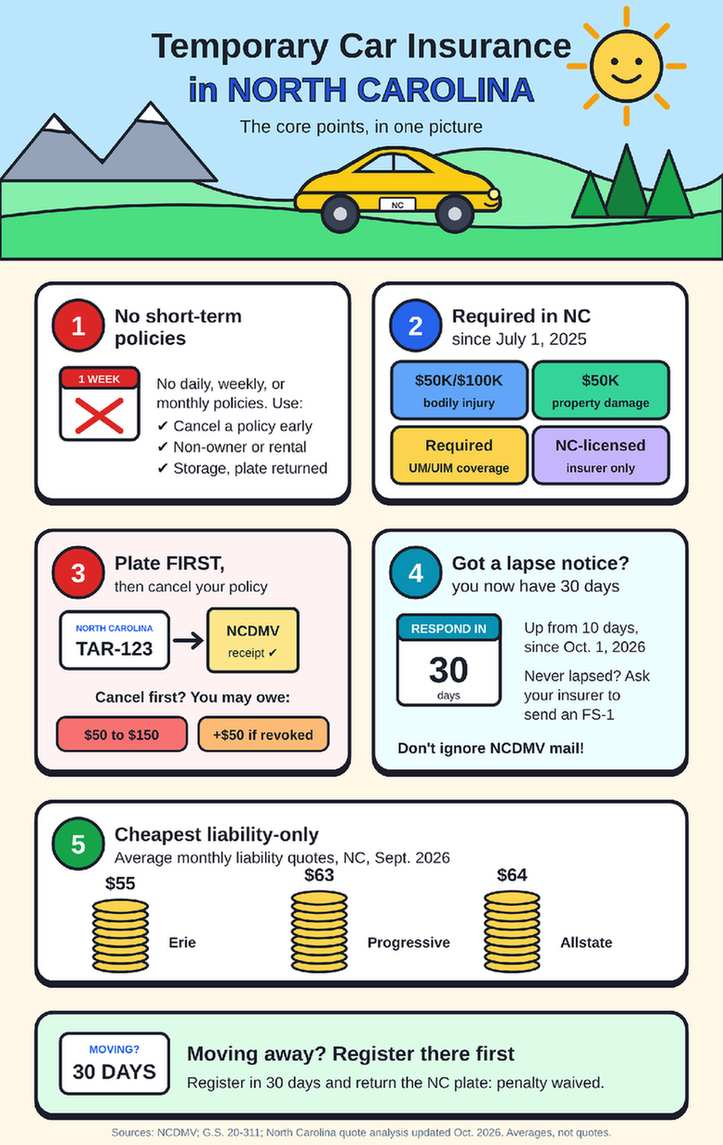
North Carolina temporary car insurance at a glance. Sources: NCDMV; G.S. 20-311; North Carolina quote analysis updated November, 2026. Averages, not quotes.
Frequently asked questions
Can you get temporary car insurance in North Carolina?
Not as a short policy. North Carolina insurers offer six- or 12-month terms, with no daily, weekly, or monthly policies. Short-term drivers can buy a standard policy and cancel early after returning the plate, or use non-owner, rental, or comprehensive-only coverage for a stored car.
What insurance is required in North Carolina?
For policies issued or renewed on or after July 1, 2025, North Carolina requires $50,000 per person and $100,000 per accident in bodily injury liability, $50,000 in property damage liability, and uninsured and underinsured motorist coverage. The policy must come from an insurer licensed in North Carolina.
Do I have to turn in my plate before canceling insurance in North Carolina?
Yes. NCDMV says to cancel insurance only after you return the plate, because canceling first can bring a fine for failing to keep continuous coverage. The rule applies even if you are storing the vehicle. Return the plate at an agency or by mail to get a receipt.
What is the penalty for an insurance lapse in North Carolina?
The civil penalty is $50 if you had no penalties in the past three years, $100 after one, and $150 after two or more. If the registration is revoked, you also pay a $50 restoration fee and the plate fee, and you must show proof of current coverage.
How long do I have to answer an NCDMV lapse notice?
NCDMV says owners have had 10 days from the notice date, and starting October 1, 2026, the response window is 30 days. If coverage never actually lapsed, ask your insurer to send a Form FS-1 electronically so NCDMV can clear the record and any fines.
Is pay-per-mile insurance available in North Carolina?
Options are limited. Nationwide SmartMiles is not available in North Carolina, Allstate Milewise does not list it among its 22 states, and Mile Auto's seven states do not include it. Ask local agents whether any insurer offers a usage-based or low-mileage option for your car.
Can I store my car without insurance in North Carolina?
Yes, if you return the plate first. NCDMV says owners storing a vehicle for an extended period should turn in the plate before canceling liability insurance. You can then keep comprehensive-only coverage to protect the parked car against theft, fire, and other damage.
What is the cheapest car insurance in North Carolina?
In real-quote data current to September 30, 2026, Erie was cheapest for liability-only at $55 a month, and Allstate for full coverage at $89. In a separate rate study, State Farm led both minimum coverage at $26 and full coverage at $59.
The final word on temporary car insurance in North Carolina
North Carolina offers no short policies, but it is one of the cheapest states to insure a car, so a six-month policy canceled early is usually an affordable way to cover a few weeks or months. The key is the order of steps: return your plate to NCDMV, keep the receipt, and only then cancel. Borrowers and renters can skip the plate question entirely with non-owner or rental coverage, and owners of parked cars can keep comprehensive-only coverage once the plate is turned in.
NEXT STEPWrite down the dates you need coverage and the car you will drive. Get three quotes from North Carolina-licensed insurers, ask about refund terms, and mark your calendar to return the plate before you cancel.
Prices, availability, cancellation terms, and state rules can change. The figures in this article are averages, published rules, and hypothetical calculations, not quotes. This article is for information only and is not legal or financial advice. The publisher is not an insurance company or a licensed insurance agency.
The bottom line on temporary car insurance in North Carolina: there are no short-term policies, but a low-cost six-month policy, non-owner, rental, or stored-vehicle coverage can match a short need, as long as the plate goes back to NCDMV before the coverage ends.
Sources
- NCDMV, Insurance Requirements and Insurance and License Plates (accessed October 2026).
- G.S. 20-311, Action by the Division when a lapse occurs (accessed October 2026).
- North Carolina Reinsurance Facility, About NCRF (accessed October 2026).
- Island Free Press, NC auto insurance rates to increase an average of 5% (June 10, 2025).
- Insurify, Temporary Car Insurance in North Carolina (updated September 30, 2026) and North Carolina Car Insurance (updated October 18, 2026).
- MoneyGeek, Cheapest Car Insurance in North Carolina (updated September 17, 2026).
- Bill Layne Insurance, NC short-rate cancellations (accessed October 2026).
- Insurance Information Institute, Uninsured Motorists, citing the Insurance Research Council.
- Nationwide, SmartMiles, Insurify, Allstate Milewise review, and Insurify, Mile Auto review (accessed October 2026).
- CarInsurance.com, New Car Grace Period (June 26, 2026).
- Insurify, One-Week Car Insurance (updated September 30, 2026) and First Alert 4, Understanding Rental Car Insurance (June 23, 2026).
- PennDOT, Insurance Overview, New York DMV, Auto Liability Insurance, and Michigan DIFS, Quick Facts.