
The Best And Cheapest Mobile Home Insurance in Florida
Shopping for the best and cheapest mobile home insurance in Florida matters more here than anywhere else, because Florida has about 824,400 manufactured homes, the most of any state, and nearly every one of them faces hurricane winds. The average Florida mobile home policy costs about $1,919 a year in early 2026, but prices vary by hundreds of dollars between companies.
This guide uses the latest state data to show what owners really pay. It ranks the 10 cheapest mobile home insurance companies in Florida, names the overall cheapest, and picks the best options for seniors, bundling, older homes, and hard-to-insure coastal homes. It also explains Citizens' 20% rule, hurricane deductibles, Florida's wind zones, the free tie-down program, the 2027 flood requirement, and the discounts Florida law requires.
KEY TAKEAWAYS
- The average Florida mobile home policy cost about $1,919 a year as of March 31, 2026, about half the $3,736 average for a regular homeowners policy (our calculation from state data).
- American Traditions is the overall cheapest choice with wind coverage, at $1,210 a year in Study A and about $1,666 on average in 2026, below the state average.
- Foremost is the best pick for seniors, with a discount from age 50 and an AARP-endorsed program, and Florida Farm Bureau and Tower Hill are good for bundling with auto.
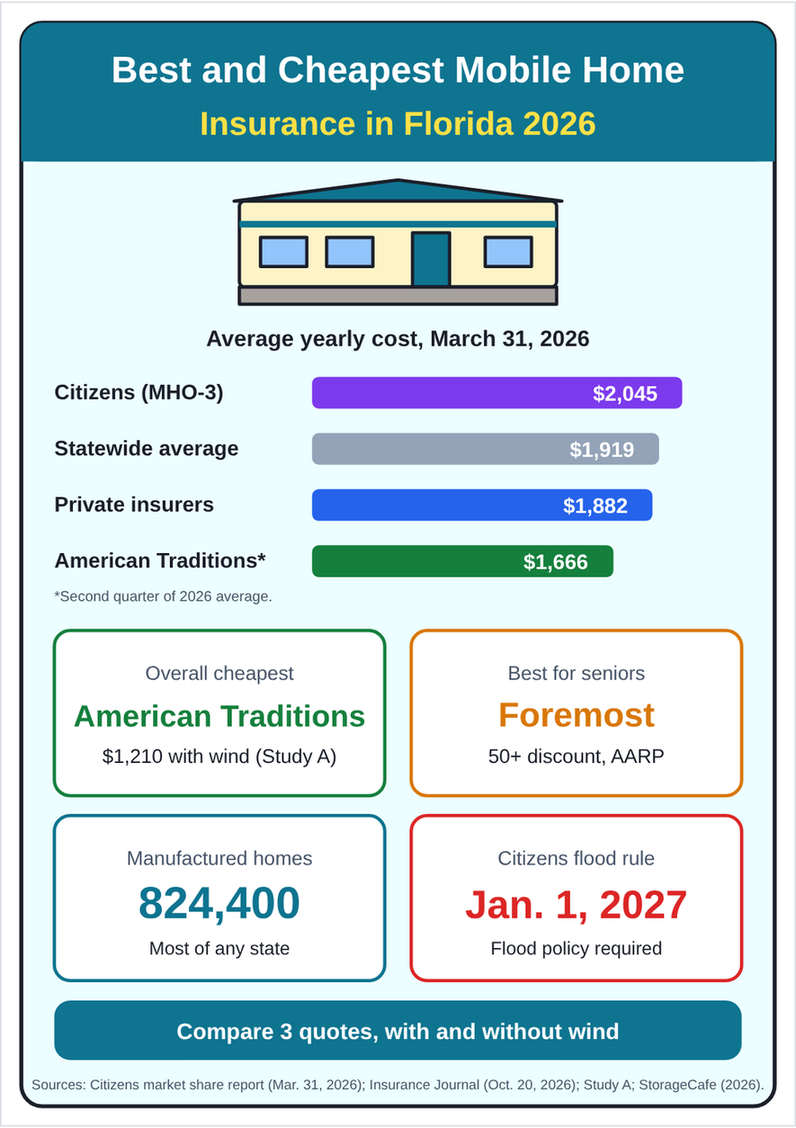
Florida mobile home insurance at a glance. State averages are our calculation from the Citizens market share report using state regulator data; averages, not quotes.
How much mobile home insurance costs in Florida
Citizens Property Insurance publishes a market share report built from state regulator data. Its March 31, 2026, edition counted 261,010 mobile home policies in Florida, with $500.9 million in premiums. That works out to an average of about $1,919 a year, or about $160 a month (our calculation).
Average Florida mobile home premium, March 31, 2026
| Group | Policies | Premium | Average a year |
|---|---|---|---|
| All insurers | 261,010 | $500.9 million | About $1,919 |
| Citizens standard policy (MHO-3) | 60,179 | $123.0 million | About $2,045 |
| All other insurers | 200,831 | $377.9 million | About $1,882 |
| Citizens basic dwelling policy (MDP-1) | 15,062 | Not shown | About $1,252 |
| American Traditions (second quarter) | About 67,000 | Not shown | About $1,666 |
Citizens market share report (March 31, 2026), using Florida Office of Insurance Regulation data; Insurance Journal (October 20, 2026). Averages are premiums divided by policies, our calculation.
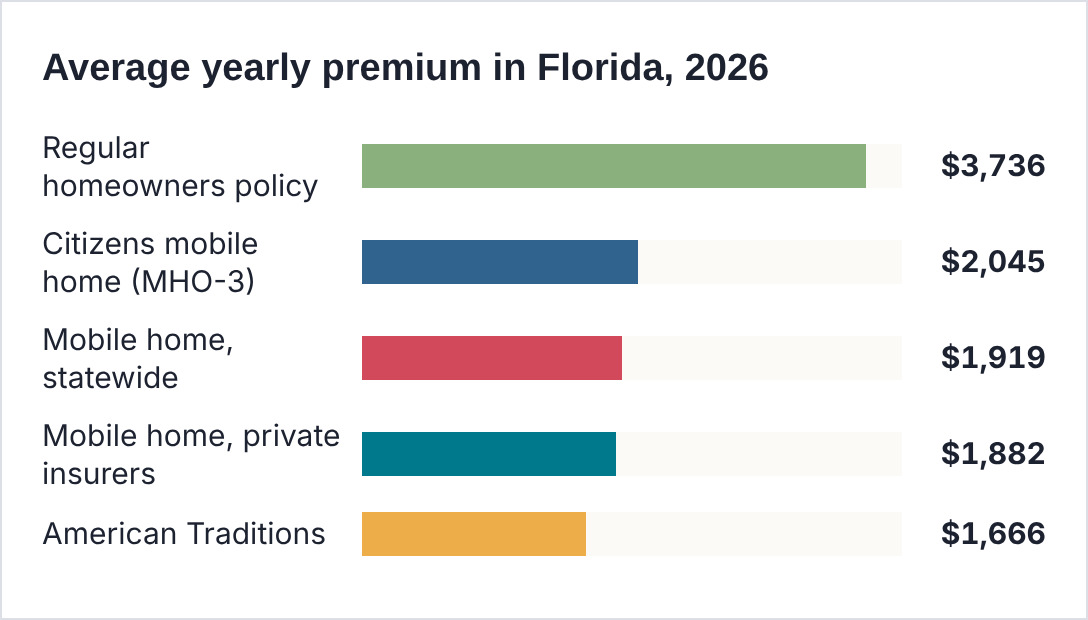
Florida Office of Insurance Regulation via Florida Realtors (September 24, 2026) for homeowners; Citizens market share report (March 31, 2026) and Insurance Journal (November 16, 2026) for mobile homes. Averages, not quotes.
A Florida mobile home policy costs about half as much as the $3,736 average homeowners policy with wind coverage. Private insurers averaged about $163 a year less than Citizens’ standard mobile home policy, which is one reason Citizens customers are encouraged to shop the private market.
Florida prices are also higher than in most of the country. There is no strong national study for 2026, but Foremost, one of the largest mobile home insurers, puts its national average at about $1,267 a year, and Study B, a 2024 analysis of Florida regulator data, found a Florida average of $1,349.
Florida mobile homes by the numbers
Florida has about 824,400 manufactured homes, more than any other state, according to a January 2026 analysis of 2024 Census data. They make up 7.8% of all Florida housing, compared with 5.4% nationally. The state also licenses 4,588 mobile home and travel parks.
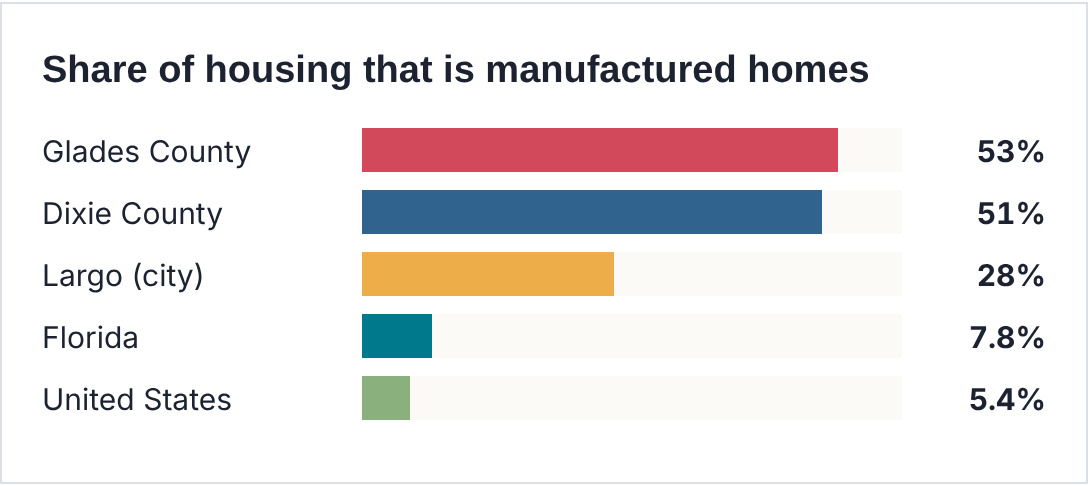
Census American Community Survey estimates, 2019 to 2023 (counties) and 2024 (state, nation, and Largo), as reported January 2026.
Mobile homes are most common in rural counties such as Glades and Dixie, where they make up about half of all housing, and in retirement areas along the Gulf Coast. Largo, in Pinellas County, has the highest share of any city studied, at 28%. Many of these homes sit in Wind Zone III counties, where storms are strongest, and insurance costs the most.
What sets your mobile home insurance price in Florida
Main factors in your Florida mobile home premium
| Factor | Why it matters |
|---|---|
| Wind zone and county | Zone III coastal counties face the highest hurricane risk |
| Year built | Homes built after July 1994 meet stronger wind standards and earn discounts |
| Tie-downs | A current tie-down certificate can earn up to 10% off |
| Wind coverage | Excluding wind cut the premium by 60% or more in Study A |
| Hurricane deductible | A 5% or 10% deductible costs less than $500 or 2% |
| Valuation | Replacement cost costs more than actual cash value |
| Park or private land | Approved parks earn discounts at some insurers |
| Flood zone | Flood coverage is separate and may be required |
| Claims history | Recent claims raise prices; claims-free years lower them |
Florida statutes; Study A; company discount lists. Factor weights vary by insurer.
Study A shows how much wind coverage drives the price. At the five largest insurers, wind coverage made up roughly 60% to 82% of the full premium (our calculation). That is why the hurricane deductible and tie-down discounts matter so much more in Florida than in other states.
Mobile home insurance vs. homeowners insurance in Florida
How Florida mobile home and homeowners policies compare
| Feature | Mobile home policy | Homeowners policy |
|---|---|---|
| Average yearly premium, 2026 | About $1,919 | About $3,736 |
| Replacement cost required to be offered | No | Yes |
| My Safe Florida Home grants | Not eligible | Eligible |
| Main discount for wind protection | 1994 HUD standard and tie-downs | Wind mitigation inspection |
| Citizens policy types | MHO-3 and MDP-1 | HO-3 and dwelling forms |
Our calculation from the Citizens market share report (March 31, 2026); Florida Realtors (September 2026); Florida statutes; My Safe Florida Home.
The top 10 cheapest mobile home insurance companies in Florida
We ranked the companies using the best public price data available. Ranks 1 to 5 are ordered by Study A, an analysis of Florida Office of Insurance Regulation data that compared average yearly costs with and without wind coverage at the largest mobile home insurers. We checked those results against 2026 state data where it exists. Ranks 6 to 10 have no public company prices, so they are ordered by their ratings, discounts, and role in the market.
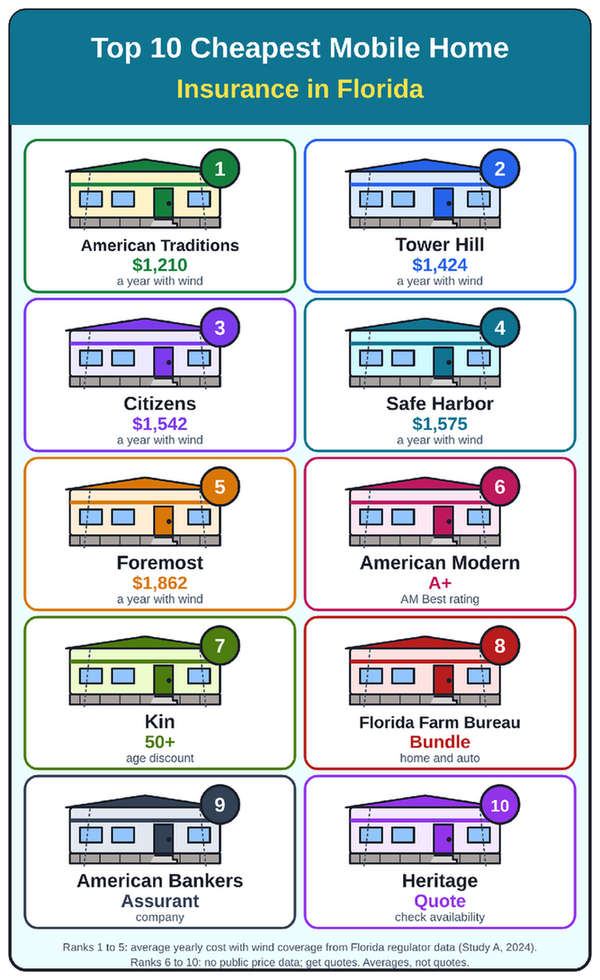
The 10 cheapest mobile home insurance companies in Florida. Prices for ranks 1 to 5 are Study A averages with wind coverage. Averages, not quotes.
Top 10 cheapest mobile home insurance companies in Florida
| Rank | Company | With wind (Study A) | Without wind (Study A) | Rating |
|---|---|---|---|---|
| 1 | American Traditions | $1,210 | $487 | Demotech A |
| 2 | Tower Hill | $1,424 | $461 | Demotech A |
| 3 | Citizens | $1,542 | $315 | State-backed |
| 4 | Safe Harbor | $1,575 | $286 | Demotech A (2021) |
| 5 | Foremost | $1,862 | $370 | AM Best A |
| 6 | American Modern | No public price | No public price | AM Best A+ |
| 7 | Kin | No public price | No public price | Ask your agent |
| 8 | Florida Farm Bureau | No public price | No public price | AM Best B++ |
| 9 | American Bankers (Assurant) | No public price | No public price | AM Best A |
| 10 | Heritage | No public price | No public price | Check availability |
Study A: analysis of Florida Office of Insurance Regulation data, published October 4, 2024. Ratings from AM Best, Demotech, and company sources as reported in 2021 to 2026. Your price will vary.
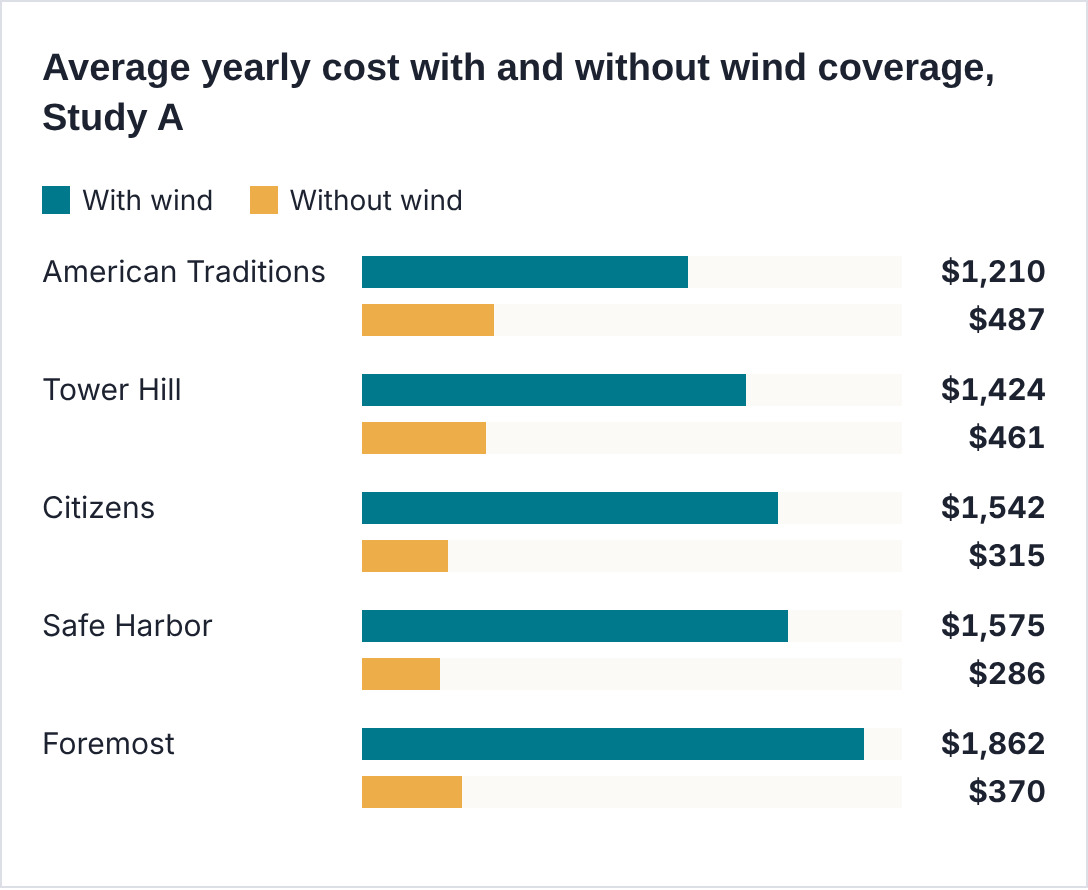
Study A: analysis of Florida Office of Insurance Regulation data (November 1, 2024). Averages, not quotes.
1. American Traditions: the overall cheapest
American Traditions is the largest private mobile home insurer in Florida, with about 67,000 policies, and it had the lowest price with wind coverage in Study A, at $1,210 a year. Newer state data backs that up. Its average premium was about $1,666 in the second quarter of 2026, according to Insurance Journal, about $250 below the statewide average and about $380 below Citizens' standard policy (our calculation).
The main catch is home age. After it took over policies from another insurer in 2024, reports said it may not insure older homes, so ask about the age limit before you apply. Part of its low average also reflects that it insures many newer homes, which cost less to cover.
2. Tower Hill: best for discounts and add-ons
Tower Hill averaged $1,424 a year with wind coverage in Study A, the second-lowest price, and is rated A by Demotech. It is one of the largest private mobile home insurers in the state. It offers discounts for tie-downs and fire extinguishers and add-ons for flood and golf cart coverage, and it can bundle auto through Safeco with a companion-policy discount.
3. Citizens: the safety net
Citizens Property Insurance, the state-backed insurer, averaged $1,542 with wind in Study A. Its 2026 average for the standard MHO-3 mobile home policy was about $2,045, and its more limited MDP-1 dwelling policy averaged about $1,252. Citizens cut its average homeowners rates by 8.8% for 2026, but it is meant to be a last resort.
You cannot buy or renew a Citizens policy if a private insurer offers comparable coverage for no more than 20% above the Citizens price. From January 1, 2027, every Citizens policy with wind coverage must also have flood insurance. We explain both rules below.
4. Safe Harbor: cheapest without wind coverage
Safe Harbor averaged $1,575 a year with wind coverage, but it was the cheapest company of all without wind, at just $286 a year in Study A. A policy without wind is only an option if your home is paid off and no lender requires wind coverage, and you would need to buy wind coverage elsewhere or accept that risk. Its most recent Demotech A rating we could confirm is from 2021.
5. Foremost: best for seniors and older homes
Foremost, part of the Farmers group, averaged $1,862 a year with wind in Study A, the highest of the five, but it stands out in other ways. It insures homes "of any age, model, make, and value," has an AARP-endorsed mobile home program, and gives a discount when the policyholder is 50 or older. A Florida agency citing state data from May 2026 called it the third-largest private mobile home insurer in Florida, with about 17,680 policies. AM Best rates it A.
6. American Modern: strongest financial rating
American Modern, owned by Munich Re, carries an A+ rating from AM Best, the highest on our list. It had about 10,517 Florida mobile home policies in 2023 and offers a Florida manufactured home program through independent agents. It paused some new homeowners business in other states in 2025, so ask an agent whether it is accepting new Florida mobile home customers.
7. Kin: best for newer homes and online buyers
Kin sells mobile home insurance in Florida online and offers discounts for homes in approved parks, owners aged 50 and older, smart home devices, a claims-free record, and electronic policies. It will not insure mobile homes built before 1976, so it works best for newer homes.
8. Florida Farm Bureau: best for bundling
Florida Farm Bureau requires a membership, but members can bundle home and auto coverage with one company. It had about 6,605 Florida mobile home policies in 2023. AM Best rates it B++ (Good), a step below the other rated companies on our list, with a stable outlook as of April 2025.
9. American Bankers: an Assurant company
American Bankers Insurance Company of Florida is part of Assurant and had about 4,548 Florida mobile home policies in 2023. Some websites say Assurant does not sell in Florida, but American Bankers is its Florida company. Ask an agent whether it is writing new mobile home policies near you.
10. Heritage: another private option to check
Heritage was one of several smaller insurers, along with US Coastal and Southern Oak, that each held about 1% to 2% of the Florida mobile home market in 2024. We could not confirm its 2026 status, so treat it as one more company for your agent to check rather than a sure option.
PRO TIP #1
Ask every company for two prices: one with wind coverage and one without. The difference shows how much of your premium is hurricane risk, and it helps you compare a full policy against a cheaper policy plus separate wind coverage.
The overall cheapest mobile home insurance in Florida
American Traditions is our pick for the overall cheapest mobile home insurance in Florida with full coverage, including wind. It was cheapest with wind in Study A, at $1,210 a year, and its 2026 average of about $1,666 is below the statewide average and Citizens. Tower Hill is a strong runner-up at $1,424.
If you own your home outright and want the lowest possible bill, Safe Harbor was the cheapest without wind coverage, at $286 a year. Be careful, though. Nearly all of Florida sits in a high-wind zone, and a policy without wind coverage would pay nothing after a hurricane.
The best mobile home insurance in Florida by need
Best mobile home insurance in Florida, by need
| Need | Best pick | Why |
|---|---|---|
| Overall cheapest with wind | American Traditions | $1,210 in Study A; $1,666 average in 2026 |
| Runner-up on price | Tower Hill | $1,424 in Study A; tie-down discount |
| Cheapest without wind | Safe Harbor | $286 in Study A, if no lender requires wind |
| Seniors | Foremost | 50+ discount and AARP-endorsed program |
| Older homes | Foremost | Insures homes of any age |
| Financial strength | American Modern | AM Best A+ |
| Bundling with auto | Florida Farm Bureau | Home and auto under one membership |
| Newer homes, online | Kin | Online quotes; 50+ and park discounts |
| Last resort | Citizens | Must take eligible homes others decline |
Our assessment, based on Study A, 2026 state data, and company information.
Cheapest mobile home insurance for seniors in Florida
Florida's mobile home parks are home to many retirees, and 55-and-older communities are common across the state. Seniors on fixed incomes feel every premium increase, but they also qualify for some of the best discounts.
Mobile home insurance options for Florida seniors
| Company | Senior benefit | Other savings |
|---|---|---|
| Foremost | Discount at age 50+; AARP-endorsed program | Approved park, newer home, multi-policy |
| Kin | Discount at age 50+ | Approved park, claims-free, smart devices |
| American Traditions | Lowest average price with wind | Ask about home age limits |
| Tower Hill | Second-lowest price with wind | Tie-down and fire extinguisher discounts |
| Citizens | Fallback if private quotes are too high | 2026 average rate cut of 8.8% |
Company websites; Study A; Citizens (2026).
For most seniors, the cheapest approach is to get quotes from American Traditions and Tower Hill for price, then from Foremost and Kin for their age discounts, and compare the totals. A senior in an approved park can stack the 50+ discount with a park discount at both Foremost and Kin.
Storm safety matters as much as price. When Hurricane Milton struck in October 2024, its tornadoes killed six people at a senior mobile home community in St. Lucie County. Make sure your home is properly tied down, know your evacuation route, and keep a copy of your policy and home inventory stored online.
- Ask for the 50+ or retiree discount by name.
- Check whether your 55+ park counts as an approved park.
- Apply for the state's free tie-down program if your home was installed in 1999 or earlier.
- Choose a hurricane deductible you could pay from savings.
- Review your personal property limit, which may be higher than you need.
PRO TIP #2
If you live on a fixed income, ask about paying in full or using automatic payments. Some insurers discount paid-in-full policies, and automatic payments help prevent a missed bill from canceling your coverage before hurricane season.
Citizens Property Insurance and mobile homes
Citizens is Florida's insurer of last resort, and it has shrunk dramatically as private companies returned. It had about 255,000 policies in September 2026, down from 1.4 million in September 2023, and expects about 248,000 by the end of 2026.
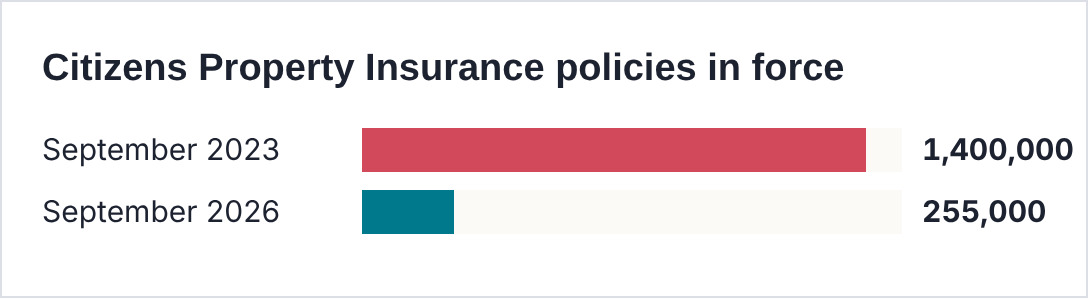
Citizens Property Insurance (2023 and September 18, 2026).
Citizens offers two mobile home policies. The MHO-3 is a fuller policy that covers the home at actual cash value, with an option to raise coverage up to 150%, and it includes sinkhole coverage. The MDP-1 is a basic dwelling policy with a dwelling limit of $250,000, or $700,000 in the coastal wind area.
Key Citizens rules for mobile home owners
| Rule | What it means |
|---|---|
| 20% rule | You cannot buy or renew if a private insurer offers comparable coverage for no more than 20% above the Citizens premium |
| Flood requirement | Every Citizens policy with wind coverage must have flood insurance by January 1, 2027 |
| 2026 rates | Homeowners policies down 8.8% on average; wind-only down 5.5% |
| MHO-3 valuation | Actual cash value, with an option up to 150% |
| MDP-1 limit | $250,000 dwelling, or $700,000 in the wind area |
Citizens Property Insurance (2026); Florida statutes as reported in 2026.
The flood rule is the biggest change for many Citizens customers. If you have a Citizens policy and no flood coverage, start shopping for a flood policy now, and include its cost when you compare Citizens with private insurers.
How Florida's insurance market has changed since 2022
Florida's property insurance market went through a crisis in 2022. Six insurers failed that year, including FedNat, Southern Fidelity, Weston, Lighthouse, Avatar, and St. Johns, and United Property and Casualty followed in February 2023. Lawmakers responded with Senate Bill 2-A in December 2022, which ended one-way attorney fees, banned assignment of benefits, and shortened the time to file a claim to one year.
Since those reforms, 20 new insurers have entered Florida, according to the Office of Insurance Regulation in May 2026, and Florida was the only state with an average homeowners rate decrease in 2025, at 0.92%, while rates rose 5.5% nationally. The mobile home market is still fragile, though. On October 19, 2026, regulators forced American Mobile Insurance Exchange to give up its license to sell insurance.
If your insurer fails, the Florida Insurance Guaranty Association pays covered claims up to legal limits, and you will need to find a new policy quickly. Checking your insurer's AM Best or Demotech rating before you buy lowers that risk.
Policies with and without wind coverage
Florida mobile home owners can sometimes choose between a full policy that includes wind and a cheaper policy that excludes it. Citizens also sells wind-only coverage in its coastal wind area, which averaged about $3,183 a year in its March 2026 report, for owners whose private policy excludes wind.
Excluding wind can make sense in only a few cases, such as a paid-off older home that you could afford to lose or replace. For most owners, it is a risky way to save. Lenders almost always require wind coverage, and a hurricane is the most likely cause of a total loss in Florida.
- Full policy with wind: the simplest choice, with one company handling every claim.
- Policy without wind plus a separate wind policy: sometimes cheaper, but two companies may argue over storm damage.
- Policy without wind and no wind coverage: the cheapest option, and the riskiest.
How to check an insurer's financial strength
Because several Florida insurers have failed since 2022, financial strength matters as much as price. Many Florida companies are rated by Demotech rather than AM Best, and lenders that back mortgages generally accept a Demotech A rating.
Financial strength ratings for Florida mobile home insurers
| Company | Rating | Rated by |
|---|---|---|
| American Modern | A+ | AM Best |
| Foremost | A | AM Best |
| American Bankers (Assurant) | A | AM Best |
| Florida Farm Bureau | B++ | AM Best |
| American Traditions | A | Demotech |
| Tower Hill | A | Demotech |
| Safe Harbor | A (2021 affirmation) | Demotech |
| Citizens | Not rated | State-backed insurer |
AM Best and Demotech ratings as reported from 2021 to 2026. Ratings change, so check the latest before you buy.
Look up any company's rating before you buy, and avoid insurers that have recently been placed under state supervision. If your insurer does fail, the Florida Insurance Guaranty Association steps in to pay covered claims, but you will have to find a new policy, often in the middle of hurricane season.
Hurricanes, wind zones, and your mobile home
All of Florida is in HUD Wind Zone II or III, the two strongest standards for manufactured homes. Zone II homes are built for 100 mph winds and Zone III homes for 110 mph. Fourteen counties are in Zone III: Broward, Charlotte, Collier, Franklin, Gulf, Hendry, Lee, Martin, Manatee, Miami-Dade, Monroe, Palm Beach, Pinellas, and Sarasota.
Florida mobile home building standards
| Year | Change | What it means for insurance |
|---|---|---|
| Before June 15, 1976 | No federal HUD code | Hardest to insure; some companies decline |
| July 13, 1994 | Stronger HUD wind standards | Florida law requires a discount for these homes when properly tied down |
| March 1999 | New Florida installation standards | Homes installed after this performed best in Hurricane Irma |
| 1999 or earlier | Eligible for the free state tie-down program | Upgraded anchors can earn a discount |
HUD wind zone map; Florida Statute 627.0629; Florida hurricane damage assessment after Irma; Gulf Coast State College tie-down program.
The 2024 hurricane season was a hard test. Hurricanes Helene and Milton together produced 436,167 insurance claims and about $5.2 billion in payments. No hurricane struck Florida in 2025, and Hurricane Isaias made landfall as a Category 2 storm near Destin on October 9, 2026.
Hurricane deductibles
Most Florida policies have a separate hurricane deductible. Insurers must offer choices of $500, 2%, 5%, and 10% of the dwelling limit, and the hurricane deductible applies only once per calendar year, even if several storms hit. A higher deductible lowers your premium, but you pay more after a storm.
Hurricane deductible on an $80,000 home
| Deductible option | You pay before coverage starts |
|---|---|
| $500 | $500 |
| 2% | $1,600 |
| 5% | $4,000 |
| 10% | $8,000 |
Our calculation for an example $80,000 dwelling limit. Florida law requires insurers to offer these options; deductibles above 10% need a signed waiver.
Florida laws every mobile home owner should know
- Florida's law requiring insurers to offer replacement cost does not apply to mobile home policies, which is why many policies pay actual cash value.
- Florida Statute 627.0629 requires insurers to give a discount for homes built to the 1994 HUD wind standard that meet state tie-down rules.
- Insurers may give up to 10% off for a current tie-down inspection certificate.
- Mobile homes are not eligible for the My Safe Florida Home inspection and grant program.
- The state's free tie-down program, run by Gulf Coast State College, upgrades anchors on homes installed in 1999 or earlier and served 764 homes in its 2024 to 2025 year.
- Under the Florida Mobile Home Act, park owners must give residents a flood disclosure.
- An MH decal is renewed each year when you rent your lot, while an RP decal applies when you own the land and the home is taxed as real estate.
PRO TIP #3
If your home was installed in 1999 or earlier, apply for the free state tie-down program. Stronger anchors make your home safer in a hurricane, and a current tie-down certificate can cut your premium by up to 10%.
Flood insurance for Florida mobile homes
Standard mobile home policies do not cover flooding. The National Flood Insurance Program covers manufactured homes that are anchored to a permanent foundation, with limits of $250,000 for the home and $100,000 for contents. Florida holds 1.77 million NFIP policies, about 39% of the national total, and the average Florida flood premium is $938 a year.
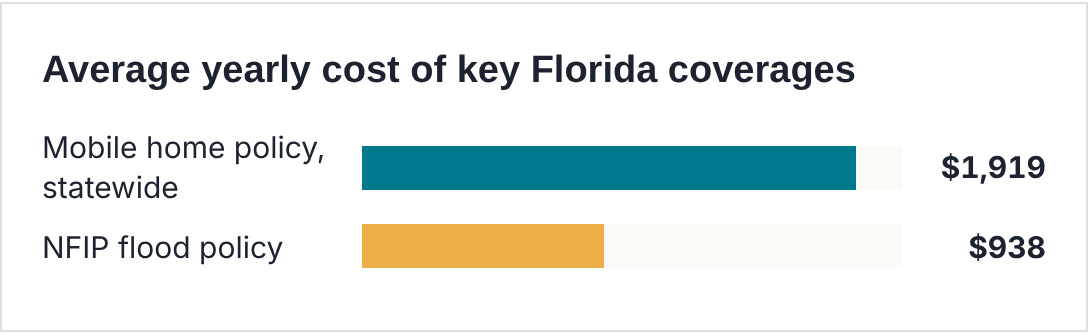
Citizens market share report (March 31, 2026), our calculation; FEMA NFIP data as reported in 2026. Flood average covers all home types.
Only about 20% of Florida homes have flood insurance. NFIP policies usually have a 30-day waiting period, so buy coverage well before hurricane season, and remember that Citizens customers will need it by January 1, 2027.
What Florida mobile home insurance covers
Main coverage parts of a Florida mobile home policy
| Coverage | What it pays for |
|---|---|
| Dwelling | Repairs or replacement of the home |
| Other structures | Carports, screen rooms, sheds, and skirting |
| Personal property | Furniture, clothes, and belongings |
| Loss of use | Hotel and living costs after a covered loss |
| Personal liability | Injuries or damage you cause to others |
| Wind and hurricane | Storm damage, subject to the hurricane deductible |
| Optional add-ons | Flood, golf carts, replacement cost, and trip coverage |
Company policy descriptions; coverage varies by insurer.
The most important choice is actual cash value versus replacement cost. Actual cash value subtracts depreciation, so an older home may be worth far less than the cost to replace it. Because Florida does not require replacement cost on mobile homes, ask every company whether it is available and what it costs.
Park homes vs. homes on private land
Where your home sits affects both your coverage and your price. Homes in approved parks can earn discounts at Foremost and Kin, and parks often have paved roads, nearby hydrants, and on-site managers. If you rent your lot, your home carries an MH decal that you renew each year.
Homes on land you own usually carry a permanent RP decal and are taxed as real estate. They often need more coverage for sheds, carports, screen rooms, fences, and docks, and you are responsible for liability on the whole lot. Make sure every structure on your land is listed on your policy.
What to do after a hurricane
Florida's 2022 reforms shortened the time to file a property claim to one year from the date of loss, so act quickly after a storm.
- Get to safety, then call your insurer or agent as soon as you can.
- Take photos and video of all damage before cleaning up.
- Make temporary repairs, such as tarps, to prevent more damage, and keep the receipts.
- Ask about loss-of-use coverage for hotel and living costs right away.
- List damaged belongings, with photos or receipts if you have them.
- Get your adjuster's name and contact details, and keep notes of every call.
- File any flood claim separately with your flood insurer.
- If you disagree with the settlement, ask for a written explanation and contact the Florida Department of Financial Services consumer helpline.
Before each hurricane season, check that your tie-downs are tight, store your policy and a home inventory online, and confirm your hurricane deductible so there are no surprises after a storm.
Bundling mobile home and auto insurance in Florida
Bundling can save money and make claims easier after a storm damages both your home and your car. In Florida, though, the mobile home insurers that charge the least do not always sell auto insurance, so the best bundle is not always the cheapest choice.
Bundling options for Florida mobile home owners
| Company | How bundling works | Notes |
|---|---|---|
| Florida Farm Bureau | Home and auto under one membership | Membership required; AM Best B++ |
| Tower Hill | Auto through Safeco with a companion-policy discount | Second-cheapest with wind in Study A |
| Foremost | Multi-policy discount for boats, ATVs, golf carts, motorcycles, and RVs | Its Florida auto homeowner discount excludes mobile homes |
| Kin | Ask whether it can bundle in your area | Mobile home discounts for 50+ and parks |
| American Traditions | No auto policy found | Pair with any low-cost auto insurer |
Company websites and agency information (2016 to 2026). Bundle percentages were not published.
Because Florida auto insurance is also expensive, compare two options. First, price a bundle from Florida Farm Bureau or Tower Hill. Second, price American Traditions for your mobile home plus the cheapest auto insurer you can find. Pick whichever total is lower for the coverage you need.
Foremost is a special case. Its multi-policy discount works well if you also own a golf cart, boat, or RV, which is common in Florida retirement communities. Its Florida auto program, however, does not give its homeowner auto discount for mobile homes.
Mobile home insurance discounts in Florida
Discounts to ask for in Florida
| Discount | Who offers it |
|---|---|
| Post-1994 HUD wind standard home | Required by Florida law when tied down to code |
| Tie-down inspection certificate | Up to 10% under Florida law; Tower Hill |
| Age 50 and older | Foremost, Kin |
| Approved park | Foremost, Kin |
| Newer home | Foremost |
| Multi-policy | Foremost, Tower Hill, Florida Farm Bureau |
| Fire extinguishers | Tower Hill |
| Claims-free | Kin and others |
| Smart home devices | Kin |
| Electronic policy | Kin |
| Affinity groups (USAA, AFI) | Foremost |
| Higher hurricane deductible | All insurers |
Florida Statute 627.0629 (2025); company websites (2024 to 2026). Discount amounts vary.
Be wary of claims that a wind mitigation inspection will save a mobile home owner 10% to 45%. The standard Florida wind mitigation form is designed for site-built homes, and the discounts for mobile homes come mainly from the 1994 wind standard and tie-down certificates.
Tips to save money on mobile home insurance in Florida
- Get at least three quotes, starting with American Traditions, Tower Hill, and Foremost.
- Ask each company for a price with and without wind coverage.
- Use an independent agent who can quote several mobile home insurers at once.
- Get a tie-down inspection certificate for a discount of up to 10%.
- Apply for the free state tie-down program if your home was installed in 1999 or earlier.
- Make sure your insurer knows your home meets the 1994 HUD wind standard.
- Choose a 2% or 5% hurricane deductible if you have savings to cover it.
- Ask for age 50+, approved park, and claims-free discounts.
- Bundle with auto, golf cart, or boat coverage when it lowers your total.
- If you are with Citizens, shop private insurers at every renewal.
- Buy flood insurance early to avoid the 30-day wait.
- Avoid small claims that could cost you a claims-free discount.
How to compare Florida mobile home insurance quotes
Quotes can look very different even for the same home, so make sure you are comparing like with like.
- Use the same dwelling limit, liability limit, and hurricane deductible for every quote.
- Check whether each quote pays actual cash value or replacement cost.
- Confirm wind coverage is included, unless you plan to buy it separately.
- Ask about home age limits before you apply.
- Check the insurer's AM Best or Demotech rating.
- Add the cost of flood insurance when you compare totals.
Florida's Office of Insurance Regulation publishes market data and company information at floir.gov, and the Florida Department of Financial Services runs a consumer helpline if you have a problem with an insurer.
Florida mobile home insurance at a glance
This illustrated summary pulls together the main points of this guide.
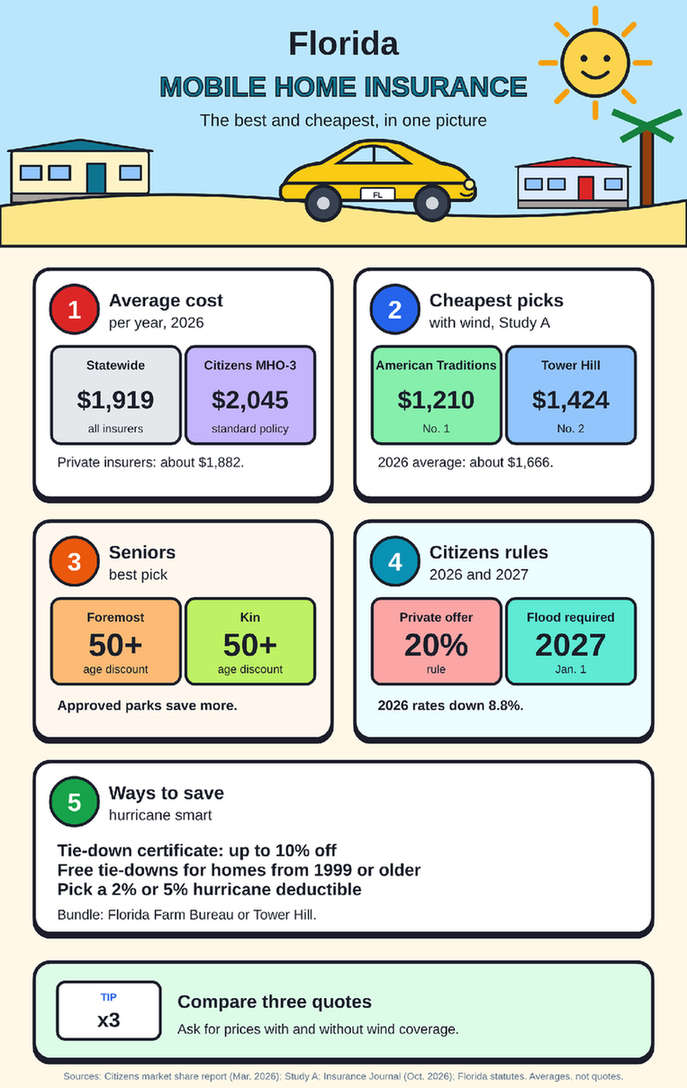
The best and cheapest mobile home insurance in Florida at a glance. Sources: Citizens market share report; Study A; Florida statutes.
Frequently asked questions about Florida mobile home insurance
How much is mobile home insurance in Florida?
The average Florida mobile home policy cost about $1,919 a year as of March 31, 2026, based on state data in the Citizens market share report. Private insurers averaged about $1,882, and Citizens' standard policy averaged about $2,045. Your price depends on your home, location, and deductible.
Who has the cheapest mobile home insurance in Florida?
American Traditions was cheapest with wind coverage in Study A, at $1,210 a year, and averaged about $1,666 in 2026. Tower Hill was second at $1,424. Without wind coverage, Safe Harbor was cheapest at $286 a year.
What is the best mobile home insurance for seniors in Florida?
Foremost is our pick for seniors because it offers a discount from age 50 and an AARP-endorsed program, and it insures homes of any age. Kin also has a 50+ discount. Compare both with American Traditions, which has the lowest average price.
Does Citizens insure mobile homes?
Yes. Citizens offers the MHO-3 mobile home policy and the MDP-1 dwelling policy. You cannot buy or renew if a private insurer offers comparable coverage within 20% of the Citizens price, and you need flood insurance by January 1, 2027.
Can I get mobile home insurance without wind coverage?
Yes, some insurers sell policies that exclude wind, and Safe Harbor's averaged $286 a year in Study A. Lenders usually require wind coverage, and without it, a hurricane could leave you with nothing. It only makes sense if you can afford to lose the home.
Is mobile home insurance required in Florida?
State law does not require it, but your lender will if you have a loan. Your park rules may also set requirements, so read your lease. Insurance is strongly recommended because nearly all of Florida is in a high-wind zone.
Can I bundle mobile home and auto insurance in Florida?
Yes. Florida Farm Bureau bundles home and auto under one membership, and Tower Hill offers auto through Safeco with a companion discount. Foremost's multi-policy discount covers golf carts, boats, and RVs. Compare bundles with separate policies.
Do I need flood insurance for a mobile home in Florida?
Standard mobile home policies do not cover flooding. Your lender requires flood insurance if you are in a high-risk flood zone, and every Citizens policy with wind coverage must have flood insurance by January 1, 2027. The average Florida flood policy costs about $938 a year.
What hurricane deductible should I choose?
Florida insurers must offer $500, 2%, 5%, and 10% options. A higher deductible lowers your premium, but you pay more after a storm. On an $80,000 home, a 2% deductible is $1,600 and a 10% deductible is $8,000, so pick an amount you could pay from savings.
Will Florida insurers cover an older mobile home?
Some will. Foremost insures homes of any age, and Citizens covers eligible homes others decline. Kin will not insure homes built before 1976, and American Traditions may limit older homes. Homes built after July 1994 are easier and cheaper to insure.
The final word on the best and cheapest mobile home insurance in Florida
The best and cheapest mobile home insurance in Florida starts with American Traditions, which was cheapest with wind coverage in Study A and averaged about $1,666 in 2026, below the $1,919 statewide average. Tower Hill is a strong second, Foremost is the best choice for seniors and older homes, and Citizens remains the safety net for homes others decline.
To pay as little as possible, compare at least three quotes with and without wind, claim every tie-down and age discount, choose a hurricane deductible you can afford, and add flood coverage before you need it. Recheck your coverage before each hurricane season, and your mobile home will be protected at a fair price.
Sources
- Citizens Property Insurance, market share report (March 31, 2026).
- Insurance Journal, American Traditions and American Mobile (November 16, 2026).
- Study A: LendingTree, mobile home insurance in Florida (November 4, 2024), using Florida Office of Insurance Regulation data.
- Study B: ValuePenguin, mobile home insurance in Florida (2024).
- Florida Office of Insurance Regulation, property and casualty market overview.
- Florida Statute 627.0629 (2025).
- Foremost, mobile home insurance, and Cornerstone, Foremost in Florida (September 15, 2026).
- Cornerstone, American Traditions in Florida and FloridaInsuranceWatch, American Traditions.
- Kin, Florida mobile home insurance.
- Tower Hill review and ratings.
- AM Best, Florida Farm Bureau rating (April 10, 2025).
- Policygenius, Florida mobile home insurance (May 30, 2024), for 2023 policy counts.
- Florida Insurance Guaranty Association, insolvencies.
- Beinsure, American Mobile oversight (August 12, 2026).
- American Integrity Insurance, prospectus (November 2025).
- Citizens Property Insurance: policies in force, 2026 rates, 20% eligibility rule, flood requirement, and mobile home policy types.
- Florida Trend, Citizens policy count (September 24, 2026).
- FEMA, manufactured homes flood coverage (August 2025), and Florida flood insurance costs.
- Florida Highway Safety and Motor Vehicles, Hurricane Irma mobile home damage report, and HUD 1994 wind standards.
- Insurance Business, Helene and Milton claims, and CBS News Miami, St. Lucie County mobile home park.
- Florida Statute 627.701, hurricane deductibles, 627.7011, replacement cost, and Chapter 723, Florida Mobile Home Act.
- Gulf Coast State College, mobile home tie-down program, and My Safe Florida Home eligibility.
- Florida Office of Insurance Regulation, 20 new insurers (May 20, 2026).
- Moody's, Hurricane Isaias (November 16, 2026).
- StorageCafe, manufactured housing in the U.S. (January 8, 2026); WUSF, mobile home park living (July 4, 2026); Florida Realtors, home insurance rates (September 2026).
Disclaimer
This website provides independent reviews and comparisons. It is not affiliated with, endorsed by, sponsored by, or connected to American Traditions Insurance Company, Tower Hill, Citizens Property Insurance Corporation, Safe Harbor, Foremost, Farmers, American Modern, Kin, Florida Farm Bureau, American Bankers Insurance Company of Florida, Assurant, Heritage, Safeco, AARP, or any of their affiliates.
All company names, brand names, trademarks, and logos are the property of their respective owners and are used here only to identify the companies being reviewed. Their use does not imply any affiliation or endorsement.
The information on this page is provided for general informational and educational purposes only. It is not insurance, legal, tax, or financial advice, and it is not an offer, quote, or solicitation to buy or sell insurance. We are not an insurance company, insurance agency, or licensed insurance producer, and we cannot bind coverage, change a policy, or handle claims.
Prices, discounts, ratings, and company details are drawn from public sources and third-party studies that use specific home profiles, and they can change at any time. They are estimates and averages, not guarantees of what you will pay. Coverage, eligibility, and discounts vary by location, home, and owner, and are subject to each insurer's underwriting rules and policy terms.
While we make reasonable efforts to keep this guide accurate and current, we make no representations or warranties, express or implied, about its completeness, accuracy, or reliability. Opinions here are our own. Always confirm details directly with the insurer, read your policy documents, and consult the Florida Department of Financial Services or a licensed professional before making a decision. Your use of this information is at your own risk, and we are not liable for any loss or damage arising from reliance on it.