
Mobile Home Insurance in New York: Companies, Costs & Coverage
The best mobile home insurance in New York depends on your home’s construction year, park or private-land location, anchoring, and exposure to snow, wind, and flooding. Published manufactured-home insurer quotes are limited, so a sample price from another state cannot establish New York’s cheapest company. This guide separates verified New York rules from out-of-state insurance samples and general homeowners data.
This guide compares 10 companies and coverage routes worth checking for a New York manufactured home; it does not assign a verified lowest-price ranking. It covers New York City, Buffalo, Syracuse, Long Island and upstate risks; policy differences; park residents’ rights; senior tax programs; and a quote checklist designed for meaningful comparisons.
KEY TAKEAWAYS
- Assurant ($969), American Modern ($1,025), and Foremost ($1,607) are the prices in one three-city sample outside New York—not a New York ranking.
- New York-specific manufactured-home premiums should be established with quotes for the same home and coverage. Published $490 standard-home rates cannot be substituted for mobile-home prices.
- NYCM lists a 10-year maximum home age, permanent steps, handrails and skirting for its mobile-home program; confirm current acceptance and eligibility with an agent.
- Most park rent increases are limited to 3%, with justified increases up to 6% under specified conditions; above 6% generally requires court-approved temporary hardship.
Editorial note: This legacy infographic contains insurer rankings or numerical labels that are not verified for New York manufactured homes. Use the corrected text and tables, not the image, for decisions.
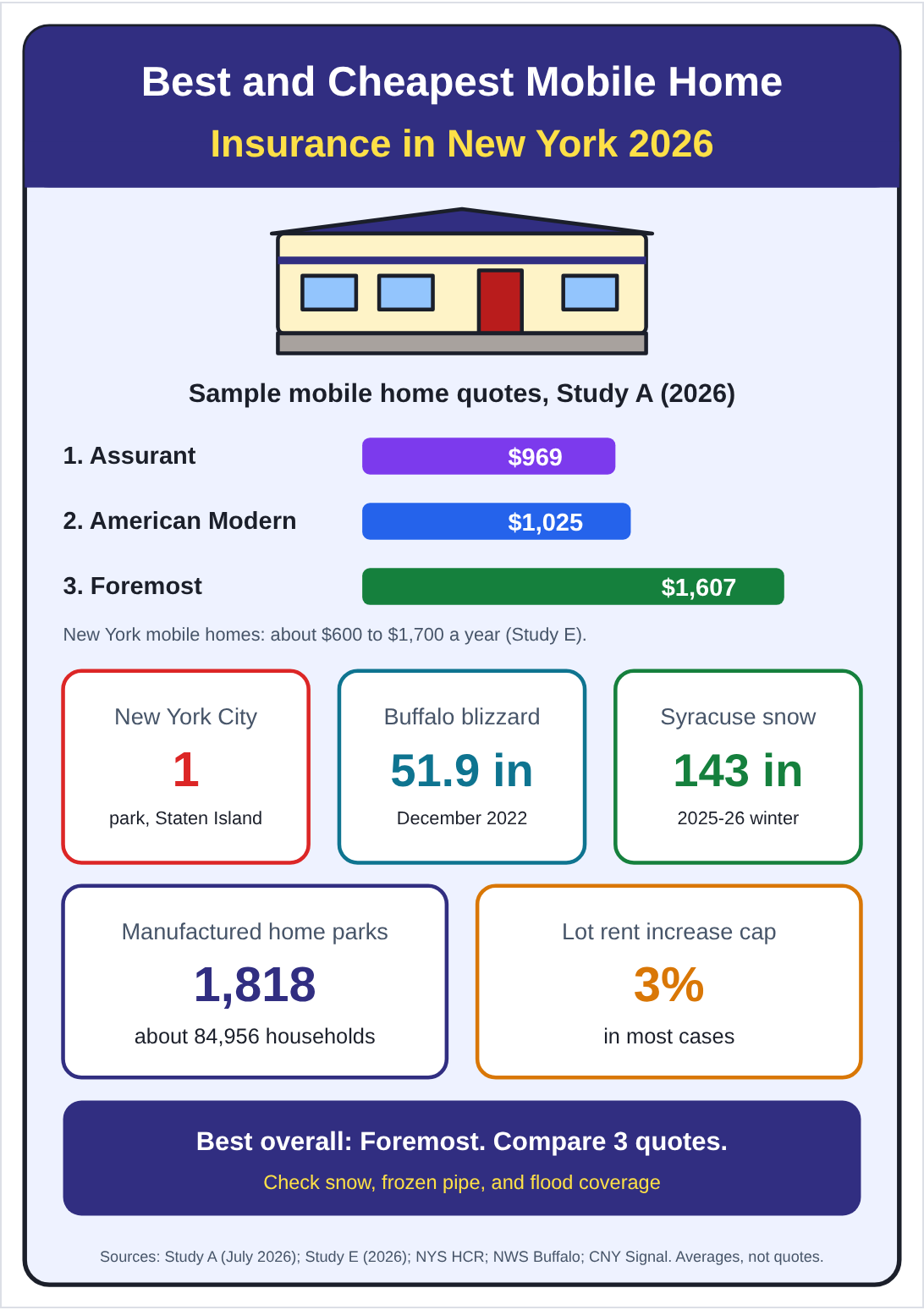
New York mobile home insurance at a glance. Company prices are Study A’s 2026 sample quotes, not New York quotes.
How much mobile home insurance costs in New York
We did not identify a published, statewide comparison quoting the same New York manufactured home with multiple insurers. Study A is ValuePenguin’s July 2026 three-city sample for a 10-year-old single-wide in a park in Austin, Indianapolis and Mesa; the quoted insurer figures are $969 for Assurant, $1,025 for American Modern, and $1,607 for Foremost. Those are not New York premiums. Study E publishes a rough $600–$1,700 New York range and an approximate $710 average, but without a transparent rate profile or sampling method. Treat it as an unverified third-party estimate, not a typical price guaranteed to New York owners.
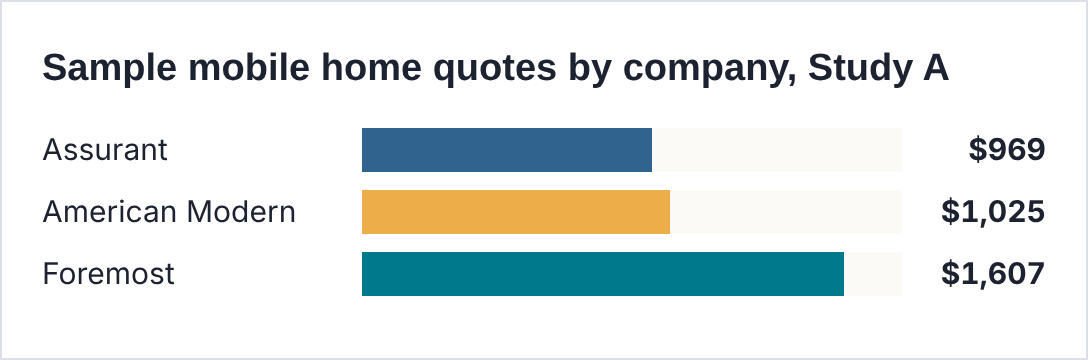
Study A: national mobile home quote study updated July 6, 2026, for a 2016 single-wide in a park in Austin, Indianapolis, and Mesa. Not New York quotes.
In that limited Study A sample, Assurant was $56 below American Modern and $638 below Foremost. This comparison may help generate a quote shortlist, but it cannot show which insurer will be cheapest—or available—for your specific New York property.
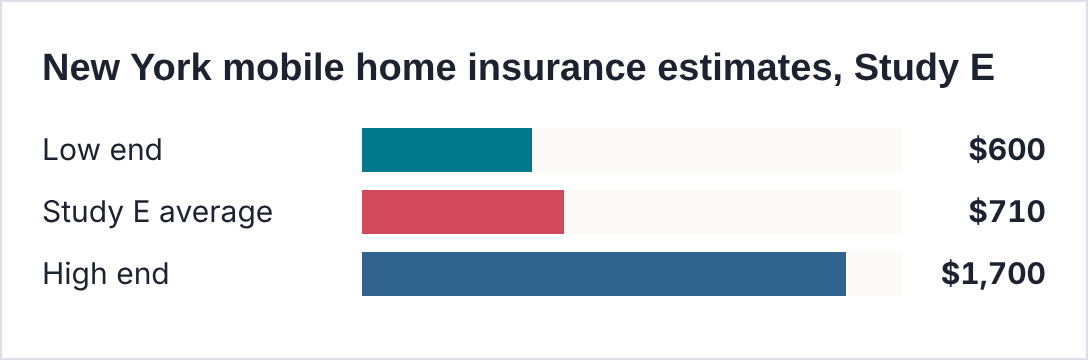
Study E: New York mobile home review updated October 18, 2026. Its national table lists $716. Averages, not quotes.
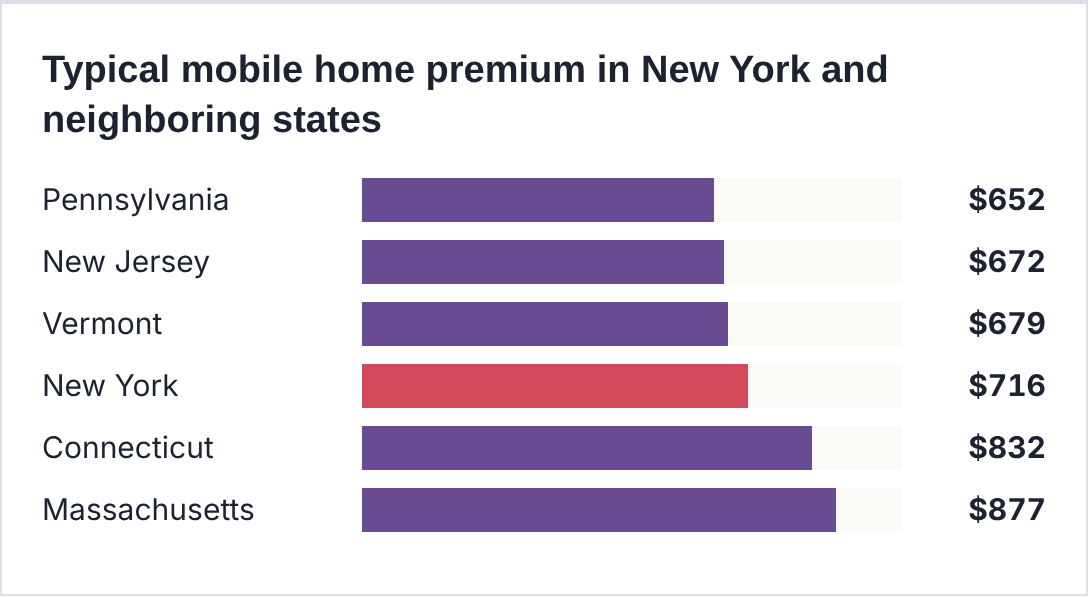
Study E national table (October 18, 2026). Method not published, so treat as rough estimates.
Study C reports New York prices for conventional site-built homeowners policies, including a $100,000 dwelling example (State Farm at $490 a year). Those policies insure a different construction type and use a different underwriting model. They are not manufactured-home quotes and should not be used to estimate what State Farm would charge for a mobile home.
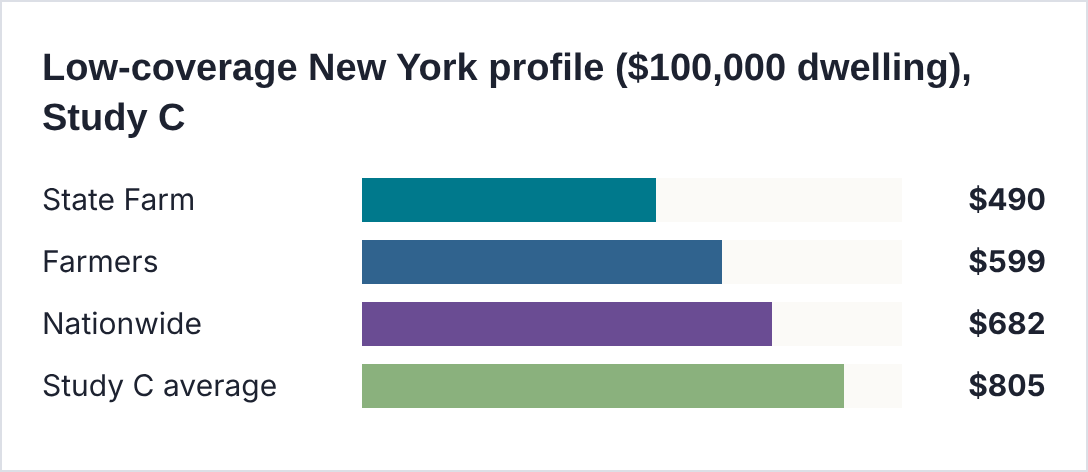
Study C: New York homeowners study (2026), $100,000 dwelling profile. Standard-home policies, not mobile home policies. Averages, not quotes.
New York mobile home insurance price evidence
| Source | Yearly cost | Notes |
|---|---|---|
| Study E, New York range | $600 to $1,700 | Average approximately $710 (unverified estimate) |
| Study E, national table | $716 | Method not published |
| Study A, Assurant | $969 | Sample single-wide, not in New York |
| Study A, American Modern | $1,025 | Sample single-wide, not in New York |
| Study A, Foremost | $1,607 | Sample single-wide, not in New York |
| Study C, State Farm | $490 | New York, $100,000 dwelling, standard policy |
Study A (July 6, 2026); Study C (2026); Study E (October 18, 2026).
Conventional homeowners studies can show why location, construction, coverage limits, and deductibles affect premiums, but they do not establish manufactured-home prices. The New York comparisons below remain clearly labeled as standard-home research and should not drive the manufactured-home company ranking.
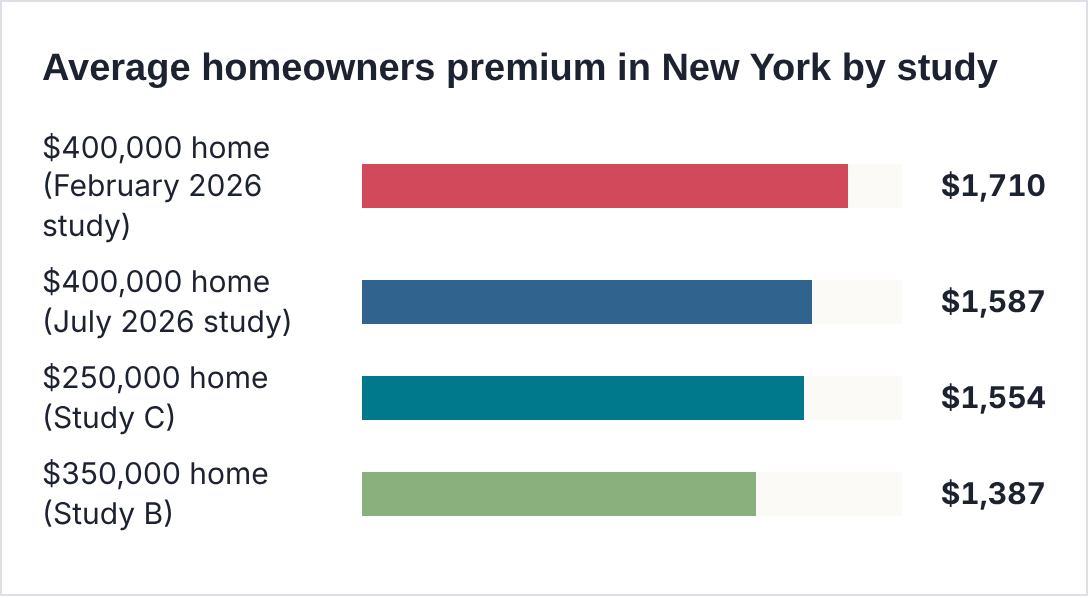
February 2026 national study; July 2026 national study; Study C (2026); Study B (September 25, 2026). Averages, not quotes.
New York mobile homes by the numbers
Available housing and agency studies show that manufactured homes are important in many rural and upstate New York communities. Counts of housing units, households and registered park communities measure different things, so figures such as 183,310 units and approximately 1,818 parks should not be treated as interchangeable or as a current insurance-market census. Verify updated community counts directly with NYS Homes and Community Renewal.
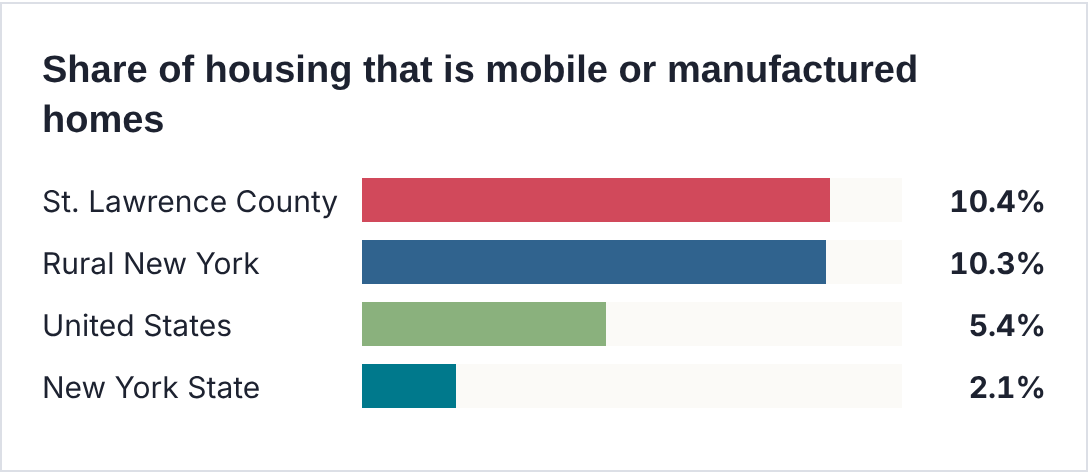
St. Lawrence County ACS profile (2022); Rural Housing Coalition (June 2023); HomeSnacks (2024 Census data).
10 mobile home insurance companies and coverage options to compare in New York
These are ten potential insurer or distribution options, NOT the ten cheapest companies proven by New York quotes. Three prices come from a small manufactured-home sample outside New York. The $490 State Farm example is from a conventional-home policy. Other entries are based on product availability or distribution and have no comparable published New York manufactured-home premium. The FAIR Plan is a limited fallback, not a standard replacement-cost policy.
Editorial note: This legacy infographic contains insurer rankings or numerical labels that are not verified for New York manufactured homes. Use the corrected text and tables, not the image, for decisions.
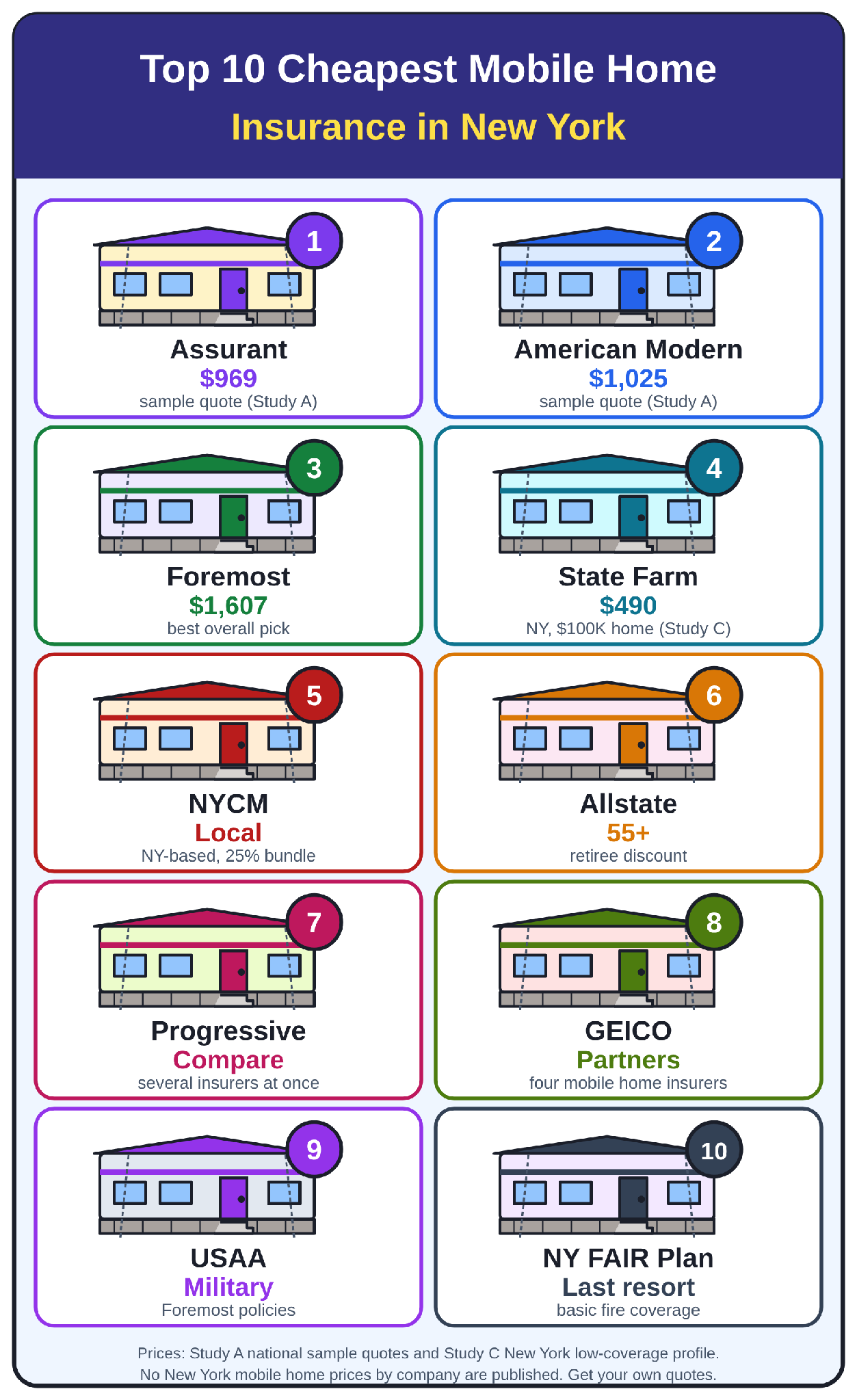
Legacy infographic: sample prices are NOT New York quotes; the numbered entries should NOT be read as a verified New York price ranking. Refer to the corrected comparison and methodology above.
10 manufactured-home insurance options to compare in New York — not price-ranked
| Option # (not price-ranked) | Company | Price or evidence | Complaint index |
|---|---|---|---|
| 1 | Assurant | $969 (Study A sample) (out-of-state sample) | 3.1 |
| 2 | American Modern | $1,025 (Study A sample) (out-of-state sample) | 1.4 |
| 3 | Foremost | $1,607 (Study A sample); Specialist product; sample from outside New York | 0.7 |
| 4 | State Farm | NY $490 standard-home study—NOT a mobile-home rate; request a manufactured-home quote | 1.4 |
| 5 | NYCM | NY manufactured-home program; home age ≤10 years and physical requirements; bundle savings unverified for mobile homes | Not reported |
| 6 | Allstate | 55+ retiree discount; 17% to 19% bundle | 1.2 |
| 7 | Progressive | Places policies with partner insurers | 1.8 |
| 8 | GEICO | Four partner mobile home insurers | Not rated |
| 9 | USAA | Foremost policies for military families | Not rated |
| 10 | New York FAIR Plan | Only basic DP-01 may be written for eligible mobile homes; no broad form | Not rated |
Study A (July 6, 2026); Study C (2026); Study D (April 21, 2026); 2025 NAIC complaint index from a national mobile home review updated September 15, 2026. 1.0 is average, and lower is better.
1. Assurant: lowest sample price
Assurant posted $969 in Study A’s sample outside New York. Ask an agent for an actual New York manufactured-home quote, verify who underwrites the policy, and compare dwelling settlement terms, exclusions and complaint information for that legal insurer. A low out-of-state sample price is not proof it is cheapest in New York.
2. American Modern: low price, broad eligibility
American Modern posted $1,025 in the same out-of-state Study A sample. Its willingness to review older homes and distribution through independent agents can make it worth contacting, but age, condition and New York availability must be confirmed for each property.
3. Foremost: specialized manufactured-home coverage
Foremost posted $1,607 in that same out-of-state sample, and a separate third-party review names it an overall option for New York. Its specialized manufactured-home products and possible age, park or affinity discounts make it a candidate—not a verified best overall insurer. Request written coverage forms and comparable quotes before selecting it.
Before bundling with Farmers-related products or Foremost, verify the actual underwriting companies. The Farmers insurer overview (Spanish) provides corporate and auto-policy context rather than mobile-home rate evidence.
4. State Farm: cheapest for modest homes
The $490 State Farm figure is for a conventional New York home with $100,000 dwelling coverage, not a manufactured home. State Farm advertises a manufactured-home product, but you must ask a New York agent whether it will insure the specific home and obtain a separate manufactured-home premium.
5. NYCM: New York coverage for eligible newer homes
NYCM markets New York mobile-home coverage, with a published $10,000 minimum dwelling limit, a maximum home age of 10 years, and required permanent steps, handrails and skirting. NYCM may offer multi-policy discounts, but published bundle percentages for conventional homes do not establish a 25% discount on a manufactured-home policy. Check actual eligibility and the written combined price.
6. Allstate: potential discounts for retirees
Allstate advertises home-related discounts, including options for qualifying retired owners, but discounts and manufactured-home underwriting are location- and policy-specific. Ask whether a New York manufactured home qualifies, and compare the entire annual premium rather than assuming savings from a standard-home bundle study.
Allstate may quote both auto and eligible property coverage, but its programs differ. Our Allstate company overview (Spanish) focuses mainly on auto insurance and should not be mistaken for a New York mobile-home policy description.
7. Progressive, 8. GEICO, and 9. USAA
Progressive, GEICO and USAA may act as distribution or referral channels for manufactured-home coverage sold by another insurer. Availability and partners vary. Confirm the name of the insurance company on the declarations page and avoid counting two quotes from the same underwriter as independent alternatives.
10. New York FAIR Plan: the last resort
New York Property Insurance Underwriting Association (NYPIUA) says that only its basic Dwelling Fire form (DP-01) may be written on an eligible mobile home; its broader DP-02 form is not available for mobile homes. Basic fire and specified extended perils do not replace a comprehensive manufactured-homeowners policy; review the form for exclusions, settlement basis, deductibles and any missing liability or flood coverage. Contact NYPIUA or an agent to verify eligibility.
PRO TIP #1
Progressive, GEICO, and USAA often place policies with Foremost, American Modern, or Assurant. To get truly different prices, make sure your three quotes come from three different underlying insurers, and add NYCM if your home is newer and meets its requirements.
Is there a verified cheapest mobile home insurer in New York?
There is no verified statewide cheapest manufactured-home insurer in the cited research. Assurant was least expensive only in Study A’s non-New-York three-city sample. The State Farm $490 figure is for a different product. For a New York homeowner, obtain like-for-like quotations from at least three independent underwriting companies (for example, Assurant, American Modern, Foremost and any eligible NYCM or State Farm manufactured-home program).
The $600–$1,700 range reported by Study E can be used as a rough lead, not a validated range for your property. Compare annual totals on the same dwelling amount, valuation method, personal property and liability limits, exclusions and deductibles, then check whether flood coverage is separate.
New York mobile home insurance options by coverage need
Best mobile home insurance in New York, by need
| Need | Company to quote or check | Why |
|---|---|---|
| Lowest sample price | Assurant | $969 in Study A |
| Older homes | American Modern | Insures homes of any age |
| Specialist option | Foremost | Manufactured-home products; compare real policy terms and quotes |
| Modest homes | State Farm | Manufactured-home quote required; $490 conventional-home figure is not comparable |
| Newer homes and bundling | NYCM | Published manufactured-home age and installation requirements; compare bundle total |
| Retirees 55+ | Allstate | Retiree discount |
| Military families | USAA | Foremost policies |
| Turned down everywhere | New York FAIR Plan | Basic fire coverage |
Our assessment, based on Study A, Study B, Study C, Study D, Study E, and company information.
Mobile home insurance options for seniors in New York
Foremost and Allstate are useful questions for seniors seeking manufactured-home coverage, but no cited study proves either is cheapest for New York retirees. Confirm age-related discounts and actual policy availability, then compare written quotes. New York tax relief, described separately below, is not an insurance-premium discount.
Enhanced STAR can reduce eligible school property taxes for qualifying owners aged 65 or older; the 2026–27 income limit is $110,750. A separate Senior Citizens Exemption may be available where the locality has adopted it; income thresholds and eligibility are determined locally. Owners of homes in manufactured-home parks may receive STAR as a credit rather than an exemption. These tax programs are distinct from homeowners insurance; confirm status and eligibility with the New York State Tax Department and your local assessor.
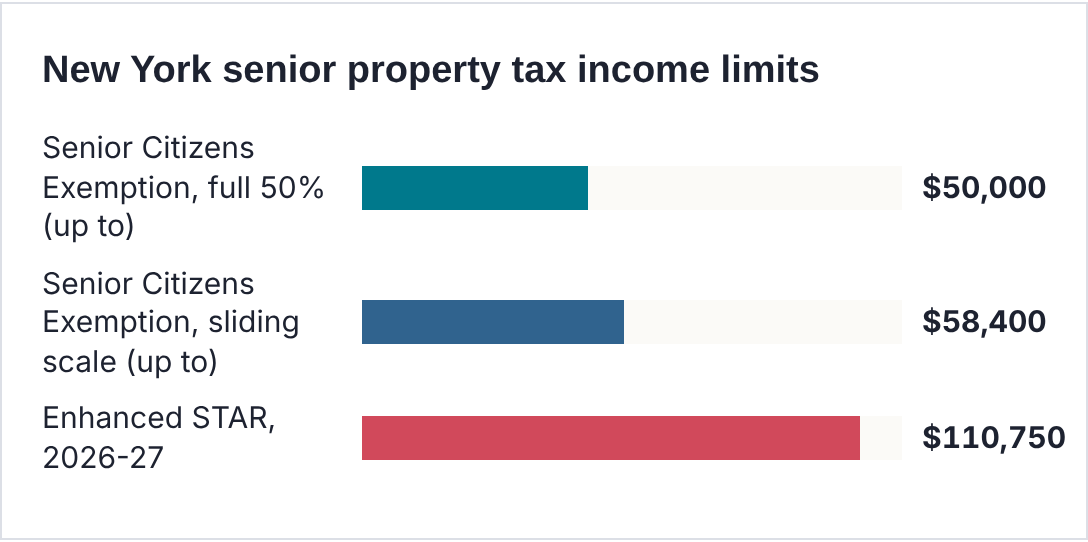
New York State Department of Taxation and Finance (2026). Senior exemption limits are set by each locality.
PRO TIP #2
If you are 65 or older, register for the Enhanced STAR credit and ask your town assessor whether it offers the Senior Citizens Exemption. Pair those savings with Foremost’s 50+ discount or Allstate’s retiree discount.
New York City mobile home insurance
Mobile homes are uncommon in New York City. A 2017 report described Goethals Garden Homes on Staten Island as the city’s only mobile-home park, but that historical report does not verify the current number of communities. Conventional NYC homeowners premiums cited below cannot be translated into prices for those manufactured homes.
Storm exposures illustrate why wind and flood are separate coverage questions. Our Florida windstorm and flood coverage comparison is an out-of-state example, not a New York rate study.
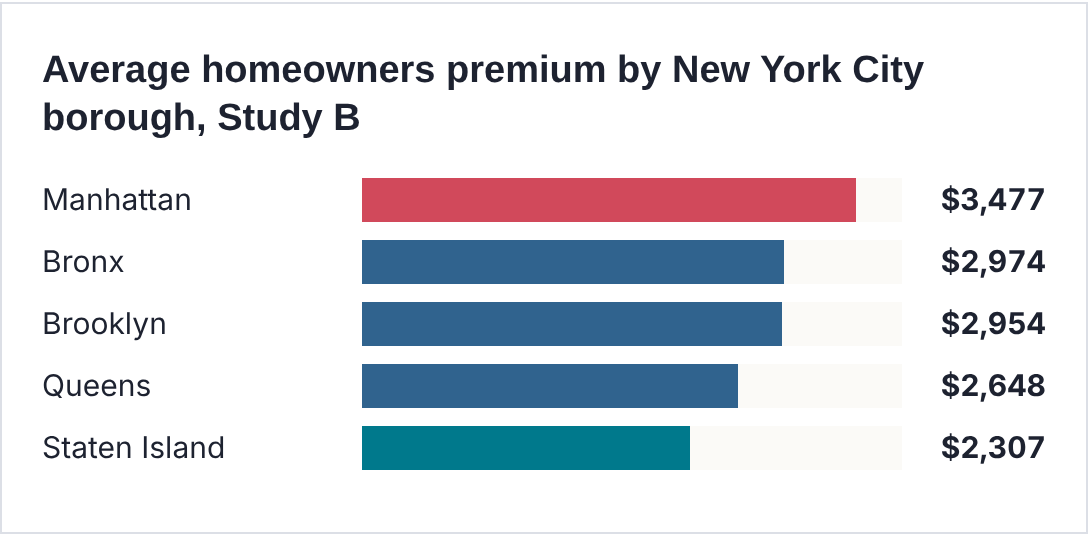
Study B: New York homeowners study (September 25, 2026), $500,000 home. Standard homes, not mobile homes. Averages, not quotes.
The Staten Island and NYC prices cited in Study B and Study C are for conventional site-built homeowners policies, not manufactured-home policies. Do not use those premiums to choose a mobile-home insurer. Instead, confirm flood-zone exposure and request property-specific manufactured-home quotes.
Flooding in New York City
Flooding is New York City’s biggest home insurance risk. Hurricane Sandy in October 2012 killed 44 New Yorkers and cost the city $19 billion, with most deaths on Staten Island and a storm surge of up to 13.88 feet. In September 2021, Hurricane Ida’s rain killed 13 people in the city, 11 of them in basement apartments. About 400,000 New Yorkers and 72,000 buildings sit in the 100-year floodplain.
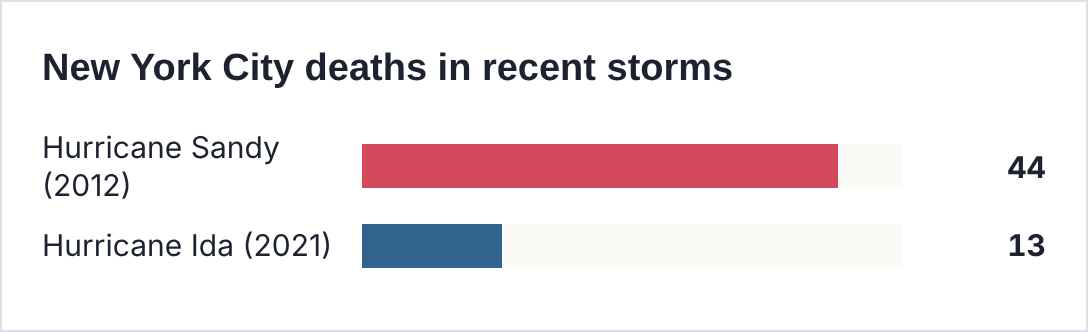
NYC Mayor’s Office of Resiliency; ABC7 New York (2021).
Standard policies do not cover flooding. The National Flood Insurance Program covers anchored manufactured homes for up to $250,000 on the home and $100,000 on contents, usually after a 30-day wait. In 2025, two rare tornadoes also touched down in the city area, near JFK Airport and at Atlantic Beach, so wind coverage matters too.
New York City mobile home insurance checklist
| Risk | What to check |
|---|---|
| Coastal and flash flooding | Flood insurance; home anchored; 30-day wait |
| Storm surge | Flood zone status on Staten Island |
| Wind and rare tornadoes | Wind and hail coverage; roof condition |
| High repair costs | Replacement cost coverage |
| Theft | Personal property limits |
Our assessment, based on NYC Mayor’s Office of Resiliency, NYC Planning, and FEMA information.
If you live in or near Staten Island’s mobile home park, know your flood zone before you buy. Sandy’s surge reached deep into the island’s low-lying neighborhoods, and New York City runs programs that help residents understand flood insurance and lower their premiums through mitigation. Ask your agent whether elevating utilities or adding flood vents could reduce your flood insurance cost, and keep a home inventory with photos stored online, so a flood does not wipe out your records along with your belongings.
Long Island mobile home insurance
Manufactured-home communities exist on Long Island, including in Suffolk County. Historical park and housing counts do not establish the current number of occupied homes. Coastal wind, flood exposure, roof age, and anchoring are particularly important when requesting a quote. NYPIUA’s C-MAP can help eligible coastal property owners locate private-market coverage, but it does not guarantee that a manufactured home will qualify.
Buffalo mobile home insurance
Manufactured-home communities can be found in Erie County and Buffalo-area suburbs; a third-party park listing should not be treated as an exhaustive registry or proof none exist within city limits. The cited Buffalo prices below are conventional homeowners averages, not manufactured-home quotes.
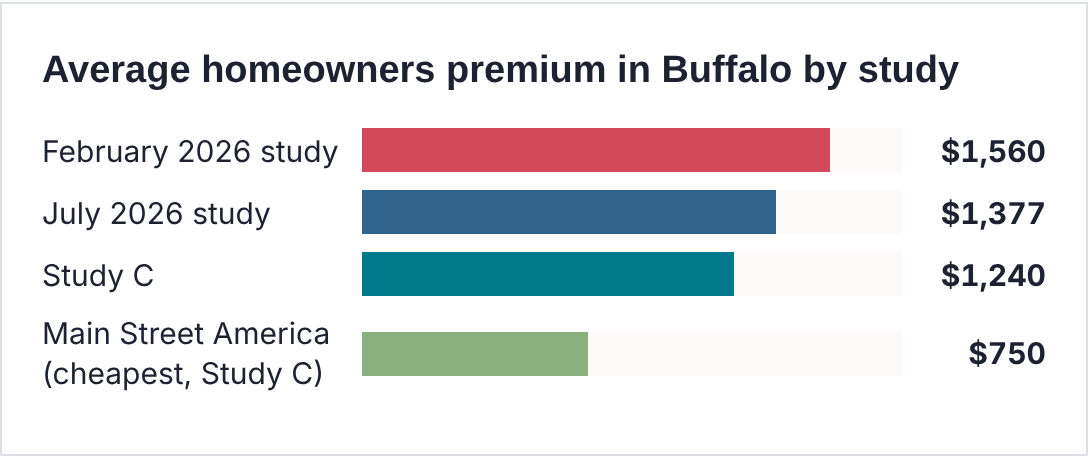
February and July 2026 national studies; Study C (2026). Standard homes, not mobile homes. Averages, not quotes.
Lake-effect snow and the Buffalo blizzards
Snow is Buffalo’s biggest risk. The December 2022 blizzard dropped 51.9 inches at the airport, with gusts of 79 mph and 37.5 straight hours of blizzard conditions, and it killed 46 people in Erie County and 47 in the region. In November 2014, a lake-effect storm buried South Cheektowaga under up to 65 inches of snow, killed 13 people, and caused hundreds of major roof collapses.
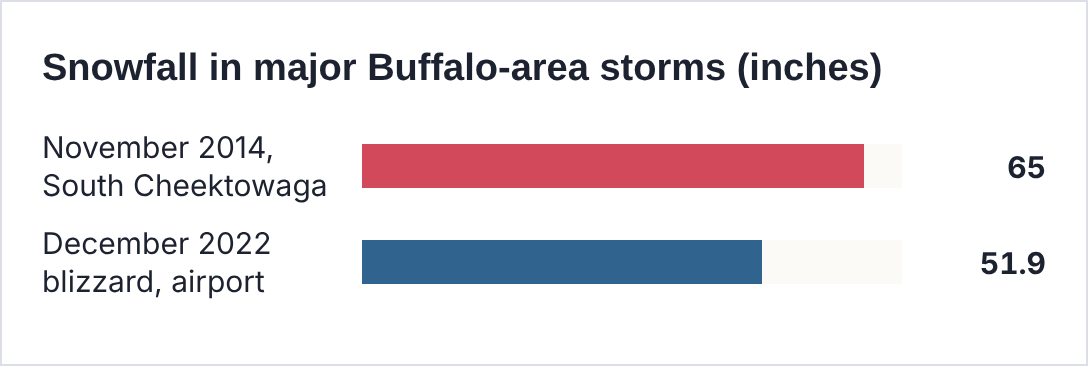
National Weather Service Buffalo; December 2022 blizzard summary.
Erie County is in HUD’s middle roof-load zone, so manufactured homes there must be built for 30 pounds per square foot of snow, compared with 20 in New York City. Even so, a big storm can exceed that. Clear heavy snow from your roof when it is safe, keep your heat on, and confirm that your policy covers roof collapse and frozen pipes. Study E notes that New York ranked second nationally for frozen-pipe claim costs in 2022, at $17 million.
Buffalo mobile home insurance checklist
| Risk | What to check |
|---|---|
| Lake-effect snow | Roof collapse coverage; 30 psf roof rating |
| Blizzards | Loss of use if you cannot stay home |
| Frozen pipes | Water damage coverage; heat tape and skirting |
| Ice storms and falling trees | Tree damage and other structures |
| Power outages | Food spoilage and generator safety |
Our assessment, based on National Weather Service Buffalo and HUD roof-load rules.
Syracuse mobile home insurance
Manufactured-home communities operate in Onondaga County and the Syracuse area. Listing-site park counts may change and are not an official state inventory. The Syracuse prices below come from conventional homeowners studies, so they are not a basis for ranking manufactured-home insurers.
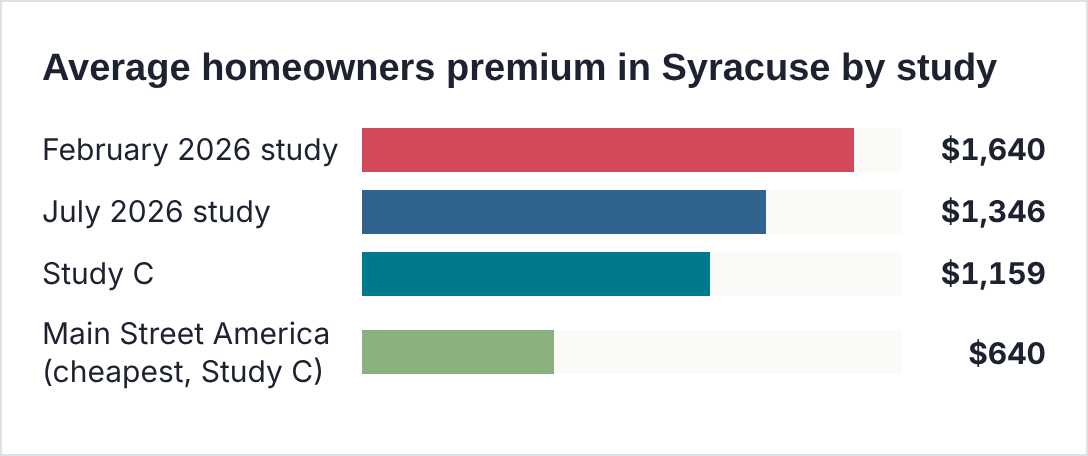
February and July 2026 national studies; Study C (2026). Standard homes, not mobile homes. Averages, not quotes.
America’s snowiest big city
Syracuse won the Golden Snowball again in 2025-26 with 143.1 inches of snow, well above its normal of 127.8 inches, though short of its record of 192.1 inches set in 1992-93. Buffalo had 92.5 inches that same winter. Like Erie County, Onondaga County is in HUD’s middle roof-load zone, built for 30 pounds per square foot.
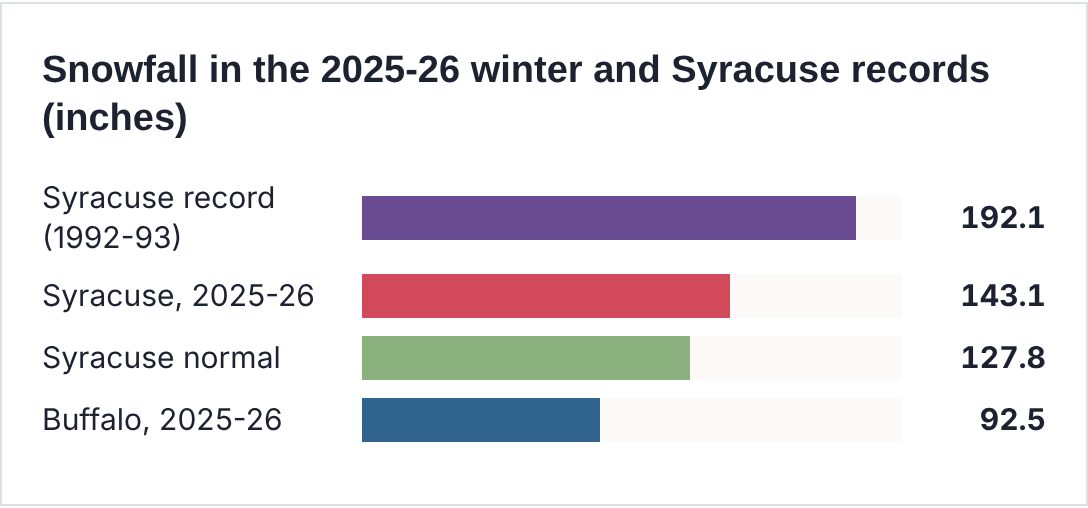
CNY Signal (2026), citing National Weather Service data.
Central New York also sees severe storms. On July 16, 2024, a high-end EF2 tornado with winds of about 135 mph cut a 5.25-mile path through Rome, about 40 miles east of Syracuse, and New York had at least 32 tornadoes that year. Keep wind coverage, check your anchors, and know where you will shelter.
Syracuse mobile home insurance checklist
| Risk | What to check |
|---|---|
| Heavy snow | Roof collapse coverage; snow removal plan |
| Ice dams | Water damage coverage |
| Frozen pipes | Heat tape, skirting, and water damage coverage |
| Tornadoes and storms | Wind coverage; tie-downs |
| Spring snowmelt | Flood insurance if near water |
Our assessment, based on National Weather Service and HUD roof-load rules.
Rochester, Albany, and the Hudson Valley
Rochester and Monroe County face lake-effect snow, freezing temperatures, and wind exposure. Although a cited study reports conventional homeowners premiums for Rochester, no inference that a well-kept mobile home “should be inexpensive” is justified without manufactured-home quotes.
Albany and the Capital Region face heavy snow and ice storms. The January 1998 ice storm coated parts of northern New York with up to 4 inches of ice and caused about $1.4 billion in damage across the United States, a reminder to check coverage for falling trees and power outages. Saratoga County, just north of Albany, has more manufactured home parks than almost any other county in the state, along with Dutchess and Ulster counties in the Hudson Valley.
Hudson Valley homes face a mix of winter storms, summer thunderstorms, and river flooding. If your park sits near the Hudson River or one of its tributaries, check your flood zone and consider a flood policy, since standard mobile home policies leave flooding out.
Other New York cities
Average homeowners premium in other New York cities
| City | Study C | February 2026 study |
|---|---|---|
| Rochester | $1,095 | $1,540 |
| Albany | $1,186 | $1,710 |
| Yonkers | $1,507 | $2,050 |
Study C (2026); February 2026 national study. Standard homes, not mobile homes.
PRO TIP #3
Upstate, ask each insurer how it handles roof collapse from snow and burst pipes, and keep your home heated and skirted all winter. Downstate, check your flood zone and buy flood insurance at least 30 days before storm season.
Winter checklist for New York mobile homes
Snow, ice, ice dams, and frozen plumbing are significant winter risks in upstate New York, but the cited material does not establish that winter is the leading season for manufactured-home claims. Before winter, inspect roof drainage and skirting, service the heating system, insulate exposed pipes, and follow any policy conditions for a home left vacant. For roof snow removal, use a qualified professional when conditions are unsafe; never climb onto a snow-covered roof.
New York park tenants’ rights
Under New York Real Property Law §233-b, manufactured-home park rent generally may not increase by more than 3% annually absent qualifying increases in operating expenses, property taxes, or capital improvements. An increase up to 6% must be justifiable under the statute; exceeding 6% requires a court-approved temporary-hardship exception. Residents may challenge a proposed increase above 3% in court within the applicable 90-day period. This is a park tenancy rule, not an insurance-price rule.
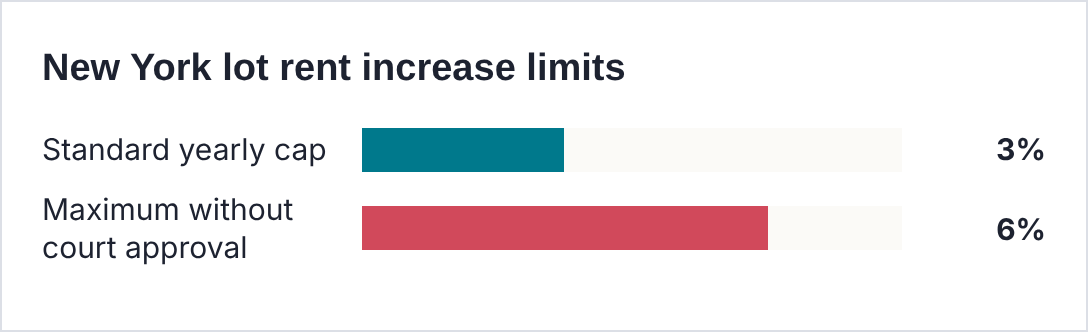
NYS Homes and Community Renewal, rent increases in manufactured home parks (Real Property Law 233-b).
New York park tenant protections
| Protection | Details |
|---|---|
| Rent increase cap | Generally 3%; justified increases up to 6% under statutory conditions |
| Above 6% | Court-approved temporary hardship required |
| Time to challenge | Challenge qualifying increase within 90 days; consult HCR/legal aid |
| Help line | NYS HCR Manufactured Homes Program, 1-800-432-4210 |
| Park registration | Confirm applicable registration and oversight with NYS HCR and local officials |
NYS Homes and Community Renewal; New York State Department of Taxation and Finance.
New York laws every mobile home owner should know
- New York generally does not require homeowners insurance simply to occupy an owned manufactured home, but lenders and park leases may require it. Check financing documents, your park lease, and local obligations.
- Installers are certified by the Department of State, with two years of experience, a 13-hour course, a $10,000 security deposit, and a $200 fee, and every installed home carries a warranty seal.
- New York DMV title requirements depend on the manufactured home’s model year and title/property status; the title-only application fee is $125 for a manufactured home. Do not assume every older unit is automatically real property.
- No New York county is in HUD Wind Zone II or III, so the whole state is Wind Zone I.
- Thirty upstate counties, including Erie, Onondaga, Monroe, and Niagara, are in HUD’s middle roof-load zone (30 pounds per square foot); the rest of the state, including New York City and Long Island, is in the south zone (20 pounds per square foot).
New York mobile home rules at a glance
| Item | Rule |
|---|---|
| Installer | Department of State certification; warranty seal on each home |
| Title | Check DMV model-year/title eligibility; manufactured-home title-only fee $125 |
| Wind zone | Zone I statewide |
| Roof load | Middle zone (30 psf) in 30 upstate counties; south zone (20 psf) elsewhere |
| STAR | Credit for park homes since 2022 |
| Lot rent | 3% cap in most cases |
New York Department of State; NYS DMV; Stewart Title bulletin; NYS HCR; 24 CFR 3280.305.
The New York FAIR Plan and C-MAP
New York FAIR Plan basics
| Item | Details |
|---|---|
| Name | New York Property Insurance Underwriting Association |
| Covers | Fire, extended perils, and vandalism |
| Payout | Actual cash value |
| Dwelling limit | $600,000 |
| Not covered | Liability, flood, and theft |
| Mobile homes | Excluded from the broad form; ask about basic coverage |
| Coastal help | C-MAP for coastal homeowners |
| Phone | 800-522-3372 |
New York Property Insurance Underwriting Association, product information and C-MAP.
Why New York home insurance costs are rising
New York’s average homeowners premium was about $1,900 in 2025, up more than $1,000 since 2020, according to coverage of a December 2025 state Senate hearing, and about 500,000 New York homeowners have no insurance. One 2026 projection expects premiums to hold roughly flat this year after an 11% rise in 2025. Severe weather, higher repair costs, and claims for frozen pipes and water damage all add pressure.
Mobile home insurance vs. homeowners insurance in New York
How New York mobile home and homeowners policies compare
| Feature | Mobile home policy | Homeowners policy |
|---|---|---|
| Published estimates — not comparable products or sample profiles | Third-party $600–$1,700 NY mobile-home estimate; method not published | Conventional-home studies; different construction, limits, and samples |
| Main insurers | Foremost, American Modern, Assurant, NYCM | NYCM, State Farm, Allstate, Travelers |
| Title | Depends on title, affixation and legal ownership status | Deed |
| STAR | Credit for park homes | Credit or exemption |
| Biggest risk factor | Roof snow load, pipes, and anchoring | Roof age and construction |
| Flood coverage | Separate policy | Separate policy |
Study B; Study C; Study E; NYS HCR; 2026 homeowners studies.
What New York mobile home insurance covers
Main coverage parts of a New York mobile home policy
The meaning of dwelling, personal property and liability coverages can be clarified with general homeowners coverage basics, though manufactured-home forms and exclusions may differ.
| Coverage | What it pays for |
|---|---|
| Dwelling | Repairs or replacement of the home |
| Other structures | Carports, decks, sheds, and skirting |
| Personal property | Furniture, clothes, and belongings |
| Loss of use | Living costs after a covered loss, such as a roof collapse |
| Personal liability | Injuries or damage you cause to others |
| Not usually covered | Flood, which needs a separate policy |
Company policy descriptions; coverage varies by insurer.
What sets your mobile home insurance price in New York
Main factors in your New York mobile home premium
| Factor | Why it matters |
|---|---|
| Location | Downstate and coastal homes cost more than upstate homes |
| Snow load zone | Upstate homes face heavy snow and roof collapse risk |
| Year built | Newer homes earn discounts; NYCM wants homes about 10 years old or newer |
| Skirting and steps | Required by some insurers, such as NYCM |
| Park or private land | Approved parks can earn a discount at Foremost |
| Deductibles | Higher deductibles lower the premium |
| Owner age | Discounts at 50 (Foremost) and 55 (Allstate) |
Company discount lists and underwriting rules; Study E.
New York mobile home insurance by region
Main risks and coverage needs by New York region
| Region | Main risk | What to check |
|---|---|---|
| New York City | Flooding and storm surge | Flood insurance, replacement cost |
| Long Island | Coastal storms and flooding | Flood insurance, C-MAP, wind coverage |
| Hudson Valley (Dutchess, Ulster) | Storms and falling trees | Tree damage, other structures |
| Capital Region (Saratoga, Albany) | Snow and ice | Roof collapse, frozen pipes |
| Western New York (Buffalo, Rochester) | Lake-effect snow and blizzards | Roof collapse, loss of use |
| Central and North Country (Syracuse, St. Lawrence) | Heavy snow and cold | Frozen pipes, roof load, heat |
Our assessment, based on National Weather Service, NYC, and HUD information.
How to check an insurer’s service record
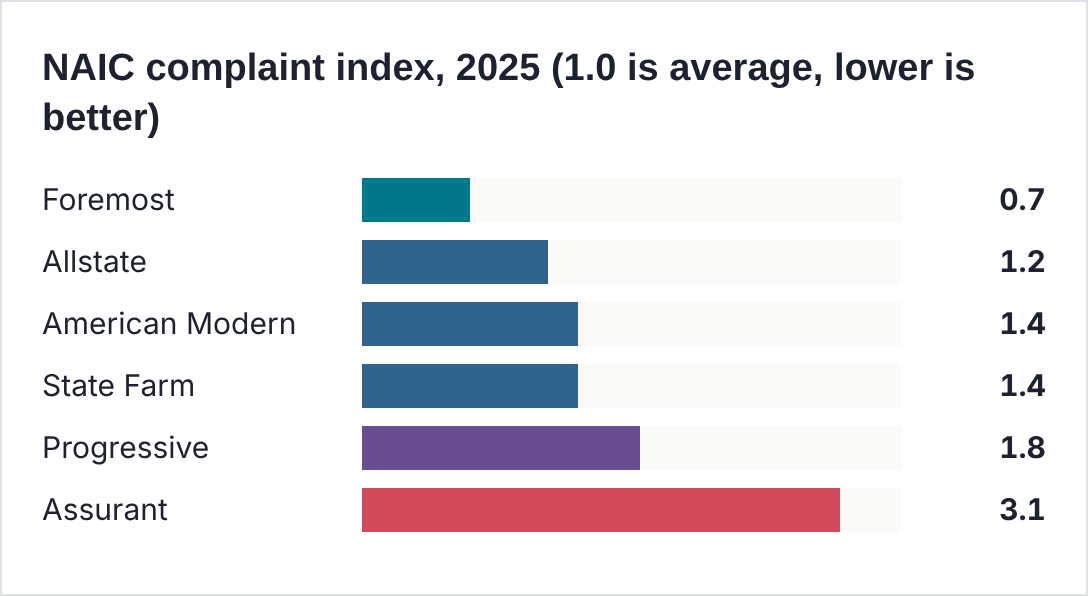
NAIC complaint index for 2025, as reported in a national mobile home review updated September 15, 2026.
The chart shows complaint indices reported by a third-party review for specific legal insurance entities and periods. Before using an index to decide, verify the NAIC company and line-of-business data and compare it with the exact policy underwriter; distributor names alone are insufficient.
Bundling mobile home and auto insurance in New York
No study publishes New York bundle savings for mobile homes, but two 2026 New York studies show which companies reward bundling most for standard homes.
If you also insure a car in New York, compare the home-and-auto bundle against separate policies. Our New York auto insurance options (Spanish) article discusses the automobile side of that decision; it does not quote manufactured-home coverage.
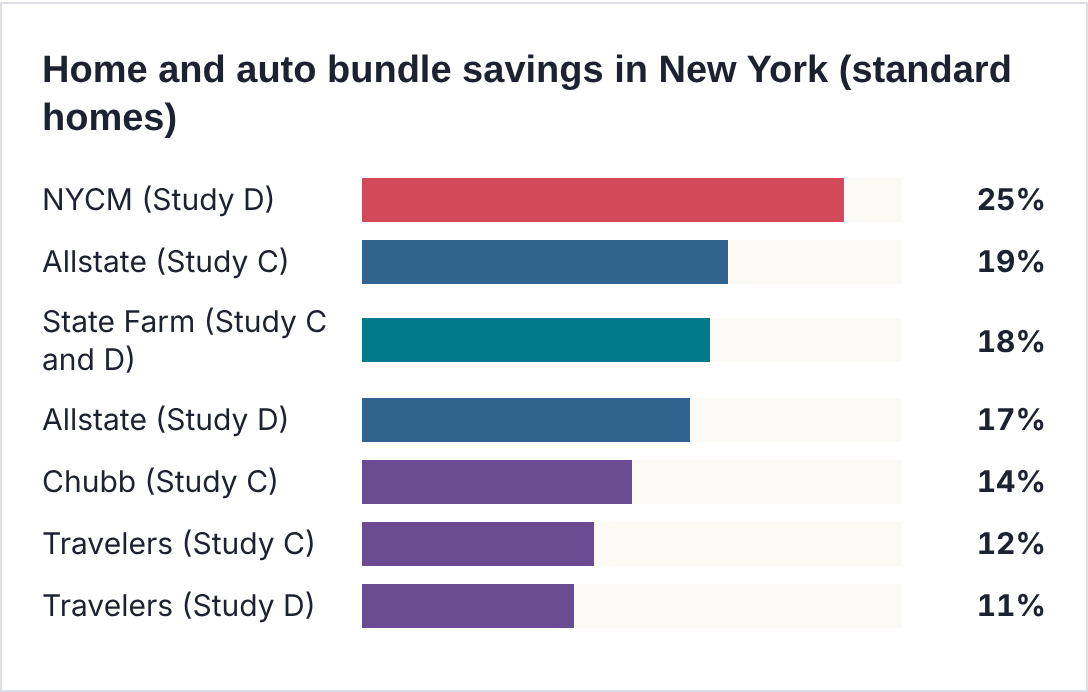
Study C: New York bundle study updated September 2, 2026; Study D: New York bundle study updated April 21, 2026. Figures are for standard homes, not mobile homes.
If the home meets NYCM’s published eligibility rules, ask for an exact manufactured-home-and-auto bundle quote. Compare that written total with two separately quoted policies; conventional homeowners discount studies do not establish manufactured-home bundle savings.
Mobile home insurance discounts in New York
Discounts to ask for in New York
| Discount | Who offers it |
|---|---|
| Age 50+ or retiree 55+ | Foremost (50+), Allstate (55 and retired) |
| AARP or USAA membership | Foremost |
| Newer home | Foremost, State Farm |
| Approved park | Foremost |
| Home alarms | State Farm |
| Long-time customer | State Farm |
| Multi-policy | Most insurers, including NYCM |
Company websites (2025 to 2026). Discount amounts vary.
Insuring older and pre-1976 mobile homes in New York
Homes built before the federal HUD code became effective on June 15, 1976, may be harder to insure. NYCM currently publishes a 10-year age limit for its mobile-home product, while other specialist insurers may consider older units subject to underwriting; do not assume acceptance of every pre-1976 home. Keep records of updates to the roof, wiring, plumbing, and heating, and if private insurers say no, ask about the FAIR Plan’s basic coverage.
Park homes vs. homes on private land
Many New York manufactured homes are in parks, and others sit on privately owned land. Some approved parks may qualify for discounts, while statutory rent protections address a different expense from insurance. Homes on private land, common in rural counties such as St. Lawrence, often need more coverage for garages, sheds, and fences, and may cost more to insure if they are far from a fire station.
How much coverage you need
Start with what it would cost to replace your home with a similar new model built for your county’s snow load, plus delivery and installation by a certified installer. Do not insure for the land. Add up your belongings, keep at least $100,000 of liability coverage, and make sure loss of use would pay for a hotel during a blizzard or after a roof collapse.
Insurance for renters in New York parks
If you rent a mobile home rather than own it, the landlord’s policy covers the structure but not your belongings or your liability. A renters policy is usually inexpensive and covers your furniture and electronics after a fire, burst pipe, or theft, along with liability if a guest slips on an icy step.
Low-cost coverage choices that still protect you
- Raise your deductible if you have savings to cover it.
- Keep coverage for roof collapse, frozen pipes, and wind.
- Set your personal property limit to what you actually own.
- Keep at least $100,000 of liability coverage.
- On a lower-value older home, compare the quoted annual premium with the payout reduction under actual cash value coverage before changing settlement terms.
- Install skirting and heat tape to prevent frozen pipe claims.
Tips to save money on mobile home insurance in New York
- Get at least three quotes, starting with Assurant, American Modern, and Foremost.
- Add State Farm and NYCM, which priced modest homes low.
- Confirm that competing quotes are from distinct legal underwriters, even when the websites or agencies differ.
- Ask for age, AARP, park, newer-home, and alarm discounts.
- Claim Enhanced STAR and the Senior Citizens Exemption if you qualify.
- Buy flood insurance downstate or near rivers.
- Challenge rent increases above 3% within 90 days.
- Shop again every year.
For broader examples of comparing limits and deductibles, see our Florida-focused guide to comparing coverage and deductibles. The premium figures and Florida insurance laws there do not apply to a New York manufactured home.
How to compare New York mobile home insurance quotes
- Use the same dwelling limit, liability limit, and deductibles for every quote.
- Check whether each quote pays replacement cost or actual cash value.
- Confirm coverage for roof collapse from snow and frozen pipes.
- Ask which discounts are already applied.
- Check each insurer’s complaint index.
- Add the cost of flood insurance when you compare totals.
When evaluating manufactured-home quotes, a general policy-comparison checklist can remind you to check limits and exclusions; its conventional-home examples are not direct New York mobile-home prices.
How to switch mobile home insurers in New York
Buy your new policy first and set it to start the day your old one ends, so you are never without coverage, especially before winter. Once the new policy is active, cancel the old one in writing, ask for a refund of any unused premium, and send the new declarations page to your lender or park manager.
Questions to ask before you buy
- Does the policy cover roof collapse from the weight of snow and ice?
- Are burst pipes and ice dams covered?
- Does it pay replacement cost or actual cash value?
- Are carports, decks, skirting, and sheds covered?
- Which insurer will actually handle my claims?
Common reasons mobile home claims get denied
- Flood damage on a policy that does not include flood coverage.
- Frozen pipes in a home that was left unheated.
- Wear and tear, rot, or slow leaks that were never repaired.
- Missed deadlines for reporting damage or sending proof of loss.
What to do after a storm or flood
- Get to safety, then call your insurer or agent as soon as you can.
- Take photos and video of all damage before cleaning up.
- Make temporary repairs and keep the receipts.
- File flood claims separately with your flood insurer.
- If you have a problem, contact the New York Department of Financial Services.
Documenting property damage matters. The property-claim documentation overview for California homeowners discusses a generic adjuster workflow; New York claim deadlines and your specific manufactured-home policy still control.
New York mobile home insurance at a glance
This illustrated summary pulls together the main points of this guide.
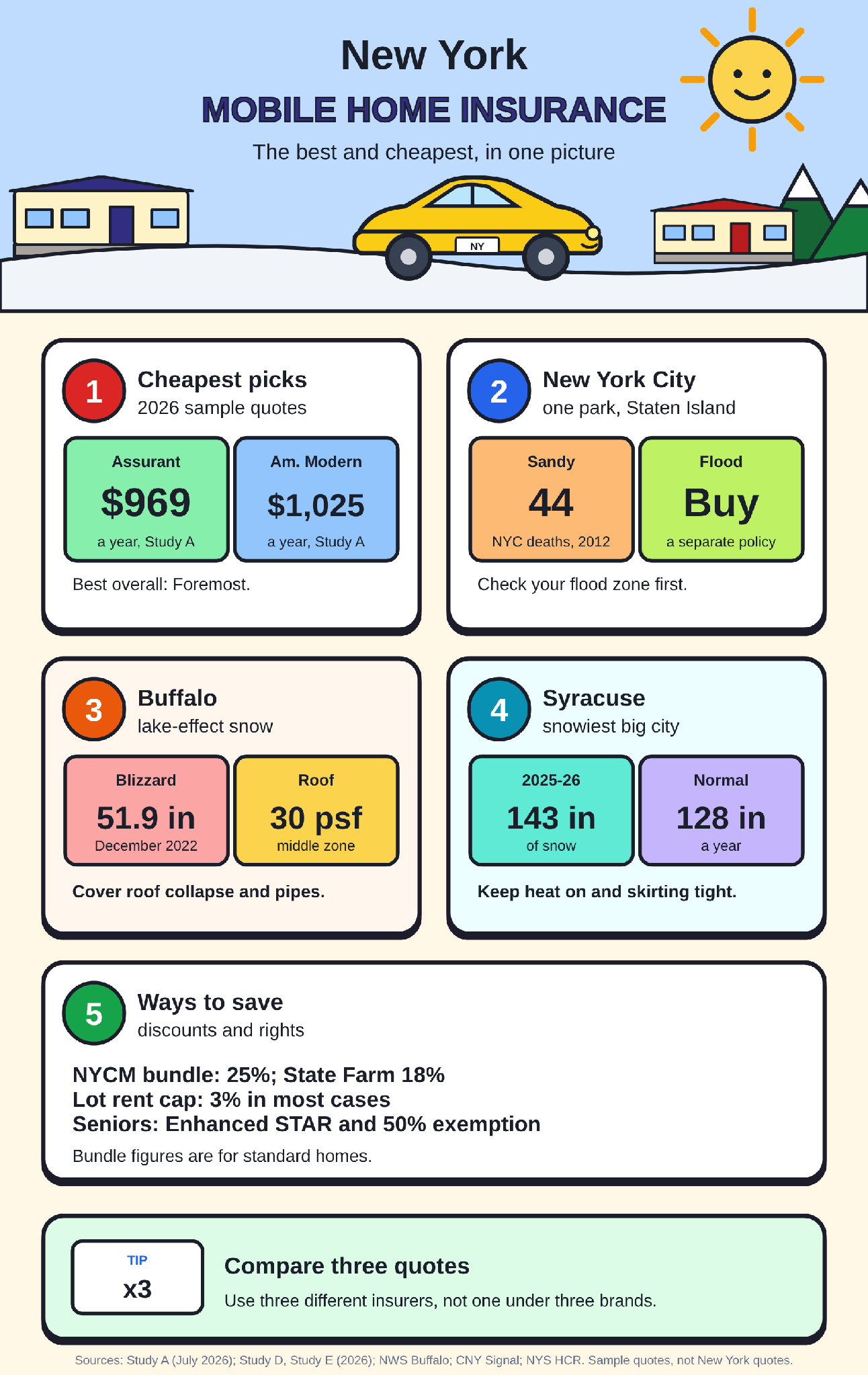
The best and cheapest mobile home insurance in New York at a glance. Sources: Study A; Study D; Study E; National Weather Service; NYS HCR.
Frequently asked questions about New York mobile home insurance
How much is mobile home insurance in New York?
One third-party estimate suggests about $600–$1,700, but it does not publish enough methodology to establish a dependable New York average. Get manufactured-home quotes for your exact property.
Who has the cheapest mobile home insurance in New York?
No statewide company ranking was verified. Assurant was $969 and American Modern $1,025 in a non-New York sample; $490 for State Farm comes from conventional-home data and is not a manufactured-home premium.
What is the best mobile home insurance in New York City?
No NYC manufactured-home insurer ranking was verified. Compare specialized quotes, ask NYCM about its strict eligibility rules, and check whether separate flood insurance is appropriate for your specific flood exposure.
What is the best mobile home insurance in Buffalo?
Ask Foremost, American Modern and any eligible NYCM agent for comparable manufactured-home quotes in Erie County. Make sure your policy covers roof collapse from snow and frozen pipes.
What is the best mobile home insurance in Syracuse?
For Onondaga County, compare manufactured-home specialists and do not substitute conventional Syracuse homeowners averages for mobile-home rates. With more than 140 inches of snow some winters, check snow and pipe coverage closely.
What is the best mobile home insurance for seniors in New York?
Ask Foremost or Allstate whether a senior or affinity discount is available for your exact New York mobile-home product. Seniors can also claim Enhanced STAR and, in many towns, the Senior Citizens Exemption.
How much can my New York park raise my lot rent?
Generally 3%; justified increases up to 6% may apply for certain documented costs, and a temporary-hardship court order is needed above 6%. Residents may challenge certain increases within 90 days.
Is mobile home insurance required in New York?
We found no state law requiring it, but lenders do, and many parks require it in the lease.
The final word on the best and cheapest mobile home insurance in New York
No cited dataset proves who sells the cheapest manufactured-home insurance statewide in New York. Assurant, American Modern and Foremost can be useful specialist quotes; NYCM is a potential option for eligible newer homes, and State Farm requires a genuine manufactured-home quote rather than a conventional-home rate comparison. NYPIUA offers only limited DP-01 basic coverage for eligible mobile homes as a fallback.
Your region shapes your risks. In New York City and on Long Island, focus on flood coverage. In Buffalo and Syracuse, focus on snow, roof, and frozen pipe coverage. Everywhere, compare at least three quotes, claim every discount and tax break, and use New York’s strong rent protections.
Sources
- Study A: ValuePenguin, mobile home insurance (July 6, 2026).
- Study B: ValuePenguin, cheap homeowners insurance in New York (September 25, 2026).
- Study C: MoneyGeek, cheap homeowners insurance in New York; average cost of home insurance in New York; New York City; Buffalo; Syracuse; and home and auto bundle (2026).
- Study D: Insurance.com, cheapest home and auto bundle in New York (April 21, 2026).
- Study E: Insuranceopedia, mobile home insurance in New York, and mobile home insurance by state (October 18, 2026).
- LendingTree, best mobile home insurance companies (September 15, 2026); New York homeowners insurance (July 6, 2026); and NerdWallet, New York homeowners insurance (February 20, 2026).
- NYCM, mobile home coverage; Foremost, USAA mobile home program; AARP, Foremost mobile home insurance; Policygenius, Assurant review; and State Farm, manufactured homes.
- HomeSnacks, mobile homes by state (2024 Census data); NYS Homes and Community Renewal, manufactured homes; Spectrum News, Rural Housing Coalition report (June 2023); and St. Lawrence County housing characteristics.
- MHVillage, Erie County parks; Onondaga County parks; NY1, Staten Island mobile home park; The Real Deal, Calverton park; and CBS New York, Amityville park.
- NYC Mayor’s Office of Resiliency, Sandy impacts; Baruch College, Hurricane Sandy; ABC7, Ida deaths; NYC Planning, flood risk; and The Weather Network, New York City tornadoes.
- December 2022 blizzard in New York; WIVB, blizzard deaths; National Weather Service Buffalo, November 2014 storm; and CNY Signal, Syracuse snowfall (2026).
- CNY Central, Rome tornado (2024); National Weather Service, 2024 New York tornadoes; and FEMA, manufactured homes flood coverage (August 2025).
- NYS HCR, rent increases in manufactured home parks; New York Department of State, manufactured homes; NYS DMV, titles; Stewart Title, manufactured home bulletin; and 24 CFR 3280.305.
- NYS HCR, STAR for park homes; NYS Tax Department, STAR types; and Senior Citizens Exemption.
- NYPIUA, product information; C-MAP program; Insurance News Net, rising New York home insurance costs (December 2025); and Insurify, price projections (2026).
- NYPIUA Dwelling Fire: mobile homes only on basic DP-01
- NYCM Mobile Home Coverage Guide: underwriting requirements
- NY Attorney General: manufactured-home park tenants
- NYS Tax: Enhanced STAR income limits
- NYS DMV: certificate of title and manufactured-home fee
Disclaimer
This website provides independent reviews and comparisons. It is not affiliated with, endorsed by, sponsored by, or connected to Assurant, American Modern, Foremost, Farmers, State Farm, NYCM Insurance, Allstate, Progressive, GEICO, Cabrillo, USAA, Main Street America, Preferred Mutual, Travelers, Chubb, Nationwide, the New York Property Insurance Underwriting Association, or any of their affiliates.
All company names, brand names, trademarks, and logos are the property of their respective owners and are used here only to identify the companies being reviewed. Their use does not imply any affiliation or endorsement.
The information on this page is provided for general informational and educational purposes only. It is not insurance, legal, tax, or financial advice, and it is not an offer, quote, or solicitation to buy or sell insurance. We are not an insurance company, insurance agency, or licensed insurance producer, and we cannot bind coverage, change a policy, or handle claims.
Prices, discounts, ratings, and company details are drawn from public sources and third-party studies that use specific home profiles, and they can change at any time. They are estimates and averages, not guarantees of what you will pay. Coverage, eligibility, and discounts vary by location, home, and owner, and are subject to each insurer’s underwriting rules and policy terms.
While we make reasonable efforts to keep this guide accurate and current, we make no representations or warranties, express or implied, about its completeness, accuracy, or reliability. Opinions here are our own. Always confirm details directly with the insurer, read your policy documents, and consult the New York Department of Financial Services or a licensed professional before making a decision. Your use of this information is at your own risk, and we are not liable for any loss or damage arising from reliance on it.